

On 30 September 2026, Kalshi told the CFTC it would end its Volume Incentive Program, which paid traders for trading volume, no earlier than 13 October. It came amid claims of inflated volume, which Kalshi denies. Yet its program that pays for resting orders runs until 1 January 2027. The lesson for any new platform: pay for depth, not for trades.
Prediction market liquidity is the hardest problem a new platform faces. Users leave when spreads are wide, and market makers stay away until users arrive. This guide shows how to break that loop: which engine to use, what Polymarket and Kalshi pay makers, a worked maker budget and a cold-start plan.
In this guide:
- Pick the engine by traders per market: an order book needs paid makers from day one, while an LMSR market maker always quotes a price and caps your loss at b x ln(2), or about $693 per Yes or No market at b = 1,000.
- Polymarket pays makers twice: a daily rebate of 15% to 25% of taker fees, plus separate liquidity rewards for resting quotes near the midpoint.
- Kalshi’s Liquidity Incentive Program pays $1 to $1,000 per market per day for resting orders, scored every second.
- Rebates alone cannot fund a new market: 10,000 shares a day at 50 cents earns $125 in sports taker fees, so the rebate pool is under $20.
- Budget a fixed launch pool: for example, 20 markets x $50 a day x 90 days = $90,000 in rewards, plus AMM subsidies for the long tail.
What Is Prediction Market Liquidity?
Prediction market liquidity is how easily a trader can buy or sell a Yes or No share near its fair price. Three things show it:
- Spread: the gap between the best bid and the best ask. A 49 / 51 cent book has a 2-cent spread.
- Depth: how many shares rest near the best prices. Deep books absorb large orders without big price jumps.
- Price impact: how far one trade moves the price. In a thin market, a $200 order can move the odds by ten points.
Volume is not the same thing. A busy market can still be shallow.
Why New Platforms Struggle to Get It
Traders want tight prices before they deposit. Market makers want flow before they commit capital. So both sides wait, and the books stay empty.
Market making is also harder here than in stocks. Every share ends at $1 or $0, so a maker holding the wrong side at resolution loses it all. Also, informed traders pick off stale quotes. A founder of a small exchange shared one case on Reddit in January 2026: a family market asked whether dinner would be served by 6:30 pm, and the person cooking it made easy money from the house bot.
That is why liquidity is a budget line, as our prediction market development cost guide shows.
CLOB vs AMM vs LMSR: How Each Engine Supplies Liquidity
The trading engine decides who supplies prices and who carries the risk.
Central limit order book (CLOB): Traders and makers post limit orders, and the engine matches them. Polymarket and Kalshi both run one. The platform never takes a side, but someone must quote, so you pay makers.
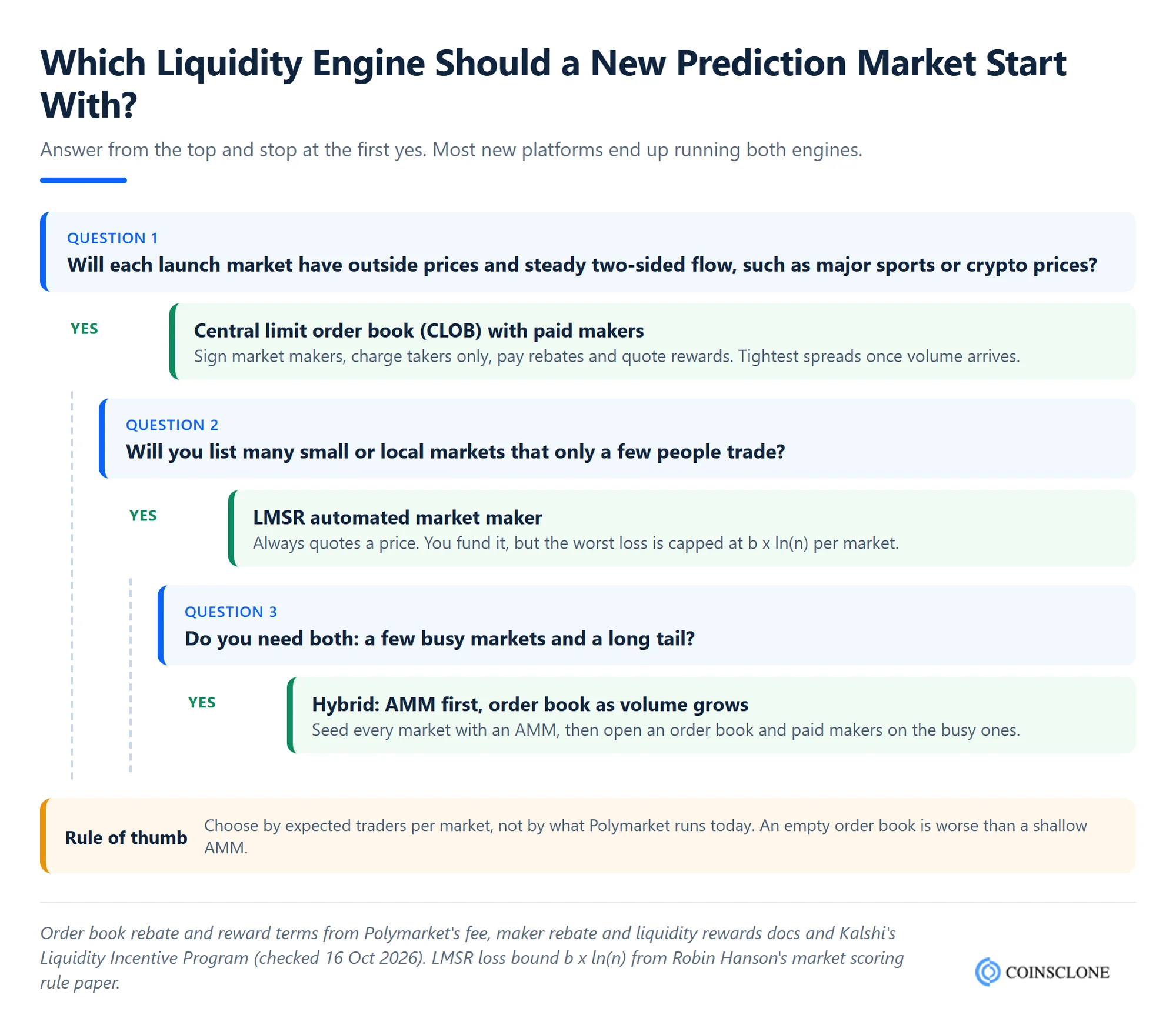
Automated market maker (AMM): A formula sets the price. The common choice is the Logarithmic Market Scoring Rule (LMSR), designed by economist Robin Hanson. It always quotes a price. The platform funds its losses, but they have a hard cap.
Hybrid: Seed every market with an AMM, then open an order book on the busy ones. Our prediction market platform development page shows both engines side by side.
| CLOB with paid makers | LMSR AMM | Hybrid | |
| Who quotes prices | Market makers and traders | A formula funded by you | AMM first, makers later |
| Your cost | Rebates, rewards, maker deals | Capped subsidy per market | Both, on different markets |
| Spreads when busy | Tightest | Wider; set by the b parameter | Tight on busy markets |
| Spreads when quiet | Empty book, no trades | Always a price | Always a price |
| Best for | Sports, crypto prices, big elections | Long-tail and local markets | Most new platforms |
| Main risk | No makers show up | Subsidy spent on a few markets | Two systems to run |
How the LMSR Parameter Sets Depth and Cost
LMSR has one dial, called b. A higher b makes prices move less per trade. However, it also raises the platform’s worst case, which is b x ln(n) for n outcomes.
Take a Yes or No market at 50%. With b = 1,000, a trader must spend about $223 to push the price to 60%. The platform’s worst case is $693. Raise b to 5,000, and the same 10-point move costs $1,116, but your worst case grows to $3,466.
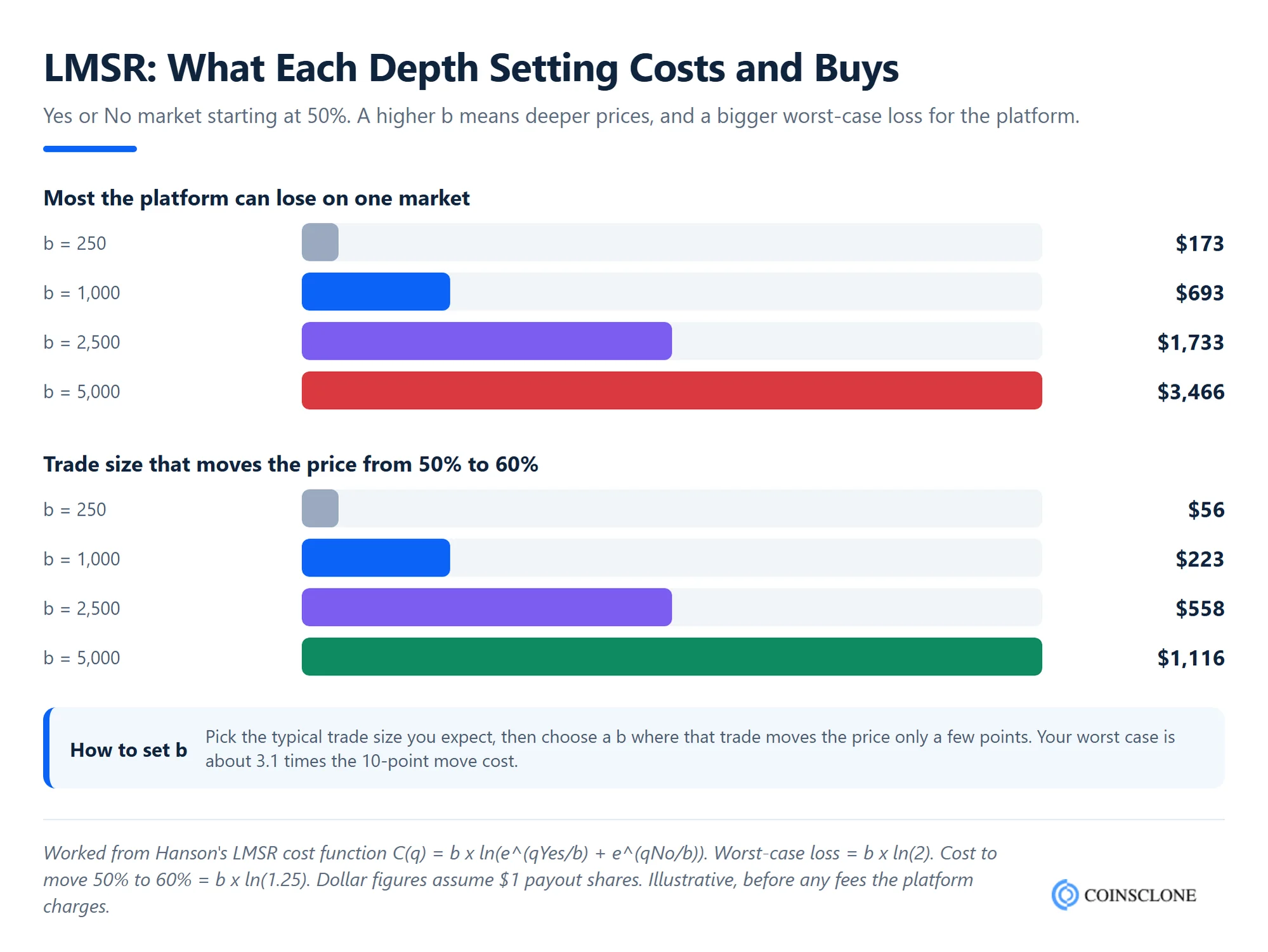
So set b from the trade size you expect. If typical trades are $50, a b of 1,000 keeps each trade’s price move small. If your users trade $1,000 at a time, you need a larger b and a larger subsidy.
The decision tree below sorts most launches in three questions.
How Polymarket Pays for Liquidity
Polymarket runs two public programs for makers.
Maker Rebates Funded by Taker Fees
Makers are never charged fees. Takers pay shares x fee rate x price x (1 – price), so the fee peaks at 50 cents.
A share of those fees goes back to makers every day, per the Maker Rebates Program. As of 16 October 2026, the rates are:
| Category | Taker fee rate | Share rebated to makers |
| Crypto | 0.07 | 20% |
| Sports | 0.05 | 15% |
| Politics, Finance, Tech, Mentions | 0.04 | 25% |
| Economics, Culture, Weather, Other | 0.05 | 25% |
| Geopolitics | 0 (fee-free) | None |
Rebates are paid daily in pUSD, with a $1 minimum. Each maker’s share follows the fee value of its filled orders in that market. Polymarket can change the rates at any time.
The pool is large. DefiLlama tracked about $112 million in Polymarket fees in the 30 days to 15 October 2026. If 15% to 25% of that went back to makers, rebates would be worth very roughly $17 million to $28 million a month.
Liquidity Rewards for Resting Quotes
The second program pays for orders that rest on the book, even if they never fill. Per Polymarket’s liquidity rewards methodology:
- Each market sets its terms: a minimum order size, a maximum spread from the midpoint and a daily reward pool.
- Closer quotes score more: an order’s score is ((max spread – its spread) / max spread) squared. So a quote 1 cent from the middle, with a 3-cent limit, scores four times more than one 2 cents away.
- Two sides beat one: single-sided quotes score at one third. Near the extremes (below 10 cents or above 90 cents), only two-sided quotes count.
- Random sampling: the book is sampled once a minute at a random moment, so a maker cannot flash quotes for a snapshot.
Rewards are paid daily at midnight UTC. Polymarket also adds short boosts: when it moved short crypto markets to TWAP settlement, it added $1 million in rewards for a month.
A third route is the Builder Program. Apps route orders to Polymarket’s book with a builder code and add their own fee. That buys instant liquidity, but not your own exchange.
How Kalshi Pays for Liquidity
Kalshi is CFTC-regulated, so it files its incentive programs with the regulator. Its 15 July 2026 filing, in force from 30 July, sets out the Liquidity Incentive Program:
- Snapshots: once a second, at a random moment.
- Target size: each period sets a size between 100 and 20,000 contracts. If either the Yes or the No side falls short, that snapshot pays nothing.
- Distance penalty: orders at or better than a reference price score in full; each tick further away cuts the score.
- Reward: $1 to $1,000 per market per day, split by each member’s share of the score.
- Who can join: most Kalshi members. Introducing brokers, FCMs and their customers are excluded, and the help page also bars non-US users.
Kalshi also offers a Market Maker API usage level with more capacity. Its general taker fee is 0.07 x contracts x price x (1 – price), and some markets add a maker fee.
Polymarket vs Kalshi Liquidity Programs
| Feature | Polymarket | Kalshi |
| Pays for filled maker orders | Yes, 15% to 25% of taker fees | No public rebate program |
| Pays for resting quotes | Yes, daily pool per market | Yes, $1 to $1,000 per market per day |
| Sampling | Once a minute, random | Once a second, random |
| Two-sided rule | Required near the extremes; one side scores one third | Both sides must meet target size |
| Ends | At Polymarket’s discretion | 1 January 2027, unless changed |
| Volume-based rewards | Taker rebate tiers, live since 28 May 2026 | Volume program being wound down |
The shared design is the takeaway. Both reward size near the middle, sample at random times and favour two-sided quotes. Copy those three rules, and your program will be hard to game.
Market Maker Economics: A Worked Example
What does a maker actually earn? A June 2026 Reddit thread put it plainly: many Polymarket bots earn more from rewards and rebates than from the spread itself, and spreads sit near 1%.
Take one busy sports market at 50 cents. Takers trade 200,000 shares in a day, about $100,000. A maker quotes 49 / 51 and fills 40% of that flow.
- Taker fees: 200,000 x 0.05 x 0.5 x 0.5 = $2,500. The 15% rebate pool is $375.
- Spread: 80,000 filled shares x 1 cent from the midpoint = $800.
- Rebate: 40% of $375 = $150.
- Reward: if the market’s daily pool is $100 and the maker earns 40% of the score, it gets $40.
- Adverse selection: informed traders take the quotes that are about to be wrong. Assume that costs 70% of the spread, or $560.
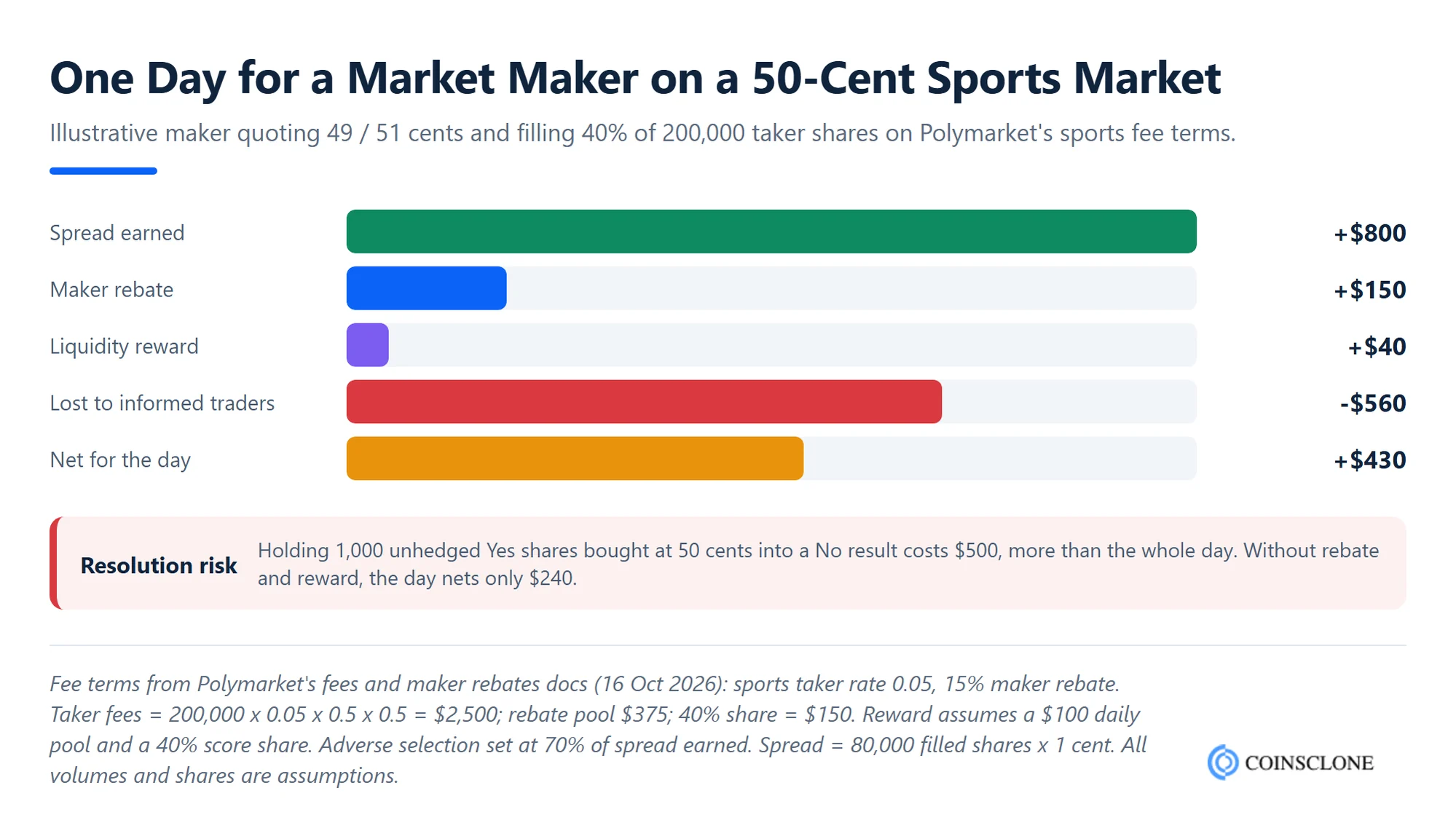
The maker nets about $430. Without the rebate and the reward, it nets only $240. One wrong-way position held into the result can wipe out the day: 1,000 Yes shares bought at 50 cents lose $500 if the answer is No.
The platform keeps $2,500 – $375 – $100 = $2,025. That is the fee loop working.
Why the Loop Fails at Launch
Now shrink it. A new market trades 10,000 shares a day at 50 cents. Taker fees are $125, and the 15% rebate pool is under $19. No serious maker writes code for that.
So at launch, you fund liquidity from your own budget until volume arrives. Plan that bridge before you go live.
Launch a Prediction Market With Liquidity Built In
Prediction Market Development — done right.
- Hybrid Engine: Order book and LMSR market maker in one platform, with per-market depth settings.
- Maker Programs: Taker-only fees, daily maker rebates and quote rewards you set from the admin panel.
- Market Maker Tools: Post-only and batch orders, cancel-on-disconnect, higher rate limits and history data.
- Launch Controls: Seeded launch markets, spread tracking, wash-trade alerts and clear resolution rules.
Polymarket-style white label in 5 to 7 weeks, Kalshi-style in 6 to 8 weeks.
Book a Free Demo to see how your markets open with tight spreads on day one.
Cold-Start Tactics: How to Seed a New Prediction Market
This plan works on any engine. Follow the steps in order.
- Launch fewer markets. Start with 10 to 30, not 300. Thin liquidity across many markets helps none of them.
- Pick questions with outside prices. Sports lines and crypto prices let makers price your market from a bigger venue. Markets only insiders can price invite losses.
- Seed the long tail with LMSR. Give quiet markets a capped AMM subsidy. For example, 50 markets at b = 1,000 cap your total exposure near $34,650.
- Charge takers only. Zero maker fees, as Polymarket does, remove the first objection a maker raises.
- Fund a fixed rewards pool. Pay for resting depth near the midpoint, sampled at random. For example, 20 markets x $50 a day x 90 days = $90,000.
- Sign two or three designated market makers. Put duties in writing: a maximum spread, a minimum size and an uptime target. In return, offer rebates, a fee waiver or a monthly fee. Token market-maker retainers often run $10,000 to $50,000 or more a month, as our guide to crypto liquidity providers shows.
- Make hedging easy. A maker who can hedge on a larger venue will quote your market tighter. A September 2025 paper on BTC-based prediction markets found this cross-market making gives users the best risk profile, though it needs pro makers or a subsidy.
- Build for makers. Offer post-only and batch orders, cancel-on-disconnect, higher rate limits and clean history data.
- Move busy markets to the order book. Once a market has steady two-sided flow, open the book and let rebates replace the subsidy.
| Tactic | What you pay for | Example 90-day budget |
| LMSR seeding | Worst-case AMM loss | 50 markets x $693 = $34,650 cap |
| Quote rewards | Resting depth near the midpoint | 20 markets x $50 x 90 days = $90,000 |
| Designated makers | Rebates, waivers or a monthly fee | Negotiated per firm |
| Maker rebates | A share of taker fees | Self-funding once volume arrives |
For retainer and loan deals, see how crypto market makers make money.
Mistakes That Waste a Liquidity Budget
- Paying for volume: volume rewards invite wash trades, where one party trades with itself. Kalshi is winding down its volume program after public claims of inflated volume, which it denies. Pay for depth instead.
- Letting a house bot quote alone: insiders pick off simple bots. If you quote, widen spreads near news and set loss limits.
- Rewarding one-sided quotes: a maker who only bids is betting, not making a market.
- Vague resolution rules: makers price the risk of a disputed result. Name the data source and the cut-off time in every market.
- Ignoring the rules: a US exchange files incentive programs with the CFTC, as Kalshi does. Elsewhere, gambling or securities rules can apply, so ask counsel first.
- Rewards without monitoring: watch for self-trades, quote stuffing and orders that vanish just before each sample.
How to Plan Liquidity With Your Build Partner
Liquidity belongs in the build, not after it. Ask any partner how the admin panel funds AMM markets, sets reward pools, onboards makers and tracks spreads.
Coinsclone has delivered 350+ platforms for 200+ clients across 20 industries since 2018. Our Polymarket clone script ships with the order book and seeded launch markets in 5 to 7 weeks for a white label. Our Kalshi clone script takes 6 to 8 weeks as a white label.
Before a scoping call, write down:
- Launch markets: the first 10 to 30 questions and their data sources
- Engine: order book, LMSR or hybrid, and the b value for AMM markets
- Fee plan: taker rates by category and the share rebated to makers
- Rewards: daily pool per market, minimum size and maximum spread
- Maker deals: how many firms, their duties and what you pay them
- Launch budget: AMM caps plus 90 days of rewards
- Countries: where you will operate and what your counsel allows
For the full build budget, published 2026 agency cost guides put a white label at about $10,000 to $100,000 before liquidity. Our guide on how to build a prediction market platform like Polymarket walks through the other build steps.
Frequently Asked Questions
What is liquidity in a prediction market?
Liquidity is how easily you can buy or sell a Yes or No share near its fair price. It shows in tight spreads, deep books and small price moves per trade, so one trade cannot swing the odds.
Who provides liquidity on Polymarket?
Market makers and traders who post limit orders. Polymarket pays them in two ways: a daily rebate of 15% to 25% of taker fees on their filled orders, and liquidity rewards for resting quotes near the midpoint. Makers pay no trading fees.
How do Polymarket liquidity rewards work?
Each market sets a minimum order size, a maximum spread and a daily pool. Orders closer to the midpoint score more, on a squared scale, and two-sided quotes score higher than one-sided ones. The book is sampled once a minute at random, and rewards are paid daily at midnight UTC.
Do market makers make money on prediction markets?
Some do, but the spread alone is thin, often near 1%. Informed traders pick off stale quotes, and a wrong-way position at resolution can go to zero. Many makers depend on rebates and rewards, so a strategy should be tested with and without them.
How much capital do you need to be a prediction market maker?
No platform sets a minimum, and payouts start at $1. Traders in a June 2026 Reddit thread said one person can run about $50,000, while $1 million usually needs a team for tech, trading and risk.
What is LMSR in prediction markets?
LMSR is the Logarithmic Market Scoring Rule, a formula that acts as an automated market maker. It always quotes a price and caps the platform’s loss at b x ln(n) per market. For a Yes or No market with b = 1,000, the most you can lose is about $693.
How do you get liquidity in a new prediction market?
Start with fewer markets that have outside reference prices. Seed quiet markets with a capped LMSR subsidy, charge takers only and fund a daily rewards pool for resting quotes. Then sign two or three market makers with clear spread and size duties.
Does Kalshi pay market makers?
Kalshi pays for resting orders through its Liquidity Incentive Program: $1 to $1,000 per market per day, scored every second, until 1 January 2027 unless changed. It also offers a higher API usage level for market makers. Its own market maker deals are not public.