
A token generation event (TGE) is the moment a crypto project mints its token on chain and hands out the first shares to buyers, users, backers and the team. It is the day the token starts to exist as a real asset. In most launches, it is also the day trading opens.
That makes the TGE the single most watched day in a token’s life, and the easiest one to get wrong. This guide explains what a TGE is, how it differs from an ICO and a listing, and how founders plan one that does not fall apart in the first week. It uses real dated launches and fresh 2026 rules.
In this guide:
- The plain meaning: what a TGE is, and why it is not the same as an ICO or an exchange listing.
- A founder checklist: contracts, audits, vesting, liquidity, market makers, listings, airdrop claims and legal steps.
- Unlock design: a worked example of how much supply can trade at launch and after the cliff.
- What goes wrong: snipers, market maker dumps, claim site crashes and unlock sell-offs, with real cases.
- 2026 rules: what MiCA asks in the EU and what the SEC proposed in August 2026.
What Is a Token Generation Event (TGE)?
A TGE is the event where a token’s smart contract goes live and the first tokens are created and sent out. Before the TGE, a token is only a plan in a white paper or a promise in a sale agreement. After it, people hold the token in their wallets and can usually trade it.
Three things tend to happen on the same day:
- Mint: the contract is deployed and the full or first supply is created.
- Distribute: tokens go to sale buyers, airdrop users, the treasury and locked vesting contracts for the team and backers.
- Trade: a pool opens on a DEX, one or more exchanges list the token, or both.
The TGE also starts every clock in the token plan. Vesting cliffs, unlock dates and claim windows are almost always counted from TGE day. That is why founders, backers and traders all care about the exact date.
TGE vs ICO vs Token Listing: What Is the Difference?
People often use these terms as if they mean the same thing. They do not. An ICO is a way to raise money, a TGE is the technical birth of the token, and a listing is when an exchange lets people trade it.
| Term | What it is | When it happens | Who runs it |
| ICO or token sale | Selling tokens for money, often before the token exists | Weeks or months before TGE, or on the same day | The project, a launchpad or an exchange |
| TGE | Minting the token and sending out the first shares | One fixed day and time | The project’s contracts |
| Listing | An exchange or DEX pool starts trading the token | On TGE day or later | Exchanges and liquidity providers |
| Unlock | Locked tokens become free to move or sell | Months or years after TGE | Vesting contracts |
A project can hold a sale months before its TGE. Buyers then wait for the TGE to receive their tokens. A project can also run a TGE with no public sale at all and hand out tokens through an airdrop.
What Happens on TGE Day?
A clean TGE day follows a fixed run order. The steps below are the usual order for a token that launches on a DEX and a few exchanges at once.
- Deploy and verify: the team deploys the audited token contract and publishes the verified source code on the block explorer.
- Mint and fund: the supply is minted and sent to the treasury, vesting contracts, sale contract and airdrop contract in one scripted run.
- Lock the keys: admin rights move to a multisig, and any mint or pause power is given up or time-locked.
- Open claims: sale buyers and airdrop users can claim, or tokens arrive in their wallets with no claim step.
- Seed liquidity: the team or market maker adds the first DEX pool, and partner exchanges open deposits and then trading.
- Watch and report: the team tracks holders, large sells and pool depth for the first hours, and posts updates.
Order matters. If trading opens before claims work, early holders cannot sell while bots can, and the first price is set by a few wallets.
How to Plan a Token Generation Event: The Checklist
Most failed launches skip one of these steps. Plan them in this order, about 8 to 12 weeks ahead of the date.
Smart contracts and audit
You need more than a token contract. A normal TGE uses a token contract, a vesting contract, a sale or claim contract and often a staking or treasury contract. Each one needs a security audit, and the fixes need a second look before launch.
Keep the token contract simple. Hidden mint rights, blacklist powers or fee switches scare buyers and can flag the token as risky on scanners. Our crypto token development team builds these contracts as one audited set.
Tokenomics, vesting and unlocks
Write down every share of supply, who holds it, and when it unlocks. Then put that plan into code with a token vesting smart contract so no one has to trust a spreadsheet.
The key numbers to fix before launch are:
- Float at TGE: the share of supply that can trade on day one.
- Cliff: how long team and backer tokens stay fully locked.
- Release pace: monthly, daily or block by block after the cliff.
- FDV: the launch price times the full supply, which buyers compare with the float.
Liquidity and market makers
Decide how much money and how many tokens go into the first pool, and who manages trading depth on exchanges. Most teams lend tokens to a market maker under a contract. Read the terms closely. In March 2026, Binance told token issuers they must disclose their market maker and its contract terms, and it banned profit-sharing and guaranteed-return deals.
If you are new to these deals, read how crypto market makers make money before you sign one.
Exchange listings
Talk to exchanges early. Each one runs its own review of the team, the contracts, the token plan and the legal status. Line up the price trackers and DEX listing pages too, so buyers can find a real price on day one. Our guide on how to list a token covers each step.
Airdrop claims
An airdrop needs a snapshot, a filter for fake wallets, a claim contract and a claim site that can handle a rush. Publish the exact unlock split, such as “50% at TGE, the rest over six months”, well before the day. Our guide on how to design a token airdrop walks through the rules.
Legal and compliance
Get legal advice in each country where you will sell or market the token. Block countries you cannot serve, and keep sale terms, risk notes and KYC records. The next section covers the 2026 rules in the EU and the US.
What Are the Rules for a TGE in 2026?
Rules depend on where your buyers live, not where your company sits. Two sets of rules matter most this year.
EU (MiCA): an offer of a new token to the public in the EU needs a crypto-asset white paper. You must notify the white paper to your home regulator at least 20 working days before you publish it. Article 4 of MiCA lifts the white paper duty for offers to fewer than 150 people per member state, offers worth up to EUR 1,000,000 over 12 months, and offers made only to qualified investors. Tokens given away for free are outside these offer rules. But a drop is not “free” if people must hand over personal data to claim it, so a KYC-gated airdrop may still count as an offer. Listing the token on an EU trading platform brings its own white paper duty.
US (SEC): on 18 August 2026 the SEC proposed Regulation Crypto Assets. It would allow a raise of up to $5 million over four years, or up to $75 million in each 12-month period with financial statements and ongoing reports. It also proposes a safe harbor under which a token stops being treated as part of an investment contract once the issuer’s key work is done. The comment period closed on 20 October 2026, and it was still a proposal when this guide was written. Until final rules exist, a US token sale follows current securities law.
How to Design TGE Unlocks That Do Not Sink the Price
Unlock design is where most TGEs win or lose. The worked example below shows a common plan for a token with a 1 billion supply.
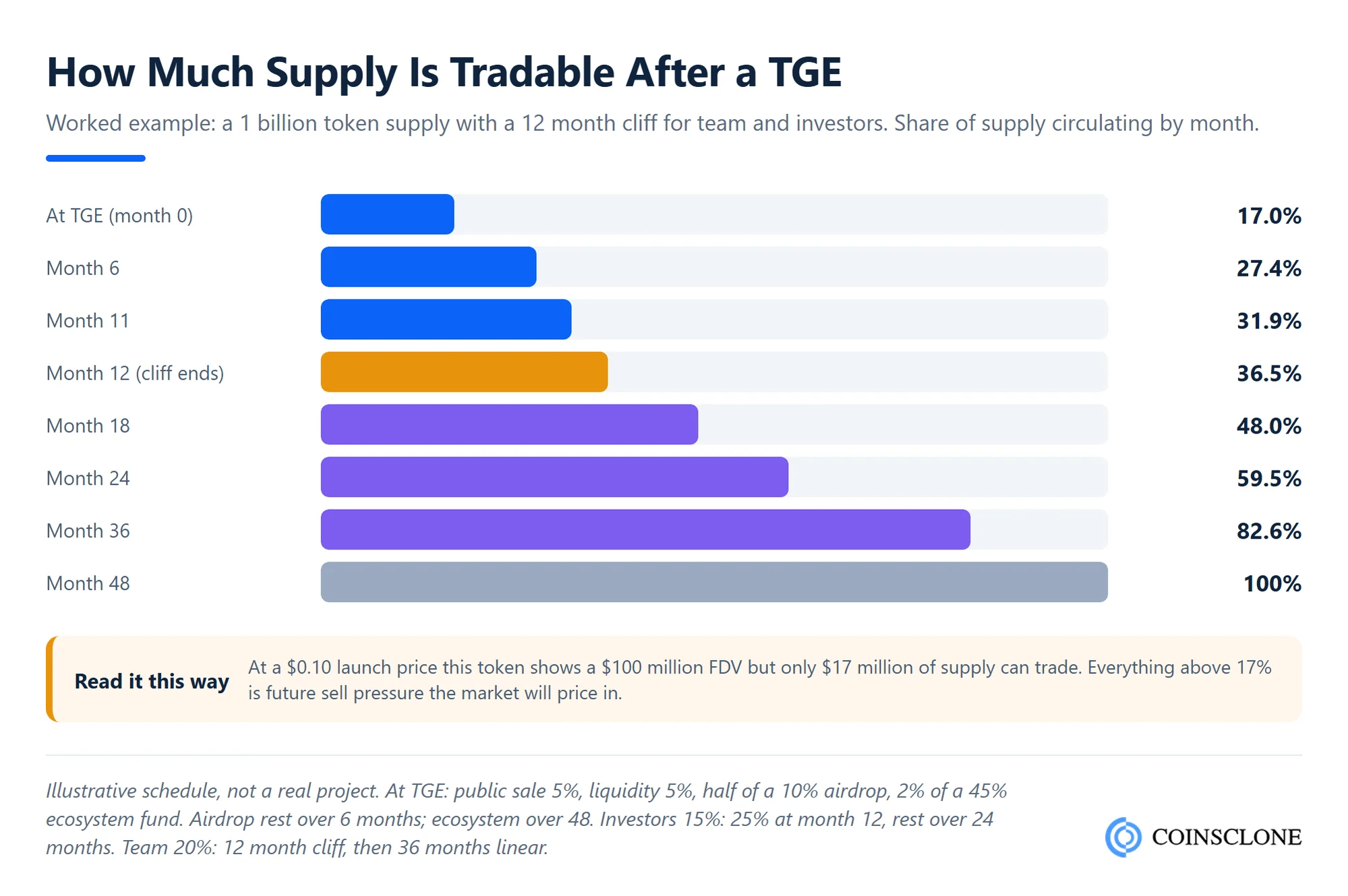
At TGE only 17% of supply can trade. At a $0.10 launch price, that is a $17 million market cap sitting under a $100 million FDV. Every month after that, more supply arrives, and the cliff at month 12 adds a jump that traders will see coming.
Real launches show both sides of this choice.
- Starknet, 2024: about 1.3 billion STRK for early backers and staff was set to unlock on 15 April 2024. After a public backlash, StarkWare cut that day’s unlock to 64 million STRK, 0.64% of supply. It then moved to 64 million a month, rising to 127 million a month from March 2025 until March 2027.
- Hyperliquid, 2024: at its genesis event on 29 November 2024, Hyperliquid sent 310 million HYPE, 31% of supply, to users, fully unlocked. The team share stayed locked for a year, and there was no share for private backers.
- Monad, 2025: Monad sold 7.5% of its 100 billion supply at $0.025 in a public sale hosted by Coinbase. It raised about $269 million from 85,820 buyers, and the TGE and trading followed on 24 November 2025.
A few rules hold up across launches:
- Use linear releases after the cliff: Keyrock’s study of 16,000+ unlocks found linear unlocks cause less short-term damage than one large cliff.
- Avoid a big team cliff: in the same study, team unlocks led to the worst drops, about 25% on average.
- Publish the calendar: traders price in unlocks about 30 days before they land, so surprises hurt more than known dates.
- Size the float to real demand: a tiny float can pump on day one and then fall for a year as supply unlocks.
What Can Go Wrong at a TGE?
Most new tokens trade below their launch value. Memento Research tracked 118 TGEs in 2025 and found 84.7% in the red. Keyrock found 90% of unlocks add selling pressure.
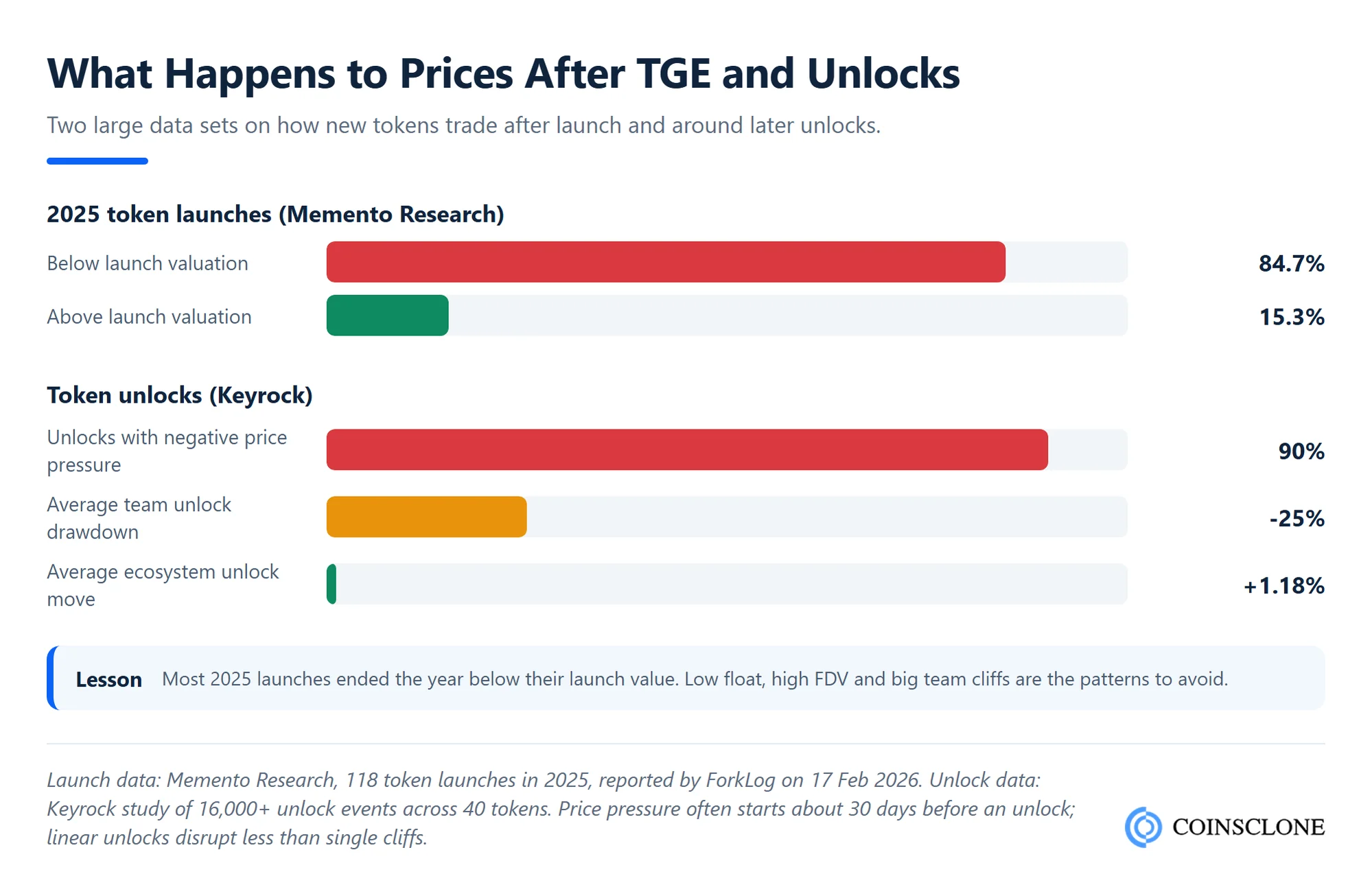
These are the failures that cause it, with real cases.
Snipers and bundlers
Bots buy in the first block a pool opens, then sell into the first real buyers. On a DEX launch, a handful of wallets can grab a large share of supply in seconds. Fixes include a trading delay, early wallet caps, a falling fee on early buys and a fair-launch auction. Our guide on how to stop snipers on a token launch compares each fix.
Market maker dumps
A market maker should quote both buy and sell orders. In the MOVE launch, Binance said a market maker placed sell orders for 66 million MOVE one day after listing with little buy support. It made about $38 million and was removed by Binance in March 2025. Read every loan and option term, and track the market maker’s wallets after launch.
Claim sites that crash
When Arbitrum opened ARB claims on 23 March 2023, its site and block explorer went down under the load. Only about 23,000 of 625,000 eligible wallets claimed in the first hour, and fake claim sites spread fast. Load test the claim site, add a direct contract route, and post the one real link everywhere.
Insider supply
When a few wallets hold most of the supply, they can drain the pool. With the LIBRA token in February 2025, on-chain trackers found that insider wallets cashed out about $107 million within hours, and the price fell about 90%. Lock team and partner tokens in public vesting contracts, and lock or burn the pool tokens.
Unlock sell-offs
The first big cliff is often the second crash. Spread team and backer unlocks, stagger them away from other big events, and tell the market well ahead.
Which Launch Route Fits Your Token?
Your launch route decides who gets tokens first and how the price is set. Use this tree to pick a starting point.
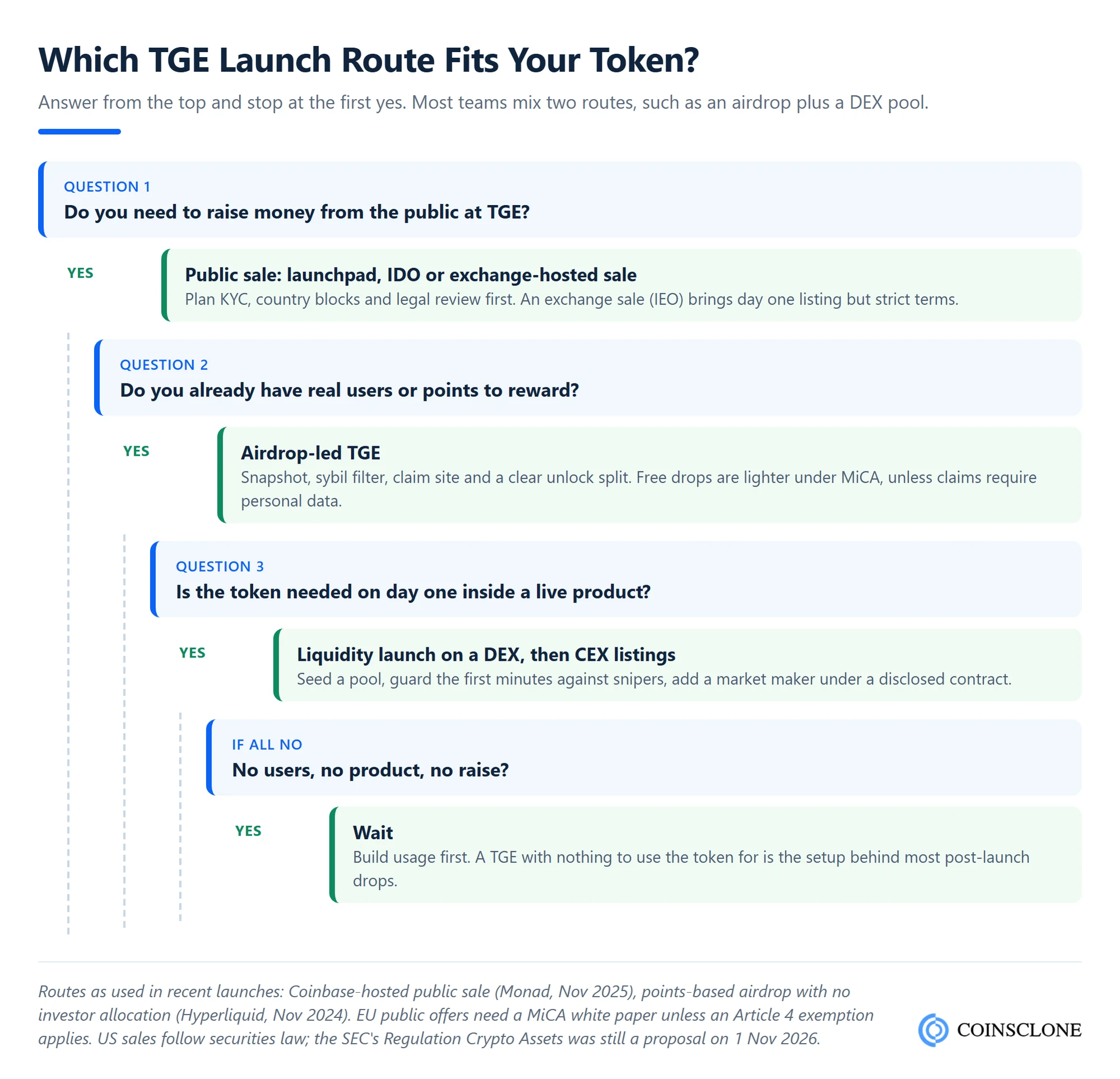
- Public sale: best when you need to raise money from many buyers. A crypto launchpad or an exchange-hosted sale handles KYC, caps and claims.
- Airdrop-led TGE: best when you already have users, points or a testnet crowd to reward.
- DEX liquidity launch: best when the token is needed in a live product on day one. Pair it with anti-sniper guards.
How Long Does It Take and What Does It Cost to Plan a TGE?
Plan 8 to 12 weeks for a TGE with a sale, an airdrop and exchange listings. A simple token with a DEX pool can move faster, but the audit and legal review still set the pace.
A sample plan:
| Weeks before TGE | Work |
| 12 to 9 | Token plan, vesting rules, legal advice, exchange talks |
| 9 to 5 | Build contracts, sale or claim site, run the audit |
| 5 to 3 | Fix audit findings, sign market maker terms, file white paper if needed |
| 3 to 1 | Snapshot, load tests, dry run on a testnet, publish unlock calendar |
| TGE week | Scripted deploy, claims, liquidity, live watch |
On cost, published 2026 agency cost guides put token builds at about $5,000 to $15,000 for a basic token and $15,000 to $50,000+ for a complex one. The rest of a TGE budget depends on:
- Audits: one firm or two, and how many contracts.
- Liquidity: the cash and tokens you put in the first pools.
- Market making: a monthly fee, a token loan, or both.
- Exchange listings: each exchange sets its own terms.
- Legal: the number of countries and whether you need a MiCA white paper.
Launch Your Token With a TGE Built to Hold Up on Day One
Token launch development, done right.
- Audited Token Contracts: Token, sale, claim and staking contracts with clean admin rights
- Vesting and Unlocks: Cliff and linear schedules for team, backers and airdrops, coded on chain
- Launchpad and Claim Site: KYC, caps, country blocks and a claim page tested under load
- Launch Day Guards: Anti-sniper rules, scripted deploys and a live holder dashboard
See a live demo of our token launch and vesting tools.
Book a Free Demo to plan your token generation event with our team.
How Coinsclone Helps You Run a Clean TGE
Coinsclone builds the full TGE stack: the token contract, vesting and claim contracts, sale and launchpad pages, airdrop tools and the launch dashboard your team watches on the day. We script the deploy, test the claim site under load, and wire in anti-sniper guards before trading opens. Coinsclone has built crypto products since 2018 and delivered 350+ platforms for 200+ clients across 20 industries. Talk to our token development team to plan your TGE.
Frequently Asked Questions
What does TGE mean in crypto?
TGE stands for token generation event. It is the moment a project’s token is minted on chain and the first tokens are sent to buyers, users, backers and the team. Trading often starts on the same day.
What is the difference between a TGE and an ICO?
An ICO is a sale that raises money by selling tokens. A TGE is the technical event that creates the token and sends it out. A project can hold its ICO months before the TGE, or skip a sale and launch through an airdrop.
Is TGE the same as listing?
No. The TGE creates and distributes the token, while a listing is when an exchange or DEX pool lets people trade it. They often happen on the same day, but a token can exist for days or weeks before it lists.
What does unlocked at TGE mean?
It means the share of tokens you can move or sell on TGE day. For example, “25% unlocked at TGE, rest over 12 months” gives you a quarter of your tokens at once and the rest in monthly parts. Check the project’s own claim page for the exact split.
What happens after a TGE?
Holders claim and trade the token, and more exchanges may list it. Locked tokens for the team and backers then release on the vesting calendar, often after a 6 to 12 month cliff. Many tokens see selling pressure around these unlocks.
How do I participate in a token generation event?
You can take part by buying in the public sale, earning an airdrop by using the product, or buying once trading opens. Use only links from the project’s official site and channels, since fake claim sites are common on TGE day.
Are token generation events regulated?
Yes, in many places. In the EU, a public offer of a new token needs a MiCA white paper unless an exemption applies. In the US, token sales fall under securities law, and the SEC proposed new exemptions and a safe harbor in August 2026 that were not yet final.
Why do tokens drop after TGE?
Early holders sell, new supply unlocks, and launch prices are often set too high. Memento Research found 84.7% of 118 tokens launched in 2025 were below their launch value by late December 2025.