
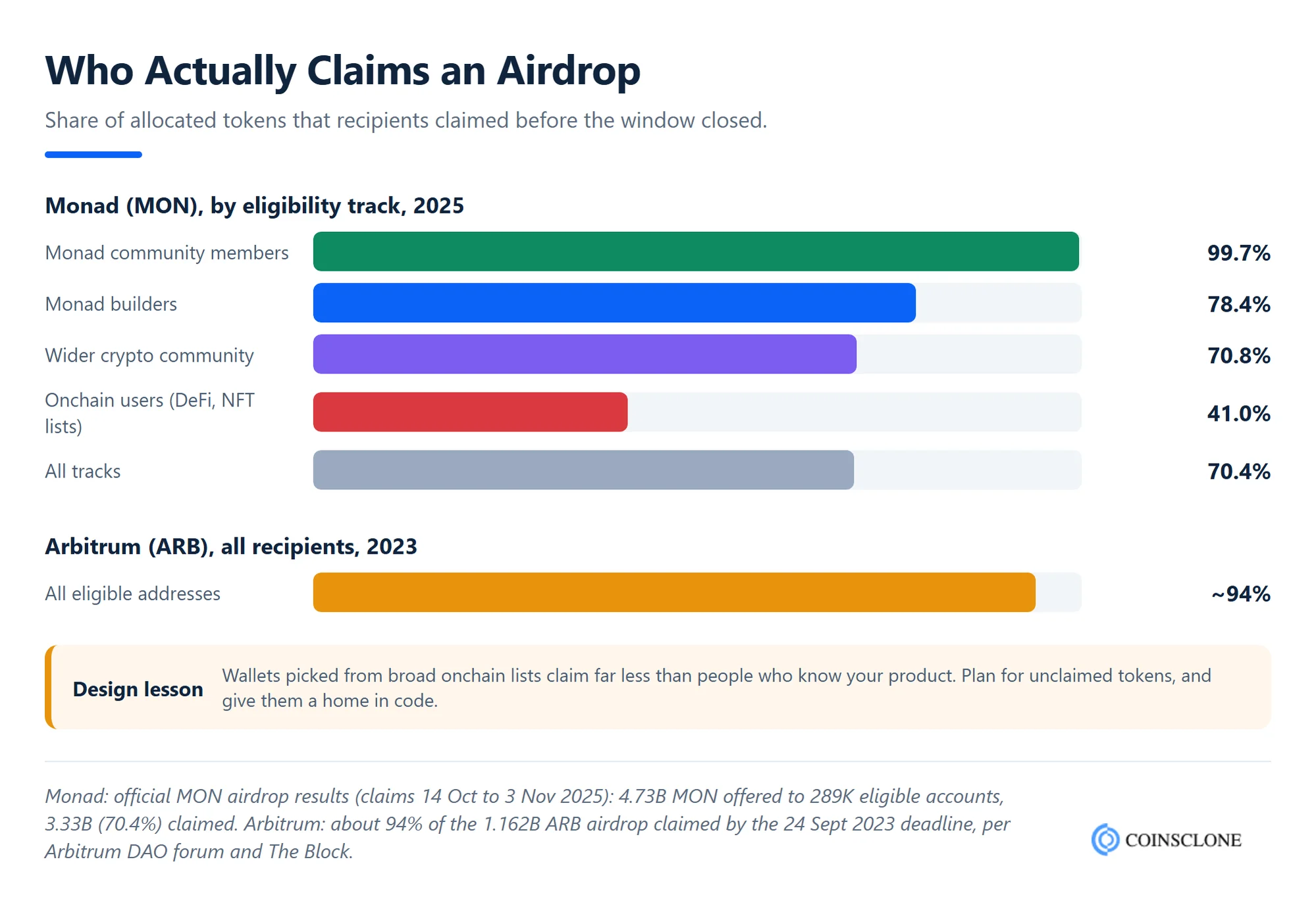
When Monad closed its airdrop claims on 3 November 2025, almost 30% of the tokens on offer were never claimed. In its largest list of wallets, picked from onchain DeFi and NFT activity, only 41% of the tokens were claimed, Monad’s own results show. Its own community track claimed 99.7%. That gap is the whole lesson of how to design a token airdrop: who you pick matters more than how much you give.
The rules changed in 2026 too. In March, the SEC said that a free airdrop of a non-security token involves no “investment of money”. In August, it proposed a new exemption that covers airdrops with strings attached. So US founders now have a real path instead of a default geo-block.
This guide takes you through each choice in order, from the goal to the law, the timeline and the cost. You get real data from six large drops and a worked example you can copy.
In this guide:
- Supply share: recent large drops gave users between 8.5% (LayerZero) and 31% (Hyperliquid) of total supply.
- Sybil filters work at scale: LayerZero flagged 803,093 of about 6 million addresses; Linea removed over 800,000 before its drop.
- Free and retroactive is safest in the US: under the SEC’s March 2026 view, a drop for past use with nothing asked after the announcement needs no exemption.
- Claim fees, quests and KYC change the legal picture: they can count as consideration in the US and make a drop “not free” under MiCA.
- Plan for 6% to 30% unclaimed: Arbitrum saw about 94% claimed, Monad 70.4%, so put a deadline and a treasury sweep in the contract.
How to Design a Token Airdrop: The Eight Decisions
To design a token airdrop, you make eight decisions in order. Each one limits the next.
- Goal: spread governance, reward past users, or pull in new ones.
- Budget: the share of supply, and how much unlocks at launch.
- Eligibility: which actions count, up to a snapshot block.
- Sybil filter: how you remove fake wallets, and how people appeal.
- Allocation: a floor, a weighted part and a cap per wallet.
- Claim: a Merkle claim with a deadline, or a direct push.
- Unlocks: fully liquid, cliff, or streamed.
- Legal scope: who can claim and what you ask of them.
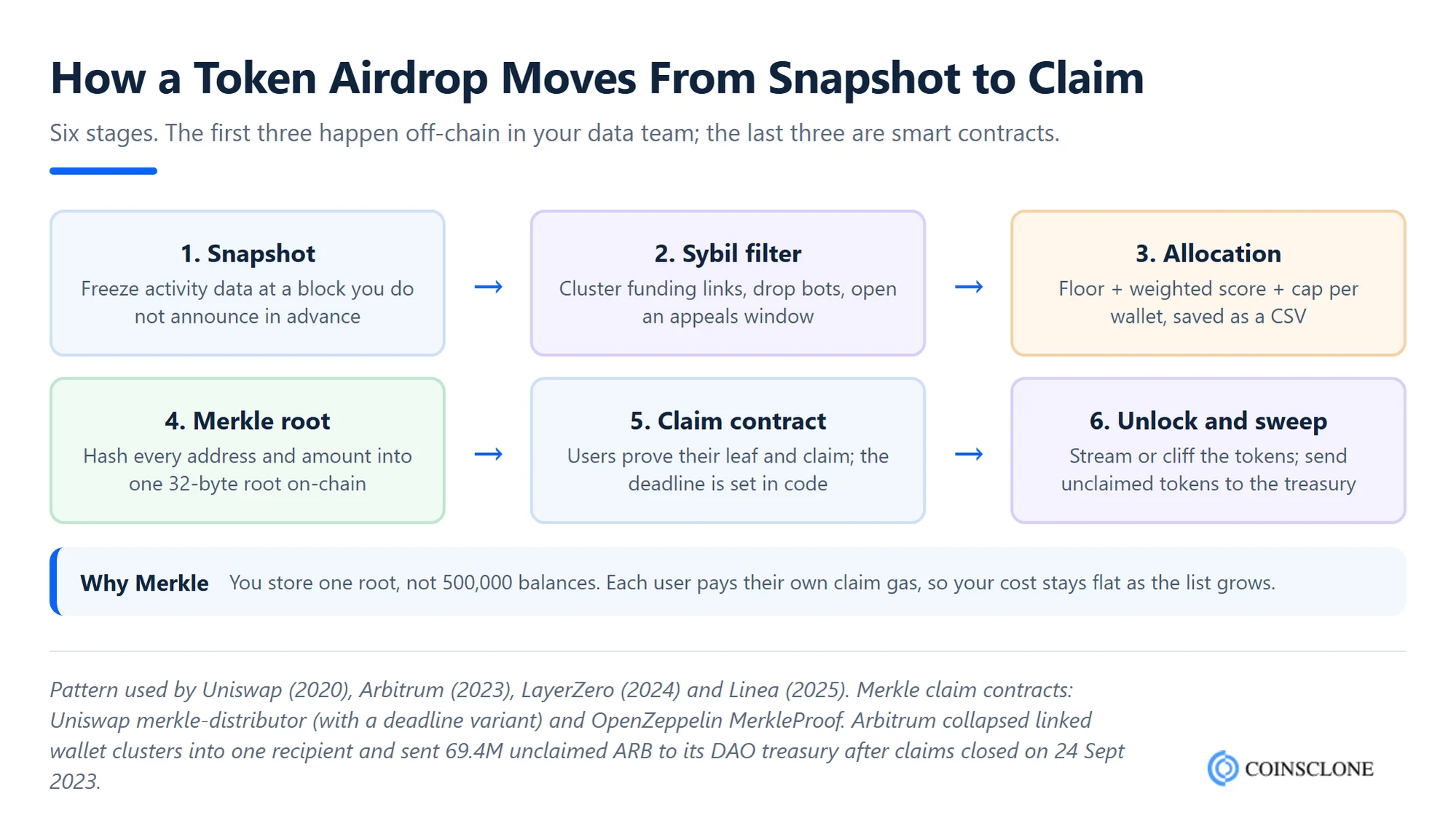
The first three stages are data work. The last three are smart contracts that need an audit before any token moves.
Real Airdrop Outcomes: What the Data Shows
Before you set any number, look at what real projects did.
| Airdrop | Date | User share | Recipients | Filter used | Claim window |
| Uniswap (UNI) | Sep 2020 | 400 UNI each to past users | 251,534 addresses | Almost none | No deadline |
| Arbitrum (ARB) | Mar 2023 | 1.162B ARB (11.62%) | 625,143 addresses | Cluster analysis | Closed 24 Sep 2023 |
| LayerZero (ZRO) | Jun 2024 | 85M ZRO (8.5%) | 1.28M wallets | Self-report, bounty, vendor review | 20 Jun to 20 Sep 2024 |
| Hyperliquid (HYPE) | Nov 2024 | 310M HYPE (31%) | 94,000+ addresses | Points program | Distributed at launch |
| Linea (LINEA) | Sep 2025 | 9.36B LINEA | 749,662 addresses | Proof of humanity, thresholds | From 10 Sep 2025 |
| Monad (MON) | Oct to Nov 2025 | 4.73B MON offered | 289K eligible accounts | Five tracks, vouching | 14 Oct to 3 Nov 2025 |
Sources: Uniswap, The Block on Arbitrum, The Block on LayerZero, CoinDesk on Hyperliquid, The Block on Linea and Monad.
Three patterns stand out. First, a loose filter costs you: Uniswap’s list even held about 12,000 addresses that had only sent failed transactions. Second, broad lists claim less. Third, unclaimed tokens need a plan. Arbitrum sent 69.4 million unclaimed ARB to its DAO treasury after the deadline.
Step 1: Set the Goal and the Budget
Your goal decides who is eligible. A governance drop should reach many real users so voting power spreads out. A user reward should favour people who stayed and paid fees. A growth drop is really marketing, and it carries the most legal risk. If you also raise money, keep the drop apart from any sale; our ICO presale guide covers the sale side.
Then size the pool. Recent large drops sit between 8.5% and 31% of supply, but those projects had years of usage. A newer project should size the pool to its real user count, not to a headline. Many guides quote 5% to 10% with no source, so treat it as a habit, not a rule.
Also decide how much unlocks on day one. Linea’s early-user drop was fully unlocked at launch, with about 22% of total supply in circulation, per its tokenomics post.
Step 2: Design Eligibility That Rewards Real Use
Eligibility is a set of rules run against data up to a snapshot block. Good rules measure what you want more of:
- Time: how many separate months a wallet was active.
- Fees paid: real cost beats raw transaction count.
- Depth: volume or liquidity, with a ceiling.
- Breadth: use of several features, not one loop.
- Community: builders, writers and testers, which Monad ran as separate tracks.
Keep the snapshot block secret until it has passed. If farmers know the date, they pile in just before it. Publish the rules afterwards, with a checker so people see their result before claims open, as Linea did.
Worked Example: Allocating an 80 Million Token Pool
Say your token has 1 billion supply and you set aside 8%, or 80,000,000 tokens. Your snapshot finds 410,000 wallets. Your sybil filter removes 150,000, leaving 260,000.
- Hold back a reserve: keep 5% (4,000,000) for appeals. Monad added vouching in its first claim week for the same reason.
- Pay a floor: split 30% of the rest (22,800,000) equally. Each wallet gets about 87.7 tokens.
- Weight the rest: share the other 53,200,000 by the square root of each wallet’s score. A wallet with 4 times the activity gets 2 times the tokens, which blunts whales and farms.
- Cap each wallet: set a ceiling, for example 40,000 tokens, and send any excess back into the weighted pool.
- Expect unclaimed tokens: at a 70% claim rate, about 23 million tokens stay unclaimed. Decide now if they go to the treasury, a later round or a burn.
Save the final table as a CSV, publish its hash, and build the Merkle tree from that exact file.
Step 3: Decide Whether to Run a Points Program
A points program keeps an offchain score that later turns into tokens. Hyperliquid ran points, then sent 31% of HYPE supply to points holders in November 2024. Points let you track use over months without promising a token too early. However, they bring three traps:
- Farming: a public points table tells farmers exactly what to repeat.
- Delay anger: OpenSea pushed back its SEA token past a planned 30 March 2026 start, citing market conditions, while users held points with no date.
- Legal shift: points for tasks set after you announce a token look like work done for tokens, which matters under the 2026 SEC rules below.
If you run points, publish how they convert before launch, and avoid a fixed rate that reads like a price.
Step 4: Build Sybil Detection Into the Plan
A sybil is one person running many wallets to collect many shares. As one r/CryptoCurrency user put it, a protocol that cannot tell small users from big ones hands the drop to farmers. Detection works best in layers:
- Funding links: group wallets funded from one source or that sweep to one address. Arbitrum merged tight clusters into a single recipient, per its Foundation docs.
- Timing: farms act in lockstep, so first gas and first use land close together.
- Thresholds: ask for real value or several active months.
- Proof of personhood: Story Protocol used Human Passport stamps from its testnet onward.
- Self-report: LayerZero let flagged users confess within 14 days and keep 15% of their share; up to 100,000 addresses did, The Block reported.
- Appeals: publish the lists and fix errors before the root goes on-chain.
Game drops need more. Tap-to-earn apps, like our Hamster Kombat clone script, check every tap on the server to stop bots.
| Project | Wallets checked | Result |
| LayerZero (2024) | About 6M addresses | 803,093 flagged (about 13%) |
| Linea (2025) | Voyage and Surge users | 800,000+ removed; 749,662 eligible |
False positives are the hidden cost. LayerZero first flagged over 2 million addresses, then narrowed its rules. Every real user you wrongly cut becomes a loud critic.
Step 5: Choose the Claim Contract
Most large drops use a Merkle claim. You hash every address and amount into a tree and store only the 32-byte root on-chain. Each user sends a proof that their entry is in the tree, and the contract pays them once.
| Method | Who pays gas | Best for | Watch out for |
| Merkle claim | Each claimer | 10,000+ recipients | Phishing sites copying your claim page |
| Push (batch transfer) | You | Small lists, cheap chains | Cost grows with every wallet; tokens land in dead wallets |
| Signature claim | Each claimer | Lists that change often | Your signing key becomes a target |
Build these in from day one:
- A deadline: Uniswap’s open-source merkle-distributor has a version where the owner can only withdraw after the end time.
- No token approvals: a claim should never ask users to approve spending. Linea posted scam warnings before its claims opened.
- One official address: post it on all your channels at the same moment.
- An audit: the claim contract holds the whole pool, so treat it like a vault.
On Solana, open-source Merkle distributor programs do the same job. Fees are tiny, but each new recipient needs a token account with a rent deposit of about 0.002 SOL, so a push to a large list adds up. See our Solana token development page for the token side.
Step 6: Plan Vesting and Unlocks
Unlocks trade fairness against sell pressure. There are three common choices:
- Fully unlocked: Linea and Hyperliquid did this. It is simple, but everyone can sell at once.
- Cliff and linear: part at launch, the rest over months, through a second contract.
- Streaming: tokens flow to the claimer every second, which smooths selling.
An r/defi thread in March 2026 put it bluntly: lock-ups “work for like 6 months then the unlock schedule hits”. The fix is not a longer lock. Pair the drop with a reason to hold, such as staking for fee share, votes or discounts. Then publish one calendar with all unlocks, team and investors too.
Team lock-ups matter legally too. One of five conditions in a16z’s airdrop safe harbor proposal (10 April 2025) is that insiders face transfer limits, so they cannot sell into the drop.
Coinsclone builds these parts as one package: Merkle airdrops with claim portals and anti-sybil filters, plus vesting with cliffs and linear schedules. See our crypto token development company page for the full scope.
Plan Your Token Airdrop Before You Build It
Token Airdrop Development — done right.
- Eligibility and Scoring: Snapshot scripts, scoring rules and allocation tables you can publish and verify.
- Anti-Sybil Filtering: Wallet clustering, thresholds and an appeals flow before the Merkle root goes on-chain.
- Merkle Claim Portal: Audited claim contracts with deadlines, a branded claim site and one official address.
- Vesting and Unlocks: Cliffs, linear schedules and treasury sweeps for unclaimed tokens.
Get a scoped plan for your airdrop pool, filters and claim contract.
Book a Free Demo to see a working claim portal and vesting flow for your token.
Legal Risk: US, EU and Geo-Blocking in 2026
Airdrop law moved more in 2026 than in the five years before. This is a summary, not legal advice.
United States
For years, the SEC’s 2018 case against Tomahawk Exploration, which treated tokens given for promotion as a sale, pushed teams offshore. Dragonfly’s State of Airdrops report (March 2025) estimated that US users missed $1.84 billion to $2.64 billion from 11 geo-blocked airdrops between 2020 and 2024.
Three 2026 changes now set the rules:
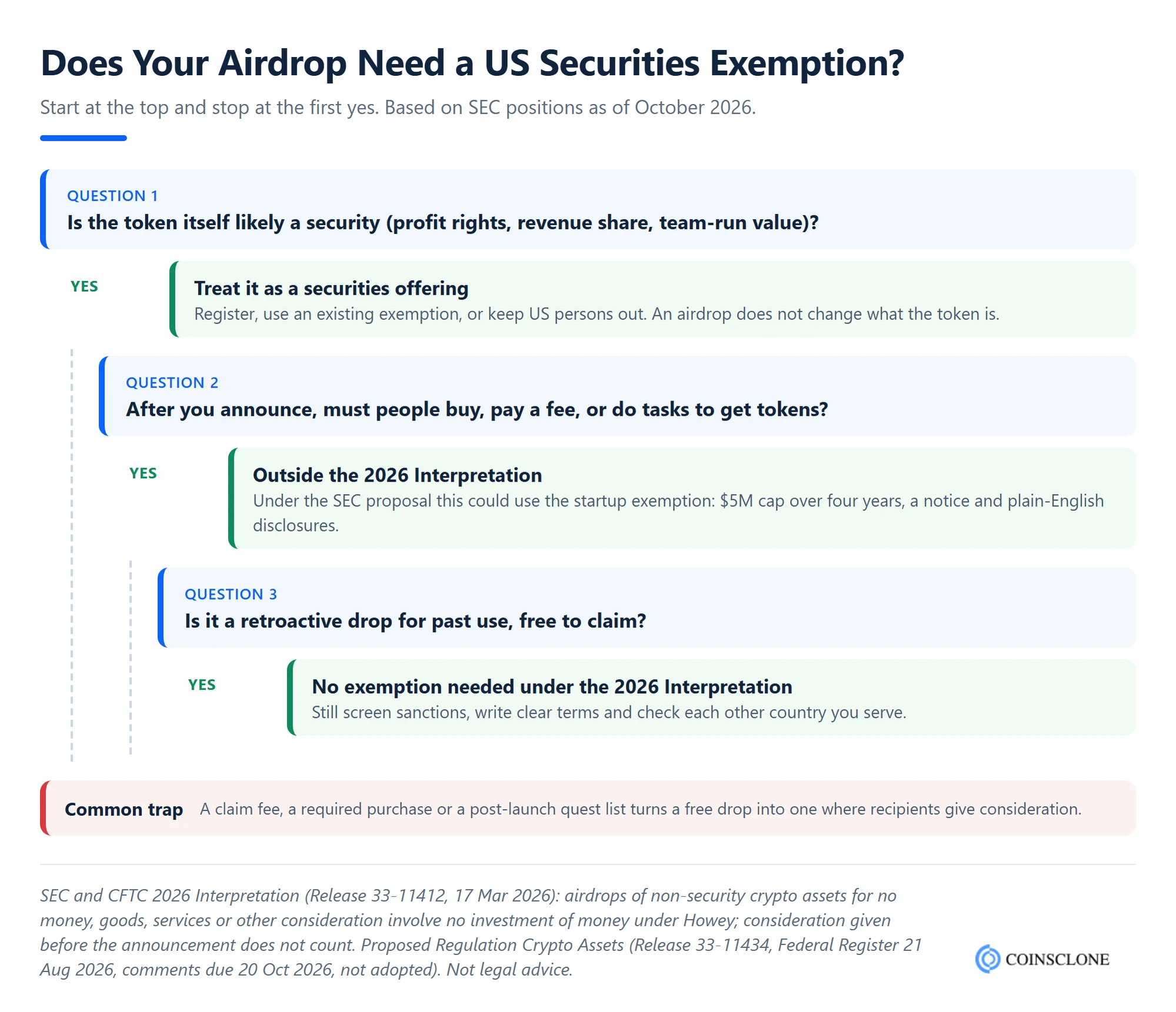
- The 2026 Interpretation (17 March 2026): the SEC and CFTC said a drop of a non-security token, given for nothing in return, involves no “investment of money” under Howey, per the SEC fact sheet. Use before the announcement does not count as payment.
- Proposed Regulation Crypto Assets: published on 21 August 2026, with comments due 20 October 2026. Its startup exemption allows up to $5 million over four years and names airdrops. Drops that ask people to buy, pay or do tasks after the announcement would use it, per the SEC proposal. It is not yet a rule.
- Lawsuit dropped: the DeFi Education Fund and Beba ended their 2024 airdrop suit against the SEC in March 2026, and kept the right to refile.
The practical rule: a drop for past use, free to claim, is the cleanest US design. A claim fee breaks it. LayerZero asked claimers to donate $0.10 per ZRO in 2024, which under today’s test is payment after the announcement. Post-launch quests do the same.
European Union and UK
Under MiCA Article 4(3), tokens offered for free need no white paper. But an offer is not free if people must hand over personal data, or if you get fees in return. So a drop gated by KYC in the EU may need a white paper. Article 4(4) also ends the exemption once you signal plans to list on a trading platform. In the UK, the FCA’s crypto promotion rules, in force since October 2023, can cover airdrop marketing.
Geo-Blocking, Sanctions and Tax
- Geo-blocking: exclude regions in the terms, block them at the claim site and drop their known wallets from the list. A contract cannot see location.
- Sanctions: screen every address against the OFAC sanctions list before you build the root.
- Tax: in the US, people owe income tax on airdropped tokens at market value once they control them, under IRS Revenue Ruling 2019-24. Say so in your FAQ.
Timeline and Cost of an Airdrop Build
A build runs in four phases, and the data work often takes longer than the code:
- Design: goal, budget, rules and legal review.
- Data: scoring, sybil review and appeals.
- Contracts and claim site: Merkle claim, vesting and audit. Coinsclone’s token page puts this “contract plus distribution” scope at 3 to 5 weeks.
- Launch: the checker, the claim window and the treasury sweep.
On cost, published 2026 agency cost guides put a token with vesting, staking or voting logic at about $15,000 to $50,000+. Published 2026 audit price guides put a simple token audit at about $5,000 to $15,000. Legal advice, sybil work and listings sit on top. Our guide to the cost to create a crypto token breaks down the full launch budget, and how to list a token covers what comes after the claim opens.
How to Choose a Partner and What to Prepare
Pick a team that has shipped data, contracts and legal work for drops before. Ask for live claim contracts they built, their audit firms, and how they filter wallets and handle appeals.
Before a scoping call, have these ready:
- Goal and pool size, with total supply and unlock plan.
- Data sources: contracts, points and community lists.
- Markets you serve and regions you will exclude.
- Dates for the TGE and exchange listings.
Coinsclone has been building since 2018, with 350+ platforms delivered for 200+ clients across 20 industries. Our token development team can scope your drop on a free call.
Frequently Asked Questions
How do airdrops detect sybil wallets?
Most teams link wallets by funding source, compare timing and set activity floors, then use proof of personhood for edge cases. LayerZero flagged 803,093 of about 6 million addresses this way. A public appeals window catches the real users the filter gets wrong.
How do you airdrop tokens on Solana, and which tool should you use?
For small lists, a batch transfer tool that sends SPL tokens to a CSV of wallets is enough. For large lists, use an open-source Merkle distributor program so users claim, since a push costs about 0.002 SOL in rent for each new token account. Audit the program and publish one official claim address.
How much of the token supply should go to an airdrop?
There is no fixed rule. Recent large drops gave users 8.5% (LayerZero), 11.62% (Arbitrum) and 31% (Hyperliquid) of total supply. Size your pool to your real user base and goal, and leave room for later rounds.
Are crypto airdrops legal in the US in 2026?
Under the SEC and CFTC view of March 2026, a free drop of a non-security token involves no investment of money under Howey. Drops that ask people to buy, pay or do tasks after the announcement fall outside it. The SEC’s August 2026 proposal would give those a $5 million startup exemption, but it is not final.
Are airdropped tokens taxable?
In the US, the IRS treats airdropped tokens as income at market value once the person can control them, under Revenue Ruling 2019-24. Other countries differ, so explain this in your claim FAQ.
How do you reward early users without creating sell pressure?
Give the token a use before the drop, such as staking for fee share, votes or discounts, so holders have a reason to keep it. Use square-root weighting and caps per wallet to stop farms. Publish all unlock dates, team and investors too.
What happens to unclaimed airdrop tokens?
It depends on the contract. Arbitrum sent 69.4 million unclaimed ARB to its DAO treasury after its September 2023 deadline. Set a deadline and a destination in code before launch.