
Stablecoin remittance platform development means building an app that sends money abroad on a stablecoin. The app turns a sender’s dollars into a coin such as USDC. The coin crosses a blockchain in seconds, and the family gets local money at the other end. The chain part is cheap and easy. The hard parts are the ramps at each end, the licenses and the payout partners. They decide whether you beat today’s prices.
This guide is for founders and remittance firms who want to build one. We price a real $200 transfer line by line against World Bank data. We score five corridors so you can pick your first. Then we map the licenses, the stack and the weak points.
In this guide:
- A $200 worked example: US to Mexico, every cost line, and where the savings vanish.
- A corridor scorecard: five big corridors rated on volume, payout, cash-out depth and rules.
- A license map: what you need on the sending side, in the middle and on the receiving side.
- A failure-mode table: what breaks in production and the control that handles it.
- Build steps, stack and cost drivers: with timelines for the core modules.
Stablecoin Remittance Platform Development: The Short Answer
At heart, it is a money transfer business with a blockchain in the middle. The customer still pays in dollars, pounds or dirhams, and the family still gets pesos, rupees or naira. The coin only replaces the slow, costly middle: the chain of banks and the cash parked in each country.
That middle is a small share of the bill. In a July 2026 test, Italy’s central bank sent 200 USDC across ten corridors and found total costs from 0.30% to 8.96%. The on-chain step was a tiny share. Buying and selling the coin drove the rest. So the real build is a ramp, FX and payout business, with checks around each step.
If you want the case for stablecoins over SWIFT first, read our guide to stablecoin cross-border payments. This guide is about building the remittance product itself.
How Does a Stablecoin Remittance Work, Step by Step?
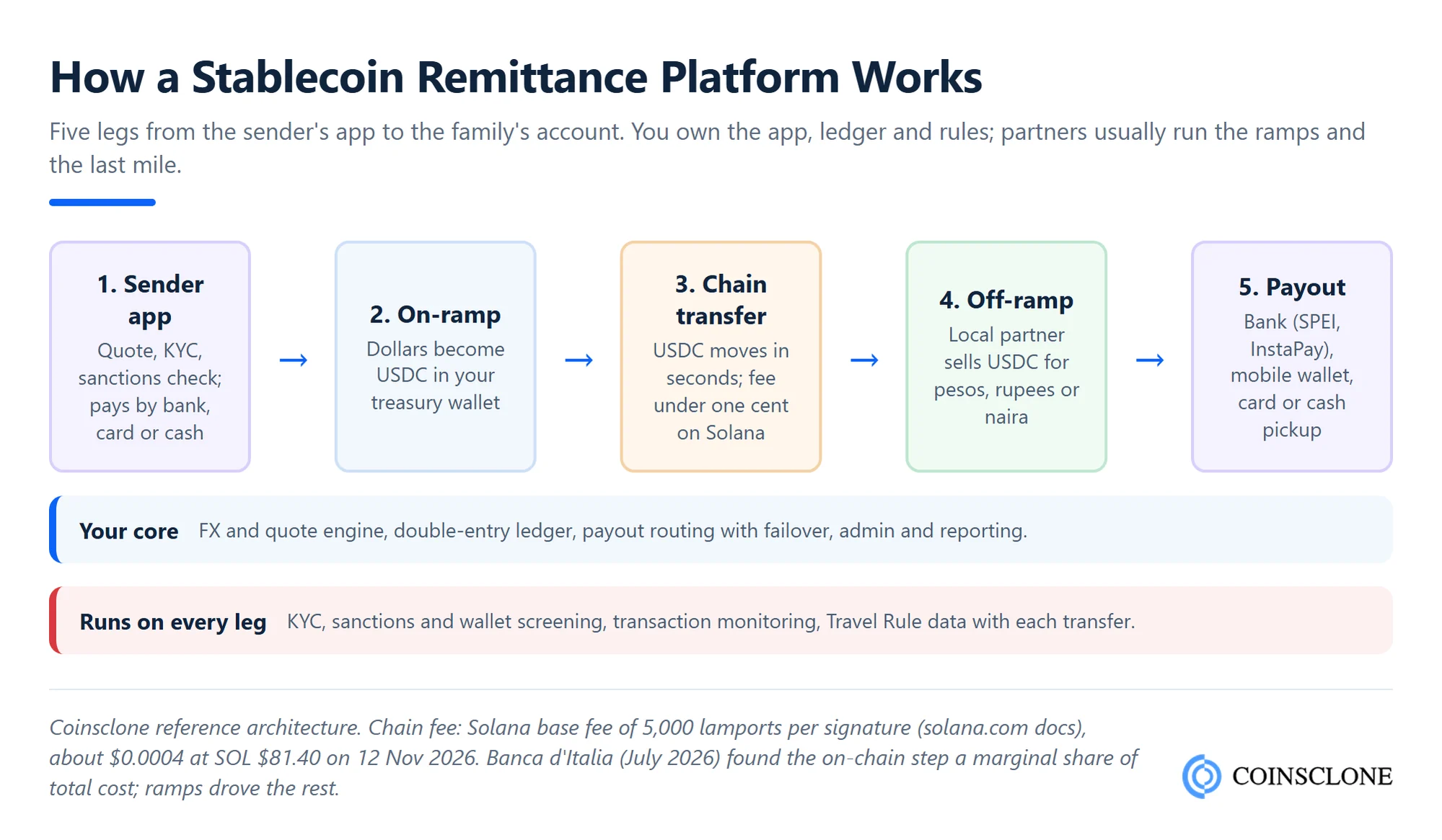
Every transfer runs through five legs. You own the app and the ledger. Partners usually run the ramps and the last mile.
- Pay-in: The sender funds the transfer by bank transfer, card or cash at an agent. You run KYC and sanctions checks first.
- On-ramp: The dollars become USDC or another stablecoin, through a ramp partner or your own treasury.
- Chain transfer: The coin moves to your wallet at the off-ramp partner. On Solana the base fee is 5,000 lamports per signature, well under one cent.
- Off-ramp: The partner sells the coin for local money at its order book or a quoted rate.
- Last-mile payout: The money lands in a bank account, a mobile wallet, a debit card or a cash pickup point.
There are two funding models. In a treasury model, you turn sender money into coins in a central wallet you control. The sender never sees crypto. In a wallet model, the sender holds a stablecoin balance in your app and sends from it. The treasury model is simpler to license and explain, so most firms start there.
Is a Stablecoin Remittance Really Cheaper? A $200 Worked Example
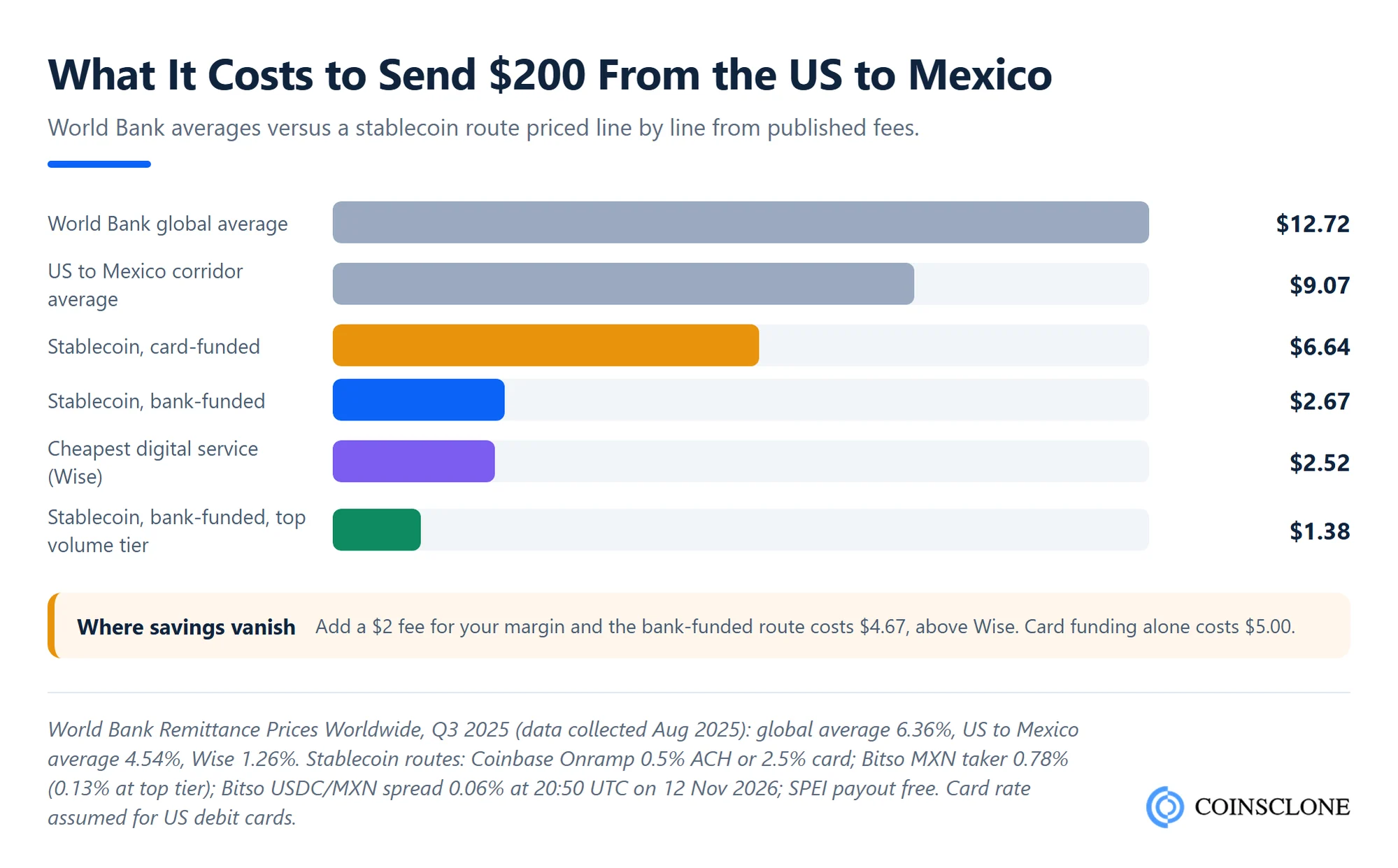
We priced a $200 transfer from the US to Mexico. Our yardstick is the World Bank’s Remittance Prices Worldwide report for Q3 2025. It was the latest on its site as of 13 November 2026. The global average to send $200 was 6.36%, or $12.72. From the US to Mexico, the average was 4.54%, or $9.07.
The coin route below uses each firm’s own published prices, checked on 12 and 13 November 2026.
| Cost line | Bank-funded route | Card-funded route | Source |
| On-ramp fee | $1.00 (0.5% ACH) | $5.00 (2.5% card) | Coinbase Onramp fee FAQ |
| Network fee (Solana) | under $0.01 | under $0.01 | Solana base fee at SOL $81.40 |
| Off-ramp trade fee | $1.55 (0.78% taker) | $1.52 (0.78% taker) | Bitso fee table, lowest volume tier |
| FX spread vs market | $0.12 (0.06%) | $0.12 (0.06%) | Bitso USDC/MXN book vs market rate |
| Payout fee (SPEI bank) | $0.00 | $0.00 | Bitso withdrawal fees |
| Total cost | $2.67 (1.34%) | $6.64 (3.32%) |
A few notes on the inputs. Coinbase lists 0.5% for ACH and 2.5% for credit cards, which it offers outside the US. Assumption: a US debit card costs about the same. The FX spread is measured, not guessed. At 20:50 UTC on 12 November 2026, Bitso’s best USDC/MXN bid was 18.586 pesos, with about 307,000 USDC behind it. The market rate was 18.597.
Where do the savings vanish?
The bank-funded route costs $2.67, far below the $9.07 average. But the cheapest services already compete. In the same World Bank corridor data, Wise sent $200 to Mexico for 1.26%, or $2.52. Three things erase the gap fast:
- Your margin: Add a $2 fee to earn money, and you charge $4.67, or 2.3%. That beats the average but not the best apps.
- Card funding: A 2.5% card fee alone costs $5.00, which is more than the whole bank-funded route.
- Cash funding: Since 1 January 2026, US senders who pay in cash or by money order owe a 1% federal tax. That is $2.00 on this transfer. Bank and US card funding are exempt.
Scale changes the math. At Bitso’s top published tier, above MXN 150 million a month, the taker fee falls to 0.13%. The same bank-funded transfer then costs about $1.38, or 0.69%. So a coin-based platform wins on volume, cheap funding and high-cost routes. Italy’s central bank found the same. USDC beat Wise in only three of seven corridors, and a card-funded send from the UAE cost 8.95%.
Which Corridor Should You Launch First?
Pick one corridor, prove the unit math, then add the next. Score each one on four things: how much money flows, how families like to get it, how deep the local off-ramp is, and how hard the rules are.
| Corridor | Annual inflow | Avg cost to send $200 (Q3 2025) | Volume | Payout options | Off-ramp liquidity | Rules (5 = easiest) | Total /20 |
| US to Mexico | $61.8B (2025) | 4.54% | 5 | 5 | 5 | 3 | 18 |
| US to Philippines | $40B (2024) | 4.52% | 4 | 5 | 4 | 3 | 16 |
| UAE to India | $129B (2024) | 3.72% | 5 | 4 | 2 | 1 | 12 |
| UK to Nigeria | $20.9B (2024) | 1.96% | 3 | 4 | 3 | 2 | 12 |
| US to Guatemala | $25.5B (2025) | 4.19% | 3 | 3 | 1 | 3 | 10 |
Inflows are for the receiving country. Mexico’s figure is from Banxico. India and the Philippines use World Bank estimates. Nigeria and Guatemala come from their central banks. Costs come from World Bank corridor pages, collected in August 2025. Scores are our judgment from these facts:
- US to Mexico: Payouts land over SPEI, Mexico’s instant bank network, and Bitso charges nothing to withdraw pesos by SPEI. The USDC/MXN book is deep.
- US to Philippines: Families get money by bank, phone wallet or cash pickup. Western Union picked the Philippines as one of its first two USDPT markets in May 2026.
- UAE to India: Huge volume, but India taxes crypto gains at 30% and holds back 1% tax on transfers. Crypto firms must register with FIU-IND. Money sent home is expected to come through banks and RBI-approved routes, so a crypto off-ramp is hard to run at scale.
- UK to Nigeria: The corridor is already cheap at 1.96%. That leaves little room to undercut, and crypto rules are still settling.
- US to Guatemala: Inflows grew 18.7% in 2025, but local off-ramps are thin. Bitso’s fee pages show peso and real books but no quetzal book.
For most US-based founders, Mexico or the Philippines is the safest first corridor.
What Licenses Does a Stablecoin Remittance Business Need?
You need cover on both sides. Using a stablecoin does not remove money transmission rules. It adds crypto rules on top.
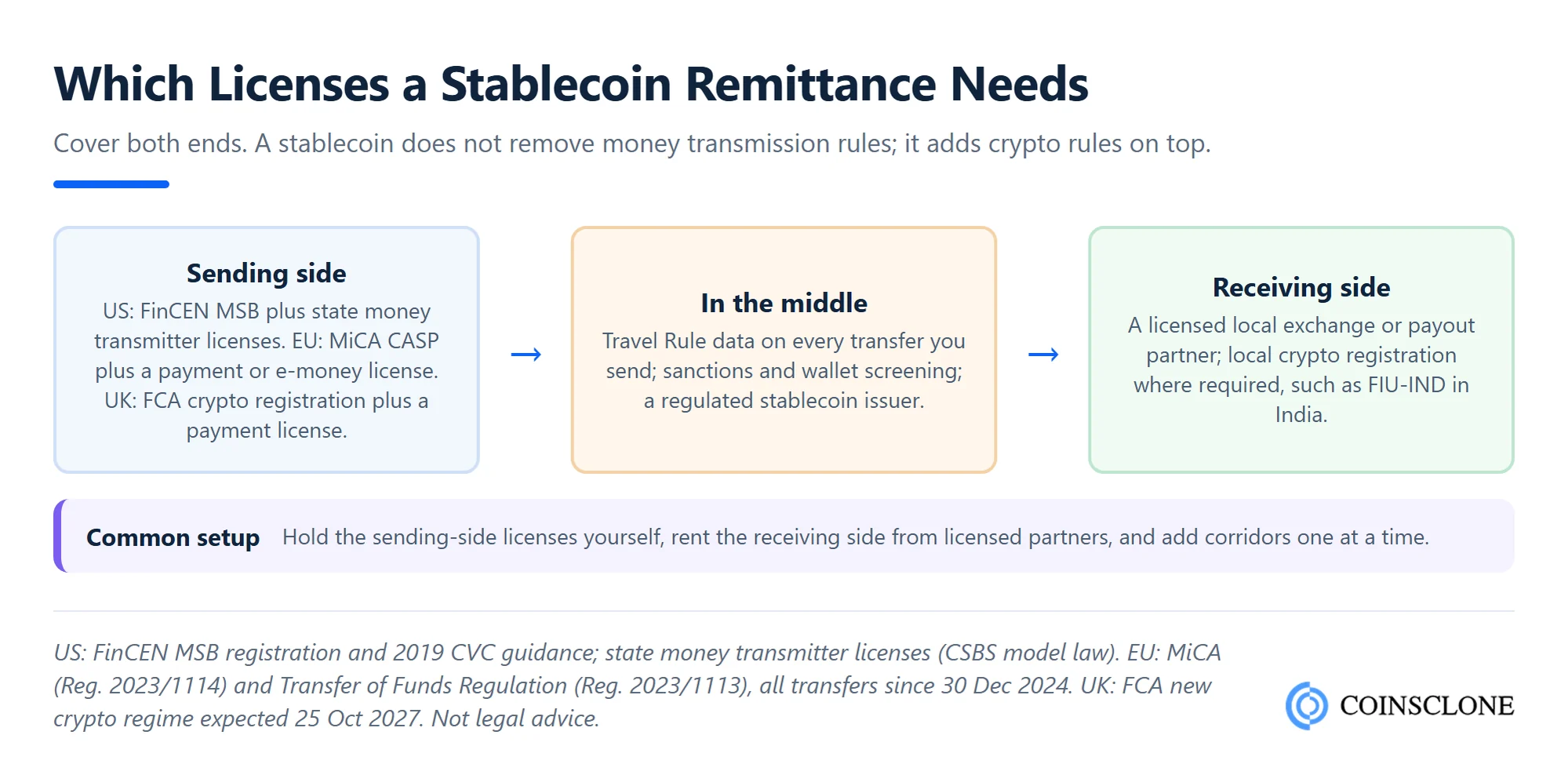
- United States: Register with FinCEN as a money services business. FinCEN’s 2019 guidance says firms that move crypto for others are money transmitters. You also need a money transmitter license in each state where you serve users. The CSBS model law aims to make those state rules match. The GENIUS Act of July 2025 covers coin issuers, not senders, so it does not replace these licenses.
- European Union: Crypto transfer and exchange services need a MiCA license as a crypto-asset service provider. Since 30 December 2024, the EU Travel Rule has covered each crypto transfer, however small. Fiat pay-ins and payouts need a payment or e-money license, or a partner that holds one.
- United Kingdom: Crypto firms register with the FCA under the money laundering rules today. The FCA says its new crypto regime is expected to start on 25 October 2027, and firms can apply now. Fiat legs need a payment license or a licensed partner.
- Receiving country: Most founders use a licensed local partner here, such as an exchange or payout firm. Few get licensed in each market.
Our crypto Travel Rule guide covers thresholds by country. Treat this section as a map, not legal advice, and budget for local counsel in every corridor.
What Tech Stack Does a Stablecoin Remittance Platform Need?
The stack has nine parts. Some you build, some you rent.
- Sender app: iOS, Android and web, with quotes, recipient lists, tracking and receipts.
- Identity and risk: KYC, sanctions screening on names and wallet addresses, transaction monitoring and case tools.
- Pay-in rails: ACH, instant bank payments, cards and agent cash, each with its own fees and fraud risk.
- Wallets: Treasury wallets with MPC keys and sign-off rules. Our crypto wallet development team builds these.
- Ramp connectors: APIs to one or more on-ramp and off-ramp partners. See how they compare in our on-ramp and off-ramp guide.
- FX and quote engine: Pulls live rates, adds your margin, and locks a quote for a short window.
- Ledger: A double-entry ledger ties each bank move to each on-chain transfer, so every cent adds up.
- Payout orchestration: Routes each transfer to the best partner, retries and fails over when one is down.
- Travel Rule and reports: Sends sender and receiver data with each transfer and flags odd activity for reports.
Which chain? Pick a chain your off-ramp partner supports for deposits. Bitso, for one, takes USDT on five chains with no deposit fee. Italy’s central bank used Ethereum, and the on-chain leg cost 0.25% to 0.40% of $200. Its Solana test cost 0.15%. Check each exchange’s withdrawal fee too, since it can cost more than the network fee.
How to Build a Stablecoin Remittance Platform in 7 Steps
- Pick your corridor and model: Choose one corridor and decide between the treasury and wallet models.
- Lock your license path: Decide what you hold yourself and what partners cover, and sign partner terms early.
- Choose the coin and chain: Match what your off-ramp partner and payout rails support.
- Design the ledger and FX engine: Model every fee, spread and float balance before you write the app.
- Integrate ramps and payouts: Connect at least two off-ramp or payout routes per corridor.
- Wire in compliance: KYC, sanctions screening, monitoring and Travel Rule messaging, with audit logs.
- Pilot with limits: Launch to a small group with low caps, reconcile daily, then raise limits.
How Much Does It Cost to Build a Stablecoin Remittance Platform?
No one publishes a solid price for a full platform. The best guides are its two core parts. Published 2026 agency cost guides put a basic crypto payment gateway at $20,000 to $60,000. A standard one runs $40,000 to $100,000, and an advanced one $100,000 to $300,000 or more. Crypto wallets run $15,000 to $90,000 for white label and $50,000 to $200,000 for custom builds.
What moves your number:
- Number of corridors: Each one adds ramp and payout links, FX rules and tests.
- Funding methods: Cards and cash agents add fraud tools, chargeback flows and tax handling.
- Custody choice: Renting wallets is fast; your own MPC custody costs more but cuts per-transfer fees.
- Compliance depth: Case tools, Travel Rule messages and reports are a large share of the work.
- Float: Not a build cost, but real money. Assumption: if partners settle the next day and you pay out $1 million a day, you need at least $1 million parked as float.
For timing, Coinsclone delivers a standard payment gateway in 6 to 9 weeks, or 10 to 14 weeks with settlement. A white label wallet takes 3 to 5 weeks, and a custom wallet 8 to 12 weeks. Licenses usually take longer than the build, so start them first.
What Can Go Wrong, and How Do You Control It?
| Failure mode | What happens | Control |
| Off-ramp liquidity gap | The partner cannot fill a large sale at a fair rate, often at weekends | Prefunded local float, size caps per transfer, a second off-ramp |
| Stablecoin depeg | The coin trades below $1 while you hold it | Short hold times, a price alarm from two sources, auto-pause, more than one issuer |
| Payout partner outage | Bank rails or the partner’s API go down | Failover routing, queued retries, live status shown to customers |
| Sanctions hit | A sender, receiver or wallet address matches a sanctions list | Screen all three before sending against the OFAC lists, hold and review |
| Issuer freeze | The issuer blocks an address that touched flagged funds | Wallet screening, your own clean wallets, known issuer policies |
| Wrong chain or address | Funds go to an address that cannot receive them | Whitelisted addresses, internal routing between your own wallets |
| Missing Travel Rule data | The other side rejects or freezes the transfer | Send only to known partners with IVMS101 data exchange |
| FX move on float | Local currency moves while money sits in float | Daily rebalancing, short quote windows, hedging at scale |
Depegs are rare but real. USDC lost its peg for about two days in March 2023 after Circle disclosed that $3.3 billion of its reserves sat at the failed Silicon Valley Bank. Payout rails pause too: Bitso posts planned SPEI maintenance windows on its status page.
Who Already Sends Money With Stablecoins?
The big money transfer firms are moving. Western Union launched its USDPT coin on Solana in May 2026. Anchorage Digital Bank issues it. Bolivia and the Philippines came first, with more than 40 countries planned for 2026. MoneyGram launched an app in Colombia in September 2025. It holds user balances in USDC on Stellar. Bitso now takes USDPT on Solana too.
For a new firm, that is both proof and pressure. The rails work, and the big firms will use them too. Your edge has to come from a corridor, a user group or a price point they serve poorly.
Launch a Stablecoin Remittance App Built for Fast, Low-Cost Payouts
Stablecoin remittance platform development, done right.
- Sender App: iOS, Android and web apps with live quotes, recipient lists and transfer tracking
- Treasury Wallets: MPC wallets with approval rules for USDC and USDT on Solana, Tron and more
- Ramp and Payout APIs: on-ramp, off-ramp and last-mile payout integrations with failover routing
- Compliance Layer: KYC, sanctions and wallet screening, Travel Rule messaging and a reconciled ledger
See a live demo of a stablecoin remittance flow from sender app to bank payout.
Book a Free Demo to plan your first corridor, partners and launch timeline.
How Coinsclone Helps You Build a Stablecoin Remittance Platform
Coinsclone builds the parts a remittance founder needs. That means sender apps, MPC wallets, ramp and payout links, the FX engine, the ledger and the checks layer. Coinsclone has built crypto products since 2018 and delivered 350+ platforms for 200+ clients across 20 industries. Start with our crypto payment gateway development service, or a white label crypto wallet if you want the wallet live first.
Frequently Asked Questions
How do stablecoin remittances work?
The sender pays in local money, which is turned into a stablecoin such as USDC. The coin moves on a blockchain to a partner in the receiving country. The partner sells it for local currency and pays the family by bank, mobile wallet or cash pickup.
Are stablecoin remittances cheaper than Wise?
Not always. Italy’s central bank found USDC cheaper than Wise in only three of seven corridors in its 2026 test. In our US to Mexico example, the bank-funded coin route cost $2.67 on $200. Wise cost $2.52 in World Bank data.
Which stablecoin is best for remittances?
Use the coin your off-ramp partners buy in size, which today is usually USDC or USDT. Check which chains each partner accepts for deposits. Low-fee chains such as Solana, Stellar or Tron keep the transfer leg cheap.
Do I need a license to run a stablecoin remittance business?
Yes. In the US you need FinCEN registration as a money services business and state money transmitter licenses. In the EU you need a MiCA license plus a payment license or partner for fiat legs. Receiving countries have their own rules.
Can I use stablecoins to send money to India?
You can, but it is hard to do at scale. India taxes crypto gains at 30%, holds back 1% tax on crypto transfers, and makes crypto firms register with FIU-IND. Money sent home is expected to move through banks and RBI-approved routes.
How long does it take to build a stablecoin remittance platform?
The software core can take a few months. At Coinsclone, a standard payment gateway takes 6 to 9 weeks, or 10 to 14 weeks with settlement. Licenses often take longer, so most teams start with licensed partners.
How do stablecoin remittance companies make money?
They charge a transfer fee, earn a margin on the FX rate, or both. Some also earn from float and from card or wallet products. In our example, the bank-funded route leaves room for a fee and still beats the $9.07 average.