

On 27 May 2026, Kraken switched on Kraken Prop inside Kraken Pro. Traders pay an evaluation fee, pass a profit target without breaking loss limits, and then trade a funded wallet of up to $200,000 while keeping up to 90% of the profit. A day later, The Block reported that Hypernova raised $3 million to run a prop firm on Hyperliquid with payouts settled by smart contracts.
So the funded-trader model has moved into crypto, and crypto has become its payout rail. In fact, Finance Magnates tracked $115.1 million in crypto payouts from the 10 largest prop firms in Q1 2026 alone. If you want to know how to start a crypto prop firm, this guide gives you the full picture: how the challenge works, how the money flows, what platform to run, what the risk engine must do, what it costs and where the licence lines sit.
In this guide:
- Revenue comes from evaluation fees first: on Kraken Prop, a $100,000 Starter evaluation costs $800, with a 10% profit target, a 3% daily loss limit and a 6% maximum drawdown.
- The pass rate is the business: in our worked month, a pass rate of 10% leaves $32,400 before team and ads, while 15% turns the same month into a loss.
- Platform costs are modest next to payouts: a hosted white label runs about $5,000 to $15,000 a month, and a custom build costs $200,000 to $500,000.
- No US, EU or UK licence is written for prop firms: but the CFTC has sued one before, the FCA bans retail crypto derivatives, and MiCA’s grace period ended on 1 July 2026.
- Plan 90 to 180 days and a real payout reserve: Hypernova earmarked $1 million of its $3 million round for a payout reserve.
How to Start a Crypto Prop Firm: How the Business Works
A crypto prop firm sells traders a test. The trader pays a fee, trades a practice account on live market prices, and tries to hit a profit target without breaking loss rules. If they pass, they get a “funded” account and a share of the profits they make on it, often 80% to 90%.
Here is the part most guides skip. In many retail prop firms, the funded account is also simulated. HyroTrader, for example, states that all of its accounts are demo accounts on real Bybit and BloFin data, and that there is “no real-capital stage at any point”. The payout is a contract: you promise to pay a share of simulated profit.
That is why autocomplete keeps asking “how do prop firms make money on simulated accounts”. The answer is simple:
- Fees come in from everyone. Most traders fail the evaluation, and their fees fund the firm.
- Payouts go out to a few. Only funded traders who stay inside the rules ever get paid.
- Live trading is optional. Some firms copy their best traders to a real venue (called A-booking) so those traders’ real profits help pay their payouts. Hypernova told The Block it decides this case by case.
So to start a crypto prop firm, you build four things: a challenge with fair rules, a platform that runs it, a risk engine that enforces it, and a payout system that people trust.
The Challenge Model: Evaluation Rules That Work in Crypto
The challenge is your product. Its rules decide your pass rate, and your pass rate decides whether you make money.
Here is how two live crypto firms set their rules, checked on 16 October 2026:
| Rule | Kraken Prop, $100k Starter | Kraken Prop, $100k Advanced | HyroTrader Two-Step |
| Fee | $800 | $330 | From $59 (smallest size) |
| Profit target | 10% | 9% | 10%, then 5% |
| Max daily loss | 3% | 3% | 5% |
| Max drawdown | 6% | 3% | 10% |
| Profit split | Up to 90% | Up to 90% | 80%, rising to 90% |
| Payout | To the Kraken account, typically within 24 hours | Same | USDT or USDC within 24 hours |
Sources: Kraken Prop rules page and HyroTrader’s site, both read 16 October 2026.
Notice the trade-off. Kraken’s cheaper Advanced plan allows only a 3% drawdown, so the low fee buys a much harder test. In other words, price and difficulty move together.
Five crypto-specific rule choices
Forex prop rules do not port cleanly to crypto. Plan for these:
- Markets never close. Crypto trades 24/7, so set the daily loss reset to a fixed UTC time and say so plainly.
- Leverage caps. Kraken Prop allows up to 5x. Higher leverage lifts pass rates fast, so start low.
- Funding rates. Perpetual futures charge or pay funding every few hours. Decide if your simulated accounts apply it, or traders will farm it.
- Static or trailing drawdown. A trailing limit follows the account’s peak and is harder to pass. Whichever you pick, show the live floor on the dashboard.
- Capital caps. Kraken caps each trader at $200,000 across all funded wallets. Without a cap, one trader can buy ten accounts and multiply a lucky streak by ten.
Payout Economics: A Worked Example
Now let’s put numbers on it. Take one month at a new firm that sells 1,000 evaluations at an average of $150. Assume 10% pass, and 40% of funded traders reach a payout. Use the $1,865 average crypto payout that Finance Magnates tracked in Q1 2026.
| Line | At 10% pass | At 15% pass |
| Challenge fees in | $150,000 | $150,000 |
| Funded traders | 100 | 150 |
| Traders paid (40%) | 40 | 60 |
| Payouts at $1,865 each | -$74,600 | -$111,900 |
| Fees refunded on first payout | -$6,000 | -$9,000 |
| Affiliate share (15%) | -$22,500 | -$22,500 |
| Platform licence | -$10,000 | -$10,000 |
| KYC, data, hosting, 1% processing | -$4,500 | -$4,500 |
| Left before team and ads | +$32,400 | -$7,900 |
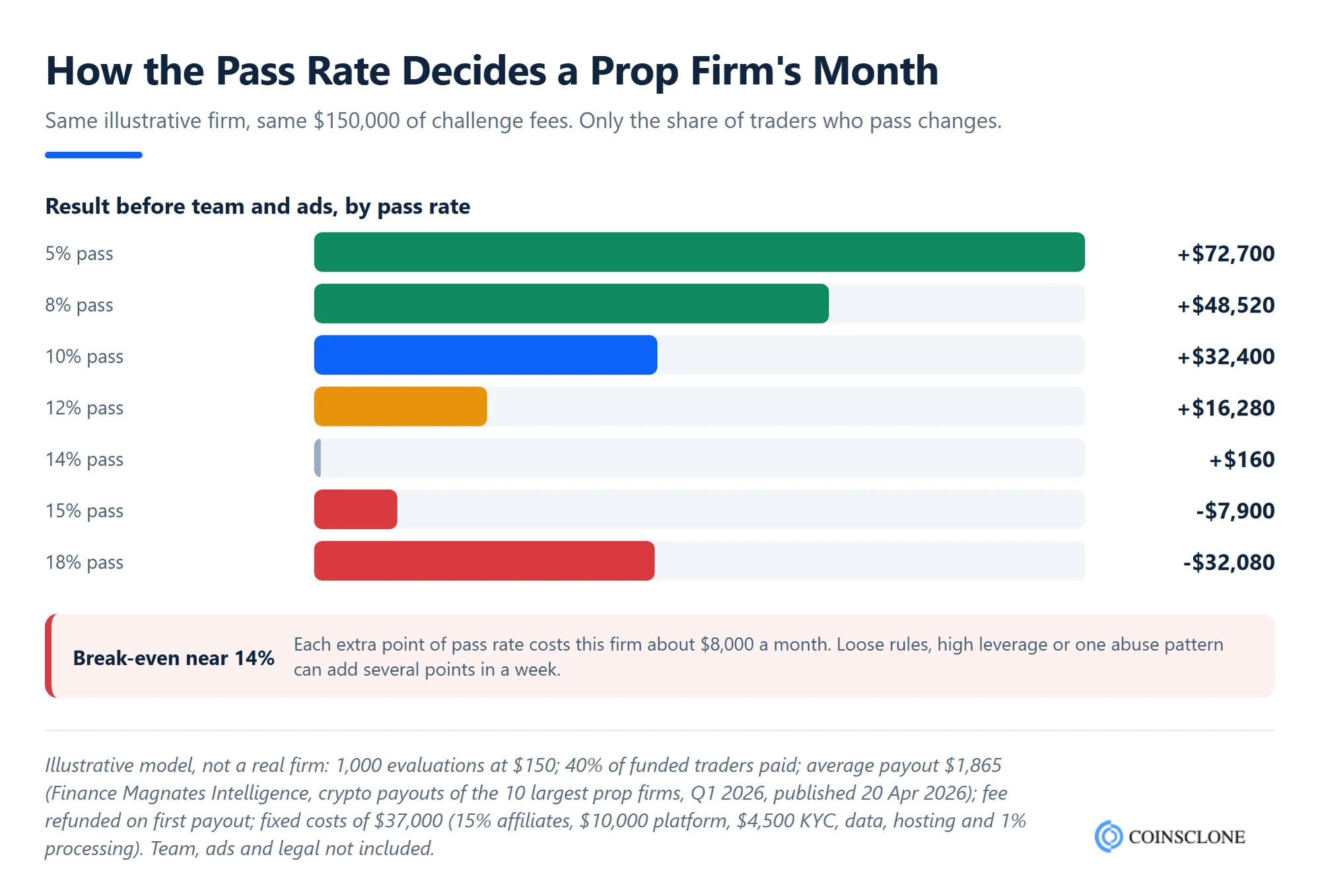
Three lessons follow:
- Payouts are the biggest cost, not the software. The platform is under 7% of revenue here.
- Break-even sits near a 14% pass rate. Each extra point costs this firm about $8,000 a month.
- Growth hides problems. New fees pay old payouts. When sales slow, the gap shows up as payout delays. Finance Magnates estimates that 80 to 100 prop firms closed between January 2024 and Q1 2026.
Three Ways to Run the Trading Side
Before you pick a vendor, pick a model. The choice shapes your costs, your risk and your legal position.
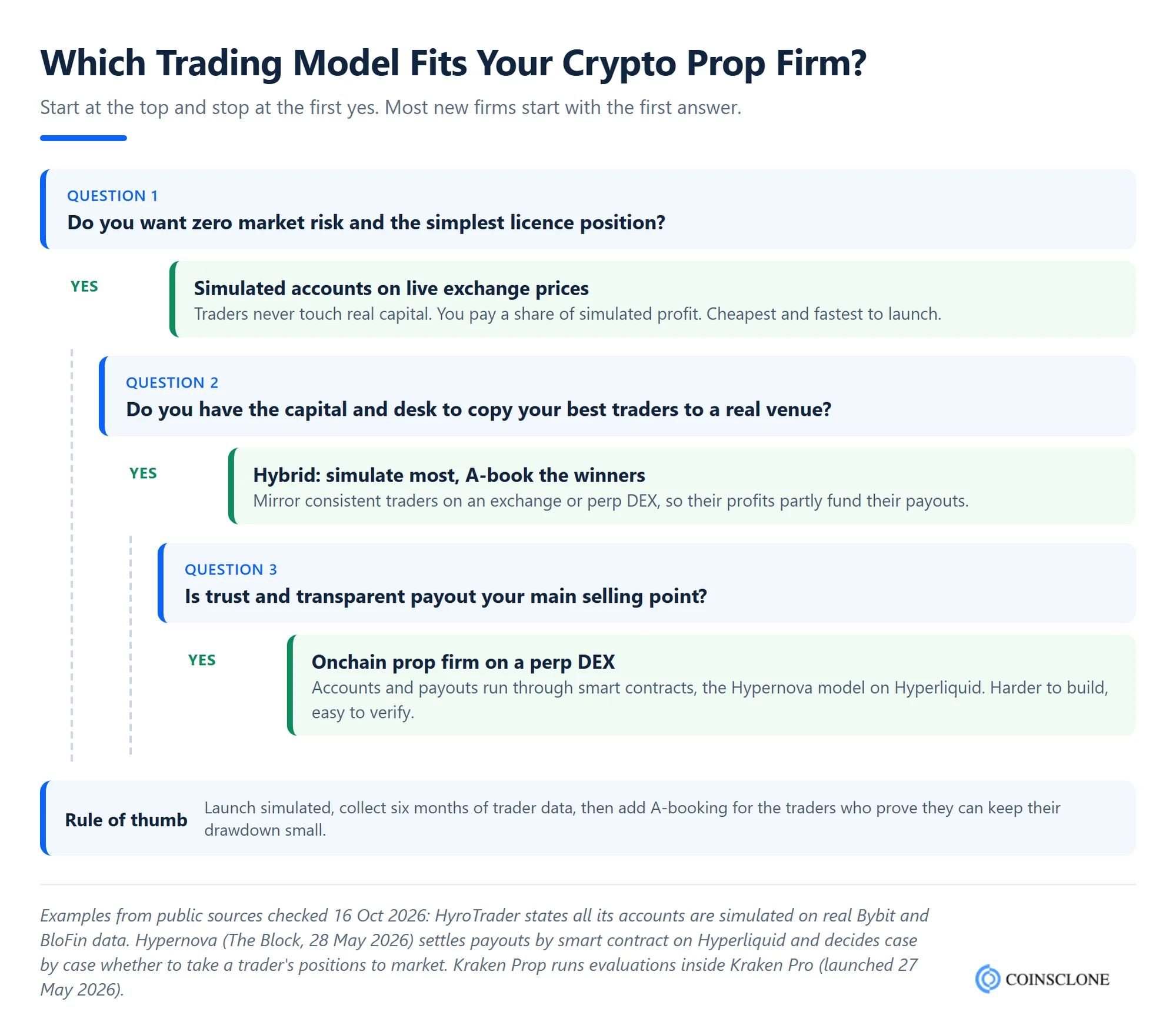
| Model | How it works | Your market risk | Best for |
| Simulated (B-book) | All accounts are demo accounts on live exchange prices | None, only payout risk | First launch, small team |
| Hybrid | Most accounts simulated, proven winners copied to a real exchange | Some, on copied trades | Firms with a trading desk and capital |
| Onchain | Accounts and payouts run through smart contracts on a perp DEX | Depends on design | Firms selling trust and transparency |
Most founders should launch simulated, gather six months of trader data, and only then A-book the traders who keep their drawdown small. The onchain route is newer. Hypernova’s closed alpha, which began on 1 May 2026, onboarded 250 traders, funded more than 20 and paid out over $30,000. If that route appeals, our Hyperliquid clone script page explains the perp DEX side.
The Platform Stack: White Label vs Custom
A crypto prop firm platform has seven parts. The trader sees four. The other three decide whether you survive.
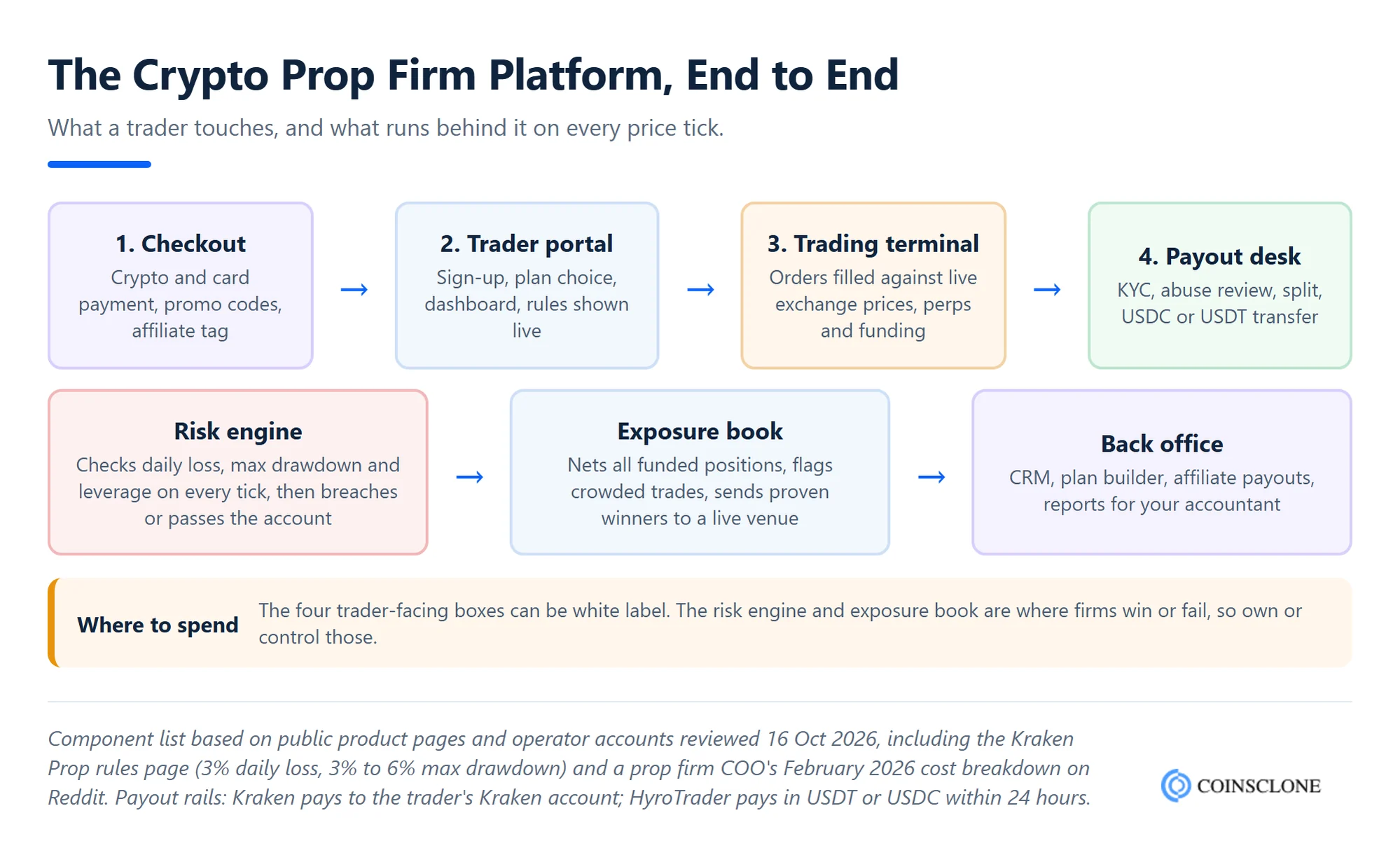
So should you rent or build? Here is how the options compare:
| Option | Typical cost | Launch time | Watch out for |
| Hosted white label | $3,000 to $50,000 setup, then $5,000 to $15,000 a month | Weeks | Shared rules engine, little control, vendor can cut you off |
| White label exchange core plus prop layer | $15,000 to $60,000 for the exchange core, plus the prop modules | Coinsclone quotes 8 to 12 weeks for a white label exchange with futures and perps | You run a real venue, so the licence questions grow |
| Custom platform | $200,000 to $500,000 | 6 months or more | Cost and time, but you own the risk engine and data |
Ranges from published 2026 prop-tech and agency cost guides and a prop firm COO’s February 2026 breakdown on Reddit. Checked October 2026.
The vendor risk is real. In February 2024, MetaQuotes cut off MetaTrader access for prop firms serving US clients through grey-label brokers, and several firms had to stop trading overnight. Therefore, ask any vendor what happens to your traders if they drop you.
Founders also keep asking Reddit which white label to choose. In one April 2026 thread, the top reply said the platform matters less than payouts, risk controls and support, and that weak rules fail “once traders start winning”. In short, test execution under load and the flexibility of the rules engine, not the demo screens.
The Risk Engine: What It Must Do
The risk engine is where crypto prop firms win or fail. A good one does six jobs:
- Enforce rules in real time. Check daily loss, drawdown, leverage and position size on every tick, not once a minute. Crypto prices can jump in seconds.
- Breach fairly. Use the same price feed for the trader and the engine, and log every breach with the price that caused it. Disputes are cheap when the log is clear.
- Catch abuse. Flag traders who hedge across two accounts, copy a signal group trade for trade, trade only at price spikes, or exploit feed delays. Decide early if you allow bots; if you do, our trading bot development guide shows what they can do.
- Watch total exposure. If 300 funded traders are all long the same coin, one rally can drain your reserve. The engine should net positions and alert you.
- Route winners. Mark the traders worth copying to a live venue, based on drawdown and consistency, not just profit.
- Gate payouts. Run KYC, sanctions checks and a trade review before money moves.
The prop firm COO who posted on Reddit in February 2026 said their firm judges traders on max drawdown and daily drawdown, not on fancy ratios. Build your engine around the same few numbers. If you also plan to let retail users follow your best funded traders, a copy trading module can sit on the same data.
Launch Your Crypto Prop Firm on a Platform You Control
Crypto Prop Trading Platform Development — done right.
- Challenge Engine: Build one-step and two-step plans with your own targets, loss limits and splits.
- Risk Controls: Check daily loss, drawdown and leverage on every price tick.
- Trading Core: Perpetuals and spot on live exchange prices, with funding and leverage caps.
- Your Brand: White label or custom, with your own trader portal and admin panel.
Get a free branded demo before you commit a single cent.
Book a Free Demo to see the trading core and risk controls in action.
Licences and Grey Areas by Market
No major market has a licence written for retail prop firms. That does not make them unregulated. It means the rules that apply depend on what you actually do. Here is the picture as of October 2026:
| Market | What applies | Recent action |
| United States | The CFTC oversees leveraged retail commodity trading. Many prop firms cut US clients after 2024. | The CFTC’s case against My Forex Funds’ parent was dismissed with prejudice in May 2025, with fees awarded against the agency. On 5 October 2026 the CFTC proposed Regulation CTX and CAM for leveraged retail crypto. |
| European Union | MiCA covers crypto services. Crypto derivatives fall under MiFID II. | MiCA’s transition for existing firms ended on 1 July 2026 at the latest. |
| United Kingdom | Retail crypto derivatives stay banned. Crypto promotions must follow FCA rules. | The FCA lifted its crypto ETN ban but kept the derivatives ban. Its new crypto regime takes applications from 30 September 2026 to 28 February 2027 and is expected to start on 25 October 2027. |
| India | Crypto service providers serving Indian users must register with FIU-IND. Residents may trade forex only through authorised dealers. | Autocomplete shows “are prop firms legal in India” as a top question. Get local advice before you market there. |
The grey area is the same everywhere. A firm that sells a simulated test and pays a contractual reward argues it is not a broker. Three things weaken that argument fast:
- Holding trader crypto beyond the fee, which can look like custody.
- Calling the account “real capital” in ads when it is simulated.
- Executing trades for traders on a live venue in their name.
Scrutiny of onchain venues is rising too. On 29 September 2026, House Oversight Chairman James Comer wrote to Hyperliquid, Crypto.com and PredictIt about how they verify users. So even an onchain prop firm needs KYC at payout. Write your terms, ads and payout flow with a lawyer before you take the first fee.
What It Costs to Start a Crypto Prop Firm
Software is only one line. Here is a full launch budget, using published 2026 figures:
| Cost item | Typical range |
| Platform (hosted white label) | $5,000 to $15,000 a month, plus setup |
| Platform (custom build) | $200,000 to $500,000 |
| CRM and trader portal | $5,000 to $25,000 one-time |
| Crypto payment setup | About $1,500, then 0.4% to 1.5% per payment |
| Card processing | 4% to 9% per payment, if you can get it |
| Liquidity or data provider setup | $5,000 to $30,000 |
| Legal structure | $5,000 to $40,000 offshore; $30,000 to $100,000 for EU-facing work |
| Payout reserve | Size it to your worst month; Hypernova set aside $1 million |
Ranges from published 2026 prop-tech and agency cost guides and a prop firm COO’s February 2026 breakdown on Reddit. Checked October 2026.
In total, the COO priced a “barebones” launch at $70,000 to $250,000. A 2026 operator playbook puts starting capital at $300,000 to $700,000 once you fund a real reserve. If you also want your own trading venue under the brand, see our white label crypto exchange cost guide.
Step-by-Step: Launching in 90 to 180 Days
Here is a practical order of work. Most firms take 90 to 180 days from idea to first paying trader.
- Weeks 1 to 3, model and markets. Pick simulated, hybrid or onchain. Choose the countries you will serve and the ones you will block.
- Weeks 2 to 6, legal setup. Form the company, write the terms, refund policy and risk warnings, and set KYC rules for payouts.
- Weeks 3 to 6, rules and pricing. Design two or three plans. Model the pass rate, payout rate and margin as in the table above, then stress-test at a higher pass rate.
- Weeks 4 to 14, platform build. Set up white label or custom, connect the price feed, and configure the risk engine and payout desk.
- Weeks 10 to 14, payments. Add at least two payment providers, so one ban does not stop sales.
- Weeks 12 to 16, closed beta. Invite 100 to 300 traders, like Hypernova’s alpha. Watch real pass rates and abuse patterns.
- Weeks 16 to 26, public launch. Fund the reserve, launch affiliates, and publish payout proof.
Mistakes That Sink New Prop Firms
The threads and the closures point to the same traps:
- Pricing to win, not to last. Cheap tests with loose rules lift pass rates past what fees can pay.
- No reserve. If payouts rely on next month’s sales, a slow month becomes a payout delay.
- One vendor, one processor. Lose either and you stop overnight, as the 2024 MetaTrader cut-off showed.
- Vague rules. Unclear drawdown rules cause disputes, and disputes kill reviews.
How to Choose a Platform Partner
Start with the risk engine, not the dashboard. Ask any partner to show you a live breach, a payout review and an exposure report. Then check who owns the code and the trader data if you part ways.
Before a scoping call, prepare:
- Your model: simulated, hybrid or onchain.
- Your plans: account sizes, fees, targets, loss limits and split.
- Your markets: where you will sell, and where you will block.
- Your payout rails: which stablecoins and chains, and your KYC provider.
- Your budget and date: a monthly cap for hosted, or a build budget for custom.
Coinsclone has been building trading platforms since 2018, with 350+ platforms delivered for 200+ clients across 20 industries. For a prop firm, we build the trading core and risk controls on our crypto leverage trading platform stack, branded and set to your rules.
Frequently Asked Questions
How much does it cost to start a crypto prop firm?
A lean launch on a hosted white label platform costs roughly $70,000 to $250,000, per one prop firm COO’s 2026 breakdown. A custom platform alone costs $200,000 to $500,000. On top of that you need a payout reserve sized to your worst month, so many operator guides put total starting capital at $300,000 to $700,000.
How do prop firms make money on simulated accounts?
They make money from evaluation fees. Most traders fail the test, and those fees pay the few traders who pass and stay inside the rules. Some firms also copy their best traders to a live venue, so those traders’ real profits help fund their payouts.
Are crypto prop firms regulated?
No major market has a licence written for retail prop firms. However, rules on derivatives, custody, promotions and anti-money laundering can still apply, depending on what the firm does. Kraken’s own legal notice calls Kraken Prop an unregulated service, per TradeInformer’s launch report.
Is starting a prop firm profitable?
It can be, but margins are thin and depend on the pass rate. In our worked example, a 10% pass rate left $32,400 from $150,000 of monthly fees before team and ads, while a 15% pass rate made a loss. Finance Magnates estimates 80 to 100 prop firms closed between January 2024 and Q1 2026.
Can a crypto prop firm accept US traders?
Many prop firms block US traders because the CFTC oversees leveraged retail commodity trading. The CFTC sued My Forex Funds in 2023, and although the case was dismissed in May 2025, the risk of a case is costly in itself. Take US legal advice before you open to US residents.
Are prop firms legal in India?
India has no law written for prop firms. Crypto service providers serving Indian users must register with FIU-IND, and residents may trade forex only through authorised dealers, which affects forex-style challenges. Get advice from an Indian lawyer before you market to Indian traders.
What is a white label prop firm platform?
It is a ready-made prop firm system you rent and brand as your own. It usually includes checkout, a trader portal, a trading terminal, a rules engine and a back office, for a setup fee plus about $5,000 to $15,000 a month. The trade-off is less control over the risk engine and dependence on the vendor.
How do crypto prop firm payouts work?
After a funded trader makes a profit, they request a payout. The firm checks the trades, runs KYC, applies the profit split, and sends the money, often in USDT or USDC. HyroTrader and Kraken Prop both say payouts typically arrive within 24 hours.