
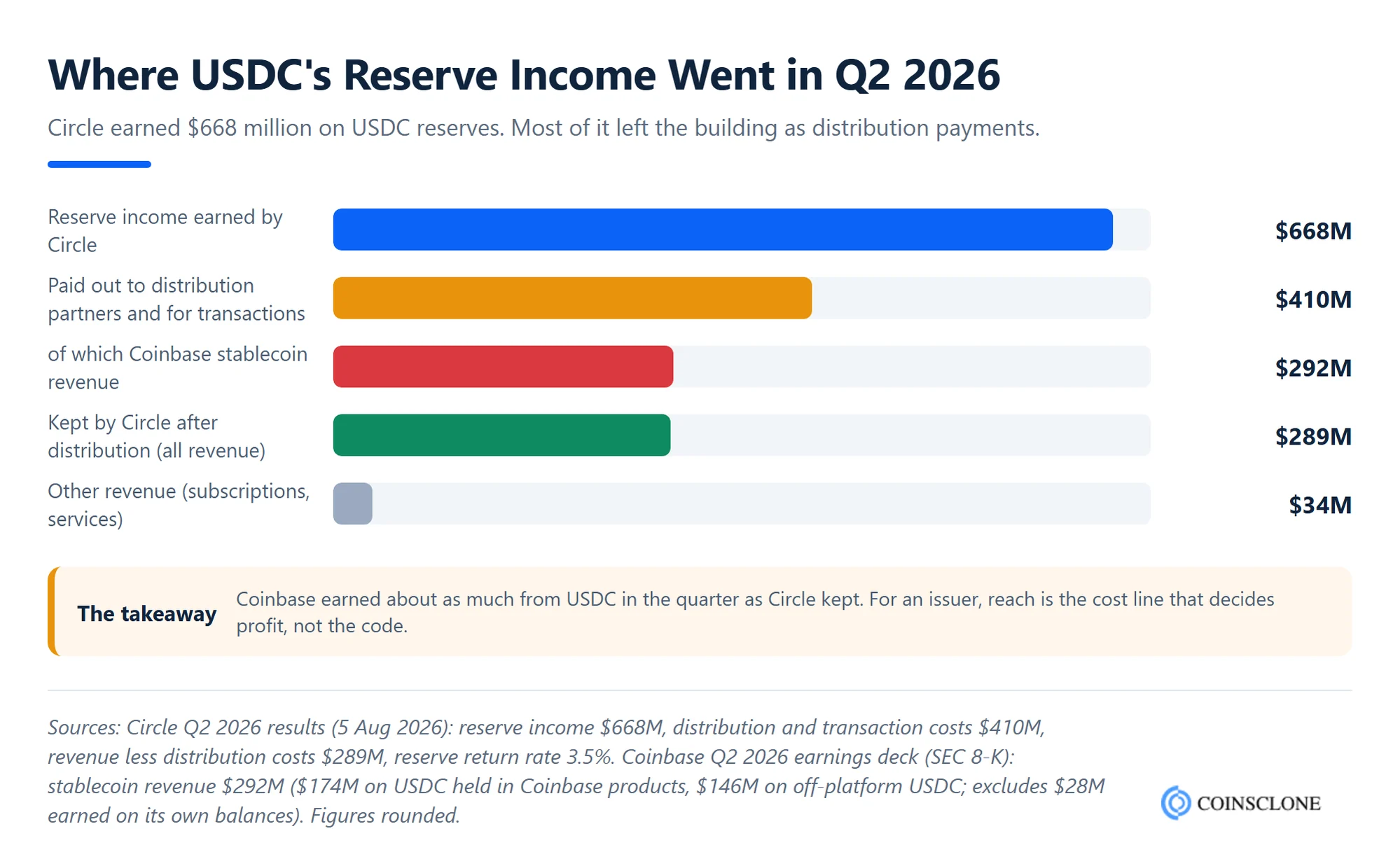
In the second quarter of 2026, Circle earned $668 million of interest on the reserves behind USDC. It then paid out $410 million in distribution and transaction costs, per its Q2 2026 results. Coinbase alone booked $292 million of stablecoin revenue in the same quarter, about as much as Circle kept.
That one quarter answers most of the question: how do stablecoin issuers make money? They earn interest on the cash and T-bills that back each coin, and they keep what is left after paying the apps and exchanges that hold their coins. This guide shows the money flow with the latest Circle and Tether figures, a worked example at today’s T-bill rates, and the GENIUS Act rules on sharing yield.
In this guide:
- Reserve yield is the business. About 95% of Circle’s Q2 2026 revenue was reserve income. Tether made about $1.5 billion of net operating profit, mostly from T-bills and repo.
- Distribution is the biggest cost. Coinbase earns all the reserve income on USDC held in its products, plus about half of the rest. The deal renewed on the same terms in August 2026.
- Rates set the ceiling. The 13-week T-bill yielded 4.20% on 15 October 2026. Each 1 point drop cuts about $10 million a year of income per $1 billion of coins.
- Issuers cannot pay holders. The GENIUS Act bans issuer yield, and an OCC draft would presume a breach when an affiliate pays it. Unrelated exchanges can still pay rewards.
- A new $1 billion coin makes about $32 million a year selling direct, or about $8 million with a Coinbase-style partner deal.
How Do Stablecoin Issuers Make Money? The Short Answer
A fiat-backed stablecoin issuer runs a simple loop. A customer sends $1. The issuer mints 1 coin and puts the $1 into safe, short-term assets. Those assets pay interest. The holder gets no interest, so the issuer keeps it.
People on Reddit often ask how that works if the coin is backed 1:1. Is it fractional reserve banking? No. A bank lends out most of your deposit, while a licensed issuer keeps the full $1 in reserve. It just holds that $1 as T-bills, which pay interest while they sit there. That interest is the profit.
Here are the main revenue streams, ranked by how much they matter today:
| Revenue stream | How it works | Who relies on it |
| Reserve yield | Interest on T-bills, repo, deposits and money funds that back the coins | Every fiat-backed issuer; about 95% of Circle’s revenue |
| Mint and redeem fees | A small fee when large clients buy or cash out coins | Tether charges 0.1% each way |
| Services and subscriptions | Payment networks, APIs, wallets and tools sold to businesses | Circle’s “other revenue”, $34 million in Q2 2026 |
| Network and token income | Fees on an issuer-owned chain or sales of a chain token | Circle’s Arc, live since 16 September 2026 |
| Issuing for others | Running the coin, reserves and reports for a brand that wants its own coin | Paxos, Anchorage and other regulated issuers |
| Stability fees | Interest paid by borrowers who lock crypto to mint coins | Crypto-backed coins such as DAI |
For most issuers, the first row is the business and the rest is side income.
Reserve Yield: The Engine Behind Every Fiat-Backed Stablecoin
Under the GENIUS Act, US payment stablecoins must be backed at least 1:1. Reserves can only sit in safe, liquid assets:
- Cash and deposits: coins and notes, Federal Reserve balances and insured bank deposits.
- Short T-bills: Treasury bills with 93 days or less left to run.
- Repo: overnight loans to large dealers, backed by US Treasury bonds.
- Government money funds: funds that hold only the assets above. Tokenized forms of these count too, which is why tokenized treasuries now matter to issuers.
So the yield an issuer can earn is close to the short T-bill rate, minus whatever it holds as plain cash.
What reserves earn right now
The US Treasury’s daily bill rates show the 13-week bill at 4.20% (coupon equivalent) on 15 October 2026. That is up from about 3.71% on 1 June 2026.
Circle’s own reserve return rate was 3.5% in Q2 2026, down 66 basis points from a year earlier. It sits a little below the bill rate, partly because some of the reserve is cash kept for same-day redemptions.
Why rates matter so much
Reserve income is roughly coins outstanding x yield, so an issuer has two levers: supply and rates. Circle’s Q2 2026 results show both levers at once: average USDC grew 25% year over year to $76.5 billion, but the lower rate ate most of that gain, and reserve income rose only 5%.
For a new issuer, the rule of thumb is simple. Every 1 point change in yields moves income by about $10 million a year for each $1 billion of coins.
Circle vs Tether: What the Two Biggest Issuers Earn
USDT and USDC together hold most of the market. DefiLlama showed about $183.5 billion of USDT and $72.7 billion of USDC on 16 October 2026, out of roughly $306 billion in dollar stablecoins. Their latest reports show two very different models.
| Q2 2026 | Circle (USDC) | Tether (USDT) |
| Coins outstanding, end of June | $73.3 billion | about $184.6 billion |
| Reserve income or profit | $668 million reserve income | about $1.5 billion net operating profit |
| Paid to partners | $410 million distribution and transaction costs | No large public revenue-share deal |
| Kept after distribution | $289 million (41% margin, all revenue) | Most of the reserve yield |
| Fees | Not broken out as a revenue line | 0.1% on buys and redemptions, $100,000 minimum |
| Other bets | Arc chain, payments network, services | Gold, bitcoin and other investments |
| Report | Public company results, 5 August 2026 | BDO attestation, 31 July 2026 |
Circle: a public company that shares most of its income
Circle’s net income was $48 million in Q2 2026. In August it raised its 2026 target for other revenue to $310 million to $330 million. That target counts early sales of its ARC token. Circle is trying to earn more from its chain and less from rates alone.
Tether: fewer partners, bigger margin, more risk
Tether pays no big partner share and earns a fee on every large buy and redemption. Its published fees are 0.1% each way, with a $1,000 minimum on redemptions and a $100,000 minimum order.
Its Q2 2026 attestation showed about $1.5 billion of net operating profit. However, that figure leaves out price swings on its bitcoin and gold. The Block reported a negative $3.2 billion result for the first half once those swings are included. Tether’s buffer above its liabilities fell from $8.23 billion to $4.11 billion.
The lesson: reserve yield is steady, but what an issuer does with its own profit can wipe it out.
Distribution Deals: Why Coinbase Earns as Much From USDC as Circle
A stablecoin only earns if people hold it, and people hold coins inside exchanges, wallets and apps. Those platforms ask for a share of the yield, and the share can be large.
How the Circle and Coinbase split works
The BIS, the central bank for central banks, sets out the deal in a recent bulletin in layers:
- Payment base: reserve income, minus costs such as fund management fees. Circle keeps a small issuer amount.
- Layer one: Circle and Coinbase each get the income on the USDC held in their own products.
- Layer two: after payments to other approved partners, Coinbase gets 50% of what is left.
Coinbase’s Q2 2026 earnings deck puts numbers on it. Coinbase earned $174 million on an average $20 billion of USDC held in its products. It earned another $146 million on $57 billion held elsewhere, which comes from the layer-two split. The deal renewed on the same terms for three more years in August 2026.
Newer models give even more away
Newer issuers share even more to win reach:
- Global Dollar (USDG): issued by Paxos. Partners can get up to 100% of the reserve rewards on USDG held on their platforms.
- Open USD: went live in late September 2026 on Ethereum, Solana, Base and Tempo. Partners earn rewards based on the supply they bring in, and minting and burning are free, per CoinDesk. Coinbase, Mastercard, Shopify, Stripe and Visa are founding partners with over $1 billion of liquidity pledged.
- Bank group coin: 21 firms, among them Bank of America, Citi and Goldman Sachs, plan a joint dollar stablecoin for the first half of 2027. Banks own the client base, so they need fewer partners.
Distribution is the cost line that decides profit. Exchanges know it, which is one reason crypto exchanges make money from stablecoin balances as well as trading.
Worked Example: What a New $1 Billion Stablecoin Earns
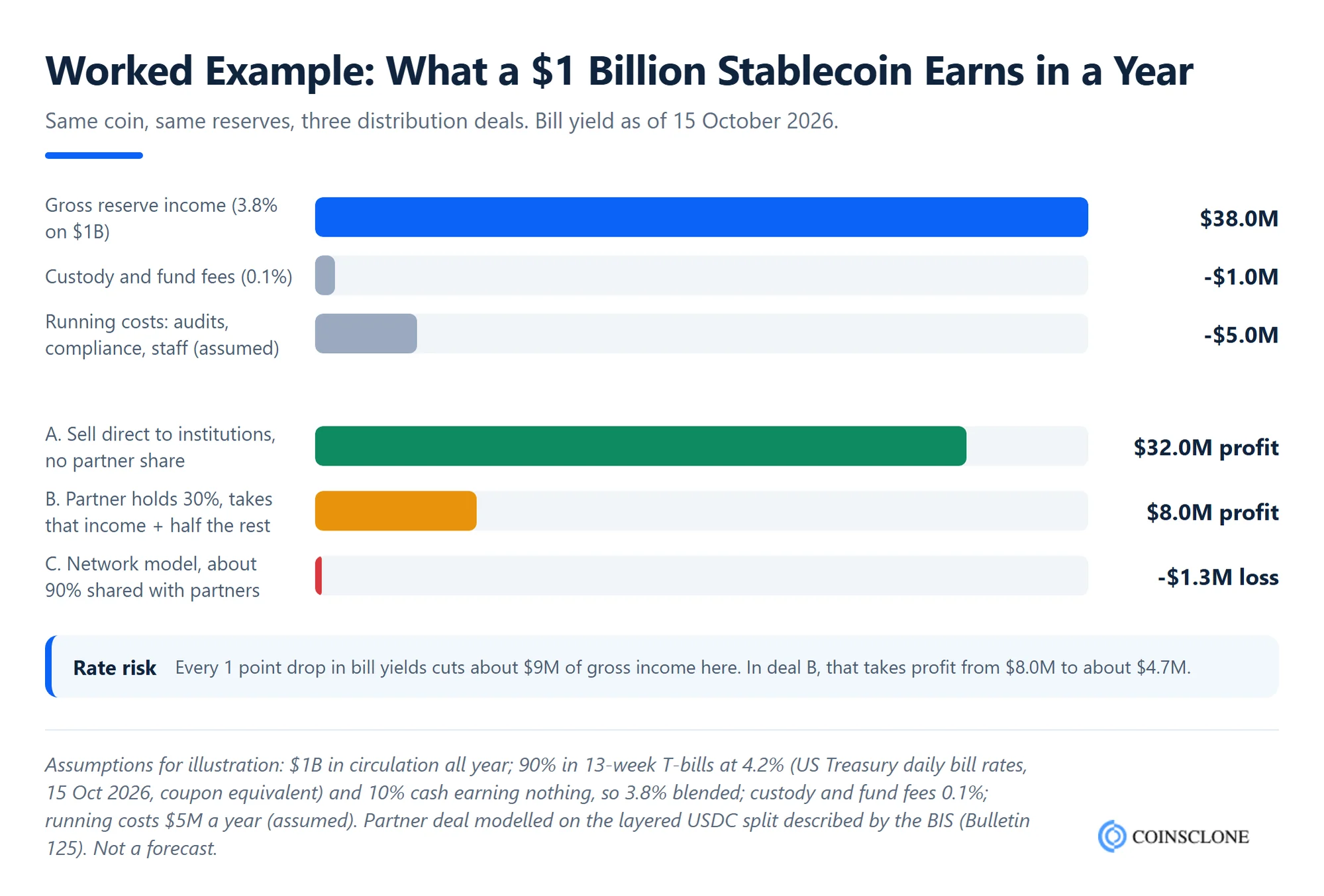
Here is a new issuer with $1 billion of coins in circulation for a full year. The yields are real; swap the cost lines for your own quotes.
| Step | Amount | How it is worked out |
| Reserve mix | 90% in 13-week bills, 10% cash | Cash covers same-day redemptions |
| Blended yield | 3.8% | 90% x 4.20% bill rate, cash earns about nothing |
| Gross reserve income | $38.0 million | $1 billion x 3.8% |
| Custody and fund fees | -$1.0 million | 0.1% of reserves (assumed) |
| Running costs | -$5.0 million | Monthly audits, compliance team, banking, chain fees (assumed) |
Now apply three distribution deals:
- Deal A, sell direct: no revenue share, close to Tether’s model. Profit is about $32 million, but you need a strong sales team.
- Deal B, one big partner: a partner holds 30% of your coins and takes all the income on that 30% plus half of the rest. You make about $8 million.
- Deal C, network model: you share about 90% of income to win fast reach, and lose about $1.3 million.
What the numbers tell you:
- Break-even point: under deal B, you need about $390 million in circulation to cover $5 million of running costs. Under deal C, you need about $1.35 billion.
- Rate risk: if bill yields fall by 1 point, deal B’s profit drops from $8.0 million to about $4.7 million.
- Capital on top: the OCC has proposed at least $5 million of capital for new issuers, plus 12 months of costs held in cash or short T-bills. That money is not spent, but you must raise it before you file.
The business works, but only at scale or with a cheap way to reach holders.
The GENIUS Act Rewards Fight: What Issuers Can and Cannot Share
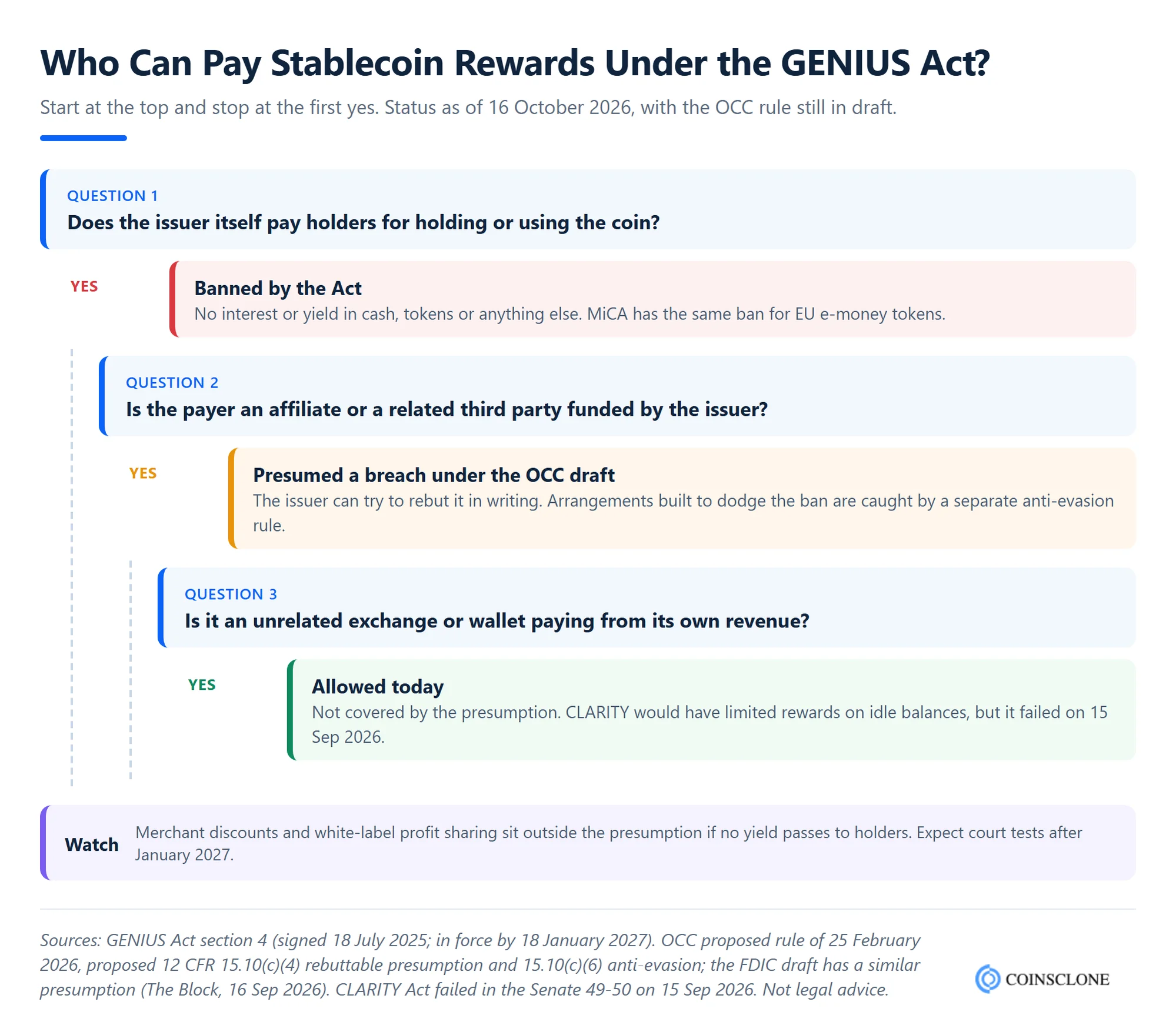
The GENIUS Act became law on 18 July 2025. It takes effect on 18 January 2027, or 120 days after final rules if that comes first. Section 4 says an issuer may not pay holders any interest or yield, in cash, tokens or anything else, just for holding or using the coin.
That sounds clear. The fight is over who else may pay.
What the regulators proposed
The OCC released its draft rule on 25 February 2026. It goes further than the Act in two ways:
- Affiliate presumption: if an affiliate or a “related third party” pays yield to holders, the OCC would presume the issuer broke the ban. The issuer can try to rebut this in writing.
- Anti-evasion rule: any setup built to get around the ban would count as a breach.
The FDIC has proposed a similar presumption, per The Block. Analysts quoted there expect the question to reach the courts once the Act takes effect.
Why exchange rewards survive for now
The draft does not cover unrelated firms that pay rewards from their own money, which is how Coinbase pays USDC rewards today. Banks wanted that closed, and the CLARITY Act’s compromise text would have banned rewards on idle balances. But the bill failed a Senate vote 49-50 on 15 September 2026, so the current framework stands.
What this means for your coin
- Do not pay holders from the issuer, in cash, points or tokens.
- Keep any partner that pays rewards truly unrelated, and get legal sign-off on ownership links.
- Revenue sharing with distributors is still allowed, as long as no yield passes through to holders.
- Outside the US, check local rules. The EU’s MiCA also bans interest on e-money tokens.
The licence routes, reserve rules and launch timeline are covered in our guide on how to launch a stablecoin.
Build a Stablecoin That Earns Its Keep
Stablecoin Development — done right.
- Token contracts: mint and burn roles, mint caps, pause, freeze and blocklist controls, audited before launch.
- Mint and redeem portal: client and API flows with fee settings you can change by client tier.
- Reserve dashboard: daily match of supply against bank and custody balances, with yield tracking and monthly report exports.
- Partner revenue ledger: track coins held by each distributor and calculate revenue shares without paying holders yield.
Get a white label stablecoin platform built around your reserve and distribution model.
Book a Free Demo to see the mint, redeem, reserve and partner reporting flows working end to end.
Other Revenue Streams Beyond Reserve Yield
Reserve yield shrinks fast when rates fall, so smart issuers build income that does not depend on the Fed.
- Fees on large orders: Tether’s 0.1% on buys and redemptions is the best-known example.
- Payments and treasury tools: Circle’s Payments Network had 175 financial institutions enrolled by the end of Q2 2026.
- Merchant acceptance: a stablecoin payment gateway lets shops take your coin, with a small fee on each payment or payout.
- Issuing for others: Anchorage Digital Bank issues USAT, the US coin Tether launched in January 2026.
- Borrow fees: coins backed by crypto, such as DAI, charge a fee to people who lock crypto to mint coins.
Risks That Eat Stablecoin Issuer Profits
- Rate cuts: income falls almost one for one with short rates. Circle’s rate fell 66 basis points in a year.
- Partner power: one large distributor can take more than half your income, so its contract becomes your margin.
- Runs and bank failures: in March 2023, USDC briefly lost its peg after Circle said $3.3 billion of reserves sat at Silicon Valley Bank. Spread cash across banks.
- Risky side bets: profit put into bitcoin or gold swings with prices, as Tether’s first half of 2026 showed.
- Rule changes: the OCC rule is still a draft. Build fees, limits and reports as settings, not hard code.
How to Plan a Profitable Stablecoin Launch
Before you spend on code, prove the unit economics.
- Pick your distribution model: direct sales, one big partner or a revenue-sharing network. This decides your margin most.
- Model three rate cases: 4.2%, a 1 point cut and a 2 point cut, and find your break-even supply in each.
- Pick your licence route: bank unit, OCC nonbank, state issuer or foreign issuer. It sets your capital and timeline.
- Get legal sign-off on rewards: map every partner’s ownership links before you promise a yield share.
- Build for the money flow: a reserve dashboard, a partner revenue-share ledger, fee settings and monthly report exports.
- Budget the build and the licence: published 2026 agency cost guides put the platform at about $25,000 to $250,000. That rises to $150,000 to $600,000 and up with licensing and custody setup, before the capital.
Coinsclone has been building since 2018, with 350+ platforms delivered for 200+ clients across 20 industries. Our stablecoin development services cover the token contracts, the mint and redeem portal and the reserve and partner reporting that this money model needs. Bring your target supply, partners and licence route to the scoping call, and the team can map the build to your numbers.
Frequently Asked Questions
How do stablecoin companies make money?
Most earn interest on the reserves behind their coins, mainly short T-bills, repo and bank deposits. Holders get no interest, so the issuer keeps it after paying partners and costs. Some add fees on large mints and redemptions, or sell payment services, but reserve income is usually more than 90% of revenue.
How does Tether make money?
Tether invests the dollars behind USDT, mostly in US T-bills and repo, and keeps the interest. It also charges 0.1% when large clients buy or redeem USDT. In Q2 2026, it reported about $1.5 billion of net operating profit, though price drops on its bitcoin and gold left a negative result for the first half.
How much money does Circle make from USDC?
In Q2 2026, Circle earned $668 million of reserve income and $701 million in total revenue. After $412 million of distribution, transaction and other costs, it kept $289 million. Net income was $48 million. Much of the payout goes to Coinbase, which booked $292 million of stablecoin revenue in the same quarter.
Can stablecoins pay yield?
Under the GENIUS Act, a US issuer cannot pay holders interest or yield just for holding or using the coin. An OCC draft would also presume a breach if an affiliate or related third party pays it. Unrelated exchanges and wallets can still pay rewards from their own revenue, as Coinbase does with USDC.
What does the GENIUS Act say about stablecoin yield?
Section 4 bans issuers from paying any interest or yield, in cash, tokens or other value, solely for holding or using the coin. The Act takes effect by 18 January 2027. The OCC’s draft adds an affiliate presumption, and its final rule is expected by November 2026.
Why does Coinbase pay USDC rewards if issuers cannot pay interest?
Coinbase is not the issuer. It earns a share of USDC reserve income under its deal with Circle and chooses to pass some of it to users as rewards. The OCC draft targets affiliates and related third parties, so whether an exchange counts as “related” is the key open question.
Do stablecoin issuers lose money when interest rates fall?
Their income falls, because reserve yield tracks short-term rates. Each 1 point drop removes about $10 million a year per $1 billion of coins. Issuers with thin margins after partner payouts can slip into a loss, which is why many are adding fees, services and chains.