
ERC827 token development means building an Ethereum token that can approve or send tokens and call a smart contract in the same transaction. Many teams still ask for it, because one-step “approve and call” makes dApps faster to use. But ERC827 was never finished. It stayed a draft, its best-known code was pulled over a security flaw in 2018, and its proposal was closed in 2022.
This guide gives you the full picture. You will learn what ERC827 tried to do, why it failed, and which final standards now give you the same one-step flow without the risk. You will also see the token types, use cases, build steps and costs, so you can plan a token that wallets, exchanges and auditors will accept.
In this guide:
- What ERC827 is, and its real status in 2026 (a closed draft, not an adopted standard)
- The call flaw that made OpenZeppelin remove its ERC827 code in June 2018
- How ERC-20 with permit (ERC-2612), ERC-1363 and wallet batching now do the job safely
- A simple decision tree to pick the right standard for your token
- The build process, a migration path for old ERC827 tokens and real cost ranges
See How Our MVP System Can Launch Your ERC827 Token Faster
ERC827 Token Development — done right.
- Advanced Smart Contracts : Build tokens with extended functionality beyond ERC20.
- Seamless Integration : Enable secure token transfers with data and value in a single transaction.
- Custom Branding : Tailor your ERC827 token to match your project’s identity and use case.
- Cross-Platform Compatibility : Ensure interoperability with wallets, exchanges, and dApps.
Get a free demo of your ERC827 token — fully branded and functional — in just 48 hours.
Book a Free Demo to see how our ERC827 Token Development Company can take you from concept to launch-ready token in just 2–4 weeks.
What Is ERC827 Token Development?
ERC827 token development is the process of creating an Ethereum token that adds “approve and call” and “transfer and call” functions on top of ERC-20. The goal was simple. With plain ERC-20, a user who wants to pay a smart contract must first send an approve transaction and then a second transaction to act. ERC827 tried to fold both steps into one.
The proposal added three functions to the normal ERC-20 set:
- transferAndCall: Sends tokens, then calls the receiving contract with extra data.
- transferFromAndCall: Moves tokens from an approved account, then calls the receiver.
- approveAndCall: Sets an allowance, then calls the spender so it can act at once.
Each one runs the usual ERC-20 action first and then makes a call to the target contract with whatever data the user passes in. That last part, a free-form call, is what later made the design unsafe.
So what does an ERC827 token development company really do today? A careful team keeps the goal (one-step payments, deposits or staking) and builds it on standards that are final and well tested. That is the approach we take at Coinsclone, and it is what the rest of this guide explains.
ERC827 Status in 2026: A Closed Draft, Not a Standard
As of 16 October 2026, ERC827 is not an Ethereum standard. Here is the record, taken from primary sources.
- January 2018: Augusto Lemble opened ERC827 as GitHub issue #827 on 11 Jan 2018. It was marked Draft and never moved past that stage.
- June 2018: A bug report showed that anyone could make an ERC827 token call any contract with any data. OpenZeppelin, the most used code library for Ethereum contracts, removed its ERC827 token on 28 June 2018.
- July 2018: A thread on Ethereum Magicians warned that ERC827 callbacks could open reentrancy attack paths.
- February 2019: The author added a proxy contract to limit the call problem, but the change never reached a final spec.
- May 2022: The EIP editors closed the issue, saying GitHub issues were no longer the place for new proposals.
The issue page still opens with a blunt warning: “This standard is still a draft and is proven to be unsafe to be used.” ERC827 also has no page on eips.ethereum.org, the main list of Ethereum standards.
A few live tokens did use it. Winding Tree’s Líf token, for example, was built on the old OpenZeppelin ERC827Token code. Those tokens still work as ERC-20 tokens, but no major library now ships or maintains ERC827.
The takeaway: if a provider offers to “launch your ERC827 token” without saying any of this, ask hard questions. The safe way to get the same result is to use a final standard.
How ERC827 Works, and Where It Breaks
ERC827 looked neat on paper. In practice, the free-form call put the token contract itself at risk.
Here is the problem in plain steps. A user calls transferAndCall and picks both the target contract and the data. The token then calls that target. To the target, the caller is the token contract, not the user. So any contract that trusts the token can be fooled.
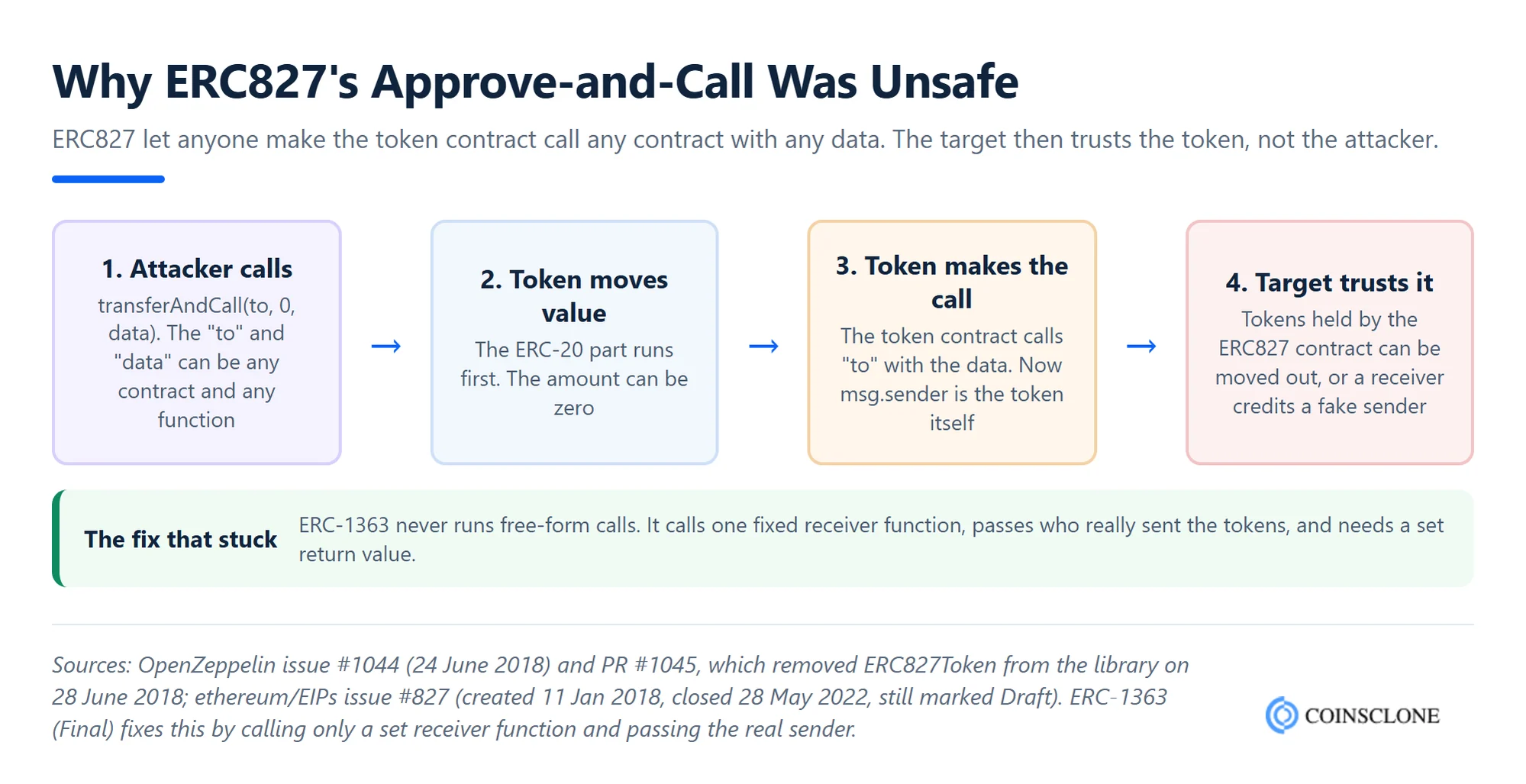
Two attacks follow from this:
- Draining tokens held by the contract: If other tokens were sent to the ERC827 contract by mistake, an attacker could make the token call `transfer` on them and send the balance to themselves.
- Faking the sender: A receiver that accepts a call “from the token” and reads the payer from the data can be tricked into paying out for a deposit that never happened.
On top of this, any call made during a transfer gives the receiver a chance to call back in. That is the reentrancy risk raised in 2018. ERC-1363 later fixed the design. It never runs free-form calls. Instead, it calls one fixed receiver function, passes the real sender, and needs the receiver to return a set value.
ERC827 vs ERC-20 and the Standards That Replaced It
ERC827 is often compared with ERC-20 alone. In 2026, the useful comparison also includes the final standards that took over its job. The status column comes from eips.ethereum.org, checked on 16 October 2026.
| Standard | Status | One-step flow | How the call works | Library support |
| ERC-20 | Final | No, approve then act | No callback | Every wallet and exchange |
| ERC827 | Draft, closed 2022, flagged unsafe | Yes | Free-form call to any contract | Removed by OpenZeppelin in 2018 |
| ERC-677 | Proposal only (GitHub issue) | Yes, transferAndCall | Fixed onTokenTransfer hook | Used by Chainlink’s LINK token |
| ERC-1363 | Final | Yes, transfer or approve and call | Fixed receiver hook with return check | OpenZeppelin since v5.1 (Oct 2024) |
| ERC-2612 (permit) | Final | Yes, sign then spend | No callback; signed approval | OpenZeppelin ERC20Permit |
| ERC-777 | Final | Yes, with hooks | Registry-based hooks | Deprecated by OpenZeppelin in 4.9, removed in 5.0 |
Two lessons stand out. First, ERC-1363 gives you the same three functions as ERC827, but in a safe shape. Second, many teams now skip token callbacks altogether. They use a signed permit, or let the wallet batch the approve and the action.
Chainlink’s own docs confirm that LINK is an ERC-677 token, which shows the fixed-hook idea works at scale. ERC-777 shows the other side. It is a final standard, yet OpenZeppelin deprecated it in version 4.9 and removed it in 5.0. Its hooks were at the heart of reentrancy exploits, such as the April 2020 attack on Lendf.me.
Which Standard Should You Use Instead of ERC827?
Pick the standard by the job you need done. Most projects need only one of the three options below.
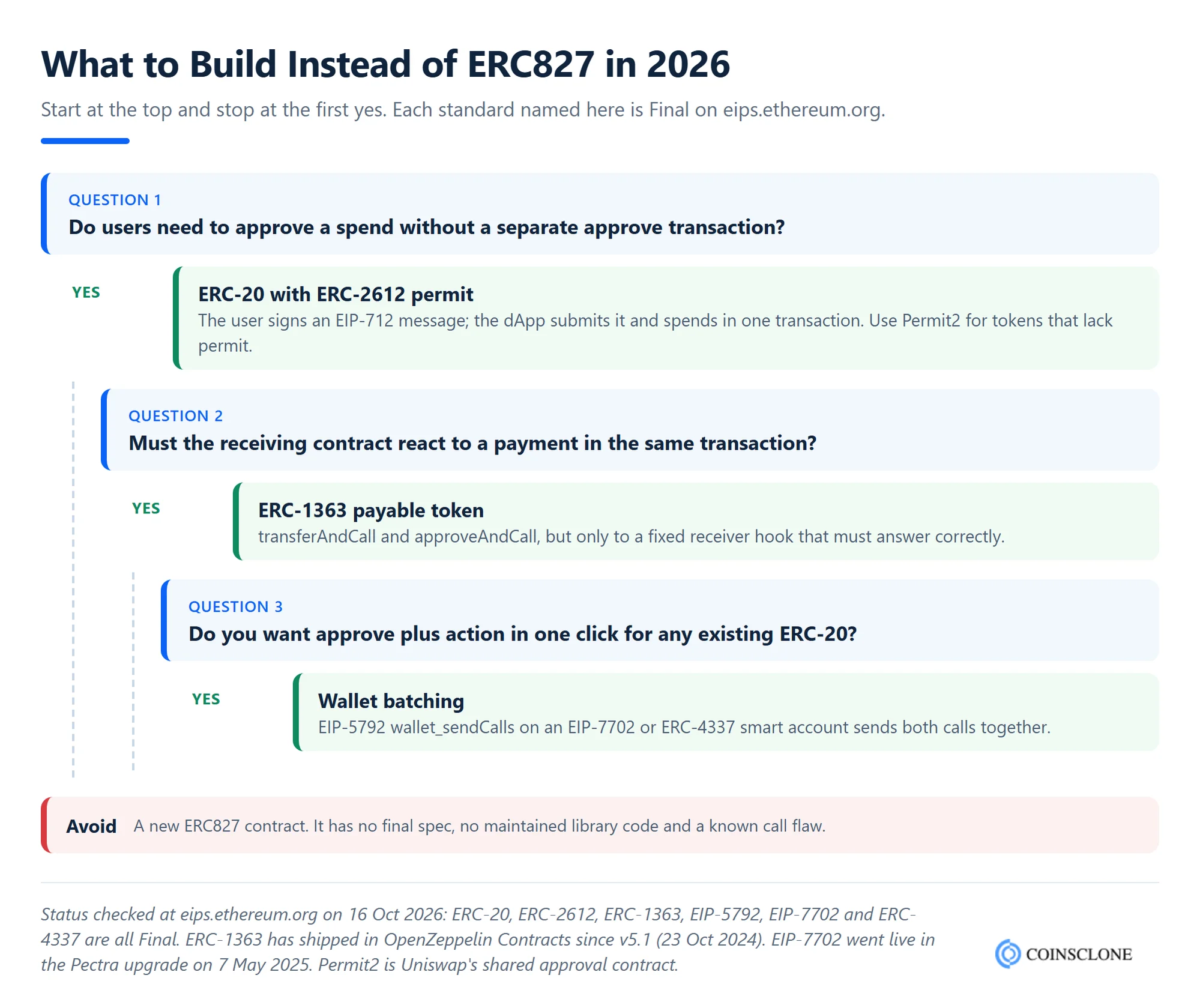
ERC-20 with Permit (ERC-2612)
If the pain is the extra approve transaction, add permit to a normal ERC-20 token. The user signs a typed EIP-712 message, and the dApp submits it along with the real action. One transaction does both. For tokens that lack permit, Uniswap’s Permit2 contract gives the same signed approvals.
ERC-1363 Payable Token
If the receiving contract must react to a payment in the same transaction, use ERC-1363. It offers transferAndCall and approveAndCall, much like ERC827. The change is that the token only calls one set hook on the target, and the call fails unless the target gives the right reply. It became Final and is now part of OpenZeppelin Contracts since version 5.1.
Wallet Batching (EIP-5792 and EIP-7702)
If you want approve plus action in one click for any existing ERC-20, let the wallet do it. EIP-7702 went live in Ethereum’s Pectra upgrade on 7 May 2025 and lets normal wallets act like smart accounts. With EIP-5792, a dApp asks the wallet to send several calls together. As a result, the token contract stays plain and simple.
Types of Approve-and-Call Tokens We Develop
The demand behind ERC827 is real. Here are the token types that gain the most from a one-step flow, built on ERC-1363, permit or batching.
- Utility Tokens: Users pay for a dApp service in one step, so fewer people drop off at the approve screen.
- Governance Tokens: Holders can lock tokens and vote in a single action, which lifts turnout.
- Payment Tokens: A shop contract can receive the payment and record the order in the same transaction.
- DeFi Tokens: Staking, lending and yield deposits skip the extra approve step, so no large open limit is left behind.
- Reward & Incentive Tokens: Rewards can be claimed and spent or staked right away.
- Crowdfunding Tokens (ICO / IDO / IEO): Buyers approve and join a sale in one step, so the sale contract records them at once.
Features of a Modern ERC827-Style Token
A token built today for the ERC827 use case should have these features. Each one fixes a weak point of the old draft.
- Smart Contract Compatibility: The token works with any contract that uses the ERC-1363 receiver hook, and with every ERC-20 tool as usual.
- Single-Step Token Transfer: Users approve and act in one transaction, through permit, ERC-1363 or wallet batching.
- Full ERC-20 Base: The token is a normal ERC-20 first, so exchanges, wallets and block explorers list it with no extra work.
- Safe Data Payload: Extra data goes only to a fixed receiver function, never as a free-form call.
- Reentrancy Guards: Any function that makes an outside call is protected and follows the checks-effects-interactions pattern.
- Signed Approvals with Limits: Permits carry a nonce and a deadline, so a leaked signature expires and cannot be used twice.
Use Cases of ERC827 Token Development
These are the use cases ERC827 was meant for. All of them work today on the safer standards above.
- Crowdfunding: Backers approve and pay in one step, so funds arrive faster.
- Loyalty & Rewards Systems: A shop contract can issue and redeem rewards automatically when tokens arrive.
- In-game Assets & Upgrades: Players buy items and upgrades instantly, which keeps play smooth.
- DeFi Lending: A borrower locks funds and opens a loan in one step, with no large open approval left behind.
- Subscriptions: A service contract can charge and extend a plan in the same call, using a capped permit.
Benefits and Risks of One-Step Token Transfers
One-step flows bring clear gains. They also carry risks you should plan for.
Benefits:
- Single-Transaction Approve & Execute: Users finish an action in one step, so the flow feels like a normal app.
- Better User Experience: Fewer pop-ups and fewer failed second steps mean fewer users give up.
- Lower Gas for Users: One transaction instead of two saves the base cost of the second transaction. The exact saving depends on the network and the logic.
- Atomic Actions: The approve and the action succeed or fail together, so there is no half-done state.
- Fewer Open Approvals: Permits for the exact amount avoid the large open limits that scammers target.
Risks to manage:
- Callback Attacks: Any call into a receiver can be abused for reentrancy. Use fixed hooks and guards.
- Signature Phishing: Permit signatures can be phished. Show clear signing details and keep deadlines short.
- Receiver Trust: Receivers must check who really sent the tokens, not just which token called them.
Industries We Assist With ERC827 Token Development
Coinsclone builds one-step token flows for many industries. In each case, we use a final standard that fits the job.
- FinTech & Digital Payments: Fast checkout flows where payment and order happen in one step.
- Supply Chain & Logistics: Tokens that pay and log a milestone together, which helps tracking and audits.
- Art & Collectibles: A buyer gets the item and unlocks its perks in one step.
- Real Estate: Fractional ownership purchases with the buyer record written at the same time. For regulated assets, we pair this with permissioned standards.
- Gaming: Instant in-game purchases and upgrades.
- Metaverse & Virtual Worlds: Payments for items and access that settle in real time.
- Ed-Tech: Course access or certificates granted the moment a payment arrives.
- Sports & Fitness: Member, reward and fan tokens that fans can use in one step.
- Healthcare: Access control flows where a token grants rights to a service.
- Agriculture: Transparent funding and supply payments that log each step.
- Entertainment & Media: Pay-to-access content, with creator payouts in the same call.
- Crowdfunding: Backers approve and buy in one step, so more of them join and funds come in sooner.
How to Migrate an Existing ERC827 Token
Some older projects still run an ERC827 token. You do not have to panic, but you should reduce the risk.
- Check the contract: Find out if the token holds any other tokens, and if any contract trusts calls from it. Those are the attack paths.
- Stop using the call functions: Tell users and partner dApps to use plain transfer and approve. Remove the call functions from your own front end.
- Move stray tokens out: If the contract holds other tokens and has an owner rescue function, recover them before an attacker does.
- Plan a new token: Deploy an ERC-20 with permit, or an ERC-1363 token, and swap holders over through a migration contract or a snapshot airdrop.
- Tell exchanges and wallets: Share the new contract address and swap dates so listings and balances stay correct.
Our ERC827 Token Development Process
At Coinsclone, we follow a clear workflow to deliver a token that is secure and ready to scale.
- Goals & Tokenomics: We start with your goal, the one-step flow you need, and any legal rules you must meet.
- Standard Selection: We pick the right base: ERC-20 with permit, ERC-1363, wallet batching, or a mix. We explain the trade-offs in plain terms.
- Smart Contract Architecture: We design the token, the receiver contracts and the access rules, building on audited OpenZeppelin code.
- Development: We write the contracts, the dApp front end and the wallet signing flow.
- Testing & Audit: We run unit tests, fuzz tests and reentrancy checks, then support a third-party audit.
- Launch: We deploy on Ethereum or a chain such as Base, Arbitrum or BNB Chain, and publish the code on the block explorer.
If you want help with the full build, our smart contract development services cover the token, receivers and audit support.
ERC827 Token Development Cost
Cost depends on how much sits around the token. Adding permit or ERC-1363 to a token is a small part of the work. Receiver contracts, staking, vesting and a full dApp take more time and testing.
Published 2026 agency cost guides put a standard ERC-20 or BEP-20 token at about $5,000 to $15,000 to build, and a feature-rich token with staking or vesting at about $20,000 to $80,000. Published 2026 audit price guides put a simple token audit at roughly $5,000 to $15,000, with complex DeFi systems far higher. For a full breakdown, read our guide to the cost to create a crypto token.
Why Choose Coinsclone for ERC827 Token Development?
Coinsclone is a trusted Crypto Token Development Company that has been building since 2018. We have delivered 350+ platforms for 200+ clients across 20 industries. Our in-house team includes blockchain engineers, smart contract developers and UI experts.
We offer professional Ethereum token development services for teams that want the ERC827 one-step flow on safe, final standards. You can also hire our ERC827 token developers to extend your own team. We also provide ERC865 token development for teams that want gasless transfers.
Frequently Asked Questions
1. What is ERC827 token development?
ERC827 token development is the process of creating an Ethereum token that extends ERC-20 with transferAndCall, transferFromAndCall and approveAndCall. ERC827 itself was never finalised and was flagged as unsafe, so today the same one-step flow is built on ERC-1363, ERC-2612 permit or wallet batching.
2. How is ERC827 different from ERC-20 tokens?
ERC-20 only moves and approves tokens, so paying a contract takes two transactions. ERC827 added functions that move or approve tokens and then call a contract in the same transaction. The catch is that ERC827 allowed free-form calls, which made the token contract open to abuse.
3. Why choose an ERC827 token development company?
A good token development company will tell you that ERC827 is a closed draft and steer you to a safe standard that does the same job. It brings smart contract skill, audit support and wallet integration, so your token is secure and accepted by exchanges.
4. What are the benefits of ERC827 tokens?
The idea behind ERC827 gives users one-step approve and pay, fewer failed second steps, slightly lower gas and fewer open approvals. You get these benefits today from ERC-1363, permit or wallet batching, without the call flaw of the original draft.
5. Can ERC827 tokens be used in existing Ethereum projects?
Existing ERC827 tokens still work as ERC-20 tokens in wallets and exchanges. However, their extra call functions should not be used, and no major library maintains ERC827 code. For a new project, an ERC-1363 or permit-enabled ERC-20 token fits existing tools better.
6. How long does ERC827 token development take?
The timeline depends on the token logic, the receiver contracts and the audit. A standard token with permit or ERC-1363 is a short build, while tokens with staking, vesting or a full dApp take longer because of testing and the audit queue.
7. Is ERC827 token development secure?
The original ERC827 design is not secure. Its own proposal page says it is “proven to be unsafe,” and OpenZeppelin removed its ERC827 code in June 2018. A secure build uses ERC-1363 or ERC-2612 permit, audited library code, reentrancy guards and a third-party audit.
See How Our MVP System Can Launch Your ERC827 Token Faster
ERC827 Token Development — done right.
- Advanced Smart Contracts : Build tokens with extended functionality beyond ERC20.
- Seamless Integration : Enable secure token transfers with data and value in a single transaction.
- Custom Branding : Tailor your ERC827 token to match your project’s identity and use case.
- Cross-Platform Compatibility : Ensure interoperability with wallets, exchanges, and dApps.
Get a free demo of your ERC827 token — fully branded and functional — in just 48 hours.
Book a Free Demo to see how our ERC827 Token Development Company can take you from concept to launch-ready token in just 2–4 weeks.