
A crypto liquidity provider is the firm or person that keeps buy and sell orders on an exchange, so traders can get in and out at a fair price. When an exchange has poor liquidity, prices jump on small orders, traders leave and fee income dries up. That is why exchange owners and liquidity providers need to work together from day one.
This guide explains what a crypto liquidity provider does, the five main types, how they get paid and what they cost, and the names exchanges talk to in 2026. It also shows how a provider plugs into your order book and how to pick one without falling for fake volume.
In this guide:
- What a crypto liquidity provider is, and how it differs from a market maker
- The five types, from market makers and OTC desks to DeFi pools
- How providers make money, and what a retainer or token loan deal looks like
- Eight well known liquidity firms, and a checklist to compare them
- The risks: wash trading, thin books in a crash, and one-sided contracts
Power Your Exchange with Elite Cryptocurrency Liquidity Providers!
Get instant access to deep, reliable liquidity — built for modern exchanges.
- Plug & Play Liquidity : Connect in minutes, trade instantly.
- Multi-Asset Support : BTC, ETH, USDT & 1000+ pairs.
- 24/7 Liquidity Flow : No downtime, no slippage surprises.
- Exchange-Ready APIs : Integrate easily with any trading platform.
See live liquidity in action — free demo in 48 hours.
Book a Demo and discover how our liquidity network can supercharge your exchange in weeks, not months.
What Is a Crypto Liquidity Provider?
Crypto liquidity is how easily you can buy or sell a coin without moving its price. On a liquid market, a trader can sell one bitcoin and get almost the same price as the last trade. On a thin market, the same order eats through several price levels and the seller gets less. That gap is called slippage, and traders check for it before they pick a platform.
A crypto liquidity provider is anyone who fills that order book with prices. In practice, there are two groups:
- Professional firms: Market makers, OTC desks and prime brokers. They use their own capital and trading software to quote buy and sell prices on many exchanges at once.
- DeFi users: People who put tokens into a DeFi pool, such as one on Uniswap, and earn a share of the swap fees.
Bitcoin is still the most liquid coin. As of October 2026, about 20.09 million BTC have been mined out of a fixed 21 million supply, and BTC is roughly 59% of the total crypto market value on CoinGecko. Most new coins have far less depth, and that is why exchanges and token teams hire these firms.
Crypto Liquidity Provider vs Market Maker
People often use the two terms for the same thing, but there is a small difference. A market maker is one kind of liquidity provider. It posts both a buy price and a sell price all the time and earns the gap between them. A liquidity provider is the wider group. It also covers OTC desks that only quote large trades on request, aggregators that resell other venues’ prices, and DeFi users who park tokens in a pool. So all market makers are liquidity providers, but not the other way round.
Types of Crypto Liquidity Providers
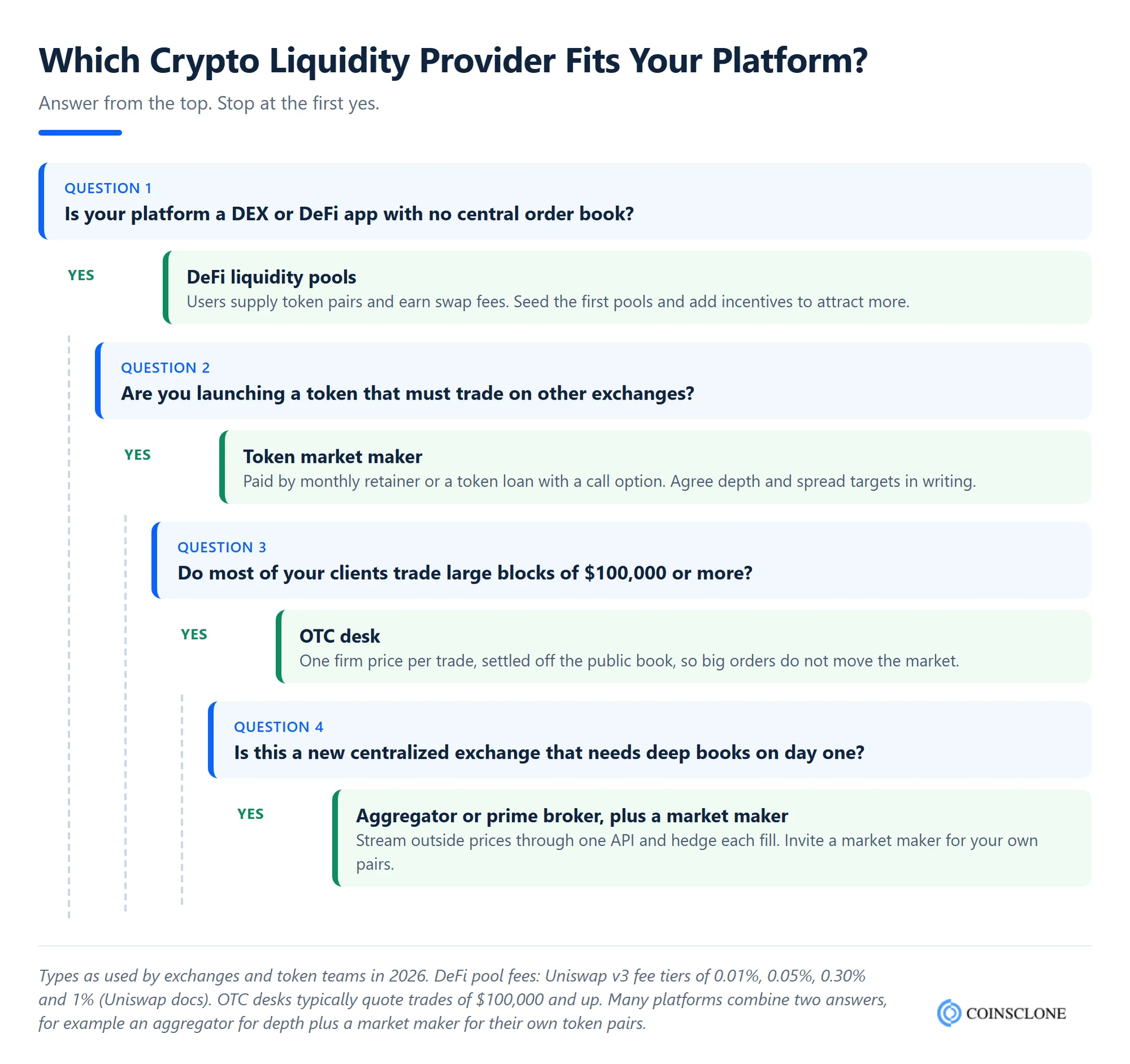
No one firm fits all needs. A new spot exchange needs something different from a token project or a DeFi app. Here are the five main types.
1. Market Makers
Market makers run trading bots that keep live buy and sell orders on the book. Some work for exchanges, so the exchange’s pairs look full from launch. Others work for token projects, so a new token has a tight spread on the venues where it lists. If you want to run this in-house, a crypto market making software setup lets your own team quote prices with your own capital.
2. OTC Desks
OTC (over-the-counter) desks quote a single price for a large trade, often $100,000 and up. The trade happens off the public order book, so a big buyer does not push the price up. Exchanges use OTC desks to rebalance their hot wallets, and funds use them to move large sums quietly. If your business is built around these large deals, an OTC crypto exchange is a better fit than a public order book.
3. Prime Brokers and Aggregators
Prime brokers and aggregators connect to many exchanges and market makers, then stream the best combined price to you through one API. This is what most people mean by liquidity as a service. A new exchange can show deep books on day one, because each customer order is matched against outside prices and then hedged on another venue.
4. Exchange Liquidity Sharing
Some white label exchanges share an order book with a larger exchange through its API. Your users see the bigger exchange’s depth, and their orders are mirrored there. It is fast and cheap to set up. The catch is that you depend on one outside exchange, its fees and its rules.
5. DeFi Liquidity Pools
On a decentralized exchange (DEX), there is often no order book at all. Instead, users deposit two tokens into a pool, and a smart contract prices each swap. For example, Uniswap v3 pools use standard fee tiers of 0.05%, 0.30% and 1%, plus a 0.01% tier for stablecoin pairs, and the fee goes to the people who supplied the pool. Our guide to the best DeFi liquidity pools covers where users earn the most today.
| Type | Who uses it | How liquidity shows up | Main trade-off |
| Market maker | Exchanges, token projects | Live bids and asks on your book | Monthly fee or token loan |
| OTC desk | Funds, exchange treasuries | One firm price for a large trade | Not visible on the public book |
| Prime broker / aggregator | New exchanges, brokers, apps | Best price from many venues via API | Spread markup, outside dependency |
| Liquidity sharing | White label exchanges | Mirror of a big exchange’s book | Locked to one partner’s rules |
| DeFi pool | DEXs, DeFi apps | Tokens locked in a smart contract | Impermanent loss for depositors |
How Crypto Liquidity Providers Help Exchanges Grow
An exchange earns from trading fees, withdrawal fees and listing fees. All three depend on traders staying, and traders stay where orders fill fast at a fair price. Here is how a good provider helps.
Steady Coin Supply
A liquidity provider brings its own stock of coins and cash. So the exchange does not run short of an asset when demand spikes, and a user who wants to buy 2 ETH at 3 a.m. can still do it.
Fair Market Prices
Providers watch prices on dozens of venues and update their quotes in milliseconds. As a result, the price on your exchange stays close to the global price. Without this, a small exchange can drift a few percent away from the rest of the market, and arbitrage traders drain it.
Faster Trade Execution
When the book is full, the matching engine finds a counter order at once. Trades fill in full instead of in small pieces. More fills mean more volume, and more volume means more fee income for the owner.
Calmer Price Swings
A deep book soaks up large orders without big jumps. That keeps volatility lower on your pairs, which in turn makes traders and new token projects more willing to list and trade with you.
Trust and Listings
Traders and data sites check spread and depth before they trust a venue. Real depth also helps when you apply to be tracked on sites like CoinGecko. In short, liquidity is one of the first things that makes a new exchange look credible.
How Does a Crypto Liquidity Provider Make Money?
These firms do not work for free. They earn in a few clear ways, and knowing them helps you judge any offer.
- The spread: A market maker buys a little lower than it sells. Say it quotes BTC at a bid of $84,490 and an ask of $84,510. If it buys one BTC from one trader and sells one to another, it keeps $20. Across thousands of trades a day, that adds up.
- Maker rebates: Many exchanges charge makers less than takers, and some pay a small rebate to firms that add orders to the book.
- Fees from the client: Token projects and exchanges often pay a monthly retainer for a set level of depth and spread.
- Token loans with options: Some market makers borrow a project’s tokens and get the right to buy them later at a fixed price. If the token rises, they profit from that option.
- Swap fees: In DeFi, liquidity providers earn a share of every swap fee in their pool.
The old idea that exchanges “pay back liquidity with a profit” mixes this up with crypto lending. In real deals, the provider earns from trading, from client fees, or from options, not from a fixed interest rate.
What Does a Crypto Liquidity Provider Cost?
Most providers do not publish prices, but deal terms do leak out through public proposals and industry reviews. There are two main models.
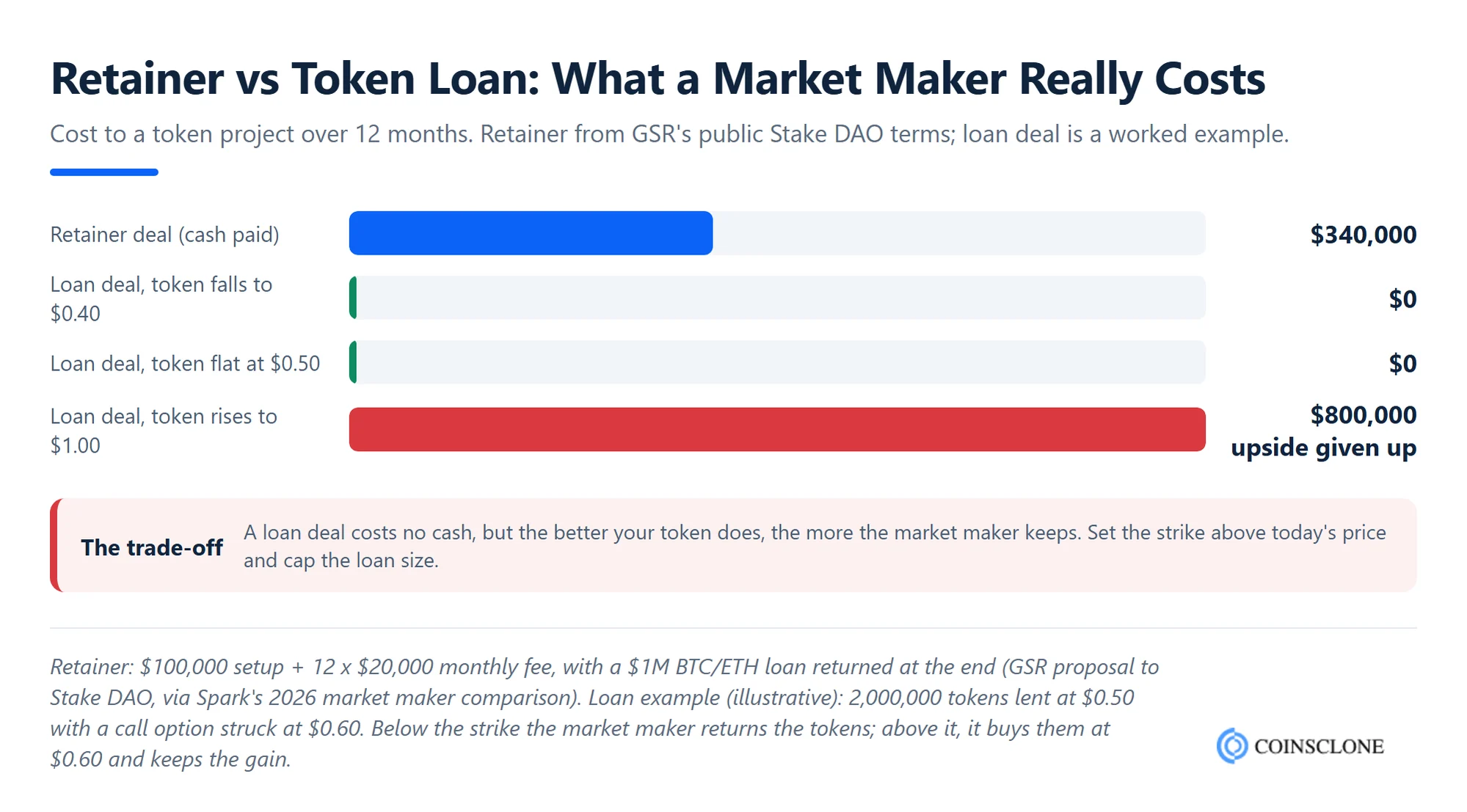
The Retainer Model
You pay a fixed monthly fee, often with a setup fee. The provider may still borrow tokens or stablecoins to trade with, but returns them in full at the end. A 2026 market maker review by Spark puts monthly fees at $10,000 to $50,000+, setup fees at $50,000 to $100,000, and most contracts at 12 to 24 months. One public case: GSR’s offer to Stake DAO asked for a $100,000 setup fee, $20,000 a month and a $1 million BTC/ETH loan.
The Loan and Call Option Model
You lend the market maker a block of your tokens and give it a call option on them at an agreed strike price. At the end of the term, it either returns the tokens or buys them at the strike. This costs no cash up front. But the market maker profits most if the price rises, and it loses little if the price falls, so check the strike and the loan size with care.
Many deals mix the two: a smaller retainer plus a modest token loan. For an exchange (not a token project), the cost is usually a mix of spread markups from an aggregator and reduced fees for the market makers you invite.
Top Crypto Liquidity Providers in 2026
Below are eight well known liquidity firms that exchanges, brokers and token teams talk to. This is not a ranking. Each one fits a different need, and all of them serve only professional clients.
1. Wintermute
Wintermute is a trading firm based in London and founded in 2017. It offers OTC spot trading, options and forwards, API liquidity for platforms, and market making for token projects across centralized and DeFi venues. It is one of the most common names in token launch deals.
2. GSR
GSR is a crypto trading firm with 13 years in the market, founded in 2013. It runs market making and OTC trading, and it also advises and invests in early projects. Its Stake DAO proposal is one of the few public market making contracts, which makes it a useful price benchmark.
3. Keyrock
Keyrock is a Brussels-based market maker, founded in 2017, with 220+ people across 36 countries. It provides market making for tokens and exchanges, OTC and options trading, and reports against agreed depth and spread targets.
4. Flowdesk
Flowdesk is a market maker and trading firm, founded in Paris in 2020. It says it trades on 150+ exchange venues and 1,000+ asset pairs, which makes it a good fit for tokens that list on many smaller venues.
5. Cumberland
Cumberland is the crypto arm of the trading firm DRW. It offers big clients OTC prices in dozens of coins and stablecoins, plus block trades in listed options and futures, and one-to-one crypto options deals. It suits exchanges and funds that need large, firm quotes.
6. B2C2
B2C2 is a liquidity firm for big clients, owned by Japan’s SBI Holdings. It streams prices to exchanges, brokers and banks through API, and offers OTC trading and stablecoin swaps. It does not serve retail clients at all.
7. Galaxy
Galaxy is a US-listed crypto firm that trades with 1,700+ institutions and ran a loan book of about $1.4 billion in Q2 2026. Its trading desk offers OTC spot, derivatives and lending, which suits large exchanges and funds.
8. FalconX
FalconX is a crypto prime broker that has executed $2.5 trillion+ in trading volume across 400+ tokens. It gives institutions one account for trading, credit and settlement across many venues, which is the aggregator model in practice.
Exchanges themselves, such as Binance, Coinbase and Kraken, also offer institutional and API liquidity. Binance alone traded about 141,000 BTC of spot volume in one day in early October 2026, per CoinGecko. That is four times more than the next exchange.
How to Connect a Liquidity Provider to Your Exchange
Signing a deal is only half the job. The other half is technical, and it decides whether the depth actually shows up for your users.
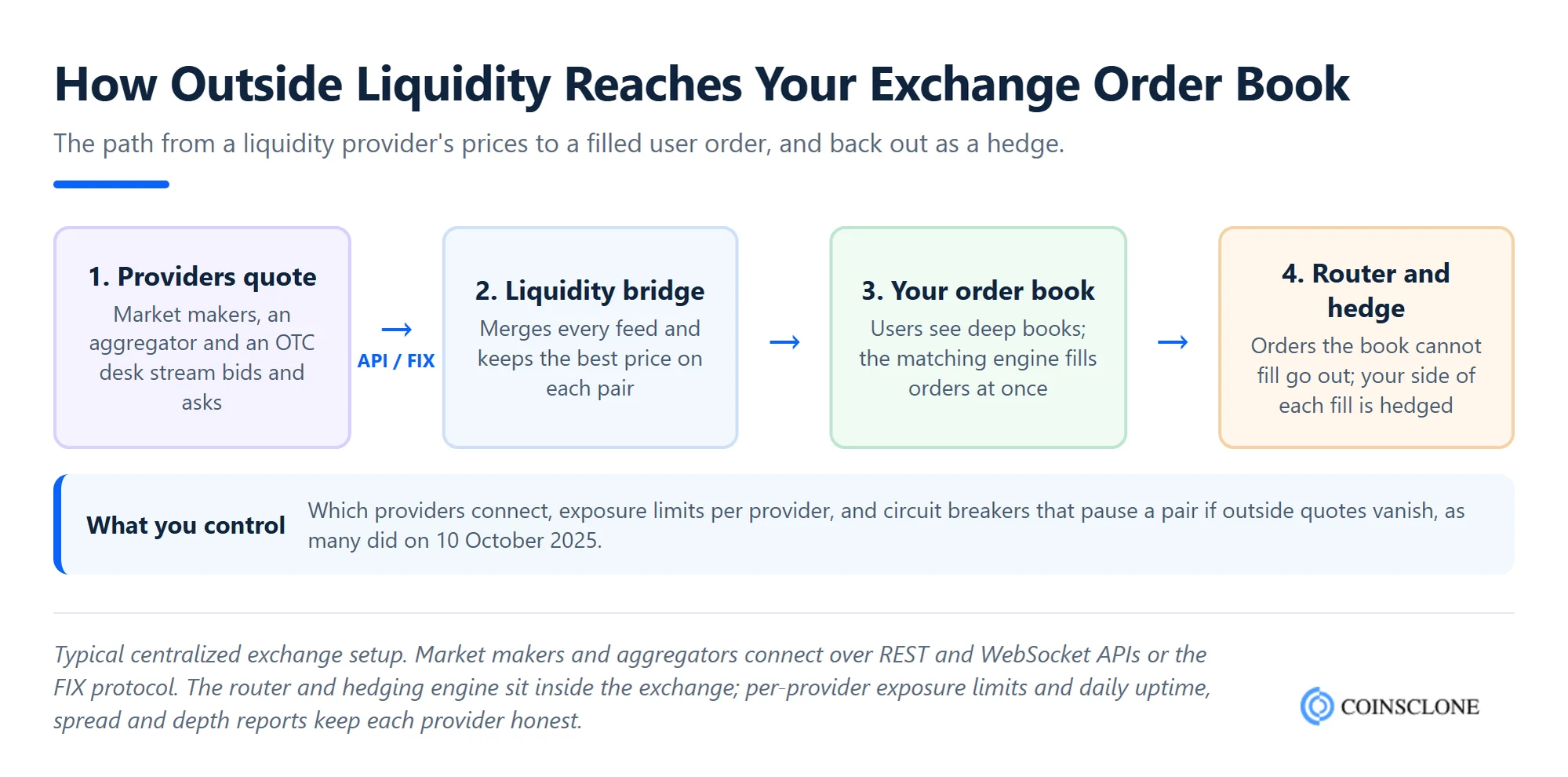
- API or FIX connection: The provider connects to your exchange through REST and WebSocket APIs, or through FIX for larger firms. Your exchange must give it fast, stable market data and order entry.
- Bridge or aggregator: If you use more than one provider, a bridge pulls in all their prices and shows your users the best one.
- Smart order routing: When a user order cannot be filled from the internal book, the router sends it to the outside venue with the best price.
- Hedging: If your platform takes the other side of a trade, it hedges at once on an outside venue, so the exchange does not hold price risk.
- Risk limits and reports: Set limits on exposure per provider, and pull daily reports on uptime, spread and depth.
Coinsclone sets this up as part of its cryptocurrency exchange development work, and connects a market maker or pooled outside prices before launch, not after. A white label exchange with liquidity connected takes about 4 to 6 weeks to deliver.
How to Choose a Crypto Liquidity Provider
Use this checklist when you compare offers. It works for both exchanges and token teams.
- Depth at ±2%: Ask how much they will quote within 2% of the mid price on each pair. Depth matters more than a tiny spread. As Flowdesk notes, a 0.30% spread with $100,000 of depth is healthier than a 0.05% spread with a few hundred dollars behind it.
- Spread targets: Agree on a maximum spread per pair, in writing.
- Uptime: Quotes should be live at least 95% of the time, including weekends and volatile days.
- Venues and assets: Check which exchanges and pairs they already cover, and whether they can add yours.
- Reports: Ask for daily or weekly reports on depth, spread, volume and uptime against the contract.
- Licence and track record: Prefer firms that are registered where they operate and can name past clients.
- Contract terms: Check the length, the exit clause, who holds the borrowed tokens, and the option strike if there is one.
- Red flags: Walk away from anyone who promises a price target or a set amount of daily volume. Real providers sell depth and spread, not pumps.
Risks of Working With Crypto Liquidity Providers
Good liquidity has real value, but bad deals can do real harm. Watch for these risks.
Fake Volume and Wash Trading
Some so-called market makers sell fake volume. They trade between their own accounts to make a token look busy. In 2025, the founder of Gotbit was sentenced to eight months in prison and forfeited $23 million after the US Justice Department found the firm had run wash trading for clients from 2018 to 2024. If a provider offers “volume support”, that is the warning sign.
Liquidity Can Vanish in a Crash
Market makers protect themselves first. On 10 October 2025, a tariff shock set off the largest forced-selling wave crypto has seen, with about $19 billion of bets forced shut in a day. Order books thinned out fast as market makers pulled quotes. So use more than one provider, and set circuit breakers on your own exchange.
One-Sided Option Deals
In a loan and call option deal, a low strike price or a large loan hands most of the upside to the market maker. Always model the worst case before you sign.
Counterparty Risk
When a provider holds your tokens or cash, its failure becomes your loss. Keep loans sized to what you can afford to lose, and prefer firms with clear custody and audited accounts.
Impermanent Loss in DeFi
If you supply a DeFi pool, a big price move in one token can leave you with less value than if you had just held both tokens. Swap fees do not always make up the gap.
Conclusion
Crypto liquidity providers decide whether an exchange feels busy and fair or empty and risky. Market makers, OTC desks, aggregators, shared books and DeFi pools each solve a different problem. And the best provider is the one that fits your platform, shows real depth, and reports against a fair contract.
There is one more thing to consider. If you hold enough crypto to act as a liquidity provider, why not start a cryptocurrency exchange business with the same funds? You have the hardest part of running an exchange, which is liquidity. And an exchange earns from more sources than liquidity alone.
Coinsclone has been building crypto platforms since 2018, with 350+ platforms delivered for 200+ clients across 20 industries. Our team builds exchanges with liquidity, custody and compliance planned in from the start. You can also check the cost of a white label crypto exchange before you talk to us.
Power Your Exchange with Elite Cryptocurrency Liquidity Providers!
Get instant access to deep, reliable liquidity — built for modern exchanges.
- Plug & Play Liquidity : Connect in minutes, trade instantly.
- Multi-Asset Support : BTC, ETH, USDT & 1000+ pairs.
- 24/7 Liquidity Flow : No downtime, no slippage surprises.
- Exchange-Ready APIs : Integrate easily with any trading platform.
See live liquidity in action — free demo in 48 hours.
Book a Demo and discover how our liquidity network can supercharge your exchange in weeks, not months.
Frequently Asked Questions
What is the difference between a market maker and a liquidity provider?
A market maker is one type of liquidity provider. It quotes both buy and sell prices all the time and earns the spread between them. The second term is wider. It also covers OTC desks, aggregators, exchanges that share their order book, and DeFi users who supply liquidity pools.
What are the different types of crypto liquidity providers?
The five main types are market makers, OTC desks, prime brokers and aggregators, exchange liquidity sharing, and DeFi liquidity pools. Centralized exchanges mostly use the first four. DEXs rely on liquidity pools funded by users.
How do I choose the best crypto liquidity provider?
Compare depth within 2% of the mid price, the widest spread they allow, uptime, the venues they cover, reports, licences and contract terms. Avoid any firm that promises price targets or fixed daily volume.
How much does a crypto liquidity provider cost?
Prices are rarely published. Industry reviews in 2026 put market maker retainers at $10,000 to $50,000+ a month, with setup fees of $50,000 to $100,000 and 12 to 24 month terms. Token projects can instead pay with a token loan plus a call option, which costs no cash but gives up some upside.
Which crypto exchange has the best liquidity?
By spot volume, Binance is the largest exchange by a wide margin, with about 141,000 BTC traded in one day in early October 2026 on CoinGecko data. OKX, Coinbase, Gate and Kraken follow at a distance.
Can anyone become a crypto liquidity provider?
Yes. Anyone can supply tokens to a DeFi liquidity pool on a DEX and earn a share of the swap fees. The main risk is impermanent loss when the prices of the two tokens move apart.