

Crypto market trends in 2026 look very different from the hype of past years. Prices are well below their 2025 peak, yet stablecoins, tokenized assets and prediction markets keep growing. This guide walks through the 11 trends that matter most right now, each backed by dated data from CoinGecko, DefiLlama, rwa.xyz and CoinDesk, checked in October 2026.
You will see what is happening in each trend, why it matters, and what it means if you plan to build or grow a crypto business. We also cover the trends that cooled off, so you do not chase last year’s ideas.
In this guide:
- Market snapshot: the total crypto market was worth about $2.78 trillion on 16 Oct 2026, with Bitcoin about 35% below its peak.
- Where growth is: stablecoins, tokenized stocks and funds, and prediction markets grew while DeFi shrank.
- New rules: the GENIUS Act, MiCA and new CFTC and SEC proposals now shape what you can launch and where.
- Business moves: a simple decision tree to match each trend to a product you can build.
This article explains market trends. It is not financial advice, and it makes no price predictions.
11 Crypto Market Trends to Watch in 2026
The big shift in 2026 is simple. Speculation cooled, while the parts of crypto that move real money kept growing. Here is where the market stood on 16 Oct 2026:
| Metric | Value on 16 Oct 2026 | One year earlier |
| Total crypto market value | $2.78 trillion | n/a |
| Bitcoin price | $82,064 | down 26% over 12 months |
| Bitcoin all-time high | $126,080 (6 Oct 2025) | n/a |
| Bitcoin share of market value | 59.3% | n/a |
| Ether price | $2,442 | down 39% over 12 months |
| DeFi total value locked | $89.9 billion | $150.9 billion |
| Stablecoin supply | $305.2 billion | $304.3 billion |
| Tokenized real-world assets | $39.18 billion | n/a |
Market, price and coin data come from CoinGecko. DeFi and stablecoin figures come from DefiLlama, and the tokenized asset value comes from rwa.xyz. CoinGecko also tracked 22,299 active coins and 1,508 exchanges that day.
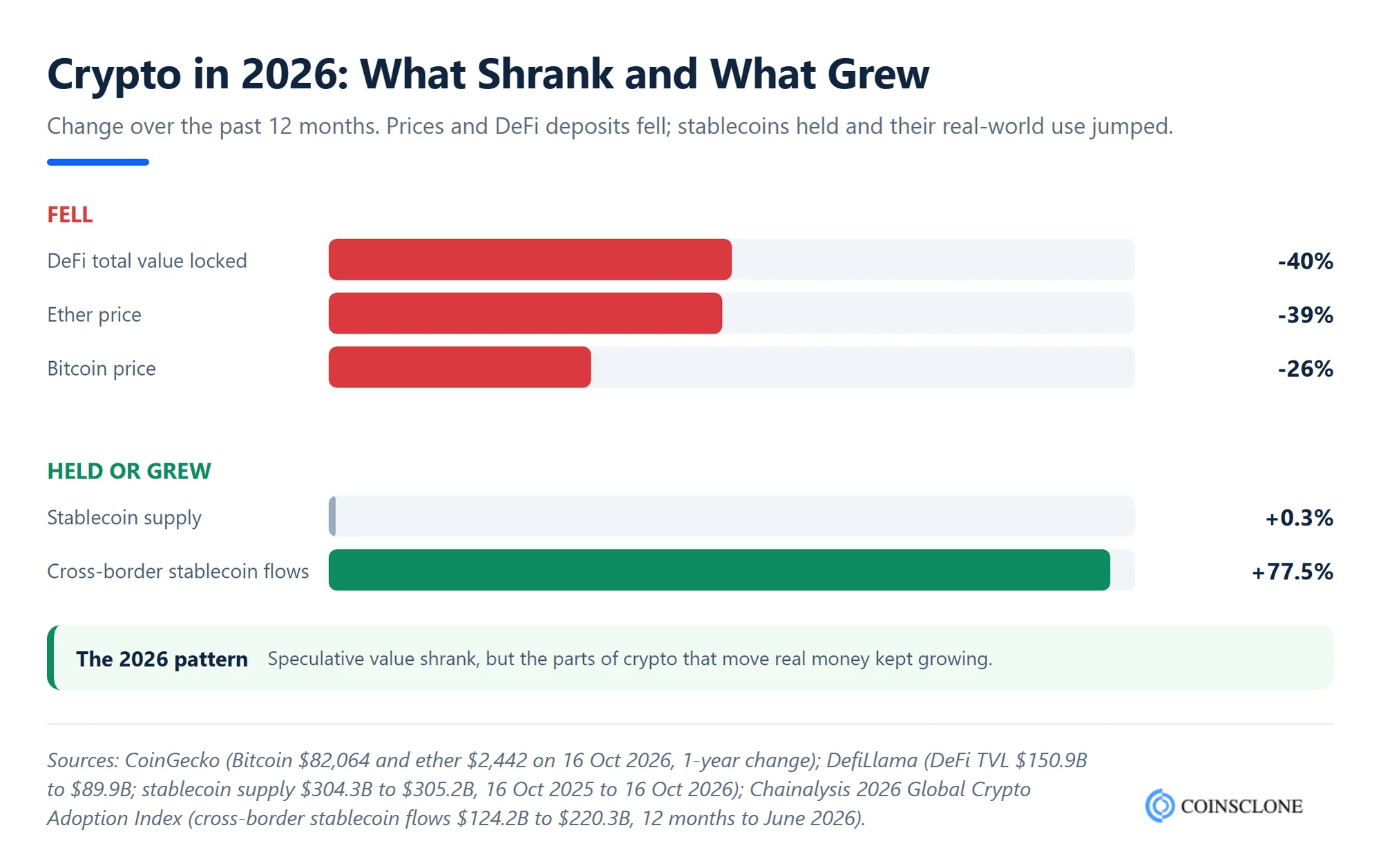
So, prices and DeFi fell, but stablecoins held their ground, and money sent across borders in them grew by more than three quarters. With that picture in mind, here are the 11 trends.
1. Stablecoins Become Crypto’s Payment Rail
Stablecoins are the part of crypto that kept growing in 2026. Supply stood at $305.2 billion on 16 Oct 2026, per DefiLlama. Tether’s USDT led with $183.4 billion and Circle’s USDC followed with $72.8 billion.
The bigger story is use, not size. Cross-border stablecoin flows rose 77.5% to $220.3 billion in the 12 months to June 2026, Chainalysis found. That growth came while the wider market shrank. In short, people and firms use stablecoins to send dollars, pay staff and settle trades, not just to trade.
Rules are also catching up. The US GENIUS Act takes effect in January 2027, and the OCC plans to finish its rule by November 2026. That opens a licensed path for new US issuers.
- For users: cheaper and faster transfers, mostly in dollars.
- For builders: demand for issuance, reserve reporting and wallet tools. See how we build stablecoins.
2. Tokenized Real-World Assets Go Live
Tokenization means putting bonds, funds, credit or property on a blockchain as tokens. It has moved past pilots. Tokenized real-world assets held $39.18 billion of value on 16 Oct 2026, with 5.26 million holders, per rwa.xyz. Holders rose 16.3% in 30 days.
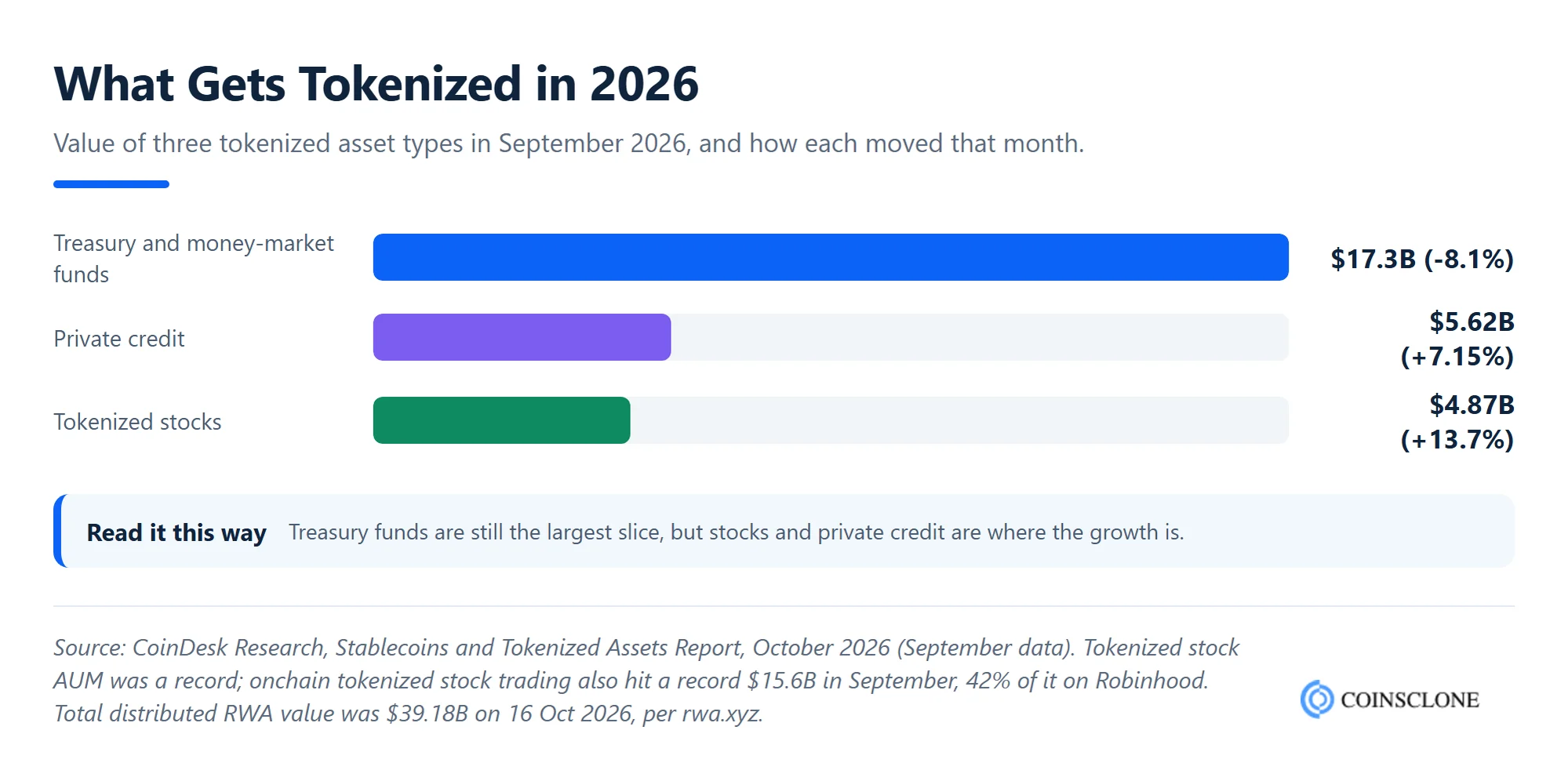
The mix is shifting, too. In Sept 2026, tokenized treasury and money-market funds fell 8.1% to $17.3 billion. Private credit rose 7.15% to $5.62 billion, per the CoinDesk stablecoins and tokenized assets report.
- Why it matters: funds and lenders get 24/7 settlement and a wider pool of buyers.
- For builders: issuers need compliant token standards, investor checks and a trading venue. Our RWA tokenization platform guide covers the build.
3. Tokenized Stocks and 24/7 Trading
Tokenized stocks are the fastest-growing slice in that data. Onchain trading in them hit a record $15.6 billion in Sept 2026, and Robinhood handled $6.57 billion of it, a 42% share, per CoinDesk. Assets held in tokenized stocks also hit a record $4.87 billion.
US rules opened the door. On 17 Sept 2026, the SEC issued a five-year Innovation Exemption that lets new venues trade tokenized stocks. Weeks later, OKXICE, a joint venture of OKX and NYSE owner ICE, filed plans for a 24/7 tokenized venue for more than 60 US stocks.
- What changes: stock trading that never closes, with faster settlement.
- What to watch: each venue still needs approvals, and listed firms get a window to object.
4. Prediction Markets Go Mainstream, and Face Lawsuits
Prediction markets let people trade on the outcome of events, from elections to sports. They became one of 2026’s biggest stories. Kalshi traded $37.17 billion in August 2026 and Polymarket $8.16 billion, The Block reported. Both were down from July, when the World Cup drove record volume.
Growth brought pushback. On 24 Sept 2026, New York’s Attorney General and Governor sued Polymarket, saying it runs illegal gambling without a licence.
- Lesson: demand is real, but every new market needs geofencing, KYC and a clear licence plan.
- For builders: see how a Polymarket clone script works and what it takes to launch one legally.
5. Crypto Exchanges Face a Licence Test
Back in late 2024, Bitcoin’s run to $95,000 after the US election pushed many founders to plan an exchange. In 2026, the question is less “when” and more “under which licence”.
- Europe: MiCA’s transition period ended on 1 July 2026, so exchanges serving EU users now need full approval. Our guide to a MiCA-compliant crypto exchange covers the steps.
- United States: the CLARITY Act stalled in the Senate in Sept 2026. On 5 October, the CFTC proposed two rules, CTX and CAM, a new route for leveraged retail crypto trading, with 60 days for comments.
So, starting a crypto exchange platform is still a strong business model, but the licence now shapes the product. Coinsclone builds white label exchanges in about 4 to 6 weeks, or 7 to 10 weeks with fiat rails.
6. AI Agents Start Trading and Paying
AI is moving from chat to action. On 29 Sept 2026, Robinhood announced Robinhood Agents, an AI agent that can research, build strategies and place trades within limits the user sets.
AI agents are also starting to pay for things with stablecoins. The x402 payment standard moved about $24 million over 30 days in July 2026, CoinDesk reported. However, one Coinbase estimate said 25% to 30% of that may have been users chasing leaderboards, so real demand is still early.
- For traders: more tools that act on your behalf, so spending limits and approvals matter.
- For builders: exchanges now need agent-ready APIs, risk limits and fraud checks. Our list of crypto trading bots shows how this space is evolving.
7. Institutions Come In Through ETFs
Big money keeps arriving through regulated funds. US spot Bitcoin ETFs took in $2.65 billion net in Sept 2026, and spot ether ETFs took in $832.43 million, per The Block.
As a result, Bitcoin holds 59.3% of total crypto market value, per CoinGecko. Institutions mostly buy Bitcoin and ether, so smaller tokens get less of the new money.
8. DeFi Shrinks in Dollars but Grows Up
DeFi apps held $89.9 billion on 16 Oct 2026, down from $150.9 billion a year earlier, per DefiLlama. That 40% drop is close to ether’s 39% price fall over the same period, since most DeFi deposits are held in crypto. Ethereum still held about 56% of all DeFi value.
The sector is also maturing. Some older apps are closing, such as Balancer, whose wind-down was approved on 29 Sept 2026. New money now goes to lending, stablecoin yield and tokenized assets. Apps also run on Solana, Base, BNB Chain and other networks, so Ethereum is no longer the only option.
- Real-world assets in DeFi: tokenized treasuries and credit now serve as collateral in lending apps.
- Deep dive: our DeFi trends guide covers this sector in detail.
9. Security Becomes the Product
Hacks remain the biggest risk in crypto. On 24 Sept 2026, Bitget lost about $352 million from hot wallets, CoinDesk reported. Its CEO said user funds were safe, backed by a protection fund of over $464 million.
A newer worry is quantum computing. On 24 Sept 2026, EU financial watchdogs warned of quantum risk to blockchain encryption. The European Commission wants member states to start moving to quantum-safe systems by the end of 2026.
- For exchanges: cold storage, multi-party signing and withdrawal limits are now expected, not optional. See how to build a non-hackable crypto exchange.
- For wallets: plan an upgrade path for quantum-safe keys.
10. Crypto Payments Reach the Checkout
Merchant payments are finally moving, led by stablecoins. In June 2025, Shopify, Coinbase and Stripe launched USDC payments on the Base network, with Stripe turning USDC into local cash for merchants who want it.
This is why the need for secure crypto payment gateways keeps rising. Merchants want stablecoin checkout, instant conversion to local money, tax reports and fraud checks in one place. Hence, creating a crypto payment gateway is now a mainstream business idea rather than a niche one.
- Must-have features: a simple checkout, auto tax reports, and payouts in fiat or stablecoins.
- Timeline: a standard Coinsclone payment gateway takes about 6 to 9 weeks, or 10 to 14 weeks with settlement.
11. NFTs Move From Art to Real Use
NFTs are tokens that prove ownership of one item, such as art, a ticket or a game asset. The art boom is over. Nifty Gateway, Foundation, MakersPlace and KnownOrigin have all closed, and OpenSea now charges a 1% fee.
What remains is utility. NFTs now act as tickets, memberships, in-game items and proof of ownership for tokenized assets. Play-to-earn gaming has cooled, but games that are fun first still use NFTs for items players truly own.
- For builders: niche, utility-led markets beat broad art platforms. See how to build an NFT marketplace for a niche.
Crypto Trends That Cooled Off in 2026
Not every trend from past forecasts came true. These ideas lost steam, so treat them with care.
- Green crypto tokens: Ethereum already cut its energy use by about 99.95% when it moved to proof of stake in 2022. As a result, “green” alone no longer sets a token apart.
- Play-to-earn games: games built only around token rewards lost players once rewards fell.
- A US central bank coin (CBDC): a January 2025 order bars US agencies from making one. Private, regulated stablecoins took that role instead.
- Fast CBDC rollouts elsewhere: the digital euro is not live yet. A pilot is planned for 2027, and a first issue could follow in 2029 if EU law passes.
Reaching people without bank accounts is still a real goal. In 2026, though, it is mostly arriving through stablecoin wallets and cheap transfers, not central bank coins.
What These Crypto Market Trends Mean for Your Business
For founders, each trend points to a product. The right one depends on the users and licences you already have.

| Trend | What you can build | Key need in 2026 |
| Stablecoin payments | Payment gateway or stablecoin wallet | Licensing under GENIUS or MiCA |
| Tokenization | RWA issuance and trading platform | Investor checks and transfer rules |
| Prediction markets | Event-contract or prediction platform | Geofencing and a licensed partner |
| Exchange licensing | White label or custom exchange | MiCA, VARA or US registration |
| AI agents | Agent-ready trading APIs and bots | Spending limits and fraud checks |
| Security | Custody and wallet upgrades | Multi-party signing, quantum plan |
If you are a crypto investor rather than a founder, the same trends help you read the market. Our list of the best cryptocurrencies explains how to judge projects, but always do your own research before you buy.
How We Checked These Numbers
Every figure in this article carries a date. Market, price and coin counts come from CoinGecko, DeFi and stablecoin data from DefiLlama, tokenized asset value from rwa.xyz, and asset mix from CoinDesk research. News items link to the original report. We checked all of them on 16 Oct 2026. Crypto data changes daily, so check the live trackers before you act on any number.
To Conclude
The crypto market in 2026 rewards real use over hype. Stablecoins, tokenization, prediction markets and licensed exchanges are growing, while prices and DeFi sit below last year’s highs. That gap is exactly where new businesses can win.
As a new start, you can begin with a crypto business idea that fits one of these trends. We at Coinsclone have built crypto products since 2018, with 350+ platforms delivered for 200+ clients across 20 industries. We build crypto exchanges, tokens, DEX platforms, ICO and STO platforms, crypto wallets and payment gateways.
Our team offers 24/7 support and ongoing maintenance after launch. Feel free to get a free quote for your crypto business, and talk to our business team to start your journey.
Frequently Asked Questions
What is the current crypto trend?
The strongest trend in October 2026 is real-world use. Stablecoin supply is $305.2 billion (DefiLlama, 16 Oct 2026), and tokenized assets hold $39.18 billion (rwa.xyz). Prediction markets and tokenized stocks are also growing fast.
What is the crypto market trend today?
On 16 Oct 2026, the total crypto market was worth about $2.78 trillion, per CoinGecko. Bitcoin traded near $82,000, about 35% below its October 2025 high, and held 59.3% of total market value. For live numbers, check CoinGecko or DefiLlama, since prices move every minute.
What is the next crypto trend?
The trends gaining speed now are AI agents that trade and pay with stablecoins, 24/7 tokenized stock trading, and licensed stablecoin issuers under the GENIUS Act from 2027. These are early signals, not price predictions.
What is the bitcoin trend now?
Bitcoin was down about 26% over the 12 months to 16 Oct 2026, per CoinGecko, but US spot Bitcoin ETFs still took in $2.65 billion net in Sept 2026. In other words, prices fell while institutional buying continued. This is not financial advice.
Also Read : Ways to Earn Bitcoin For Free