
Telegram changed a lot of names this year. In June 2026 Toncoin became Gram. On 28 September 2026 the old Wallet in Telegram was renamed Walt, and Telegram now rolls out its own Gram wallet. So if you want to accept crypto payments in a Telegram bot, half the tutorials you find now point to names and links that no longer match.
The rules matter more than the names, though. Telegram’s developer terms say digital goods sold in a bot must be paid in Stars. Crypto still has a clear place, but you need to know where. This guide compares the three routes, then shows the payment flow, real fees, common traps and what a custom build takes.
In this guide:
- The rule first: digital goods inside Telegram must use Stars. Physical goods and real-world services can use cards or crypto.
- Mini Apps are TON only: any Mini App with crypto features must use TON and TON Connect. Plain bots without a Mini App are exempt.
- Fees differ a lot: a USDT transfer on TON costs about 0.001 Gram, while Apple and Google keep 30% of Stars bought in their stores.
- Access can be automatic: a one-use invite link after payment, and removal at expiry, end manual checks and fake screenshots.
- Building your own gateway: published 2026 agency cost guides put a white label crypto payment gateway at $20,000 to $60,000.
How to Accept Crypto Payments in a Telegram Bot
To accept crypto payments in a Telegram bot, you pick one of three routes. Which one you can use depends on what you sell, not on which coin you like. Here is how they compare in October 2026:
| Route | Best for | Fees | KYC for you | Payout | Auto-access |
| Telegram Stars | Digital goods and paid access inside Telegram (required) | App-store buyers pay 30% more; Telegram sets the value per Star | No separate check | Rewards in Gram via Fragment, after up to 21 days | Built in, including 30-day subscriptions |
| USDT or Gram on TON, own wallet | Physical goods, services, B2B invoices, Mini App crypto features | About 0.001 Gram per USDT transfer, paid by the buyer | None from a provider | Instant, to your wallet | You build it |
| Gateway API (Walt Pay and others) | Teams that want checkout without running a chain watcher | A percentage per payment, set by the provider | Yes, KYB or KYC review | Held for a set time, then paid out | Webhook tells your bot |
| Your own gateway | Selling payments to many Telegram merchants | Your own fee model | You become the regulated party | You control it | You build it once for all clients |
Fees are not the main choice, though. The rule is. So start there.
Telegram’s Payment Rules in 2026: What You Can Sell for Crypto
Telegram splits payments into two groups.
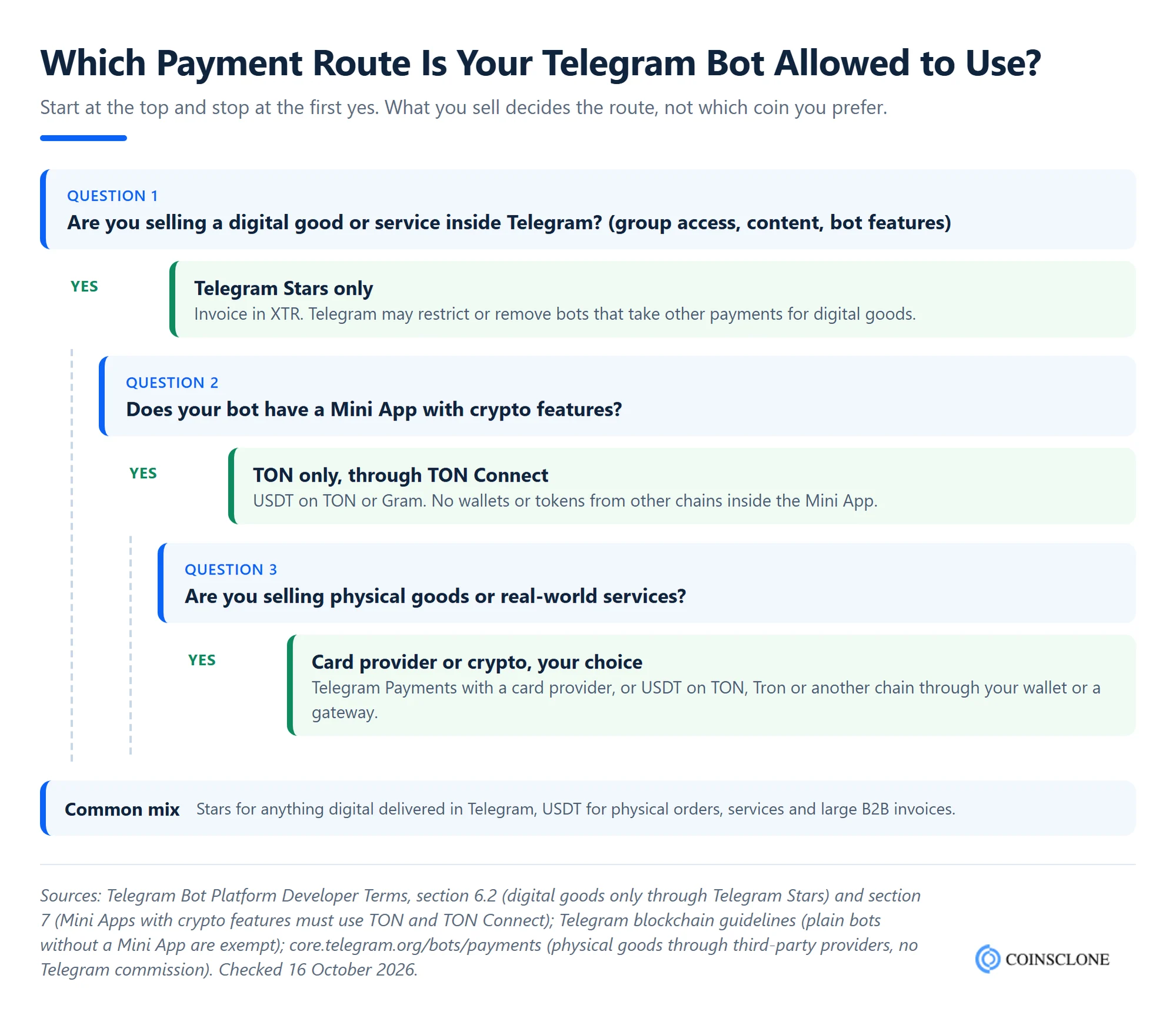
Digital goods and services must use Stars. The Stars payments guide says all such sales use the currency code XTR, and other currencies, providers and crypto are not allowed. This covers paid group or channel access, content, courses, bot features and in-app items. The reason is app store rules, since Telegram follows Apple and Google’s idea of digital goods. Under section 6.2 of the terms, a bot that takes other payments for them first gets a notice. If it does not comply, Telegram can hide it from store versions of the app or remove it.
Physical goods and real-world services are open. The payments guide for physical goods lists more than 20 card providers. Telegram takes no commission there, and each payment must be roughly $1 to $10,000. Here you can also take crypto through your own wallet or a gateway.
Mini Apps with crypto features are TON only. Section 7 of the terms says any Mini App with crypto features, in the app itself or in its connected bot, must use The Open Network. The blockchain guidelines add that wallets must connect through TON Connect, and that apps on other chains had to move by 21 February 2025. They also say plain bots that have no Mini App are exempt. That is why a chat-only bot can still take USDT on Tron for physical orders.
A note on paid groups: many no-code bots still sell group access for crypto. That works today, but the risk sits with you, not the tool. If the bot is your business, use Stars for in-Telegram access.
Route 1: Telegram Stars, the Built-In Option
Stars are the simplest route for digital goods because Telegram runs the checkout. Here is the flow the Bot API uses:
- Send an invoice: call `sendInvoice` with currency `XTR` and an empty `provider_token`.
- Confirm the order: Telegram sends a `pre_checkout_query`. Your bot must answer it within 10 seconds, or the payment is cancelled.
- Wait for proof: deliver only after the `successful_payment` update arrives. Answering the query alone does not mean you were paid.
- Store the charge ID: keep `telegram_payment_charge_id`, because you need it to refund with `refundStarPayment`.
- Handle support: every bot that sells must answer the `/paysupport` command.
Subscriptions are built in too. The Bot API allows a 30-day period only, priced from 1 to 10,000 Stars. Channels can use a subscription invite link, so Telegram itself adds and removes paying members.
Getting paid out is slower. Stars become rewards you can withdraw in Gram through Fragment. The developer terms say Stars may take up to 21 days to become available. Also, Apple and Google keep 30% of Stars bought in their stores, as Pavel Durov said at launch. Buyers who buy Stars through Telegram’s @PremiumBot skip that app-store cut.
Route 2: USDT or Gram on TON, Straight to Your Wallet
This is the route most forum posts ask about. Money lands in your own wallet, and no provider holds it. The TON website lists about 0.00039 Gram per Gram transfer and about 0.001 Gram per USDT transfer, fixed no matter how busy the network is. TON’s payment docs say a payment is final after one block, usually within about 1 second.
The hard part is not taking the money. It is knowing who paid. TON’s payment processing guide describes two ways to match a payment to an order:
| Method | How it works | Good | Watch out |
| One address + order comment | Every buyer pays the same wallet and adds the order ID as a comment | One wallet to watch, easy payouts | A missing or wrong comment needs a manual fix; one key guards all funds |
| One address per buyer | Each order gets its own deposit address | No comment needed, risk split across wallets | More wallets to deploy, track and sweep |
For a bot, the first method usually wins. The bot fills in the address, amount and order ID in the payment link, so the buyer cannot forget the comment. A Mini App sends the same request through TON Connect.
Check the token, not its name. USDT on TON is a jetton, and anyone can deploy a fake one with the same name and logo. TON’s jetton guide says to always check the jetton master address against an allowlist. The real USDT master on TON is `EQCxE6mUtQJKFnGfaROTKOt1lZbDiiX1kCixRv7Nw2Id_sDs`, which held about 1.43 billion USDT in mid-October 2026.
What about USDT on Tron? Many buyers hold USDT on Tron, and a plain bot may accept it for physical goods. But Tron has no comment field, so you need one address per order. Fees are higher too. At Tron’s current energy price, a USDT transfer burns about 6.5 TRX, or about $2.20 in mid-October 2026. A transfer to a fresh address costs about twice that, and you pay again when you sweep funds out.
Route 3: A Gateway API Such as Walt Pay
A gateway watches the chain for you and sends your bot a webhook when an order is paid. The best known one inside Telegram is Walt Pay, the merchant side of the renamed Wallet. Its API docs show how it works:
- Onboarding: log in with Telegram, fill in a form and pass a KYB or KYC check. You see your fee only after approval.
- Assets: buyers pay in Gram (still coded as TON), NOT, BTC or USDT. You can price in USD or EUR and choose auto-conversion.
- Orders: each order lasts from 30 seconds to 10 days and is linked to the buyer’s Telegram user ID.
- Webhooks: you get ORDER_PAID or ORDER_FAILED from two fixed IP addresses, and you must check the signature.
- Payout: funds are held for 48 hours by default, then move to your Walt account.
Other options include CryptoBot’s Crypto Pay API, membership bots and multi-chain gateways. Check each fee before you commit. CoinPayments, which many membership bots use, now charges 3% and left the EU on 1 July 2026. If you also take crypto on a website, our guide on how to integrate a crypto payment gateway covers the plugin and API steps.
How the Payment Flow Works, From Order to Group Access
On every route, the bot turns a payment into access, then removes access when it ends. Here is the flow for a self-hosted USDT checkout:
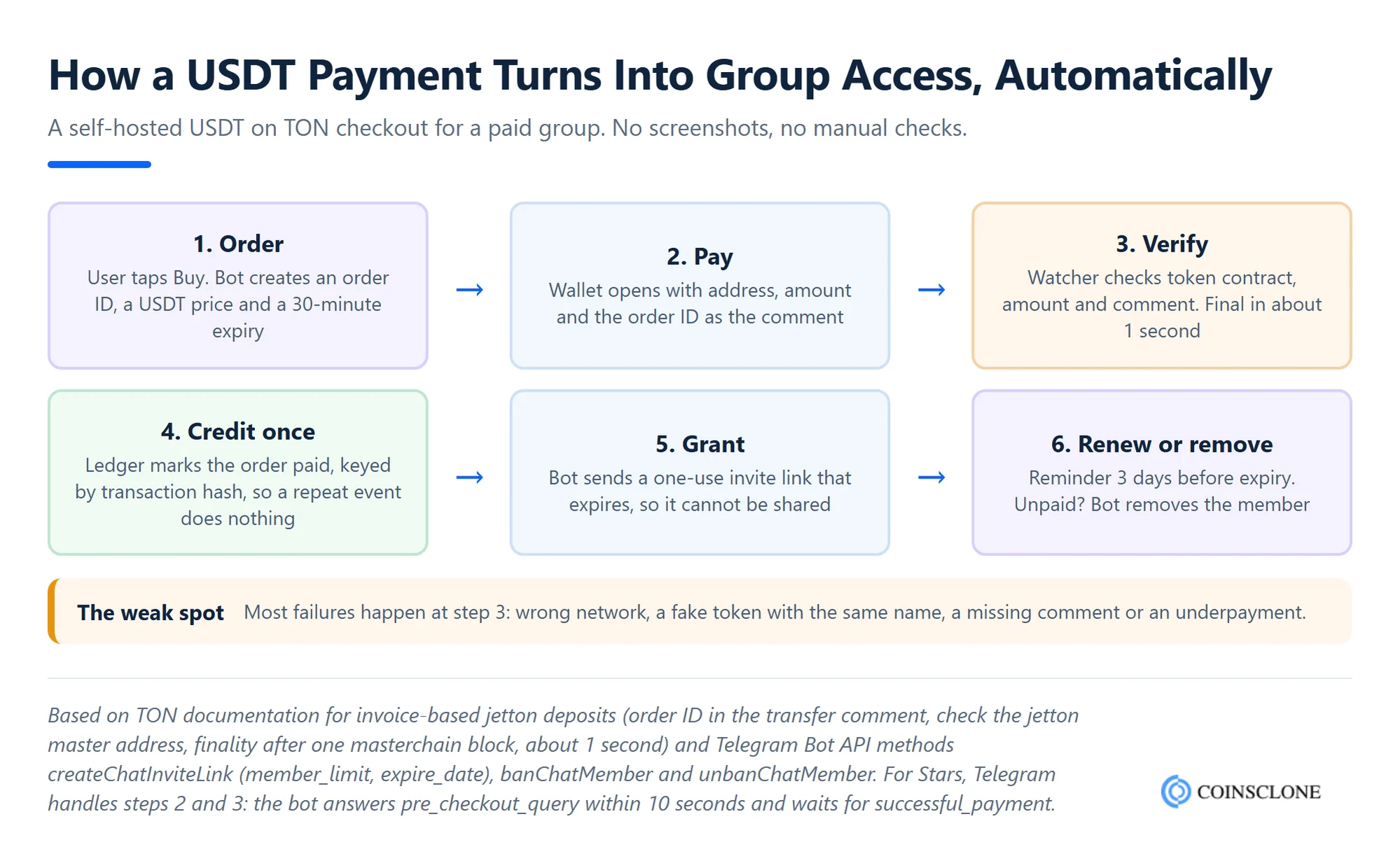
- Create the order: store the user ID, plan, USDT price, order ID and a 30-minute expiry.
- Show the payment link: fill in address, amount and order ID, so the buyer only taps Confirm.
- Verify on chain: check the jetton master, the amount and the comment. Reject anything that does not match.
- Credit once: save the transaction hash, so a repeat event cannot credit the order twice.
- Grant access: call `createChatInviteLink` with `member_limit` set to 1 and a short `expire_date`, then send it to the buyer.
- Renew or remove: remind the member before expiry. If they do not pay, call `banChatMember` and then `unbanChatMember`, which removes them but lets them rejoin later.
Worked example. Say you sell 500 memberships at $20 each, so $10,000 a month. Here is what the fees look like on each route:
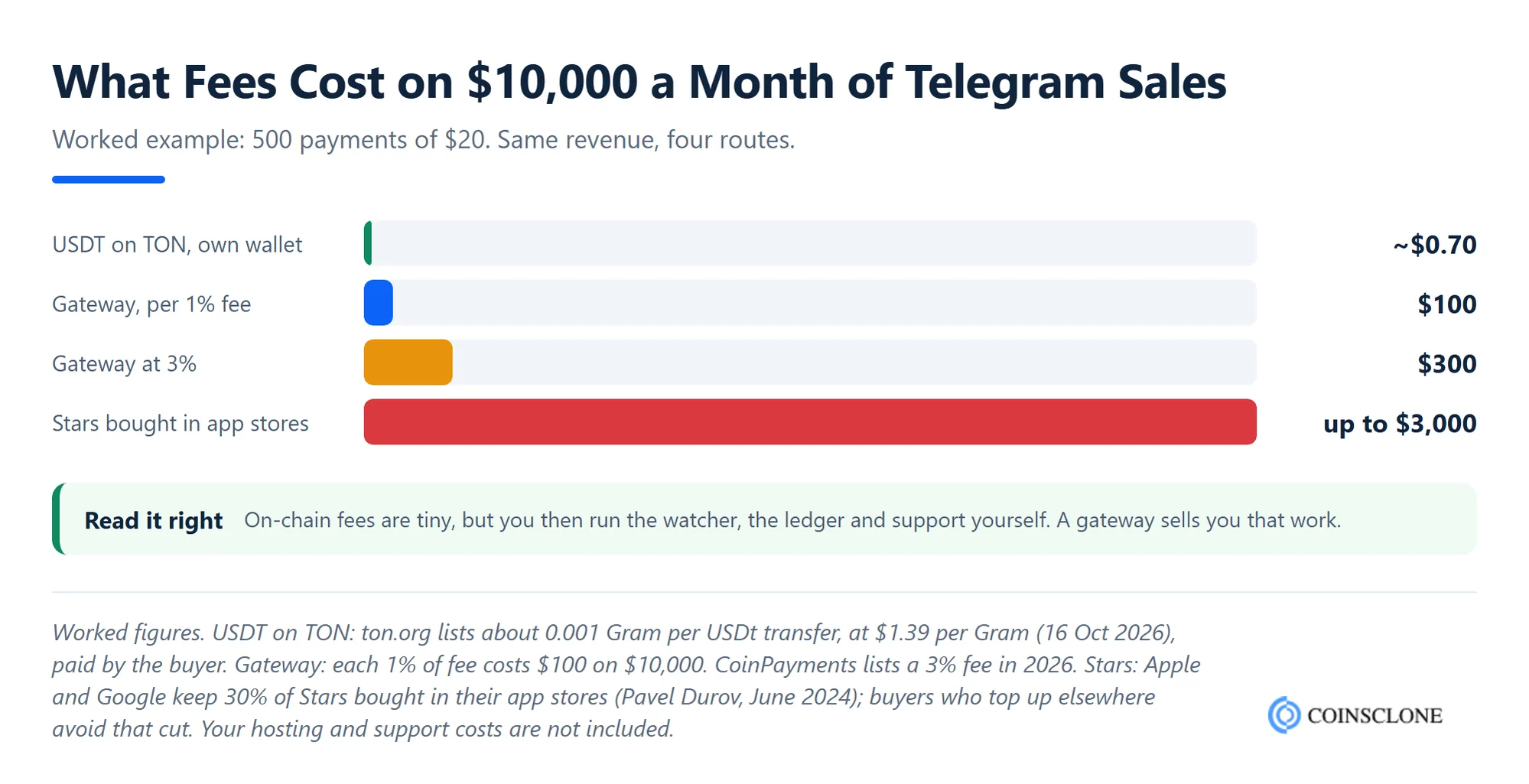
The on-chain route looks almost free, at about $0.70 in network fees, and buyers pay that. But you then run the watcher, the ledger and support. Each 1% of gateway fee costs $100, so a 3% gateway costs $300. Stars cost you nothing directly, but if buyers top up in app stores, up to $3,000 of their spend goes to Apple and Google. So the real question is how much work you want to own.
Launch Crypto Checkout Inside Telegram
Telegram Crypto Payment Gateway Development — done right.
- Bot Checkout: USDT, Gram and Stars invoices with automatic group and channel access.
- TON Connect Ready: Mini App payments that follow Telegram’s TON-only rules.
- Chain Watcher and Ledger: token checks, one-time crediting and clean payment records.
- Merchant Dashboard: plans, renewals, refunds and payouts for one store or many merchants.
Get a working demo of your Telegram payment flow with your branding applied.
Book a Free Demo to see how your bot can take crypto payments and grant access on its own.
Traps Forum Users Keep Hitting
The same problems keep coming up in Reddit threads from paid group owners:
- “I paid” plus a screenshot: a screenshot proves nothing. Only an on-chain check or a provider webhook should unlock access.
- Wrong network: on EVM chains one address works on many networks, so a buyer can send USDT on BNB Chain to an address you only watch on Ethereum. Name the network in bold.
- Fake tokens: a fake “USDT” jetton passes a name check. Always check the master address.
- Short payments: some exchanges take their fee out of the amount sent. Set a small tolerance and send a top-up link.
- Shared invite links: a plain link gets posted in other groups. Use one-use links that expire.
- Funds held by a provider: custodial tools can hold or freeze balances. Move what you earn to a wallet you control.
- A leaked bot token: whoever has it can act as your bot. Keep it in a secrets store and rotate it if it leaks.
Build It Yourself, Use a Gateway, or Have It Built?
Your choice depends on volume and on what you want to own:
| Option | Who it suits | What you own | Main limit |
| No-code membership bot | A single creator testing demand | Almost nothing | Provider fees and their rules |
| Gateway API in your own bot | A store or community with steady sales | Bot logic and customer data | Provider KYC, holds and fees |
| Custom self-hosted checkout | High volume, crypto-native buyers | Watcher, ledger, wallets | You run security and support |
| Your own Telegram payment gateway | A business selling payments to other merchants | The whole stack and fee model | Licensing and a bigger build |
The last option is a real business. Many paid communities, shops and Mini Apps run on Telegram, and their owners want a gateway built for it. Published 2026 agency cost guides put a crypto payment gateway at $20,000 to $60,000 white label, $40,000 to $100,000 custom, and $100,000 to $300,000 or more built from scratch. See our full crypto payment gateway cost breakdown for what drives those numbers.
Coinsclone has been building since 2018 and has delivered 350+ platforms for 200+ clients across 20 industries. Our crypto payment gateway development page lists 6 to 9 weeks for a standard gateway. With conversion and payouts, it takes 10 to 14 weeks. We can add the Telegram bot, Stars billing and TON Connect checkout on top.
Licences and Rules Beyond Telegram
Telegram’s rules are only half the picture. The rest depends on your role:
- You sell your own goods: taking crypto usually needs no crypto licence, but you still owe tax and must keep records.
- You process payments for others: holding or moving crypto for other merchants usually makes you a regulated firm. In the EU that means a MiCA licence, since the last transition periods ended on 1 July 2026. In the US it usually means money transmitter rules.
Our guide to crypto licences explains the main options by country. If you plan to settle mostly in USDT or USDC, our stablecoin payment gateway guide covers settlement rails in more depth.
What to Prepare Before You Talk to a Developer
A clear brief saves weeks. Before a scoping call, write down:
- What you sell: digital access, physical goods or services. This sets the Stars or crypto rule.
- Bot or Mini App: if a Mini App will touch crypto, it must be TON only.
- Assets and networks: for example USDT on TON and Tron, plus Stars.
- Volume: payments a month and average size.
- Access logic: plans, renewals, grace days and what happens when payment fails.
- Custody: your own wallet, a provider, or a gateway you run for others.
- Markets: where buyers and merchants live, for licence and tax checks.
If you are building a trading bot rather than a checkout, see our guide to Telegram trading bot development instead. And if your Mini App is a game, our Hamster Kombat clone script page shows how a tap-to-earn app is put together.
Frequently Asked Questions
Can a Telegram bot accept crypto payments?
Yes, but only for some things. Telegram’s terms say digital goods sold in a bot must be paid for in Telegram Stars. For physical goods and real-world services, a bot can take crypto through your own wallet or a gateway API.
Do I have to use Telegram Stars?
You must use Stars for digital goods and services sold inside Telegram, such as paid group access, content or bot features. Telegram may warn, restrict or remove bots that use other payment methods for these. Physical goods can use card providers or crypto.
How do I accept USDT in a Telegram bot?
Create an order with an ID, send the buyer a payment link with your address, the amount and the order ID as a comment, and watch your wallet for the transfer. On TON, check the jetton master address, the amount and the comment before you credit the order. A gateway API can do the watching for you and send a webhook instead.
Is there a free Telegram payment bot?
Some membership bots are free to start, but they take a fee per payment, and so does the provider behind them. Telegram takes no cut on physical goods. With Stars, Apple and Google keep 30% of Stars bought in their stores.
Is there a Telegram crypto payment bot on GitHub?
Yes, many open-source bots on GitHub show how to listen for USDT or TON payments. They are good for learning, but check that they verify the token contract, handle repeat events and keep keys out of the code. Older ones may still point to the Wallet Pay API, which now runs at pay.walt.io.
How do I withdraw Telegram Stars from my bot?
Stars you earn become rewards that you can withdraw in Gram through Fragment, Telegram’s partner platform. Telegram’s terms say Stars may take up to 21 days to become available. You can also spend Stars on Telegram Ads for your bot.
Can I accept crypto in a Telegram Mini App?
Yes, but only on TON. Since February 2025, Mini Apps with crypto features must use the TON blockchain and connect wallets through TON Connect. Wallets and tokens from other chains are not allowed inside the Mini App.
How does a bot give access to a private group after payment?
After the payment is confirmed, the bot creates a one-use invite link with a short expiry and sends it to the buyer. When the plan ends without renewal, the bot removes the member. For Stars, Telegram’s subscription invite links can do this for you on a 30-day cycle.