
This guide explains what a Zerion wallet clone script is and how to use one to launch your own DeFi portfolio wallet in 2026. First, we look at what the real Zerion wallet does today, with its latest numbers. Then we walk through how a clone works, from the moment a user imports a wallet to the moment a swap lands on the chain.
By the end, you will know which features to build, how the wallet earns money, what the build and the monthly data bill cost, and how long it takes to launch. We also cover a choice most guides skip: buying a clone script, building on the Zerion API, or forking open-source code.
In this guide:
- What Zerion offers in 2026: 66 chains, 10M+ wallets and 4,500+ DeFi protocols
- How a Zerion-style wallet reads balances, prices positions and routes swaps
- The user and security features to build, plus a current tech stack
- Cost ranges, launch timelines (3 to 5 weeks white label, 8 to 12 weeks custom) and data API costs
- Real fee benchmarks and a worked revenue example
What Is a Zerion Wallet Clone Script?
A Zerion wallet clone script is ready-made software that copies the core features, user flow and design ideas of the popular Zerion DeFi wallet. You launch it under your own brand. The software comes ready to deploy, so you can go live fast and still customize and scale it later.
Like Zerion, the clone acts as a single window into DeFi. It gathers balances and activity across many chains and protocols, makes token swaps simple, and turns scattered DeFi tools into one easy product. As a result, a user sees tokens, NFTs, loans and staked assets on one screen instead of ten apps.
At its core, a Zerion DeFi wallet clone should offer:
- Real-time portfolio tracking: total net worth, profit and loss, and every DeFi position in one view.
- Self-custody: private keys stay on the user’s device, never on your servers.
- Built-in swaps and bridges: routed through DEX aggregators for the best price.
- Multi-chain support: EVM chains and Solana from one seed phrase.
- Reliable data: a data layer that keeps up with thousands of DeFi apps.
For firms planning a Zerion clone app, this route gives both speed and an edge over teams that start from a blank page.
See How Our MVP System Can Launch Your Wallet App Faster
Zerion Wallet Clone Script — done smarter.
- MVP System : Launch your Zerion-like crypto wallet 90% faster.
- Portfolio Intelligence: Real-time asset tracking, DeFi insights & price monitoring pre-integrated.
- Multi-Chain Ready: Access major networks, tokens, and DeFi protocols instantly.
- Brand & Customization : Complete UI customization, your token support, your revenue model.
- Revenue Engine : Earn from swaps, premium insights, ads & referrals.
Get a free branded demo of your Zerion-like wallet in just 48 hours — before you invest a cent.
Book a Free Demo to see how our Zerion Wallet Clone Script can turn your idea into a live product in 8-12 weeks.
What Is Zerion Today?
Zerion started as a DeFi portfolio tracker and grew into a full self-custody wallet. Today it runs as a mobile app, a web app and a browser extension. Here is where it stands in October 2026, based on Zerion’s own website:
- Scale: more than 10 million wallets, with a 4.8 rating on the App Store.
- Chains: 66 networks, such as Ethereum, Solana, Tron and Base.
- DeFi reach: it tracks holdings in more than 4,500 DeFi apps.
- Trading: swaps, bridges, perps, tokenized real-world assets and one-tap copy trading.
- Fees: according to Zerion’s fee guide, it charges a 0.67% service fee on swaps and bridges, and nothing to send or receive crypto.
- Premium plan: Zerion Premium costs $99 a year. It halves swap and bridge fees and adds profit and loss tracking for any wallet plus full history exports.
- Data API: Zerion also sells its wallet data to other apps. Its API covers 42 chains, and Kraken, Uniswap, MetaMask and Safe are listed as customers.
So the lesson for founders is clear. Zerion makes money from trading fees and paid plans, and it also sells the data layer that powers its own app. A clone can follow the same path.
Why Create a Crypto Wallet Like Zerion?
If you are working out how to create a crypto wallet with strong DeFi features, a Zerion-style wallet opens many business doors. DeFi is still large and spread out. Per DefiLlama, DeFi apps held about $96 billion in total value locked on 2 October 2026, spread over more than 8,000 apps. Users need one place to see and manage all of it, and that is exactly what this wallet does.
Here is why a pre-built Zerion wallet clone helps you enter the market:
- Faster time to market: Building a feature-rich, multi-chain wallet from scratch takes months. A white label clone can launch in about 3 to 5 weeks, because the core features are already built and tested. You mainly brand, test and deploy.
- Lower cost: Security, data indexing and swap routing take a large budget to build. Published 2026 agency cost guides put a white label wallet at roughly $10,000 to $80,000, against about $70,000 to $500,000 for a wallet built from scratch.
- Proven product design: You get a product that copies the tested features of Zerion, a well-known DeFi wallet and tracker.
- Full customization and branding: You control the UI, features, logo, chains and fee model, so the wallet matches your business goals.
- Lower technical risk: A tested codebase has fewer surprises than new code. As a result, you face fewer critical bugs at launch.
In short, the clone gives you a secure, scalable and flexible base. You can then spend your budget on marketing and growth instead of long backend work.
Clone Script, Zerion API or Open-Source Fork?
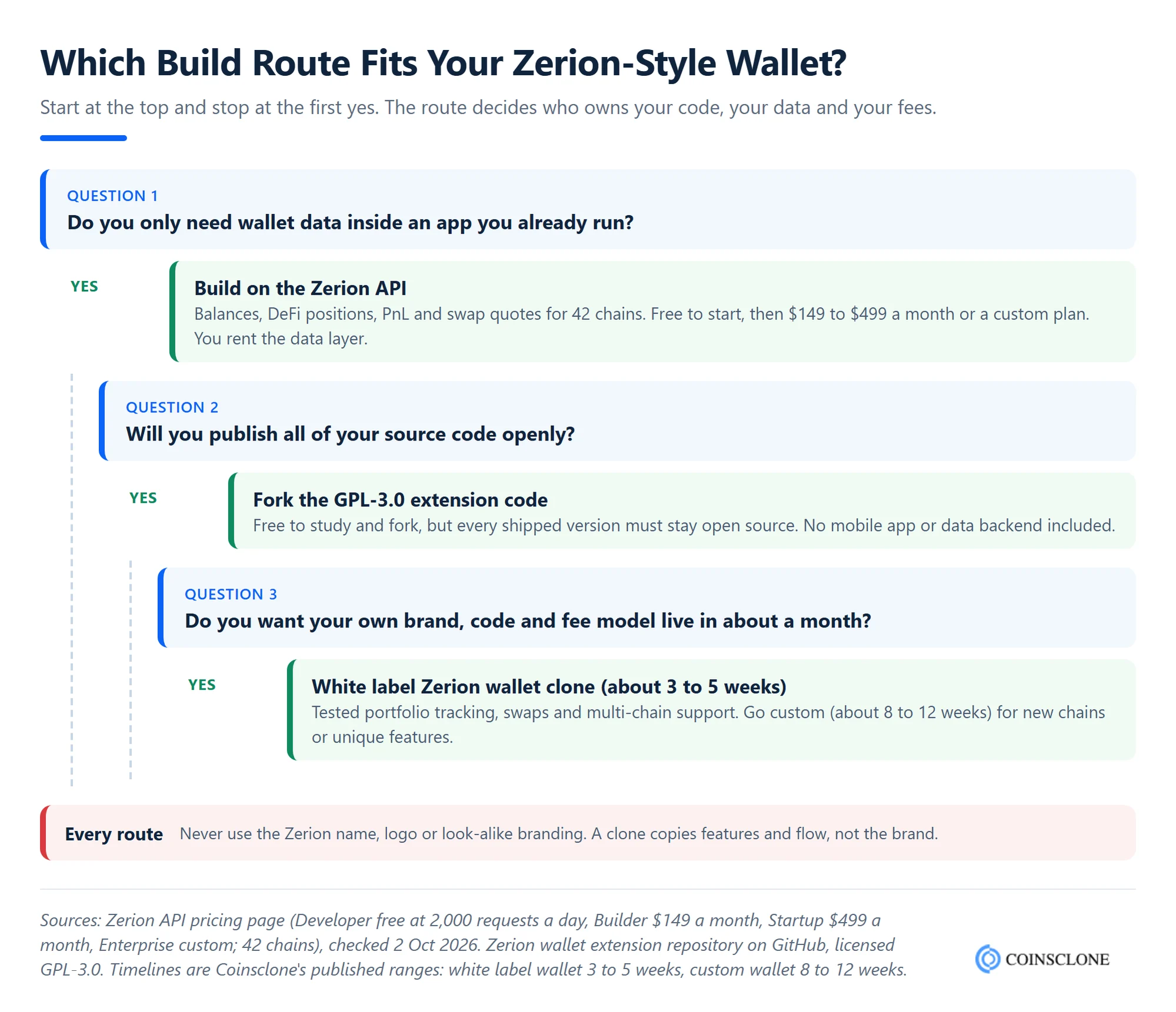
There are three ways to build a wallet like Zerion. Each one trades speed against control, so pick the route before you pick a vendor.
1. A Zerion wallet clone script. You buy or license a ready-made wallet with portfolio tracking, swaps and multi-chain support, then brand it. This is the fastest way to own the full product, including the code, the fee model and the user data.
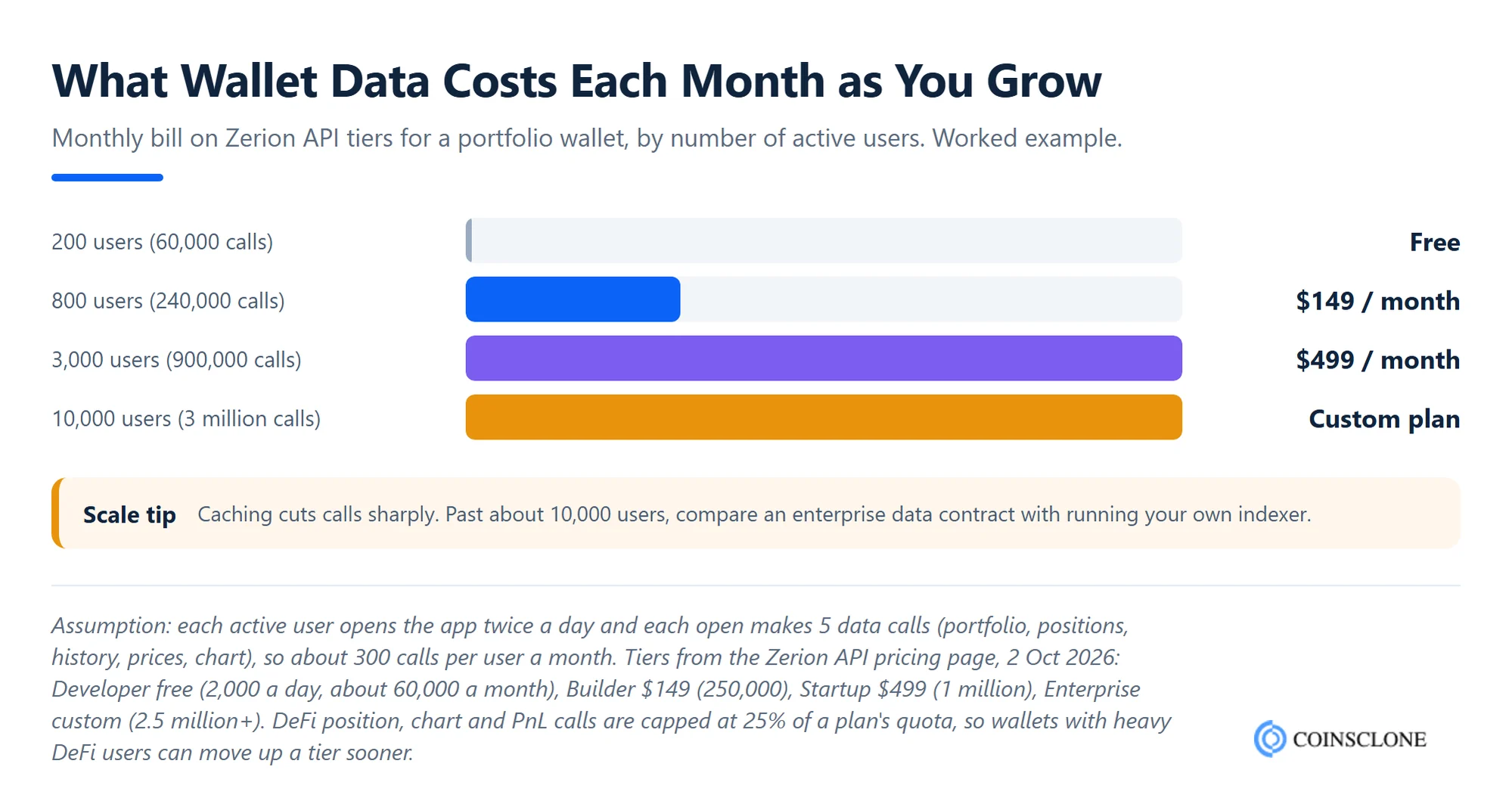
2. Build your own app on the Zerion API. Zerion sells the same wallet data that runs its app. The Zerion API returns balances, DeFi positions, transactions, profit and loss, NFTs and swap quotes for 42 chains in one call. A free tier allows 2,000 requests a day, the Builder plan costs $149 a month for 250,000 requests, and the Startup plan costs $499 a month for 1 million. Larger apps move to a custom Enterprise plan. This route saves you from running your own indexer, but you rent your core data from a rival wallet.
3. Fork the public code. Zerion has published its browser extension code on GitHub under the GPL-3.0 licence. You may study and fork it. However, GPL-3.0 means any version you ship must also be open source under the same licence, so you cannot keep your changes private. The licence also does not cover the mobile apps or the data backend.
Whichever route you choose, you cannot use the Zerion name, logo or look-alike branding. A “clone” copies features and user flow, not the brand. Your wallet needs its own name and design.
Why Choose Coinsclone’s White Label Zerion Wallet Software?
Our white label Zerion wallet clone script is a pre-built, fully working wallet for startups, small and mid-sized firms and enterprises in Web3. It copies the advanced features and smooth experience of Zerion, and you launch it as your own DeFi-focused crypto wallet.
As a white label crypto wallet software provider, we design both the user side and the admin side. You get a ready base that already includes DeFi portfolio tracking, multi-chain support and built-in token swaps. As a result, you skip long build cycles and move straight to branding: the UI, logo, themes, chains and fees. Coinsclone has delivered 350+ platforms for 200+ clients across 20 industries since 2018. Next, let’s look at how the wallet works.
How Does the Zerion Wallet Clone Script Work?
The Zerion wallet clone script works the same way as the Zerion wallet. To see the process, picture yourself as a user of the clone. Behind the screen, the wallet runs a series of steps to gather multi-chain data and show it in one place.
Above all, the process breaks down into three phases: setup, data gathering and interaction.
Wallet Creation or Import
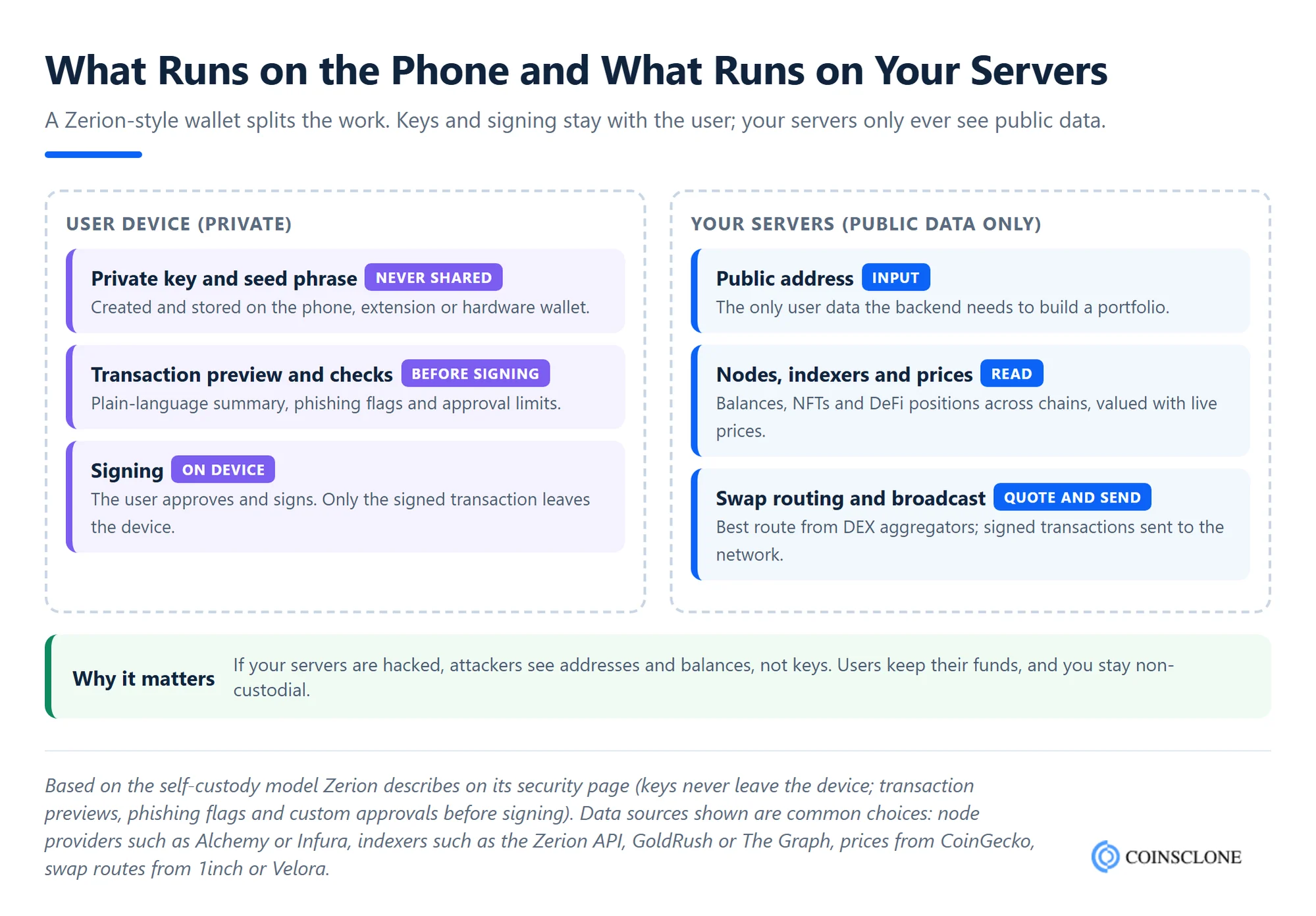
The user either creates a new self-custody wallet or connects one they already have. A new wallet creates a private key and seed phrase that stay on the user’s device. Or users can link a wallet they already use, such as MetaMask or a Ledger, through WalletConnect.
Authorization
Most importantly, the Zerion wallet clone never stores the user’s private keys or seed phrase. It only keeps the user’s public address so it can track activity. This keeps the wallet non-custodial and secure. To learn more about this split, read our guide on custodial vs non-custodial wallets.
Blockchain Node Connection
The backend connects to fast blockchain nodes on each chain the wallet supports, such as Ethereum and Solana. Most teams use node providers like Alchemy or Infura, or run their own RPC nodes.
Protocol Indexing
Next, the system uses indexers and DeFi data APIs to track thousands of DeFi smart contracts, such as DEXs, lending markets and staking pools. Common options are the Zerion API, GoldRush (once called Covalent) and The Graph. The indexer reads and stores this data all the time, so the dashboard loads fast.
This is where a ready-made Zerion wallet clone script adds value, because it already handles these links for you.
Cost-effective & Easy Deployment of the Zerion Wallet Clone SDK. Grab a Free Demo from our Technical Team Now!
Portfolio Mapping
As soon as a user opens the dashboard, the app sends the user’s public address to the indexers. The indexer then pulls all the on-chain data for that address, such as:
- Balances of ERC-20 and other tokens on every chain.
- NFTs (ERC-721 and ERC-1155) with their images and traits.
- Live DeFi holdings, such as Aave deposits, Uniswap pools and staked tokens.
Data Enrichment
The raw on-chain amounts are then matched with live price feeds, such as CoinGecko. This sets the current dollar value of each asset. In turn, the dashboard shows the total portfolio value and the profit and loss history.
Token Swapping
When a user asks for a token swap, the wallet does not trade right away. Instead, it asks DEX aggregators, such as 1inch or Velora (once called ParaSwap), for the best route, price and gas fee across many DEXs. The user then sees one clear quote.
Transaction Signing
After the user approves the quote, the wallet builds the unsigned transaction. Before signing, it shows a plain-language preview of what will leave and arrive. The user then signs with the private key stored on the device, or with a connected hardware wallet.
Broadcast
Finally, the backend sends the signed transaction to a node on the right network. It enters the mempool, and validators confirm it. The result then shows up on the user’s portfolio dashboard in real time.
In short, the clone makes advanced wallet features work with very little friction for the user. This leads to the key features startups and enterprises should include.
Core Features of Our Zerion Wallet Clone Script
Your Zerion wallet clone script should include the features that make the original work so well. These are the core features of a crypto wallet that help users manage assets safely, use DeFi with ease and move across chains smoothly. Let’s go through them one by one.
Portfolio Dashboard
One screen shows net worth, token balances, NFTs and DeFi holdings, such as staked tokens, pool shares and loans, on each chain.
Multi-Chain Wallet Support
The wallet supports major EVM chains, such as Ethereum, Base and BNB Chain, plus Solana. Users manage all of it with one seed phrase.
Token Swaps, Bridges and DEX Aggregation
DEX aggregators such as 1inch and Velora route each trade to the best rate with the lowest fees. A built-in bridge moves assets between chains without leaving the app.
NFT Management
Users can view, send and receive NFTs on every supported chain. The gallery shows images, traits and floor prices, and it hides spam NFTs by default.
Activity Feed
A simple feed shows each transfer, swap and DeFi action on each chain. It also explains each one in plain words, such as “Supplied 2 ETH to Aave”.
Address and ENS Search, Watchlists and Alerts
Users can “watch” any public address or ENS name to follow large holders or friends. They can also set alerts for big movements or new DeFi positions.
Advanced Analytics and DeFi Tools
Profit and loss for each holding, pool loss figures for liquidity providers, and gas tools help active users make better choices. These tools also make a natural paid tier.
Optional Add-On Modules
Zerion now offers perpetual trading, tokenized real-world assets and copy trading. You can add these to your clone as later phases, once the core wallet has users.
Security Features to Build In
Zerion treats security as a selling point, and your clone should too. Its security page says four firms have checked Zerion’s code: Cure53, SlowMist, Zokyo and Secfault Security. Zerion also runs a public bug bounty on Immunefi. Your clone should match these basics:
- Self-custody by design: keys and seed phrases never leave the device, and no one on your team can move user funds.
- Transaction previews: before any signature, users see in plain words which assets leave, which arrive, and which app is asking.
- Phishing protection: known scam sites and harmful contracts get flagged before the user connects.
- Custom approvals: users cap how much an app can spend instead of giving it no limit.
- Hardware wallet support: Ledger and other devices connect for users who want extra safety.
- Outside audits and a bug bounty: plan a third-party audit before launch, then reward researchers who report bugs.
Monetization Strategies of Our Zerion Wallet Clone Script
A Zerion wallet clone is not just a useful tool. It is also a steady source of income. Here are the most common ways to earn:
| Revenue Stream | Description |
| Swap and bridge fees | Charge a small, clear percentage on every swap or bridge. Zerion charges 0.67%. |
| Premium plan | Sell a yearly plan with lower fees, full history exports, tax reports and advanced alerts. Zerion charges $99 a year. |
| Token listing fees | Charge new DeFi projects to list and show their token details inside the wallet. |
| Fiat on and off-ramp partners | Earn a share when users buy or sell crypto with cards or bank transfers through partner providers. |
| dApp and protocol referrals | Earn referral income by featuring selected dApps, liquidity pools or partner protocols. |
To see the scale, take a wallet with 10,000 active users who each swap $500 a month. That is $5 million of monthly volume. At a 0.5% fee, the wallet earns about $25,000 a month from swaps alone. If 3% of those users also buy a $99 yearly plan, that adds about $29,700 a year. For a deeper look at each model, read our guide on how crypto wallets make money.
These income streams help your Zerion wallet clone grow. However, to run smoothly as users grow, it needs a strong technology base. That is where the tech stack comes in.
Tech Stack for Developing a Zerion Wallet Clone Script
To build a strong Zerion clone app, you need a fast and scalable tech stack. The stack below keeps the wallet quick, secure and well connected to Web3.
- Frontend (web and apps): React or Next.js for web, React Native or Flutter for phones, and a browser add-on built on the same code.
- Wallet and Web3 libraries: ethers.js or viem for EVM chains, Solana web3.js, and the WalletConnect SDK (Reown AppKit).
- Backend and data gathering: Node.js or Python microservices that call indexers and price feeds.
- Indexing and data layer: The Graph or custom subgraphs, a wallet data API such as the Zerion API or GoldRush, and RPC nodes from Infura, Alchemy or your own.
- Swap routing: 1inch, Velora or 0x APIs for quotes, plus a bridge aggregator for cross-chain moves.
- Database and caching: PostgreSQL for records and Redis for fast caching.
How Much Does a Zerion Wallet Clone Script Cost?
The cost depends on the build route, the number of chains, the features and the design work. Published 2026 agency cost guides put a white label wallet at roughly $10,000 to $80,000 up front. A Zerion-style wallet built from scratch runs from about $70,000 to $500,000, because the data indexing and DeFi position tracking take the most work. For a full breakdown, see our guide on crypto wallet development cost.
Time matters as much as money. At Coinsclone, a white label crypto wallet takes about 3 to 5 weeks, and a custom wallet takes about 8 to 12 weeks. Extra chains, a browser extension and an outside audit can add time.
Don’t forget the monthly running costs. A portfolio wallet calls its data layer every time a user opens the app, so data is a real, ongoing bill. Node providers, price feeds, hosting and support add more on top.
How to Launch a Wallet Like Zerion: Step by Step
Here is the path most teams follow, from idea to live wallet:
- Plan the product: pick your target users, chains, fee model and the features for version one.
- Choose the build route: a clone script, the Zerion API or a custom build, using the decision tree above.
- Brand and design: set your name, logo, colors and screens. Keep the dashboard as simple as Zerion’s.
- Connect the data layer: link nodes, indexers, price feeds and swap aggregators, then test them on every chain.
- Set up security: add transaction previews, phishing checks and approval limits, then book an outside audit.
- Test on testnets: run real user flows, such as import, swap, bridge and NFT transfer, before going live.
- Launch on web, mobile and extension: publish to the App Store, Google Play and the Chrome Web Store.
- Grow and add modules: watch usage, tune fees, and add premium plans, perps or copy trading later.
If you want one team to handle every step, Coinsclone’s DeFi wallet development service builds wallets like Zerion, with tracking and swaps, under your brand.
Conclusion
A Zerion wallet clone script is a fast, lower-risk way to launch a DeFi portfolio wallet in 2026. Zerion has shown the model works: one clean screen for every chain, built-in swaps, and steady income from fees and paid plans. Your clone can follow that path with its own brand, chains and fee model.
Coinsclone is a leading crypto wallet development company that has delivered 350+ platforms for 200+ clients since 2018. Our team builds secure, scalable and fast wallets for crypto businesses around the world. With support for many chains, self-custody and a smooth design, you can launch with confidence and grow faster. With Coinsclone, you don’t just launch a crypto wallet; you launch a brand that users trust from day one.
See How Our MVP System Can Launch Your Wallet App Faster
Zerion Wallet Clone Script — done smarter.
- MVP System: Launch your Zerion-like crypto wallet 90% faster.
- Portfolio Intelligence: Real-time asset tracking, DeFi insights & price monitoring pre-integrated.
- Multi-Chain Ready: Access major networks, tokens, and DeFi protocols instantly.
- Brand & Customization: Complete UI customization, your token support, your revenue model.
- Revenue Engine: Earn from swaps, premium insights, ads & referrals.
Get a free branded demo of your Zerion-like wallet in just 48 hours — before you invest a cent.
Book a Free Demo to see how our Zerion Wallet Clone Script can turn your idea into a live product in 8-12 weeks.
Frequently Asked Questions
What is a Zerion wallet clone script?
A Zerion wallet clone script is ready-made software that copies the features and user flow of the Zerion DeFi wallet. It tracks holdings, keeps keys with the user, swaps tokens and works on many chains. You launch it under your own brand and fee model.
How does the Zerion wallet work?
Zerion keeps private keys on the user’s device and reads the user’s public address across many chains. It then pulls token balances, NFTs and DeFi positions from indexers, prices them with live feeds, and shows everything on one dashboard. Swaps are routed through DEX aggregators for the best price.
Is Zerion a wallet or a portfolio tracker?
It is both. Zerion began as a DeFi tracker. Today it is a full self-custody wallet for phones, the web and browsers. You can also track any address without connecting a wallet, which is why many people use it as a wallet tracker.
Is Zerion wallet safe?
Zerion is non-custodial, so the company never holds users’ keys or funds. It has been audited by four security firms, publishes its extension code, and runs a bug bounty on Immunefi. As with any wallet, users stay safe only if they protect their seed phrase and check each transaction.
Does Zerion charge fees?
Yes. Zerion charges a 0.67% service fee on swaps and bridges, and nothing to send or receive crypto. Network gas fees are extra. Zerion Premium costs $99 a year and halves the swap and bridge fee.
How long does it take to launch a Zerion wallet clone?
At Coinsclone, a white label wallet takes about 3 to 5 weeks, and a custom wallet takes about 8 to 12 weeks. Extra chains, a browser extension and an outside audit can add time.
How much does a Zerion wallet clone script cost?
Published 2026 agency cost guides put a white label wallet at roughly $10,000 to $80,000, and a wallet built from scratch at about $70,000 to $500,000. Plan for monthly data, node and hosting costs on top.
Can I use the Zerion name or code in my wallet?
You cannot use the Zerion name, logo or branding. Zerion’s browser extension code is public under GPL-3.0, so a fork must stay open source under the same licence. A clone script gives you similar features under your own brand and your own licence terms.