
Most founders ask one question first: how much does a white label crypto exchange cost? The honest answer is two numbers, not one. There is the price of the software, and there is the cost of running a live exchange every month, with liquidity, compliance, hosting and support. Many exchanges fail because they budget for the first and forget the second.
In 2026, published vendor pricing puts a basic white label exchange at roughly $8,000 to $30,000, a feature-rich platform at $20,000 to $120,000, and a fully custom exchange at $80,000 to $400,000 or more. On top of that, a live exchange typically spends $8,000 to $35,000 a month to operate. This guide breaks down both, shows the hidden fees to ask about, and explains the one number most cost guides leave out: the trading volume you need to break even.
See How Much You Can Save With a White Label Crypto Exchange
White Label Crypto Exchange – Launch Faster. Spend Smarter. Own It Completely.
- Transparent Pricing:Know your exact cost upfront, starting at a fraction of custom-built development.
- MVP-Ready in Weeks: Go live 90% faster with a ready-made MVP — trading engine, wallet, and liquidity modules already built, so you skip months of dev cost.
- No Hidden Fees: One clear quote covering platform, security, and support — no surprise charges later.
- 100% White Label:Your brand, your token listings, your revenue — we just build the engine.
- Revenue From Day One: Start earning through trading fees, listing fees, and staking as soon as you go live.
Get a free, detailed cost breakdown and a branded MVP demo of your exchange — delivered within 48 hours.
Book a Free Cost Consultation and see exactly what your white label crypto exchange — MVP to full launch — will cost, with full pricing transparency, no obligation, and a 8–12 week launch timeline.
What Is a White Label Crypto Exchange?
A white label crypto exchange is ready-made exchange software that a provider builds, tests and licenses to you. You add your brand, choose your coins, fees and features, and launch under your own name. The trading engine, wallets, admin panel and security are already built, so you skip most of the development work.
- Faster time to market
- Lower upfront cost than a custom build
- Your own branding and domain
- Tested security and trading engine
- Compliance tools such as KYC and AML built in
- Room to add features as you grow
Want the full product view? See our white label crypto exchange software.
How Much Does a White Label Crypto Exchange Cost in 2026?
Prices vary widely because providers sell very different things, from a hosted template to full source code. Here are the ranges two vendors publish, so you can compare quotes against real market numbers.
| Option | Typical upfront cost | Typical launch time |
| Hosted (SaaS) white label | Setup fee plus about $2,000 to $8,000 a month | 2 to 4 weeks |
| Basic spot exchange licence | $8,000 to $30,000 | 4 to 6 weeks |
| Spot plus margin | $30,000 to $60,000 | 6 to 10 weeks |
| Futures-ready exchange | $60,000 to $120,000 | 8 to 14 weeks |
| Enterprise white label | $100,000 to $250,000+ | 3 to 6 months |
| Fully custom exchange | $80,000 to $400,000+ | 4 to 12 months |
Ranges from pricing guides published by B2Broker (updated April 2026) and Merehead (2026). Your quote depends on features, markets and support level.
Coinsclone’s published timelines for its white label exchange are 4 to 6 weeks for a standard launch, 7 to 10 weeks with fiat gateways, 9 to 13 weeks with branded iOS and Android apps, and 4 to 6 months with margin, P2P, staking or OTC modules. We give a fixed price after a short scoping call, because two exchanges with the same feature list can need very different integrations.
What a Basic White Label Exchange Includes
- Spot trading engine and order book
- Hot and cold wallets
- User sign-up with KYC and AML checks
- Admin dashboard
- Multi-currency support
- Core security: two-factor login, encryption and SSL
Best for: startups testing one market.
What an Advanced White Label Exchange Adds
- Custom design and branding
- Liquidity provider connections
- Advanced order types and charts
- Mobile apps and more languages
- Fiat payment gateways and APIs
- Extra security modules
Best for: growing businesses and fintechs.
What a Fully Custom Exchange Adds
- An architecture built around your needs
- A high-performance matching engine
- Spot, margin, futures, OTC and staking
- Full source code ownership
Best for: large firms and institutions with long timelines.
Three Ways White Label Exchanges Are Priced
The same feature list can be sold in three very different ways. Knowing which one a quote uses matters more than the headline number.
1. Hosted subscription (SaaS). You pay a setup fee and then a monthly fee, and the provider hosts the exchange. It is the cheapest way to start and the fastest to launch. The trade-offs are limited customisation, dependence on the provider’s servers, and sometimes a share of your trading fees.
2. Licence. You pay a one-time or yearly licence to run the software, often on your own servers. You get more control, but you may not be allowed to change the code, and the licence can end if you stop paying.
3. Source code purchase. You pay once and the full code is transferred to you. It costs more upfront, but there is no licence to renew and no revenue share, and you can hire any team to change it later.
A simple rule: if you expect real trading volume, the model with the lowest ongoing cost usually wins over three years, even if it costs more on day one.
What Each Extra Module Adds
Most exchanges start with spot trading and add products over time. Each module adds build time, testing and often a new licence requirement:
| Module | What it needs | Extra licence risk |
| P2P trading | Escrow, disputes, local payment methods | Medium |
| OTC desk | Quote engine, large-order handling, settlement | Medium |
| Staking and earn | Reward logic and custody controls | Medium to high in some markets |
| Margin trading | Lending pool, liquidation engine, risk limits | High |
| Futures | Funding rates, insurance fund, liquidation engine | High |
| Launchpad | Token sale logic and project vetting | Medium |
Coinsclone’s published timeline for adding margin, P2P, staking or OTC on top of a white label base is 4 to 6 months, including testing.
White Label Crypto Exchange vs Building From Scratch
The choice comes down to budget, time and how different your product must be.
| White label | Built from scratch | |
| Upfront cost | Lower | Much higher |
| Time to market | Weeks | Many months |
| Customisation | Wide, within the platform | Unlimited |
| Security | Tested engine and wallets from day one | Every control built and tested by your team |
| Maintenance | Often shared with the provider | Fully on your team |
| Technical skill needed | Low to medium | High |
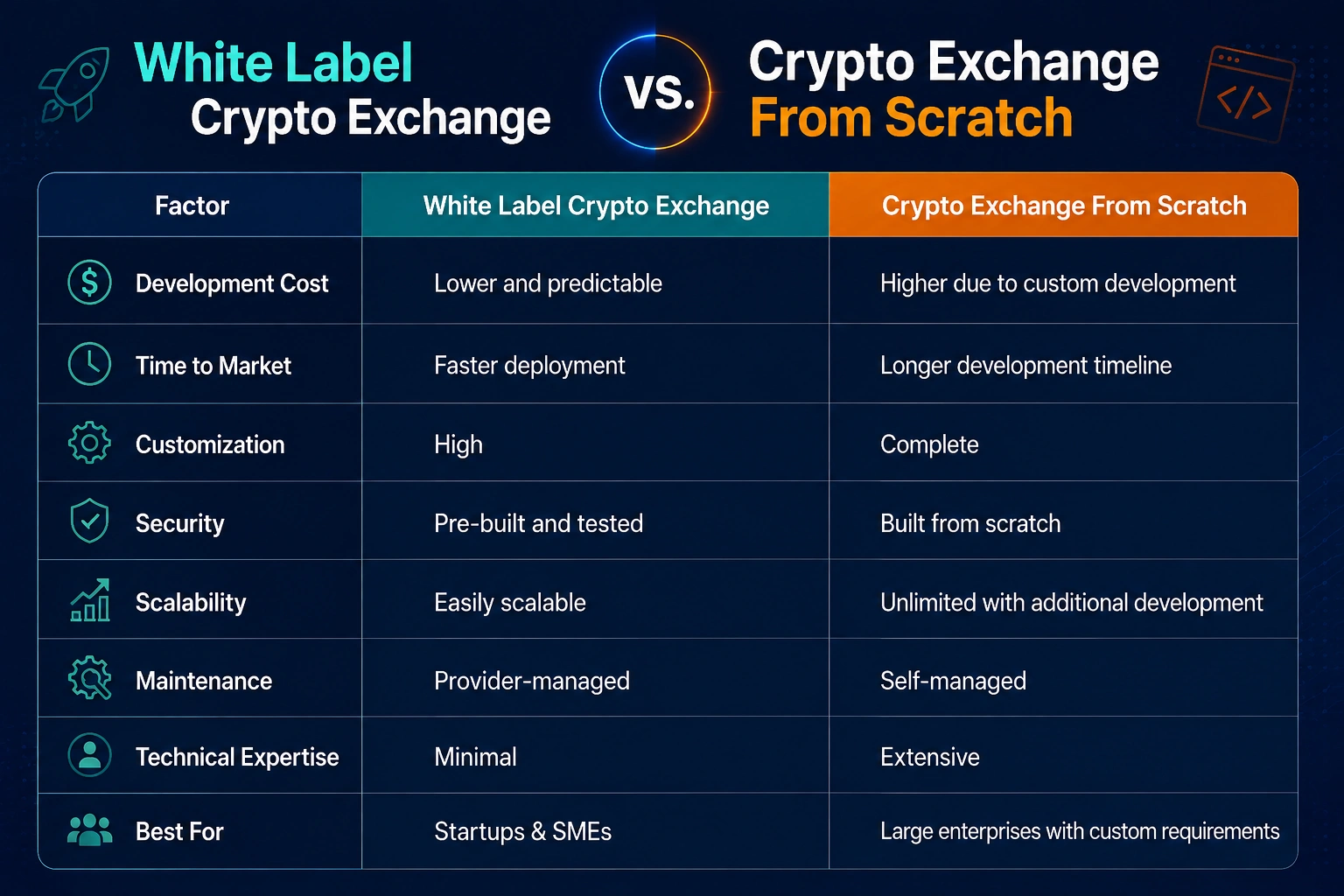
Many teams do both in sequence: launch on a white label to prove demand, then move parts to custom code once volume justifies it.
The Break-Even Question Most Cost Guides Skip
Software cost is only half the budget. The other half is what it takes to keep the exchange running every month, and that is paid from trading fees. So the real question is: how much volume do you need to cover your costs?
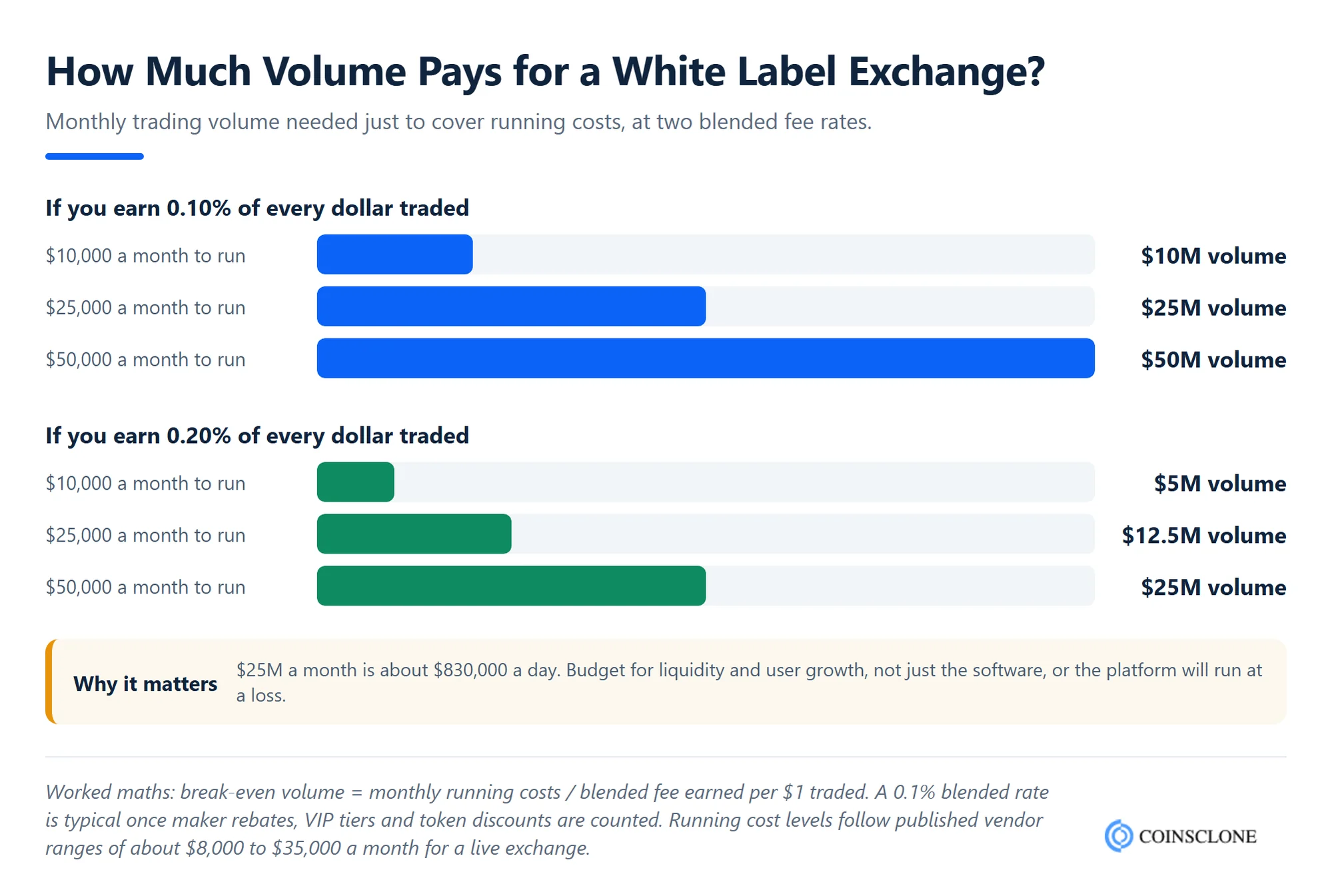
Two lessons follow. First, your liquidity and marketing budget matters as much as your software budget, because without volume, fees do not cover costs. Second, a small change in your blended fee rate moves your break-even point a lot, so plan your fee tiers and discounts carefully. Our guide on how crypto exchanges make money covers every revenue stream you can add.
Hidden Fees to Ask About Before You Sign
The upfront price is rarely the full story. Ask every provider these questions:
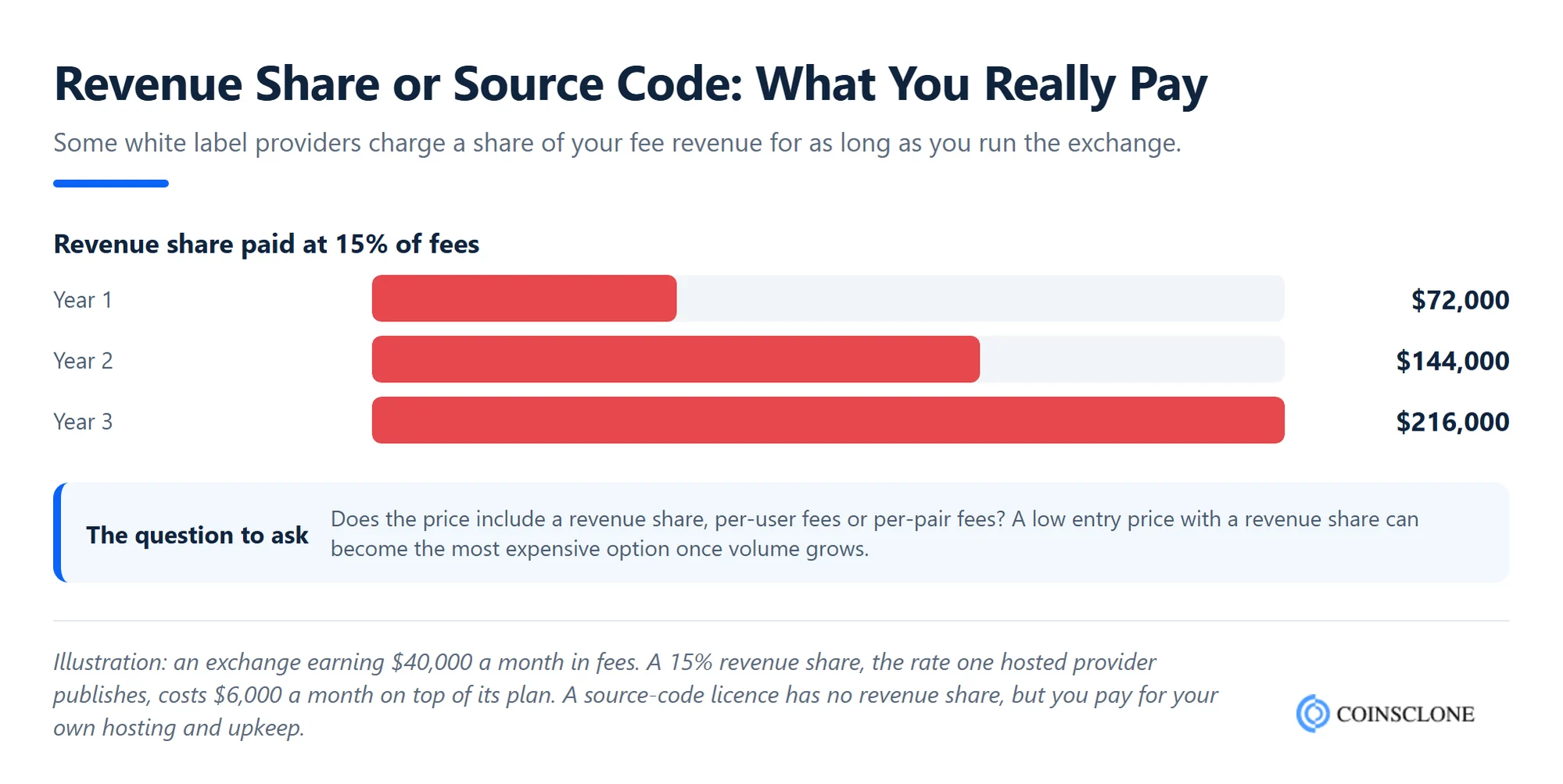
- Is there a revenue share? Some hosted platforms take a share of your trading fees for as long as you run the exchange. One provider publishes a 15% revenue share.
- Are there per-user or per-pair fees? Some charge extra for each new trading pair, often $500 to $2,000 per pair.
- Who owns the source code? Without it, you depend on the provider for every change.
- What costs extra outside the template? Custom KYC flows, new fiat gateways and design changes are often billed separately and can push costs 30% to 60% above the first estimate.
- What does support cost after launch? Support plans commonly run from about $3,000 to $10,000 a month.
Factors That Affect White Label Crypto Exchange Cost
Type of exchange: a spot exchange is the base. P2P, OTC, margin and futures each add trading logic and risk controls. Futures need a liquidation engine and an insurance fund, which is why futures-ready platforms cost the most. See our OTC crypto exchange development and P2P crypto exchange development options.
Features: staking, copy trading, lending, launchpads and trading bots all add build and testing time.
Design and branding: template branding is cheap, often $2,000 to $8,000. A fully custom interface can cost $15,000 to $50,000 or more.
Security: basic security is included, but deeper audits, penetration tests and monitoring add cost. A third-party security audit commonly costs $10,000 to $40,000.
Liquidity and integrations: liquidity providers, fiat gateways, KYC tools and blockchain nodes each carry setup fees and monthly costs. A fiat gateway alone can cost $5,000 to $20,000 to set up.
Blockchains and assets: each extra chain adds node costs, wallet work and monitoring.
Monthly Running Costs After Launch
Budget for these every month, not just once:
| Cost | Typical monthly range |
| Cloud hosting and infrastructure | $1,000 to $6,000 |
| Compliance operations (KYC checks, monitoring, staff) | $2,000 to $10,000 |
| Customer support | $3,000 to $15,000 |
| Security monitoring | $500 to $2,000 |
| Liquidity (single provider) | $5,000 to $15,000 |
| Marketing | Set by your growth plan |
Ranges from B2Broker and Merehead published guides, 2026.
KYC checks are often billed per user, commonly $0.50 to $2 per verification, so compliance costs grow with sign-ups before revenue catches up.
Year-One Budget Scenarios
Adding the software, integrations and 12 months of running costs together gives a more honest picture than the software price alone. One published 2026 guide models four scenarios:
| Scenario | Who it fits | Year-one total |
| Bootstrap MVP | One market, spot only, small team | About $126,000 |
| Growth launch | Fiat gateway, mobile apps, stronger liquidity | About $255,000 |
| Serious exchange | Several markets, margin or futures, full compliance team | About $450,000 |
| Enterprise platform | Multi-region, institutional clients | $700,000 or more |
Source: Merehead white label exchange cost guide, 2026. Treat these as planning ranges, not quotes.
The pattern is clear: in year one, running costs usually exceed the software price. A cheaper platform that raises your monthly costs, through revenue shares or paid support, can end up costing more.
White Label Bitcoin Exchange Cost
A bitcoin-only or bitcoin-first exchange can cost less than a multi-asset platform, because it needs fewer blockchain integrations, fewer wallets and less listing work. The main savings are in node and wallet costs, since you run one network instead of many.
The costs that do not shrink are licensing, KYC and AML, banking for fiat, security audits and liquidity. So a bitcoin-only exchange cuts the technical budget more than the compliance budget. Many operators start with BTC and USDT pairs, then add Ethereum and other assets once volume grows.
What a Good White Label Quote Should Include
Before comparing prices, make sure each quote covers the same items:
- Software scope: spot, margin, futures, P2P, OTC and staking, listed one by one.
- Apps: web, iOS and Android, and whether app store publishing is included.
- Source code: transferred to you, or only licensed.
- Hosting: in your cloud accounts or the provider’s.
- Integrations: which KYC provider, liquidity provider and fiat gateway are included, and who pays their fees.
- Security: whether a third-party audit and penetration test are included.
- Support: response times, hours and monthly cost after launch.
- Updates: whether new features and security fixes are included, and for how long.
- Exit terms: what happens to your exchange if you stop paying.
If one quote is far cheaper, check which of these items it leaves out.
How to Reduce the Cost of a White Label Crypto Exchange
- Launch in one market first: every extra country adds licences, banking and support costs.
- Start with spot and P2P: add margin and futures later, once you have users and the licences they need.
- Use proven integrations: a KYC or liquidity provider the platform already supports costs far less than a new one.
- Choose source code over revenue share if you expect volume: it costs more upfront but less as you grow.
- Keep the design close to the template at first: spend on branding once the product has proven itself.
- Plan liquidity early: a market maker agreement before launch avoids an empty order book, which is the fastest way to lose new users.
Licensing Costs by Region
Licences often cost more time than software. Plan for these rules in the main markets:
- European Union: a MiCA licence as a crypto-asset service provider (CASP), which then lets you serve every EU country.
- United States: registration with FinCEN as a money services business, plus state money transmitter licences.
- United Kingdom: registration with the FCA under the money laundering rules, and FCA rules on crypto promotions.
- Dubai: a licence from the Virtual Assets Regulatory Authority (VARA).
- Singapore: a licence from the Monetary Authority of Singapore, which since June 2025 also applies to firms that serve only overseas clients.
- Australia: registration with AUSTRAC as a digital currency exchange.
- Canada: registration with provincial securities regulators as a restricted dealer.
- India: registration with the Financial Intelligence Unit (FIU-IND).
Published guides put yearly licensing and legal costs at roughly $25,000 to $150,000, depending on the market. Fiat banking partners can take three to six months to onboard, whatever software you choose.
Compliance Checklist for a White Label Exchange
- Business registration and licence in each market you serve.
- KYC identity checks at sign-up, with tiered limits.
- AML transaction monitoring and suspicious activity reports.
- Counter-terrorist financing controls.
- Data protection that meets local privacy law.
- Record keeping for trades and user data.
- Travel Rule data sharing for crypto transfers where required.
- Sanctions and PEP screening at onboarding and on transfers.
- Tax reporting support for users and regulators.
- Clear terms and risk disclosures for consumer protection.
Building these in from day one is far cheaper than adding them later.
How a White Label Crypto Exchange Makes Money
Trading fees: makers add liquidity with limit orders and takers remove it with market orders. Most exchanges charge takers a little more and give makers a discount.
Listing fees: projects pay to list their tokens.
Withdrawal fees: a small fee above the network cost on each crypto withdrawal.
Fiat funding fees: charges on card and bank deposits or withdrawals, where you offer fiat.
Premium services: VIP tiers, advanced tools and API access.
Staking and earn products: a share of rewards on staked or lent assets.
OTC and margin trading: fees and interest on large trades and borrowed funds.
For a step-by-step launch plan, read how to start a crypto exchange.
Get Your White Label Crypto Exchange Cost Estimate!
Clear Pricing. No Hidden Fees. Built for Every Budget.
10 Questions to Ask a White Label Exchange Provider
A low quote can hide high costs later. Ask every provider these questions before you sign:
- Do I get the full source code, or only a licence to use it?
- Who hosts the platform, and can I move it to my own servers later?
- Is there a revenue share or per-trade fee on top of the setup price?
- Which liquidity providers are already integrated, and who pays for them?
- Which KYC and AML providers are connected, and what does each check cost?
- How are wallets secured: cold storage, multisig or MPC, and who holds the keys?
- Has the code had an independent security audit, and can I see the report?
- What is included in support after launch, and what counts as a paid change?
- How are updates delivered when blockchains upgrade or regulations change?
- Can you show live exchanges built on the same software?
Clear, written answers to these questions make quotes comparable, and they often show why the cheapest offer is not the cheapest over three years.
Why Hire Coinsclone for White Label Crypto Exchange Development?
Coinsclone is a crypto exchange development company that has delivered more than 350 blockchain platforms for over 200 clients across 20 industries. Our white label crypto exchange runs in your own cloud accounts and comes with a full source code transfer and no ongoing licence dependency, so your costs do not rise as your volume grows.
- Standard white label launch in 4 to 6 weeks
- Fiat, mobile apps, margin, P2P, staking and OTC modules
- KYC, AML and Travel Rule tools built in
- Support after launch
Prefer a proven model? Compare our Binance clone script and centralized exchange script.
Frequently Asked Questions
How much does a white label crypto exchange cost?
Published vendor pricing puts a basic white label exchange at about $8,000 to $30,000 upfront, feature-rich platforms at $20,000 to $120,000, and enterprise builds at $100,000 to $250,000 or more. Expect another $8,000 to $35,000 a month to run the exchange.
What is the price of white label crypto exchange software per month?
Hosted (SaaS) white label exchanges commonly charge about $2,000 to $8,000 a month, and some add a share of your trading fees. Source-code licences have no monthly licence fee, but you pay for your own hosting and support.
Is a white label crypto exchange better than building from scratch?
For most startups, yes. It is cheaper and launches in weeks. Building from scratch gives unlimited control but costs more and takes many months.
What hidden costs should I plan for?
Revenue shares, per-pair fees, custom work outside the template, support plans, liquidity, licensing and KYC checks. Ask for all of them in writing before you sign.
How long does it take to launch a white label crypto exchange?
A standard white label exchange can launch in 4 to 6 weeks. Fiat gateways, mobile apps and extra modules add time, and licences and banking often take longer than the software.
Do I own the code of a white label crypto exchange?
It depends on the contract. Some providers license the software and host it for you, while others hand over the full source code. Ask before you sign, because code ownership affects your running costs, your ability to switch hosts and the value of your business.
Do I need a licence to run a white label crypto exchange?
In most countries, yes. Examples include a MiCA licence in the EU, FinCEN registration and state licences in the US, VARA in Dubai and FIU registration in India.
See How Much You Can Save With a White Label Crypto Exchange
White Label Crypto Exchange – Launch Faster. Spend Smarter. Own It Completely.
- Transparent Pricing:Know your exact cost upfront, starting at a fraction of custom-built development.
- MVP-Ready in Weeks: Go live 90% faster with a ready-made MVP — trading engine, wallet, and liquidity modules already built, so you skip months of dev cost.
- No Hidden Fees: One clear quote covering platform, security, and support — no surprise charges later.
- 100% White Label:Your brand, your token listings, your revenue — we just build the engine.
- Revenue From Day One: Start earning through trading fees, listing fees, and staking as soon as you go live.
Get a free, detailed cost breakdown and a branded MVP demo of your exchange — delivered within 48 hours.
Book a Free Cost Consultation and see exactly what your white label crypto exchange — MVP to full launch — will cost, with full pricing transparency, no obligation, and a 8–12 week launch timeline.