

In 2025, people spent $5.2 billion on stablecoin-linked Visa cards, up 319% in a year. By September 2026, Visa counted more than 160 live stablecoin card programs, and its stablecoin settlement had passed a $20 billion yearly run rate.
For exchanges, wallets and fintech apps, a card is the missing link. Users can hold crypto in your app, but they cannot buy groceries with it. A card fixes that, keeps money inside your product, and earns you a share of every swipe.
This guide explains how to launch a crypto card program: how crypto cards work, who does what behind the scenes, white label versus building your own, the licences you need, how card programs make money, and the steps to go live.
What Is a Crypto Card Program?
A crypto card program is a debit, prepaid or credit card that lets users spend crypto, usually stablecoins, anywhere Visa or Mastercard is accepted. The shopper pays with digital assets. The merchant receives normal money and never touches crypto.
A “program” means the whole package behind the plastic: the card design, the issuing bank, the processor, the rules on who can get a card, and the app that shows balances and transactions. Your brand is on the card. Licensed partners handle the regulated parts.
There are three common types:
- Debit cards spend from a crypto or stablecoin balance in real time.
- Prepaid cards are loaded in advance, often with stablecoins converted to fiat.
- Credit cards let users spend now and repay later, sometimes backed by crypto held as collateral.
How Do Crypto Cards Work?
Four parties make a crypto card payment work in about a second.
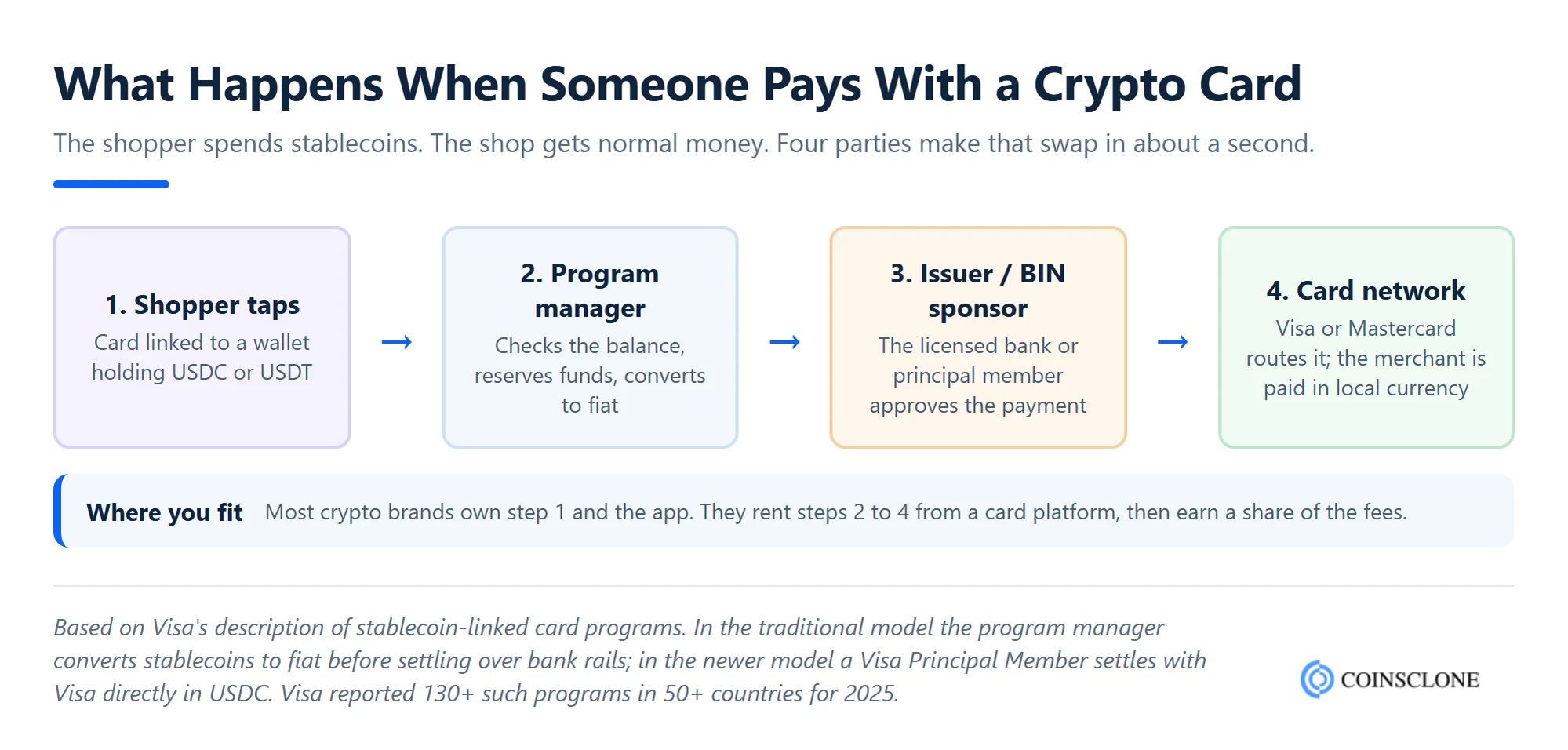
- The shopper taps the card. It is linked to a wallet holding USDC, USDT or other assets.
- The program manager checks the balance. It reserves the funds and converts them to fiat, or settles in stablecoins directly.
- The issuer approves the payment. This is the licensed bank or card network member, often called the BIN sponsor.
- The card network routes it. Visa or Mastercard pays the merchant in local currency.
Visa describes two settlement models. In the traditional model, the program manager converts stablecoins to fiat before settling over bank rails. In the newer model, a Visa Principal Member settles with Visa directly in USDC, and Visa converts it for merchants. Mastercard added stablecoin settlement in June 2026, covering USDC, PYUSD and other coins on chains such as Base, Solana and Ethereum.
Who Are the Key Players in a Crypto Card Program?
You rarely build every layer. Most crypto card programs combine these roles:
| Role | What it does | Examples |
| Card network | Runs the payment rails and merchant acceptance | Visa, Mastercard |
| Issuer / BIN sponsor | Licensed member that issues the card and owns the BIN | Lead Bank, principal members such as Rain and Wirex |
| Program manager | Runs the program, conversion, limits and compliance | Rain, Reap, Bridge, Baanx, Immersve |
| Processor | Authorises transactions in real time | Often bundled with the program manager |
| Your brand | App, wallet, users, card design and support | Your exchange, wallet or fintech |
Several card platforms now serve crypto firms. Rain raised $250 million in January 2026 and is a principal member of both Visa and Mastercard. Bridge, owned by Stripe, issues stablecoin-linked Visa cards through an API, with Lead Bank as issuer. Baanx powers the MetaMask Card on Mastercard. None of these firms publishes its pricing, so expect to negotiate.
White Label Crypto Card vs Building Your Own
There are three ways to launch:
- Full white label. A card platform provides the card, the app screens and compliance. You add your brand. Fastest, least control, and you share more of the revenue.
- Card-as-a-service plus your own app. You keep your wallet and app, and connect a program manager by API for issuing, conversion and processing. This is the most common route for exchanges and wallets.
- Become a principal member. You join Visa or Mastercard directly and run the program yourself. Most control and margin, but the longest and costliest path.
For most businesses, option two is the sweet spot. You own the user experience and the data, while licensed partners handle the card side. Rain says some programs on its platform went live in under two weeks, against 6 to 18 months with traditional issuers. Treat that as a vendor claim; your timeline depends on your licences, your markets and your own tech.
The tech you still need to build includes the wallet, real-time balance checks, conversion logic, spending limits, card controls, statements and support tools. A strong crypto wallet development base makes the card layer much easier to add.
What Licences Does a Crypto Card Program Need?
The card itself is issued by a licensed partner. But the business around it still needs its own permissions.
European Union. Card programs that hold customer money usually need an e-money institution (EMI) licence, with EUR 350,000 in starting capital. If you hold or exchange crypto for users, you also need MiCA authorisation. The EBA has also said that firms moving e-money tokens for clients need payment services authorisation after a transition period that ended on 2 March 2026.
United Kingdom. An FCA e-money licence, also EUR 350,000, plus the new crypto regime whose application window opens on 30 September 2026.
United States. FinCEN registration and state money transmitter licences, or a partner bank model where the bank issues the card and you operate under its umbrella. Bridge and many crypto card programs use this partner route.
Our crypto license guide covers costs and timelines by country if you need the crypto side too.
How Do Crypto Card Programs Make Money?
Card programs earn from several streams:
- Interchange: a small fee the merchant’s bank pays the issuer on every purchase, shared with the program. In the EU it is capped at 0.2% for consumer debit and 0.3% for credit. In the US, only issuers with $10 billion or more in assets face the debit cap, so smaller issuers and their partners can earn more.
- Conversion spread: a margin when crypto is converted to fiat at the point of sale.
- FX fees: on purchases in foreign currencies.
- Card fees: issuance, premium metal cards, ATM withdrawals.
- Balance growth: users keep more money in your app, which feeds trading and other revenue.
Revolut shows how important cards can be. In its 2025 annual report, card payments were 22.2% of its GBP 4.5 billion in revenue, the largest single stream.
How Big Is the Crypto Card Market?
Crypto card spending has grown fast. Research by Artemis, reported by CoinDesk in January 2026, found it rose from about $100 million a month in early 2023 to more than $1.5 billion a month in late 2025.
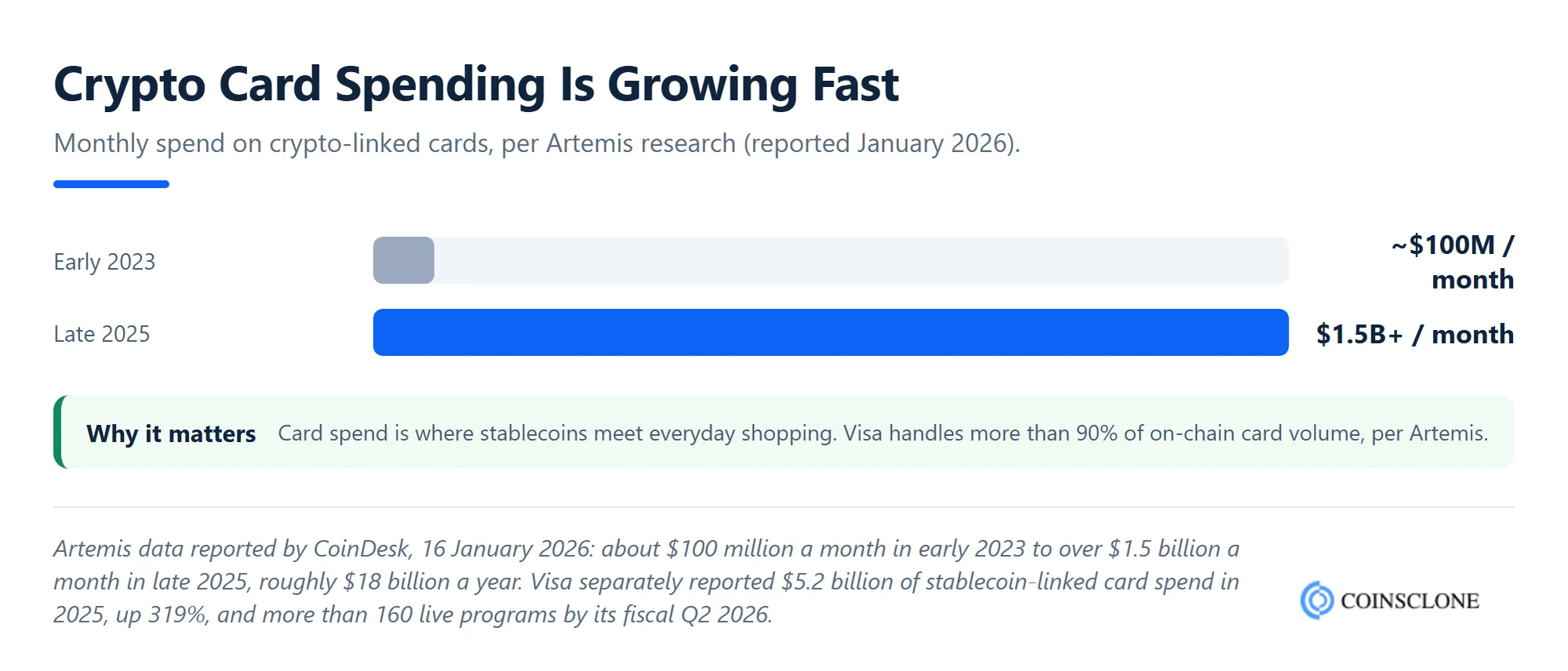
Visa handles more than 90% of on-chain card volume. It expects its number of stablecoin card programs to keep growing, and in 2026 it added new chains for stablecoin settlement. For a crypto brand, the window is open now, before every wallet has a card.
Launch Your Own Branded Crypto Card Program
Crypto Card Platform Development — done right.
- Card-Ready Wallets: Multi-currency wallets with real-time crypto-to-fiat conversion at checkout.
- Issuer Integrations: Connect to card issuers, BIN sponsors and program managers through clean APIs.
- Compliance Built In: KYC, AML screening, spending controls and audit logs.
- Revenue Engine: Earn from interchange share, conversion spreads and card fees.
Get a free card program scoping call and cost estimate — before spending a single dollar.
Book a Free Demo to see how we build the wallet, conversion and admin layers behind a crypto card.
What Features Should a Crypto Card Program Have?
Users compare your card with the best fintech apps, not with other crypto cards. Plan for these features from day one:
- Real-time balances: the card shows the spendable amount in local currency before the user taps.
- Choice of funding asset: let users pick which coin or stablecoin pays, with a sensible default such as USDC.
- Instant card controls: freeze, unfreeze, spending limits and merchant blocks inside the app.
- Apple Pay and Google Pay: most card spend now happens on phones.
- Clear receipts: each purchase shows the crypto spent, the rate and any fees.
- Cashback or rewards: a common hook, often paid in your own token or in stablecoins.
- Multi-currency wallets: a multi-currency wallet lets users hold several assets behind one card.
Businesses want a few more: team cards, spending policies per employee, and exports for accounting.
What Are the Main Risks of a Crypto Card Program?
A card touches payments, crypto and consumer rules at once. The main risks:
- Price moves: if users spend volatile coins, the value can shift between authorisation and settlement. Stablecoin funding removes most of this risk. See how a stablecoin payment gateway handles the same conversion for merchants.
- Fraud and chargebacks: card fraud rules still apply. You need monitoring, limits and a dispute process.
- Partner risk: if your issuer or program manager exits a market, your cards stop. Keep a backup plan and clean data exports.
- Rule changes: crypto and payment rules keep moving. The EU’s line between e-money tokens and payment services changed in 2026, for example.
- Liquidity: conversion needs deep, reliable liquidity at all hours. Plan it with the same care as a crypto payment gateway.
How to Launch a Crypto Card Program in 7 Steps
- Pick your market and card type. Debit, prepaid or credit; consumer or business; which countries.
- Choose your partner model. Full white label, card-as-a-service, or principal membership.
- Sort out licences. EMI, MiCA, money transmitter licences or a partner bank, depending on your markets.
- Build the wallet and conversion layer. Real-time balance checks, conversion rules, limits and card controls in your app.
- Set up compliance. KYC, transaction monitoring, sanctions screening and dispute handling.
- Design the card and the app flows. Card art, activation, PIN, freeze, statements and Apple Pay or Google Pay.
- Pilot, then scale. Launch to a small group, check approval rates and fraud, then open up.
The steps that decide success are four and five. A card that declines often, or cannot show a balance in real time, loses users fast.
What Does It Cost to Launch a Crypto Card Program?
No card platform publishes standard prices, so costs depend on your deal. Plan for these line items:
- Program setup and minimums: set by the card platform or issuer. Some ask for a deposit or collateral.
- Per-card and per-transaction fees: charged by the issuer and processor.
- Licences: from EUR 350,000 in capital for an EMI, plus legal and compliance staff.
- Your own tech: wallet, conversion engine, app features and admin tools.
- Card production: plastic or metal cards, shipping and packaging.
The biggest lever is how much of the program you own. Renting more of the stack lowers upfront cost but gives away more of each swipe. Owning the wallet and app, while renting the licensed card layer, usually gives the best balance.
Frequently Asked Questions
What is a white label crypto card?
It is a crypto debit, prepaid or credit card issued under your brand by a licensed card partner. You own the app and the users; the partner handles issuing, processing and card network membership.
How do crypto cards work?
The card links to a crypto or stablecoin balance. At checkout, a program manager checks and converts the funds, the issuing bank approves the payment, and Visa or Mastercard pays the merchant in local currency.
Do I need a licence to launch a crypto card?
Usually yes. The card is issued by a licensed partner, but your business may need an e-money licence, MiCA authorisation or US money transmitter licences, depending on where you operate and whether you hold customer funds.
How long does it take to launch a crypto card program?
It varies. Card platforms say some programs go live in weeks, while traditional issuers can take 6 to 18 months. Licences and your own tech are usually the slowest parts.
How do crypto card programs make money?
From interchange fees on purchases, conversion spreads, FX fees, card and ATM fees, and the extra activity cards bring to your app. In the EU, consumer interchange is capped at 0.2% for debit and 0.3% for credit.
Which companies issue crypto cards?
Card networks are Visa and Mastercard. Program managers and issuers used by crypto firms include Rain, Reap, Bridge, Baanx, Immersve and Wirex.
Can a crypto card be linked to a self-custody wallet?
Yes. Some programs, such as the MetaMask Card, spend directly from a user’s self-custody wallet at the point of sale, while others use a custodial balance held by the program.
How big is the crypto card market?
Crypto card spending reached more than $1.5 billion a month in late 2025, per Artemis. Visa reported $5.2 billion of stablecoin-linked card spend in 2025 and more than 160 live programs by 2026.