
A SafePal clone script is ready-made wallet software built on the SafePal model: a self-custody phone app, a DApp browser, in-app swaps and signing with an offline device for users who want it. This guide shows what the script gives you, how the wallet works for users and admins, and where SafePal itself stands in October 2026, so you copy a model that still works.
You will also get real 2026 costs and launch times, the ways a wallet earns money, the safety lessons from SafePal’s past and the legal points to clear before launch. By the end, you will know which kind of SafePal-style wallet fits your business and what it takes to build it.
In this guide:
- What a SafePal clone script includes, and how the user and admin panels work
- SafePal’s status in 2026: hardware prices, Polymarket in the app, Swiss bank accounts and the August 2026 data breach
- How air-gapped QR signing works, shown step by step
- 2026 cost bands, launch weeks and a decision tree for your build path
- Revenue streams with real fee benchmarks, plus the legal and safety checks before launch
See How Our MVP System Can Launch Your Wallet Faster
SafePal Clone Development — done right.
- MVP System: Launch your SafePal-like wallet 90% faster.
- Multi-Chain Integration: Seamlessly manage BTC, ETH, BNB & 1000+ tokens.
- Security First: Hardware-level encryption, biometric & PIN protection.
- Brand & Customization: Your logo, your design, your digital wallet.
- Revenue Engine: Earn from swaps, staking, and in-app promotions.
Get a free branded demo of your SafePal Clone Wallet in just 48 hours — before you invest a cent.
Book a Free Demo to discover how our SafePal Clone Script can take you from idea to live wallet in just 8-12 weeks.
What Is a SafePal Clone Script?
This script is a ready-to-launch wallet package that copies the main features of the SafePal crypto wallet, and you can change every part of it. It ships with the user app, the admin dashboard and the wallet engine already built. Startups then add their own brand, chains, revenue streams and extra features on top.
In short, you skip the hardest part of a wallet build: key handling, transaction signing and chain links. Your team spends its time on design, business features and testing instead. That is why a clone script launches in weeks, while a wallet built from scratch takes months.
A SafePal clone script usually covers three layers:
- Wallet core: key creation on the user’s device, seed phrase backup, signing and support for many blockchains.
- User app: a phone app for iOS and Android, with a browser add-on if you want one, swaps, a DApp browser and NFT views.
- Admin panel: user insights, content control, fee settings and support tools.
Like SafePal, the wallet is non-custodial. Users hold their own keys, and your company never touches their funds. This matters for both trust and the law, as we explain later.
SafePal in 2026: Where the Original Stands
Before you copy a wallet, check that its model still works. SafePal is active and still adding features in October 2026. Here is what we confirmed at the source.
- Background: SafePal started in 2018 inside the first Binance Labs incubation programme. Binance Labs has since renamed itself YZi Labs. SafePal’s SFP token launched on Binance Launchpad, with a total supply of 500 million.
- Hardware range: the SafePal store lists the S1 at $49.99, the X1 at $69.99 and the S1 Pro at $89.99. The S1 and S1 Pro sign through QR codes with no wireless link. The X1 uses Bluetooth and is open source. SafePal says its devices use a CC EAL6+ secure element chip.
- Software: a phone app for iOS and Android, a browser add-on for Chrome, Edge and Firefox, and SafePal Mini inside Telegram.
- Polymarket in the app: on 17 March 2026, SafePal added Polymarket to its app. Users turn EVM assets into USDC on Polygon and trade from the Trade tab, with no KYC and no new account. Hardware owners can sign these trades on the device.
- Bank accounts and cards: through Fiat24, a Swiss-regulated partner, SafePal users can open a Swiss IBAN account and get a debit card linked to the wallet. The service started in March 2024 and is not open to US users.
- Data breach: in August 2026, SafePal disclosed that hackers used a flaw in an order-tracking plugin on its store. The breach exposed the names, emails, addresses and phone numbers of 39,798 customers who ordered between 2 March 2025 and 11 April 2026, as reported by Security Affairs. Seed phrases, private keys and card details were not exposed.
So the SafePal model is alive and moving fast. It now mixes a self-custody wallet with trading, prediction markets and fiat banking. A clone in 2026 should copy that “one app for everything” idea, not just the 2020 feature list.
How Does the SafePal Clone Work?
Like the SafePal crypto wallet, the SafePal clone script follows a simple flow. Users create a wallet on their phone, back it up, connect to the chains they use and sign every transfer on the phone. Admins run the business side from a separate panel.
User Panel
Registration
A non-custodial wallet needs no username or password. When users open your SafePal-like app, it creates their private and public key pair right on their device. Some brands add an email login for alerts and support, but the keys still stay on the phone.
Security Protocols
Along with the key pair, the app creates a seed phrase, usually 12 or 24 words, that users write down for backup and wallet restore. PIN codes and fingerprint or Face ID login protect daily use. SafePal also sells Cypher, a steel plate for 12, 18 or 24 word phrases, which shows how seriously users treat backup.
Multi-chain Integration
Similar to the SafePal crypto wallet, the clone script links one wallet to many blockchain networks. Users hold Bitcoin, Ethereum, BNB Chain, Solana, TRON and EVM tokens in one app, without switching wallets.
Trade Execution
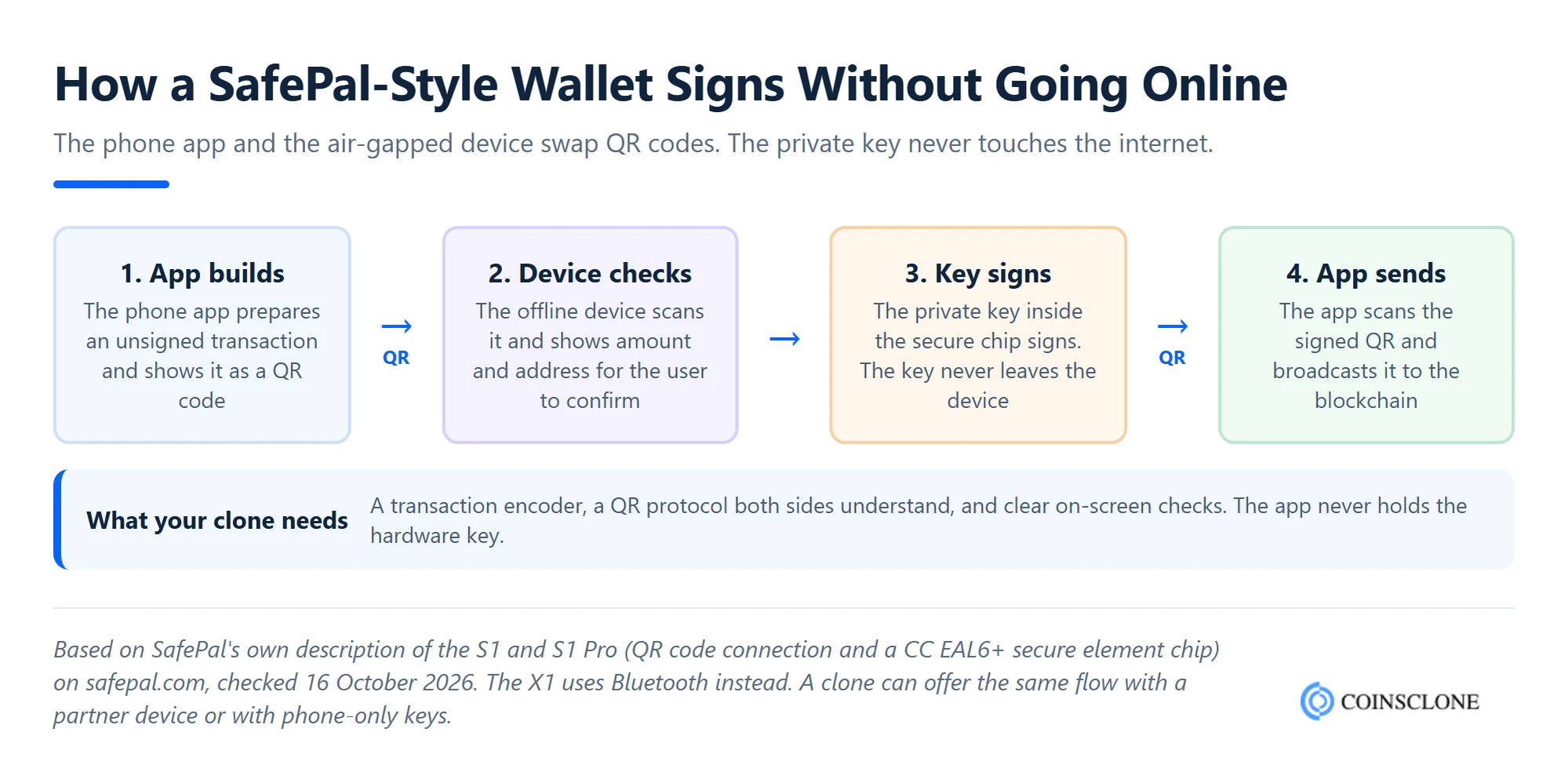
With the wallet, users send crypto, swap tokens and use DeFi apps. The private key signs each one on the phone, and the app then sends the signed transaction to the network. If users pair a hardware device, signing moves off the phone entirely, as the flow below shows.
Admin Panel
User Management
Admins see new and returning users, active wallets, swap volume and app versions in one dashboard. Alerts flag unusual patterns, such as a spike in failed swaps or traffic from a phishing domain, so the team can act fast.
CMS management
Admins can manage banners, notices, token lists and news right inside the SafePal clone admin panel.
Revenue Configuration
The admin team can set and adjust swap fees, partner splits and promotions, so you can raise earnings without a new app release.
Together, these features let the user and admin panels run smoothly. The workflow can change as market trends and business needs change.
Core Features of SafePal Clone
The crypto wallet features in our SafePal clone play a vital role in winning users. Some of the core features in our SafePal clone are:
- Multi-coin support: hold Bitcoin, Ethereum, stablecoins and other crypto in one wallet.
- Multi-chain support: connect to many blockchain networks from a single app.
- In-app token swap: swap tokens instantly through built-in DEX aggregators and cross-chain bridges.
- DApp browser: open DeFi apps, NFT markets and games right inside the wallet.
- Portfolio management: see token balances and prices in real time, and add custom tokens.
- NFT support: store, view and transfer NFTs across many blockchains.
- Transaction history: track detailed logs and set custom gas fees.
- QR code scanner: pay fast by scanning QR codes.
- 2-factor login: add an extra layer of safety for account features.
- Push notifications: get real-time alerts for transactions and market moves.
- Hardware wallet pairing: sign with cold storage through QR or Bluetooth for better safety.
- Event and perps trading (add-on): like SafePal with Polymarket, let users trade on real events from the wallet through a partner API.
- Fiat banking (add-on): link IBAN accounts and debit cards through a licensed partner, as SafePal does with Fiat24.
These features also give your SafePal clone several ways to earn money. Before we get to money, though, safety comes first.
How to Keep a SafePal-Style Wallet Safe
A wallet lives or dies on trust. SafePal’s own history shows where the risks really sit, and none of them are only in the code that holds keys.
- Device tamper checks: in 2021, Kraken Security Labs reported weaknesses in the S1’s tamper detection. It could not steal funds, and SafePal answered with a firmware update. If you sell or pair hardware, plan for outside security reviews.
- Your store and support tools: the 2026 breach came from a plugin on SafePal’s online shop, not the wallet. Customer names and addresses are prime phishing material. Keep e-commerce, CRM and support data apart from the wallet, keep plugins patched and collect as little data as you can.
- Phishing and fake apps: after the breach, SafePal warned users about fake support calls, refund offers and fake firmware updates. Build in-app warnings, signed updates and one official support channel from day one.
- Smart contract and swap risks: check every DEX route and bridge you plug in. Show users clear previews of what they sign, and block known drainer contracts.
- Independent audits: have the wallet core, key storage and any contracts audited before launch, and again after major releases.
For a deeper checklist, see our guide to crypto wallet security.
Revenue Streams of SafePal Wallet Clone Script
A wallet is free for users, so you need a clear revenue plan from day one. Our SafePal clone script has several ways to earn built in, and you can add more later. Key revenue sources in our SafePal clone include:
- Swap and transaction fees: earn a small share of every in-app swap or bridge. For scale, MetaMask charges 0.875%, Phantom 0.85% and Zerion 0.67% on swaps, while Trust Wallet adds no service fee.
- Fiat on and off ramp: collect referral fees when users buy or sell crypto through a partner.
- Staking services: keep a share of staking rewards. MetaMask, for example, keeps 15% of rewards in its pooled staking.
- Trading builder fees: earn a fee on perps or prediction market trades routed through your app.
- Premium features: offer advanced tools for a monthly or yearly fee.
- Partner deals: earn a cut when users sign up to partner exchanges, DeFi apps or DApps.
- Token listing and promotion: charge projects for featured placement of their tokens or NFTs, clearly marked as sponsored.
- Hardware sales: sell a branded signing device, as SafePal does from $49.99.
- White-label licensing: license your branded wallet to other startups.
Your real income depends on how active your users are and what your partners charge. Swap fees usually lead, so design the swap screen carefully. For more detail, see our guide on how crypto wallets make money. With a White label Crypto Wallet Software, you can launch your own fully working cryptocurrency wallet like SafePal and switch these streams on from the admin panel.
SafePal Clone Script vs Building From Scratch
Both paths can end in a strong wallet. The difference is time, cost and how much risk you carry while you build.
| Factor | SafePal clone script | Built from scratch |
| Launch time | About 3 to 5 weeks (white label) or 8 to 12 weeks (custom) with Coinsclone | Usually several months, plus audits |
| Typical cost | Lower end of each cost band below | Upper end, often $50,000 to $200,000 or more |
| Wallet core | Already built and tested | Your team writes key storage, signing and chain links |
| Custom features | Added on top of a working base | Full freedom, but every part is new code |
| Best for | Startups and brands that need to reach users fast | Teams with unusual security or custody needs |
For most founders, the clone path wins on speed. You can still reach a fully custom product later by building on the base.
How Much Does a SafePal Clone Script Cost in 2026?
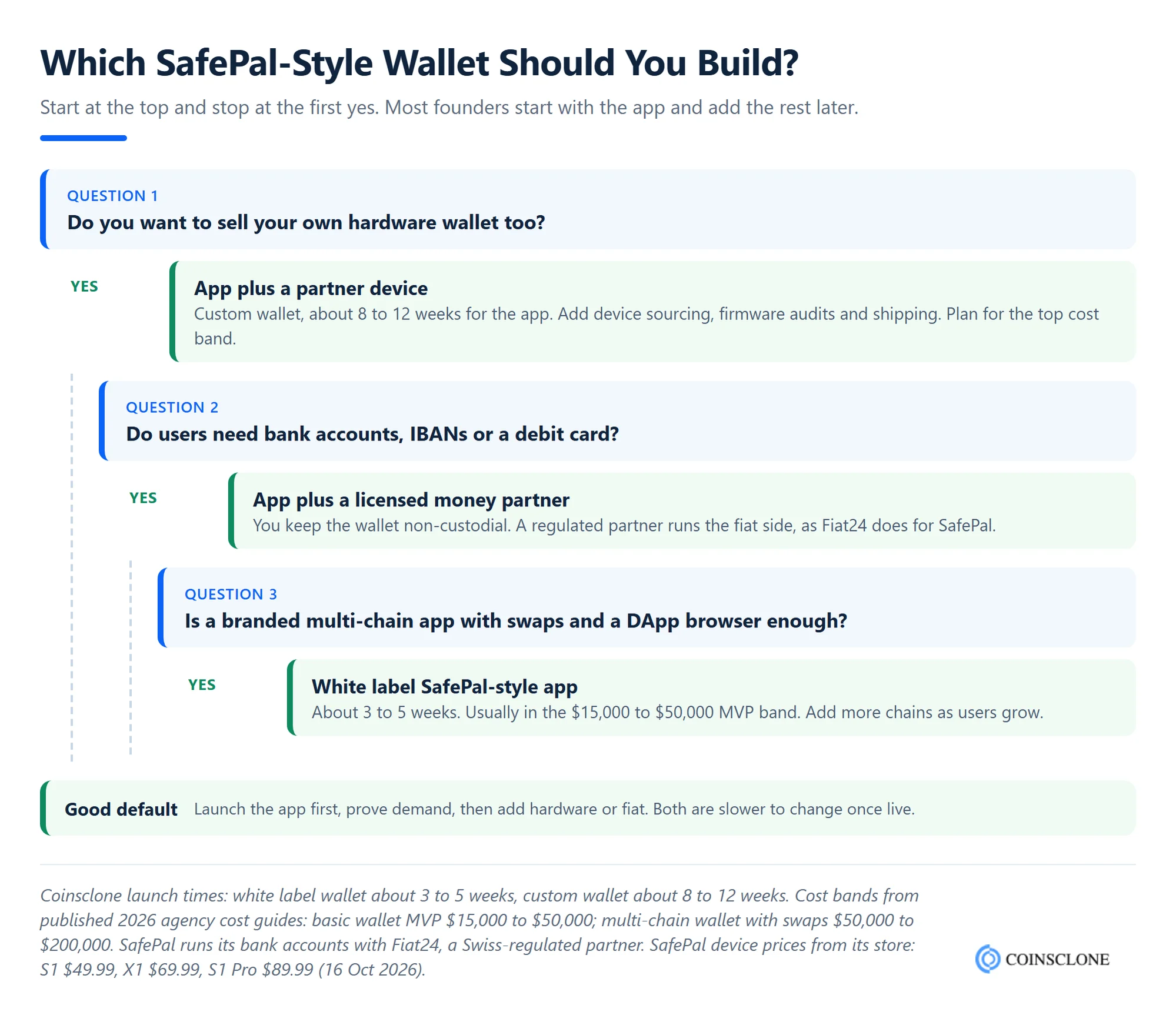
Cost depends on how much you change and how many chains you support. Published 2026 agency cost guides put a basic wallet MVP at about $15,000 to $50,000. A wallet with many chains and swaps costs $50,000 to $200,000. A large wallet for banks or funds runs $200,000 to $500,000 or more. A clone script usually sits at the lower end of each band, because the core is already built.
Time matters as much as money. With Coinsclone, a white label wallet launches in about 3 to 5 weeks, and a basic custom wallet takes about 8 to 12 weeks. Hardware pairing, fiat banking and native apps for both phones add time.
Not sure which version you need? Use this decision tree.
Also plan for running costs after launch. These include node and data APIs, app store fees, audits, support and updates. Our full breakdown of crypto wallet cost covers each line.
Steps to Launch Your SafePal Clone Wallet
Here is the path most of our wallet projects follow, from first call to live app.
- Pick your market and model: choose your users, chains and whether you need hardware or fiat banking.
- Plan custody and licences: stay non-custodial if you can, and check the rules in each country you serve.
- Brand and design: set your own name, logo, screens and user flows.
- Configure the script: add chains, swap partners, on-ramps, the DApp list and fee settings.
- Test and audit: run security tests, a third-party audit and a beta with real users.
- Launch and grow: publish to app stores, watch the admin dashboard and add features based on real usage.
Once live, keep updating. Chains change, new tokens arrive and app stores update their rules every year.
Legal Points to Clear Before You Launch
A clone script copies features, not a brand. Two legal points matter most.
- Brand and design: never use SafePal’s name, logo or look. “SafePal clone” describes the feature set; your app must carry your own name and design, or you risk trademark claims and app store removal. Copycat wallets are also a common phishing trick, so a clearly different brand protects your users too.
- Custody rules: in the US, FinCEN’s 2019 guidance says firms that only provide self-custody wallet software are not money transmitters. Wallets that hold user funds usually are. In the EU, MiCA treats holding crypto for clients as a licensed service, so a custodial wallet needs a CASP licence.
Fiat features follow banking rules. That is why SafePal uses a licensed partner for its IBAN accounts instead of running them itself. For more, read our guide to custodial vs non-custodial wallets. Our post on whether clone scripts are legal to use covers the rest. Then get legal advice in each market you serve.
Why Use a SafePal Clone Script
Building a crypto wallet like SafePal from scratch takes months and needs rare skills in key security, phone apps and blockchain links. Using a SafePal clone script saves time, money and effort. Here are the main advantages:
Time-Saving
A SafePal clone script lets startups launch a fully working crypto wallet in weeks: about 3 to 5 weeks for a white label app and 8 to 12 weeks for a custom build with Coinsclone. This speed helps you win early users and gives you a head start in the market.
Cost-Effective
Creating a SafePal-like crypto wallet from scratch needs a big budget for coders, safety experts and servers. A clone script reuses a tested core, so it usually lands at the lower end of the cost bands above. That makes it a sound choice for startups.
Proven Security
A SafePal clone script comes tested, with strong safety tools: keys kept on the phone, seed phrase backup, PIN and face or fingerprint login, and hardware signing if you want it.
Customizability & Branding
Unlike closed wallets, a SafePal clone script is easy to change. You can change the design, add features like staking, support fiat payments or include region-specific tokens. This flexibility helps build your brand and earn user trust.
Scalability for Growth
A SafePal clone script can handle more users and more trades as your business grows. Start with basic features and add advanced options like cross-chain swaps, prediction markets or MPC key sharing when needed.
In short, a SafePal clone script helps startups launch a safe wallet that can grow and earn, and do it fast. Be sure to choose a trusted provider with real wallet projects behind it. If you want to compare SafePal with other models first, see our list of the best crypto wallet clone scripts.
Start Your Crypto Journey With Our Safepal Wallet Clone!
Affordable. Customizable. Scalable. Live Demo Available.
Frequently Asked Questions
Is SafePal a decentralized wallet?
Yes. SafePal is a non-custodial wallet. Private keys are made and kept on the user’s phone or hardware device, and SafePal cannot move user funds. A SafePal clone script follows the same model. Optional extras like Swiss bank accounts are run by a separate licensed partner.
Is SafePal a cold wallet?
SafePal offers both. The mobile app and browser extension are hot wallets, since they run on online devices. The S1 and S1 Pro hardware wallets are cold wallets that sign offline through QR codes, and the X1 connects by Bluetooth.
Is SafePal safe?
SafePal says it saw no sign that any wallets or funds were hit in the August 2026 breach, which exposed contact and shipping data from its online store. Kraken Security Labs did report hardware tamper weaknesses in 2021, which SafePal answered with a firmware update. For your own clone, audits, separate customer data and strong phishing warnings matter most.
How long does it take to launch a SafePal clone?
With Coinsclone, a white label SafePal-style wallet launches in about 3 to 5 weeks. A custom wallet takes about 8 to 12 weeks. Hardware pairing, fiat banking and extra chains add time.
Does a SafePal clone script support multiple blockchains?
Yes. A SafePal clone script supports Bitcoin, Ethereum, BNB Chain, Solana, TRON and other EVM chains from one app. You can add more chains after launch as your users ask for them.
Can I integrate third-party services into a SafePal clone wallet?
Yes. Fiat on-ramps, cards, swap routers and trading markets all plug in by API. SafePal itself links Swiss IBAN accounts through Fiat24 and prediction markets through Polymarket. Your clone can connect licensed partners the same way while the wallet stays non-custodial.
Wrapping Up
SafePal shows that a self-custody wallet can grow into a full money app: hardware signing, swaps, prediction markets and bank accounts in one place. A SafePal clone script lets you copy that model under your own brand, in weeks rather than months.
Coinsclone is a leading crypto wallet development company. Since 2018, we have delivered 350+ platforms for 200+ clients across 20 industries. Our team tailors each wallet to your business needs, from a white label app to a custom multi-chain build. We also offer crypto exchange software, DEX platforms, token creation and more. Partner with us to launch your crypto wallet business and succeed in a competitive market.
See How Our MVP System Can Launch Your Wallet Faster
SafePal Clone Development — done right.
- MVP System: Launch your SafePal-like wallet 90% faster.
- Multi-Chain Integration: Seamlessly manage BTC, ETH, BNB & 1000+ tokens.
- Security First: Hardware-level encryption, biometric & PIN protection.
- Brand & Customization: Your logo, your design, your digital wallet.
- Revenue Engine: Earn from swaps, staking, and in-app promotions.
Get a free branded demo of your SafePal Clone Wallet in just 48 hours — before you invest a cent.
Book a Free Demo to discover how our SafePal Clone Script can take you from idea to live wallet in just 8-12 weeks.