
Private credit tokenization turns a loan, a pool of loans or a share in a credit fund into a token on a blockchain. The loans stay real. A company or homeowner still borrows and repays. The token is the investor’s claim, and the chain keeps the record of who owns it, who can buy it and who gets paid.
This guide shows how tokenized private credit works and how big the market is as of 2 November 2026. It covers the live products, where people lost money and the rules. It ends with a build plan for a private credit tokenization platform: the features, the cost drivers and the order of work.
In this guide:
- Market size: why the same market is quoted at $8 billion and at $41 billion, using rwa.xyz data.
- How it works: the path from borrower to lender, SPV, tranche tokens and buyer.
- Live examples: Figure, Maple, Centrifuge, Apollo and WisdomTree, with fresh figures.
- Risk in numbers: a worked default example that shows who loses money first.
- Build plan: the modules, token standards, cost drivers and steps for a platform.
What Is Private Credit Tokenization?
Private credit is lending that does not come from a bank or a public bond market. A fund or a lender makes the loan directly to a company, a fintech, a property owner or a trade finance firm. The IMF put the market at $2.1 trillion in assets and committed capital in 2023, with about three quarters of it in the US.
Private credit has three old problems. Tickets are large, so few investors can join. Records live in spreadsheets and PDFs, so reporting is slow. And loans rarely trade, so prices are stale.
Tokenization does not change the loan. It changes the wrapper. Each buyer’s share becomes a token. Smart contracts check who may hold it, pay out interest and log every transfer. That cuts admin work and lets a lender sell smaller slices to a wider, but still checked, group of investors.
It is one branch of real world asset tokenization, next to tokenized Treasuries, funds, real estate and gold.
How Does Tokenized Private Credit Work?
Most deals follow the same chain of parties. The names change by platform, but the roles stay the same.
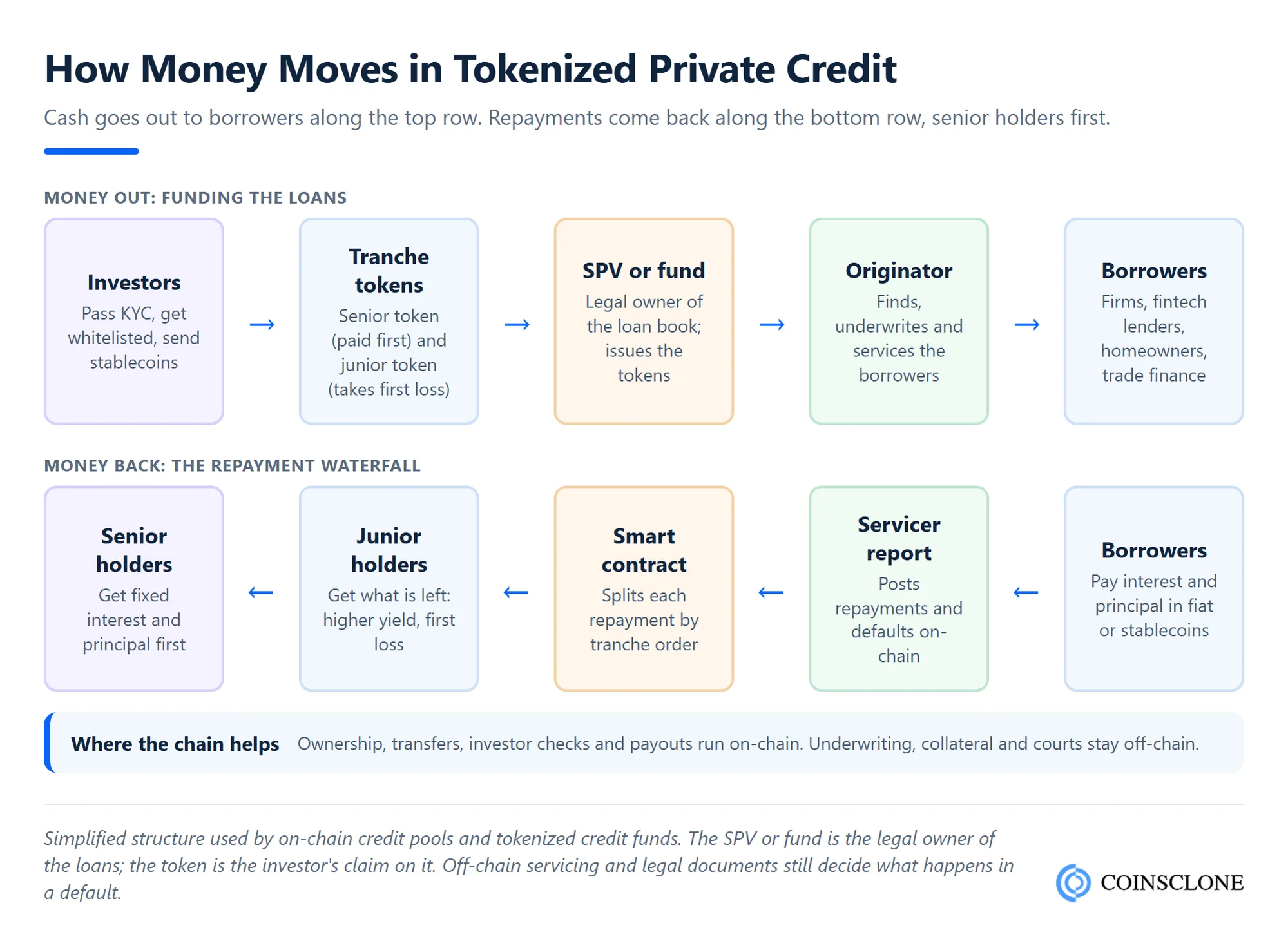
- Borrowers: firms, fintech lenders, homeowners or trade finance clients take the loans.
- Originator: this is the lender. It finds the borrowers, checks them, writes the loans and collects the payments. This step decides whether the deal is good.
- SPV or fund: the loans move into a special purpose vehicle (SPV) or a fund. This legal shell owns the loan book. That keeps the loans apart from the lender’s own books.
- Tokens: the SPV issues tokens that give holders a claim on the loan book. Some deals issue one token. Others split it into a senior token and a junior token.
- Investors: buyers pass KYC, get their wallet approved and pay in stablecoins or cash. They get the tokens back.
- Payback: borrowers pay the lender back. The lender’s servicing team posts each payment and any default on-chain. A smart contract splits the cash by tranche, senior first.
What Are Senior and Junior Tranches?
A tranche is a slice of the same loan pool with a different place in the payment line. The senior tranche gets paid first and earns a lower, steadier rate. The junior tranche gets paid last, earns more and takes the first loss. Centrifuge’s earlier Tinlake pools used this model, with a senior token called DROP and a junior token called TIN.
The junior slice is a cushion for senior holders. Often the lender holds it, so it has its own money at risk.
What Is an On-Chain Loan Book?
An on-chain loan book is a record of each loan, its balance, its rate and its status, kept on a blockchain. Some platforms mint each loan as its own token, often an NFT, and hold it in the pool. Others post a hashed record of each loan and keep the details off-chain. Either way, investors and auditors can check the pool against the chain instead of waiting for a quarterly PDF.
Which Structure Fits Which Deal?
| Model | How it works | Live example | Best for |
| Fund wrapper | A token gives a share of an existing credit fund | Apollo ACRED, WisdomTree CRDT | Asset managers with a fund already running |
| On-chain lending pool | Lenders put stablecoins in a pool; a manager lends to vetted borrowers | Maple | Short loans to institutions, often backed by crypto |
| Tranched SPV pool | An SPV holds a loan book and issues senior and junior tokens | Centrifuge | Fintech lenders, trade finance, invoices, CLOs |
| Chain as record | Every loan is recorded on a chain; tokens stay on one platform | Figure on Provenance | Large originators that want faster sales and audits |
How Big Is the Tokenized Private Credit Market?
The answer depends on what you count, which is why blogs quote anything from $4 billion to $40 billion.
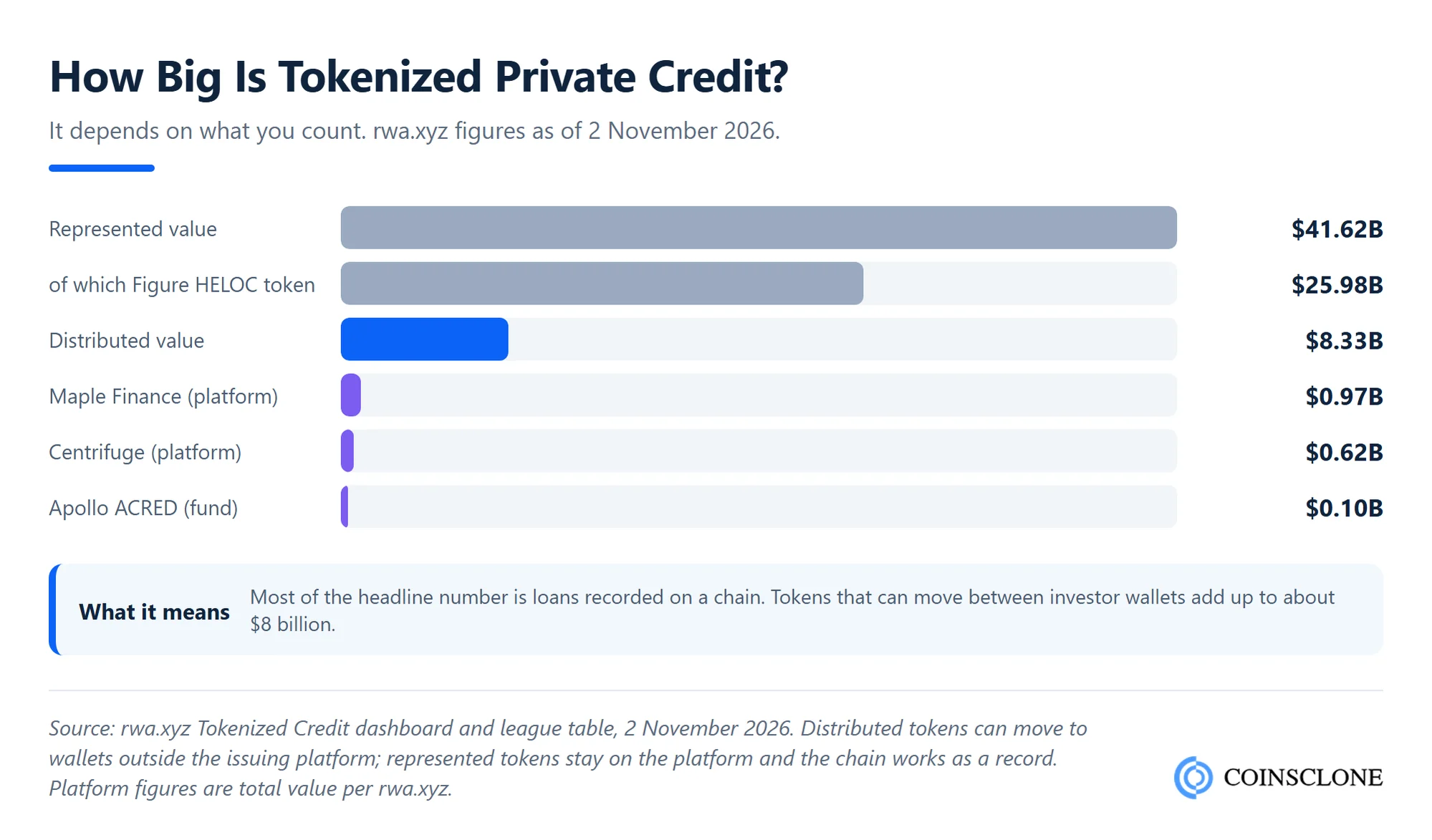
The rwa.xyz tokenized credit dashboard showed these figures on 2 November 2026:
- Distributed value: $8.33 billion, up 2.95% in 30 days. These are tokens that can move to wallets outside the issuing platform.
- Represented value: $41.62 billion. These tokens stay on the issuing platform, and the chain works mainly as a record.
- Assets and holders: 2,724 assets and 205,585 holders.
- Largest single asset: the Figure HELOC token on the Provenance chain, at $25.98 billion of represented value.
rwa.xyz explains the split in its November 2025 framework. In plain terms, the $8.33 billion is the market where tokens actually move between investors. The $41.62 billion adds loans that are recorded on a chain but do not leave one company’s system.
Its platform league table on the same date was led by STOKR ($1.5 billion), Maple Finance ($969.8 million), Hastra ($652.1 million), Centrifuge ($623.6 million) and Realiz ($500 million).
Next to the $2.1 trillion private credit market, even $41 billion is small. That gap is the reason so many lenders and fund managers are looking at this now.
Tokenized Private Credit Examples in 2026
These are the products searchers ask about most. All figures are dated, because they change every week.
| Product | What it is | Size | Who can buy |
| Figure (Provenance) | Home equity loans recorded on Figure’s own chain | $25.98B represented, rwa.xyz, 2 Nov 2026 | Institutional loan buyers |
| Maple Finance | On-chain lending to institutions | $4.43B AUM, Maple site, 2 Nov 2026 | Mainly non-US and qualified investors |
| Centrifuge JAAA | Tokenized AAA CLO fund, Janus Henderson sub-advisor | $573.1M, rwa.xyz, 2 Nov 2026 | Whitelisted investors |
| Apollo ACRED | Feeder into Apollo’s diversified credit fund via Securitize | $95.6M, rwa.xyz, 2 Nov 2026 | Eligible investors, $50,000 minimum |
| WisdomTree CRDT | Fund holding listed credit vehicles | Launched 12 Sep 2025 | Retail and institutional, $25 minimum |
Figure
Figure is the largest by far. Its February 2026 prospectus says every loan it makes is logged on its Provenance chain as a hashed record. It also reports more than $18 billion of home equity loans (HELOCs) made through 30 September 2025. These tokens are represented, not distributed, so they are not a product for the public.
Maple Finance
Maple’s site showed $4.43 billion in assets under management on 2 November 2026. Its Maple Institutional pool held $674 million at a 5.5% APY, with a 144% collateral ratio. Put simply, borrowers post more collateral than they borrow. That is a different risk from loans with no collateral.
Centrifuge and JAAA
Centrifuge is a platform for tranched credit pools and tokenized funds. Its largest product is JAAA, a tokenized AAA CLO fund with Janus Henderson as sub-advisor. The JAAA page on rwa.xyz showed $573.1 million across eight networks on 2 November 2026.
Apollo ACRED
ACRED gives on-chain access to an Apollo credit fund. Securitize issues the token. The ACRED page on rwa.xyz lists $95.6 million, 46 holders and seven networks. The minimum is $50,000, you can cash out once a quarter, and the fund started on 30 January 2025.
WisdomTree CRDT
WisdomTree took a retail route. Its private credit fund token went live on 12 September 2025 with a $25 minimum. It runs on Ethereum and Stellar. It holds listed credit funds, such as BDCs and REITs, not direct loans.
What Are the Risks of Tokenized Private Credit?
Tokenization makes credit easier to see. It does not make it safer. If borrowers stop paying, token holders lose money, exactly as fund investors would.
Who Loses Money When a Loan Defaults?
Take a $10 million loan pool. It issues an $8 million senior token and a $2 million junior token. The junior token earns more because it takes losses first.
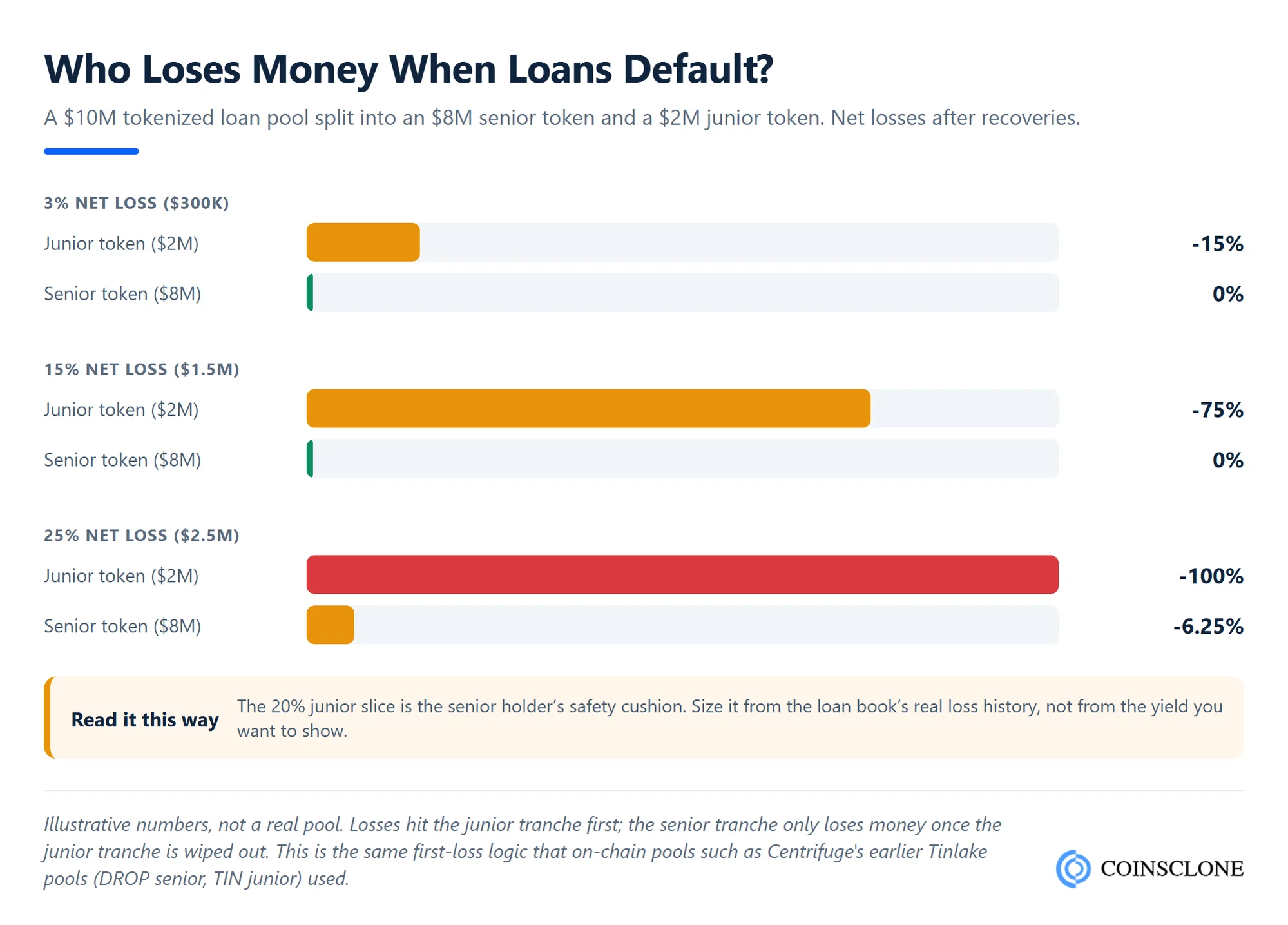
- 3% net loss ($300,000): the junior token loses 15% of its value. Senior holders lose nothing.
- 15% net loss ($1.5 million): the junior token loses 75%. Senior holders still lose nothing.
- 25% net loss ($2.5 million): the junior token is wiped out. Senior holders lose $500,000, or 6.25%.
The lesson for a platform builder is simple. Size the junior tranche from the real loss history of the loan type, then show investors that math on the deal page.
Real Defaults in On-Chain Credit
- Maple, December 2022: Orthogonal Trading defaulted on $36 million across eight loans after losses tied to FTX. That was about 30% of Maple’s active loans at the time. Losses stayed inside the pools that lent to it, because each pool sat in its own contract.
- Goldfinch, 2023: the protocol wrote down about $7 million of a $20 million loan to the credit fund Stratos.
- Goldfinch, June 2026: token holders voted to wind down Goldfinch Prime. The work now is getting money back from old pools.
Other Risks to Plan For
- Liquidity: most tokens can only be sold to other approved holders. If no one wants to buy, you wait for redemptions, which may be quarterly.
- Valuation: loans rarely trade, so prices come from models. The IMF warned of stale and subjective marks across private credit funds.
- Oracle and servicer risk: the chain only knows what the servicer reports. A late or false report means a wrong price on-chain.
- Smart contract risk: a bug in the pool or token contract can lock or lose funds. Audits help, but they do not remove the risk.
- Legal risk: if the token holder’s claim on the SPV is not clear in the documents, the token may be worth little in a dispute.
What Rules Apply to Tokenized Private Credit?
In most countries, a token that pays you a share of loan income is a security. Putting it on a chain does not change that. Plan the legal structure first and the software second.
- United States: most deals use Regulation D, often Rule 506(c). It allows public ads, but only checked accredited buyers can invest. Regulation S covers sales to buyers outside the US. Funds also need an exemption under the Investment Company Act, or they must register. Consumer lenders need their own state lending licenses.
- European Union: MiCA does not cover tokens that count as financial instruments. Those stay under MiFID II and the Prospectus Regulation. The DLT Pilot Regime has let licensed venues trade and settle tokenized securities since 23 March 2023.
- Singapore, Hong Kong and the UAE: tokenized debt is still a security under local law. Each also runs pilots for tokens like these.
Your platform has to enforce these rules in code. That means investor checks, transfer limits, lock-ups and country blocks built into the token itself.
How to Build a Private Credit Tokenization Platform
A private credit platform has more moving parts than a simple token sale. It must handle loans, payments and investor rules every day for years.
Core Features
- Issuer and originator portal: upload loan tapes, create pools, set tranche sizes, rates and terms.
- Investor checks: KYC, AML and accredited status checks, then a wallet allow list.
- Permissioned tokens: tokens that only move between approved wallets, with lock-ups and country rules.
- Pool and tranche contracts: deposit, redeem, and split repayments by tranche order.
- Loan book and NAV engine: track each loan, its balance and status, and publish NAV on-chain.
- Servicer feed: post payments, late loans and defaults from the loan system.
- Payments: stablecoin and bank rails for deposits, interest and cash-outs.
- Investor dashboard: holdings, yield history, documents, tax forms and reports.
- Admin and compliance console: freeze, force transfer under court order, cap tables and audit logs.
- Optional secondary market: a bulletin board or matching engine for approved holders only.
Which Token Standards Should You Use?
- ERC-3643: a final Ethereum standard for tokens that only approved holders can own. It checks each holder’s on-chain ID before a transfer. See our guide to ERC-3643 token development.
- ERC-7540: a final standard for vaults with request-based deposits and redemptions. It fits credit pools well, because redemptions often wait for loans to repay.
- ERC-4626: the base vault standard that ERC-7540 extends. It makes your pool easy for other DeFi apps to read.
Steps to Build the Platform
- Pick the deal type: fund wrapper, lending pool, tranched SPV or chain as record. This drives everything else.
- Set the legal structure: SPV or fund, offering exemption, investor types and countries. Get counsel early.
- Choose the chain: Ethereum, a layer 2, Solana or a private chain. Many live funds now issue on several chains.
- Design the token and pool contracts: tranches, waterfall logic, fees, lock-ups and redemption queues.
- Build the off-chain stack: onboarding, loan servicing link, NAV engine, payments and reports.
- Audit and test: smart contract audits, default scenario tests and a test run with a small pool.
- Launch and run: onboard the first investors, publish pool reports and add new pools over time.
If you want to see how these modules work for other asset types first, our DeFi lending and borrowing platform guide covers the pool and interest logic.
How Much Does a Private Credit Tokenization Platform Cost?
There is no reliable public price for a full private credit platform, because each one is shaped by its legal structure and loan type. What we can share are the cost drivers and one sourced range.
Published 2026 agency cost guides put the token contract alone at $5,000 to $15,000 for a basic token and $15,000 to $50,000 or more for a complex one. A private credit token is usually the complex kind, because it carries investor checks, tranches and payout logic.
| Cost driver | Lower cost | Higher cost |
| Build route | White label platform you rebrand | Fully custom platform |
| Deal model | One fund wrapper token | Many tranched pools with a waterfall |
| Chains | One chain | Several chains with bridging |
| Investor checks | Third-party KYC plugged in | Custom accreditation and identity system |
| Loan data | Manual uploads by the issuer | Live feed from the servicer’s system |
| Payments | Stablecoins only | Stablecoins plus bank rails in several currencies |
| Trading | Primary issue and redemption only | Secondary market for approved holders |
| Audits | One contract audit | Several audits plus ongoing reviews |
On timing, the legal setup often takes longer than the code. A white label tokenization platform shortens the software side, since onboarding, token issue and dashboards already exist. A custom build makes sense when your loan type, waterfall or data feeds are unusual.
Launch a Private Credit Platform Investors Can Trust
Private credit tokenization, done right.
- Investor onboarding: KYC, accreditation checks and wallet whitelisting in one flow
- Tranche tokens: permissioned senior and junior tokens with a coded repayment waterfall
- Loan book and NAV: servicer feeds that post repayments, defaults and NAV on-chain
- Investor portal: dashboards, payouts in stablecoins or fiat, reports and redemptions
See a live demo of a private credit tokenization platform with pools, tranches and investor dashboards.
Book a Free Demo to plan your private credit platform, from legal structure to launch.
How Coinsclone Helps You Build a Private Credit Tokenization Platform
Coinsclone builds private credit tokenization platforms for lenders, fund managers and fintechs. We build the investor checks and the tranche tokens. We also build the pool contracts, NAV and loan data feeds, payments and dashboards. Coinsclone has built crypto products since 2018 and delivered 350+ platforms for 200+ clients across 20 industries. See our RWA tokenization platform development and asset tokenization platform development services to plan your build.
Frequently Asked Questions
Is tokenized private credit an on-chain asset?
Partly. The token and its ownership record live on-chain, but the loan itself is an off-chain contract between a lender and a borrower. Some tokens move freely between approved wallets, while others stay on one platform and use the chain only as a record. rwa.xyz calls these distributed and represented assets.
Does tokenizing a loan remove its credit risk?
No. If the borrower stops paying, the token loses value just as a fund share would. Tokenization makes the loan book easier to check. Safety still comes from careful lending, collateral and the size of the junior slice.
How do investors receive interest on tokenized private credit?
Borrowers pay the lender back in cash or stablecoins. The lender posts each payment. A smart contract then pays holders in stablecoins or raises the token’s value. In tranched pools, senior holders are paid before junior holders.
Is tokenized private credit liquid?
Not very. Most tokens can only be sold to other approved buyers, and trading is thin. Many products let you cash out on set dates instead. Apollo’s ACRED, for example, pays out once a quarter.
What is the Apollo tokenized private credit fund?
It is ACRED, a token that gives access to an Apollo credit fund. Securitize issues it. It launched in January 2025, runs on seven networks and has a $50,000 minimum. rwa.xyz listed it at $95.6 million on 2 November 2026.
How big is the tokenized private credit market?
On 2 November 2026, rwa.xyz showed $8.33 billion of distributed tokenized credit. Represented value was $41.62 billion. Most of the larger number is Figure’s home equity loans logged on its own chain.
How much does it cost to build a private credit tokenization platform?
The cost depends on the deal model, the number of chains, investor checks, loan data feeds and whether you add a secondary market. Published 2026 agency cost guides put a complex token contract alone at $15,000 to $50,000 or more. A white label platform costs less than a custom build and launches sooner.