
In the US, a real-money prediction market needs a CFTC license. In most cases that means a Designated Contract Market, or DCM, plus a clearing house that settles each contract. You can apply for your own DCM, partner with a firm that already has one, or buy one. Outside the US, a few places now issue a prediction market license, and Gibraltar was the first to write rules just for it.
This guide is for founders choosing a route, not a news recap. It gives the time, capital and risk of each route, sourced and dated as of 13 November 2026. It also shows what the CFTC rules mean for the software you must build.
In this guide:
- Four routes compared: full DCM, partner with a DCM, buy a DCM, or go offshore, with time to launch, who can trade, capital and the main risk.
- Real approval times: 2026 approvals took about 6 to 12 months, based on CFTC orders.
- Core principles turned into features: the surveillance, limits, records and controls your platform must ship.
- A readiness checklist: the documents, policies, systems and staff to prepare before you call a lawyer.
- Where it is legal: the US state fight, Gibraltar, the UK and Canada, and how to geo-block the rest.
What Is a Prediction Market License?
A prediction market license is a regulator’s OK to run a venue where people trade on how events turn out. Each contract pays a fixed amount, usually $1, if the event happens and $0 if it does not. Prices between those two points show what the crowd thinks the odds are. If you are new to the model, our guide on what a prediction market is covers the basics.
Who issues the license depends on where your users live:
- United States: event contracts are swaps or futures, so the Commodity Futures Trading Commission regulates them. The main license is DCM designation.
- Gibraltar: its own permit just for these markets, under new 2026 rules.
- UK: these markets count as betting, so a gambling license is the usual path.
- Europe: rules vary by country, and several, such as France, Germany and Italy, are on Polymarket’s restricted list.
- Canada: securities regulators control them, and sports contracts are off the table for now.
Running a market without the right license is not a gray area. On 3 January 2022 the CFTC fined Polymarket $1.4 million and made it wind down its unlawful markets. Its fault was offering event contracts without being a DCM.
What Is a DCM and Why Does a Prediction Market Need One?
A DCM is a futures exchange approved by the CFTC under Section 5 of the Commodity Exchange Act. Retail traders in the US can only trade these contracts on a DCM. The rules are in 17 CFR Part 38, which sets out 23 core principles. Every DCM must show it meets them before approval and keep meeting them after launch.
The license market is busy. On 13 November 2026, the CFTC list of contract markets showed 33 designated DCMs and 18 pending applications. Nine new DCMs were approved in 2026 alone, including ProphetX (11 June), Sporttrade (30 October) and tZERO (10 November). Kalshi has held its DCM since 3 November 2020.
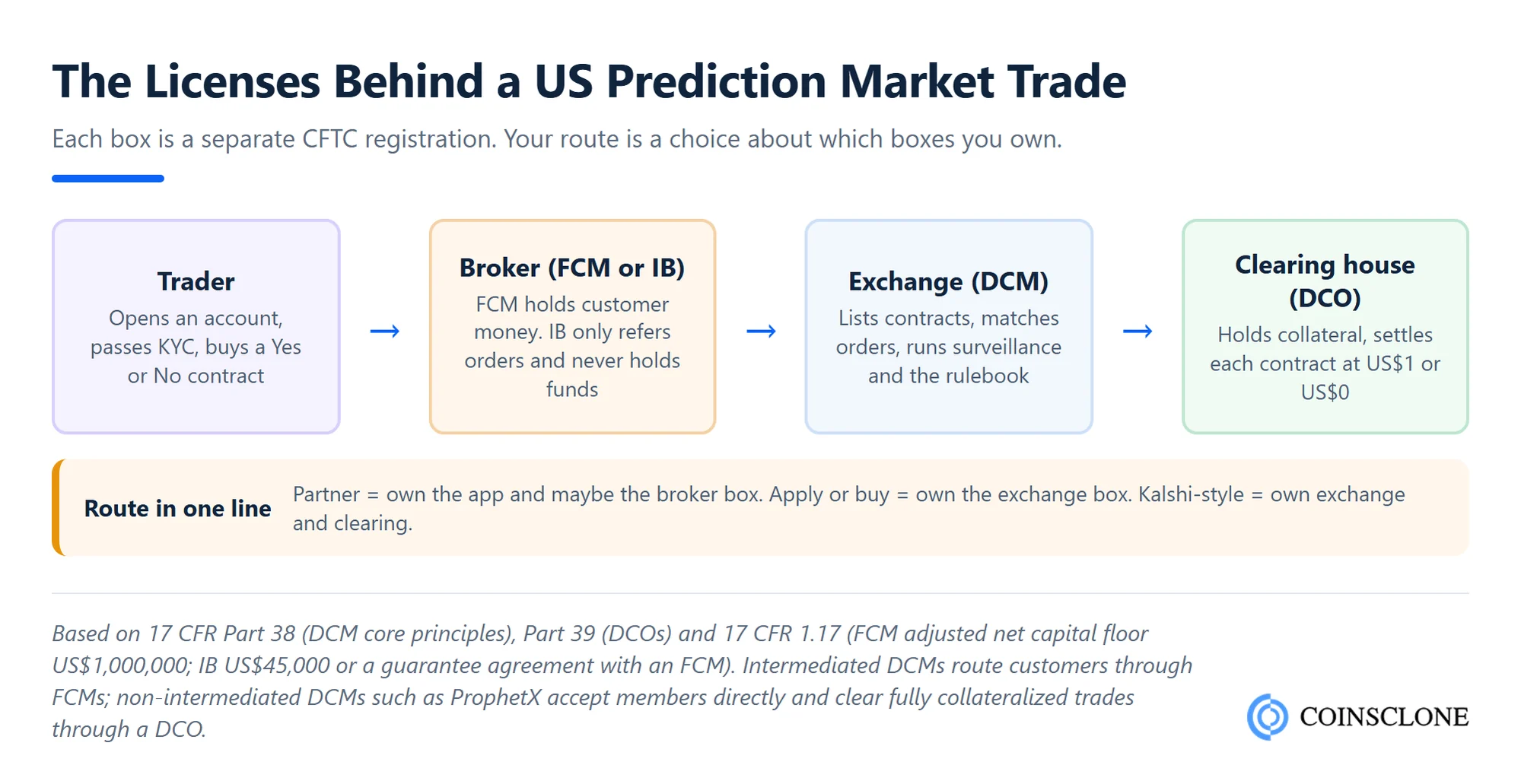
A DCM does not work alone. Its trades must be cleared by a Derivatives Clearing Organization, or DCO. If you want brokers to hold customer money, you also need Futures Commission Merchants, or FCMs. Introducing Brokers, or IBs, can send orders but never hold funds.
What Are the Four Ways to Get a Prediction Market License?
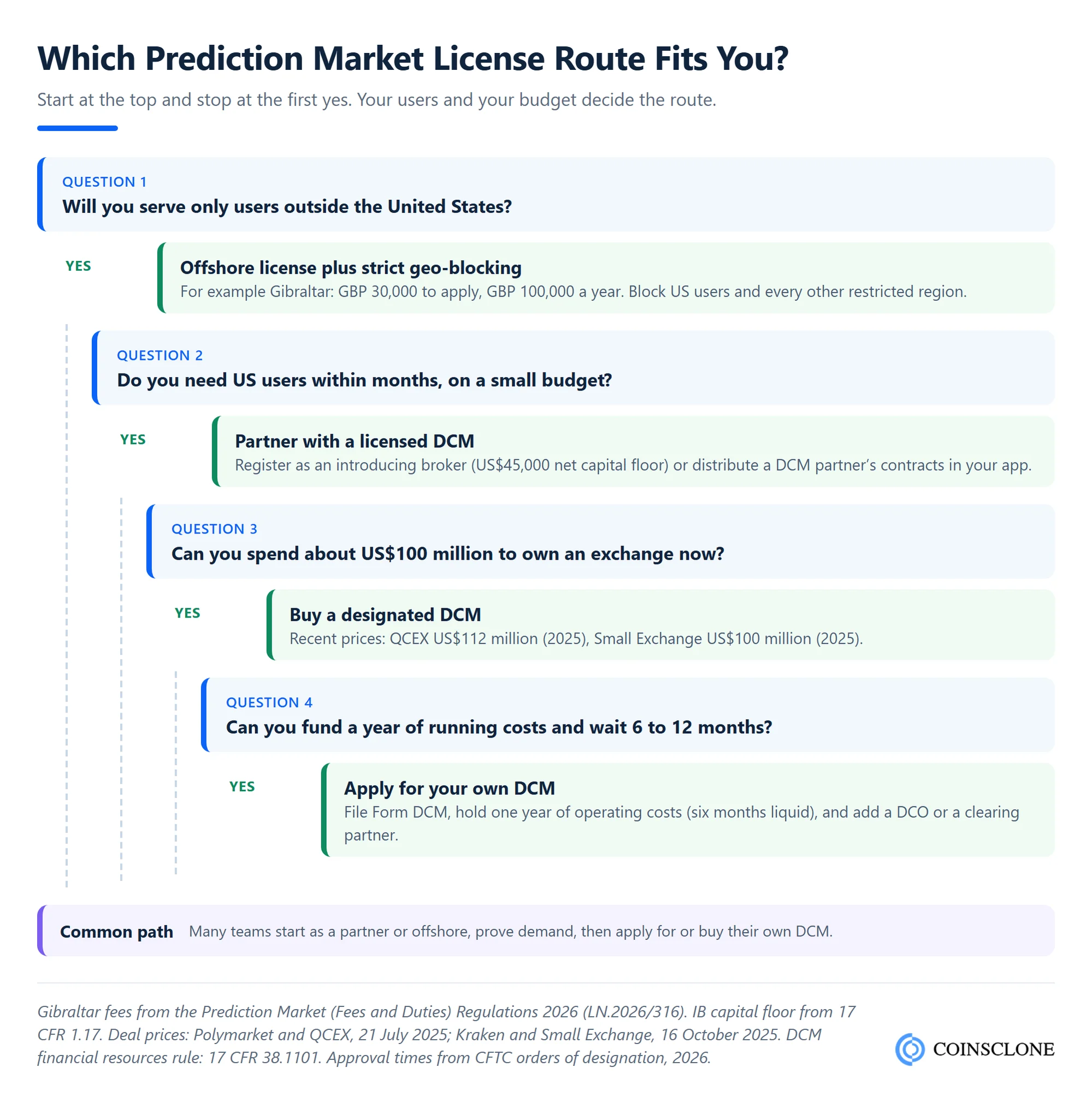
There are four real routes. They differ most in time to launch and in how much control you keep. The table uses figures checked on 13 November 2026.
| Route | Time to launch | Who can trade | Rough capital | Main risk |
| Apply for your own DCM | About 6 to 12 months in 2026 approvals (CFTC orders); Gemini Titan took 5+ years | US retail and institutions, subject to state law fights on sports | Financial resources equal to 1 year of running costs, 6 months of it liquid (17 CFR 38.1101), plus a DCO or a clearing partner | Long review; you carry all compliance from day one |
| Partner with a DCM as a broker or distributor | Fastest US path; you only add a broker license or a commercial deal | US users, but only the partner’s listed contracts | IB: $45,000 net capital or an FCM guarantee; FCM: $1,000,000 floor (17 CFR 1.17) | You rely on the partner’s markets, pricing and uptime |
| Buy a designated DCM | Deal close, then a CFTC notice within 10 business days of a 10% or larger stake change (17 CFR 38.5) | Same as your own DCM | $112 million for QCEX (July 2025); $100 million for Small Exchange (October 2025) | Very high price; you inherit the old rulebook and any issues |
| Offshore license, such as Gibraltar | Decision within 6 months of a complete application (Gibraltar rules, in force 13 July 2026) | Non-US users only, with US and other restricted places blocked | GBP 30,000 to apply, GBP 100,000 a year, 0.15% duty on commission | US enforcement if US users get in; fewer banks and app stores |
How Do You Get a DCM License From the CFTC?
You apply by filing Form DCM under 17 CFR 38.3. The form has a cover sheet, general questions and 22 exhibits, lettered A to V. The CFTC then has 180 days to approve, deny or approve with conditions. That clock only starts once the CFTC treats your file as materially complete.
The steps, in order:
- Form the exchange company: a separate US entity, with owners above 10% named and a board that meets fitness standards.
- Write the rulebook: contract terms, access rules, banned trade practices, discipline and dispute rules.
- Build the platform and the surveillance stack: matching engine, real-time monitoring, audit trail and risk controls.
- Line up clearing: register your own DCO or sign with an existing one. Exhibit T must name it.
- Prove the money: show one year of running costs on hand, with six months in cash or near cash.
- File, answer questions, amend: expect several rounds of staff comments. Each approved firm’s order lists months of submissions.
- Self-certify each contract: after approval, new event contracts are listed under Part 40 and can be reviewed by the CFTC.
How long does DCM approval take?
Recent CFTC orders give a clear picture. ProphetX filed on 3 December 2025 and was designated on 11 June 2026, about 6 months. Sporttrade took about 9 months and tZERO about 12. Gemini Titan’s first Form DCM on file dates from 2020, and its designation came on 10 December 2025.
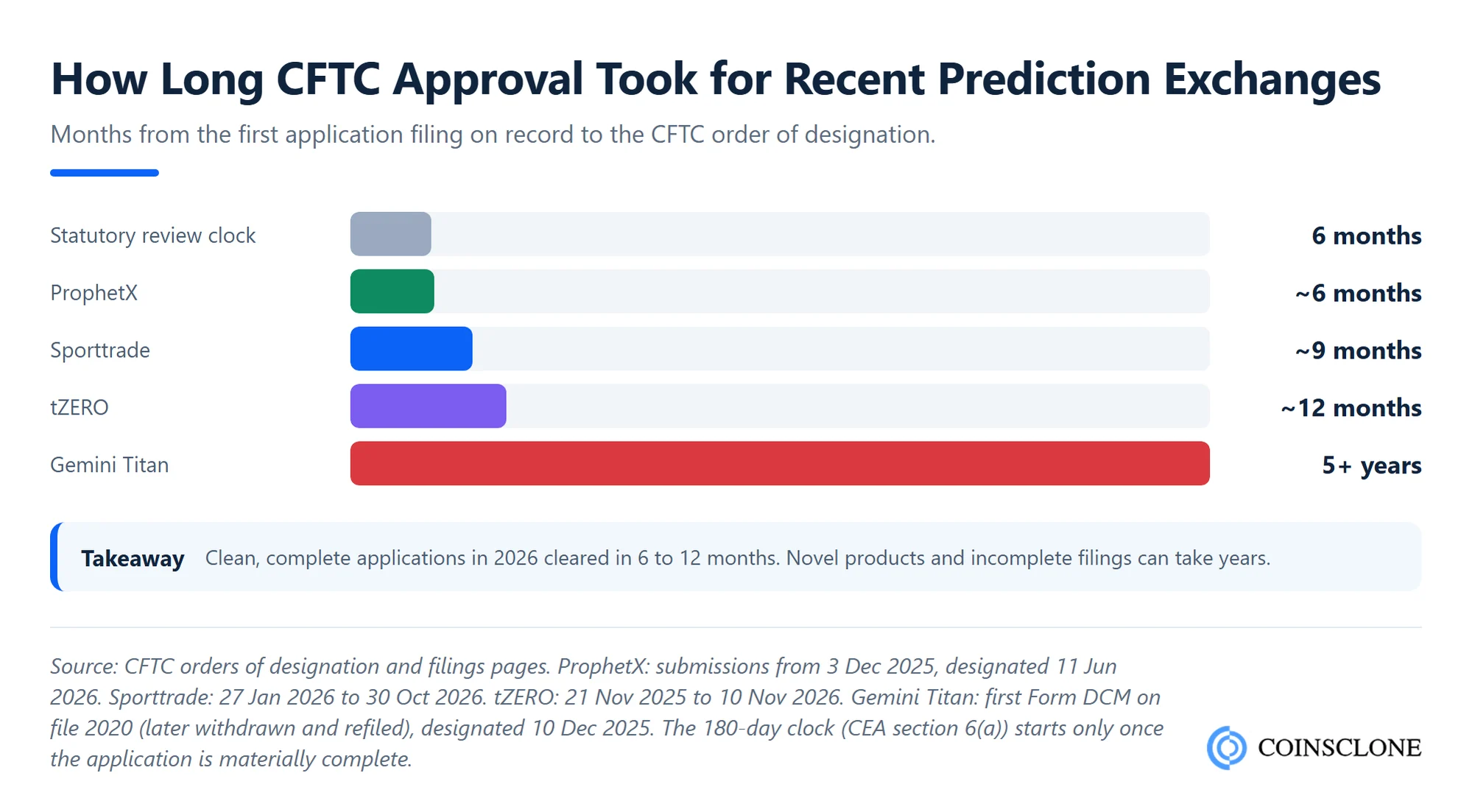
The lesson is simple. A complete file with a working platform and clear rules moves fast. A novel product or a thin file stalls.
How much capital does a DCM need?
There is no fixed dollar minimum. Instead, 17 CFR 38.1101 says your financial resources must cover at least one year of operating costs, on a rolling basis. At least six months of that must be cash or highly liquid assets. You report it every quarter, within 40 days of quarter end, and 60 days after year end.
Here is a worked example. Assumption: an exchange spends $300,000 a month on staff, tech, legal and audit.
- Annual running costs: $300,000 x 12 = $3.6 million in total financial resources.
- Liquid part: $300,000 x 6 = $1.8 million in cash or near cash, or a committed credit line.
- On top of that: clearing costs, either your own DCO capital or fees to a clearing partner.
If your monthly spend is half that, the numbers halve too. The rule scales with your size, so a lean team is cheaper to license.
Do you also need a DCO?
Yes, someone must clear every trade. Core Principle 11 says trades must clear through a registered DCO. Most new prediction exchanges list fully collateralized contracts, so a buyer posts the full price up front and there is no margin call. You can register your own DCO, as Kalshi and ProphetX did, or sign with an existing clearing house. Your own DCO adds another CFTC review under Part 39, but it keeps fees and control in house.
What Do the CFTC Core Principles Mean for Your Software?
Most guides list the 23 principles and stop. Below, the ones that shape your code most are mapped to the features you must ship. Each one is backed by a rule in Part 38.
| Core principle | What the rule asks | What your platform must ship |
| 2: Compliance with rules (38.150, 38.151) | Enforce the rulebook and give impartial access | Member onboarding with KYC, access rules in code, an audit log of every rule breach |
| 3: Contracts not easily manipulated (38.200) | Each contract settles on a reliable source | A settlement engine tied to named data sources, with a second source check and a dispute window |
| 4: Prevent market disruption (38.251) | Real-time monitoring and the ability to rebuild any day of trading | A surveillance dashboard, alerts for spoofing and wash trades, T+1 reports, full order book replay |
| 5: Position limits (38.300) | Limits or accountability levels per contract | Per-account and per-contract position caps, checked before each order |
| 6: Emergency authority (38.350) | Power to halt or adjust markets | A market halt switch, price bands and an admin action log |
| 9: Execution of transactions (38.500) | A fair, transparent trading system | A central limit order book with documented matching rules (Q) |
| 11: Financial integrity (38.600) | Clearing through a DCO and safe customer funds | DCO integration, segregated customer balances, daily reconciliation |
| 8 and 10: Trade data (38.450, 38.550) | Publish daily volume and prices; keep trade records | Public daily data feed and a trade database with timestamps |
| 18: Recordkeeping (38.950) | Keep all records for at least 5 years | Write-once storage for orders, chats, alerts and decisions, kept 5 years or more |
| 20: System safeguards (38.1051) | Security, testing, backups and capacity planning | Penetration tests, disaster recovery site, load tests, change control |
| 21: Financial resources (38.1101) | One year of running costs, six months liquid | A finance report that works out the quarterly figures |
Two newer CFTC actions affect this list. On 10 November 2026 the CFTC issued guidance on DCM impartial access, which shapes how you set member criteria. A proposed rule on data reporting for event contracts (1 July 2026) may change how you report trades.
If you plan to build on a ready base rather than from scratch, a Kalshi clone script already follows this regulated exchange model.
Can You Partner With an Existing DCM Instead?
Yes, and it is the fastest way to reach US users. You keep the brand and the app, and a licensed DCM lists and clears the contracts. There are three common setups:
- Introducing Broker: you register as an IB, send orders to an FCM, and never hold customer money. Under 17 CFR 1.17, you need $45,000 in net capital. An FCM can stand behind you instead.
- Futures Commission Merchant: you hold customer funds yourself. The floor is $1,000,000 in adjusted net capital, and the compliance load is much heavier.
- Distribution deal: you show a DCM’s markets in your app under a business deal. The DCM or its FCM partner owns the customer account.
The trade-off is control. You can only offer contracts your partner lists, and the partner sets much of the fee split. Many teams use this route to test demand, then apply for their own DCM once they have volume.
Can You Buy a Company That Already Holds a DCM?
Yes. Buying a designated exchange is how several big names entered the market in 2025. Prices are high because the license saves years of work.
| Deal | Date | Reported price |
| Polymarket buys QCEX (DCM and DCO) | 21 July 2025 | $112 million |
| Kraken buys Small Exchange from IG Group | 16 October 2025 | $100 million |
| DraftKings buys Railbird Exchange | 21 October 2025 | Not disclosed |
| Robinhood and Susquehanna buy 90% of MIAXdx | Agreed November 2025, closed 20 January 2026 | Not disclosed; MIAX had paid $50 million for it in 2023 |
Before you buy, check three things:
- Status: a “Dormant” DCM on the CFTC list must reinstate its designation before it lists contracts again (38.3(b)). The list showed 12 dormant DCMs on 13 November 2026.
- Clearing: does the target come with a DCO, or will you need a clearing partner?
- History: read its rule filings, any CFTC letters and any open cases. You inherit them all.
Where Are Prediction Markets Legal Outside the US?
Outside the US, the picture changes country by country. A few places license prediction markets, many treat them as betting, and some block them outright.
What does a Gibraltar prediction market license cost?
Gibraltar’s new prediction market rules took effect on 13 July 2026. They create an authorization separate from a normal gambling license. The fees, set on 13 August 2026, are GBP 30,000 to apply and GBP 100,000 a year, plus a duty of 0.15% of commission charged. The regulator must decide within six months of a complete application.
The form asks for much the same things as a DCM. You show how you watch for abuse, guard client money and run AML and sanctions checks. You also name your outside vendors and give a plan to wind down if you fail.
Is a prediction market legal in the UK?
There is no separate UK prediction market license. The Gambling Act 2005 treats a bet on whether an event will happen as betting, so you need a Gambling Commission license to serve UK users. Polymarket’s own geo-block list marks the UK as close-only as of 13 November 2026.
Is a prediction market legal in Canada?
Only in a narrow way. On 27 August 2026, Canada’s market watchdogs spoke in Joint Staff Notice 91-307. They said sports and show-business event contracts do not belong under their rules. Two CIRO dealers may offer a limited set of other event contracts. No such market has been approved as an exchange in Canada.
How should you geo-block restricted users?
Geo-blocking is not optional on the offshore route. Polymarket’s own list on 13 November 2026 shows how wide it gets. It blocks 7 places fully for sanctions and sets 38 to close-only. Five more are close-only on its website. The close-only list has the US, the UK, France, Germany and Italy. It also lists Australia, Singapore and four parts of Canada.
Your stack should check where the user is at sign-up, login, deposit and each order. Use IP and device signals, block VPN and proxy traffic where you can, and keep logs to prove it worked.
How Does the US State Law Fight Affect Your Launch?
A DCM license does not end the state question, mainly for sports contracts. On 6 April 2026 the Third Circuit sided with Kalshi against New Jersey. On 28 August 2026 the Ninth Circuit sided with Nevada. New Jersey has asked the Supreme Court to decide (case No. 26-299), and Kalshi’s response is due 7 December 2026.
For a founder, this means three things:
- Launch non-sports markets first: economics, weather, finance and culture carry less state risk.
- Build state-level geofencing: you may need to switch off sports contracts in a state at short notice.
- Watch the CFTC’s own rules: the proposed rule on public interest reviews of event contracts (12 June 2026) sets out how gaming, war and terrorism contracts would be judged.
If you already run a sportsbook, our guide on how sportsbooks can launch a prediction market covers the state license risk in detail.
What Should You Prepare Before Calling a Lawyer?
A lawyer will move faster, and bill fewer hours, if you arrive with this ready. The list follows the Form DCM. The letters in brackets are the form’s own labels for each part.
Documents
- Owners: each owner above 10% and anyone who runs the firm (A).
- Officers and board: names, roles, five years of work history and any past cases (B).
- Board fitness and structure: how many public directors, plus an org chart with affiliates (C, D).
- Company papers: your setup papers and a proof of good standing (G).
- Financials: balance sheet, income and cash flow, and a one year cost forecast (I).
Policies
- Rulebook: contract terms, access, trading rules and position limits (M).
- Fees: each fee and how you set it (K).
- Surveillance manual: how you watch for abuse, day to day (O).
- Discipline and disputes: how you look into and punish rule breaks (P).
- AML, KYC and sanctions rules, plus a rule on conflicts of interest.
Systems
- Matching engine notes: how orders match, with worked examples (Q).
- Data and records plan: how you store trade data for 5 years or more (S).
- Clearing agreement or DCO plan: the clearing house that will guarantee trades (T).
- Tech answers: how you handle security, backups, load and tests (V).
Staff
- A head of compliance who knows futures rules.
- Market watch staff who can work the alerts each trading day.
- A staffing plan for each function and each key person’s background (E, F).
The CFTC also wants each outside contract that helps you meet a core principle (N). Mark what you want kept private (U).
Launch a Prediction Market Built to Pass a License Review
Prediction market development, done right.
- Order Book and Matching: A central limit order book with documented matching rules, price bands and a market halt switch.
- Surveillance Tools: Real-time alerts for spoofing and wash trades, T+1 reports and full order book replay.
- Settlement Engine: Contracts tied to named data sources, with a second source check and a dispute window.
- Compliance Controls: KYC onboarding, position caps, geo-blocking by country and state, and audit logs kept for years.
See a live demo of our prediction market platform with surveillance and settlement in action.
Book a Free Demo to plan your license route, your feature list and your launch date.
How Coinsclone Helps
We build the trading software a licensed market runs on. That means the order book, the payout engine, abuse alerts, position caps, audit logs and geo-blocks. Our prediction market clone script can go live in 5 to 7 weeks on the Polymarket model, or 6 to 8 weeks on the Kalshi model. Coinsclone has built crypto products since 2018 and delivered 350+ platforms for 200+ clients across 20 industries. Want a custom build with your own rules and controls? See our prediction market platform development service. To plan a budget, read our prediction market development cost guide.
Frequently Asked Questions
Do I need a license to operate a prediction market platform?
Yes, if real money changes hands. In the US you need a CFTC-registered DCM, or a partnership with one, to offer event contracts. Elsewhere you need a local license, such as a Gibraltar permit or a UK gambling license. Free play-money markets usually fall outside these rules.
How do I get a DCM license?
File Form DCM with the CFTC, with all 22 parts. These cover your rules, your accounts, your abuse checks and your clearing plan. The CFTC has 180 days to decide once the file is complete. Recent prediction exchanges were approved in about 6 to 12 months.
How much does a DCM license cost?
The CFTC does not charge a set fee, but you must hold one year of running costs, with six months of it liquid. Buying an existing DCM costs far more: Polymarket paid $112 million for QCEX in July 2025 and Kraken paid $100 million for Small Exchange in October 2025.
Is a prediction market legal in the US?
Yes, on a CFTC-registered DCM. Sports contracts are still fought over by states. Courts are split after the Third Circuit backed Kalshi in April 2026 and the Ninth Circuit backed Nevada in August 2026, and the Supreme Court has a petition pending.
What is the difference between a DCM, a DCO and an FCM?
A DCM is the exchange that lists and matches contracts. A DCO is the clearing house that holds collateral and settles each trade. An FCM is the broker that holds customer money; an Introducing Broker sends orders but never holds funds.
Is a prediction market legal in the UK?
Not without a license. UK rules treat prediction markets as betting under the Gambling Act 2005, so an operator needs a Gambling Commission license. Polymarket lists the UK as close-only, so UK users cannot open new trades there.
Is a prediction market legal in Canada?
Only in a limited form. Since 27 August 2026, its watchdogs say sports and show-business contracts fall outside their rules. Only two CIRO dealers may offer a short list of other event contracts.