

A prediction market platform script is ready-made software that lets you launch your own site where people trade on real events, from elections and sports to crypto prices. Each share pays $1 if its outcome happens, so the price reads as the crowd’s odds. Instead of building the trading engine, wallets and payout system from zero, you start with a tested base and add your brand.
This guide shows you what sits inside a good script, how it works from sign-up to payout, and how to judge one before you buy. You will also see when free code on GitHub is enough, what a script costs, how long launch takes, and which legal model fits your plans. Every market figure here was checked against its source in October 2026.
In this guide:
- What a prediction market script includes, layer by layer
- How one $1 share pair turns into a trade, a fee and a payout, with worked numbers
- A buyer’s checklist to judge any script, plus what open-source code can and cannot do
- Real 2026 cost ranges and launch times, from white label to full compliance
- The features, security and tech stack your platform needs
See How Our MVP System Can Launch Your Prediction Market Platform Script Faster
Prediction Market Platform Script —Build Your Own Event Trading Platform
- MVP System: Launch your prediction market platform quickly with our ready-to-deploy script and reduce development time by up to 90%.
- Event Market Engine : Built-in event creation, trading markets, order matching, settlement, and live market updates — everything needed to run prediction markets.
- Brand & Customization: Fully customize your platform name, prediction categories, trading rules, interface design, and blockchain integration.
- Revenue Engine:Generate revenue through trading fees, market listings, liquidity participation, and platform commissions.
Get a free branded demo of your prediction market platform within 48 hours — see it live before you invest. Book a Free Call to learn how our Prediction Market Platform Script can turn your idea into a live event-trading platform in 8–12 weeks.
What Is a Prediction Market Platform Script?
A prediction market platform script is pre-built software that lets businesses launch their own forecasting platform quickly. It copies the core functions of popular platforms such as Polymarket and Kalshi, so users can trade on the outcome of future events.
Prediction markets are online platforms where people forecast real-world results, such as sports matches, elections, crypto prices, economic data or award shows. Users buy shares in the outcome they expect. When the event ends, each winning share pays $1 and each losing share pays nothing. So a share priced at 63 cents means the crowd sees about a 63% chance of that result.
A good script ships the whole working system, not just a website. It includes the apps users see, the trading engine, the ledger that tracks every dollar, the payout logic, the result-checking flow and an admin panel.
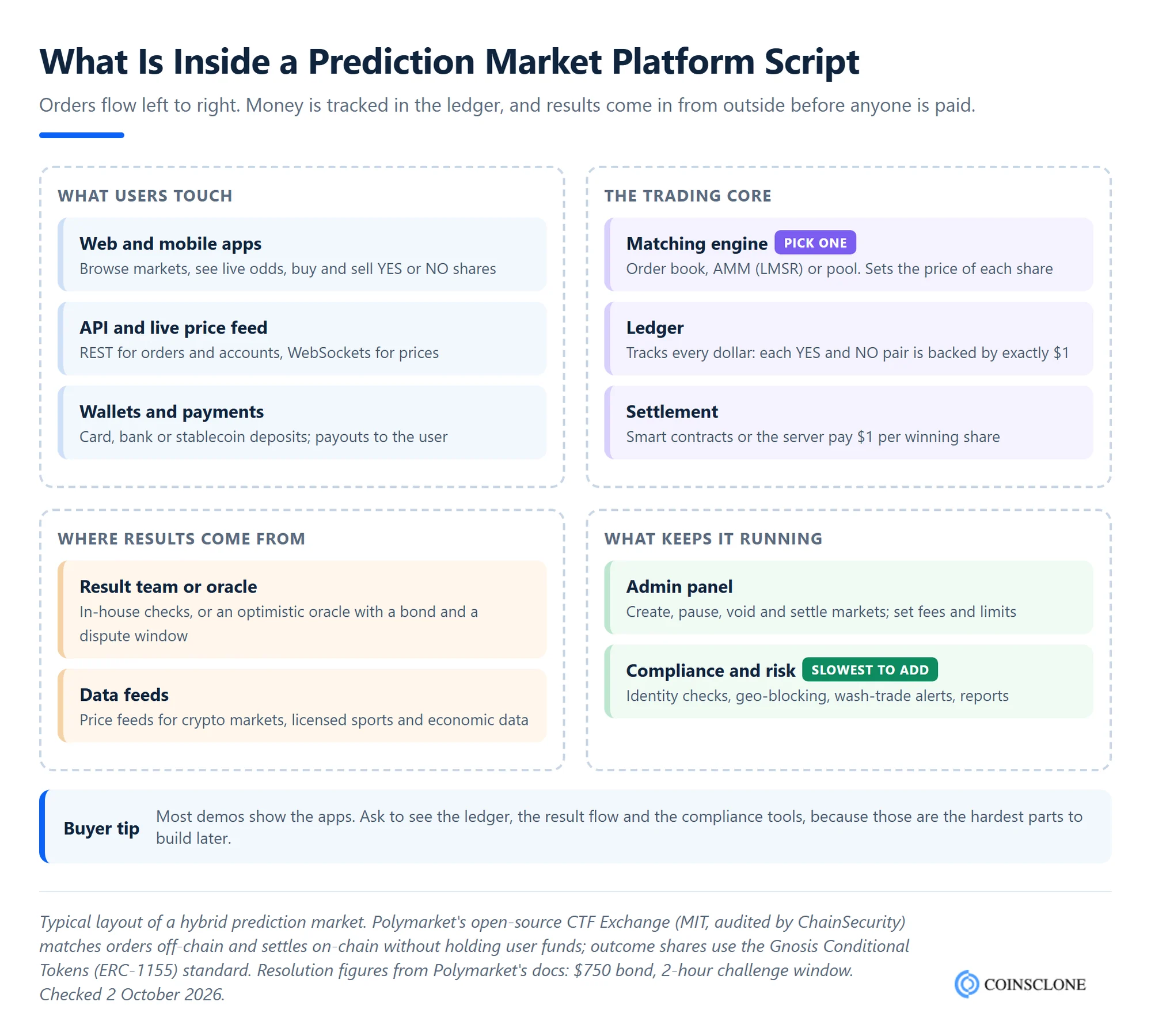
In simple terms, a prediction market platform script is a launch-ready base. It helps you enter a fast-growing market while giving users a clear place to study trends, share views and trade on what happens next.
How Does a Prediction Market Platform Script Work?
A prediction market platform script creates a digital market where users trade on the outcome of future events, much like Polymarket or Kalshi. The platform runs the same step-by-step flow for every market: a question goes live, users trade, the result is checked, and winners get paid.
1. User Registration and Account Setup
The process starts when a user signs up. After that, the user can log in, edit their profile, pass identity checks if your model needs them, and add funds by card, bank transfer or crypto.
2. Market Creation by Admin
The admin creates markets in categories such as sports, politics, finance, crypto, entertainment or world events. Each market has one clear question, a closing time and a named result source. Clear rules matter most here, because vague wording causes disputes later.
3. Users Place Predictions
Once a market is live, users buy YES or NO shares in the outcome they expect. Behind the scenes, every YES share is paired with a NO share, and each pair is backed by exactly $1. That is why the two prices always add up to about $1. Depending on your model, users pay with cash, stablecoins such as USDC, or play-money points.
4. Live Prices and Market Data
As users trade, prices move and the system shows live odds, volume and charts. Users can sell before the event ends to lock in a gain or cut a loss. This live data helps users make better choices before the market closes.
5. Event Outcome Verification
After the event, the platform checks the result against the named source. Some platforms use an in-house team. Others use an oracle. For example, Polymarket uses UMA’s optimistic oracle: someone proposes the answer with a $750 bond, and anyone can challenge it within 2 hours. A disputed result takes about 4 to 6 days.
6. Reward Distribution
Once the result is final, the system pays $1 for each winning share and closes the losing ones. On blockchain platforms, smart contracts release the funds to winning wallets automatically.
7. Admin Monitoring and Management
The admin panel lets the owner watch users, markets, trades, risk and platform health in one place.
Here is the full money flow for one share pair, with a real fee formula.
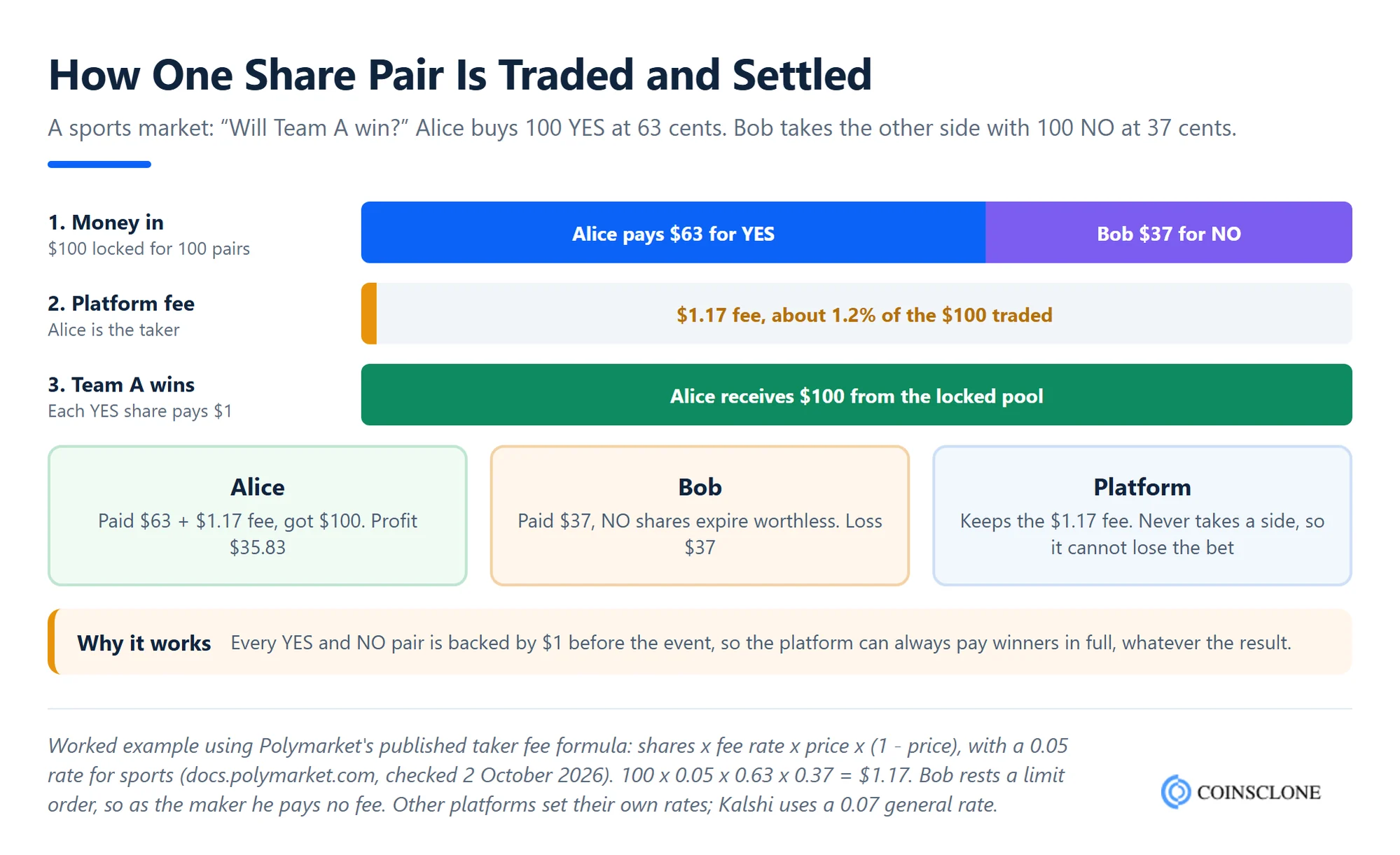
By following this flow, a prediction market platform script creates a fair market where users test their knowledge, follow trends and get paid for being right.
Order Book, AMM or Pool: Which Engine Should Your Script Use?
The trading engine is the heart of any script, so ask which one you are buying. There are three common designs.
Order book (CLOB): Buyers and sellers post prices, and the engine matches them, like a stock exchange. Kalshi and Polymarket both use order books. Prices are tight in busy markets, but a new market can look empty, so you need market makers from day one.
Automated market maker (AMM): A formula sets the price, so users can always trade, even when no one else is online. The usual choice is the Logarithmic Market Scoring Rule (LMSR), which caps how much the platform can lose while it funds early liquidity. AMMs suit many small markets with few traders.
Pool (parimutuel): All stakes go into one pot, and winners split it after the event, minus a cut. It needs no market maker, but users cannot trade in and out while the event runs.
A good rule of thumb: start with an AMM or pool if you expect many small markets, then add an order book once a few markets carry real volume. For a deeper look at each design, read our guide to prediction market platform development.
Core Features of a Prediction Market Platform Script
A prediction platform needs both user-friendly features and strong admin controls. Together, they keep trading smooth, markets fair and funds safe. Here are the key features for both sides.
User Features
Easy Sign-Up and Login: Users create accounts with email, phone, social login or a crypto wallet, then start trading in minutes.
Profile and Account Management: Users manage their profile, view past trades, track earnings and follow open positions.
Wallet Integration: Users connect a crypto wallet or add funds by card or bank, then trade and receive payouts safely.
Market Discovery: Users browse markets by category, search for topics and see trending or closing-soon markets.
Prediction Trading: Users buy and sell YES or NO shares with market or limit orders. Live prices help them decide when to act.
Real-Time Market Data: Live odds, price charts, volume and order book depth help users read the market.
Rewards and Payouts: Winning shares pay out to the user’s wallet as soon as the result is final.
Alerts and Updates: Users get alerts for new markets, closing times, results and payouts.
Admin Features
Dashboard Overview: The admin dashboard shows active users, live markets, trading volume, fees earned and open risk.
Market Creation and Management: Admins create markets, write rules, set outcomes, limits and closing times, and pause or void a market when needed.
User Management: Admins review accounts, run identity checks, set user tiers and handle flagged activity.
Transaction and Wallet Monitoring: Admins track deposits, withdrawals, trades and hot wallet balances across the platform.
Outcome Verification: Admins confirm results from trusted sources, or watch the oracle, before payouts run.
Settlement Management: The platform pays winners automatically once the result is confirmed, with refund rules for voided markets.
Security and Risk Control: Admins watch for unusual trading, linked accounts and wash trading, and set exposure limits.
Analytics and Reporting: Reports on volume, fees, users and market trends help admins grow the platform and meet reporting needs.
By combining strong user features and admin controls, a prediction market platform script gives you a safe, scalable and engaging platform.
Security Features of a Prediction Market Platform Script
Security is key for any prediction market, because users put real money on real-world results. A good script stacks several layers of protection so funds stay safe and every trade stays transparent.
- Secure User Login: Two-factor login, device checks and session limits stop account takeovers.
- Data Encryption: User data and private keys are encrypted at rest and in transit.
- Smart Contract Audits: On-chain contracts get an outside audit before launch. Polymarket’s exchange contracts, for example, were audited by ChainSecurity.
- Safe Wallets and Payments: Most funds sit in cold or multi-signature wallets, with only small balances in hot wallets.
- Fraud and Wash-Trade Checks: The system flags linked accounts, self-trading and bot spam.
- Fair Result Checks: Each market names its result source, with a dispute window before payout.
- Role-Based Admin Access: Each admin sees only what their job needs, and every action is logged.
- Regular Security Updates: The team patches and re-tests the platform as threats change.
With these layers in place, users can trade with confidence while every market stays secure and transparent.
Now, let’s explore why many businesses choose a prediction market platform script to launch.
Why Do Businesses Choose a Prediction Market Platform Script?
Prediction markets are one of the fastest-growing parts of finance. Combined monthly trading on Kalshi and Polymarket rose from $2.0 billion in July 2025 to $53.0 billion in July 2026, per Pew Research Center. Then Kalshi alone traded about $60.7 billion of contracts in September 2026, a monthly record, by DeFi Rate’s count at face value. Big brands are joining too: Robinhood made $156 million from event contracts in Q2 2026, more than 10 times a year earlier.
Not all of that volume is organic, though. In September 2026, CNBC reported questions over some products’ trading numbers. Still, demand is clear, and many startups now look for faster ways to enter. A prediction market platform script gives them a ready base, so they can launch quickly and focus on growth.
Faster Time to Market
A prediction market platform script cuts build time sharply because the core system already exists. As a result, you can launch in weeks instead of the months a build from scratch needs.
Lower Build Cost
Building a prediction platform from scratch costs a lot in coding, testing and setup. A ready-made script lowers that cost while still giving you a full-featured, reliable platform.
Proven Business Model
Prediction markets have already shown strong user interest and real income. With a script, you adopt a tested model and shape it around your own audience, whether that is sports fans, crypto traders or news readers.
Room to Customise and Scale
Most scripts let you change the design, market categories, payment methods and features. So it is easier to grow the platform as your user base grows.
Less Technical Risk
Prediction platforms involve hard problems: matching orders, tracking every dollar, settling results and handling traffic spikes on big match days. A script solves these with tested code, so fewer things break at launch.
Faster User Growth
With a working platform in place, your team can spend its time on marketing, partners and community instead of code.
Many Ways to Earn
A prediction market can earn from several sources:
- Trading Fees: A small fee on each matched trade. Polymarket’s taker fee follows the formula shares × rate × price × (1 – price), with a rate of 0.05 for sports and 0.04 for politics, per Polymarket’s fee docs.
- Settlement Fees: A small cut of winning payouts at resolution.
- Market Creation Fees: Charges for listing user-proposed markets.
- Premium Tools and Data: Paid plans, pro charts, APIs and data feeds for traders and media.
- Partner Fee Shares: Builder or affiliate codes that share fees with partner sites.
To see how the largest platform earns at scale, read how Polymarket makes money.
With a prediction market platform script, businesses can build a strong presence in this market while keeping build risk and running costs low.
How a Ready-Made Script Helps You Launch a Prediction Market Platform
Launching a prediction market from scratch is a long, hard road. You need a live trading system, event management, safe payments and strong security, all working together. A ready-made prediction market script gives you these parts already built: live trading, user accounts, payment gateways and more. You add your brand, set your markets and launch.
1. Quick Platform Setup
A ready-made script includes market creation, live trading, user accounts and wallets. So your platform can go live in weeks, not months.
2. Full Feature Set From Day One
Most scripts include payment gateways, event management, analytics dashboards and alerts. You start with a complete platform that meets what users expect today.
3. Focus on Growth and Marketing
With the tech in place, your team can focus on users, campaigns, partners and community instead of build problems.
4. Reliable Technical Backbone
Prediction markets need live updates, exact settlement and strong security. A tested script handles these hard parts and lowers the risk of errors or downtime.
5. Faster Earnings
A ready platform lets you switch on trading fees, premium plans or ads from launch day, which shortens the road to profit.
Can You Use an Open-Source Prediction Market Script From GitHub?
Many founders search GitHub first. There is useful free code, but it is not a ready business. Here is what you will find.
Polymarket’s own contracts: Polymarket published its CTF Exchange contracts on GitHub under the MIT licence. The exchange matches orders off-chain and settles them on-chain without holding user funds, and ChainSecurity audited it. The repo was archived in May 2026 and replaced by a v2. Polymarket also shares MIT-licensed trading clients in TypeScript, Python and Rust.
Conditional Tokens Framework: Gnosis built the ERC-1155 token standard that Polymarket uses for YES and NO shares. It is a solid base for on-chain outcome shares.
“Polymarket clone” repos: Many free clones on GitHub are demos or student projects. Some are old PHP sites with no audit at all.
“Open” white-label kits: Read the licence closely. Some allow you to change the front end but require you to run on the vendor’s servers, so you never fully own the platform.
What free code lacks: a full back office, identity checks, geo-blocking, fiat payments, market-maker tools, result handling, support and an audit for your exact setup. For a real-money launch, you need all of these.
In short: use open-source code to learn or test an idea with play money. For a real business, use a supported script or a custom build on top of audited contracts.
How to Choose the Right Prediction Market Platform Script
Every vendor says its script is secure and scalable. These checks show which one really is.
Source Code Ownership: Do you get the full source code, or only a hosted licence? Owning the code lets you change vendors, pass audits and raise funds more easily.
Trading Engine: Is it an order book, an AMM, a pool or a hybrid? Ask for a live demo with real orders, partial fills and fast price updates.
Result Handling: How are results checked? Look for clear market rules, a dispute window, void and refund rules, and support for oracles or data feeds.
Custody Model: Who holds user funds: your platform, smart contracts or users’ own wallets? This choice shapes your legal model and security work.
Audit Report: Ask for a recent outside audit of the smart contracts and the date it was done. An old audit on old code tells you little.
Compliance Tools: Check for identity checks, geo-blocking, user limits, trade monitoring and reports. These take the longest to add later.
Liquidity Plan: Does the script support market makers, rebates or seed liquidity? Empty markets drive users away.
Admin Depth: Can your team create, pause, void and settle markets without a developer?
Support and Updates: Ask what happens after launch: bug fixes, upgrades, uptime help and response times.
Not sure which path fits your plans? This decision tree helps.
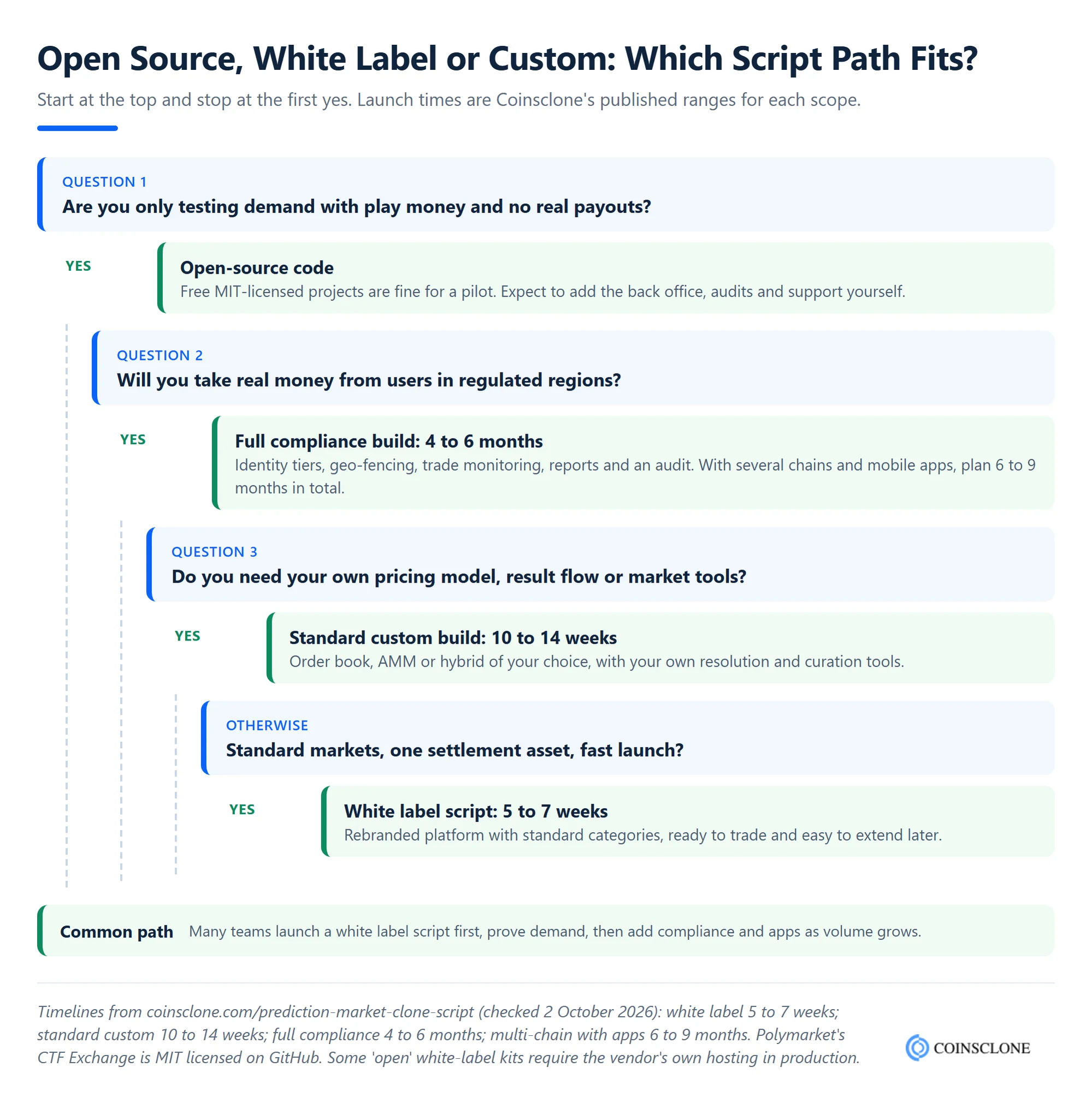
Prediction Market Platform Script vs Custom Development: Comparison
A prediction market platform is far more than a simple website. It needs a trading engine, live pricing, event markets, settlement logic, wallets and strong security.
Building all of that from scratch takes a lot of time, money and skill. That is why many businesses choose a prediction market platform script, which gives them a ready base to launch quickly.
| Key Factors | Development From Scratch | Prediction Market Platform Script (Faster Option) |
| Build Effort | You build the trading engine, pricing and settlement logic from the ground up. | A tested trading engine and market tools come ready. |
| Time to Launch | Usually 3 to 6 months or more, and 6 to 9 months with several chains and mobile apps. | A white label launch takes 5 to 7 weeks; a standard custom build takes 10 to 14 weeks. |
| Platform Structure | Needs its own design for market creation, trading and result checks. | Includes modules for market creation, trading and automatic settlement. |
| Team Needs | Needs a large team skilled in trading systems, blockchain or payments, and security. | A ready base cuts the heavy technical work. |
| Cost | Higher, because of longer build, setup and testing. | Lower, since the core platform is already built and tested. |
| Security | Must be designed and audited from scratch. | Comes with a tested security base that is ready for audit. |
| Scale | Growth must be planned and built in from the start. | Built to grow with more users and market types. |
| Best For | Large firms building a fully custom trading business. | Startups and businesses that want a fast launch with lower risk. |
For most new platforms, a script is the smart start. It cuts build time and cost, so you can focus on users, growth and new markets instead of core code.
How Much Does a Prediction Market Platform Script Cost?
The cost of a prediction market platform script depends on your trading engine, legal model, settlement design, design work and the number of extras you add. The ranges below come from published 2026 agency cost guides. They are market ranges, not a quote.
White Label Script With Core Features: about $10,000 to $30,000. It covers market creation, YES and NO trading, user dashboards, wallets, automatic settlement and admin tools.
White Label With Custom Features: about $30,000 to $100,000. Order books, compliance tools, liquidity programs, mobile apps and more market types all push the price up.
Full Custom Build: about $90,000 to $250,000, and $800,000 or more for a full exchange-grade platform.
Costs to plan on top: A smart contract audit runs about $15,000 to $50,000, with a 2 to 6 week wait. Oracle and data feeds can add $15,000 to $40,000. Legal advice, licences, identity checks and starting liquidity are extra in every model.
Want a firm figure for your scope? Coinsclone offers a ready prediction market clone script and can quote after a short call.
Now that you know the cost, let’s look at the time it takes to launch.
How Long Does It Take to Launch a Prediction Market Platform?
The timeline depends on how much you customise, your security work and your legal needs. In fact, compliance is the single biggest factor. A web-only launch is faster than one with mobile apps, fiat payments and full identity checks.
Here are Coinsclone’s published timelines for each type of build:
- White Label Platform: 5 to 7 weeks. A rebranded platform with standard categories and one settlement asset.
- Standard Custom Platform: 10 to 14 weeks. Your chosen pricing model, result flow and market tools.
- Platform With Full Compliance: 4 to 6 months. Identity check tiers, geo-fencing, trade monitoring, reports and an audit.
- Multi-Chain Platform With Apps: 6 to 9 months. Several chains or fiat rails, native mobile apps and APIs.
Fiat payments move at your payment partner’s pace, and fixing audit findings cannot be rushed. So knowing these timelines early helps you plan your launch, budget and roadmap.
Licensing and Compliance Before You Launch
Legal choices shape your whole build, so decide them first. In most countries, trading money on future events falls under either financial rules or gambling rules.
United States: The CFTC regulates event contracts, so real-money platforms need a licensed exchange or a licensed partner. Even so, states keep pushing back. In September 2026, the 6th Circuit ruled that states can apply their gambling laws, and New York sued Polymarket as unlicensed gambling.
Outside the US: Crypto platforms often run on chain with stablecoins, add identity checks and block regions where they lack approval. Local licences may still apply, so get legal advice for each country.
Play money: Points that cannot be cashed out avoid most money rules. This is a fair way to test demand first.
So pick a script that already supports identity checks, geo-blocking and trade monitoring. Adding them later costs far more.
Technology Stack for a Prediction Market Platform Script
The right tech stack keeps your platform fast, safe and ready to grow. It powers live price updates, safe payments and reliable payouts.
Frontend (User Interface)
The front end gives users a smooth screen to explore markets, place trades and watch live prices.
Common Technologies:
- React.js, Next.js, Angular or Vue.js
- WebSockets for live prices
- Tailwind CSS or Bootstrap for responsive design
Backend (Platform Logic)
The back end runs market creation, users, order matching, settlement and security.
Common Technologies:
- Node.js with Express.js
- Python (Django or FastAPI)
- Java (Spring Boot) or Go for fast order matching
Database and Messaging
The database stores user profiles, markets, trades and past results, and keeps every record exact.
Common Technologies:
- PostgreSQL or MySQL for trades and accounts
- Redis for caching and the live order book
- Kafka or NATS for real-time event streams
Blockchain Layer (for Crypto Platforms)
On crypto platforms, smart contracts hold funds and settle trades on chain.
Common Technologies:
- Solidity on EVM chains such as Polygon, Base, Arbitrum or BNB Chain, or Rust on Solana
- ERC-1155 conditional tokens for YES and NO shares
- Stablecoins such as USDC for deposits and payouts
Oracles and Data Feeds
Oracles bring real-world results into the platform.
Common Technologies:
- UMA’s optimistic oracle for questions with a dispute window
- Chainlink or Pyth for price-based markets
- Licensed sports and economic data feeds
Mobile Apps
Mobile apps let users find markets, track prices and trade from their phones.
Common Technologies:
- Flutter or React Native for cross-platform apps
- Swift for iOS
- Kotlin for Android
The right stack helps you build a safe, high-performing platform. With the right team and setup, you can launch a prediction market that supports live trading, safe payments and long-term growth.
Still, the stack is only part of the story. Success also depends on choosing the right build partner. Here’s why.
Why Choose the Coinsclone Prediction Market Platform Script?
Coinsclone is a trusted prediction market platform development company. We offer a ready prediction market platform script that you can shape to your brand and goals. Since 2018, we have delivered 350+ platforms for 200+ clients across 20 industries. Our team helps you launch a fast platform with smooth trading, safe payments and strong security.
We deliver a white label prediction market that you can brand, extend and grow, so you can launch quickly and stay ahead. We build in the style of Polymarket, Kalshi and Myriad, so explore our Polymarket clone script and Kalshi clone script for ready models. For a fully custom build, see our prediction market development service. Our team supports you from planning to launch and beyond, so you can move from idea to a live, market-ready platform.
See How Our MVP System Can Launch Your Prediction Market Platform Script Faster
Prediction Market Platform Script —Build Your Own Event Trading Platform
- MVP System: Launch your prediction market platform quickly with our ready-to-deploy script and reduce development time by up to 90%.
- Event Market Engine : Built-in event creation, trading markets, order matching, settlement, and live market updates — everything needed to run prediction markets.
- Brand & Customization: Fully customize your platform name, prediction categories, trading rules, interface design, and blockchain integration.
- Revenue Engine:Generate revenue through trading fees, market listings, liquidity participation, and platform commissions.
Get a free branded demo of your prediction market platform within 48 hours — see it live before you invest. Book a Free Call to learn how our Prediction Market Platform Script can turn your idea into a live event-trading platform in 8–12 weeks.
Frequently Asked Questions
What is a prediction market clone script?
A prediction market clone script is ready-made software that copies the core features of platforms like Polymarket or Kalshi. It includes the trading engine, wallets, settlement and admin tools, so you can launch your own branded prediction market in weeks.
Can a prediction market platform script be customised?
Yes. You can change the brand, design, market categories, payment methods, trading engine, fees and languages. You can also add features such as mobile apps, identity checks, liquidity tools or AI-based market suggestions.
What is the difference between a clone script and a custom prediction market platform?
A clone script starts from a tested base, so it launches faster and costs less. A custom platform is built from scratch for unique needs, which gives full control but takes months longer and costs more.
How long does it take to launch a prediction market platform script?
A white label platform launches in about 5 to 7 weeks, and a standard custom build in 10 to 14 weeks. A platform with full compliance takes 4 to 6 months, and a multi-chain platform with mobile apps takes 6 to 9 months.
Which blockchain networks can support a prediction market script?
Most scripts run on EVM chains such as Polygon, Base, Arbitrum or BNB Chain, or on Solana. Polymarket settles on Polygon in a USDC-backed dollar token, while Kalshi runs without a blockchain as a regulated US exchange.
Can a prediction market script support both centralized and decentralized models?
Yes. A centralized model keeps user funds in a regulated platform account, like Kalshi. A decentralized model keeps funds in smart contracts and users’ own wallets, like Polymarket. A hybrid matches orders off-chain and settles them on chain.
How much does a prediction market platform script cost?
Published 2026 agency guides put a white label script at about $10,000 to $30,000, a customised build at $30,000 to $100,000, and a full custom build from $90,000 to $250,000 or more. Audits, legal work and starting liquidity come on top.
What are the ways to earn with a prediction market script?
Most platforms earn a fee on each trade. Others add settlement fees, market listing fees, premium plans, data sales and partner fee shares.
Are prediction market scripts secure?
A good script is, if it has an outside smart contract audit, cold or multi-signature wallets, two-factor login, fraud checks and clear result rules. Always ask for a recent audit report before you buy.