
A Polymarket trading bot is software that reads Polymarket’s order book through its API and places signed orders for you, all day, without a person clicking buttons. Most bots do one of four jobs: they quote both sides as market makers, close price gaps between venues, react to news, or copy other wallets.
This guide is for founders and trading desks that want a bot built. It shows how the order book and payouts work after the big 2026 upgrades. It also covers what each bot type earns after fees, the parts each build needs, and where a bot may trade.
In this guide:
- How Polymarket’s CLOB, pUSD and the new SDKs work for bots after the April 2026 upgrade
- The real taker fees and maker rebates, with worked numbers
- Four bot types, the edge behind each and the risk that kills it
- Risk controls, geoblocking rules and the US route through Polymarket US
- What drives the cost, and when to build, buy or launch your own market
What Is a Polymarket Trading Bot?
A Polymarket trading bot is a program that trades Polymarket’s prediction markets through its public API. It pulls live prices, decides what to do with a set of rules or a model, then signs and sends orders to Polymarket’s central limit order book (CLOB).
Each market on Polymarket is a Yes or No question. A share pays $1 if the outcome happens and $0 if it does not, so a price of 62 cents means the market sees roughly a 62% chance. A bot tries to buy shares below their true odds, or sell above them, or earn the spread by quoting both sides.
Bots matter here because the work is constant. Markets run across sports, politics, crypto and more, prices move on news at any hour, and fills happen in milliseconds. A person cannot watch that many books. A bot can.
How Does a Polymarket Bot Trade on the CLOB?
Polymarket uses a hybrid design. Orders are matched off chain by Polymarket’s operator, and each matched trade settles on the Polygon network (chain ID 137). The operator can match and order trades, but it cannot set prices or move funds without your signed order.
For a bot, a trade follows four steps:
- Find the market: the Gamma API returns events, markets and the token IDs for each outcome.
- Read the book: the CLOB WebSocket market channel streams order book changes and trades in real time.
- Sign and send: the bot signs each order with its wallet key (EIP-712), then posts it with API credentials that sign each request (HMAC).
- Track fills: the authenticated user channel reports fills and order updates, and the Data API reports positions and history.
The CLOB takes four order types: GTC (good till canceled), GTD (good till a date), FOK (fill or kill) and FAK (fill and kill). A post-only flag rejects any order that would match at once. Market makers live on post-only orders, since a resting order pays no fee.
All trading uses pUSD, a dollar token on Polygon backed by USDC. A bot that trades only through the API must wrap its USDC into pUSD itself; the website does this step for normal users.
What changed for Polymarket bots in 2026?
Polymarket rebuilt its trading stack this year, and any bot written before April 2026 is now broken. These are the changes that matter, from the Polymarket changelog:
| Date (2026) | Change | What your bot must do |
| 5 Jan | Taker fees and maker rebates start on 15-minute crypto markets | Price fees into every taker trade |
| 6 Jan | Heartbeat endpoint and post-only orders added | Use the heartbeat as a dead man’s switch |
| 28 Apr | CLOB V2 goes live; pUSD replaces USDC.e; old orders wiped | Move to V2 signing and pUSD |
| 1 Jun | Order limits raised to 120,000 per 10 minutes | Plan quote refresh rates around the new caps |
| 10 Jul | Sports taker fee rises from 0.03 to 0.05; sports rebate falls to 15% | Re-check sports market maker returns |
| 4 Sep | Data API v2 launches; crypto taker delay set to 150 ms | Move history and copy feeds to v2 |
| 24 Oct | Data API v1 retired | Remove all v1 calls |
| 2 Nov | New markets start moving to Protocol V2 (tentative date) | Support V2 position IDs alongside old token IDs |
The tools changed too. The old Python and TypeScript CLOB clients are now retired, and the new route is one shared SDK. The Python SDK installs as polymarket-client and reached version 0.15.0 on 29 October 2026. Under Protocol V2, new markets use a new exchange contract and new position IDs, while existing holdings are not converted. A serious bot has to handle both kinds of market for some time.
What Are Polymarket’s Fees for Bots?
Fees decide which bots can make money. Polymarket charges takers only. Makers, whose resting orders get filled, never pay a fee.
The Polymarket fee page sets the taker fee as shares x fee rate x price x (1 – price). The fee peaks at 50 cents and shrinks toward 1 cent and 99 cents. Rates by type of market, as of 2 November 2026:
| Category | Taker fee rate | Fee on 100 shares at 50 cents | Share of fees rebated to makers |
| Crypto | 0.07 | $1.75 | 20% |
| Sports | 0.05 | $1.25 | 15% |
| Economics, Culture, Weather, Other | 0.05 | $1.25 | 25% |
| Politics, Finance, Tech, Mentions | 0.04 | $1.00 | 25% |
| Geopolitics | 0 | $0.00 | None |
Here is what that means in practice. A bot that buys 100 crypto shares at 50 cents pays $1.75 on a $50 trade, which is 3.5% of the money spent. At 90 cents the same 100 shares cost $0.63 in fees. Short-term taker strategies on coin-flip markets need a large edge just to break even.
Each market also carries its own fee settings, so a bot should read the market’s fee schedule from the API instead of trusting a table. Polymarket can change these rates at any time, as it did when it raised the sports rate in July 2026.
Which Types of Polymarket Bots Can You Build?
Most Polymarket bots fall into four groups. Each has a different source of profit and a different way to fail.
| Bot type | Where the profit comes from | Speed needed | Main risk |
| Market making | Spread plus maker rebates | High | Getting filled just before news moves the price |
| Arbitrage | Price gaps between linked markets or venues | High | Fees, and two venues settling a question differently |
| News and event | Reacting faster than the crowd | Very high | Wrong reading of the news or the resolution rules |
| Copy trading | Following wallets with a track record | Medium | Entering late at worse prices |
Market making bots
A market maker quotes a bid and an ask on the same outcome and earns the gap when both fill. On Polymarket it also earns maker rebates. Each day, Polymarket pays back a share of the taker fees in each market to the makers filled there. Your cut matches your share of filled maker volume. Payouts come in pUSD once you accrue at least $1.
A worked example: a taker buys 1,000 crypto shares at 50 cents from resting orders. The taker pays 1,000 x 0.07 x 0.5 x 0.5 = $17.50 in fees. Of that, 20%, or $3.50, goes into that market’s rebate pool for the makers who were filled. The rebate is a bonus. The real work is pricing quotes well and keeping inventory small when the odds swing. Our guide to crypto market making software covers the quoting logic in more depth.
Arbitrage bots
Arbitrage bots look for prices that cannot all be right. Inside Polymarket, this means checking that the Yes prices in a multi-outcome market add up to about $1. Across venues, it means comparing the same question on Polymarket and on Kalshi, a CFTC-regulated exchange.
There is real money here. A 2025 study of Polymarket’s on-chain order book data estimated about $40 million in realized arbitrage profit. But most of the easy gaps close within seconds, and fees take a big bite of what is left.
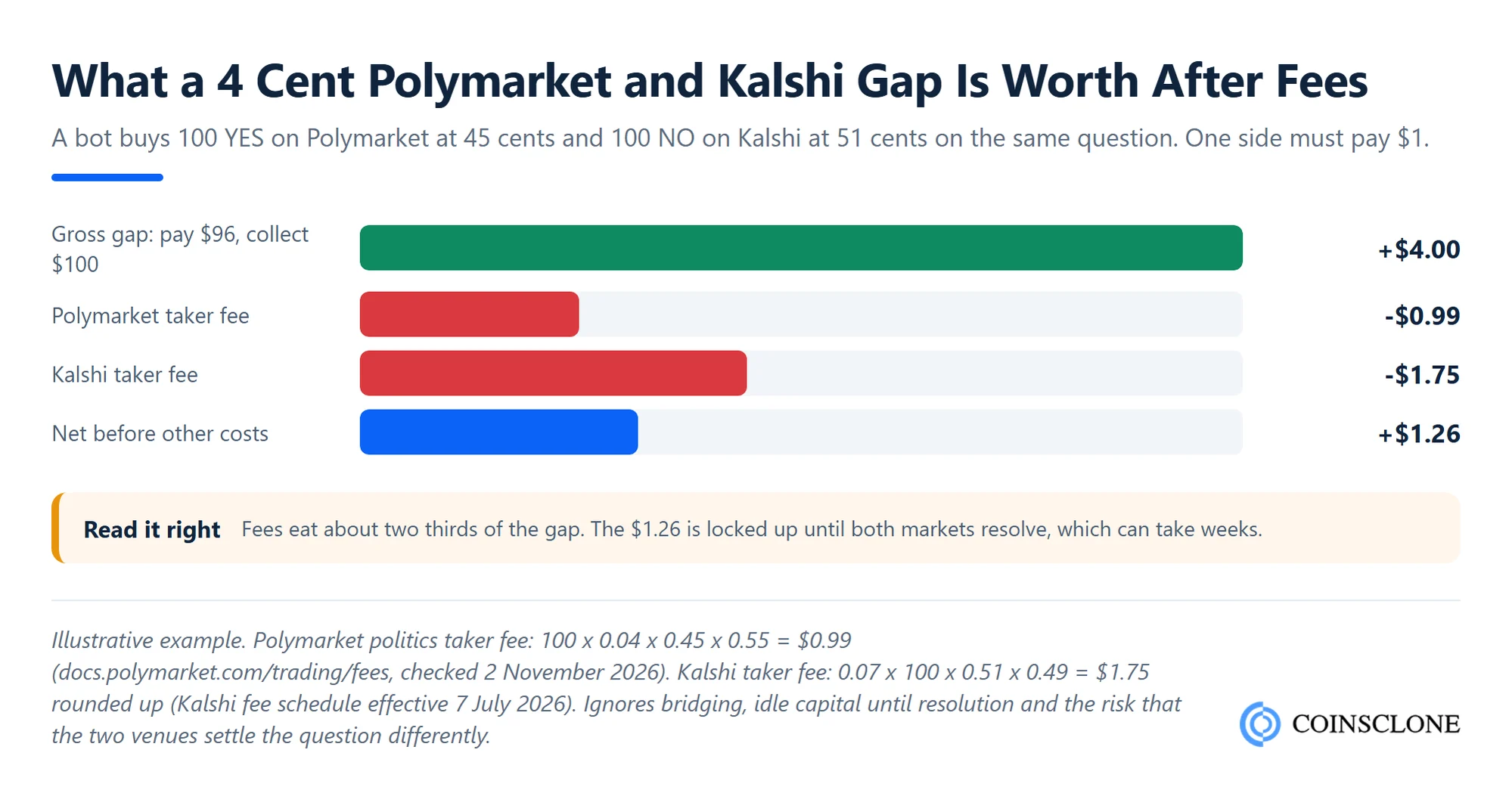
In the example above, a 4 cent gap on 100 contracts earns $4.00 before fees. Polymarket’s politics fee takes $0.99 and Kalshi’s taker fee of 0.07 x contracts x price x (1 – price), from the Kalshi fee schedule, takes $1.75. That leaves $1.26, tied up until both markets resolve. A cross-venue bot also has to confirm that both venues will settle the question on the same facts, since a small wording gap can turn a hedge into two losing bets. Our guide to the crypto arbitrage bot shows how the basic model works.
News and event bots
News bots read outside data, such as sports scores, economic releases or crypto prices, and trade before the book catches up. This is the hardest edge to keep. On crypto markets, Polymarket holds incoming taker orders for 150 milliseconds before matching, which blunts pure speed plays. Crypto up or down markets now settle on a Chainlink price averaged over 60 seconds, so a bot must model that average, not the last tick.
News bots also need to read the market rules. Polymarket markets settle through the UMA oracle, where anyone can propose an outcome and others can dispute it. An undisputed result settles in about 2 hours, while a disputed one can take 4 to 6 days. A price near 99 cents is not the same as a payout.
Copy trading bots
A copy bot watches chosen wallets through the Data API and mirrors their trades at a set size. Data API v2 added wallet profit and loss, volume and leaderboard routes, which makes it easier to pick wallets to follow.
Copy trading looks simple but has a built-in flaw. You always enter after the leader, often at a worse price, and you cannot see whether the leader is hedged on another venue. Use caps per market and skip trades where the price has already moved past a set limit. For a wider view of the product, see our page on crypto copy trading software.
What Does a Polymarket Bot Architecture Look Like?
Every bot that lasts has the same five parts, whatever the strategy.
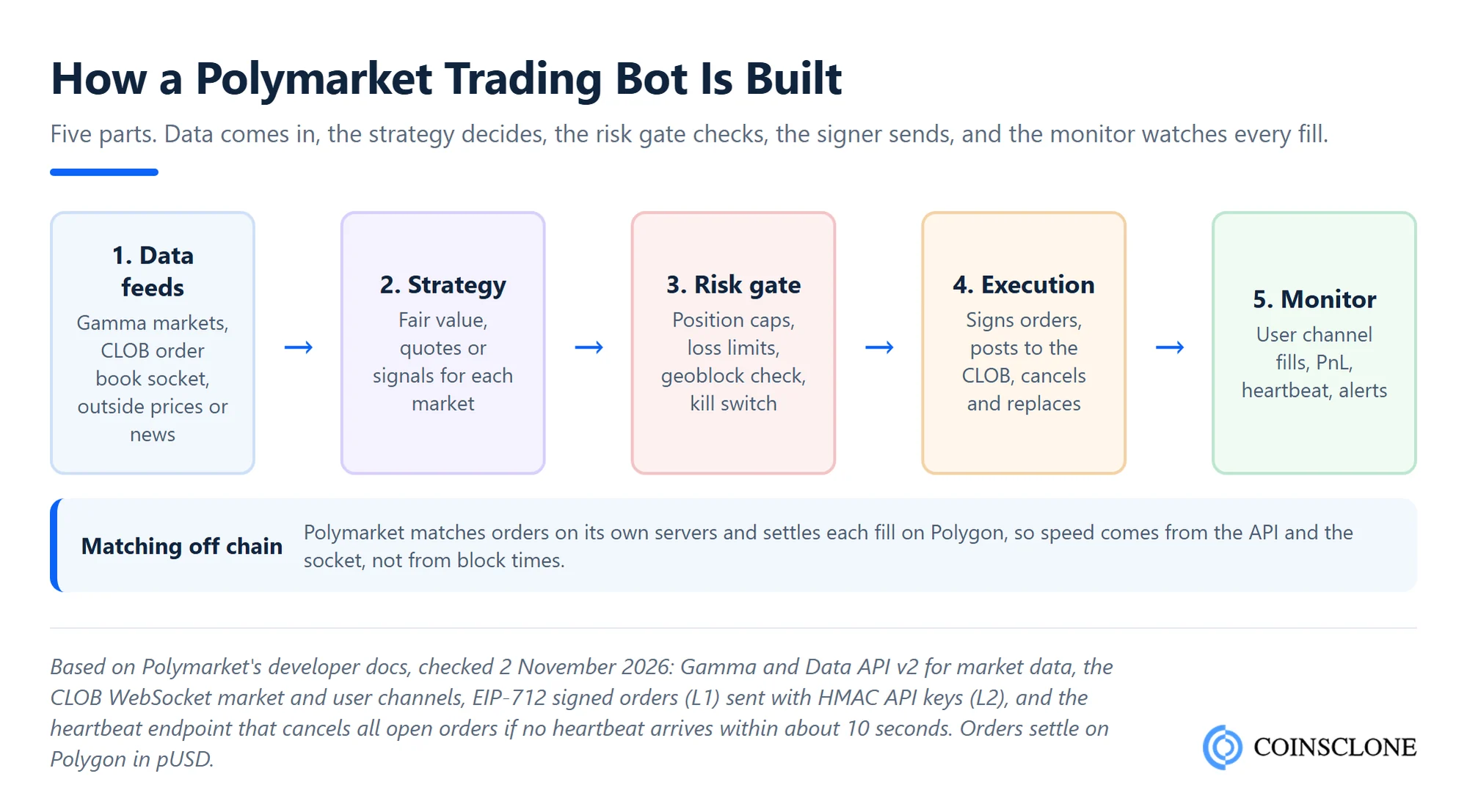
- Data feeds: the Gamma API for market lists, the CLOB market channel for live books, and any outside feed your strategy needs.
- Strategy engine: turns data into a fair price, a set of quotes or a trade signal for each market.
- Risk gate: checks every order against position caps, loss limits and the geoblock result before it leaves.
- Execution: signs orders, posts them alone or in batches, and cancels and replaces stale quotes.
- Monitor: reads fills from the user channel, rebuilds positions, tracks profit and loss, and raises alerts.
Python suits most bots. The official SDKs cover Python and TypeScript, and there is also a Rust client for fast code paths. Host the bot close to the matching engine. Polymarket’s main servers run in the eu-west-2 region. Market makers and traders on their own account can co-locate there after a KYC or KYB check. It is not open to apps that trade for end users.
Plan around the published rate limits. Order posting allows bursts of 5,000 requests per 10 seconds and 120,000 per 10 minutes. Batch posting allows 2,000 per 10 seconds. Limits apply per IP address, with a separate limit per signing wallet. When you go over, requests are queued rather than rejected, so a bot that ignores limits gets slow before it gets blocked.
What Risk Controls Does a Polymarket Bot Need?
Most bot losses come from bugs and bad days, not bad ideas. Build these controls in from day one:
- Heartbeat kill switch: send a heartbeat every few seconds. If Polymarket hears nothing for about 10 seconds, it cancels all your open orders, which protects you when the bot crashes.
- Position and loss caps: set a maximum size per market, per event and in total, plus a daily loss limit that stops trading.
- Stale data guard: pause quoting when the socket drops or prices stop updating, then rebuild the book before trading again.
- Cancel all on events: pull quotes before scheduled news, game starts and market close.
- Fill checks: since July 2026, orders that match at once return trade IDs, not transaction hashes. Match each trade ID to its on-chain result.
- Key safety: keep trading funds in their own hot wallet and the main balance in another. Store keys in a secrets vault, never in code.
- Resolution check: read each market’s rules and track disputes before treating a position as won.
Test in stages: replay recorded data, then paper trade against live books, then trade small sizes before you scale.
Is a Polymarket Trading Bot Legal?
Using the API to run a bot on your own account is normal, and Polymarket’s docs include a full section for market makers. Where you trade from is the real question.
The Polymarket geoblock page sorts places into three groups. As of 2 November 2026:
- Fully blocked: OFAC-sanctioned places such as Iran, Syria, Cuba, North Korea and the occupied regions of Ukraine. No new orders and no closing trades.
- Close-only on the website and the API: a long list. It includes the US, the UK, France, Germany, Italy, Australia, Singapore, Taiwan, Thailand, Brazil and four parts of Canada. Users there can close old positions but cannot open new ones.
- Close-only on the website only: Ireland, Japan, the Netherlands, South Korea and Malta for sports.
A bot should call the geoblock endpoint before trading and respect the answer. Do not route around it with a VPN or a server in another country. Orders from blocked regions are rejected, and dodging the block puts your funds and your business at risk.
US traders have a legal route. Polymarket US is a CFTC-regulated exchange and clearing house. It has its own API with keys issued after identity checks, its own fee schedule, and it trades in US dollars rather than crypto. A US desk that wants to trade gaps between venues pairs Polymarket US with Kalshi, not the main exchange.
Some tactics cross legal lines. US commodities law bans wash sales and spoofing, which means placing orders you plan to cancel before they fill. On the main exchange, the Builder Program terms let Polymarket take away fee rights from builders whose volume is fake, self-referred or not bona fide. Build bots that trade for real, or do not build them.
How Much Does It Cost to Build a Polymarket Trading Bot?
There is no fixed price, because the strategy drives the work more than the API does. A copy bot is a small job. A market maker that quotes hundreds of markets with tight risk limits is a trading system.
These are the main cost drivers:
- Strategy depth: a simple rule set costs far less than a pricing model with backtests and live tuning.
- Number of venues: each extra venue, such as Kalshi or Polymarket US, adds its own API, signing method, fees and settlement checks.
- Latency target: co-location, a Rust execution path and order book replay tools add cost but matter for market makers.
- Risk and reporting: dashboards, alerts, audit logs and tax records add steady work.
- Upkeep: Polymarket changed its fees, contracts, SDKs and data API in 2026 alone, so budget for regular updates.
Running costs are lower than most people expect. There are no Polymarket fees to deposit or withdraw, and makers pay no trading fees. Your main ongoing costs are servers, data feeds, upkeep and taker fees if your strategy crosses the spread.
Should You Build or Buy a Polymarket Bot?
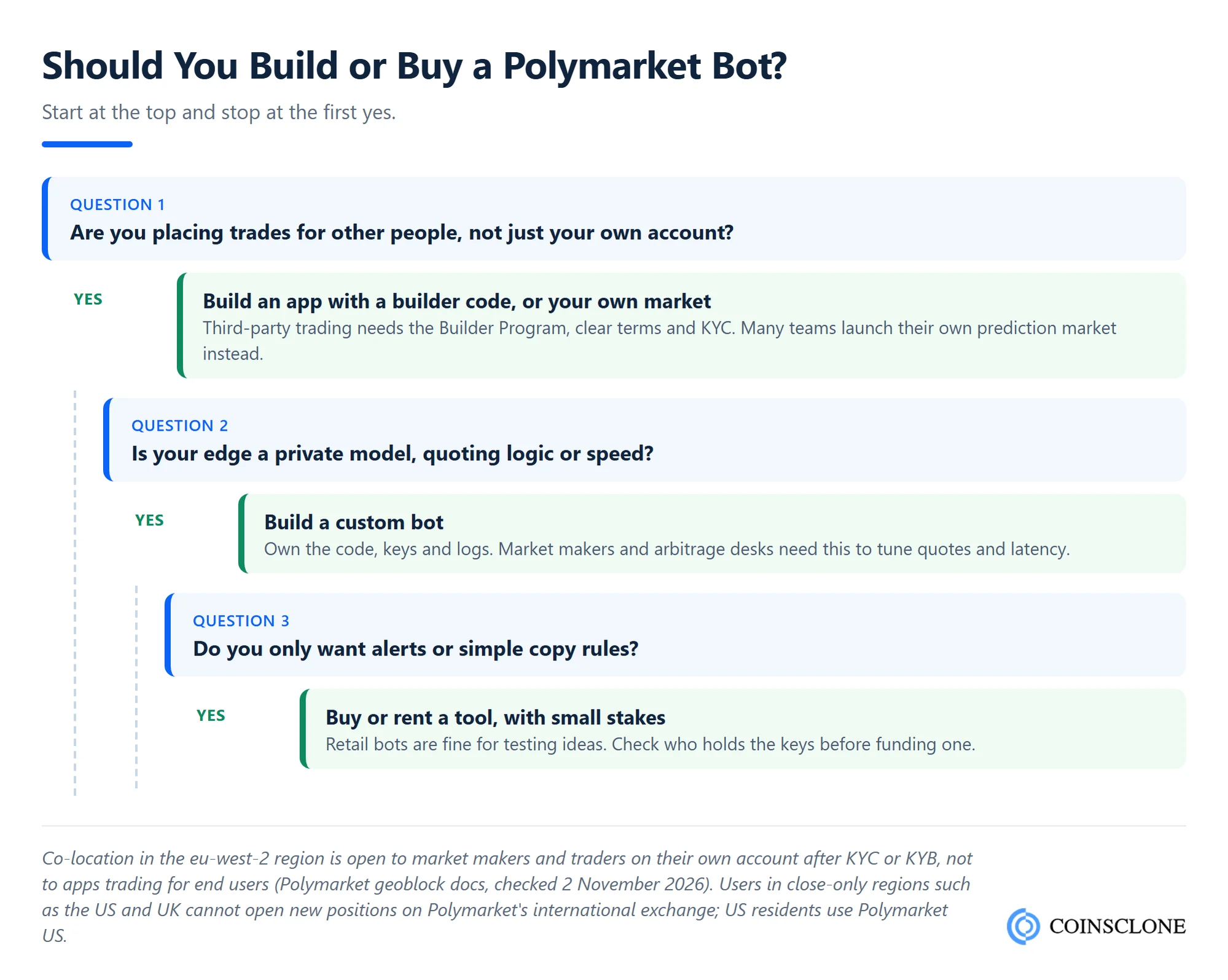
Retail bots and Telegram tools are fine for testing an idea with small money. They are a poor fit for a desk with real money. You cannot read the code, you may not control the keys, and your edge is shared with every other user.
| Option | Best for | Trade-off |
| Buy or rent a retail bot | Testing ideas with small stakes | No control over code, keys or edge |
| Build a custom bot | Market makers, arbitrage desks, funds | Higher upfront cost, full ownership |
| Launch your own prediction market | Firms that want fee income, not trading risk | Licences and liquidity to arrange |
The third route surprises many founders. If your plan is to serve traders rather than trade, owning the venue may pay better than running bots on someone else’s. A Polymarket clone script from Coinsclone goes live in 5 to 7 weeks.
Launch a Polymarket Trading Bot Built for 2026 Rules
Polymarket bot development, done right.
- CLOB V2 execution: pUSD balances, signed orders, batch quotes and cancel and replace logic
- Market making engine: two-sided quotes tuned for maker rebates and inventory limits
- Cross-venue arbitrage: Polymarket and Kalshi price matching with fee-aware trade checks
- Risk and compliance: geoblock checks, heartbeat kill switch, loss caps and full audit logs
See a live demo of our prediction market and trading bot builds.
Book a Free Demo to plan your Polymarket bot or your own prediction market.
How Coinsclone Helps
Coinsclone builds custom Polymarket trading bots, from market making and cross-venue arbitrage engines to copy trading tools, on the current CLOB V2 and pUSD stack with geoblock checks, kill switches and full logs. Coinsclone has built crypto products since 2018 and delivered 350+ platforms for 200+ clients across 20 industries. Our crypto trading bot development team scopes the strategy and risk limits with you first, then builds, tests and hands over the code. If you would rather run the venue than trade on it, our prediction market platform development team can build that too.
Frequently Asked Questions
Can you use bots on Polymarket?
Yes. Polymarket offers a public API for trading, with docs written for market makers and other automated traders. You still have to trade from an allowed location, since the API rejects new orders from blocked and close-only regions such as the US and UK.
Are Polymarket bots profitable?
Some are, but most simple bots are not. Taker fees reach $1.75 per 100 shares at 50 cents on crypto markets, which wipes out small edges. The bots that last tend to earn the spread and maker rebates, or trade a real edge in data or speed with tight risk limits.
Is running a Polymarket bot allowed?
Running a bot on your own account through the official API is allowed where Polymarket is available to you. Bypassing the geoblock with a VPN, wash trading and spoofing are not. US residents should use Polymarket US, which has its own regulated API.
Do I need an API key for a Polymarket bot?
You do not need a key to read public market data from the Gamma API, the Data API or the market socket. To place orders, you create API credentials by signing a message with your wallet. Each order is then signed by the wallet and sent with those credentials.
What programming language should I use for a Polymarket bot?
Python is the most common choice for research and most strategies, and Polymarket’s unified SDK supports it. TypeScript suits teams with web skills. For the fastest order path, there is also a Rust client. The strategy and risk logic matter far more than the language.
Can I backtest a Polymarket bot?
Yes, in part. Data API v2 gives price history and past trades, which is enough to test signals. To test a market maker fairly, record the live order book from the socket and replay it. Your fills depend on your place in the queue.
Is my money safe with a Polymarket trading bot?
It depends on who holds the keys. With a custom bot, your funds stay in your own wallet and the bot only signs orders. With a third-party bot, check whether it asks for your private key, keep only trading funds in that wallet, and set loss limits.