
This guide explains NFT art marketplace development in 2026: what the platform does, how an art NFT sale works, and which kind of art marketplace you can build. You will see the features artists and collectors expect, how curated and open platforms earn, and where the artwork itself should be stored. It also covers the tech stack, rights and royalty rules, build steps, costs and delivery times.
The NFT art space looks very different from the 2021 boom. Some famous art platforms closed between 2024 and 2026, while others kept growing with new ideas such as card checkout and physical art. So this guide uses current facts and shows what those closures teach a new founder. By the end, you will know which model fits your budget and how to plan a platform that lasts.
In this guide:
- What NFT art marketplace development covers, and how an art NFT moves from upload to its next sale
- Curated vs open marketplaces, with worked numbers on what each one earns from the same artwork
- Where the art file should live so it survives even if a platform shuts down
- Coinsclone’s published build times and current market cost ranges
- What the closures of Nifty Gateway, Foundation and Exchange Art teach new art platforms
Build Your Own NFT Art Marketplace to Empower Digital Artists
NFT Art Marketplace Development — designed for creators, collectors, and galleries.
- Diverse Art Collections: Support digital, 3D, fine, and programmable art.
- Seamless Platform Features: Minting, listing, search filters, and analytics.
- Global Reach: Showcase art to collectors worldwide and build your brand.
- Monetization Opportunities: Earn from transaction fees, royalties, and minting charges.
See a free branded demo of your NFT marketplace in 48 hours — before you invest a cent.
Book a Free Demo to discover how our NFT Art Marketplace Development can help you launch a profitable, artist-focused platform in just 8–12 weeks.
NFT Art Marketplace Development
NFT art marketplace development is the process of building an online platform made for art-based NFTs (non-fungible tokens). Artists upload their work, mint it as an NFT and list it for sale. Buyers then buy, bid on and resell those pieces at any time. Once a sale is complete, ownership moves to the buyer’s wallet at once, and the record stays on the blockchain for good.
Unlike a general NFT marketplace, an art platform focuses on one thing: art. This focus helps it draw the right crowd. Buyers who look for digital art come to you, and artists find buyers who value their style. So careful planning pays off. Building an NFT Marketplace for artwork also needs extra care in a few areas that general platforms often skip:
- Provenance: Each piece needs a clear history of who made it, who owned it and what it sold for.
- Display quality: Art needs full-size, high-resolution views, zoom and support for video, 3D and code-based work.
- Artist identity: Buyers want to know the artist is real, so checked profiles matter.
- Royalties: Artists expect a share each time a piece sells again, so the platform must pay it right.
- Lasting storage: A collector pays for art they expect to keep for years, not for a link that may break.
How an Art NFT Sale Works
Here is how one artwork moves through an NFT art marketplace:
- Sign up and verify: The artist creates a profile and links a crypto wallet. Many platforms now also allow email sign-in and create a wallet in the background.
- Upload the artwork: The artist uploads the file and adds a title, story, edition size and licence terms.
- Mint the NFT: The platform turns the artwork into a token on the blockchain. This records the artist’s wallet as the creator.
- List for sale: The artist sets a fixed price, opens it for offers or starts an auction with a reserve price.
- Sell and transfer: A collector pays in crypto or by card. The smart contract sends the NFT to the buyer and the funds to the artist in the same step.
- Earn on resales: When the buyer later sells the piece, the artist can get a cut of that sale.
Now that you know how it works, let’s look at the kinds of art platforms you can build.
Types of NFT Art Marketplaces You Can Build
There are many forms of NFT art, and each one can have a platform built for it. Here are the main types.
Digital Art Platform
Digital art platforms are made just for screen-based work, such as drawings, photos and graphic design. They have changed the art world by letting creators sell straight to buyers, without galleries or publishers in the middle.
All-Styles Art Platform
All-styles art platforms take many art forms, from online paintings to scans of work on canvas. They welcome each style and medium. So they suit firms that want to draw buyers who like variety, and artists who do not want to stick to one niche.
Fine Art Platform
Fine art NFT platforms are built for high-value, rare work, often from well-known artists. Unlike open platforms, they focus on quality and a hand-picked list of artists. Fine art NFTs may include digital versions of classic works, limited editions or new pieces from famous artists who are new to NFTs.
Some fine art platforms now also sell physical artworks with an NFT that proves ownership. For example, SuperRare began to list physical art in 2026, with size, medium and shipping details on each piece. If you plan to tokenize paintings or sculptures for shared ownership, our guide to art tokenization covers that model.
Code-Based Art Marketplace
Code-based art platforms blend art with code. Here, smart contracts make the artwork dynamic. For instance, a piece might change colour with the weather in a city, or change shape each time it sells. Generative art goes one step further: the artist writes an algorithm, and each mint produces a unique output. This niche has a loyal, tech-savvy crowd of buyers.
3D Art Platform
3D art platforms host and trade 3D work. This could include 3D sculptures, building models, game assets and virtual or augmented reality (VR and AR) objects. They often include interactive previews, so buyers can turn and explore a piece before they buy.
You can build any of these types faster with a ready-made White Label NFT Marketplace Software set up for art. It speeds up the build and helps you launch your own art platform sooner.
Curated or Open: Choose Your Art Marketplace Model
Before you pick features, decide who can sell on your platform. This one choice shapes your fees, your brand and how many sales you need to break even.
- Curated marketplace: Your team picks the artists. Fewer pieces are listed, but prices and fees are higher. SuperRare works this way. It takes 15% of each first sale, gives artists 10% of each resale, and adds a 3% fee paid by the buyer, as its help centre on fees explains.
- Open marketplace: Anyone can mint and sell. You get far more listings and buyers, but each sale earns little. OpenSea works this way. Its platform fee rose from 0.5% to 1% on all chains on 15 September 2025.
- Hybrid model: An open platform with a curated “featured” area, paid spotlight slots or invite-only drops. Many new platforms start here.
The chart below runs the same $1,000 artwork through both models, from first sale to second sale.
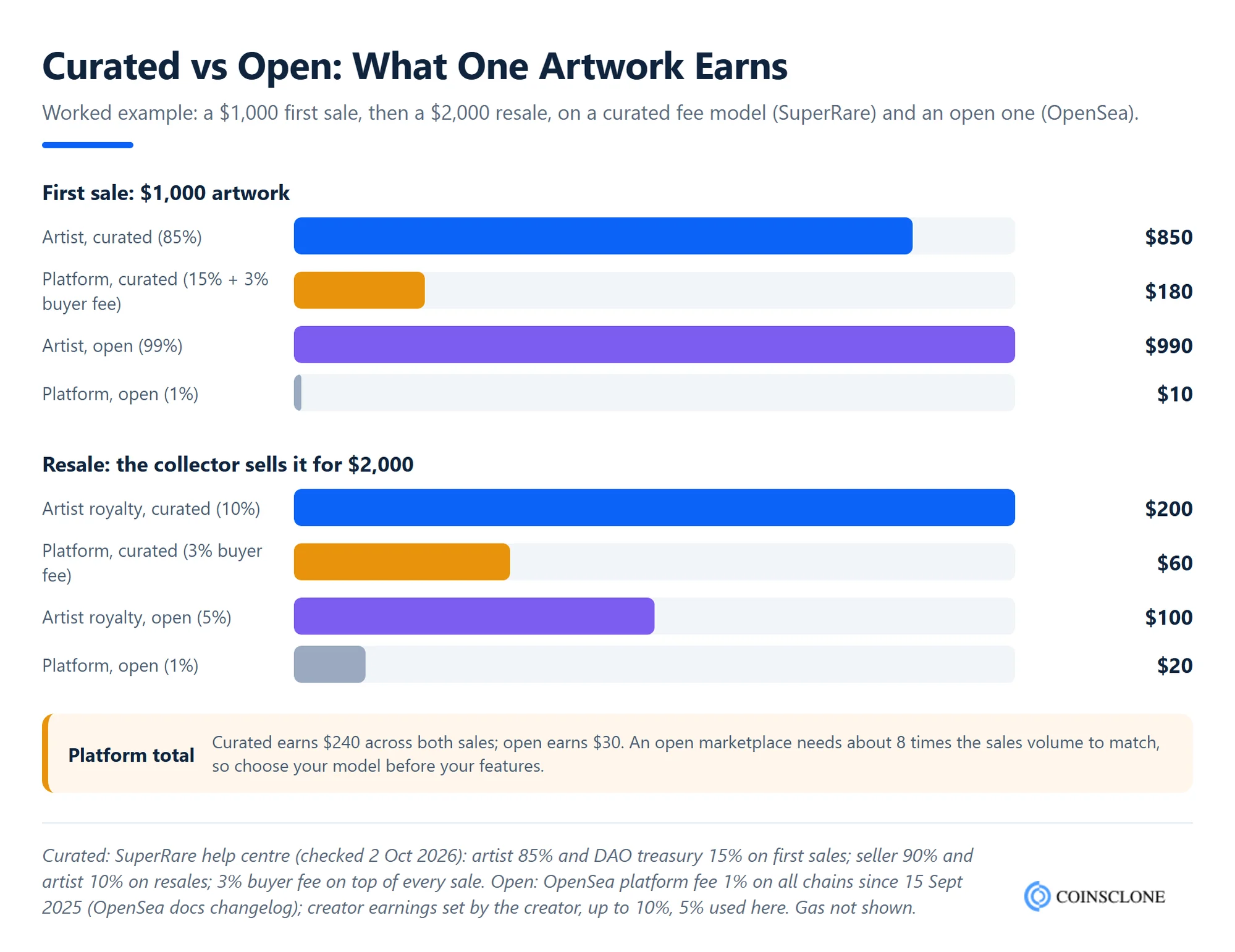
In short, a curated platform earns about eight times more per artwork. But it must win top artists and keep its quality high. An open platform needs far more sales, so it needs strong marketing and low costs from day one.
Top NFT Art Marketplaces in 2026
Looking at the leaders helps you pick a model and a feature set. Here are five art marketplaces that are still running in October 2026.
OpenSea
OpenSea is the largest and best-known NFT platform, and art is one of its biggest sections. It supports many blockchains, has an easy interface and charges a 1% fee on sales. Creators can set resale earnings of up to 10% on their collections. OpenSea’s huge range of art, from new creators to famous names, serves both new and expert buyers. So building an NFT Platform like OpenSea is a smart move if you want an open, high-volume art market.
Rarible
Rarible is an NFT platform where people create, list, sell and buy NFTs. In May 2026, a company called IMPOSSIBLE bought the Rarible brand and core platform assets, while the RARI token and its voting stay with the RARI Foundation. Rarible now runs on Ethereum, Base and MegaETH, and it added Solana in August 2026. Creators can set their own royalty rates, which keeps artists coming back. If you are a startup, you can build an NFT Marketplace like Rarible for art fans.
SuperRare
SuperRare is built only for art. It hand-picks the artists it lets mint, so it works more like a high-end gallery than a shop. Most pieces are one of a kind, though artists can now also sell editions and prints. In 2026, SuperRare added card checkout for USDC listings between $10.50 and $4,999.99, plus support for physical artworks. Startups that plan a curated, artist-first platform often build an NFT Marketplace like SuperRare.
Art Blocks
Art Blocks is the leading platform for generative art. Artists write algorithms that are stored on the Ethereum blockchain. When a buyer mints, the chain makes a unique code that the script turns into a one-of-a-kind piece. Because the art lives on the chain, it does not depend on any server. Art Blocks shows how a narrow niche can build a loyal, high-value market.
Zora
Zora began as an art and creator platform and later opened to everyone. It has since changed direction. Today, Zora is a social app where posts can be traded as coins, rather than a classic art platform. Its path shows how fast this market moves, and why your platform needs room to adapt.
Art Marketplaces That Closed, and the Lesson
Some well-known art platforms have closed since 2024. Many guides still list them as live, so check before you copy their model:
- KnownOrigin (owned by eBay) closed in 2024. NFTs minted on its contracts still exist and trade on other marketplaces.
- MakersPlace announced its closure on 15 January 2025, citing market and funding problems.
- Nifty Gateway, owned by Gemini, stopped sales in January 2026 and said it would close.
- Foundation went offline on 27 April 2026 after a planned sale fell through.
- Exchange Art, the largest Solana platform for one-of-one art, shut down on 1 August 2026.
- Mintable announced in 2026 that it is sunsetting its NFT platform to move into a new area.
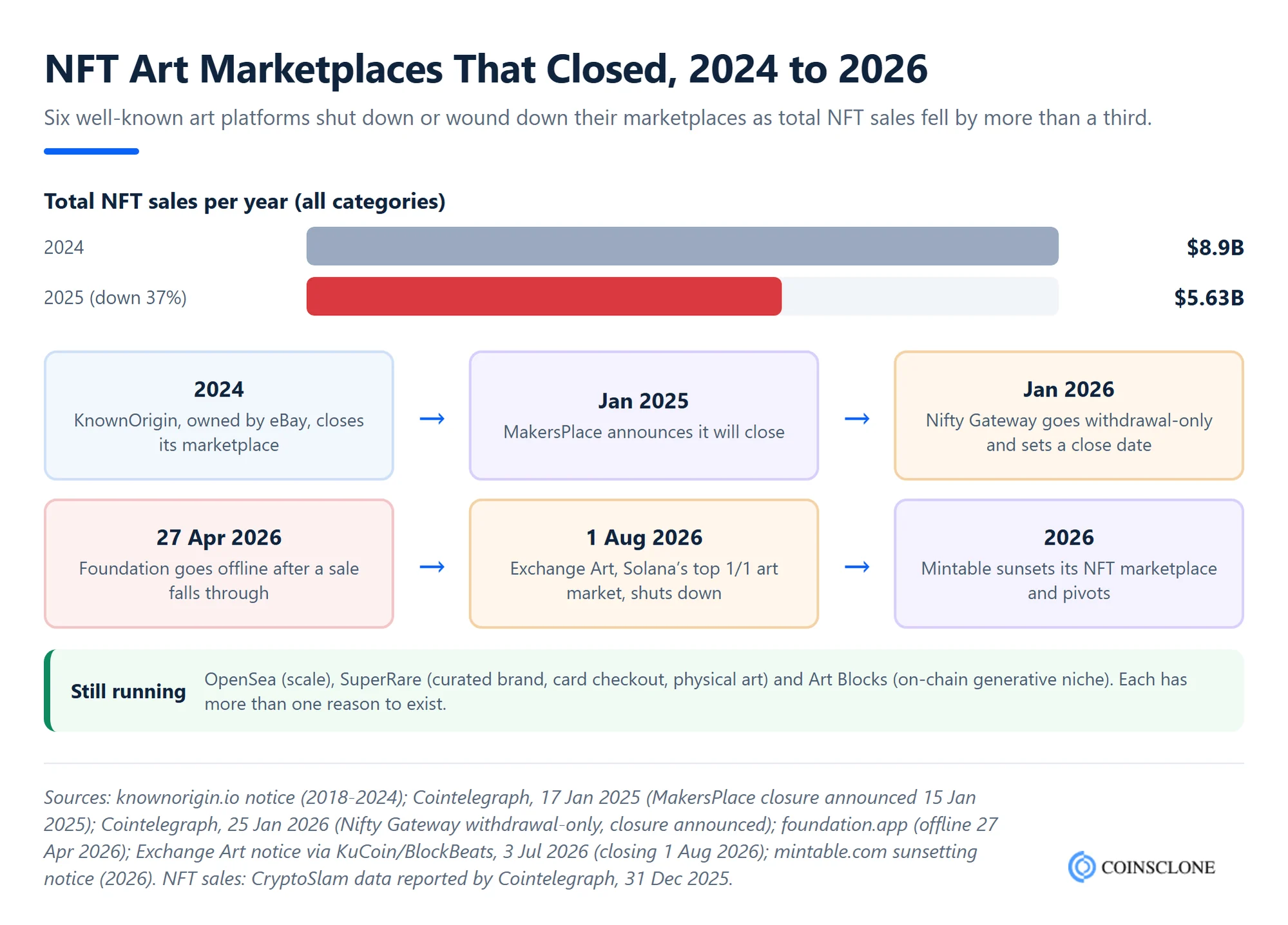
The lesson is clear. Platforms that lived mainly on fees from first sales could not survive when trading fell. The ones still running have huge volume (OpenSea), a strong hand-picked brand (SuperRare) or a niche with loyal fans (Art Blocks). So plan more than one income line, keep your costs lean and store the art so it outlives your platform.
Key Features of an NFT Art Marketplace
Features are what users notice first, and they decide whether people trust your platform. A skilled NFT art marketplace development company can add these features as one smooth system.
- Attractive Storefront: A gallery-style home page with top artists, new drops and hot pieces.
- High-Resolution Viewer: Full-screen views with zoom, plus support for video, GIF, 3D models and code-based art.
- NFT Listing: Fixed price, open offers and timed or reserve auctions, all from one listing screen.
- Editions and One-of-Ones: Sell single pieces or numbered sets.
- Provenance History: A clear record of the maker, each owner and each past sale on each art page.
- Verified Artist Profiles: Badges and checks that prove an artist is who they claim to be.
- Advanced Search Filters: Search by artist, medium, price, edition size, chain and sale type.
- Royalty Settings: Artists set their resale cut when they mint, and the platform pays it each time the piece sells.
- Card Checkout and Email Sign-In: Buyers without a wallet can pay by card, which opens your platform to mainstream art lovers.
- More Ways to Pay: Many coins and stablecoins, plus cards.
- Rewards: Points, airdrops or perks for active buyers.
- Analytical Tools: Sales, price and audience data for artists and admins.
- Instant Notifications: Alerts for bids, sales, outbids and new drops from followed artists.
- Activity Tracking: A live feed of mints, sales and listings across the platform.
- Admin Profit Management: Controls for fees, featured slots, payouts and reports.
- Highly Secured Admin Panel: Role-based access, two-step login and audit logs.
- KYC/AML Verification: Identity checks where your market or payment partner requires them.
- API Security and SSL: Locks down user data and each link to the site.
With these features in place, you can launch your NFT art marketplace with a top-notch user experience.
Tech Stack: Chains, Standards and Where the Art Lives
An art platform runs on the usual NFT stack. But a few choices matter more for art than for other NFTs.
- Blockchain: Ethereum still holds most of the art history and the top sales. Base and Polygon keep minting cheap for editions. Solana suits fast, low-fee trading, and Tezos has a long-running art scene on objkt.com.
- Token standards: ERC-721 suits one-of-one pieces, and ERC-1155 suits editions. ERC-2981 tells marketplaces who should get a royalty. Our guide to NFT standards compares them in depth.
- Storage: This is the most important choice for art. The token itself is small. It points to a metadata file, which in turn points to the artwork file. If either file goes offline, the collector owns a token with a broken image.
- Wallets and payments: Browser and mobile wallets, embedded wallets for email sign-in, and a card payment partner.
- Indexer and backend: A service that reads on-chain sales and keeps prices, profiles and rankings up to date.
The diagram below shows where an art NFT’s parts live, and what happened to each storage choice when real platforms shut down.
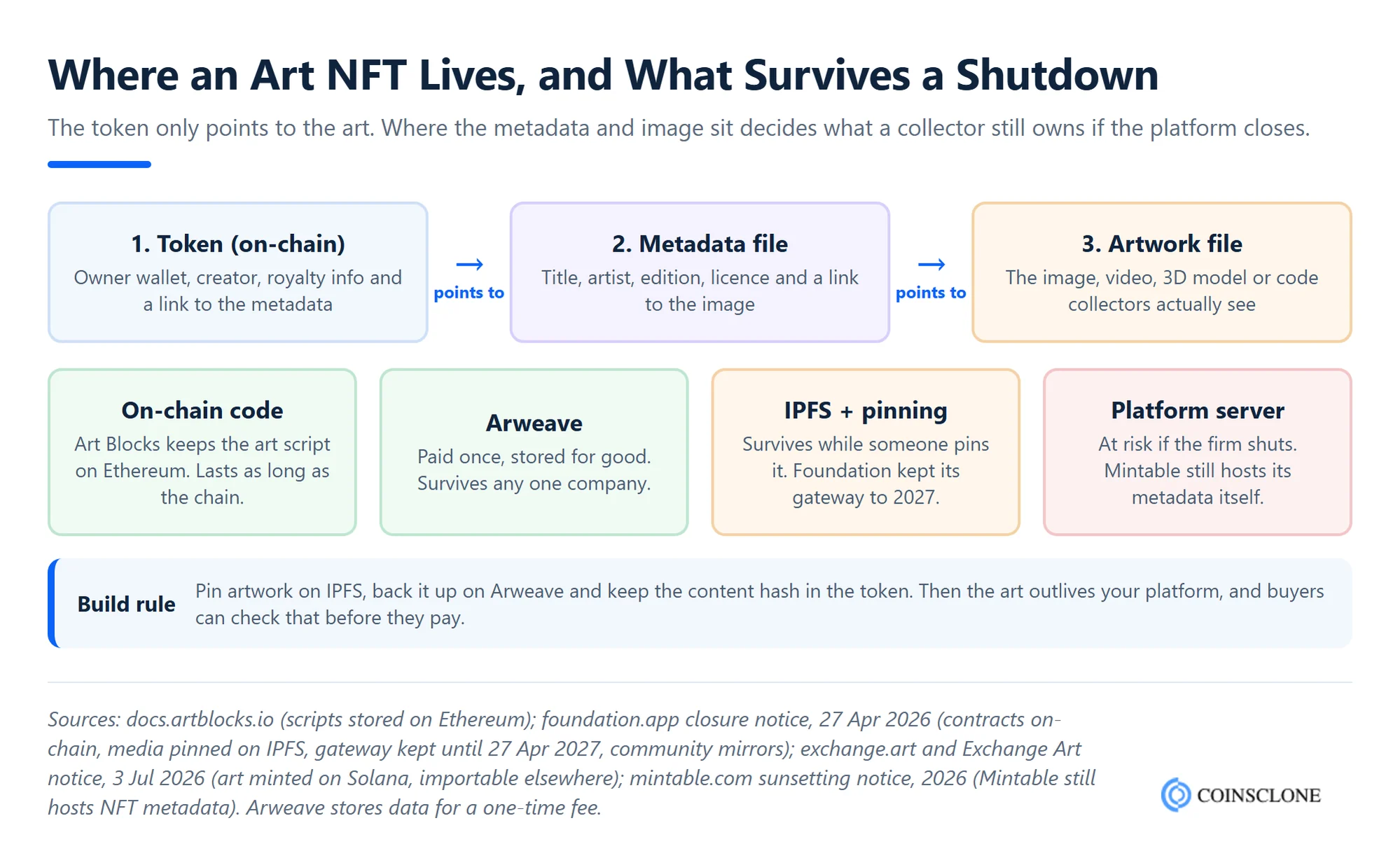
Foundation’s closing notice made this point well. Because its contracts and media were on-chain and on IPFS, buyers still hold their art. The team also kept its IPFS gateway running until April 2027, and the community stepped in to mirror the files. So store artwork on IPFS with paid pinning, keep a backup on Arweave, and put the content hash inside the token.
Rights, Royalties and Rules for Art NFTs
Many art NFT disputes have nothing to do with code. Instead, they come from unclear rights, unpaid royalties or tokens that fall under finance laws. So settle these points before your first drop.
Owning the NFT is not owning the copyright. In March 2024, the US Copyright Office and the USPTO put out a joint report on NFTs and intellectual property. It found that many buyers and sellers do not know which rights come with an NFT sale. So each listing should state in plain words what the buyer gets: a collectible to display, a print right, or a licence for business use.
Royalties are a signal, not a promise. The ERC-2981 royalty standard tells marketplaces who should get a royalty and how much. But each marketplace decides whether to pay it. If resale cuts matter to your artists, enforce them in your own contracts. OpenSea, for one, supports the ERC721-C way to do this. Or limit trading to sites that honour them.
Copied art needs a takedown process. Art platforms often face “copy-minting”, where someone mints work they did not make. Plan artist checks, image matching and a fast way to remove stolen work.
Shared ownership can bring finance rules. Selling one artwork as many small shares makes it look like an investment. In the EU, MiCA leaves unique NFTs out of scope, but large series or fractions of one asset can fall back in. Get legal advice before you sell fractions.
Other checks include KYC rules from your card payment partner, tax on artist payouts and clear terms for physical artworks and shipping.
How to Build an NFT Art Marketplace: Step by Step
Here is a proven process to build an art platform from idea to launch:
- Plan the Business: Pick your niche, such as fine art, 3D, code-based or physical art. Then pick your model (curated, open or hybrid) and your income streams.
- Pick the Tech: Choose the blockchain, token standards, wallets, storage and card payment partner.
- Design the Screens: Design a gallery-quality storefront, artwork pages, artist profiles and a simple minting flow.
- Build the Core: Write the smart contracts for minting, listings, auctions and royalties. Then build the web app, admin panel and indexer.
- Test and Audit: Test each flow and have the smart contracts audited before real money moves through them.
- Launch and Grow: Go live with a launch drop from a few known artists. Then add features based on how artists and buyers use the platform.
Build time depends on the route you take. Here are Coinsclone’s published build times:
| Build route | Build time | Best for |
| White label NFT marketplace | 4 to 6 weeks | A fast launch on proven code |
| White label with creator minting | 7 to 10 weeks | Art platforms where artists mint their own work |
| Standard custom platform | 9 to 13 weeks | Your own design and feature mix |
| Multi-chain custom platform | 6 to 11 months | Large platforms on many chains |
How Much Does NFT Art Marketplace Development Cost?
Your cost depends on the build route, the number of chains, the art features and the smart contract audit. Current market ranges from development firms in 2026 give a good guide:
- White label platform with art branding: about $10,000 to $30,000.
- Basic custom art platform (MVP): about $20,000 to $45,000.
- Mid-size platform with auctions, editions and card checkout: about $40,000 to $80,000.
- Enterprise or multi-chain art platform: about $80,000 to $150,000 or more.
On top of the build, plan for a smart contract audit, hosting, IPFS pinning, KYC checks, card payment fees and marketing. Upkeep usually runs 15% to 25% of the build cost each year. For a line-by-line view, read our guide on NFT marketplace development cost.
Benefits of Building an NFT Art Marketplace
A well-built art platform offers real gains for founders, artists and buyers alike. Here are the top three.
Revenue Generation
An NFT art marketplace opens up many income streams. By letting artists turn their work into NFTs, the platform can charge minting fees. Beyond that, it can take a share of each sale. Paid plans, featured spots and royalty shares add more income on top. (See the next section for the full list.)
Global Market
An NFT art platform works across borders from day one. Artists can show their work to buyers anywhere in the world, and a buyer in any country can collect with a wallet or a card. This direct link between creators and buyers builds a market where art trades safely and openly.
Brand Building
An art platform does more than handle sales. It also builds a strong brand in the digital art world. When you back high-quality art and offer useful tools, artists and buyers start to trust your platform. That trust makes you a name in the space and draws more users over time.
How Do NFT Art Marketplaces Make Money?
NFT art marketplaces can earn in many ways, and each one gives value to both the platform and its users. Here are the main income streams:
- Transaction Fees: This is the most common model. For each NFT sale on the platform, the admin charges a share of the price or a fixed fee. Open platforms often charge around 1%, while curated ones charge far more on first sales.
- Buyer Fees: Some platforms add a small fee on top of the price that the buyer pays, such as SuperRare’s 3%.
- Minting Fees: The platform can charge a fixed rate or a share when an artist mints an NFT. This turns the act of creating NFTs into income.
- Listing Fees: You can charge a fee to list NFTs, especially for premium listings or featured spots that bring more views.
- Paid Plans: Monthly plans for artists and buyers, with perks such as top listings, custom shop pages or deeper sales data.
- Royalties: Artists set royalties on their NFTs, so they earn each time their art resells. The platform can also take a small share when it handles the sale.
For more ideas, see our guide to the NFT marketplace revenue model.
Bring Your Vision to Life with Our NFT Art Marketplace Solutions
Earn with Art NFTs. User-Friendly Platform. Guaranteed Royalty. Global Reach.
Why Choose Coinsclone as Your NFT Art Marketplace Development Company?
Coinsclone is a trusted NFT Marketplace Development firm. We have been building blockchain products since 2018 and have delivered 350+ platforms for 200+ clients across 20 industries. Our team keeps up with the latest trends and tools, so we can shape each build around your goals.
For art, we build gallery-style shop fronts, auctions, editions, payout contracts and lasting IPFS storage. Coinsclone can launch a white label NFT art marketplace in 4 to 6 weeks, or build a custom platform around your own model. We also offer 24/7 support and a track record of on-time delivery. Reach out today for a free demo and a free consultation.
With Coinsclone, your art platform is just a step away!
Build Your Own NFT Art Marketplace to Empower Digital Artists
NFT Art Marketplace Development — designed for creators, collectors, and galleries.
- Diverse Art Collections: Support digital, 3D, fine, and programmable art.
- Seamless Platform Features: Minting, listing, search filters, and analytics.
- Global Reach: Showcase art to collectors worldwide and build your brand.
- Monetization Opportunities: Earn from transaction fees, royalties, and minting charges.
See a free branded demo of your NFT marketplace in 48 hours — before you invest a cent.
Book a Free Demo to discover how our NFT Art Marketplace Development can help you launch a profitable, artist-focused platform in just 8–12 weeks.
Frequently Asked Questions
What is NFT art marketplace development?
NFT art marketplace development is the process of building a blockchain-based platform where artists create, mint, show and sell digital artwork as NFTs. It includes smart contracts, a gallery storefront, wallets, payments, storage and an admin panel.
How does an NFT art marketplace work?
Artists mint their artwork as NFTs and list it at a fixed price, for offers or at auction. Buyers pay in crypto or by card, and a smart contract moves the NFT to the buyer and the funds to the artist. On later resales, the artist can earn a royalty.
How long does it take to develop an NFT art marketplace?
Coinsclone’s published times are 4 to 6 weeks for a white label build and 7 to 10 weeks with creator minting. A standard custom build takes 9 to 13 weeks, and a custom platform on many chains takes 6 to 11 months.
How much does it cost to develop an NFT art marketplace?
Market ranges in 2026 run from about $10,000 to $30,000 for a white label platform, $20,000 to $45,000 for a basic custom build and $40,000 to $80,000 for a mid-size platform. Enterprise or multi-chain platforms often cost $80,000 to $150,000 or more. Audits, hosting and marketing are extra.
Which blockchain is best for NFT art marketplace development?
Ethereum is still the main chain for high-value art. Base and Polygon suit low-cost editions, Solana suits fast trading, and Tezos has a strong art scene. Many platforms support two or more chains.
Is NFT art still a thing in 2026?
Yes, but the market is smaller and more selective. NFT sales across all categories fell 37% to $5.63 billion in 2025, per CryptoSlam data. Hand-picked and code-based art sites such as SuperRare and Art Blocks still run, while some art platforms closed.
Is NFT worthless now?
No, but prices are far below the 2021 peak, and the average NFT sale fell from $124 in 2024 to $96 in 2025. Value now comes from real art, proof of ownership and access, rather than quick flip profits.
Why are NFT art marketplaces good for digital artists?
They let artists earn from their work, get a cut of each resale, prove who owns a piece and reach buyers worldwide without a middleman.