
Hybrid crypto exchange development means building one trading platform that pairs the speed of a central exchange with the self-custody of a DEX. Orders match off-chain in milliseconds, while funds settle on the blockchain and stay under the user’s control. Coinsclone builds these platforms for exchange owners, trading firms and startups.
This guide explains what a hybrid exchange is, how one trade moves through it, and which real platforms use the model in 2026. It also covers the features, safety layers, ways to earn, cost, time to launch and the build steps, so you can decide if a hybrid model fits your plans.
In this guide:
- How a hybrid exchange differs from a CEX and a DEX, side by side
- How a trade is signed, matched off-chain and settled on-chain, with a diagram
- Real hybrid designs in 2026: dYdX, Polymarket, Lighter and Paradex
- What a hybrid build costs, how long it takes and the risks to plan for
- The features, revenue streams and six-step process we follow
Accelerate Your Hybrid Crypto Exchange Launch
Hybrid Crypto Exchange Development — built for performance and scalability.
- MVP System : Launch your hybrid (CEX + DEX) exchange 90% faster.
- Liquidity & Wallets : Pre-integrated modules for centralized and decentralized trading — no coding needed.
- Brand & Customization : Your design, your tokens, your liquidity pools, your market.
- Revenue Engine : Earn from trading fees, listings, staking, and DeFi yield integrations.
Get a free branded demo of your hybrid exchange in just 48 hours — before you invest a cent.
Book a Free Demo to discover how our Hybrid Exchange Software can take you from idea to live platform in just 8 – 12 weeks.
What Is Hybrid Crypto Exchange Development?
Hybrid crypto exchange development is the work of building a trading platform that combines the best parts of centralized and decentralized exchanges. The builder designs a system where users get fast trades, as on a central exchange, and keep their own funds, as on a DEX. The goal is a balance of speed, safety and ownership.
In practice, a hybrid exchange splits the job in two:
- The fast part runs off-chain: The order book, the matching engine, charts and the user interface run on servers, so trades fill in milliseconds.
- The money part runs on-chain: Smart contracts or a rollup hold funds and settle trades, so the operator cannot move funds on its own.
As a result, traders get a familiar exchange screen without handing their coins to a company. That matters after events like the February 2025 Bybit hack, the largest crypto theft on record, which cost $1.5 billion. In total, Chainalysis counted more than $3.4 billion stolen in 2025.
Hybrid vs Centralized vs Decentralized Exchanges
Here is how the three models compare on the points that matter most to traders and owners.
| Factor | Centralized (CEX) | Decentralized (DEX) | Hybrid exchange |
| Who holds funds | The exchange | The user | The user, through a settlement contract |
| Order matching | Off-chain engine | On-chain pools or order book | Off-chain engine |
| Settlement | Internal ledger | On-chain | On-chain or proven on a rollup |
| Speed | Milliseconds | Depends on the chain | Milliseconds to match |
| Fiat deposits | Yes | Rarely | Possible through partners |
| Main risk | Hacks and insolvency | Smart contract bugs | Operator order sequencing and contract bugs |
| Examples | Binance, Coinbase | Uniswap, Raydium | dYdX, Polymarket, Lighter, Paradex |
How a Hybrid Crypto Exchange Works
Each trade on a hybrid exchange follows the same four steps. First, the user deposits funds into their own wallet or a settlement contract. Next, the user signs an order with their wallet. Then the off-chain engine checks the balance and matches the order by price and time. Finally, a smart contract settles the trade on-chain and updates both balances.
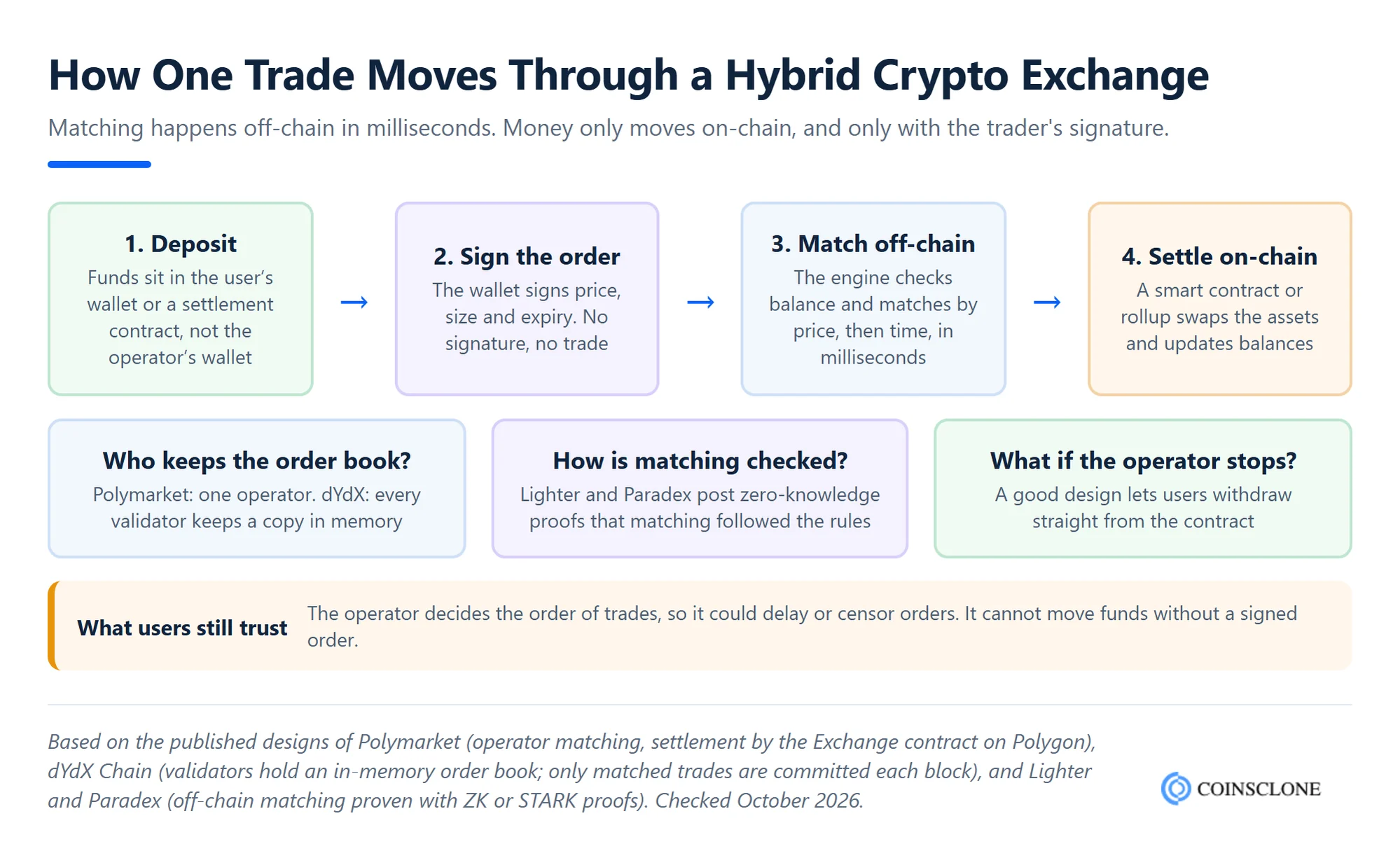
The signature is the key. Because each order carries the trader’s signature, the operator can match trades but cannot invent them. Still, a hybrid exchange is not fully trustless. The operator decides the order in which trades reach the book, so users trust it not to delay or front-run their orders. That is why the best designs add one more safety net: users can withdraw straight from the contract if the operator goes offline.
Three Ways to Build the Hybrid Layer
Live platforms in 2026 use one of three designs:
- Operator matching with contract settlement: One company runs the order book and a smart contract settles each trade. Polymarket works this way. It matches orders off-chain and settles them on Polygon.
- Validator-run order book: On the dYdX Chain, each validator keeps the order book in memory. Only matched trades are written to the chain in each block.
- Proven off-chain matching: Lighter and Paradex match orders off-chain, then post cryptographic proofs to Ethereum. Anyone can check that the engine followed its own rules.
Meanwhile, big centralized exchanges are moving toward hybrid too. Binance Alpha 2.0, launched in March 2025, lets users buy on-chain tokens from their Binance account. Similarly, Coinbase opened in-app DEX trading to all US users outside New York in October 2025.
Why Hybrid Exchanges Matter in 2026
On-chain trading is no longer a side market. In August 2026, decentralized exchanges handled $205 billion in spot trades, or 18.7% of all spot volume. On-chain perpetuals and futures added $549 billion, according to the CoinDesk Data exchange review for August 2026.
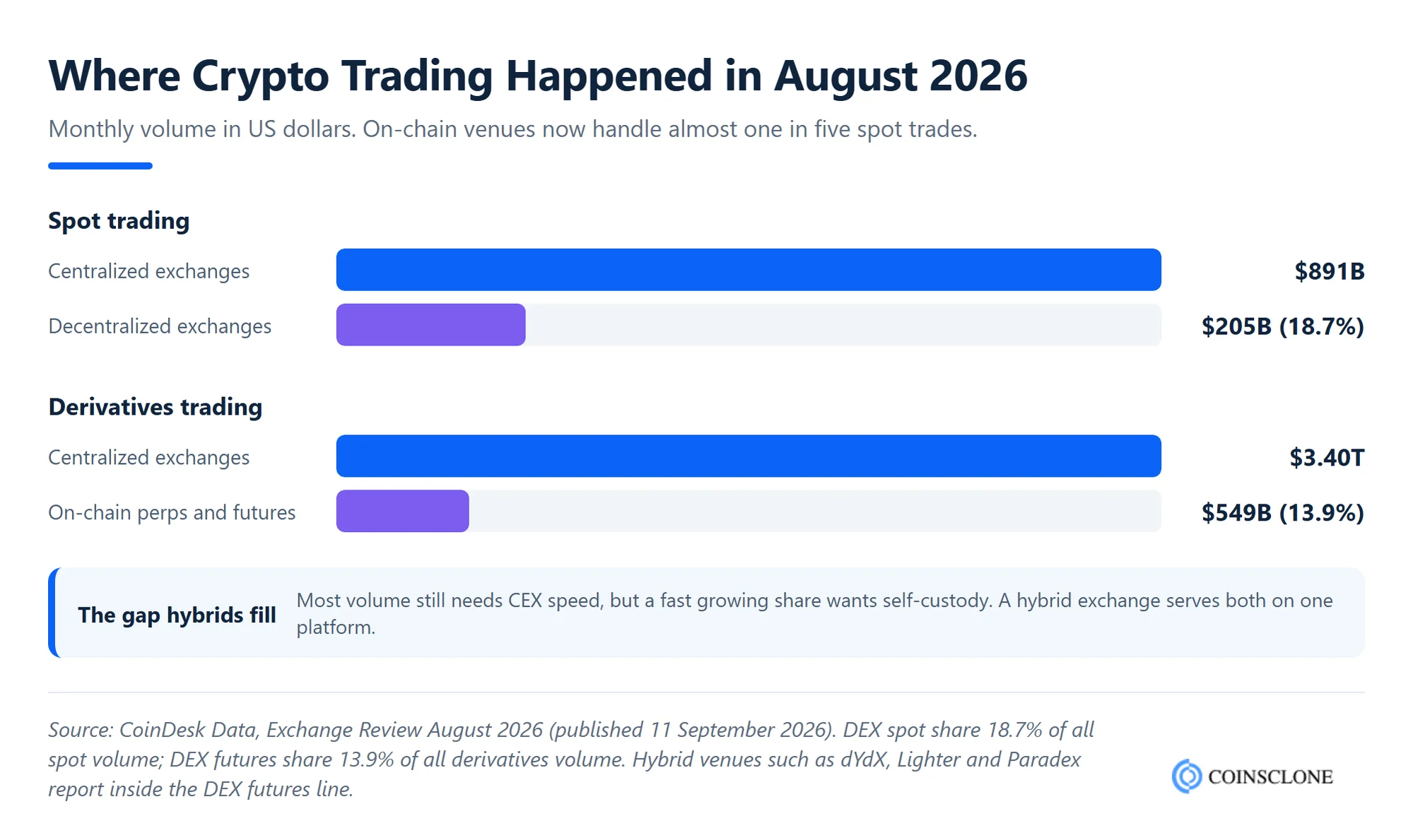
Even so, centralized exchanges still handled $891 billion in spot and $3.40 trillion in derivatives that month. In other words, most traders still want CEX speed and depth, while a growing share wants to keep their own keys. A hybrid exchange lets you serve both groups on one platform.
Is a Hybrid Exchange Right for You?
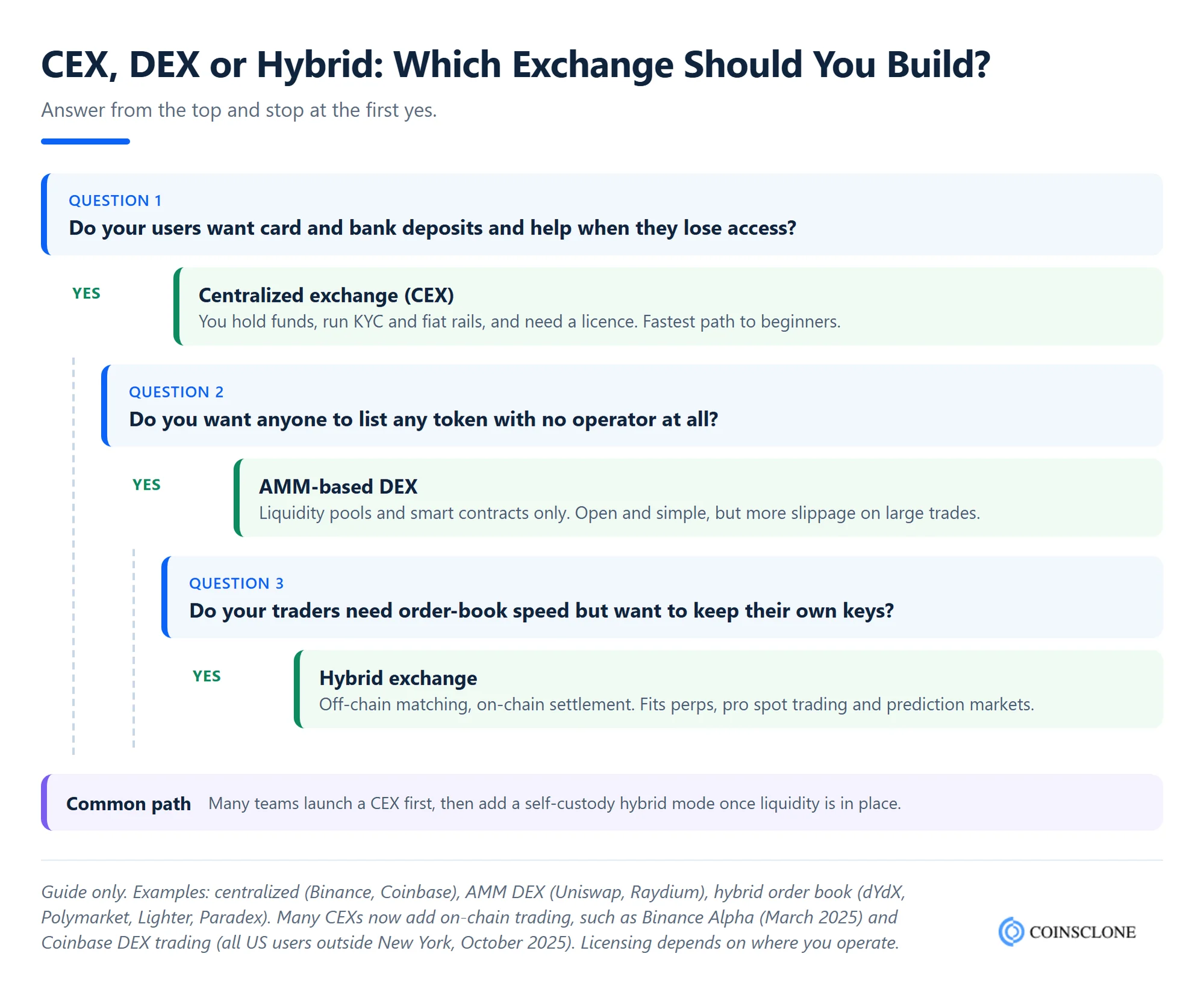
A hybrid model is not the answer for every business. If your users are beginners who pay by card, a centralized exchange is usually the better start. If you want open, permissionless token listings, a DEX fits better. However, if your traders want order-book speed and self-custody, a hybrid is the right choice.
Not sure yet? Compare the other routes in our guides to DEX development and CEX development.
Our Hybrid Crypto Exchange Development Approaches
No two firms have the same goals, budget or deadline. So at Coinsclone, we offer two ways to build a hybrid crypto exchange: from scratch, or with our white-label hybrid exchange script. Both give you a secure, fast and scalable platform. Each one suits a different need.
Hybrid Exchange Development From Scratch
If you want full freedom to design every feature, build from scratch. Our team creates the whole platform around your plan, from the trading engine and liquidity modules to the UI design and blockchain setup. This route suits businesses that plan to build for the long term and want a strong market presence.
Hybrid Exchange Script
If you are a startup that wants to enter the market fast and at a lower cost, our hybrid exchange script is the better fit. It comes with ready features, a tested trading engine and pre-built modules, so you can launch in about 8 to 12 weeks instead of many months. It also suits first-time founders who want a quick launch without cutting corners on quality or security.
Hire Hybrid Exchange Developers
Hire skilled hybrid exchange developers who build secure, fast trading platforms. With hands-on blockchain skills, our team keeps the work smooth, shares progress openly and shapes the product around your goals.
Key Features Integrated with Our Hybrid Crypto Exchange Software
A winning crypto exchange needs the right features and strong safety from day one. Users around the world expect fast trades and clear safety rules. Our team builds a platform that gives your users smooth, reliable trading with all the tools they need.
User Features
- Sign Up and Login: Users sign up with email or phone and log in safely.
- KYC/AML Checks: A simple ID check keeps trading safe and compliant for all users.
- User Dashboard: A clean dashboard shows balances, recent activity and key trading data.
- Own-Wallet Trading: Users trade from their own wallet, so their funds never sit in the exchange’s hot wallet.
- Buy/Sell Crypto: Users buy or sell crypto at market or limit prices.
- Order Book View: A live order book helps users make informed trades.
- Crypto Swap: One-click token swaps for users who do not want a full trading screen.
- Notifications and Alerts: Users get instant updates on orders, prices and account activity.
- Profile Settings: Users change their details, safety settings and choices with ease.
- Trade History: Users track each deposit, payout, trade and swap in one place.
Admin Features
- Admin Dashboard: One dashboard to watch platform activity, user numbers, liquidity and system health.
- Liquidity Control: Connect or adjust pools and outside market makers to keep trading steady.
- Wallet and Funds Control: Watch wallet balances, fund flows, deposits and payouts.
- Trading Engine Controls: Manage order matching, trading pairs and settlement settings across spot, swap and hybrid markets.
- Fee Settings: Set trading fees, payout charges, referral rewards and offers.
- Reports: Build clear reports on volume, revenue, user activity and exchange health.
- Safety Controls: Set up and watch key tools such as SSL, DDoS shields, multisig wallets and audit logs.
With these parts in place, your platform runs smoothly and gives users a better trading experience. Next, let’s look at security.
Security Features Integrated in Our Hybrid Exchange Software
Our hybrid crypto exchange software uses safety layers from both CEX and DEX systems. Together, they protect the platform against common threats:
- Multi-Factor Login (MFA): A second check at each login and payout.
- Cold Wallet Storage: Offline storage for any funds the platform must hold.
- Data Encryption and SSL: Protection for user data at rest and in transit.
- Anti-DDoS and Firewall: Shields that keep the platform online during attacks.
- Smart Contract Audits: Outside reviews of the settlement contracts before launch.
- Risk Tools: Live checks on odd trades, payouts and logins.
Popular Hybrid Crypto Exchange Scripts We Offer
Leading exchanges such as Binance, HTX and OKX now mix centralized trading with on-chain features, from Web3 wallets to in-app DEX trading. Many businesses want to build on the same model. At Coinsclone, we help you copy and improve these proven models with our white-label hybrid crypto exchange solutions.
- Binance Clone Script: Copy Binance’s fast order matching, deep liquidity and many markets with our hybrid exchange software.
- Huobi Clone Script: Offer the trusted trading experience of Huobi, now called HTX, on a hybrid base. Our script supports spot, OTC, margin trading and a multi-currency wallet.
- OKX Clone Script: Bring OKX’s trading features into a hybrid setup. It blends fast CEX parts, such as quick order matching and deep liquidity, with DeFi features.
Each of these white-label hybrid exchange solutions is built for speed, scale and user trust. As a result, you can enter the market quickly with a ready-to-launch hybrid exchange.
Diverse Hybrid Crypto Exchange Development Services We Offer
Custom UI/UX Solutions
We design clear, user-friendly screens made just for hybrid crypto exchanges. Our UI/UX work focuses on easy navigation, clear trade flows and a dashboard that suits both beginners and pro traders. With clean visuals and simple controls, users can trade, track assets and manage portfolios with ease.
Secure Wallet Integration
Our hybrid crypto exchange solutions come with secure wallet integration to protect user assets. We build both custodial and self-custody wallets on many chains, including MPC wallets that split each key into shares. This gives users safe storage, smooth transfers and strong protection, so they can trade with confidence.
Multi-Mode Payment Integration
We add many payment methods to make your hybrid exchange easy to use around the world. Our multi-mode payment setup keeps transactions fast, secure and compliant. That helps your exchange attract traders from many countries and work across different payment systems.
Robust Liquidity Infrastructure
We connect central order flow, decentralized liquidity pools and outside market makers, so trades fill smoothly with little slippage. Our liquidity engine supports high-volume trading, keeps prices stable and builds user trust. For a deeper look, see our guide to crypto liquidity providers.
Next-Gen Hybrid Exchange App Development
At Coinsclone, we make sure your hybrid exchange meets today’s standards and is ready for what comes next.
Our next-gen hybrid exchange app brings speed, choice and safety to crypto trading on phones. We build a crypto exchange app that blends the reliability of central systems with the openness of blockchain, so users can trade on the go. The app supports instant trades, multi-chain wallet links, fast order matching and secure on-chain settlement, all in a clean and simple design.
We also add face or fingerprint login, one-tap trading, price alerts, staking and live portfolio tracking. With our hybrid exchange app, your users stay engaged anytime, anywhere.
Benefits of Our Hybrid Crypto Exchange Development
At Coinsclone, we do not just build crypto exchanges. We build hybrid trading platforms that help your business grow, scale and stand out.
Superior Liquidity
We connect deep liquidity pools and multi-source order books. So your platform supports high-volume trading with instant fills and accurate prices, which is key to winning pro traders.
Enterprise-Grade Security
Our hybrid exchange design uses both central and on-chain safety layers. Along with 2FA, SSL encryption and cold storage, it protects funds and user data.
Lightning-Fast Performance
Our trading engine and scalable backend handle thousands of transactions per second without lag, even when markets surge.
Revenue-Focused Design
Each feature we build, from staking to liquidity tools, aims to keep users active and raise revenue.
Seamless User Experience
We design simple screens and add many ways to trade, such as spot, P2P and OTC markets. That makes your exchange easy to use for all kinds of traders.
In short, by working with Coinsclone, you get a secure, revenue-ready hybrid exchange built to compete.
Revenue Streams of Our Hybrid Exchange Software
Coinsclone’s hybrid exchange software comes with many ways to earn, so your platform can turn a profit. Here are the main ones:
- Trading Fees: Earn maker and taker fees on each trade.
- Withdrawal Fees: Charge users for crypto and fiat withdrawals.
- Listing Fees: Earn when new tokens or projects list on your exchange.
- P2P Transaction Fees: Earn a share of peer-to-peer trades.
- OTC Desk Commissions: Earn from large, private trades.
- Margin and Derivatives Fees: Earn more from futures, options and leveraged trades.
- Staking and Yield Programs: Share rewards from staking pools and earning products.
- Launchpad/IEO Fees: Earn from project launches hosted on your exchange.
At Coinsclone, we make sure each revenue stream is set up and working from day one. That helps you build a lasting, high-return hybrid exchange.
Hybrid Crypto Exchange Development Cost and Timeline
A hybrid exchange is the hardest exchange model to build, because you build two systems and the bridge between them. Market estimates for a custom hybrid platform start at about $150,000 to $300,000 or more, and a full custom build can take 10 months or longer. Our crypto exchange development cost guide breaks these numbers down by exchange type.
A script-based build is much faster. For reference, our white-label exchange core goes live in 4 to 6 weeks, 7 to 10 weeks with fiat rails, and 9 to 13 weeks with mobile apps. A hybrid launch on a script usually takes about 8 to 12 weeks, because the settlement contracts and their audit add time.
The main cost drivers are:
- Settlement layer: Smart contracts on an existing chain cost less than your own rollup or appchain.
- Matching engine: Speed targets, order types and the number of trading pairs.
- Markets: Spot only, or also perpetual futures, margin and options.
- Audits: Each settlement contract needs an outside audit before launch.
- Liquidity: Market-maker deals and links to outside order books.
- Licensing: Fees and legal work in each country you serve.
Challenges of Hybrid Crypto Exchange Development
A hybrid exchange solves real problems, but it brings its own risks. Plan for these from the start:
- Operator power: The off-chain engine decides the order of trades. Publish clear matching rules and, where you can, prove them on-chain.
- Smart contract risk: A bug in the settlement contract can put all user funds at risk. Audits and bug bounties are a must.
- Settlement delays: A trade can match in milliseconds but settle later when the chain is busy. Show users clearly when a trade is final.
- Split liquidity: Liquidity spread across the order book and on-chain pools can leave both thin. A shared liquidity engine helps.
- Regulation: Running the matching engine or holding any user funds usually makes you a regulated crypto service. In the EU, the MiCA grace period for crypto firms ended on 1 July 2026, so EU users now need a licensed operator. Our guide to a MiCA-compliant crypto exchange explains the steps.
Step-by-Step Process In Our Hybrid Crypto Exchange Development
A hybrid crypto exchange goes through several stages before launch. At each one, we check each part of the tech you need. Coinsclone builds fast, feature-rich hybrid crypto exchange software and supports you at each step, from planning to launch. Here is how it works.
Research and Planning
We study your needs and create a project plan that sets the scope, schedule and budget. By working closely with you, we agree on clear goals, so the final product matches what you need.
UI/UX Designing
Next comes UI/UX design. Our design team works closely with the developers to create a platform that looks good and is easy to use. The goal is simple: your users should place trades without any trouble.
Core Blockchain and Backend Development
In stage three, we build the platform: the settlement contracts, trading engine, payment gateway and safety tools. Our build and design teams work together so all the parts fit. The timeline depends on how complex the platform is.
API and Liquidity Setup
Next, we connect APIs and liquidity sources to make your hybrid exchange trade smoothly. By linking to leading crypto liquidity providers, you get deep order books and instant fills. Our APIs also give live market data and links to other exchanges and tools.
Testing and Code Audits
Testing is the fifth stage. We test your platform in depth to make sure it is reliable and secure. Our testers work with the coders to find and fix bugs, and the settlement contracts go through an outside audit. This stage builds the trust your users need.
Launch and Support
In the final stage, we launch your platform in a live setting. Our team checks that everything is set up right and works as expected. After launch, we keep the platform updated, monitored and safe.
In short, our hybrid crypto exchange development process is open and efficient. Whether you are a startup or a large firm, our team builds a product for you, on time and on budget.
Build your Hybrid Crypto Exchange with Coinsclone — where innovation meets reliability.
Launch Faster. Trade Smarter. Earn higher ROI. Connect With us!
Why Choose Coinsclone as Your Hybrid Exchange Development Company?
Coinsclone is a leading Cryptocurrency Exchange Development Company. We are a trusted partner to build your hybrid crypto exchange at a fair cost. Our hybrid design runs the order book and matching engine off-chain for speed. Then each trade settles safely on-chain through smart contracts.
We have built blockchain products since 2018 and delivered more than 350 platforms for over 200 clients across 20 industries. Our team builds secure, scalable exchange software shaped around your business goals. We also focus on clear design, smooth features and a fast launch, so your platform goes live sooner and runs well.
At Coinsclone, we do more than build exchanges. We help you shape a strong business plan and find growth in a competitive crypto market. So let our blockchain developers turn your hybrid exchange idea into a working platform with a higher return and a lower build cost.
Get in touch with us today and launch your hybrid crypto exchange with Coinsclone!
Frequently Asked Questions
What is hybrid crypto exchange development?
Hybrid crypto exchange development is the process of building a trading platform that combines central order matching with decentralized control of funds. Trades fill fast, while users keep more control over their crypto than on a fully centralized exchange.
What does a hybrid crypto exchange development company do?
It builds the full platform: the trading engine, wallets, settlement contracts, user dashboards, admin panel and safety features. It also links liquidity, trade monitoring and compliance tools.
How is a hybrid exchange different from centralized and decentralized exchanges?
A centralized exchange holds user funds and runs trades on its own system. A decentralized exchange runs fully on smart contracts. A hybrid exchange combines both: it matches orders off-chain for speed and settles them on-chain, so users keep control of their funds.
How does a hybrid crypto exchange work?
Users sign orders with their wallet. A central engine matches those orders off-chain in milliseconds. Then a smart contract or rollup settles the trade on-chain. The operator can match trades, but it cannot move funds without the user’s signed order.
What are examples of hybrid crypto exchanges?
Well-known hybrid designs in 2026 include dYdX and Polymarket. dYdX keeps its order book in the memory of its validators. Polymarket matches off-chain and settles on Polygon. Lighter and Paradex match off-chain and prove the results on Ethereum. Big exchanges such as Binance and Coinbase have also added on-chain trading inside their apps.
Is a hybrid crypto exchange fully trustless?
No. Users keep control of their funds, but they still trust the operator to process orders fairly and in the right order. Good platforms reduce this trust with public matching rules, on-chain proofs and a way for users to withdraw straight from the contract if the operator goes offline.
How much does it cost to develop a hybrid crypto exchange?
Market estimates for a custom hybrid exchange start at about $150,000 to $300,000 or more. The final cost depends on the settlement layer, the markets you offer, audits, liquidity deals and licensing. A script-based build costs much less and launches faster.
How long does hybrid exchange development take?
A script-based hybrid exchange takes about 8 to 12 weeks. The time grows with each added chain, mobile app, compliance tool and audit. A full custom build can take 10 months or more.
Is hybrid crypto exchange development legal?
Building a hybrid exchange is legal in many countries, but running one depends on local rules. Most places require KYC, AML checks, data rules and trade reports, mainly when you offer fiat or hold user funds. In the EU, operators now need a MiCA licence.
What security features are required in a hybrid crypto exchange?
A safe hybrid crypto exchange needs encrypted wallets, smart contract audits, two-factor login, payout limits, live monitoring, cold storage and strict admin access. These features protect both user funds and the platform itself.
Accelerate Your Hybrid Crypto Exchange Launch
Hybrid Crypto Exchange Development — built for performance and scalability.
- MVP System : Launch your hybrid (CEX + DEX) exchange 90% faster.
- Liquidity & Wallets : Pre-integrated modules for centralized and decentralized trading — no coding needed.
- Brand & Customization : Your design, your tokens, your liquidity pools, your market.
- Revenue Engine : Earn from trading fees, listings, staking, and DeFi yield integrations.
Get a free branded demo of your hybrid exchange in just 48 hours — before you invest a cent.
Book a Free Demo to discover how our Hybrid Exchange Software can take you from idea to live platform in just 8-12 weeks.