
This guide shows you how to create a crypto exchange like Paxful, the peer-to-peer (P2P) marketplace where buyers and sellers traded crypto directly, with the platform holding the coins in escrow. It covers the three ways to build one, the features users expect, the licences you need, the real launch times and the costs, step by step from idea to launch.
It also covers what most Paxful guides leave out. Paxful itself closed on 1 November 2025, and in February 2026 a US court fined it for weak anti-money-laundering checks. So the useful question is not just how to copy Paxful’s features. It is how to build the same trusted marketplace with the controls Paxful lacked, so your platform lasts.
In this guide:
- Paxful’s real status in 2026, and the lessons its closure leaves for new founders
- How a Paxful-style escrow trade works, including the dispute path
- MVP vs white label vs custom build, with launch times of 4 to 16 weeks
- The features, licences and costs to plan for
- A seven-step build process and the revenue model, with real numbers
Launch A P2P Crypto Exchange Like Paxful Using MVP — Faster!
P2P Exchange Development, simplified for founders.
- Ready-Made P2P MVP : Launch your Paxful-like platform up to 90% faster.
- Built-in Escrow System : Secure trades with auto-release & dispute handling.
- Admin-First Control Panel : Manage users, ads, fees & disputes with ease.
- Revenue from Day One :Earn via trade commissions, ads & premium listings.
Get a free branded P2P exchange demo in just 48 hours — before you invest anything.
Book a Free Demo and see how our Paxful clone script helps you go from idea to live marketplace in 8-12 weeks.
How to Create a P2P Crypto Exchange Like Paxful
To create a crypto exchange like Paxful, you plan your market and licences, pick a build method, build the escrow and trade engine, add KYC and dispute tools, test it under load and launch in one region first. In short, the steps are:
- Plan: pick your first country, coins, payment methods and licence path.
- Choose a build method: an MVP, a white label Paxful clone or a custom build.
- Design: user, vendor and admin dashboards with clear escrow status.
- Build: escrow wallet, offer and trade engine, chat, KYC and dispute tools.
- Test: load tests, fraud scenarios and a security audit.
- Launch region by region: start small, add payment rails as you grow.
- Support and grow: updates, new coins and new markets.
The detailed process is further down. First, knowing the three build methods will bring clarity to your project. Each one suits a different budget, timeline and long-term goal, so let’s look at them in turn.
1. Create a Paxful MVP to Kick Start Your Platform
A P2P MVP, or minimum viable product, is a platform with only the essential features. It is the best way to prove your idea with real users before you spend on extras, because it keeps the first build small. The steps to create a Paxful-like MVP are:
- Market research: study the trends, user demands and problems in your target market. Talking to traders and local experts makes the MVP scope much easier to set.
- Designer and developer collaboration: once the research is done, designers create the UI/UX layout for the platform. With expert guidance, you can also fix the cost range, features and expected outcomes.
- MVP platform creation: developers build the frontend and backend, then add only the core features, so the platform works smoothly from day one.
- Test running: the MVP goes through load testing to check how it performs, and the team fixes any bugs before launch.
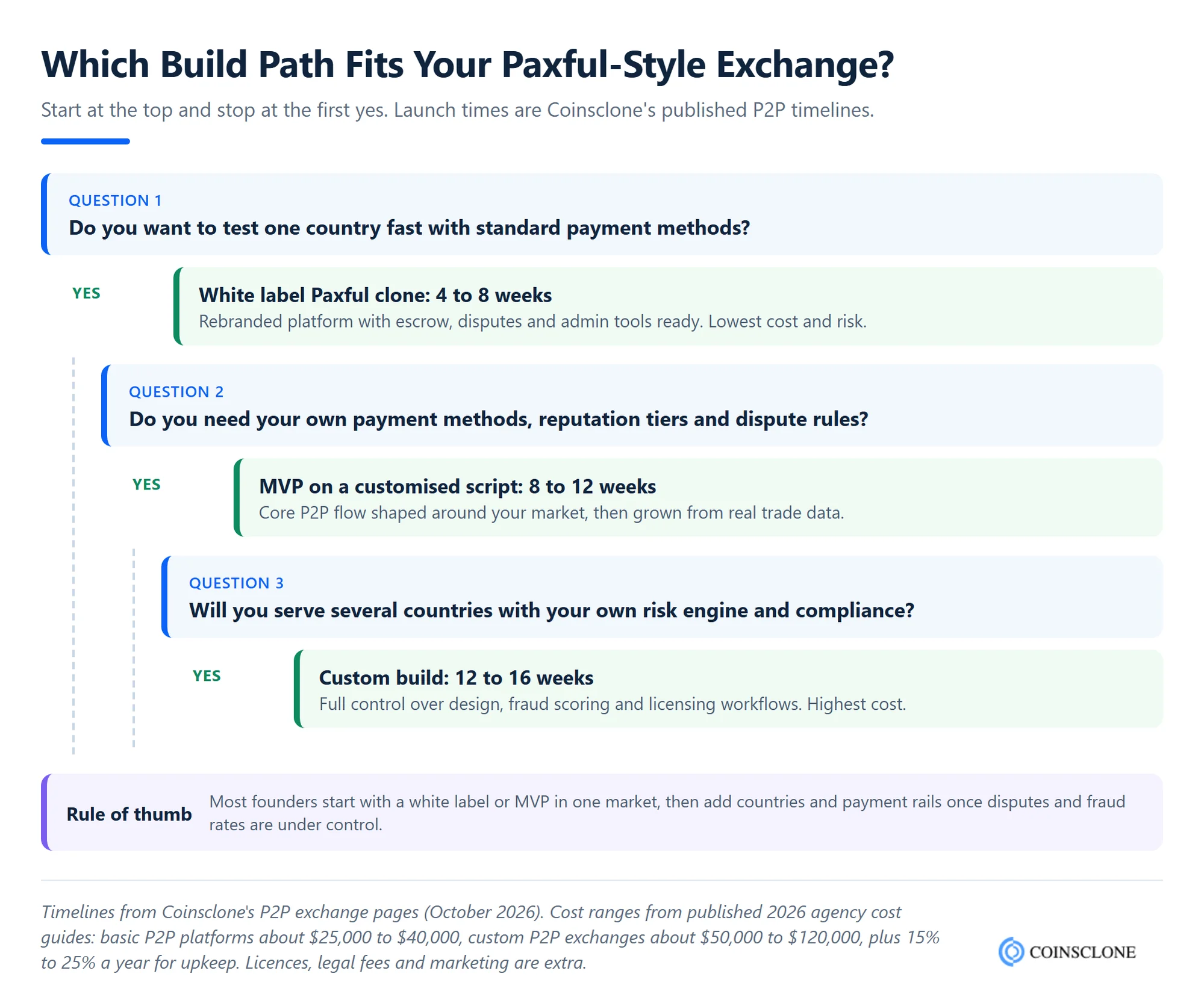
An MVP built on a customised P2P script takes about 8 to 12 weeks with Coinsclone. It suits founders who want their own product shape but still want to launch quickly.
- Best suited for: budding startups and new enterprises
2. Acquire a White Label Paxful Clone and Customize It
A white label Paxful clone script is pre-made, tested software for launching a P2P crypto exchange quickly. It comes with the core features, add-on modules and security tools already built. The main parts of a white label Paxful clone are:
- Pre-built offer and trade features
- Secure escrow wallet
- Dispute and moderator tools
- Mobile and web apps
You can then redesign and customise the clone to suit your business, from the brand and coin list to the fees and payment methods. This is the fastest route: a white label P2P exchange can go live in about 4 to 8 weeks.
- Best suited for: entrepreneurs and enterprises that want to enter a market fast
3. Develop a Paxful-Like Exchange From Scratch
You can also build a Paxful-like P2P exchange from the ground up, without any pre-made software. This lets you choose your own architecture, features and scaling plan. However, a build from scratch takes longer and costs the most, so it is a heavy load for an early startup. A custom P2P exchange takes about 12 to 16 weeks with Coinsclone.
- Best suited for: established enterprises and funded teams
A custom build fits founders who want unique features, deep changes and rules for several regions. Each method has its own benefits and risks. So it helps to work with a P2P crypto exchange development company whose team has built these platforms before and can match your build plan to your business goals.
Paxful in 2026: Why It Closed and What Still Works
Before you copy Paxful, you should know what happened to it. Paxful launched in 2015 and grew into one of the largest P2P bitcoin marketplaces, with about 14 million users in more than 140 countries. Its strength was choice: sellers could accept bank transfers, mobile money, cards and gift cards, which made crypto easy to buy where banks blocked exchanges.
Here is what happened next, as of October 2026:
- April to May 2023: Paxful suddenly suspended its marketplace on 4 April 2023, amid a dispute between its co-founders. It reopened on 8 May 2023 under new leadership.
- October 2025: Paxful announced that it would wind down all operations by 1 November 2025. It blamed misconduct by its former co-founders before 2023 and the high cost of fixing its compliance, not a lack of money.
- February 2026: The US Justice Department announced that Paxful was sentenced to a $4 million criminal penalty. It had pleaded guilty to running an unlicensed money business and failing to keep a proper anti-money-laundering (AML) program, among other charges.
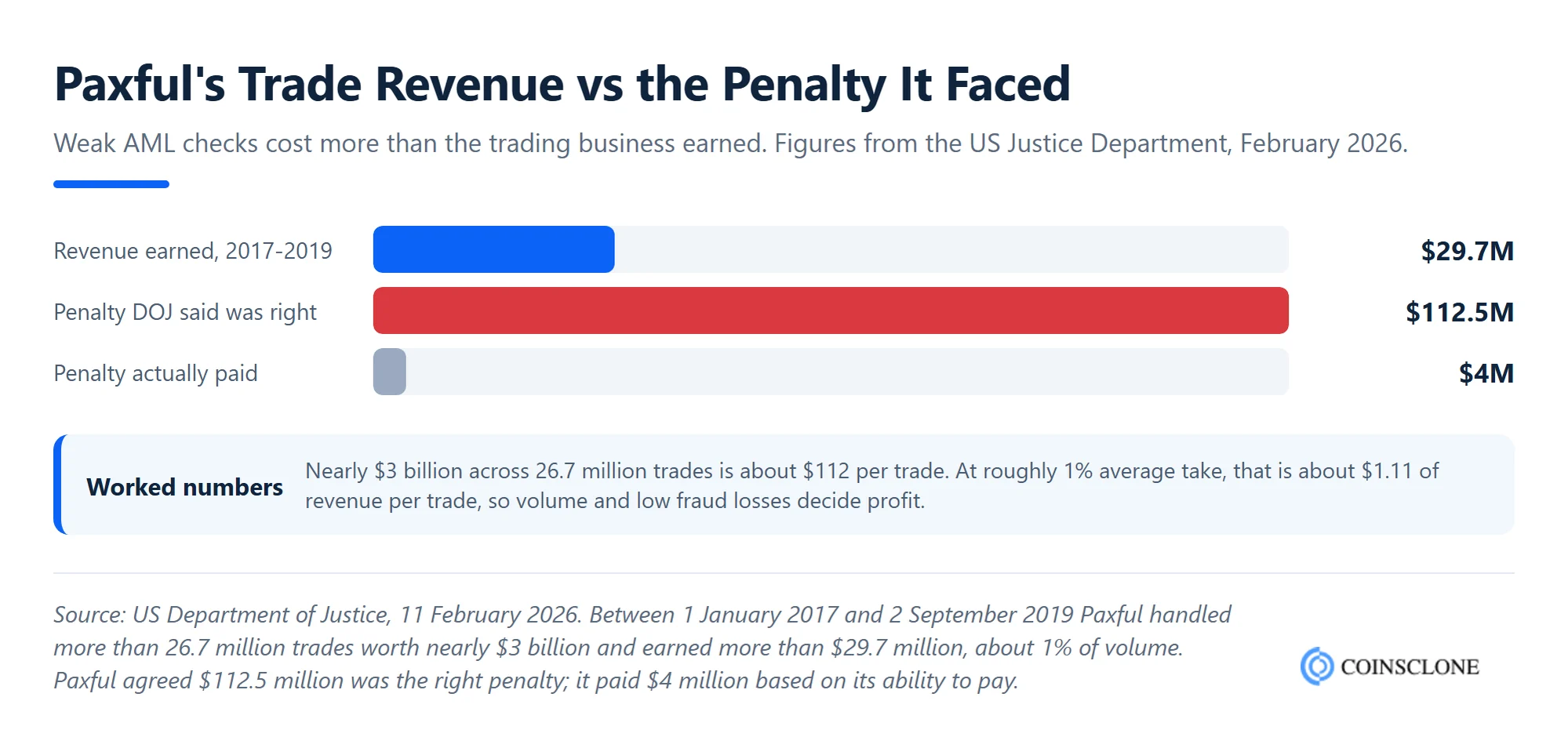
The numbers tell the story. Between 2017 and 2019, Paxful handled more than 26.7 million trades worth nearly $3 billion and earned about $29.7 million. Yet the Justice Department said the right penalty was $112.5 million, almost four times that revenue. It accepted $4 million only because Paxful could not pay more.
So why build a Paxful-like exchange at all? Because the demand did not go away. Paxful’s users moved to the P2P desks of big exchanges, and to newer platforms such as NoOnes, which a Paxful co-founder started. Many local markets still lack a focused, trusted P2P venue. See our list of the best P2P crypto exchanges for where traders went. The business that failed was Paxful’s compliance, not the P2P model.
Why Do You Need to Create a Crypto Exchange Like Paxful?
The P2P model still has strong business reasons behind it, as long as you build compliance in from the start. Here are the top reasons to create a crypto exchange like Paxful.
Market Demand
P2P platforms like Paxful let users trade with each other at prices they set, using payment methods that suit them. That matters most where banks block card payments to exchanges, or where local payment apps rule. Since Paxful and LocalBitcoins closed, those traders have fewer options, which leaves room for trusted local platforms.
Lighter Infrastructure
A P2P exchange does not need a high-speed matching engine or a deep pool of market makers. The platform acts as a facilitator: it holds only the crypto in escrow during a trade, while the cash moves directly between users. However, lighter does not mean unregulated. Paxful’s case shows that P2P platforms need the same licences and AML checks as other exchanges, which we cover below.
Multiple Revenue Streams
A Paxful-like exchange offers several ways to make money. Instead of relying on one stream, you can earn from trade fees, vendor plans, featured listings, withdrawal fees and fiat on-ramp commissions. We break these down later, with real numbers from Paxful.
Escrow Services
The peer-to-peer crypto exchange, like Paxful, uses an escrow system with structured dispute steps. The escrow, moderator-led dispute handling and user ratings build trust quickly, which is the main thing a new marketplace needs.
Through this, it is clear that a P2P crypto exchange can still be a profitable venture for startups and enterprises. Next, let’s see how a trade actually works on one.
How a Paxful-Style P2P Exchange Works
On a Paxful-style platform, the seller posts an offer and the buyer accepts it. The platform then locks the seller’s crypto in escrow, the buyer pays the seller directly, and the escrow releases the crypto once the seller confirms payment. If something goes wrong, a moderator decides who gets the coins.
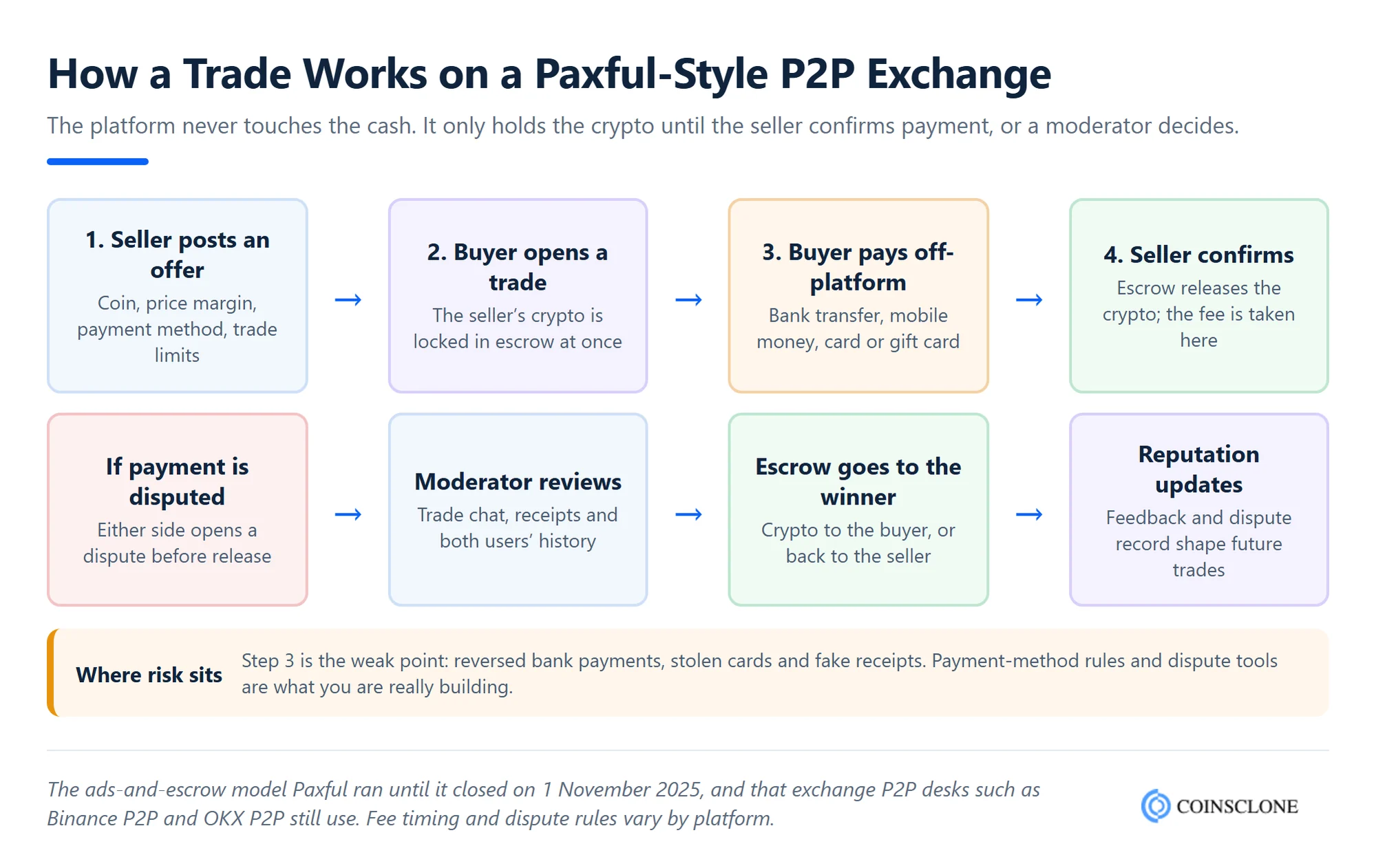
The weak point is the payment step. The platform cannot see a bank transfer or gift card, so fraudsters target it with reversed payments, stolen cards and fake receipts. That is why your payment-method rules, trade limits and dispute tools matter more than any other part of the build.
Paxful MVP vs White Label vs Custom Development
Here is how the three build methods compare. Launch times are Coinsclone’s published P2P timelines.
| Aspects | White Label Paxful Clone | P2P MVP (Customised Script) | Custom Development |
| Purpose | Enter one market fast | Prove the idea with your own core features | Build a fully custom, long-term exchange |
| Time Frame | 4 to 8 weeks | 8 to 12 weeks | 12 to 16 weeks |
| Estimated Cost | Lowest | Low to medium | High |
| Feature Scope | Standard P2P trading, escrow, disputes | Core P2P flow shaped around your market | Advanced, enterprise-grade features |
| Customization | Brand, coins, fees, payment methods | Moderate | Full control over features |
| Security Architecture | Tested standard security layer | Standard security layer | Custom security and risk engine |
Still not sure which path fits you? This decision tree helps you choose in three questions.
Features To Integrate Into A Paxful-Like Crypto Exchange
A peer-to-peer crypto exchange needs smooth, easy features to keep users engaged. At the same time, cutting complex extras keeps the build cost and timeline down. Here are the core features of the crypto exchange to build into your platform.
User Features
- KYC/AML verification: checks each user’s identity to stop fraud, scams and money laundering.
- P2P buy and sell offers: users can post or accept buy and sell offers that match their needs.
- Advanced trade filters: users filter offers by coin, price, payment method, country and trader rating.
- Multi-payment method support: trades can settle by bank transfer, UPI, mobile money, card and other local methods.
- Secure escrow wallet system: locks the seller’s crypto for the length of each trade to protect both sides.
- Trade chat system: lets buyers and sellers talk in real time and share payment proof.
- Real-time notifications: alerts users about trade steps, price moves and platform news.
- Transaction history: gives a clear record of completed, pending and canceled trades.
- Helpdesk: connects users with support to resolve questions and trade issues quickly.
Vendor/Merchant Features
- Vendor feedback: shows each vendor’s ratings and reviews to build trust.
- Trade caps: lets vendors set minimum and maximum trade limits for risk control.
- Vendor pricing margins: lets vendors set their own margin above or below the market price on each offer.
- Paid visibility for vendors: boosts a vendor’s offers through sponsored placements.
- Featured listings: highlights selected offers to attract more buyers.
- Vendor badges and verification: shows verified status and track records to lift a vendor’s reputation.
Admin Dashboard
- User management: lets admins monitor, verify and manage user accounts.
- Revenue analytics: shows the platform’s earnings, commissions and trade volume.
- Fee configuration: sets trade, escrow and service fees on the fly.
- Payment method control: manages which payment options are open in each region and for which users.
- Escrow release control: lets admins hold or release funds during disputes.
- Suspicious behavior alerts: flags odd trading patterns and likely fraud.
- Dispute resolution: supports clear workflows for handling trade conflicts.
- Compliance reports: keeps audit logs and creates the suspicious activity reports regulators ask for.
These are the core features of a crypto exchange like Paxful. The overall cost to create a crypto exchange depends on how many of them you build first, and on the licences you need. Let’s look at those licences next.
Licences and Compliance for a Paxful-Like Exchange
Older guides, including an earlier version of this one, said P2P exchanges face lighter rules. That is no longer true. Any platform that holds crypto in escrow for users is usually treated as a virtual asset service provider. Here are the main rules as of October 2026:
- United States: a P2P platform that serves US users must register as a money services business with FinCEN, hold state money transmitter licences where needed and run a full AML program. Paxful’s guilty plea was over exactly these points.
- European Union: under MiCA, a platform that holds escrow or swaps crypto for money needs a crypto-asset service provider (CASP) licence. The grace period for older firms ended on 1 July 2026. Our guide to a MiCA-compliant crypto exchange covers the steps.
- United Kingdom: crypto firms must register with the FCA under the money laundering rules before they serve UK users.
- India: platforms that serve Indian users, including P2P desks, must register with FIU-IND, and a 1% TDS applies to crypto transfers.
- Everywhere: the FATF Travel Rule asks platforms to share sender and receiver details on larger transfers, so plan for it from day one.
The lesson from Paxful is simple: build KYC, trade monitoring and record keeping into the first release. Adding them later costs far more, and it is the cost Paxful named when it closed.
How Long Does It Take To Create A Crypto Exchange Like Paxful?
The time to build a Paxful-like crypto exchange depends on your build method, features and number of markets. With Coinsclone, a P2P exchange takes 4 to 16 weeks to build, plus the time your licences take. Here are the details.
White Label Paxful Clone Timeline
A white label Paxful clone is a ready-made framework that you rebrand and adjust to your business. So you can launch in about 4 to 8 weeks. The software already includes the P2P trade engine, escrow system and admin and moderator tools.
Paxful MVP Development
An MVP on a customised P2P script takes about 8 to 12 weeks. It covers the core P2P features shaped around your market, such as your own payment methods and reputation tiers. Because it starts small, it keeps the upfront spend low.
Custom Paxful-like Exchange Development
A custom P2P exchange offers full control, but it takes the longest. It usually takes about 12 to 16 weeks for a multi-market platform with its own risk engine. This approach suits funded teams and large startups.
Keep in mind that native mobile apps, extra payment rails and licensing can add time to any of these paths.
How Much Does It Cost to Create a Crypto Exchange Like Paxful?
The cost to create a crypto exchange like Paxful depends on the build method, features, payment methods, licences and number of countries. Published 2026 agency cost guides give these market ranges:
| Build Type | Typical Market Range (2026) | What You Get |
| Basic P2P platform or MVP | About $25,000 to $40,000 | Offers, escrow, chat, KYC, basic admin |
| Custom P2P exchange | About $50,000 to $120,000 | Own design, risk engine, several markets |
| Yearly upkeep | About 15% to 25% of the build cost | Updates, hosting, security, support |
A white label Paxful clone usually costs less than any of these, because the core software is already built and tested. On top of the software, budget for:
- Licences and legal advice: often the largest cost, and it varies by country.
- KYC and AML tools: usually charged per check or per month.
- Security audits: for the escrow wallet and platform before launch.
- Marketing and early liquidity: to bring the first vendors and buyers onto the platform.
Detailed Paxful-Like Crypto Exchange Development Process
Building a Paxful-like P2P crypto exchange works best as a phased process. A clear plan for each phase keeps the platform running smoothly once it launches.
Step 1: Platform Planning
The process begins with planning, where business goals meet technical choices. In this phase, you define the exchange’s core purpose, target market and operating model.
Key activities in this phase include:
- Setting the business goals and vision
- Checking compliance and licence needs in each target market
- Choosing the tech stack and architecture
Step 2: MVP Metric Validation
Before the full build, the MVP of the Paxful-like crypto exchange tests your core ideas with real user data. These measurable results tell you what to build next.
The MVP metrics include:
- User onboarding rate
- Trade success ratio
- User retention and dispute resolution speed
Checking these metrics helps you refine the features, customizations and workflows of the full platform.
Step 3: UI/UX Designing
Next, designers create the layout of the Paxful-like exchange. In this phase, they design the user, vendor and admin dashboards to be clear and easy to use. This phase includes:
- User dashboard design with your themes, logo and features
- Clear escrow status signs and a trade progress view
- Mobile-friendly dashboards
Good UI/UX design wins users’ attention and makes trading easier. A clear dashboard lays the base for long-term engagement.
Step 4: Feature Integration
Once the design is done, developers build the core features into the dashboards. This stage focuses on strong security, automation and smooth daily running. The core feature layer of a P2P crypto exchange like Paxful includes:
- Secure escrow wallet system
- P2P trade engine with live price feeds
- Multi-payment method support
- KYC, AML screening and trade monitoring
- Admin and moderator dashboards
Each feature is tested as it is added, to make sure the platform performs well, stays secure and works across devices.
Step 5: Load Testing Process
With the platform built, the next step is testing. Load testing checks how the platform handles high traffic and peak trade volume. The testing also covers:
- Many trades and escrow locks running at once
- Payment gateway response times
- Fraud scenarios such as fake receipts and payment reversals
- Database and API stress tests
- Bug finding and fixing
Step 6: Launch the Platform Region-Wise
Once testing is complete, the P2P crypto exchange is ready to launch. Launching in one region at a time lowers your risk and makes compliance easier. Instead of going global on day one, a regional launch helps you earn user trust step by step. The benefits include:
- Easier compliance with local rules
- Gradual onboarding of payment methods
- Controlled user growth and support load
This phase lets the exchange settle its operations and learn from each region.
Step 7: Ongoing Support & Growth Partnership
After launch, the platform needs steady monitoring and updates. Its success depends on support, tuning and new features over time, based on user behaviour, rule changes and market trends. Ongoing support includes:
- Regular security updates and audits
- Feature upgrades and UI improvements
- New coins and payment methods
- Technical support for fixing bugs
A long-term growth partner keeps the platform competitive. By following these steps, startups can build a secure and future-ready P2P trading platform.
Common Challenges When Building a P2P Exchange Like Paxful
Every P2P exchange faces the same few problems. Planning for them early is what separates a lasting platform from a short-lived one.
- Payment fraud: reversed bank transfers, stolen cards and fake receipts hit sellers first. Set risk levels for each payment method, hold times for new users and trade limits that rise with reputation.
- The empty marketplace: buyers come where sellers are, and sellers come where buyers are. Recruit a group of trusted vendors before launch, and consider lower fees for early vendors.
- Dispute load: every dispute needs a human decision. Clear evidence rules in the trade chat and trained moderators keep users happy and costs under control.
- Compliance drift: rules change often. Keep your KYC levels, sanctions screening and reports easy to update, so a new rule does not mean a rebuild.
- Custody risk: escrow wallets hold users’ coins. Use cold storage for most funds and multi-signature or MPC controls for releases.
Revenue Opportunities Of Creating A Crypto Exchange Like Paxful
A Paxful-like crypto exchange has several revenue streams. Paxful’s own numbers show how the main one works: between 2017 and 2019 it earned about $29.7 million on nearly $3 billion of trades, which is about 1% of trade volume, or roughly $1.11 on an average trade of about $112. Here are the common revenue streams of a Paxful-like exchange:
- Trading commissions: a fee on every completed P2P trade, usually charged when the escrow releases.
- Vendor subscription plans: vendors pay a monthly fee for advanced tools, higher limits or lower fees.
- Paid trade visibility: vendors pay to place their offers at the top of search results.
- Fiat on/off-ramp commissions: commissions from built-in fiat-to-crypto and crypto-to-fiat services.
- Withdrawal and conversion fees: small fees on wallet withdrawals and swaps between coins.
- Referral and affiliate programs: partners earn a share of fees for the users they bring, which grows your user base at low cost.
Volume is what makes the model work. At around a dollar per trade, profit depends on many trades and low fraud losses. To start this kind of platform, working with an experienced team saves time and costly mistakes, and Coinsclone is a strong option in the market.
Why Choose Coinsclone To Develop A P2P Crypto Exchange Like Paxful?
Coinsclone is a leading cryptocurrency exchange development company that builds P2P exchanges from plan to launch. Building since 2018, our team has delivered 350+ platforms for 200+ clients across 20 industries. We guide you based on your business vision and goals.
Coinsclone builds Paxful-style P2P exchanges with escrow, dispute tools, KYC/AML and local payment rails built in. A white label P2P platform launches in 4 to 8 weeks, a standard build takes 8 to 12 weeks, and a fully custom build takes 12 to 16 weeks. Along with the ready-made software, we offer long-term monitoring and updates to keep the platform easy to use.
Contact our business team to get your own P2P crypto exchange and kickstart your business!
Launch A P2P Crypto Exchange Like Paxful Using MVP — Faster!
P2P Exchange Development, simplified for founders.
- Ready-Made P2P MVP : Launch your Paxful-like platform up to 90% faster.
- Built-in Escrow System : Secure trades with auto-release & dispute handling.
- Admin-First Control Panel : Manage users, ads, fees & disputes with ease.
- Revenue from Day One :Earn via trade commissions, ads & premium listings.
Get a free branded P2P exchange demo in just 48 hours — before you invest anything.
Book a Free Demo and see how our Paxful clone Script helps you go from idea to live marketplace in 8-12 weeks.
Frequently Asked Questions
Is Paxful still working?
No. Paxful wound down all operations by 1 November 2025. It said the misconduct of its former co-founders and the high cost of fixing its compliance made the business too costly to run. In February 2026, a US court sentenced the company to a $4 million criminal penalty.
Why did Paxful shut down?
Paxful pointed to the lasting impact of misconduct by its former co-founders before 2023 and the cost of fixing its compliance. It said the closure was not caused by a lack of money. The company had also pleaded guilty in the US to running an unlicensed money business and failing to keep a proper AML program.
What replaced Paxful?
No single platform replaced it. Many users moved to the P2P desks of large exchanges such as Binance P2P, OKX P2P and Bybit P2P, while others moved to NoOnes, which a Paxful co-founder started. Local markets still have room for trusted new P2P platforms.
How much does it cost to build a P2P crypto exchange like Paxful?
Published 2026 agency cost guides put a basic P2P platform at about $25,000 to $40,000 and a custom P2P exchange at about $50,000 to $120,000. A white label Paxful clone usually costs less. Licences, KYC tools, audits and marketing are extra.
How long does it take to create a crypto exchange like Paxful?
With Coinsclone, a white label P2P exchange takes 4 to 8 weeks, a standard MVP build 8 to 12 weeks and a fully custom build 12 to 16 weeks. Mobile apps, extra payment rails and licensing can add time.
How do P2P crypto exchanges make money?
Mainly from a fee on each completed trade. Paxful earned about 1% of its trade volume between 2017 and 2019. Other revenue streams include vendor plans, paid listings, withdrawal fees, fiat on-ramp commissions and referral programs.
Do I need a licence to run a P2P crypto exchange?
In most markets, yes. A platform that holds crypto in escrow usually counts as a virtual asset service provider. That means FinCEN registration in the US, a MiCA CASP licence in the EU, FCA registration in the UK and FIU-IND registration in India, along with KYC and AML checks.