
Binance opened in July 2017, and nine years later it is still the exchange every new platform gets measured against. If you want to know how to create a crypto exchange like Binance, the good news is that you do not need Binance’s budget to copy what makes it work. You need the right build route, the right features, a licence and a plan for liquidity.
This guide walks you through each of those steps in plain terms. You will see how Binance stays on top in 2026, how custom builds compare with a white label Binance clone, what an MVP should include, which features matter, and what the whole project costs and how long it takes.
In this guide:
- A 7-step plan to build a Binance-style exchange, from market choice to launch
- Custom build vs white label Binance clone vs MVP, with real 2026 costs and timelines
- The user, admin and security features you need on day one
- The licences and liquidity you must sort out before the first deposit
- How an exchange like Binance makes money, with worked numbers
Create a Crypto Exchange Like Binance — Faster Than Ever!
Build a powerful, scalable crypto exchange without starting from scratch.
- Launch Fast with MVP : Go live in weeks with a ready-to-scale Binance-style platform
- Core Trading Engine: Spot, liquidity, wallets & order matching built-in
- Your Brand, Your Rules : Custom UI, coins, pairs & market settings
- Monetize Smart : Trading fees, token listings, staking & more
See your own Binance-like exchange in action — free demo in 48 hours.
Book a Free Demo and learn how to create a crypto exchange like Binance in just 8-12 weeks.
How to Create a Crypto Exchange Like Binance
To create a crypto exchange like Binance, you pick a market, get the right licence, choose how to build (custom or white label), launch a small MVP with core trading features, connect liquidity, test security, and then grow step by step. Here is the short version of the plan.
- Pick your market and model: Decide who you serve, which country you start in, and whether you run a centralized exchange (CEX) like Binance or a mix of CEX and P2P.
- Check the licence you need: Rules differ by country. In most places you need a licence before you take customer funds.
- Choose a build route: Build from scratch for full control, or start from a Binance clone script to launch in weeks.
- Plan an MVP: Start with spot trading, wallets, KYC and an admin panel. Add futures, staking and a launchpad later.
- Connect liquidity: Link to market makers or other exchanges so your order books are full from day one.
- Secure and test: Use cold storage, 2FA and multi-signature wallets, then run load tests and a security audit.
- Launch and grow: Go live with a small coin list, track how people trade, and add products as volume grows.
The rest of this guide explains each step in detail. But first, it helps to see what you are copying.
Why Binance Is Still the Benchmark in 2026
Binance grew from a basic trading site into a full crypto ecosystem used by millions of people. As of October 2026, it is still the world’s largest crypto exchange by trading volume, and the numbers show why so many founders want to copy its model.
- Users: Binance reported more than 320 million registered users at its ninth anniversary in July 2026, according to its company release.
- Volume: It handled about $13.8 billion in 24-hour spot volume on CoinGecko on 9 October 2026.
- Market share: In Q2 2026, Binance held 38.7% of all spot trading on the top 10 centralized exchanges, per CoinGecko’s quarterly report.
- Fees: Regular users pay 0.1% maker and 0.1% taker on spot trades, per the Binance fee schedule.
Key factors behind Binance’s success
- Deep liquidity: High volume means fast order fills and fair prices.
- Wide choice: Hundreds of coins and trading pairs appeal to both retail and big traders.
- Strong security: Cold wallets, risk checks and an emergency fund protect user money.
- Easy to use: A clean interface, pro trading tools, mobile apps and many languages.
- One ecosystem: Spot, futures, staking, a launchpad, P2P, payments and a Web3 wallet all sit under one account.
The lesson from Binance’s 2023 settlement
Binance’s growth also came with a hard lesson. In November 2023, Binance pleaded guilty to US federal charges, including weak checks on money laundering and moving money without a licence, and agreed to pay over $4.3 billion. So when you copy Binance, copy its scale and product range, but build compliance in from day one.
While Binance’s success offers useful lessons, you should learn from its strategy rather than copy the platform screen for screen. The real takeaways are its focus on scale, security and the user. With these lessons in mind, the next step is to choose how you will build.
Custom Build vs White Label Binance Clone
Before you build a crypto exchange like Binance, you need to pick a build route. This choice depends on your budget, your launch date and how far you plan to grow. There are two main routes:
- Custom crypto exchange development from scratch
- A white label Binance clone
Custom Crypto Exchange Development From Scratch
Building from scratch means your team designs and codes every part of the exchange to fit your business. That covers the trading engine, wallets, admin tools and all the security layers.
Advantages of Custom Crypto Exchange Development
- Full ownership and control: You decide everything, from the core design to the features you add later.
- No limits: You can build any feature your business needs, without working around someone else’s code.
- Deep customisation: You can shape the platform around your exact workflows and markets.
- Room to grow: You can add new tech and new markets as your business expands.
Limitations of Custom Crypto Exchange Development
- Higher cost: A custom build costs far more than white label software.
- Slower launch: Design, coding and testing take many months.
- Harder to build: You need an in-house team or outside experts with exchange experience.
- Ongoing upkeep: You handle every security patch, test and update yourself, which adds to running costs.
White Label Binance Clone
A white label Binance clone is ready-made exchange software that follows the core features of Binance. It comes with a trading engine, wallets, an admin panel and built-in security. You add your brand, coins and fees, so you can launch quickly without building from the ground up.
Advantages of a White Label Binance Clone
- Faster launch: The software is already built and tested, so you can go live in weeks.
- Lower cost: It costs much less than a custom build, which suits startups.
- Less tech risk: Tested code means fewer bugs and more stable performance.
- Simple setup: A ready framework makes deployment smoother.
Drawbacks of a White Label Binance Clone
- Less room to stand out: If you never change the base, your exchange can look like many others.
- Vendor ties: Upgrades and big changes often depend on the provider.
- Growth limits: Some scripts struggle at high volume if the core design is weak, so check load test results before you buy.
Whichever route you choose, a secure and scalable exchange needs both tech skill and industry know-how. A good crypto exchange development company helps you meet the rules and set up strong security from the start.
Coinsclone offers white label and custom exchanges, plus MVP builds. Whichever path you choose, starting with an MVP helps you test your idea and lower your risk. That brings us to the next step.
Creating an MVP for a Binance-Like Crypto Exchange
An MVP (minimum viable product) is a simple version of your exchange with only the features people need to buy, sell and trade crypto. Instead of launching every Binance feature at once, you start with the basics and let real users show you what to build next. This keeps the tech simple and cuts your financial risk.
Why an MVP Comes Before a Full Launch
- Real-world test: It tests your business idea with real traders.
- Lower spend: It needs less money up front.
- Faster launch: You reach the market sooner.
- Less risk: Fewer features mean fewer things can break.
- Early feedback: You learn what users want before you build more.
- Quick changes: You can adjust fast based on what people do.
An MVP shows whether there is real demand for your exchange. You can track which pairs people trade, which features they use and how long they stay. It also tests your revenue streams, such as trading fees, listing fees and premium services.
A good Binance-style MVP usually includes sign up with KYC, a spot order book for 10 to 30 pairs, crypto wallets, deposits and withdrawals, a basic mobile-friendly interface and an admin panel. Futures, copy trading, staking, a launchpad and P2P come later, once you know your users.
Overall, an MVP is a smart first step toward a successful Binance-like exchange. It gives you a strong base to grow from and real data for every decision.
MVP vs Custom Crypto Exchange Development: Which Is Right for You?
An MVP launches a small but working exchange to test your idea. Custom development builds a full platform with advanced features for long-term growth. The two differ a lot in cost, build time, flexibility and risk, so the right choice depends on your goals, your audience, your budget and your growth plan.
MVP vs Custom Crypto Exchange Development Comparison
| Factor | MVP Development | Custom Development |
| Purpose | Tests market demand quickly | Builds a fully custom, scalable platform |
| Build Time | Weeks on white label software; 6 to 9 months if custom | 9 to 14 months for a full build |
| Cost | $15,000 to $60,000 on white label; $100,000 to $200,000 if custom | $250,000 to $500,000 or more |
| Customisation | Core features only | Full control over every part |
| Risk Level | Lower, because you test early | Higher, because you spend before you test |
| Scalability | Scales once demand is proven | Designed for scale from day one |
Cost and time ranges are from published 2026 agency cost guides; white label timelines are Coinsclone’s published weeks.
- MVP development suits startups and first-time founders. You can test your idea and study how users behave while you keep costs low.
- Custom development, on the other hand, suits funded firms with a clear vision, enough capital and a long-term plan for a large exchange.
So many successful platforms start with an MVP and move to custom work once the market is proven. Next, let’s look at the features your exchange needs.
Key Features to Create a Crypto Exchange Like Binance
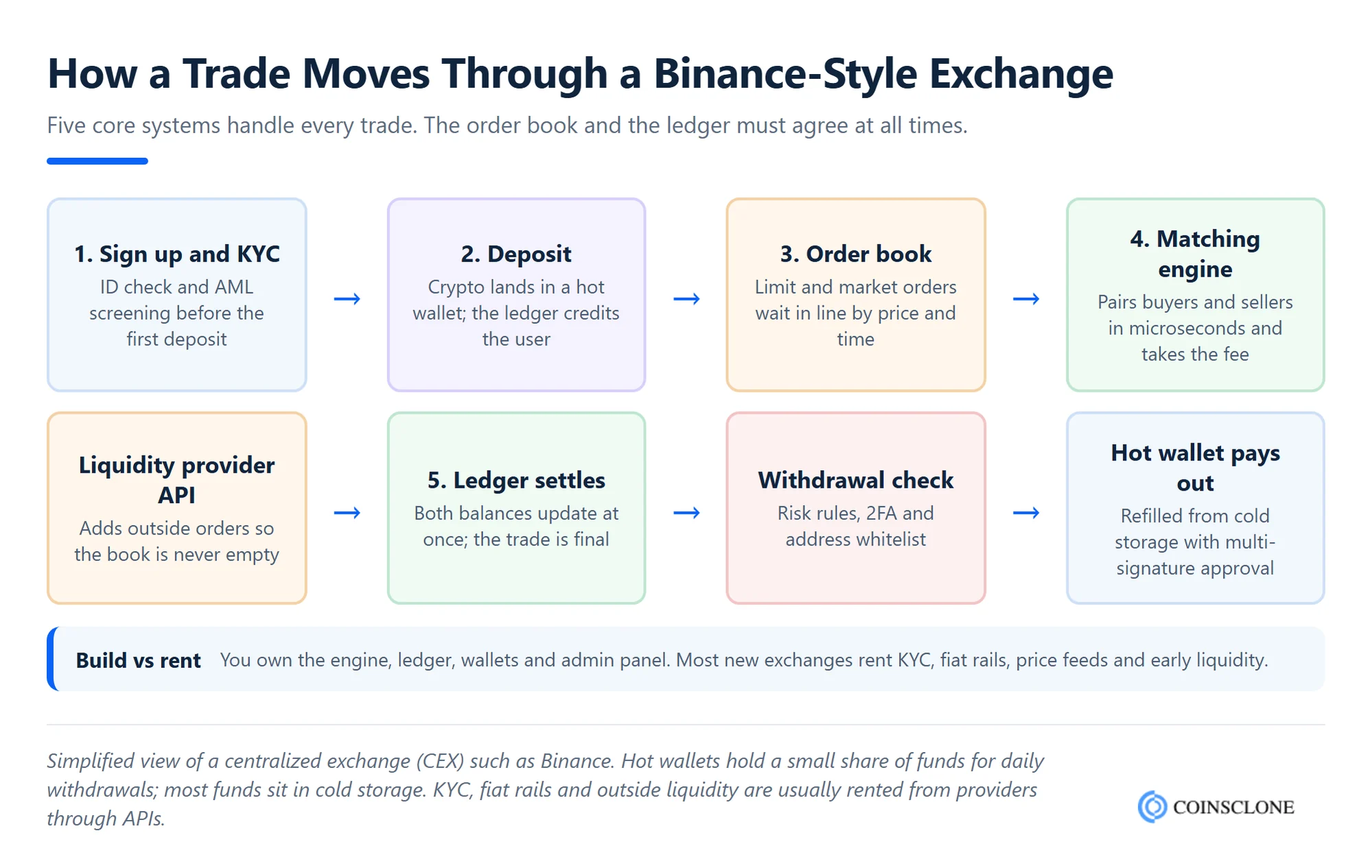
A Binance-like exchange needs more than a trading screen. It needs easy tools for users, strong controls for admins and high-level security. These parts work together to keep trading smooth, meet the rules and support growth. For a deeper list, see our guide to crypto exchange features.
User Features
- Sign up and KYC: Users open a secure account and verify their identity to meet KYC and AML rules.
- Advanced trading screen: Live charts, an order book and many order types help both new and expert traders.
- Multi-currency wallet: Users can deposit, withdraw and store many coins in one place.
- Deep order books: Enough buy and sell orders keep trades smooth and prices fair.
- Mobile trading: Users can trade on the go through a responsive site or mobile trading apps.
- Many languages and currencies: Support for local languages and fiat currencies helps you reach users worldwide.
- Clear fees and trade history: Users see every fee up front and a full record of their trades, which builds trust.
Admin Features
- Admin dashboard: Admins manage user accounts, trades, transactions and platform health in one place.
- User and role control: Admins set access rights, watch user activity and stop fraud.
- Trading pair control: Admins add, change or remove trading pairs as the market shifts.
- Fee settings: Admins set trading fees, withdrawal fees and referral rewards.
- Liquidity panel: Admins watch liquidity providers and the health of each order book.
- Reports and analytics: Live data on trading activity, platform performance and revenue.
- Content and alerts: Admins post news, alerts and messages to users from one place.
Security Features
- Two-factor authentication (2FA): An extra login step with OTP or an authenticator app.
- Cold and hot wallets: Most funds stay offline in cold storage, and only a small share sits online for daily withdrawals.
- DDoS protection: Keeps the platform online during traffic attacks.
- Data encryption: Protects personal data and transaction details.
- Multi-signature wallets: Several people must approve large transfers, so one stolen key is not enough.
- Regular security audits: Outside experts test the platform for weak spots on a set schedule.
- Live fraud detection: The system watches for odd behaviour and raises alerts at once.
Security is the one area you should never cut. In February 2025, hackers took about $1.5 billion from Bybit in a single attack, Chainalysis reports. That is why Binance-style exchanges keep most funds in cold storage and publish proof of reserves.
Licences and Rules You Need Before Launch
Software can be ready in weeks, but licences often take months. So start this step early, and get advice from a lawyer in each market you plan to serve. Here is a short view of the main rules in 2026.
- European Union: Under MiCA, exchanges need a CASP licence. The transition period ended on 1 July 2026, and a trading platform must hold at least 150,000 euros in capital. One licence covers all 27 member states. See how to launch a MiCA-compliant crypto exchange in the EU.
- United States: You register with FinCEN as a money services business, which is free, and then need money transmitter licences state by state. New York runs its own BitLicense, with a $5,000 application fee.
- Dubai: VARA charges AED 100,000 to apply and AED 200,000 a year for a licence.
- Everywhere: KYC, AML checks and the Travel Rule apply before the first deposit.
The key point is simple: plan your licence and your build at the same time, so one does not hold up the other.
How to Get Liquidity for a New Binance-Style Exchange
Liquidity decides whether traders stay. If your order book is thin, prices jump and orders fill slowly, so users go back to Binance. A new exchange has no traders yet, so it has to borrow liquidity at first.
- Liquidity provider APIs: Connect your order books to bigger exchanges or crypto liquidity providers. Setup usually costs about $5,000 to $20,000.
- Market makers: A market maker places buy and sell orders all day to keep spreads tight. This often costs $5,000 to $30,000 a month.
- Fewer, deeper pairs: Launch with a short list of pairs, such as BTC, ETH and major stablecoins, and make each one deep before you add more.
- Fee rewards: Lower or zero maker fees reward users who add orders to the book, as Binance does for its VIP tiers.
Our Binance-Like Crypto Exchange Development Process
A clear process is key to building a secure, scalable and fast exchange that works like Binance. Our approach focuses on your business goals, sound tech and the rules you must meet, so the platform is ready to grow.
Business Goals and Requirements
We start by learning your business model, target market, licence needs and feature list. This step sets the platform design, tech stack and roadmap.
UI/UX Design and Architecture Planning
Our team designs an easy interface and a system that grows with you. Users can find their way around easily, and the platform handles heavy trading without slowing down.
Core Development and Integration
We build the trading engine, wallets and admin dashboard. We also link payment gateways, KYC tools and liquidity partners, and we add security at each stage.
Security and Testing
We add encryption, multi-signature wallets and DDoS protection. Then we test the platform hard, with load tests and security checks, to find weak spots before launch.
Deployment, Launch and Ongoing Support
The platform goes live once testing is complete. After launch, we offer support, upgrades and performance reviews to help you grow over time.
With this step-by-step plan, you can launch a solid Binance-like exchange that grows with you, with less risk.
How Long Does It Take to Build a Crypto Exchange Like Binance?
The time it takes depends on three things: your build route, how complex your features are and how much you customise. Binance took years to grow into what it is today, but you can reach the market much faster by picking the right route.
White Label Binance Clone
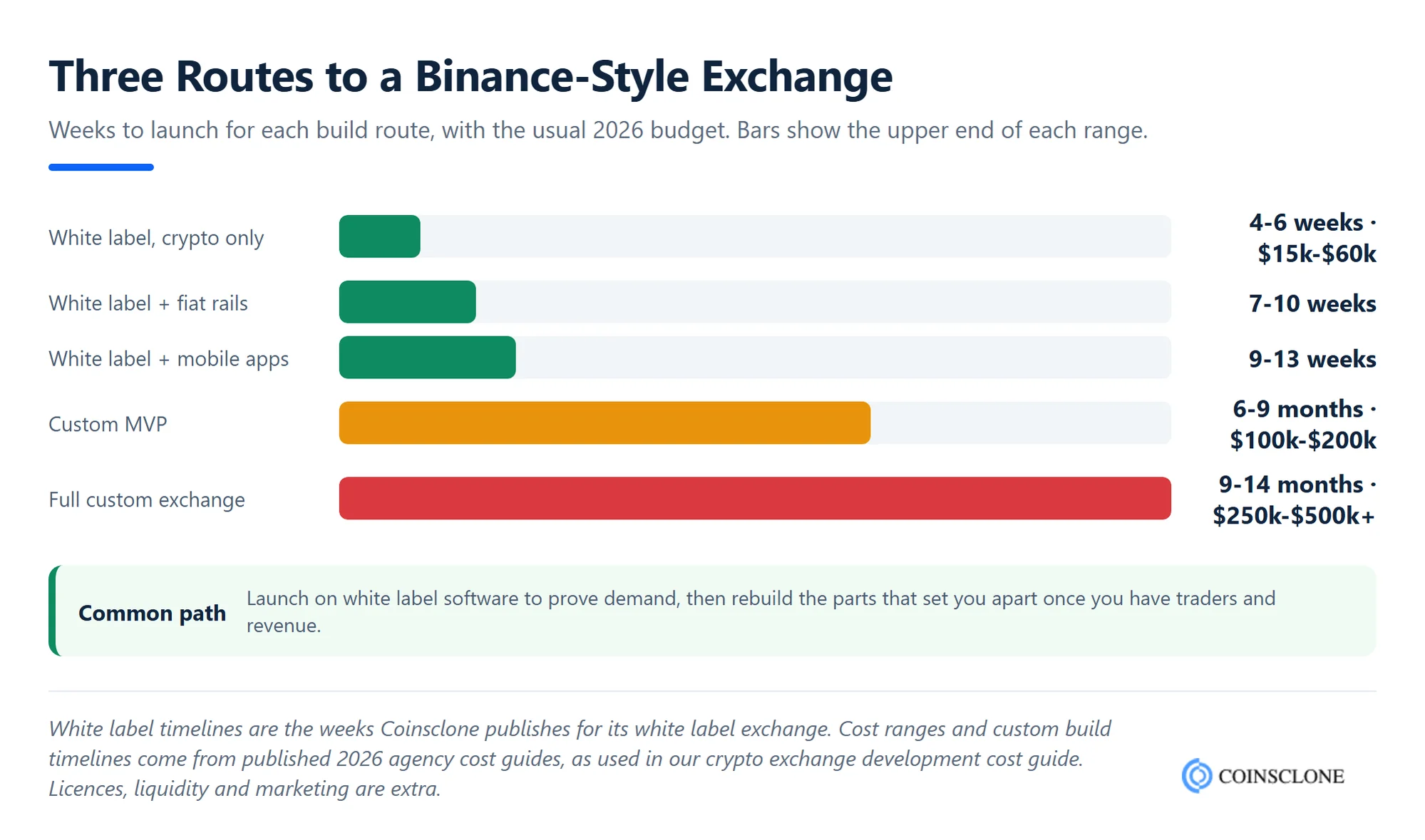
A white label Binance clone from Coinsclone takes 4 to 6 weeks for a crypto-only exchange, 7 to 10 weeks with fiat rails and 9 to 13 weeks with mobile apps. It is fast because the core software is already built and tested.
Custom MVP for a Binance-Like Exchange
A custom MVP built from zero usually takes 6 to 9 months, per published 2026 agency cost guides. It covers the core trading features you need to test demand, but your team writes every part.
Full Custom Crypto Exchange Like Binance
A full custom exchange takes about 9 to 14 months, or longer. The time grows with the number of features, the integrations you need and the depth of your security work.
Keep in mind that licensing can add months to any of these routes, so start it early. Overall, the right partner helps you hit your dates without cutting corners. Coinsclone offers several build models that let you launch fast while keeping security and scale in place.
How Much Does It Cost to Build a Crypto Exchange Like Binance?
In 2026, a Binance-style exchange costs about $15,000 to $60,000 on white label software, $100,000 to $200,000 for a custom MVP and $250,000 to $500,000 or more for a full custom build, based on published 2026 agency cost guides. Large, multi-region platforms can pass $1 million.
The build is only part of the budget, though. Plan for these costs too:
- Licences and legal work: From a few thousand dollars to well over $100,000 in the first year, based on the country.
- Liquidity: About $5,000 to $20,000 to set up, plus market maker fees.
- Security audits: Often $20,000 to $60,000 or more for a full review.
- Servers, KYC checks and support staff: Monthly costs that grow with your user base.
For a full line-by-line breakdown, read our guide to the cost to develop a cryptocurrency exchange.
How Does a Crypto Exchange Like Binance Make Money?
Binance earns from many streams, and your exchange can use the same ones. The main ones are:
- Trading fees: A small cut of each trade. Binance charges regular spot users 0.1% maker and 0.1% taker.
- Listing fees: Projects pay to list their tokens.
- Withdrawal fees: A small fee on each crypto withdrawal.
- Margin and futures: Fees and interest on leveraged trades.
- Staking and earn products: A share of the rewards users earn.
- Launchpad and P2P: Fees from token sales and P2P trades.
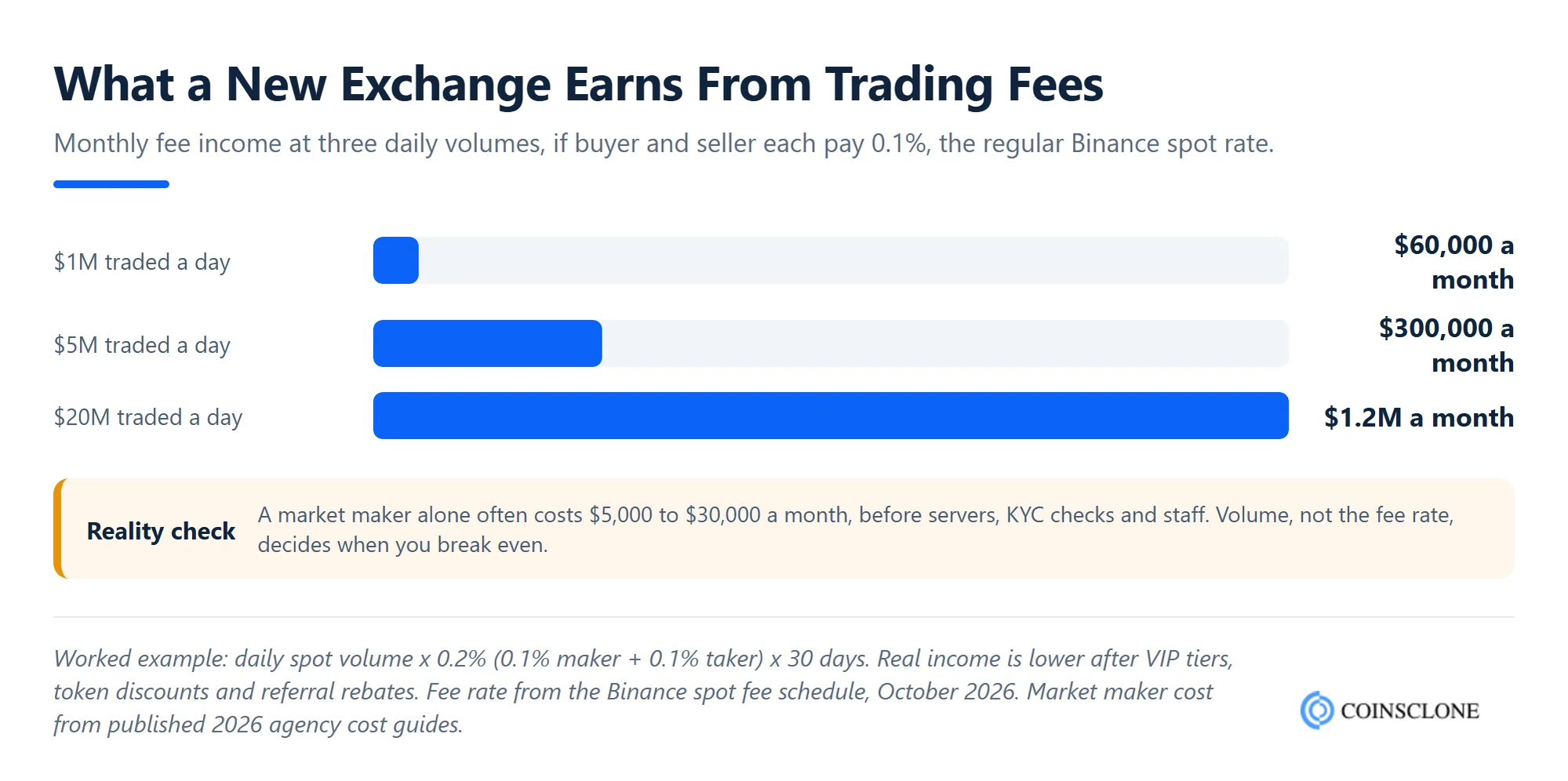
Trading fees grow with volume. At $1 million traded a day and a 0.1% fee on each side, an exchange earns about $60,000 a month before discounts. That is why liquidity and user growth matter more than the fee rate itself. Our guide on how crypto exchanges make money covers each stream in depth.
Why Choose Coinsclone to Create a Crypto Exchange Like Binance?
Coinsclone is a trusted cryptocurrency exchange development company that has been building since 2018. We have delivered 350+ platforms for 200+ clients across 20 industries. Our team builds secure, scalable trading platforms and shapes each one around your business needs.
Our white label and custom exchanges come with strong security, a smooth user experience and advanced trading features. Our support team helps at every step, from build to launch and ongoing upkeep, so you can grow your exchange with confidence. To see the software first, explore our Binance clone script and book a demo.
Frequently Asked Questions
How much does it cost to build a crypto exchange like Binance?
A white label Binance clone usually costs $15,000 to $60,000 in 2026. A custom MVP costs about $100,000 to $200,000, and a full custom exchange costs $250,000 to $500,000 or more, per published 2026 agency cost guides. Licences, liquidity and audits are extra.
How long does it take to develop a Binance-like exchange?
A white label exchange from Coinsclone takes 4 to 6 weeks, 7 to 10 weeks with fiat rails and 9 to 13 weeks with mobile apps. A custom MVP takes about 6 to 9 months, and a full custom build takes 9 to 14 months.
Do I need a licence to run a crypto exchange?
In most markets, yes. The EU needs a MiCA CASP licence, the US needs FinCEN registration plus state money transmitter licences, and Dubai needs a VARA licence. Get legal advice for each country before you take customer funds.
Is it better to build from scratch or use a Binance clone script?
A clone script suits most startups because it is faster, cheaper and already tested. A custom build suits funded firms that need a unique engine or full control of the code. Many teams launch on a clone script and rebuild key parts later.
Can I customise a Binance clone script?
Yes. You can change the brand, design, coins, trading pairs, fees and features. Good providers also let you add modules such as futures, P2P, staking or a launchpad as you grow.
How do crypto exchanges make money?
Exchanges earn mainly from trading fees, plus listing fees, withdrawal fees, margin and futures fees, and staking products. Binance charges regular spot users 0.1% per trade.
Can I build a crypto exchange without coding skills?
Yes, if you work with a development partner. A white label exchange arrives ready to brand and set up, so you focus on licences, liquidity and marketing while the provider handles the code.
Create a Crypto Exchange Like Binance — Faster Than Ever!
Build a powerful, scalable crypto exchange without starting from scratch.
- Launch Fast with MVP : Go live in weeks with a ready-to-scale Binance-style platform
- Core Trading Engine: Spot, liquidity, wallets & order matching built-in
- Your Brand, Your Rules : Custom UI, coins, pairs & market settings
- Monetize Smart : Trading fees, token listings, staking & more
See your own Binance-like exchange in action — free demo in 48 hours.
Book a Free Demo and learn how to create a crypto exchange like Binance in just 8-12 weeks.