
How does Polymarket work? It runs like a stock exchange for yes or no questions. Each share pays $1 if its outcome happens and $0 if it does not, so a price of $0.65 means traders see about a 65% chance. Users trade with each other on an order book. Polymarket matches the orders on its own servers, and the trades settle on the Polygon blockchain in a dollar token called pUSD.
This guide goes one level deeper, using Polymarket’s own documentation as checked on 1 November 2026. It covers how a trade moves from click to blockchain, where the money sits, who decides the winner, where the platform is legal, and what changed in 2026. The last part shows what a team would need to build a platform like it.
In this guide:
- How a share price turns into a probability, with worked numbers
- How the hybrid order book matches off-chain and settles on-chain
- How $1 of collateral becomes one Yes share and one No share
- How UMA’s oracle resolves markets, and what a dispute costs in time
- Which countries are blocked, and the parts you need to copy the design
How Does Polymarket Work? The Short Answer
On Polymarket, users trade with each other. There is no house setting odds. Every market asks one question with a fixed end date and written rules, such as “Will Bitcoin reach $150,000 by December 2026?”
Here is the full cycle in five steps:
- Fund: You deposit crypto from a supported chain. It lands in your Polymarket wallet as pUSD, a token backed by USDC.
- Trade: You buy Yes or No shares at a price between $0 and $1. Another user is on the other side.
- Match: Polymarket’s order book engine pairs your signed order with a matching one.
- Settle: A smart contract on Polygon moves the pUSD and shares between the two wallets.
- Resolve: When the event ends, an oracle reports the result. Each winning share pays $1 and each losing share pays $0.
You can also sell at any time before the market resolves. That is how traders lock in a gain or cut a loss without waiting for the result.
How Are Polymarket Prices Set?
Prices come from traders, not from Polymarket. The price of a Yes share is the crowd’s estimate of the chance that the event happens. The Yes and No prices on a binary market add up to about $1, because one Yes and one No together always pay exactly $1.
| Yes price | Implied chance | Profit per share if Yes wins | Loss per share if No wins |
| $0.25 | 25% | $0.75 | $0.25 |
| $0.40 | 40% | $0.60 | $0.40 |
| $0.65 | 65% | $0.35 | $0.65 |
| $0.90 | 90% | $0.10 | $0.90 |
Take the $0.40 row. You buy 100 Yes shares for $40. If Yes wins, they pay $100, so you make $60, a 150% return. If No wins, you lose the $40. You can never lose more than you paid.
The price you see on the site is not always the price you get. Per Polymarket’s pricing docs, the displayed number is the midpoint between the best bid and the best ask. If the best bid is $0.34 and the best ask is $0.40, the page shows $0.37. A buyer pays $0.40 and a seller gets $0.34. When the gap is wider than $0.10, the page shows the last trade price instead.
Why does the price move?
The price moves when someone trades at a new level. News, polls, injuries and data releases change what people believe, and they buy or sell until the price reflects the new view. There is no trade size limit, but a large order in a thin market will push the price a long way.
How Does the Polymarket Order Book Work?
Polymarket uses a central limit order book, or CLOB, the same tool stock exchanges use. Its design is hybrid. Matching happens off-chain on Polymarket’s servers, which keeps it fast. Settlement happens on-chain through smart contracts, which keeps custody with the user.
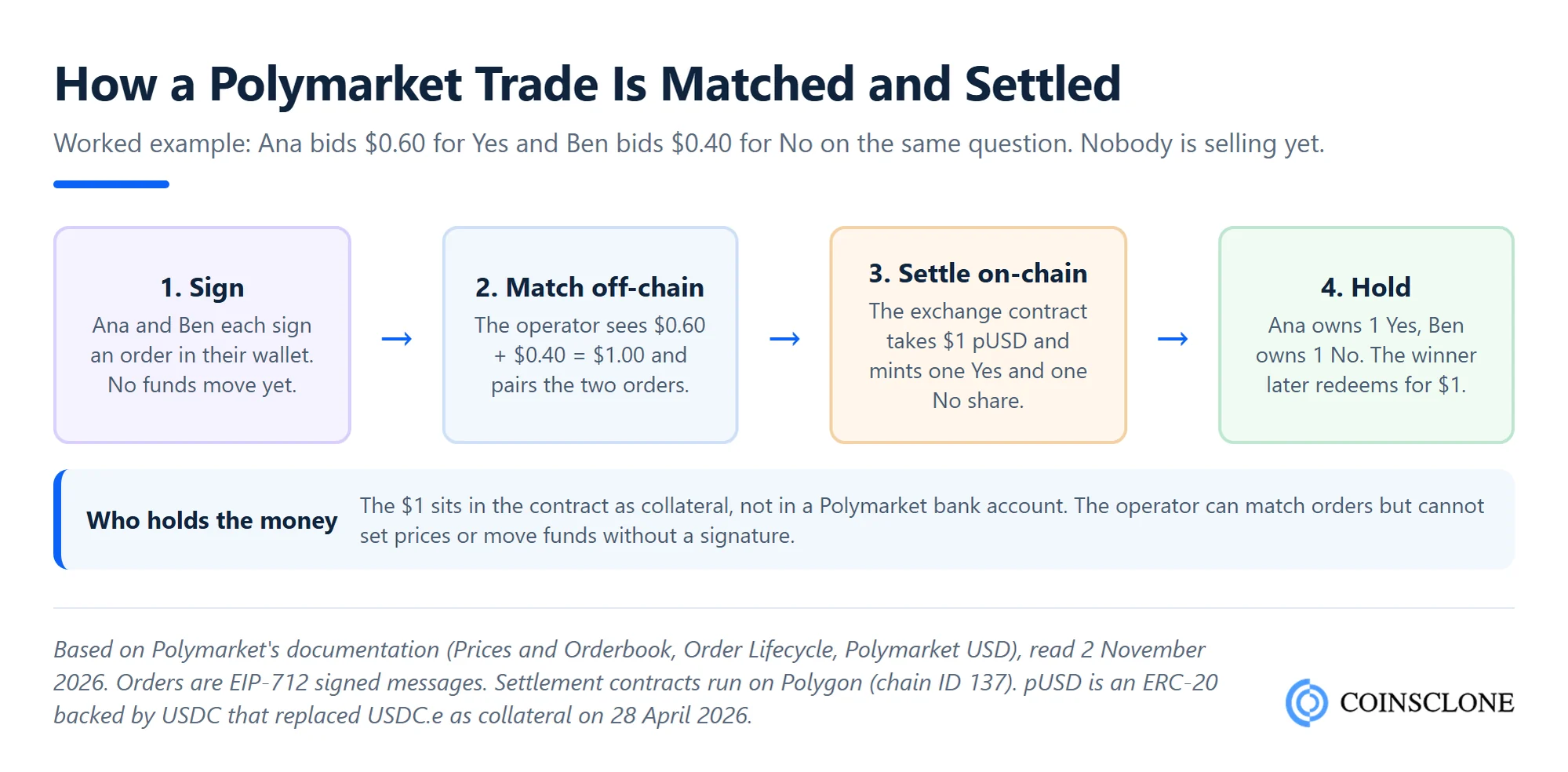
Every order is a message you sign with your wallet using the EIP-712 standard. The signature lets the exchange contract carry out that trade for you without taking custody of your funds. Polymarket’s trading overview is clear on the limits. The operator can match orders and decide their order in the queue. It cannot set prices or run trades that users did not sign.
What happens to an order step by step?
The order lifecycle docs set out five stages:
- Create and sign: Your app builds the order (outcome, side, price, size, expiry) and you sign it.
- Submit: The order goes to the CLOB. It checks the signature, your balance, your approvals and the price tick size.
- Match or rest: If your price crosses the best opposite price, it fills now. If not, it waits in the book.
- Settle: The operator sends the matched trade to the exchange contract, which settles it in one atomic step. Either the whole trade goes through or none of it does.
- Confirm: The trade reaches finality on Polygon and your balance updates.
Some markets add a short wait before a taker order can match. Selected crypto Up or Down markets use a taker delay, and some live sports markets use a game delay. During the wait the order cannot be cancelled, and it is checked again before it fills.
Which order types can you use?
All Polymarket orders are limit orders. A “market order” is just a limit order priced to fill at once.
| Order type | What it does | Typical use |
| GTC (Good Till Cancelled) | Rests in the book until filled or cancelled | Normal limit orders |
| GTD (Good Till Date) | Expires at a time you set | Time-limited quotes |
| FOK (Fill or Kill) | Fills in full right away or cancels | All-or-nothing entries |
| FAK (Fill and Kill) | Fills what it can, cancels the rest | Market orders that accept partial fills |
| Post-only | Rejected if it would match at once | Market makers who want maker status |
If your buy order at $0.55 meets a resting sell at $0.52, you pay $0.52. Price improvement always goes to the taker. Fees are worked out at the moment of the match, not set on the order. For the fee rates and how the company earns, see our breakdown of how Polymarket makes money.
Where Does the Money Go? Shares, pUSD and Collateral
Every Yes and No share is fully backed. That is the core rule of the whole system: $1 of collateral creates exactly one Yes share and one No share, and the pair can always be turned back into $1.
The collateral is pUSD (Polymarket USD). It replaced USDC.e on 28 April 2026 as part of the CLOB V2 upgrade. Per the pUSD docs, it is a standard ERC-20 token on Polygon, backed by USDC, and the backing is enforced by smart contracts. Users rarely see it. They deposit, see a dollar balance, trade and withdraw.
Shares are ERC-1155 tokens, a standard that lets one contract hold many token types. Three actions move value between pUSD and shares:
- Split: 100 pUSD becomes 100 Yes plus 100 No. Market makers do this to create stock to sell.
- Merge: 100 Yes plus 100 No becomes 100 pUSD again. This is a way to exit without trading.
- Redeem: After the result, each winning share is swapped for $1 of pUSD. Losing shares are worth $0.
How does a new market get its first price?
A brand new market has no price and no shares. The first trade creates them. Say Ana bids $0.60 for Yes and Ben bids $0.40 for No. Together they offer $1.00, so the engine matches them. The contract takes the $1, splits it into one Yes and one No, and sends each share to its buyer. Every share in the market starts life this way.
As of 1 November 2026, Polymarket also paid a 4% yearly reward on shares held in eligible markets. The rate can change at any time.
What are multi-outcome markets?
Questions like “Who will win the election?” have many answers but only one winner. Polymarket builds these as a group of linked Yes or No markets, one per candidate, called a negative risk market.
The link is a conversion rule. Per the negative risk docs, one No share on any candidate can be turned into one Yes share on every other one. Betting against one outcome is the same as betting on all the others, so traders tie up less capital. When a new candidate appears after launch, placeholder outcomes and an “Other” option catch them.
Can you parlay on Polymarket?
Yes, through Combos. A Combo joins several outcomes into one new Yes or No pair. For example, “Team A wins and Team B wins and Market C resolves No.” The Combo Yes pays only if every leg wins. The Combo No pays if any leg fails. The Combo docs say market makers quote prices through a request for quote (RFQ) flow. Combos run on the newer Protocol V2 contracts.
Who Creates Polymarket Markets?
Polymarket’s own markets team creates every market. Users cannot list their own, but they can suggest ideas, says Polymarket’s help centre (updated 19 April 2026). The main route is a post on X that tags @polymarket, with a title, a source for the result and proof of demand.
Several older guides still say anyone can create a market with their own liquidity. That is not how the platform works today.
Each market has written rules with three parts:
- Resolution source: Where the answer will come from, such as an official result or a named website.
- End date: When the market can be resolved.
- Edge cases: What happens if the event is delayed, cancelled or unclear.
The title asks the question, but the rules decide the payout. If something unexpected happens after trading starts, Polymarket can add a note with more context on-chain. It cannot change the core intent of the question.
How Are Polymarket Markets Resolved?
Event markets resolve through UMA’s Optimistic Oracle. “Optimistic” means the system assumes a proposed answer is right unless someone pays to challenge it. Price markets, such as “Will BTC go up in this hour?”, skip that process and resolve from a Chainlink time-weighted average price (TWAP) feed.
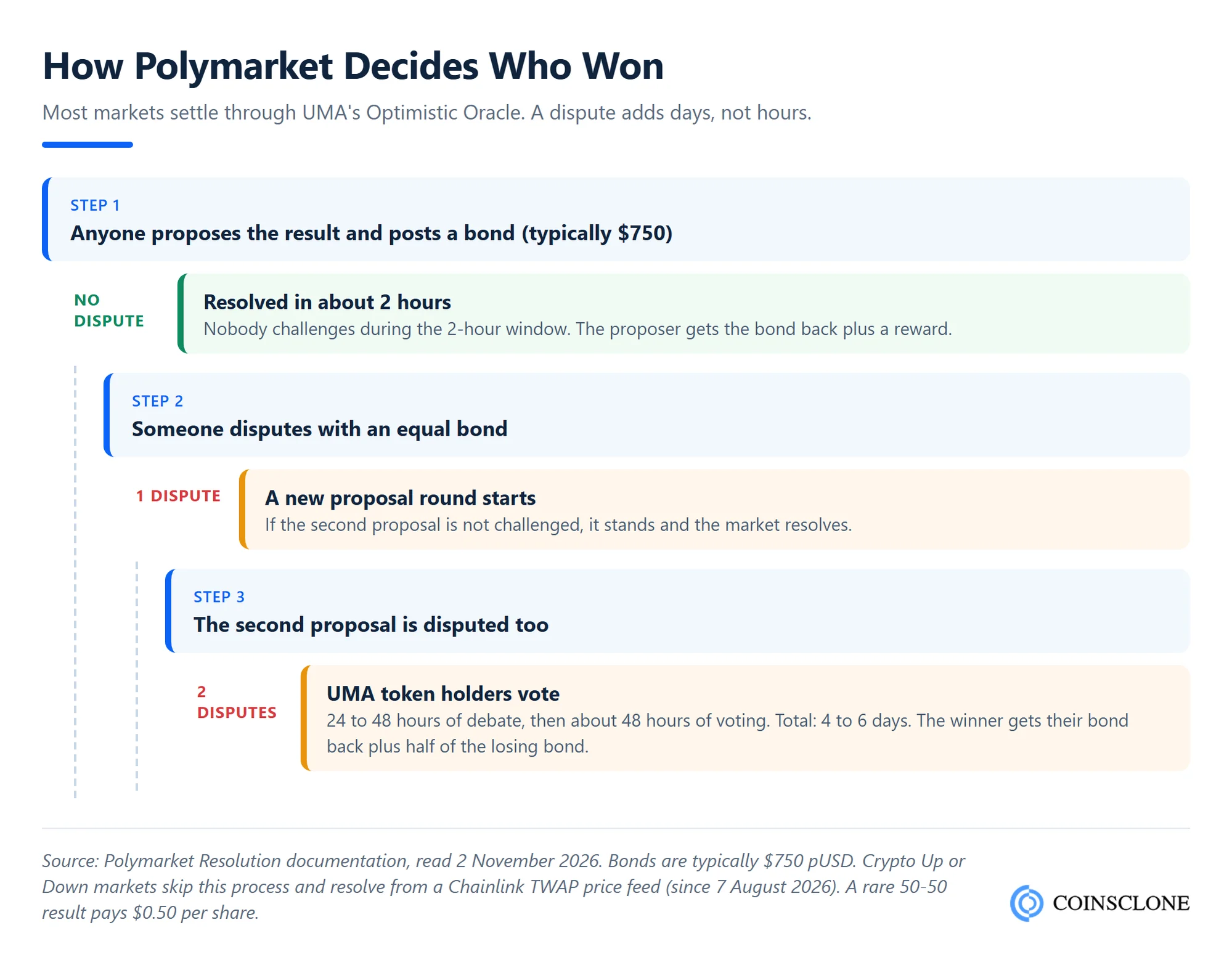
Here is how the UMA path works, per Polymarket’s resolution docs:
- Propose: After the end date, anyone can propose the winning outcome. They post a bond, typically $750 in pUSD.
- Challenge window: For 2 hours, anyone can dispute by posting the same bond.
- No dispute: The proposal stands. The market resolves about 2 hours after the proposal and the proposer gets the bond back plus a reward.
- First dispute: A fresh proposal round starts. If the new proposal goes unchallenged, it stands.
- Second dispute: The question goes to UMA’s Data Verification Mechanism (DVM), where UMA token holders vote.
What happens if a result is disputed?
A disputed market takes much longer. There is a 24 to 48 hour debate period, when evidence is posted in UMA’s Discord, then about 48 hours of voting. In total, a disputed market takes 4 to 6 days. The winner of the vote gets their bond back plus half of the losing side’s bond.
| Path | What happens | Time to resolve |
| No dispute | Proposal accepted | About 2 hours |
| One dispute | Second proposal accepted | Two challenge windows, plus time for a new proposal |
| Two disputes | UMA token holder vote | 4 to 6 days |
| Event not over | Vote returns “too early” | A new proposal is needed later |
| No clear answer | Vote returns 50-50 | Each share pays $0.50 |
Because the final say rests with UMA token holders, the written rules carry a lot of weight. For traders, the lesson is simple: read the rules and the resolution source before you buy.
How do crypto Up or Down markets resolve?
Since 7 August 2026, crypto Up or Down markets resolve from Chainlink TWAP prices. The average price at the start sets the “price to beat.” The average at the end sets the final price. If the final price is equal to or higher, Up wins. Because the inputs are fixed, there is no proposal or dispute step.
What Changed at Polymarket in 2026?
Polymarket rebuilt most of its stack this year. Older guides that mention USDC.e, an AMM or user-created markets are out of date.
| Date | Change | What it means for users |
| 28 April 2026 | CLOB V2 went live: new exchange contracts and a rewritten matching engine | Old open orders were wiped; pUSD replaced USDC.e as collateral |
| 7 August 2026 | Chainlink TWAP resolution for crypto Up or Down markets | Faster, rule-based payouts on price markets |
| 5 to 30 October 2026 | Protocol V2 tested on a small set of live markets | No action needed for app users |
| From 2 November 2026 (announced date) | Polymarket said new markets would be created on Protocol V2 | New position contracts; old positions stay on Gnosis Conditional Tokens |
Protocol V2 replaces the Gnosis Conditional Tokens system that Polymarket had used for years. As crypto.news reported on 6 October 2026, one PositionManager contract now holds all positions. Each market type gets its own module: binary, multi-outcome and combo. A new OracleAggregator lets UMA, Chainlink and other sources plug in. Polymarket’s contracts page lists audits of the new contracts by six security firms between March and August 2026.
Where Is Polymarket Legal?
It depends on where you live, and the list keeps growing. Polymarket checks each user’s IP address. Its list of blocked places sorts them into three groups, as of 1 November 2026:
- Fully blocked: OFAC-sanctioned places (Iran, Syria, Cuba, North Korea, and the Crimea, Donetsk and Luhansk regions). No new trades and no closing of old ones.
- Close-only on the site and API: Over 30 countries and regions. The list includes the US, the UK, France, Germany, Italy, Poland, Belgium, Australia, Singapore, Thailand, Taiwan, Brazil and four Canadian provinces. Users there can close positions but not open new ones.
- Close-only on the website only: Ireland, Japan, the Netherlands, South Korea and Malta (sports only).
Is Polymarket legal in the US?
Not the main international platform. In January 2022 the CFTC fined Polymarket $1.4 million and ordered it to wind down its markets, after which it blocked US users. In November 2025 the CFTC cleared a separate US exchange called Polymarket US. It is a CFTC-regulated exchange that users reach through brokers. In April 2026 Polymarket asked the CFTC to let US users back onto the main exchange, CoinDesk reported. We found no public decision on that request as of 1 November 2026.
Polymarket Architecture: What a Builder Needs to Copy
If you want to launch a platform like Polymarket, the lesson is the split between speed and trust. Matching must be fast, so it runs on servers. Money and payouts must be trusted, so they run on smart contracts.
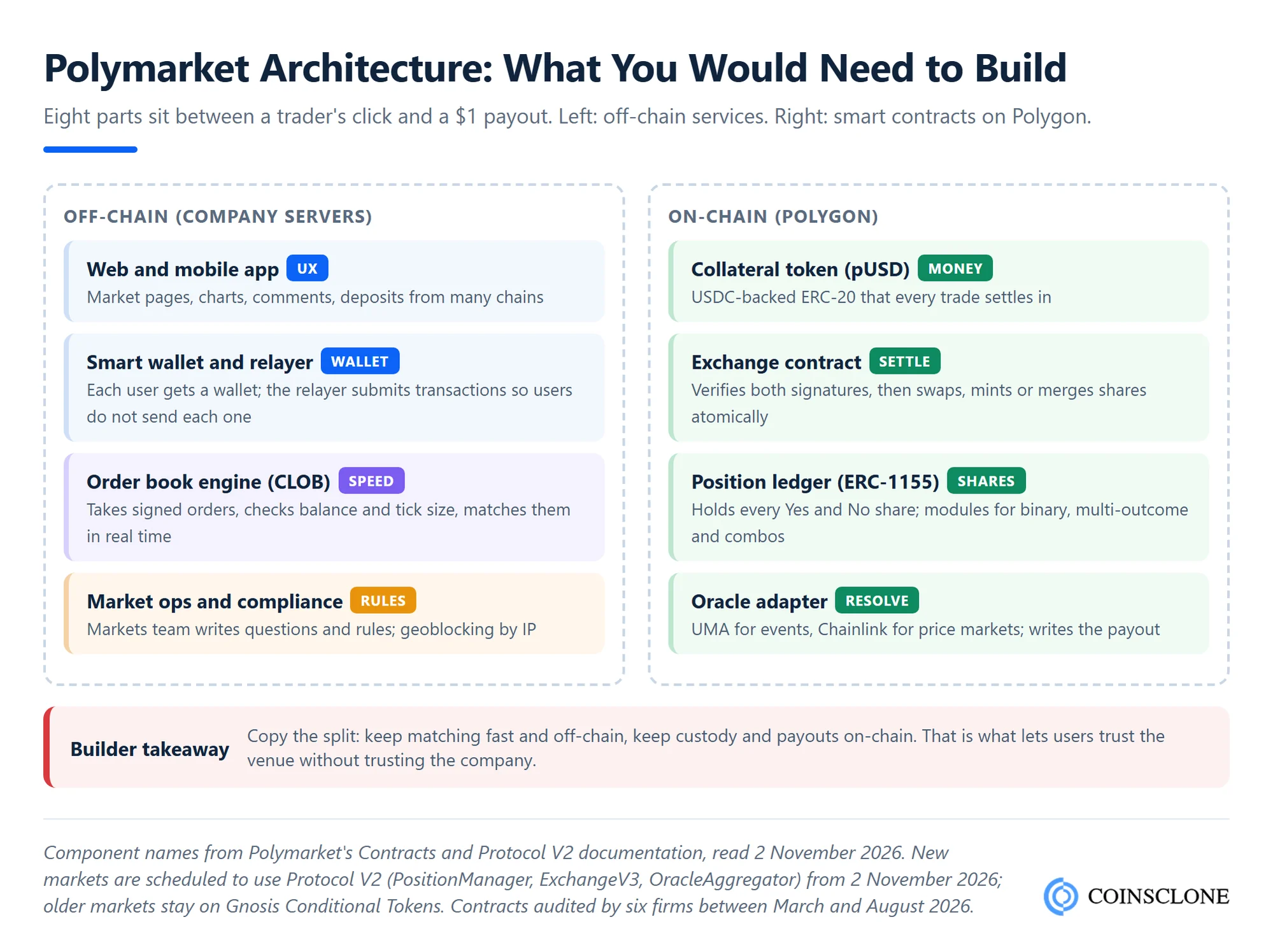
| Layer | What Polymarket uses | What you need to build |
| Collateral | pUSD, a USDC-backed token on Polygon | A stablecoin or wrapped stablecoin with on-chain backing |
| Shares | ERC-1155 positions (Conditional Tokens, now PositionManager) | Split, merge and redeem logic that keeps every pair at $1 |
| Matching | Off-chain CLOB with EIP-712 signed orders | A matching engine, order signing, cancel and expiry handling |
| Settlement | Exchange contracts that verify signatures | Atomic settlement, audited before launch |
| Multi-outcome | Negative risk conversion and Combos | Linked markets, and RFQ if you offer parlays |
| Resolution | UMA Optimistic Oracle plus Chainlink TWAP | An oracle adapter, bonds, a dispute path and clear rules |
| Wallets | Smart wallets plus a relayer | Embedded wallets so users never handle gas |
| Compliance | IP geoblocking, close-only tiers | Geofencing, KYC where needed, a legal opinion per market |
Two parts are harder than they look. The first is liquidity: an empty order book shows wide spreads and drives users away, so plan market makers and rewards from day one. Our guide to prediction market liquidity covers the options. The second is resolution: vague rules cause disputes, and disputes cost trust.
Cost depends on scope more than on code. The main drivers are a custom matching engine versus an AMM, the number of smart contract audits, the oracle design, wallet setup, and the licence you need in your target market. Our prediction market cost guide walks through each driver. Our guide on how to build a prediction market like Polymarket covers the build order.
Launch Your Own Polymarket-Style Prediction Market
Prediction market development, done right.
- Order Book Engine: Off-chain CLOB matching with EIP-712 signed orders and on-chain settlement
- Outcome Tokens: Fully backed Yes and No shares with split, merge and redeem logic
- Oracle Resolution: UMA-style bonds and disputes, plus Chainlink feeds for price markets
- Wallets and Compliance: Embedded wallets, a gas relayer, geofencing and KYC options
See a live demo of our Polymarket clone script in action.
Book a Free Demo to plan your prediction market launch with our team.
How Coinsclone Helps You Build a Polymarket-Style Platform
Coinsclone builds prediction market platforms on the same hybrid design. That means an off-chain order book, on-chain settlement, outcome tokens, oracle results and embedded wallets. Coinsclone has built crypto products since 2018 and delivered 350+ platforms for 200+ clients across 20 industries. Our Polymarket clone script launches in 5 to 7 weeks, and our team can shape it to your markets, chain and licence. For a fully custom build, see our prediction market platform development service.
Frequently Asked Questions
Is Polymarket legal in the US?
The main Polymarket site is not open to new trades from the US, which it lists as close-only. A separate exchange, Polymarket US, got CFTC approval in November 2025. Users reach it through brokers. In April 2026 Polymarket asked the CFTC to reopen the main exchange to US users. We found no public decision as of 1 November 2026.
Who decides the outcome on Polymarket?
For most event markets, the answer comes from UMA’s Optimistic Oracle. Anyone can propose the result with a bond, typically $750, and anyone can dispute it within 2 hours. After two disputes, UMA token holders vote. Crypto Up or Down markets resolve from Chainlink price feeds instead.
Can you parlay on Polymarket?
Yes. Polymarket calls parlays Combos. A Combo joins several outcomes into one Yes or No position. It pays only if every leg wins. Market makers quote the price through a request for quote flow.
How do you withdraw from Polymarket?
You withdraw through Polymarket’s bridge. It sends your balance to a supported chain and token, such as Ethereum, Base, Solana or Bitcoin. Always check the network and address first, because transfers sent to the wrong chain or address cannot be reversed.
Is Polymarket gambling?
Polymarket calls itself a prediction market: users trade with each other and there is no house taking the other side. Many countries still restrict it under gambling or financial rules, which is why Polymarket blocks or limits users in more than 30 places. Whether it counts as gambling depends on local law.
Is Polymarket safe?
Polymarket is non-custodial, so your funds sit in your own wallet and smart contracts until a trade settles. Its contracts were audited by six firms in 2026 and it runs a bug bounty. The main risks are disputed results, smart contract bugs, and sending deposits to the wrong network.
How does Polymarket make money?
Polymarket charges taker fees on many market types, and part of those fees funds rebates for market makers. Rates differ by category and some categories are fee-free. See our full guide on how Polymarket makes money for the current rates.