
A DAO Maker clone script is ready-made software for launching your own crypto launchpad, the kind of platform where new projects sell tokens to early buyers before the token trades on an exchange. It copies the model DAO Maker made famous in 2021: buyers stake the platform token, turn it into “DAO Power”, and use that power to win a share of each sale. This guide explains what the script includes, what DAO Maker asks of buyers and projects today, how its Strong Holder Offerings work, and where DAO Maker stands in October 2026.
You will also learn what still works in this model today, which features and security layers to insist on, the rules that apply to token sales in 2026, and the time and money a launch takes. By the end, you will know how to build a DAO Maker-style launchpad that keeps buyers safe and keeps good projects coming back.
In this guide:
- DAO Maker’s real status in 2026: still online, but its last sale was in December 2025 and its token is down more than 99%.
- DAO Maker’s launchpad requirements: KYC, the US ban, DAO Power tiers, staking locks, the 5% fee and the project form.
- How the Strong Holder Offering (SHO) lottery and refund rules work, step by step.
- What DAO Maker’s two 2021 hacks teach anyone who builds a launchpad.
- Features, revenue models and the 2026 rules in the EU and the US.
- Build steps, Coinsclone’s launch timelines and real market cost ranges.
See How Our MVP System Can Launch Your DAO Platform Faster
DAO Maker Clone Script — Decentralized DAO Platform Development..
- MVP System : Launch your DAO Maker-like platform 90% faster.
- Smart Contracts Ready : IDO and staking contracts pre-built..
- Brand & Customization : Your interface, access modules, and token architecture.
- Revenue Engine : Earn from project launches, staking rewards, and transaction fees.
Get a free branded demo of your DAO Maker-like platform in just 48 hours — before investing a cent..
Book a Free Demo to discover how our DAO Maker Clone Script can take you from concept to a live DAO platform in just 8–12 weeks.
What Is a DAO Maker Clone Script?
A DAO Maker clone script is pre-built software that lets startups create their own token sale platform. It copies the core features of DAO Maker: staking for sale access, project listings, lottery-based sales, vesting and claims, refunds and an admin panel, all running on audited smart contracts. It can also serve as an IDO, IGO (gaming) or INO (NFT) platform, depending on your project needs.
The script comes with built-in SHO (Strong Holder Offering) tools, investor dashboards, staking, vesting and other key tools for smooth fundraising. As this is a clone solution, you can fully customize the software to match your own brand. You can also support crypto tokens, gaming projects and NFTs, all while keeping build costs down.
In short, you start from a working base instead of a blank page. However, a clone script is a starting point, not a finished business. You still need an outside audit, a plan to find good projects and a legal review before your first sale.
Before you copy DAO Maker, it helps to know what the original did well and where it went wrong.
What Is DAO Maker?
DAO Maker is a crypto incubator and launchpad that helps early-stage startups raise money and build communities. It was founded in 2019, and its flagship product, DAO Pad, let retail investors join token sales for projects the team had checked. According to a CoinMarketCap explainer from July 2026, it has hosted more than 100 IDOs, including Orion Protocol and My Neighbor Alice.
Its token, DAO, was the key to every sale. Users staked DAO to earn DAO Power, then spent that power to enter sales. Besides sales, DAO Maker offered yield vaults, airdrops, social mining rewards for active community members, and advisory help on tokenomics and market makers.
Is DAO Maker Still Running in 2026?
Yes, but at a much smaller scale. Here is what we found on 26 October 2026:
- The platform is online. daomaker.com now points to app.daomaker.com, which promotes “The Launchpad For Real Founders” and offers launchpad sales, airdrops, farms, vaults and staking. Projects can still apply.
- Sales have stopped for now. DAO Maker’s own launchpad page lists 141 past projects. It shows 13 sales in 2025, and the latest one, Helios, is dated 12 December 2025. No sale appears in 2026 so far.
- The wider record is similar. Chain Broker counts 166 projects and about $86.5 million raised. Its busiest year was 2021, with 74 sales.
- The token has lost almost all its value. CoinGecko lists DAO at about $0.022, with a market cap near $5.6 million. Its all-time high was $8.71 on 21 April 2021.
- Its tokens did not hold up. Tokens sold on DAO Maker peaked at 7.85 times their sale price on average, according to Chain Broker. Today they trade at about 4% of it. Only one of them, My Neighbor Alice, trades above its sale price.
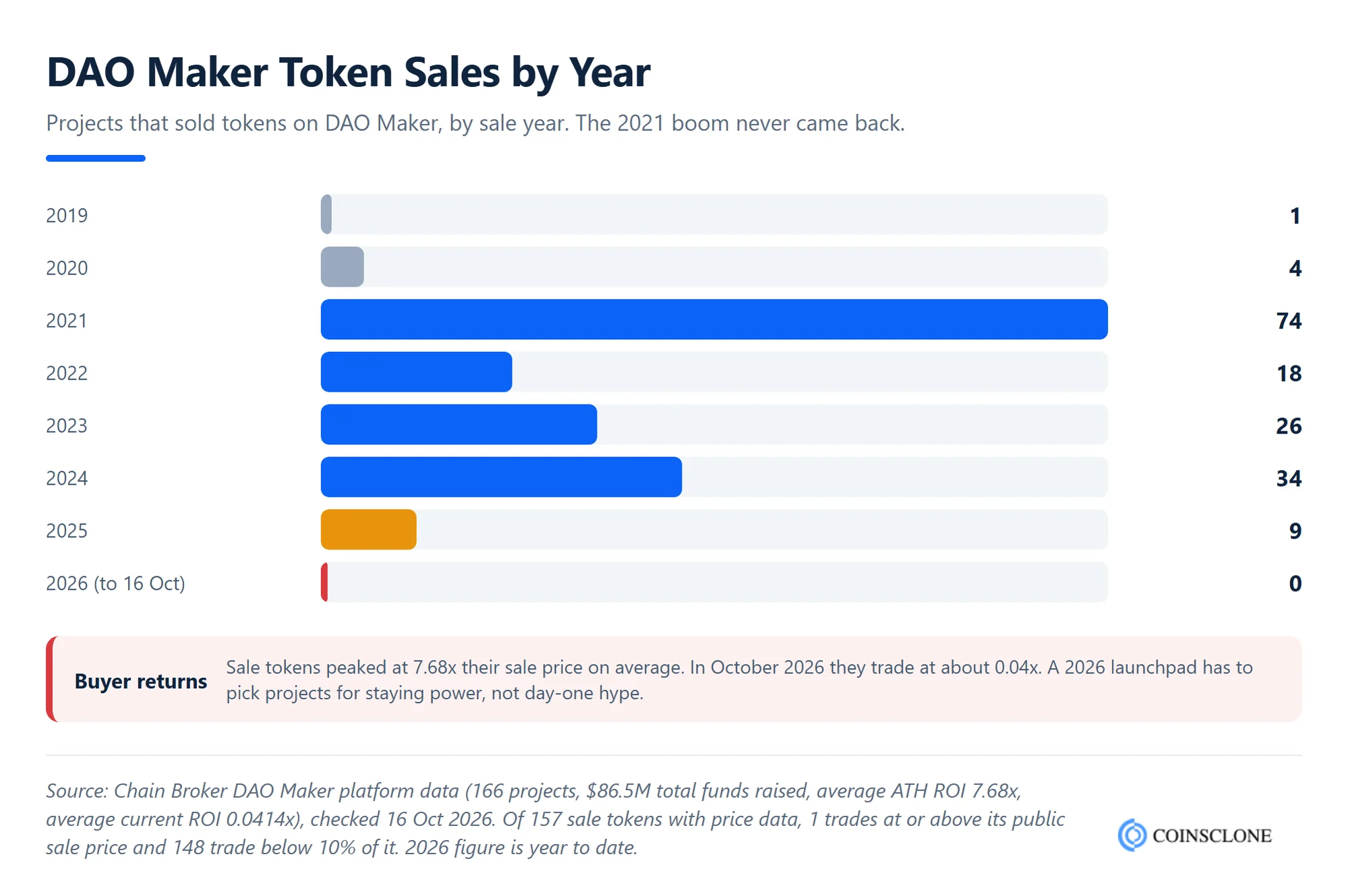
So why build a DAO Maker clone at all? Because the launchpad model itself is still alive. Launchpad apps earned about $1.08 billion in fees in the 12 months to 26 October 2026, according to DefiLlama. What faded was the 2021 recipe: many small hype sales, a platform token that only had value while sales boomed, and weak checks on project quality. Your clone should keep the parts users liked and fix the parts that let the original shrink.
DAO Maker Launchpad Requirements in 2026
To join a DAO Maker sale, you need a crypto wallet, a home outside the United States and, when the sale asks for it, a passed KYC check before you can claim tokens. Private sales also need staked DAO: in practice at least 250 DAO Power, because DAO Maker’s docs give anything below that no weight.
These rules come from DAO Maker’s own docs and its app, checked on 26 October 2026. They are worth knowing even if you never buy on DAO Maker, because they show what a working launchpad asks of its users.
Requirements to Join a DAO Maker Sale
- A wallet: you connect a wallet to app.daomaker.com. Staking runs on Ethereum, BNB Chain and Solana.
- A home outside the US: the app shows a “Restricted Territory” notice. It says the site is not meant for users in the United States, and you must confirm you are not a US resident or citizen.
- KYC when the sale needs it: the app asks users to finish KYC in their profile and warns that, without it, they will not be able to claim their tokens.
- Public SHO: open to everyone. You deposit USDT, or pick “DAO Boost”, which swaps your USDT into DAO and raises your share of the sale by 500%. Unused USDT comes back on its own after the sale.
- Private SHO: open only to DAO stakers. Your DAO Power and your deposit decide your share. You can take a guaranteed share or enter a lottery, where tickets are usually 100 DAO each.
- Hold your DAO Power until vesting ends: if it drops below the level you used, you have 3 days to top it up. Otherwise, you lose all future unlocks of that project’s tokens.
- A 5% platform fee: DAO Maker takes 5% of the tokens in each round when you claim them.
How Do DAO Maker Tiers Work?
DAO Maker no longer uses named tiers. Instead, each staked DAO gives 1 DAO Power, and a multiplier grows with your total. Older reviews call these bands Tier 0 to Tier 6.
| DAO Power from staking | Multiplier |
| Under 250 | 0x (no weight) |
| 250 to 2,000 | 1x |
| 2,000 to 4,000 | 1.05x |
| 4,000 to 10,000 | 1.1x |
| 10,000 to 25,000 | 1.15x |
| 25,000 to 50,000 | 1.2x |
| 50,000 to 100,000 | 1.25x |
| 100,000 and more | 1.3x |
So 25,000 staked DAO counts as 30,000 DAO Power. At about $0.022 per DAO, the 250 DAO floor costs under $6, so the entry bar is now very low.
Staking rules differ by chain, according to the staking docs:
- Ethereum: you choose a term of 30 to 1,095 days, and longer terms earn more. The first 15 days are fully locked. After that, leaving early costs the rewards from the first half of your term, and very early exits also cost part of your stake.
- BNB Chain and Solana: there is a 15-day cooldown after you ask to unstake. Leaving before it ends costs 15% of your stake. Solana stakers must also link a BNB Chain wallet to get DAO Power.
Does DAO Maker Require KYC?
Yes, for sales that need it. DAO Maker’s app tells users to complete KYC in their profile, or they cannot claim the tokens they bought. It also blocks US residents and citizens. The docs do not publish a list of other blocked countries, so check the terms of each sale.
For your own clone, this is a sound pattern: let people register early, but check identity before tokens are paid out. That keeps sign-up easy while the payout stays compliant.
What Projects Need to Launch on DAO Maker
Projects apply through an application form after they sign in with a wallet. The form asks for:
- contact details and a full project overview;
- a comparison table with top rivals, or proof that people want the product;
- a quarterly roadmap and how the team earns revenue;
- a plan to win the first users;
- the technology and the team’s track record;
- tokenomics, investors and the cap table;
- partners, confirmed exchanges, KOLs (crypto influencers) and a confirmed market maker;
- the size and valuation of each round (seed, private, public and DAO), plus the initial market cap.
The form does not list fees or a review time. If you build a clone, ask for the same facts, and publish your fees and review time. Our guide on how to create a crypto launchpad explains how to set up that project pipeline in five stages.
How Does DAO Maker’s SHO Model Work?
DAO Maker’s best-known idea is the Strong Holder Offering (SHO). Instead of first-come, first-served sales, it shares out tokens by stake and lottery and gives better odds to people who hold for the long term. These are the parts a clone script copies. The first two parts below describe the 2021 design; the rules above show how they work now.
Staking and DAO Power
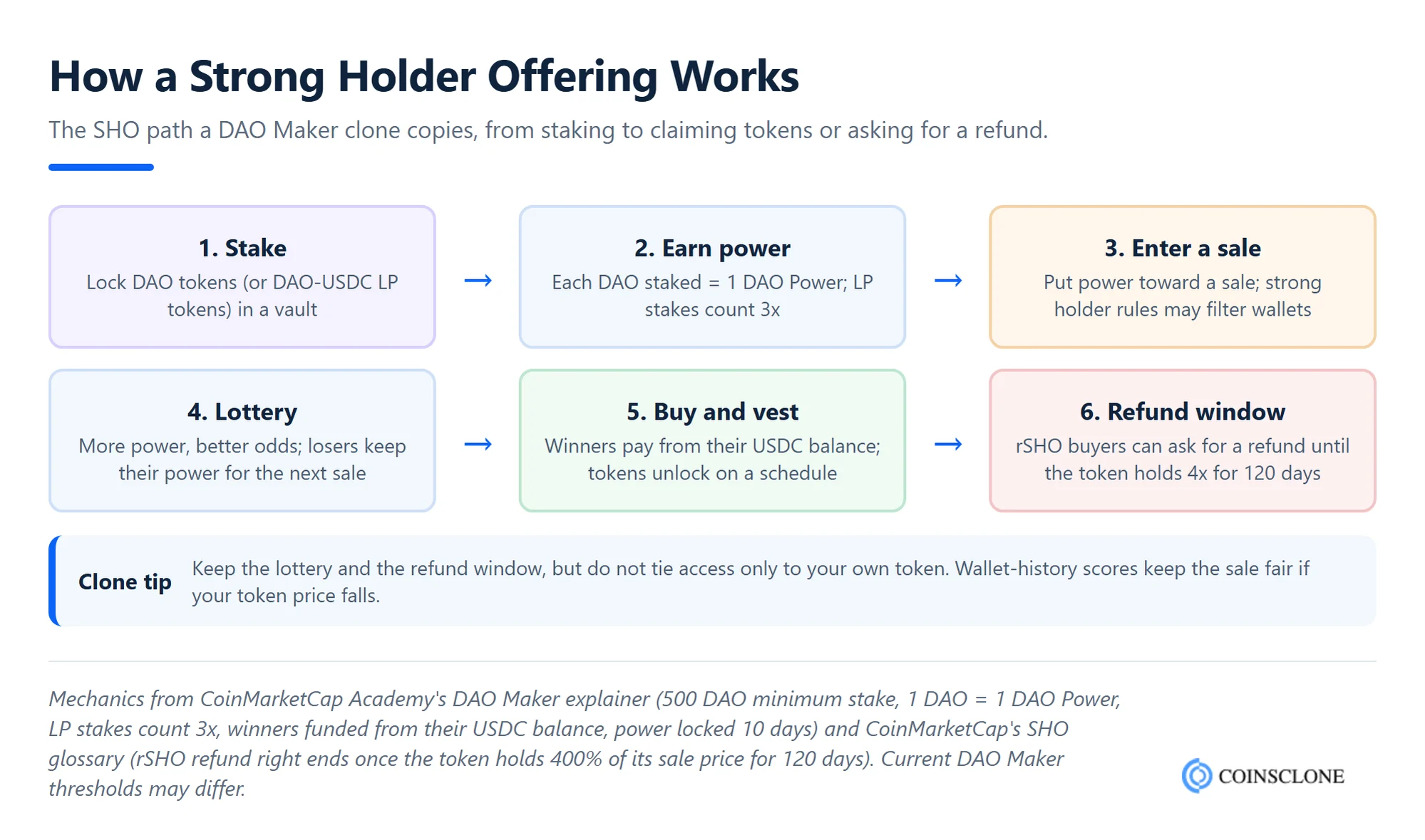
Users staked DAO tokens in DAO Maker’s vaults to take part. In 2021, according to CoinMarketCap Academy, the minimum was 500 DAO, and each staked DAO gave one unit of DAO Power. Staking DAO-USDC liquidity tokens tripled that power, and lock periods ran from 30 days up to 1,095 days. Today the floor is 250 DAO Power, and the docs list no liquidity bonus.
The Sale Lottery
For each sale, users chose how much DAO Power to put toward it. That entered them into a lottery, and more power meant better odds. Winners had their allocation paid straight from the USDC they had deposited. Their DAO Power was then locked for 10 days before it could be used again. Losers got their power back for the next sale. Today, private sales mix a guaranteed share based on DAO Power with an optional lottery.
Strong Holder Rules
Some sales were open only to “strong holders”, picked on their on-chain history. For example, a sale could be limited to people who had held a rival coin for six months or who provided liquidity on a DEX. This rewarded real users over bots and fresh wallets.
Refundable SHOs
Later, DAO Maker renamed the model the refundable SHO (rSHO). Buyers could ask for a refund if they lost faith in a project. According to the CoinMarketCap glossary, the refund right ended once the token rose to 400% of its sale price and stayed there for 120 days.
How Does the IDO Launchpad Process Work in a DAO Maker Clone?
The IDO launchpad process in a DAO Maker clone runs in four stages: a project is reviewed and listed, buyers stake and register, the sale shares out tokens, and smart contracts release the funds and the vested tokens. Here is each stage for both sides of a sale.
- Project Onboarding: A blockchain project that needs to raise funds is listed on the platform after a review. The project team sets the sale terms, such as token price, hard cap, vesting and refund rules.
- Investor Participation: Registered users browse upcoming and live projects through the dashboard. They stake the platform token, earn power and put it toward the sales they like.
- Fundraising: When the sale opens, the lottery picks the winners, and their allocations are paid in supported stablecoins or crypto. In return, buyers receive project tokens, either at once or on the schedule the project sets.
- Collateral and Fund Allocation: Smart contracts hold the raised funds and release them by pre-set rules. This protects both projects and investors, stops misuse of funds and builds investor trust.
Even though it copies DAO Maker’s working flow, the clone script can be shaped around your own project goals.
The space is filled with launchpad projects. So you may wonder why you should pick this model over the others.
Why Should You Create an IDO Launchpad Like DAO Maker?
Here are the top reasons to build an IDO launchpad like DAO Maker in 2026.
A Fairer Sale Model
Lottery-based sales are fairer than first-come, first-served rounds that bots win in seconds. With the DAO Maker clone script, small investors also get a real chance to take part. This fair token sale draws a wide investor base and gives the projects you host strong community support.
Rewards for Long-Term Holders
The strong holder idea is still one of the best tools against “flippers” who buy and dump on day one. By rewarding wallets with real history, you attract buyers who stay, which is exactly what projects want.
Trust Through Refunds
Refunds give buyers a safety net that few launchpads offer. As a result, buyers feel safer joining early sales, and projects feel pressure to deliver.
Global Reach
A crypto launchpad lets you serve projects and investors in many countries from one platform. By building your own IDO launchpad like DAO Maker, you join the shift toward open, borderless and transparent investment models, within the rules of each market you serve.
Scalable Business Model
With many projects looking to raise funds, your platform can keep adding new launches. Just like DAO Maker, you can also expand into incubation, airdrops and advisory services over time.
Now let us see the features that come with a DAO Maker clone solution.
Built-In Features of the DAO Maker Clone Script
A DAO Maker clone script comes with a wide range of features. All of them aim to make fundraising simple and draw more investors. Let us explore them.
Airdrops
The airdrop feature lets projects send free tokens to early investors, loyal community members or people who join promo campaigns. Airdrops raise brand visibility, increase user activity and build awareness across wider crypto communities.
Swapping
Just like DAO Maker, the swap feature lets users exchange tokens inside the platform without leaving for an outside exchange. This keeps trading smooth, with less friction.
Staking and Vesting Options
Investors can stake tokens in the DAO Maker clone app to earn rewards and power for sales. The vesting feature sets a planned, controlled token release schedule. Together, these features protect each project’s token plan and help prevent sudden price dumps. Our guide to the token vesting smart contract shows how to set cliff and linear unlocks.
Investor Dashboard
A dedicated dashboard gives investors a real-time view of their holdings. They can see tokens, staking power, rewards, sale results and project updates in one place. This makes tracking funds simple and the investing journey smoother.
SHO Tools
Strong Holder Offering (SHO) tools let projects filter buyers by set rules, such as holding history, liquidity provided or past activity. As a result, only trusted, committed investors take part in the sale.
Lottery and Allocation Engine
This engine turns each user’s staking power into lottery tickets, draws winners fairly and assigns allocations. DAO Maker’s own private sale contract builds its random numbers from a hash of the block’s timestamp and difficulty value. The draw runs off-chain, and the contract then checks the winners. That is open to review, but block producers can nudge those inputs a little. So your clone should use a verifiable random function, such as Chainlink VRF, which anyone can check and no one can steer. To keep bots and sniper wallets out of the draw too, see our guide on how to stop snipers on a token launch.
Refund Module
The refund module lets buyers claim their money back within the window each sale sets. You decide the rules, such as DAO Maker’s 400% for 120 days limit or a simple 48-hour window after listing.
Collateral Options
With collateral support, projects and investors can safely lock assets for future fund releases. This lowers risk and gives the platform key risk control tools.
Automated Fund Allocation
This feature sends raised funds to project wallets or pools by pre-set rules. By automating this step, you remove manual errors, speed up payouts and keep the split of funds fair.
Customizable Project Parameters
The DAO Maker clone software lets each project set its own goals, token supply, sale price and vesting period. This makes the IDO launchpad flexible enough for many kinds of projects.
Auto Investment Features
Investors can set automatic choices for upcoming projects, such as how much power to commit to each new sale. This way, they do not miss good chances, and projects get steady interest.
Security Protocols
The DAO Maker clone script is protected with KYC checks, two-factor login (2FA), fraud detection and other tools. Its smart contracts also go through outside audits to prevent hacks. The next section explains why this matters so much for this model.
Security: Lessons From DAO Maker’s 2021 Hacks
DAO Maker’s own history is the best lesson for anyone building a clone. In 2021, it was hit twice in less than a month.
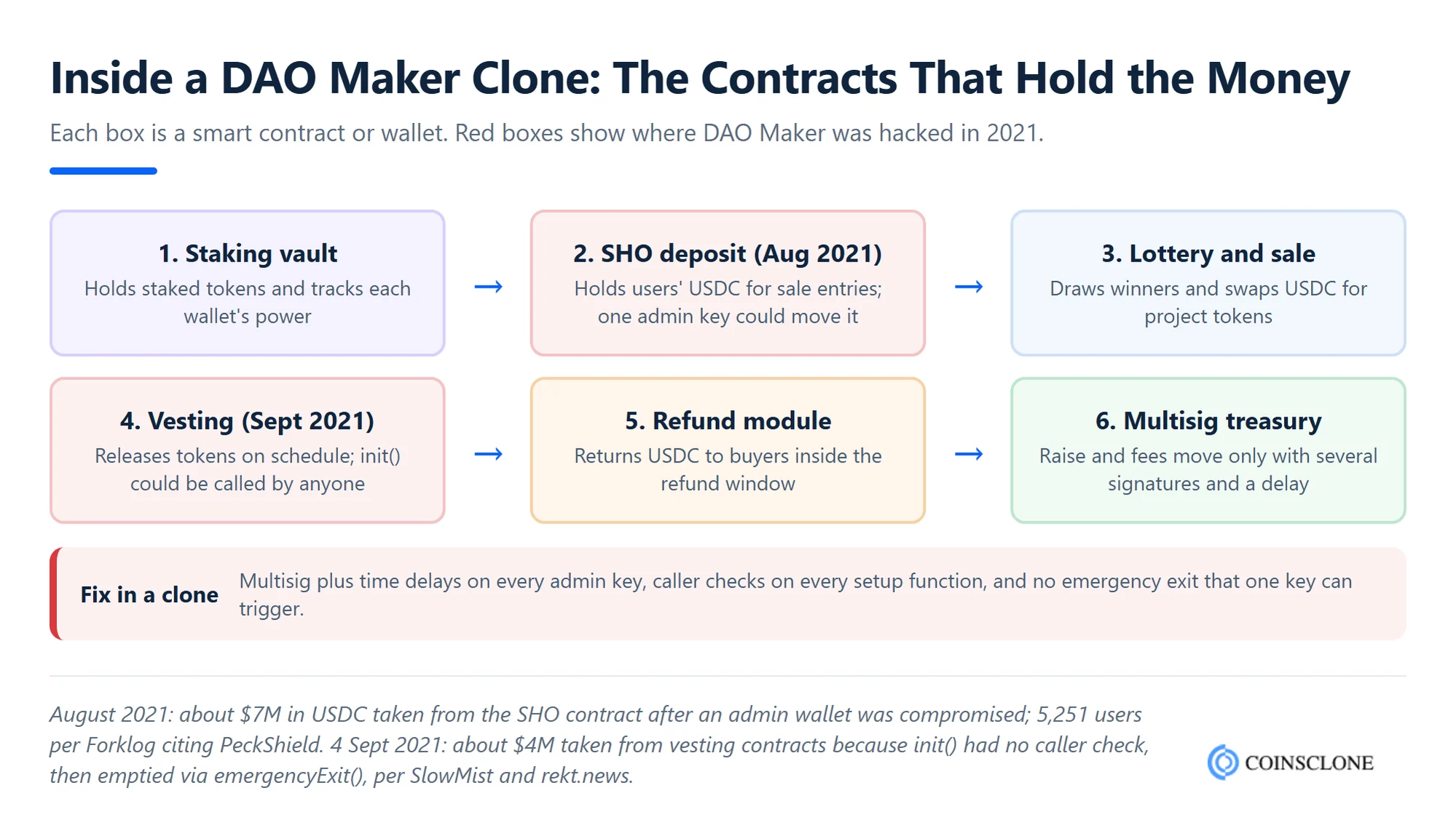
- August 2021, about $7 million: An attacker gained access to a wallet with admin rights and drained USDC from the SHO contract, where users kept funds for their sale entries. More than 5,000 users were affected, according to Forklog, citing PeckShield.
- September 2021, about $4 million: The start function, init(), in DAO Maker’s vesting contracts did not check who was calling it. So an attacker reset four token contracts and pulled the tokens out through an emergency exit function, as SlowMist’s analysis explains.
The aftermath hurt as much as the hacks. DAO Maker paid victims partly in USDC and partly in an IOU token, USDR. In October 2022, a governance vote proposed stopping the remaining USDR payouts, then worth about $3.5 million across some 3,500 wallets, as rekt.news reported. Lost trust is hard to win back.
Because of this, a DAO Maker clone should include these safety layers:
- Multisig wallets with time delays for every admin key and the treasury, so one stolen key cannot drain user funds.
- Caller checks on every function that sets up, changes or empties a contract.
- No “emergency exit” that one key can trigger. If you need one, put it behind a multisig and a public delay.
- Outside audits of the staking, sale, vesting and refund contracts, plus a re-audit after every change.
- A bug bounty and a public incident plan, with a funded reserve for paying users back.
Stolen keys still do the most damage today. DefiLlama’s hack tracker logged 285 incidents worth $2.24 billion from January to 1 October 2026. Key thefts alone caused $704 million of that.
Business Benefits of a DAO Maker Clone Script
A DAO Maker clone solution offers many business perks, which makes it a good fit for startups, investors and entrepreneurs.
Faster Market Entry
As the DAO Maker clone solution is pre-built, you skip the long build cycle. A white label launchpad can go live in about 5 to 7 weeks, and a standard custom build in 10 to 14 weeks.
Cost-Effective Solution
Building a crypto launchpad from scratch is costly. With a DAO Maker clone, the core contracts, screens and admin tools already exist. You pay for branding, changes and audits, not for every line of code.
A Model Ready for 2026
With a DAO Maker clone, you can add newer ideas on top, such as wallet-history scores, open launch tracks and compliance tools. This lets your crypto fundraising platform grow with the fast-changing DeFi market.
Several Income Streams
Just like DAO Maker, the clone solution supports several revenue models, from listing fees to staking. The section below lists them in full.
Support for Startup Projects
With SHO tools, flexible project settings and investor dashboards, your IDO launchpad can become a trusted hub for startups. New businesses can raise funds safely and reach committed buyers.
What Works in the DAO Maker Model in 2026
The launchpad market looks very different from the IDO boom of 2021. CryptoRank counted 533 public token sales in 2025, and only about 12% traded above their sale price by the end of the year. Meanwhile, big sales have moved to exchanges. Coinbase paid about $375 million for the sale platform Echo in October 2025, and its first sale, for Monad, drew $269 million from 85,820 buyers. Kraken Launch now runs sales with Legion. So, here is what to keep, change and add.
Keep:
- Lottery sales with fair odds. They beat bot-driven first-come rounds, and buyers trust them.
- Strong holder rules. Newer platforms such as Legion also score buyers on their real on-chain history.
- Refunds and vesting. A refund window and a clear unlock plan protect buyers when a project falls short.
Change:
- Do not make the platform token the only way in. When DAO fell more than 99%, staking for access lost its pull. Add scores based on wallet history, as Legion and Binance Alpha do, or access based on stablecoin deposits.
- List fewer, better projects. One good sale a month beats ten weak ones. Coinbase runs about one sale a month.
- Keep user money out of hot admin wallets. Funds waiting for a sale should sit in contracts that no single key can drain.
Add:
- Lockups for project teams, such as the six-month issuer lockup Coinbase requires.
- Compliance tools: country blocks, investor checks and per-sale rules.
- An open launch track for small tokens next to a vetted track for larger raises. Open launchers such as Pump.fun earned about $432 million in fees in the 12 months to 26 October 2026.
How a DAO Maker-Style Launchpad Makes Money
A launchpad earns from both sides of every sale. These are the common revenue models:
| Model | How it works |
| Listing fees | Projects pay for a launch slot |
| Raise commission | You take a share of the funds each sale raises |
| Token allocation | You receive a small share of the project’s tokens |
| Staking demand | Investors buy and stake your token to gain sale power |
| Incubation and advisory | Paid help with tokenomics, market makers and listings |
| Featured placement | Projects pay for premium promotion |
| White label licensing | You license your launchpad to other operators |
Plan for at least three of these. If your only income is demand for your own token, your business falls with it.
Is a DAO Maker-Style Launchpad Legal? Rules for 2026
Yes, if you follow the rules in each market you serve. Token sales can count as securities offerings, and running sales for others can make your platform a regulated business. DAO Maker itself shuts out US users. Here is the 2026 picture in the two biggest markets:
- European Union: Under MiCA, placing tokens for a project is a regulated crypto service, so an EU launchpad usually needs a CASP licence. The transition period for older firms ended on 1 July 2026.
- United States: On 18 August 2026, the SEC proposed Regulation Crypto Assets. It would let startups raise up to $5 million over four years. Comments closed on 20 October 2026, and the rule is not final yet.
- Everywhere: Plan for KYC and anti-money laundering checks, country blocks and clear terms of use. Lottery-based sales may also need a legal review in places with strict gaming laws.
In practice, build these checks into the platform and let each project’s lawyers decide who may buy.
How to Create a Launchpad Like DAO Maker in 6 Steps
You can turn a DAO Maker clone into a working DeFi launchpad in six steps. If you also want community voting on listings, start with our guide on how to start a DAO. Here is a breakdown of the DAO Maker clone app build process.
Project Ideation
Begin by studying the DeFi market’s trends and gaps. Pick your niche, such as one chain, one sector (gaming or AI, for example) or one buyer group. Then set your business goals.
Project Mapping
Next, draft a clear roadmap. Based on your target market, decide on the features, staking and lottery rules, refund terms, security layers and compliance needs. This plan should also fit your long-term goals.
DAO Maker Clone Customization
With the base plan ready, customize the DAO Maker clone script. Every part can be changed to match your brand, from features and the working flow to logos and design.
Smart Contract and API Integration
Smart contracts run the launchpad on their own. They handle staking, the lottery, sales, vesting, refunds and fund releases. API links to KYC providers, wallets and price feeds are also added here.
Audit and Quality Checks
Now, test the platform often and run mock sales with real users. Then send the contracts for an outside audit, fix what it finds and re-audit. This stage catches bugs before they cost real money.
Deployment
Once testing is done, move the launchpad from the testnet to the mainnet and deploy it on your chosen servers. Start with one or two strong projects. Ongoing support and upgrades keep the platform safe and competitive.
| Option | What you get | Typical build time |
| White label DAO Maker clone | Your brand, standard staking and lottery, one chain | 5 to 7 weeks |
| Standard custom launchpad | Custom power and refund rules, project vetting, audit | 10 to 14 weeks |
| Launchpad with governance | Community listing votes, advanced tiers, analytics | 4 to 6 months |
| Multi-chain launchpad | Several chains, cross-chain sales, full project tools | 6 to 10 months |
These times come from Coinsclone’s own crypto launchpad development work. Audits, lottery and refund design, load tests and legal review usually decide the final date. For a full walk-through, see our guide on how to create a crypto launchpad.
How Much Does a DAO Maker Clone Script Cost?
There is no single price, because the cost depends on your chains, features and audit scope. The main cost drivers are:
- The number of chains and wallets
- Custom staking, lottery, refund and vesting logic
- Outside smart contract audits
- KYC and compliance tools
- Design, hosting and support after launch
As a guide, published 2026 agency cost guides put a white label launchpad at roughly $20,000 to $50,000 and a custom build at about $100,000 to $300,000. Audits are a large share of that. Sherlock’s 2026 audit pricing guide puts mid-level DeFi code at $40,000 to $100,000, with each re-audit round adding $5,000 to $20,000.
Can You Build a Token Launchpad for Free?
You can start a token launchpad for almost nothing, but you cannot run a safe one for free. Solo developers ask about this often. One 2026 r/defi thread came from a developer building a meme token launcher with zero budget.
Free launchpad code on GitHub is a fair way to learn how sale, staking and claim contracts fit together. However, most of it is old, unaudited and built for one chain, with no KYC, no anti-bot rules and no admin tools. A DAO Maker-style platform also holds buyers’ deposits, and DAO Maker’s own 2021 losses show what one weak contract can cost.
Free “launch your token” sites are a different thing. You launch on someone else’s platform and pay their fees, but you do not own the software. A white label launchpad sits in the middle: tested code that you rebrand and own. Our guide on how to create a crypto launchpad compares these routes in full.
Other Launchpad Clone Scripts to Compare
DAO Maker is one of several launchpad models. If you are still choosing, compare it with these:
- TrustPad clone script: a multi-chain IDO launchpad with tiers and refund windows.
- Polkastarter clone script: a multi-chain IDO platform with whitelist sales.
- BSCPad clone script: a BNB Chain IDO launchpad with a tier system.
- Pump.fun clone script: an open meme token launcher with a bonding curve.
- PinkSale clone script: a self-serve, multi-chain launchpad where any team can run its own presale or fair launch.
Create Your Own Crypto Launchpad Like DAO Maker
Cost-effective | White-Label Solutions | Premium Features | Live Demo Available
What Makes Coinsclone’s DAO Maker Clone Script the Best?
Coinsclone is a leading crypto launchpad development company that offers a wide range of blockchain services, including IDO, ICO and token launch platforms. Since 2018, we have delivered 350+ platforms for 200+ clients across 20 industries. Our in-house team of business analysts, designers and blockchain developers takes care of everything from the first plan to the final launch.
We build DAO Maker clone software with audited contracts, multisig admin controls and many rounds of tests before launch. We also help you design staking, lottery and refund rules that make your platform stand out. You own the code and the contracts, deployed under your own keys. If you plan to run DEX-based sales, our IDO development team can build that track too.
Enter the DeFi world with confidence, with our DAO Maker clone solution!
See How Our MVP System Can Launch Your DAO Platform Faster
DAO Maker Clone Script — Decentralized DAO Platform Development..
- MVP System : Launch your DAO Maker-like platform 90% faster.
- Smart Contracts Ready : IDO and staking contracts pre-built..
- Brand & Customization : Your interface, access modules, and token architecture.
- Revenue Engine : Earn from project launches, staking rewards, and transaction fees.
Get a free branded demo of your DAO Maker-like platform in just 48 hours — before investing a cent..
Book a Free Demo to discover how our DAO Maker Clone Script can take you from concept to a live DAO platform in just 8–12 weeks.
Frequently Asked Questions
What is a DAO Maker clone script?
A DAO Maker clone script is ready-made software for launching a crypto launchpad like DAO Maker. It includes staking for sale access, lottery-based Strong Holder Offerings, project listings, vesting and claims, refunds and an admin panel. You can rebrand it and change its features, chains and fees before launch.
What is DAO Maker?
DAO Maker is a crypto incubator and launchpad founded in 2019. Its DAO Pad product lets retail investors join token sales for checked projects, and it has hosted more than 100 IDOs. It is still online in 2026, but its last listed sale was on 12 December 2025, and none has run in 2026 so far.
What are the requirements to join a DAO Maker sale?
You need a connected wallet, a home outside the United States and, for sales that ask for it, a passed KYC check before you claim tokens. Public SHOs take USDT deposits from anyone. Private SHOs need staked DAO worth at least 250 DAO Power, and you must keep that power until your tokens finish vesting. DAO Maker keeps 5% of the tokens in each round.
Does DAO Maker require KYC?
Yes, for sales that need it. The DAO Maker app asks users to complete KYC in their profile and warns that they cannot claim their tokens without it. US residents and citizens are blocked from the site.
How do DAO Maker tiers work?
DAO Maker no longer has named tiers. Each staked DAO gives 1 DAO Power, and a multiplier rises with your total, from 1x at 250 DAO Power to 1.3x at 100,000 or more. Below 250 DAO Power, your stake carries no weight in private sales.
What is an SHO (Strong Holder Offering)?
An SHO is DAO Maker’s token sale model. Buyers stake DAO tokens to earn DAO Power, put that power toward a sale and get a guaranteed share or enter a lottery for one. Some sales are limited to wallets with a strong on-chain history. The refundable version, rSHO, let buyers ask for a refund until the token held 400% of its sale price for 120 days.
How do you make a launchpad lottery fair?
Use a random number that no one can predict or steer, such as Chainlink VRF, and publish every entry and result on-chain. Then cap the weight any one wallet can hold and check wallet history, so whales and bot farms cannot crowd out small buyers. This came up in a 2025 r/CryptoCurrency thread about a launchpad that sells its VRF lottery as whale-proof.
Is DAO Maker safe to use?
DAO Maker lost about $7 million in August 2021 and about $4 million in September 2021 to two separate hacks. Some victims say they were never fully repaid. If you build a similar platform, use multisig admin keys, caller checks on every contract function and outside audits.
How much does it cost to build a launchpad like DAO Maker?
Published 2026 agency cost guides put a white label launchpad at roughly $20,000 to $50,000 and a custom build at $100,000 to $300,000. Outside audits often add $40,000 to $100,000. The final price depends on your chains, features and audit scope.
How long does it take to launch a DAO Maker clone?
A white label DAO Maker clone can go live in about 5 to 7 weeks, and a standard custom launchpad in about 10 to 14 weeks. Adding governance or several chains can stretch that to 4 to 10 months.
Can you create a token launchpad for free?
You can start with free open-source code or launch a token on someone else’s platform, but a launchpad that holds buyers’ money is never free to run safely. You still pay for audits, hosting, KYC checks and support. A white label launchpad is the usual middle route.