
A crypto exchange for sale can mean three very different things: exchange software, a licensed company with no users, or a running exchange with customers and staff. Public listings we read in 2026 range from about $10,600 for source code to about $1.2 million for a company licensed under MiCA. The price matters less than what actually moves to you on closing day, because licenses, bank accounts and liquidity deals often do not move on their own.
This guide shows what each type of listing really sells, what buyers paid or were asked in 2026, and which rules decide whether the license survives the sale. It ends with a year-one cost comparison and a simple framework for choosing between buying and building.
In this guide:
- What sellers mean by “crypto exchange for sale”, with real listings dated and priced
- Why the regulator, not the seller, decides if a license moves to you
- A year-one cost table for four paths, with each assumption shown
- A due-diligence checklist and a red-flags table for listings
- A decision tree for buying vs building
Crypto Exchange for Sale: What Is Actually Being Sold?
Search for this phrase and almost every result is a broker listing. Read three or four of them and a pattern shows. Each listing sells one of three things.
Software only: Source code, an admin panel and a trading engine. No company, no license, no users. This is what “buy crypto exchange script” or “buy crypto exchange software” usually means. One listing titled as an exchange “for sale in Tallinn, Estonia” turned out to be source code for INR 1,000,000, with no license and no revenue.
A licensed shell: A company that holds a registration or license but has few or no customers. Sellers call it “ready-made” or “turnkey”. You get the company, its license and its files. You still need software, a team, banking and liquidity.
A running exchange: A company with a license, a platform, staff, bank accounts and users. This is the only type that brings revenue on day one. It is also the rarest and the most expensive.
| Type | What you get | What you still need | Main risk |
| Software only | Code, admin panel, trading engine | Company, license, bank, liquidity, team | Code quality and no support |
| Licensed shell | Entity, license, policies | Software, team, bank, liquidity | License lost or blocked at change of control |
| Running exchange | Entity, license, platform, users, staff | Regulator approval of you | Hidden debts, bad AML history, fake volume |
How Much Does a Crypto Exchange for Sale Cost?
The table below lists public broker listings we read between February and November 2026. These are asking prices set by sellers. None is verified, several are marked sold, and the claims inside them are the sellers’ own. We have left the brokers unnamed on purpose. Dollar figures use the European Central Bank rate of 12 November 2026.
| What is listed | Jurisdiction and regulator | Seller says it includes | Asking price | Listing dates |
| Licensed shell with bank account | Australia, AUSTRAC registration | Local director, bank account, company formed 2025 | EUR 75,000 (about $83,000), marked sold | Published 28 Apr 2026, updated 23 Oct 2026 |
| Licensed shell | Australia, AUSTRAC registration | Registered May 2025, no clients stated | EUR 90,000 (about $100,000), marked sold | Published 3 Jun 2026, updated 23 Oct 2026 |
| Legacy permission | Dubai, VARA NOC from 2022 (not a full VARA license) | Renewal help, bank introductions | $105,000, available | Published 3 Mar 2026, updated 10 Nov 2026 |
| Licensed shell, never traded | El Salvador, CNAD DASP license since 2025 | No clients, transfer costs included | $225,000 in one place, $240,000 in another | Published 21 Oct 2026, updated 5 Nov 2026 |
| Exchange in test mode | Georgia, National Bank of Georgia VASP license | Client base, three banks, KYC setup, about $100,000 of capital | $440,000, marked sold | Published 19 Feb 2026, updated 21 Aug 2026 |
| Operating company | Netherlands, MiCA license | 5 staff, office, three bank accounts | EUR 1,100,000 (about $1.22 million) | No date shown, seen 13 Nov 2026 |
| Source code only | India-based seller | Code and admin panel, no license | INR 1,000,000 (about $10,600) | No date shown, seen 13 Nov 2026 |
Three points stand out. Shells cluster between about $83,000 and $240,000. Anything with users or staff jumps to $440,000 and up. And the cheapest “exchange” on sale was not an exchange at all.
Sellers of running exchanges also price on revenue. One M&A guide, updated October 2026, puts licensed EU exchanges at 5 to 10 times yearly sales. It puts offshore ones at 1 to 3 times. Treat that as one adviser’s view, not a market rule.
Can a Crypto Exchange License Be Transferred?
Not in the way most listings suggest. You do not buy the license. You buy the company, and the regulator then decides whether you may control it. If you close the deal before that approval, the license can be pulled, and in some places you commit a crime.
Here is what the main regulators ask for, read from their own rules in November 2026.
EU (MiCA): Article 83 of MiCA says anyone who plans to buy 10% or more of a licensed crypto firm, or to go past 20%, 30% or 50%, must tell the regulator first. The regulator has 60 working days to assess. It can pause the clock once, for up to 20 working days, or 30 if the buyer sits outside the EU. Under Article 84 it checks your name, your team’s skills, your money and any risk of dirty money. If it says nothing by the deadline, the deal counts as approved.
Dubai (VARA): The VARA Company Rulebook, Part VIII, bans any step that changes who controls a licensed firm without VARA’s written yes first. The firm and the buyer file together. VARA decides within 30 working days of a complete file, and it can extend that. Control is presumed at 25% of voting shares.
UK (FCA): To buy control of an FCA-registered crypto firm, you must notify the FCA and get approval first. Doing it without approval is a criminal offense. A single 25% threshold applies to these firms, and the FCA can take up to 60 working days. The crypto change in control rules were tightened from 30 June 2026.
Australia (AUSTRAC): Crypto firms on the AUSTRAC list must report changes to key staff and their details within 14 days. They renew every 3 years. AUSTRAC removed 45 money transfer and crypto firms in the year to September 2026. Dormant firms and firms that failed to report material changes were among them.
United States (FinCEN): A money transfer business must re-register within 180 days after a transfer of more than 10% of its voting power or equity. State money transmitter licenses add their own change of control rules on top.
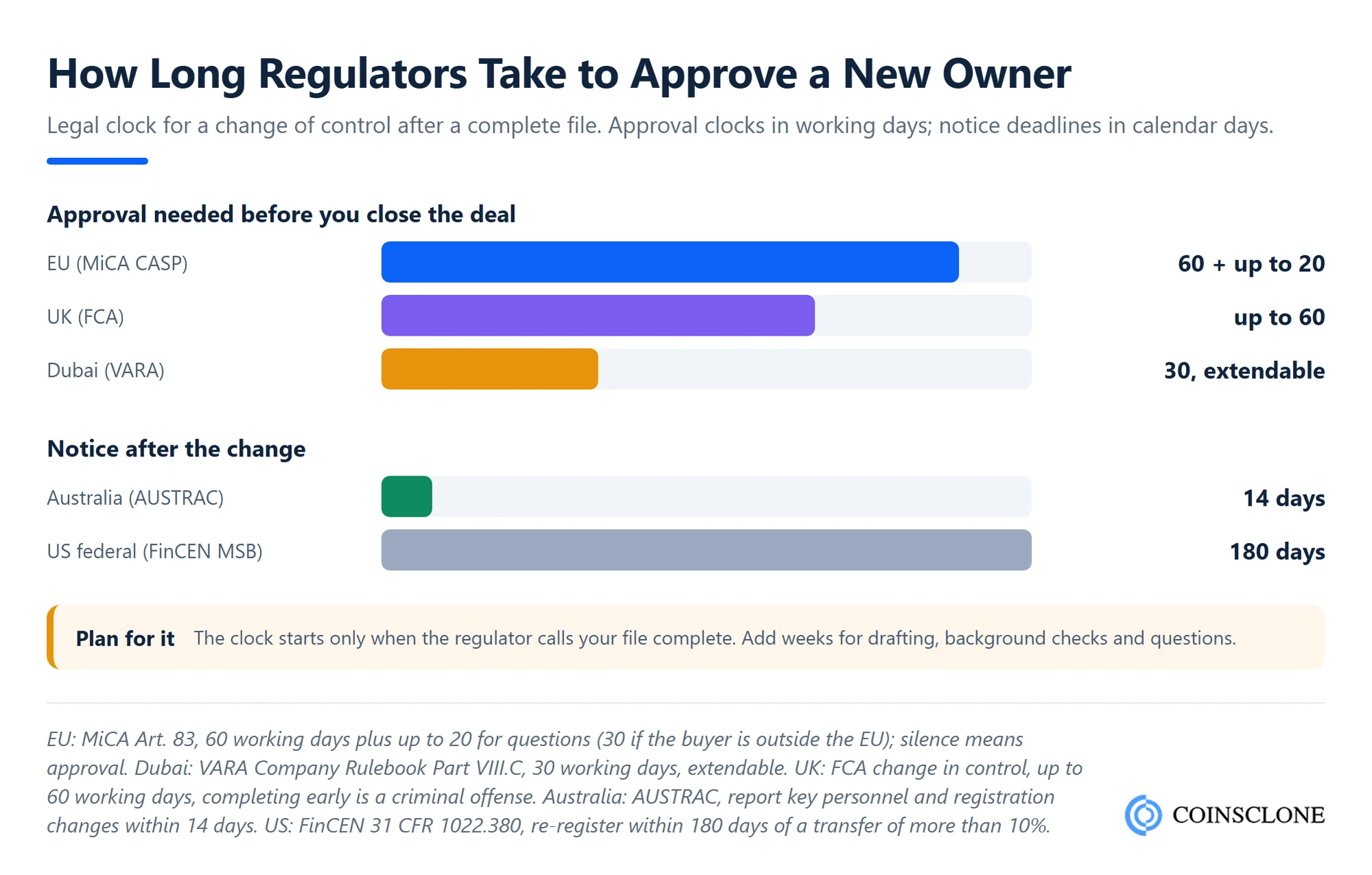
These clocks only start once the regulator calls your file complete. Drafting the file, running background checks and answering questions all come first. A broker who promises “ownership transfer in 2 weeks” is quoting the share transfer, not the approval.
What Does Not Transfer When You Buy a Crypto Exchange?
Even after approval, several things that make an exchange work may not come with it.
Bank accounts: Banks run their own checks on new owners. One listing above says its accounts are “transferable after KYC”. That means the bank can still say no.
Liquidity and market maker deals: These contracts often end or reopen on a change of control. An exchange with an empty order book is worth far less.
Software licenses: If the platform runs on a vendor’s license, the vendor may need to consent. Check who owns the code.
KYC and custody vendors: Identity checks and wallet custody often sit on contracts tied to the old owner.
Key people: Licenses are often granted on the strength of named directors and a compliance officer. If they leave at closing, the regulator will look again.
User consent: Moving user data to a new owner must follow privacy law and the platform’s own terms.
Buy vs Build: Year-One Cost of Four Paths
No ranking page compares buying with building on the same terms. So here is a worked example for a spot exchange serving one market, with web trading and fiat on and off ramps.
Assumptions:
- Purchase prices: The public listings above, converted at the ECB rate of 12 November 2026.
- Software: Market ranges from published 2026 agency cost guides: $15,000 to $60,000 for a white label exchange and $100,000 to $200,000 for a custom MVP.
- Legal and compliance work: Assumption: $25,000 to $150,000 on each path, the license and legal range from our white label exchange cost guide. On a purchase, this pays for due diligence and the change of control filing instead of a new application.
- Left out: Running costs (team, hosting, liquidity, ads) are much the same on each path. Capital the regulator asks for is money you must hold, not spend, on each path. For example, MiCA asks a trading platform to hold at least EUR 150,000.
- A running exchange: We assume its software comes with it at no extra cost. In real life, budget for a code and security review.
| Cost line | White label + new license | Licensed shell + white label | Custom build + new license | Buy a running exchange |
| Purchase price | $0 | $83,000 to $240,000 | $0 | $440,000 to $1,220,000 |
| Exchange software | $15,000 to $60,000 | $15,000 to $60,000 | $100,000 to $200,000 | Included |
| Legal and compliance work | $25,000 to $150,000 | $25,000 to $150,000 | $25,000 to $150,000 | $25,000 to $150,000 |
| Year-one one-off total | $40,000 to $210,000 | $123,000 to $450,000 | $125,000 to $350,000 | $465,000 to $1,370,000 |
| What sets the launch date | Your license decision | Regulator approval of you | License and the build | Regulator approval of you |
| Users on day one | None | None | None | Yes, if they stay |
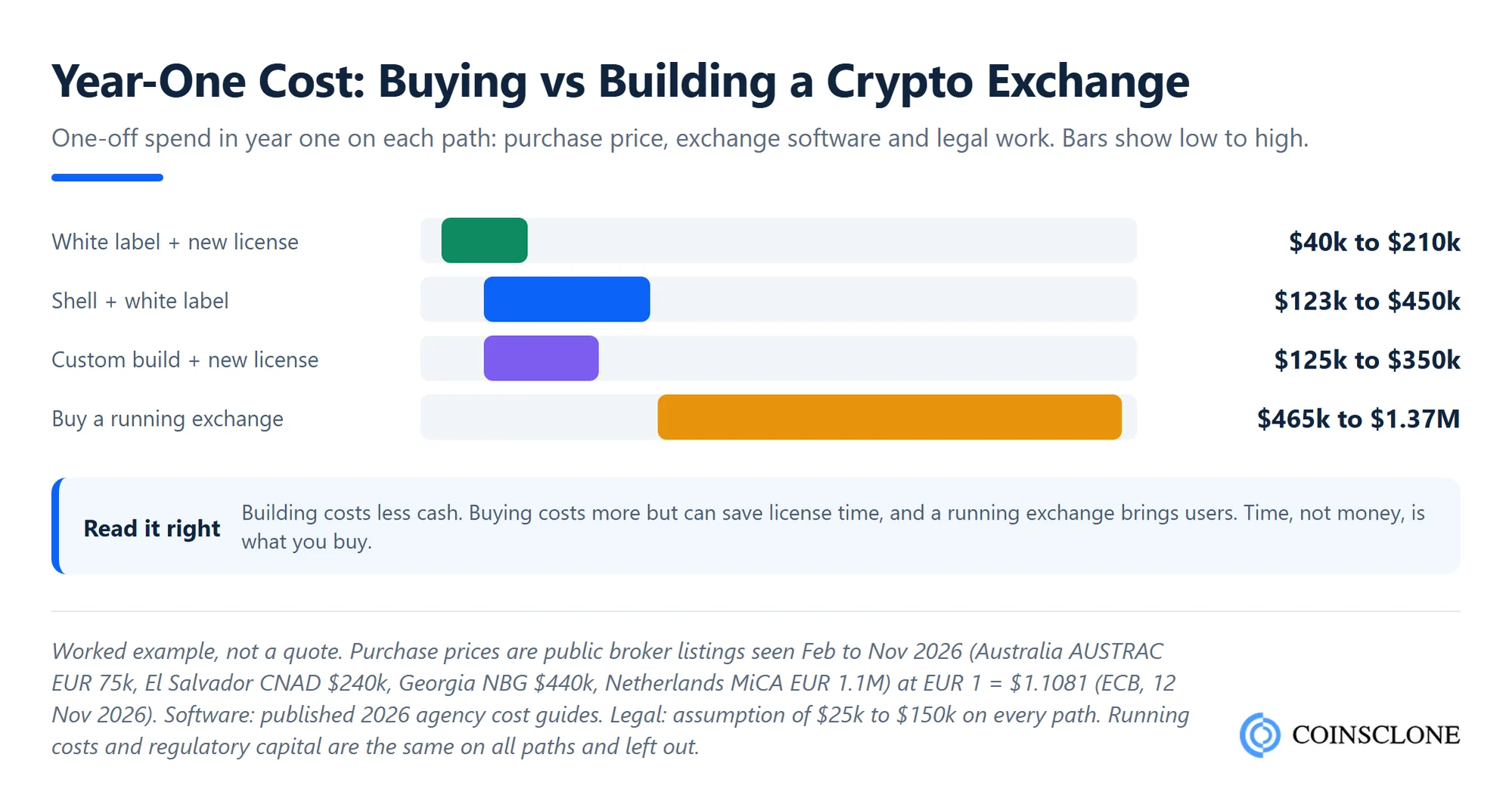
The white label path costs the least cash. Its launch date depends on the license. Under MiCA, a regulator has 25 working days to check a file is complete and 40 more to decide, and preparing that file takes longer. Coinsclone’s white label exchange takes 4 to 6 weeks, 7 to 10 with fiat rails, so the software is ready long before most licenses are.
A shell costs two to three times more and can save license time, but only where new licenses are slow or closed. A running exchange is the only path that buys revenue. It is also the one where hidden problems cost the most. If you want to see how revenue might cover these costs, our guide on whether owning a crypto exchange is profitable works through the numbers.
Due-Diligence Checklist for Buying a Crypto Exchange Company
Use this before you sign anything binding. Ask for documents, not answers.
- Change of control approval: Which regulator, what threshold, how long, and who files. Do not close until the regulator says yes.
- License status and conditions: Look up the license on the regulator’s own public list. Read its conditions and limits on services.
- License activity: When did the firm last serve a client? Dormant licenses can be withdrawn.
- AML file and past audits: The AML rules, the risk review, reports of odd trades sent to the state, past letters from the regulator and outside audit reports.
- Bank and payment accounts: A written statement from each bank on what happens after the sale.
- Hot wallet and key handover: A list of every wallet, who holds which keys, and a plan to rotate all keys at closing. Match on-chain balances to user balances.
- Tax: Filed returns, unpaid tax, VAT or GST position and any open tax audit.
- User data and consent: Privacy policy, data locations and whether the terms allow a transfer to a new owner.
- Liquidity and market maker contracts: Change of control clauses, fees and notice periods.
- Software and vendors: Who owns the code, which licenses end on a sale, and the state of KYC, custody and Travel Rule vendors.
- Debts and claims: Audited accounts, open complaints, lawsuits and user disputes.
- Volume and users: Verify volume from the database and the blockchain, not from screenshots.
Our guide to crypto compliance software explains the AML, KYC and Travel Rule tools you should expect to find in a clean file.
Red Flags in Crypto Exchange Listings
Most problems show up in the listing itself. This table pairs the wording with the rule that makes it matter.
| Red flag in the listing | Why it matters |
| “Dormant”, “non-operational” or “clean, no clients” license | MiCA Article 64 withdraws a license unused for 12 months or idle for 9 months. AUSTRAC removed dormant firms in the year to September 2026. |
| Old national crypto registration sold in the EU | MiCA’s transition for firms under old national rules ended on 1 July 2026 at the latest. An old registration alone no longer lets you serve EU users. |
| Nominee or “local director can stay” | Regulators judge who really runs the firm. A nominee can hide control and fail the fit and proper test. |
| License tied to one person | If the named director or compliance officer leaves, the firm must report it and the regulator may review the license. |
| No audited accounts | You cannot check debts, capital or past losses. MiCA firms must hold set capital at all times. |
| “Transfer in 1 to 2 weeks, no approval needed” | MiCA, VARA and the FCA all need approval before you take control. In the UK, skipping it is a crime. |
| Two prices on one listing | One listing above shows $225,000 and $240,000. Small errors in a listing often mean bigger ones in the files. |
| Legacy permission sold as a license | A Dubai NOC from before VARA’s regime is not a VARA license. Check the VARA register. |
| Bank accounts “included” | Banks decide, not sellers. Get the bank’s position in writing. |
| Volume claims with no data | Screenshots prove nothing. Ask for ledger exports and wallet addresses. |
Crypto Exchange for Sale in Dubai: What to Check
Dubai listings need extra care. The listing above sells a 2022 VARA NOC for $105,000. An NOC was an early permission, not a full VARA license.
A full exchange license under VARA costs AED 100,000 to apply and AED 200,000 a year in supervision fees for exchange services. The firm must also hold set capital. That is at least AED 800,000 if a VARA-licensed firm holds its coins, and AED 1,500,000 if not. A share of yearly costs applies if that is higher. Any buyer of control needs VARA’s prior written approval, as shown above.
So a cheap Dubai listing does not replace a VARA license. It may only shorten part of the path. For a side-by-side view of license options in other markets, see our crypto license guide.
Should You Buy a Crypto Exchange or Build One?
Answer these questions in order and stop at the first yes.
- Do you need users and revenue on day one, and can you spend $450,000 or more? Buy a running exchange, after the full checklist above.
- Is a new license in your market slow or closed, and is a clean licensed company for sale there? Buy a licensed shell and add white label software.
- Do you need a product no white label offers, such as your own matching engine or new markets? Build custom on your own license.
- Everyone else: Launch a white label exchange in your own new company and license.
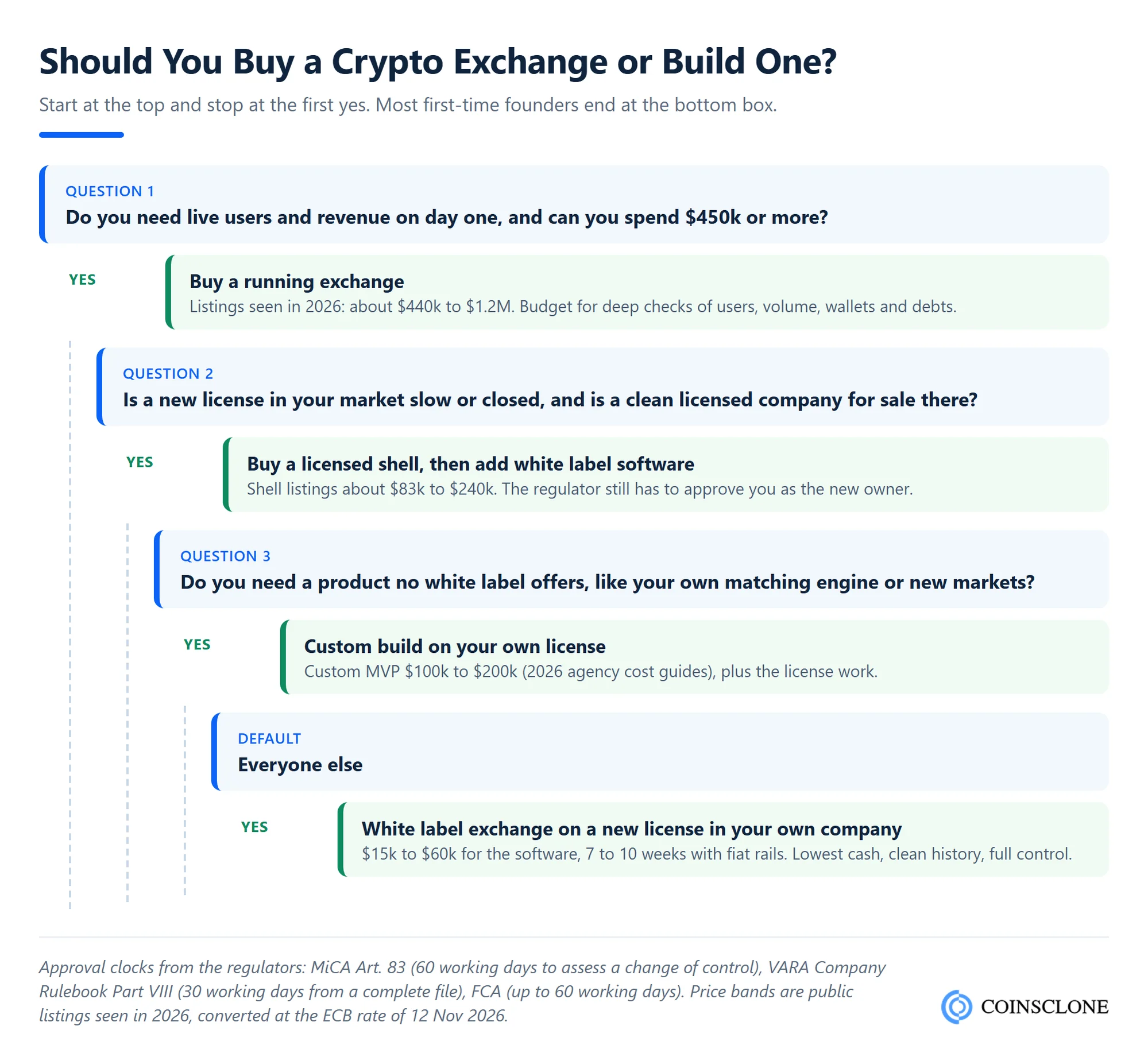
Most first-time founders land on the last answer. It costs the least cash, starts with a clean history, and gives you full control of the code and the brand. If you buy a shell, you will still need software, and a crypto exchange clone script is the fastest way to put a proven platform on that license.
Skip the Hunt for a Ready-Made Exchange and Launch Your Own
White label crypto exchange development, done right.
- Branded Exchange: A spot exchange with your name, domain and fee settings, live in 4 to 6 weeks
- Fiat On and Off Ramps: Bank and card rails added in 7 to 10 weeks
- Compliance Built In: KYC, AML screening and Travel Rule tools ready for your regulator
- Code You Control: Platform setup for an exchange company you buy or one you start new
See a live demo of our white label crypto exchange.
Book a Free Demo to plan your exchange launch, whether you buy or build.
How Coinsclone Helps
Coinsclone builds the software side of every path in this guide. We deliver white label crypto exchange software in 4 to 6 weeks, 7 to 10 with fiat rails and 9 to 13 with mobile apps. If you buy a licensed company, we can launch a branded platform on it while your approval runs. If you need a product white label cannot offer, our crypto exchange development company team builds it custom. Coinsclone has built crypto products since 2018 and delivered 350+ platforms for 200+ clients across 20 industries.
Frequently Asked Questions
Can you buy a crypto exchange?
Yes. You can buy exchange software, a licensed company or a running exchange. With a licensed company, you buy the shares and the regulator must approve you as the new owner. In the EU, Dubai and the UK, that approval must come before you take control.
Can a crypto license be transferred?
A license usually stays with the company that holds it, so you buy the company instead. The regulator then reviews you. Under MiCA that review takes up to 60 working days, under VARA 30 working days from a complete file, and the FCA can take up to 60 working days.
How much does it cost to buy a crypto exchange?
Public listings seen in 2026 asked about $83,000 to $240,000 for licensed shells and about $440,000 to $1.2 million for companies with users or staff. Source code alone was listed for about $10,600. Add legal work, software and the capital the regulator requires.
Is it worth buying a ready-made crypto company?
It can be, when new licenses in your market are slow or closed and the company is clean. For most founders, a white label exchange on a new license costs less cash and avoids someone else’s history. Run the full due-diligence checklist before paying any deposit.
How long does it take to buy a licensed crypto company?
The share transfer can take weeks, but the regulator’s review sets the real date. Plan for the legal clock (60 working days under MiCA, 30 under VARA after a complete file) plus the time to prepare the file and answer questions.
How much is a crypto exchange license in Dubai?
VARA charges AED 100,000 to apply for an exchange services license and AED 200,000 a year in supervision fees. The firm must also hold capital of at least AED 800,000 or AED 1,500,000, depending on how it handles custody.
Is owning a crypto exchange profitable?
It can be, but only when trading fees cover running costs such as staff, compliance, hosting and liquidity. Buying a running exchange gives you revenue sooner, while building gives you lower start-up costs. Model both before you choose.