
An NFT marketplace is a platform where people mint, list, buy and sell non-fungible tokens, with the sale settled by a smart contract rather than by the platform holding the asset. The token stays in the seller’s wallet until the moment of purchase, and the marketplace only ever has permission to move it. That one fact explains most of what follows.
This guide explains what an NFT marketplace is, how a sale works step by step, what the platforms charge in 2026, and which types and examples exist today. It is written for first-time buyers, creators choosing where to list, and founders weighing up their own platform.
In this guide:
- How a sale moves from listing to settlement, and why the platform never holds your NFT.
- What you really pay on a sale in 2026, with OpenSea and Blur fees worked through on a $1,000 example.
- The token standards, platform types and real platforms you will meet, plus which ones closed.
- Where the NFT market stands now, with CryptoSlam sales data from 2021 to 2025.
- Clear steps to buy safely, and a yes/no chart for founders picking a model.
Understand What an NFT Marketplace Is and How It Works Today
What is an NFT Marketplace — discover features and working process clearly.
- Easy Asset Listing: Creators mint and list NFTs with fixed or auction pricing.
- Seamless Wallet Integration: Buyers connect wallets to browse, bid, and purchase.
- Robust Admin Controls: Manage users, content, fees, and blockchain interactions.
- Essential Features: Includes search filters, royalties, security, and notifications.
See a free branded demo of your NFT marketplace in 48 hours — before you invest a cent.
Book a Free Demo to discover how What is NFT Marketplace can help you launch in just 8–12 weeks.
What Is an NFT Marketplace?
An NFT marketplace is an online platform for trading non-fungible tokens, which are blockchain records that prove who owns a single digital or real-world item. It joins a plain web shop with smart contracts that handle escrow, transfer and payment in one step.
- It is a marketplace in the classified-advert sense: it lists what other people own rather than holding stock.
- The purchase and the transfer happen at once, so neither buyer nor seller can take the other side’s value and walk away.
- They run on chains such as Ethereum, Solana, Polygon, Base and Bitcoin (through Ordinals).
In short, think of it as eBay where the listing, the payment and the handover are all done by code that nobody can quietly change.
What an NFT Marketplace Is Made Of
It has six working parts, and only two of them live on the blockchain. Knowing which is which answers most questions about how these platforms behave.
- Listing layer and indexer: a normal web app plus a service that reads chain data so the site can show who owns what and at what price.
- Smart contracts: the escrow and transfer logic that runs a sale, and the only part that moves assets.
- Wallet connection and fee logic: how you are known to the site, and how the platform cut and creator fee come out when the sale closes.
- Off-chain storage: the image or file itself, most often on IPFS or a server, with the token holding a pointer to it.
How Does an NFT Marketplace Work?
An NFT marketplace works in four stages: a creator mints a token, the owner lists it by signing an approval, a buyer pays and the contract transfers the token in the same step, and fees split as the sale closes. The platform never takes custody in a standard platform flow.
- Minting writes a new token to the chain with metadata pointing at the file.
- Listing is a signature that lets the platform contract transfer the token later. It is not a transfer itself.
- Buying runs payment and transfer together, which is what removes the risk that one side does not pay.
- Payout takes off the platform fee and any creator fee, then sends the rest to the seller.
For example, on OpenSea a listing is a signed order kept off-chain. Nothing touches the blockchain until a buyer accepts it. That is why listing is often free of gas, while buying always costs gas.
How Do NFT Marketplaces Run Day to Day?
Day to day, a platform runs a web shop, an indexer that keeps pace with the chain, a review team, and a fee and payout system. The hard part is not the trading. It is keeping what the site shows in sync with what is true on the chain.
- Indexing lag is why a sold item can briefly still appear listed.
- Content review handles stolen art, fake sets and banned items, none of which the blockchain stops.
- Data on floor price, volume and holder spread is now a core part of the product, not an extra.
NFT Token Standards You Will Meet
A token standard is the shared rulebook that lets any wallet or platform read an NFT the same way. A platform can only list the standards it supports, so this is one of the first things to check.
- ERC-721 (Ethereum and EVM chains): the first one-of-one standard. Each token ID is unique. The ERC-721 standard on ethereum.org sets the rules most platforms follow.
- ERC-1155 (Ethereum and EVM chains): one contract can hold many items, such as copies of the same piece. Games and ticketing use it to save gas.
- Metaplex (Solana): Solana NFTs follow Metaplex rules, so they trade on their own venues.
- Ordinals (Bitcoin): data written onto single satoshis. Fewer venues support them, and support has shrunk in 2026.
Most EVM platforms also read EIP-2981, a standard way for a collection to state its royalty. Stating a royalty is not the same as forcing one to be paid, as the royalties section below explains. For a deeper comparison, see our guide to popular NFT token standards.
Types of NFT Marketplace
NFT marketplaces divide into five types by who may list and where the buyers come from: open, curated, aggregator, chain native and niche. The type sets both the quality of supply and the depth of demand.
- Open platforms let anyone mint and list, which gives the most supply and the least curation.
- Curated platforms vet the artist before listing, trading volume for quality.
- Aggregators pull listings from other venues so buyers see the true floor across the market.
- Chain native platforms serve one chain in depth, and niche platforms serve one type of item or one group of fans.
Centralised vs Decentralised NFT Marketplaces
Most well-known platforms are a mix: a company runs the website, and smart contracts settle the trades. The split that matters is who controls the listings, the fees and your access.
| Centralised (company-run) | Decentralised (protocol-run) | |
| Who runs it | A company sets fees, rules and what is shown | Smart contracts and often a DAO or token holders |
| Custody | Usually non-custodial; a few hold assets in house | Non-custodial; NFTs stay in your wallet |
| Payments | Some accept cards and fiat | Crypto only |
| Moderation | Can hide stolen or fake items quickly | Hard to remove items from the protocol itself |
| Risk | The company can delist you or shut down | Bugs in code; fewer support options |
| Examples | OpenSea, Magic Eden, SuperRare | Protocols like Seaport, which other sites build on |
How Crypto Wallets Connect to NFT Marketplaces
A wallet connects to a platform by signing a message that proves you control an address. This costs nothing and grants no power to move assets. Approving a contract is an on-chain step that does grant that power, and that gap is where most NFT losses start.
- Connecting is free and off-chain, and it only lets the site look. The site can see what your address holds and nothing more.
- Approving is an on-chain step that lets the platform’s contract move tokens from that set when a sale runs.
- Approvals last until you revoke them, so review old ones from platforms you no longer use.
- MetaMask and WalletConnect cover most EVM platforms, while Phantom and Backpack cover Solana.
How Do NFT Marketplaces Prove Who Owns What?
The blockchain, not the platform, proves ownership, because a token’s transfer history is public and cannot be edited. Proving the art is real is another problem. Platforms solve it with verified badges, contract checks and content review.
- The chain proves who holds a token and every address it has passed through, which no platform can alter.
- It does not prove that the artwork was made by the person who minted it, which is why verified badges exist.
- Always open a collection from inside the platform and check the contract address, because copycat sets are the most common scam.
How Do NFT Marketplaces Make Money?
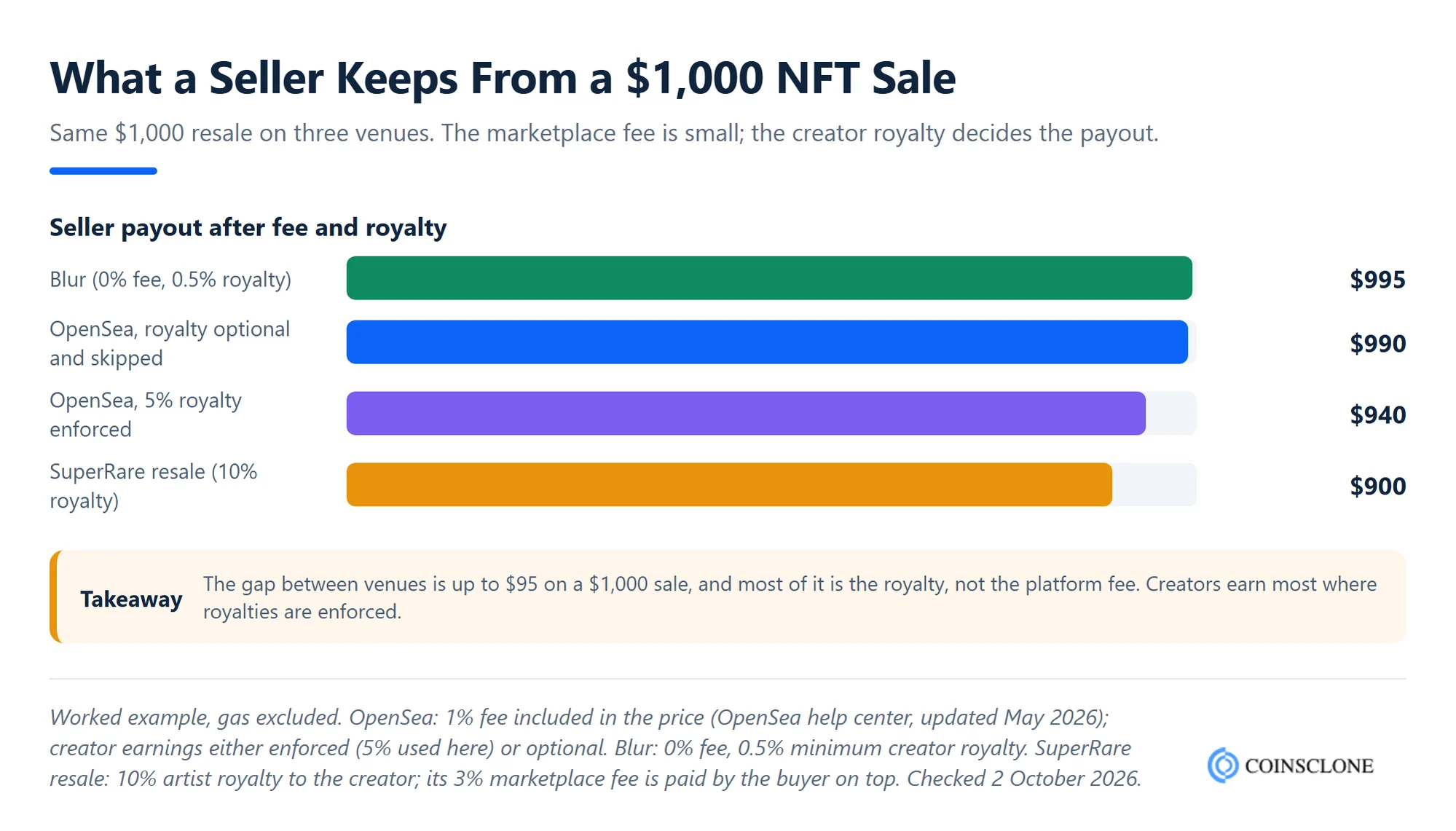
Most NFT platforms earn from a fee on each sale, plus fees on primary drops, launchpads and premium tools. The fee is small next to the creator fee and, on Ethereum, the gas.
Here is what the largest venues charge as of October 2026:
| Platform | Sale fee | Other fees and notes |
| OpenSea | 1%, included in the price | 10% on primary drop mints, 0% on swaps |
| Blur | 0% | Ethereum only; creators have had a 0.5% minimum royalty, and a governance proposal (BIP-1) would swap it for a 0.5% protocol fee |
| Magic Eden | Small taker fee | Solana only since 9 March 2026 |
| SuperRare | 3%, paid by the buyer on resales | 15% on first sales of curated art |
OpenSea raised its fee from 0.5% to 1% on 15 September 2025, and its fee page was last updated in May 2026. So check the fee inside the product before you list, because platforms change it with little notice.
Beyond sale fees, platforms earn from launchpad deals, paid spots on the home page, paid data tools and, more and more, their own tokens. Our breakdown of the NFT marketplace revenue model covers each stream in detail.
How Do NFT Marketplaces Handle Resales and Royalties?
Resales run through the same contract flow as a first sale, with the platform fee and any creator royalty taken as the sale closes. The big change in recent years is that royalties became optional on most major platforms.
- A creator royalty is set at the collection level and is only paid where the platform chooses to enforce it.
- On OpenSea, each set’s creator fee is either forced or left to the seller, who then decides what to pay.
- Blur has kept a 0.5% royalty floor (a pending governance proposal would turn it into a protocol fee), while curated art venues such as SuperRare still enforce royalties in full.
- Creators who want firm royalties can use contracts that block sales on venues that skip them, such as Limit Break’s ERC-721C on EVM chains.
For creators, this means the venue you list on now shapes long-term income, not just first-sale reach.
Which NFT Marketplaces Are Live in 2026?
The market has shrunk to a handful of large venues and many niche ones. Here is who matters today, and what changed this year.
- OpenSea: the widest range of items across many EVM chains plus Solana. The default for casual collectors.
- Blur: the pro trader venue for Ethereum, with zero fees and NFT lending through Blend.
- Magic Eden: now a Solana-only platform. It closed its Bitcoin Ordinals, Runes and EVM markets, and non-Solana trading ended on 9 March 2026.
- SuperRare: a curated venue for one-off art on Ethereum.
- Courtyard: a platform for real trading cards held in a vault and sold as NFTs on Polygon. It is one of the biggest sellers by volume.
Several well-known names have closed. Nifty Gateway shut in February 2026, Foundation in April 2026 and Binance NFT in July 2026. MakersPlace and KnownOrigin closed earlier. For fees, chains and use cases side by side, see our list of the best NFT marketplaces in 2026.
What Can You Buy on an NFT Marketplace?
You can buy any item that has its own token, and in 2026 art is no longer the main story. The same platform flow handles very different assets.
- Art: profile picture sets, code-made art and one-off pieces.
- Game items: skins, characters and land that you can sell outside the game.
- Tickets and passes: event tickets and memberships that prove entry and can be resold under set rules.
- Domain names: ENS names such as yourname.eth that point to a wallet address.
- Real goods in a vault: trading cards, sneakers and watches held by a custodian, where the NFT is the claim on the item.
Physical-backed NFTs have been one of the few growth areas, led by vaulted trading cards on Courtyard.
The NFT Market in 2026
NFT trading is far below its 2022 peak, but it has not vanished. Instead, it has moved from high-priced art to cheaper, more useful items.
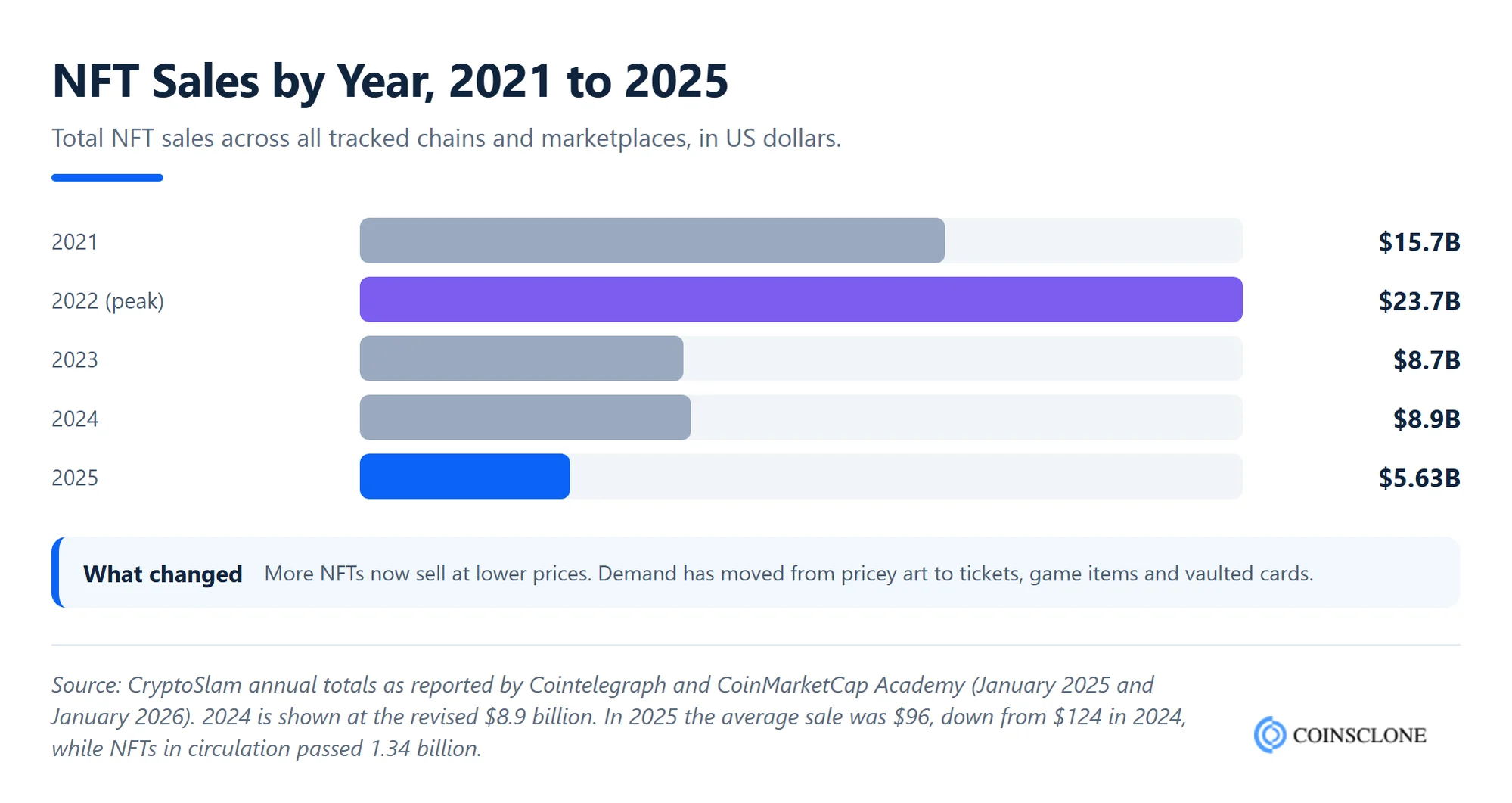
- Total NFT sales fell 37% in 2025 to $5.63 billion, per CryptoSlam data reported by CoinMarketCap.
- The average sale dropped to $96 from $124 in 2024, while the number of NFTs in circulation passed 1.34 billion.
- More sales at lower prices means buyers now care about use, such as tickets, games and vaulted goods, over pure speculation.
For platform owners, the lesson is clear. Volume now comes from a focused niche with real demand, not from one more general platform.
What NFT Marketplaces Are Not
Several common beliefs about these platforms are simply wrong, and they cause both confusion and real losses. The most important is that the platform does not hold your NFT.
- The image is not on the blockchain. The token holds a pointer, and the file most often lives on IPFS or a server.
- Buying an NFT does not buy the copyright. You own the token, and the rights stay with the creator unless assigned.
- The platform does not hold your asset. It holds the right to transfer, which is why you should revoke old approvals.
- Creators are not always paid on resales. Each platform sets its own rules.
- NFTs are not only art. Tickets, game items, domain names and vaulted real goods use the same standards.
Key Features of an NFT Marketplace
The features that decide whether a platform works are wallet support, minting tools, listing formats, search and filters, creator fee logic, and a reliable indexer. The rest is down to taste.
- Wallet support across the wallets your target chain uses.
- Minting with set item data, editions and creator fee settings.
- Listing types such as fixed price, timed auction and offers on a whole set.
- Search, filters and rarity data, which is how buyers find their way through large sets.
- Indexing and data on floor price, volume and past owners.
- Review and trust checks to handle stolen work and fake sets.
We cover each of these, and the extras that drive growth, in our guide to the features of an NFT marketplace.
How to Buy Your First NFT
For a first purchase, use a large platform on the chain where the set you want lives, check the contract before buying, and start with an amount you could afford to lose. The technical risk is low and the human risk is high.
Follow these steps for a first buy:
- Set up a wallet: MetaMask for Ethereum and other EVM chains, or Phantom for Solana. Write down the recovery phrase offline.
- Fund it: buy ETH, SOL or the chain’s coin on an exchange and send it to your wallet, plus extra for gas.
- Pick the right venue: OpenSea covers the widest range of chains and sets, and Magic Eden is the main choice on Solana.
- Check the collection: open it from inside the platform, look for the verified badge and match the contract address.
- Buy or bid: pay the listed price or place an offer, then confirm it in your wallet.
After that, a few habits keep you safe:
- Never mint or buy from a link sent to you in a message or post.
- Budget for gas on top of the price. On Solana it is a fraction of a cent; on Ethereum mainnet it can be a few dollars.
- Revoke approvals you no longer need, using your wallet or a tool such as Revoke.cash.
Building an NFT Marketplace
A build has five parts: a smart contract layer, an indexer, a wallet layer, a shop front and an admin panel. The contracts are the smallest part of the work, and the indexer is most often the largest.
- Contracts: minting, listing, escrow, transfer and creator fee logic, audited before launch.
- Indexer: the service that keeps what users see in sync with the chain, which decides whether the product feels reliable.
- Shop and admin: browsing, search, rarity, review tools, fee settings and reports.
- Chain choice: set by where your target sets and buyers are today, not by tech taste.
Before any of that, decide which model fits your supply and your community. The decision tree below is a quick way to start.
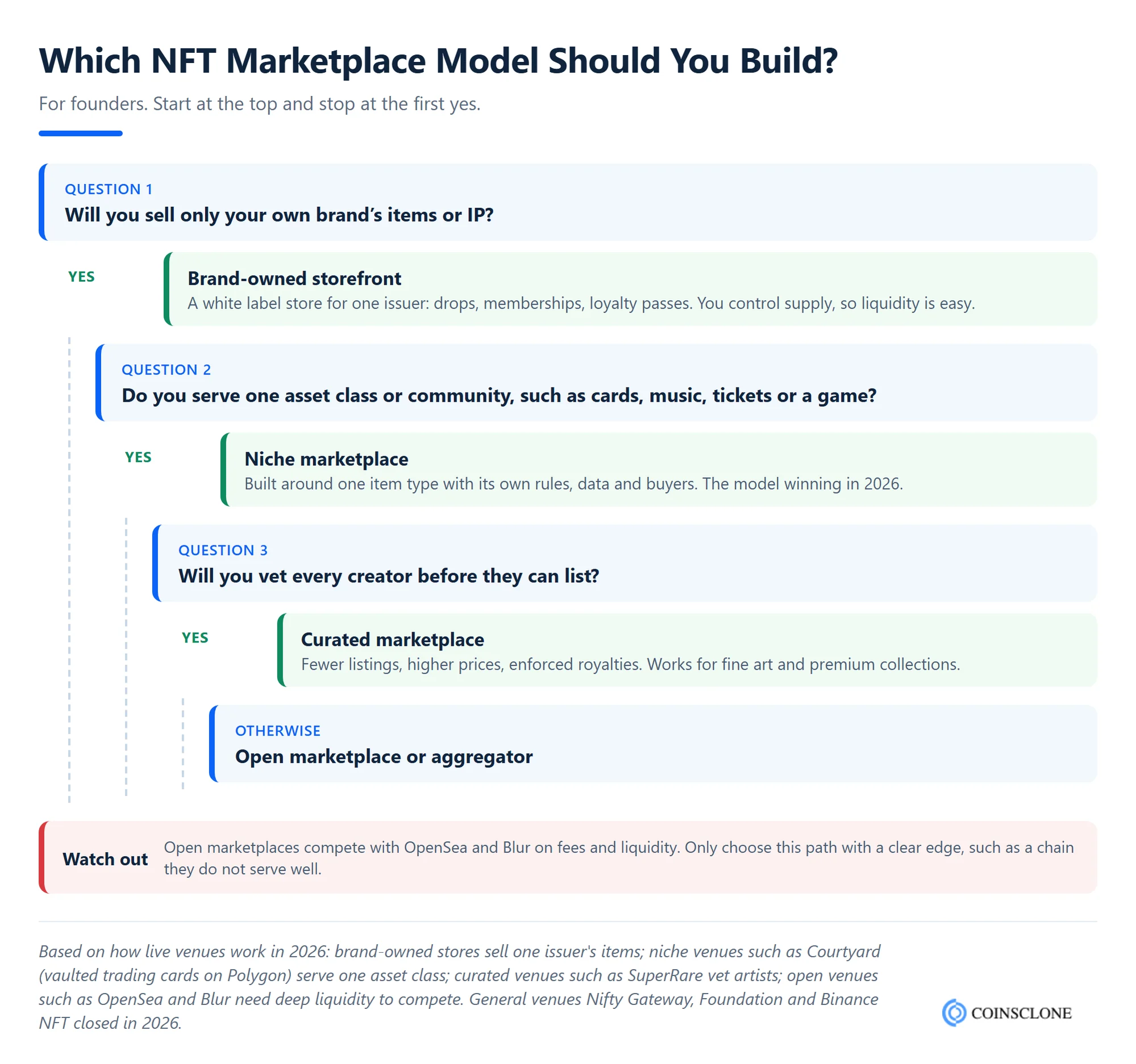
Our step-by-step guide on how to build an NFT marketplace walks through the full process, and the NFT marketplace development cost guide breaks down the budget. If you would rather launch with a tested team, Coinsclone’s NFT marketplace development service covers contracts, indexer, wallets and admin tools in one build.
Frequently Asked Questions
What is an NFT marketplace in simple terms?
A website where people list non-fungible tokens for sale and buyers purchase them, with the swap of payment for token carried out by a smart contract rather than by the site itself.
How does an NFT marketplace make money?
Mainly a cut of each sale, such as OpenSea’s 1%, and sometimes fees on primary drops, launchpad deals or premium tools. Some venues, such as Blur, charge no sale fee and earn elsewhere.
What is the most popular NFT marketplace?
OpenSea has the widest range and the most chains, so it is the most used by casual collectors. Blur leads among pro Ethereum traders, and Magic Eden is the main venue on Solana.
Do I need a crypto wallet to use an NFT marketplace?
Yes. The wallet is your identity and your account, and it holds the assets. There is no password-based account holding a balance for you.
Is the NFT stored in the marketplace?
No. The token stays in your wallet and the media file most often sits on IPFS or a server. The platform shows both.
What is the difference between an NFT marketplace and a crypto exchange?
An exchange trades fungible assets, where any one unit equals any other. An NFT marketplace trades one-off items, so each listing has its own price and there is no single order book price.
Are NFTs still worth money?
Some are, but most are worth far less than at the 2021 and 2022 peak. NFT sales totalled $5.63 billion in 2025 with an average sale of $96, per CryptoSlam. Value now sits mostly in items with a use, such as tickets, game items and vaulted cards, and in a small group of famous sets.
Can you cash out an NFT?
Yes. Sell the NFT on a platform for crypto, such as ETH or SOL, then send that crypto to an exchange and sell it for your local currency. You can only cash out if a buyer wants it at your price, and the sale may be taxable where you live.
Can you give me an example of an NFT?
An ENS domain such as yourname.eth is an NFT, and so is a Pudgy Penguins profile picture or a Courtyard token backed by a graded Pokémon card in a vault. Each one is a one-off token that a marketplace can list and sell.
Why would anyone buy an NFT?
People buy NFTs to collect art from creators they like, to use an item in a game, to get into an event or a members’ club, or to own a claim on a real item they can trade quickly. Some also buy to resell, which carries real risk of loss.
Can anyone create an NFT marketplace?
In theory, yes, and the contracts are well known. The hard parts are buyers, trust checks and content review, which is what separates a working platform from an empty one.
Understand What an NFT Marketplace Is and How It Works Today
What is an NFT Marketplace — discover features and working process clearly.
- Easy Asset Listing: Creators mint and list NFTs with fixed or auction pricing.
- Seamless Wallet Integration: Buyers connect wallets to browse, bid, and purchase.
- Robust Admin Controls: Manage users, content, fees, and blockchain interactions.
- Essential Features: Includes search filters, royalties, security, and notifications.
See a free branded demo of your NFT marketplace in 48 hours — before you invest a cent.
Book a Free Demo to discover how What is NFT Marketplace can help you launch in just 8–12 weeks.
Build Your NFT Marketplace with Coinsclone
Coinsclone builds NFT marketplaces for founders who aim at one chain, one type of asset or one group of fans, not one more general site. Since 2018 we have delivered 350+ platforms for 200+ clients across 20 industries. Our work covers audited smart contracts, the indexer that keeps what users see correct, wallet support, minting and listing flows, creator fee logic, and the review and admin tools a live platform needs.
We start from a live demo rather than a spec document. Talk to our team about the chain and the fans you want to reach, and we will map the fastest route to launch.