
ERC-20 is the standard behind most tokens on Ethereum, from stablecoins like USDT and USDC to governance tokens like UNI. Because every wallet, exchange and DeFi app understands it, an ERC-20 token works across the whole Ethereum ecosystem the moment it is deployed.
Creating one is easier than ever. With audited open-source code, you can write a basic token in about ten lines and deploy it for a few cents on a layer 2, or around $30 on Ethereum mainnet at today’s gas prices. The hard part is not deployment. It is choosing the right token features, keeping the contract safe and planning the launch. This guide shows you how to create an ERC20 token step by step, with real code, current costs and the mistakes to avoid.
See How Our ERC20 Token System Can Launch Your Crypto Project Faster
Create Your ERC20 Token — done right.
- MVP Token System : Launch your fully functional ERC20 token 90% faster.
- Smart Contracts & Wallets : Pre-built contracts, ready-to-deploy, no coding required.
- Brand & Customization : Your token name, symbol, supply, and logo — fully customizable.
- Revenue & Utility : Add staking, rewards, or transaction fees for instant monetization.
See a free branded demo of your ERC20 token in 48 hours — before you spend a dime.
Book a Free Demo to discover how our ERC20 Token Development service can take you from concept to live token in just 2–4 days.
What Is an ERC20 Token?
An ERC20 token is a fungible token on Ethereum, or on an Ethereum-compatible chain, that follows the ERC-20 standard. “Fungible” means every unit is identical and interchangeable, like dollars. The standard defines a common set of functions, so any wallet or app can read balances and move tokens in the same way.
ERC-20 is a technical standard, not a token type. The same standard can power a utility token, a governance token, a stablecoin or a reward point. What the token does depends on your project, not on the standard.
The Six Functions Every ERC20 Token Has
- totalSupply: the total number of tokens in existence.
- balanceOf: how many tokens a given address holds.
- transfer: sends tokens from your address to another.
- approve: lets another address, such as a DEX, spend up to a set number of your tokens.
- allowance: shows how many tokens an address is still allowed to spend on your behalf.
- transferFrom: moves tokens on your behalf, within the approved allowance. This is how DEXs and apps move your tokens after you approve them.
Tokens also expose a name, a symbol and decimals, usually 18.

How to Create an ERC20 Token in 6 Steps
Step 1: Plan the Token
Decide what the token is for, how many will exist, and who gets them. Write down the total supply, how tokens will be distributed (team, investors, community, liquidity), any vesting schedules, and whether you need extra features such as minting or burning. These choices shape the contract, so make them first.
Step 2: Choose the Network
You can deploy the same ERC-20 code on Ethereum mainnet or on any EVM-compatible chain. Mainnet has the most liquidity and trust but higher fees. Layer 2s such as Base, Arbitrum and Optimism, and chains such as BNB Chain and Polygon, cost a fraction of a cent per transaction. Pick the chain where your users and trading will be.
Step 3: Choose the Features
Start from the plain standard and add only what you need:
- Fixed supply: all tokens are minted once, at deployment. This is the simplest and most trusted option.
- Mintable: an owner can create new tokens later. Buyers will ask who controls this.
- Burnable: holders can destroy their own tokens.
- Pausable: an owner can stop transfers in an emergency.
- Capped: a hard limit on total supply, even if minting is allowed.
- Permit (EIP-2612): users approve spending with a signature instead of a separate transaction, which saves gas.
- Votes: tracks voting power for governance.
Every owner power you add is also a trust question. Many investors and token scanners treat unlimited minting or the ability to block transfers as red flags.
Step 4: Write the Smart Contract
Smart contracts on Ethereum are written in Solidity (or, less often, Vyper). You do not need to write the token logic from scratch. OpenZeppelin’s audited contracts are the industry standard, and its free Contracts Wizard can generate code with the features you pick.
Here is a complete fixed-supply ERC-20 token using OpenZeppelin Contracts version 5:
// SPDX-License-Identifier: MIT
pragma solidity ^0.8.24;

import {ERC20} from "@openzeppelin/contracts/token/ERC20/ERC20.sol";
import {ERC20Permit} from "@openzeppelin/contracts/token/ERC20/extensions/ERC20Permit.sol";

contract MyToken is ERC20, ERC20Permit {
    constructor() ERC20("My Token", "MTK") ERC20Permit("My Token") {
        // 1,000,000 tokens with 18 decimals, sent to the deployer
        _mint(msg.sender, 1_000_000 * 10 ** decimals());
    }
}
This contract has no owner and no minting after deployment, so the supply can never change. That is the easiest design for buyers to trust.
Step 5: Test and Audit
Test the contract before any real money is involved:
- Write automated tests with Foundry or Hardhat, including transfers, approvals and edge cases.
- Deploy to a testnet such as Sepolia and try it with a real wallet.
- For any custom logic, such as taxes, vesting or minting rules, get an independent security audit.
A plain OpenZeppelin token with no changes carries little risk. Custom code is where most token bugs and exploits happen.
Step 6: Deploy and Verify
Deploy the contract from a wallet using Remix, Foundry or Hardhat, and pay the network fee. Then verify the source code on the block explorer, such as Etherscan or Basescan, so anyone can read it. Unverified contracts look suspicious to traders and scanners.
After deployment, add the token to wallets with its contract address, and share only that official address, because scammers often create copycat tokens with the same name.
How Much Does It Cost to Deploy an ERC20 Token?
The network fee depends on the chain and on gas prices at the moment you deploy.
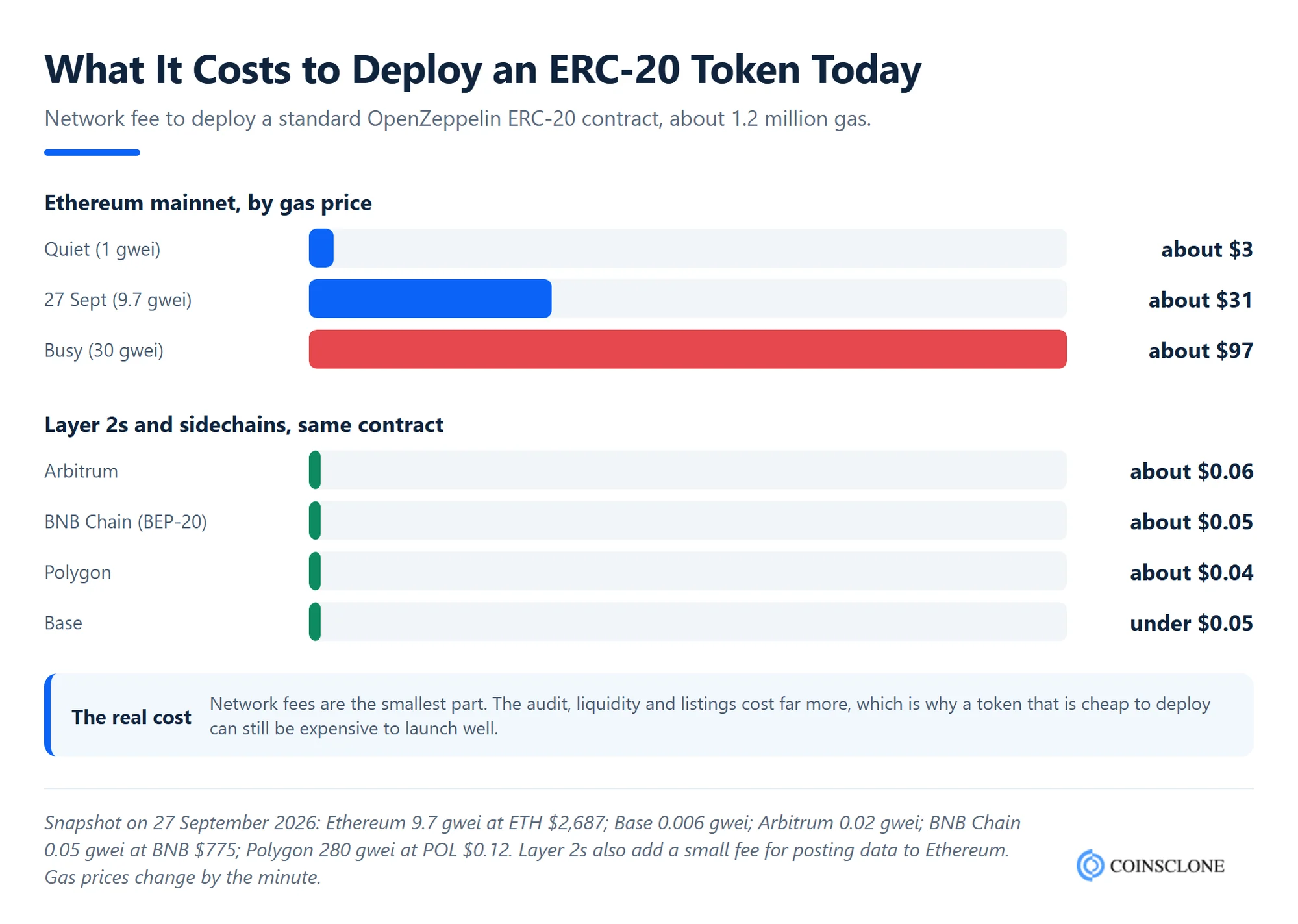
The network fee is only one cost. A full launch also includes development of any custom features, an audit, liquidity for trading, and listings. Our guide to the cost to create a crypto token breaks down the full budget.
Can You Create an ERC20 Token for Free or Online?
Online token generators let you create an ERC-20 token by filling in a form, with no code. They are fast and cheap, but check three things first:
- Who controls the contract: some generators keep hidden owner powers or fees in the code.
- Whether the code is verified: you should be able to read exactly what was deployed.
- Whether it is a standard contract: tokens built from odd templates can be flagged by exchanges and scanners.
You always pay the network fee to deploy, so no token is truly free on mainnet. On a testnet, you can deploy for free using test ETH, which is the right place to practise.
How to Launch an ERC20 Token After Creating It
Creating the token is the start. To launch it well:
- Publish token details: supply, distribution, vesting and the official contract address.
- Add liquidity: create a pool on a DEX such as Uniswap so people can trade.
- Lock or vest team tokens: show that insiders cannot sell everything at once.
- Get listed: apply to token lists, data sites and exchanges.
- Build a community: explain the token’s use clearly and honestly.
Common ERC20 Mistakes to Avoid
- Unlimited owner minting: buyers see it as a rug-pull risk.
- Hidden transfer taxes or blacklists: often flagged as a honeypot by token scanners.
- Wrong decimals: sticking with 18 avoids errors in apps and exchanges.
- Skipping verification: unverified code scares off buyers and listings.
- Copying random code: always start from audited libraries like OpenZeppelin.
- Unlimited approvals in your app: ask users to approve only what a transaction needs.
Why Create an ERC20 Token for Your Business?
- Works everywhere: every major wallet, exchange and DeFi app supports ERC-20.
- Proven and audited code: standard libraries are battle-tested.
- Low cost to deploy: especially on layer 2s.
- Easy to list: exchanges and DEXs already know how to handle it.
- Flexible use: payments, rewards, governance, access and fundraising.
If you are comparing chains, see our guide to ERC20 vs TRC20 tokens and the full list of ERC token standards.
Why Work With a Token Development Company?
A plain token is simple. Most real projects need more: vesting contracts, staking, governance, cross-chain deployment, an audit and a launch plan. A development team handles these safely and makes sure the contract matches your token plan.
Coinsclone offers ERC20 token development and Ethereum token development, including:
- Supply, distribution and vesting setup
- Mintable, burnable, pausable and capped options
- Permit and governance features
- Testing, audit support and contract verification
- Deployment on Ethereum and EVM chains
- Liquidity and listing support
Why Choose Coinsclone?
Coinsclone has delivered more than 350 blockchain platforms for over 200 clients. As a crypto token development company, we build tokens on audited foundations, keep owner powers transparent, and help you launch with a clear plan. Read our broader guide on how to create a crypto token, or talk to our team.
See How Our ERC20 Token System Can Launch Your Crypto Project Faster
Create Your ERC20 Token — done right.
- MVP Token System : Launch your fully functional ERC20 token 90% faster.
- Smart Contracts & Wallets : Pre-built contracts, ready-to-deploy, no coding required.
- Brand & Customization : Your token name, symbol, supply, and logo — fully customizable.
- Revenue & Utility : Add staking, rewards, or transaction fees for instant monetization.
See a free branded demo of your ERC20 token in 48 hours — before you spend a dime.
Book a Free Demo to discover how our ERC20 Token Development service can take you from concept to live token in just 2–4 days.
Frequently Asked Questions
How do I create an ERC20 token?
Plan the supply and features, choose a network, write the contract in Solidity (usually with OpenZeppelin’s audited code), test it on a testnet, deploy it from a wallet, and verify the source code on the block explorer.
How much does it cost to create an ERC20 token?
On 27 September 2026, deploying a standard ERC-20 cost about $31 in network fees on Ethereum mainnet, and a few cents on layer 2s such as Base and Arbitrum. Custom features, audits and liquidity add much more.
Can I create an ERC20 token for free?
You can practise for free on a testnet. On a live network, you always pay a network fee to deploy, though on layer 2s it is a few cents.
What programming language is used to create an ERC20 token?
Solidity, the main smart contract language for Ethereum. Vyper is a less common alternative. JavaScript or TypeScript is often used for testing and deployment scripts.
What is the difference between ERC20 and a utility token?
ERC-20 is a technical standard. A utility token is a use case. A utility token can be built with the ERC-20 standard, but so can stablecoins and governance tokens.
How do I launch an ERC20 token after creating it?
Publish the token details and official address, add liquidity on a DEX, lock or vest team tokens, apply for listings and build a community around the token’s real use.