

The question gets asked every cycle, and it usually gets answered badly because the person asking and the person answering are talking about different things. Price is one thing. Usage is another. In 2026 those two diverged more sharply than in any previous cycle: Bitcoin roughly halved from its October 2025 record, ETF flows turned negative for the first time, and sentiment reached cycle lows, while stablecoin settlement volume, tokenized treasuries and institutional custody infrastructure all grew straight through the drawdown. This article separates those two stories, states what genuinely did die and deserved to, and sets out where the sector is actually working.
Is Blockchain Dead in 2026?
No. Blockchain is not dead in 2026, but a large part of what was built on it is, and the two get confused because the price chart is the only thing most coverage looks at.
The short answer, split into the parts that actually moved in different directions:
- Prices fell. Token valuations corrected hard, and the headlines followed the chart.
- Usage did not. Settlement volume, active addresses and stablecoin transfer value held up or grew through the decline.
- Stablecoins became the real product. They are the one use case with obvious demand, institutional participants and regulatory attention.
- Speculative categories collapsed. Chains without users, NFT projects without buyers and yield built on nothing all went away, and needed to.
- Enterprise adoption got quieter and more real. Fewer press releases, more production systems in payments, tokenized funds and supply chain.
So the honest position is that the speculative layer died and the settlement layer did not. The sections below put numbers behind each of those claims and say where the sector is genuinely working.
Price Fell, Usage Did Not: What the Gap Shows
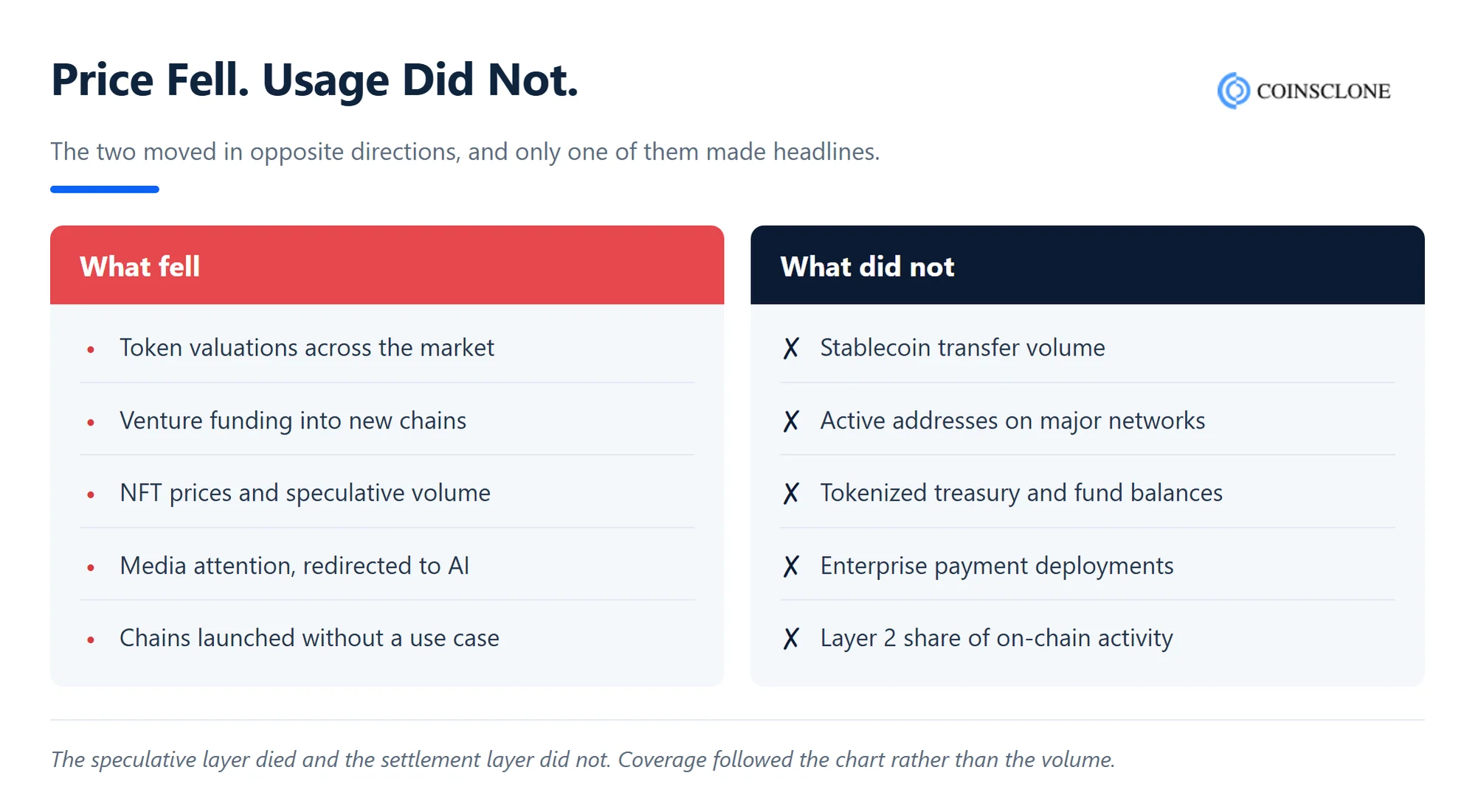
What fell: Bitcoin declined roughly 50 percent from its October 2025 record near $126,000, which several analysts noted was its shallowest bear market to date. ETF flows turned negative for the first time. Sentiment indicators sat near cycle lows. Speculative token launches collapsed, and many chains launched during 2025 emptied out within weeks of their token events.
What kept growing: stablecoin settlement volume, tokenized real-world assets, institutional custody and market infrastructure, enterprise deployment relative to retail Web3, and regulated banking access to digital assets.
The more useful description of this cycle is not collapse but repricing. The market is deciding which parts of the sector deserve capital, and that is a different phenomenon from a technology failing. Previous downturns were crises of both price and infrastructure. This one is not.
Why Do People Keep Asking If Blockchain Is Dead?
The question keeps returning for reasons that are mostly rational, and dismissing them is how the sector lost credibility in the first place.
- The price is the only visible metric. When the token falls, the technology looks like it failed, even when usage rose over the same period.
- A decade of overpromising. Blockchain was pitched as the answer to voting, healthcare records, land registry and almost everything else, and most of those pilots quietly ended.
- Real failures were large and public. Exchange collapses, bridge exploits and chains that emptied after their token events were all genuine, and all newsworthy.
- AI took the attention. Capital and coverage moved, which reads as abandonment whether or not it is.
- The working parts are invisible. A stablecoin settlement running inside a treasury operation does not generate headlines the way a collapse does.
The useful response is not to argue that nothing failed. It is to be precise about what failed and what did not.
What Do the 2026 Numbers Actually Show?
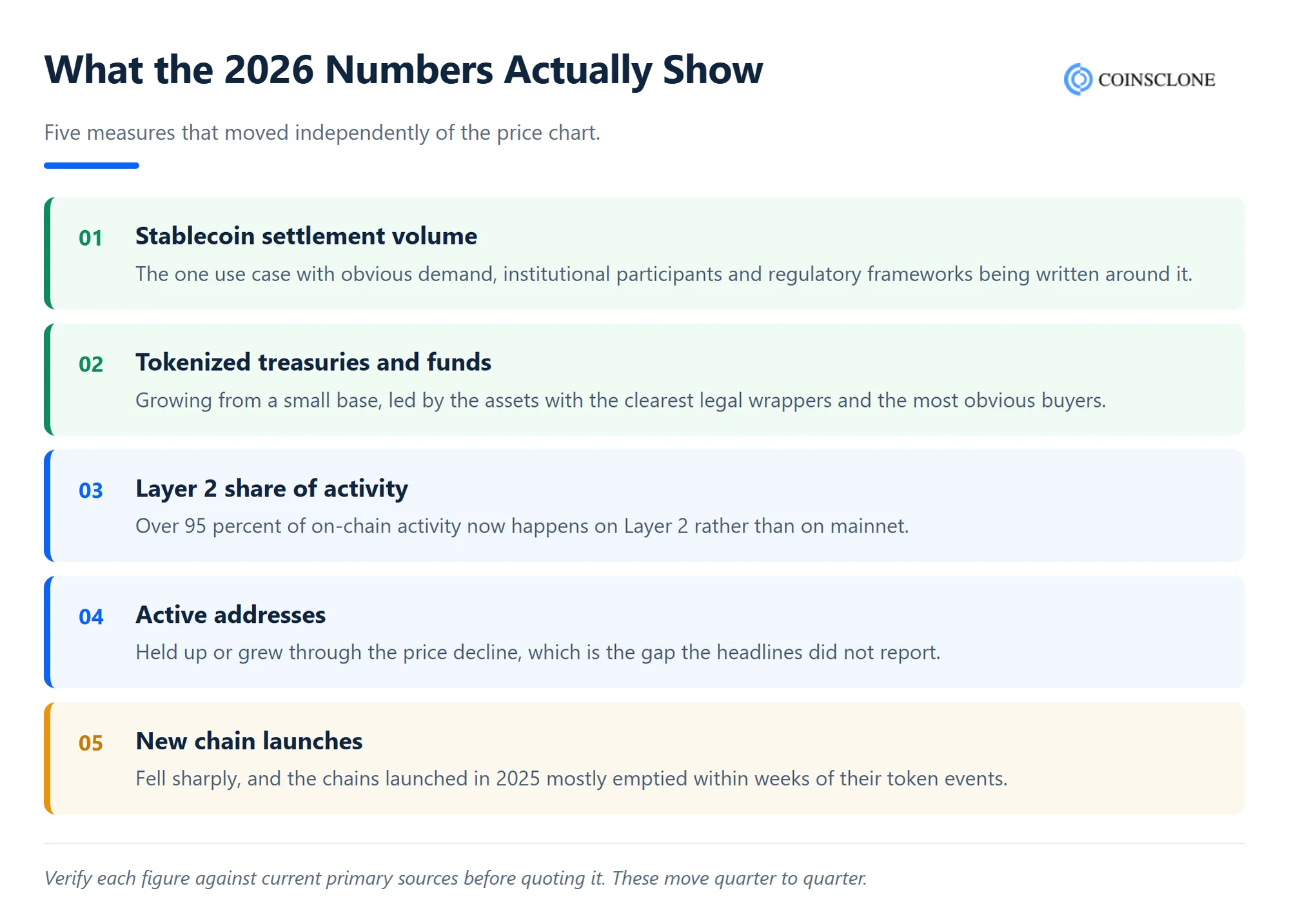
Several figures reported through 2026 are worth stating carefully, because methodologies differ and some are contested.
Bitcoin drawdown. Roughly 50 percent from an October 2025 record near $126,000, reported as its shallowest bear market.
Stablecoin liquidity. Exchange stablecoin balances reported around $180 billion, representing a substantial pool of capital that has not left the ecosystem.
Tokenised assets. Early 2026 estimates place the broader tokenized asset market above $340 billion, with on-chain cash, treasuries and money market instruments having crossed $36 billion during 2025.
Institutional intent. A Coinbase and EY-Parthenon survey reported 67 percent of institutions prioritising asset tokenization over the following two years.
Regulated access. In December 2025 the OCC conditionally approved national trust bank charters tied to digital assets for several firms, moving custody infrastructure inside the federal banking perimeter.
Attribute these rather than asserting them. Estimates in this area vary meaningfully by source.
What Actually Died, and Needed To
Being specific about this is what makes the rest of the argument credible.
Blockspace for its own sake. Chains launched without users, incentivized with points, and abandoned after a token event.
NFT speculation as a business model. Profile pictures as an asset class did not survive contact with liquidity.
Yield without a source. Returns paid from new deposits rather than from underlying economic activity, which was never sustainable and was widely known not to be.
Blockchain for single-writer data. Projects where one organization controlled everything and a database was always the correct answer.
The everything-on-chain thesis. The claim that most software should be rewritten onto a ledger.
Every one of these deserved to fail, and their failure is evidence of a maturing sector rather than a dying one. A field where nothing fails is a field where nothing is being tested.
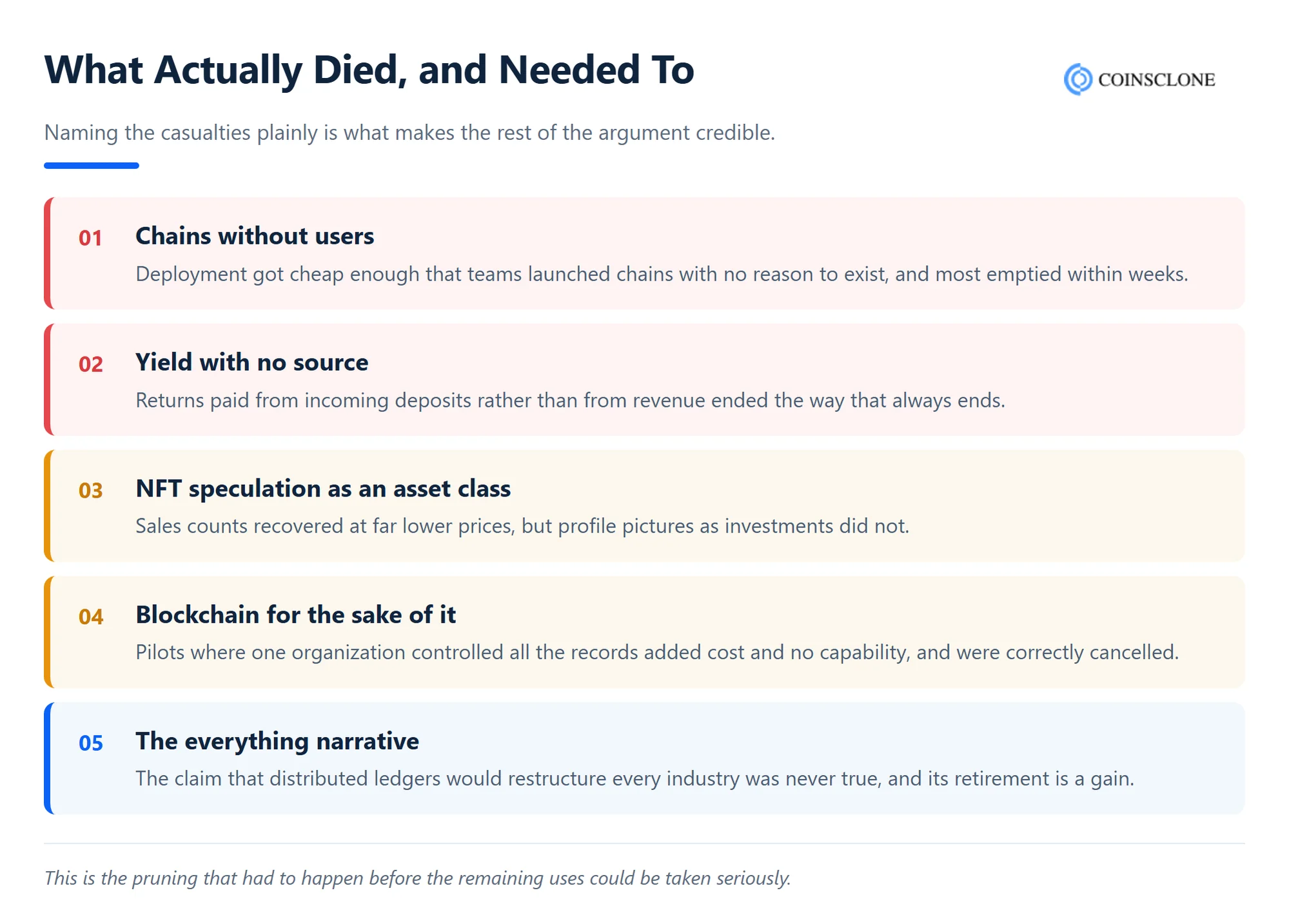
Naming the casualties plainly is what makes the rest of the argument credible.
- Chains without users. Deployment became cheap enough that teams launched chains with no reason to exist, and most emptied within weeks of their token event.
- Yield with no source. Returns paid from incoming deposits rather than from revenue ended the way that always ends.
- NFT speculation as an asset class. Sales counts recovered at much lower prices, but the 2021 model of profile pictures as investments did not.
- Blockchain for the sake of it. Pilots where one organization controlled all the records added cost and no capability, and were correctly cancelled.
- The everything narrative. The claim that distributed ledgers would restructure every industry was never true and its retirement is a gain.
None of this is a defense of the technology. It is the pruning that had to happen before the remaining uses could be taken seriously.
Where Is Blockchain Genuinely Working in 2026?
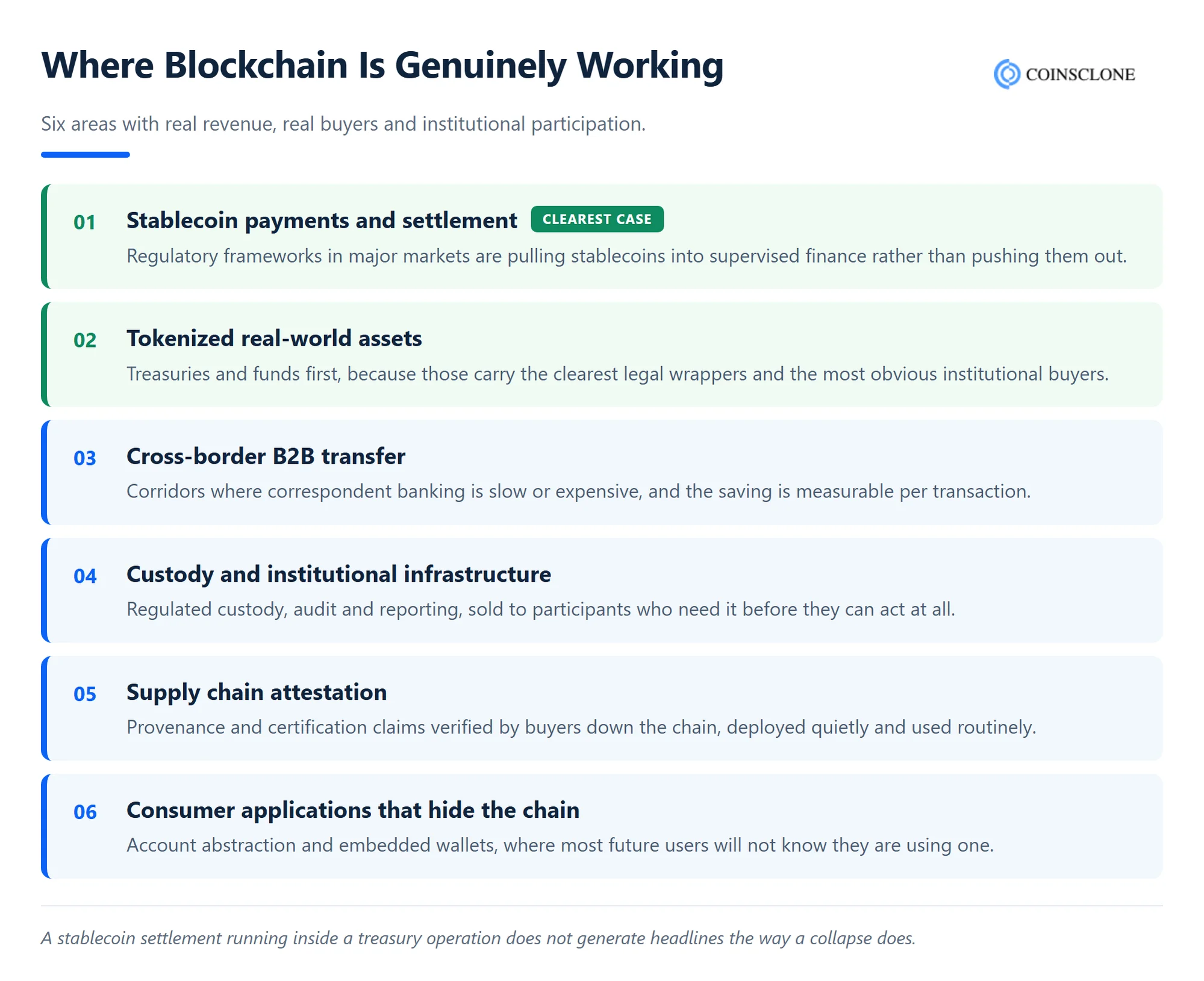
Stablecoin settlement. Cross-border payment rails moving genuine commercial volume rather than only trading liquidity, with corporates increasingly treating tokenized dollars as around-the-clock liquid cash.
Tokenised treasuries and funds. On-chain cash and short-duration instruments used as collateral and liquidity by institutions.
Regulated custody. Bank-grade custody and trust charters bringing digital assets inside the regulatory perimeter.
Enterprise supply chain. Multi-party custody records where no single participant owns the ledger.
Exchange and market infrastructure. The plumbing that keeps operating regardless of price direction.
Identity and credentials. Verifiable credentials moving into government and wallet ecosystems at meaningful scale.
The clearest signal is that enterprise adoption is now outpacing retail Web3. That is what a technology looks like when it stops being a speculative asset class and starts being infrastructure.
What Happens to Blockchain After 2026?
Where the next few years actually go, on current evidence rather than on hope:
- Stablecoins keep absorbing settlement volume. Regulatory frameworks in major markets are pulling them into supervised finance rather than pushing them out.
- Tokenized real-world assets grow from a small base. Treasuries and funds first, because those have the clearest legal wrappers and the most obvious buyers.
- Layer 2 becomes the default execution environment, with mainnet acting as settlement and data availability rather than as where activity happens.
- Consumer crypto hides the chain. Account abstraction and embedded wallets mean most future users will not know they are using one.
- Enterprise deployment stays quiet. Production systems in payments and supply chain, announced less and used more.
The pattern to expect is unglamorous: fewer new chains, more traffic on a small number of them, and value accruing to the places where real settlement happens.
Conclusion
Blockchain is not dead, and it is also not what it was sold as in 2021. What has happened is that the speculative layer contracted sharply while the settlement layer kept growing, and those two facts sit uncomfortably together in a headline. For anyone deciding whether to build, the useful question is not whether the sector is alive but whether your specific use case involves multiple parties sharing state that none of them controls. If it does, the infrastructure is more mature and better regulated than it has ever been. If it does not, no market cycle will change that.
Coinsclone builds enterprise-grade Web3 platforms including crypto exchanges, wallets, DEXs, NFT marketplaces, payment gateways and RWA tokenization, using customizable white-label clone scripts. Talk to our blockchain experts for a free consultation and live demo.
Frequently Asked Questions
Is blockchain dead in 2026?
No. Price fell substantially, with Bitcoin down roughly 50 percent from its October 2025 record, while stablecoin settlement, tokenized real-world assets, regulated custody and enterprise deployment all continued growing. The market is repricing which parts of the sector deserve capital rather than abandoning the technology.
Why does everyone keep asking if blockchain is dead?
Because price and usage are conflated. Public attention tracks token prices, which are volatile and sentiment-driven, while infrastructure adoption moves slowly and generates fewer headlines. In 2026 those two diverged more sharply than in previous cycles, with prices falling and settlement volumes rising simultaneously.
What parts of blockchain actually failed?
Chains launched without users and abandoned after token events, NFT speculation as a business model, yield paid from new deposits rather than economic activity, projects where a single organization controlled all the data, and the broader thesis that most software should be rewritten on a ledger.
Is enterprise blockchain adoption still growing?
Yes, and in 2026 it outpaced retail Web3 activity. Tokenised treasuries, funds and private credit moved from pilots toward production, and surveys reported a large majority of institutions prioritising asset tokenization over the following two years.
Are stablecoins still growing?
Yes. Exchange stablecoin balances were reported around $180 billion, and stablecoins have moved beyond trading into payment and settlement infrastructure, with corporates treating tokenized dollars as continuously available liquidity for treasury and cross-border workflows.
Should we still build a blockchain product?
It depends on the use case rather than the market. If multiple parties write to the same data, do not fully trust one another, and outsiders need to verify records, the infrastructure is more mature and better regulated than ever. If a single organization controls the data, a database remains the better answer regardless of the cycle.
What would actually indicate blockchain is dying?
Sustained decline in settlement volume, institutions withdrawing from custody and tokenization, developer numbers falling persistently, and regulated access narrowing rather than widening. Through 2026 the observable data pointed the other way on each of these, even while prices fell.