
TRC721 token development is the work of building non-fungible tokens (NFTs) on the TRON blockchain with TRC-721, TRON’s official NFT standard. Each token has its own ID, its own owner and its own metadata, so it can stand for one piece of art, one game item, one ticket or one certificate. This guide explains what TRC-721 is, how it differs from Ethereum’s ERC-721, and how a TRC721 token is built, tested and launched in 2026.
You will also see what each NFT transfer really costs in TRX, when TRC-1155 or TRC-20 is the better choice, and the checks that keep your collection safe. By the end, you will know if a TRON NFT fits your plan and what it takes to launch one.
In this guide:
- TRC-721’s real status: a Final TRON standard (TIP-721), live since 2020 and still TRON’s NFT standard in 2026.
- The one code change that breaks copied ERC-721 contracts on TRON, and how to avoid it.
- Real fee numbers: a mainnet NFT transfer used 74,636 energy, or about 7.84 TRX if the sender burns TRX.
- A simple way to choose between TRC-721, TRC-1155 and TRC-20.
- The build steps, the official tools and the security checks before launch.
See How Our MVP System Can Launch Your TRC721 Project Faster
TRC721 Token Development — done right.
- MVP System : Build and deploy your TRC721 NFT tokens 90% faster.
- Smart Contracts : Pre-tested and secure TRC721 standards on the TRON blockchain.
- Brand & Customization : Create unique NFTs that match your brand and business goals.
- Utility & Revenue : Enable staking, trading, and NFT marketplaces to maximize profits.
See a free branded demo of your TRC721 project in 48 hours — before you invest a cent.
Book a Free Demo to discover how our TRC721 Token Development Company can take you from idea to launch in just 2–4 weeks.
What Is TRC721 Token Development?
A TRC721 token development company designs and deploys NFTs on the TRON blockchain using the TRC-721 standard. TRC721 tokens stand for one-off assets such as art, game items, tickets and ID records. Unlike fungible tokens, each TRC721 token has a distinct ID and an owner record stored on-chain, plus a link to its metadata.
The work covers the smart contract, the metadata layout, the minting logic, wallet support and safety tests. Together, they keep each token one of a kind and send each transfer to the right owner.
TRC-721 Status in 2026
TRC-721 is a real, adopted standard, not a proposal. Its formal spec, TIP-721, has the status Final. It was created on 20 November 2020, and TRON announced it as its first NFT standard on 24 December 2020. TRON’s developer docs still call it “the TRON standard for non-fungible tokens” in 2026.
The standard is busy, too. TRONSCAN’s token list showed 194,910 TRC-721 contracts when we checked it on 16 October 2026. That count includes every contract ever listed, active or not, but it shows how many teams have shipped NFTs on TRON.
The Core Functions Every TRC721 Token Needs
Every TRC-721 contract must support two parts: TRC721 and TRC165, which tells apps what the contract can do. TRC-165’s own spec, TIP-165, is still marked Draft, but TRON’s docs make it required for TRC-721. The table below shows what each required function does in plain words.
| Function or event | What it does |
| balanceOf(owner) | Counts how many NFTs one address holds |
| ownerOf(tokenId) | Returns the owner of one NFT |
| safeTransferFrom(from, to, tokenId) | Moves an NFT and checks that a receiving contract can handle it |
| transferFrom(from, to, tokenId) | Moves an NFT with no receiver check |
| approve / getApproved | Lets one address move one NFT for the owner |
| setApprovalForAll / isApprovedForAll | Lets an operator, such as a marketplace, move all of an owner’s NFTs |
| supportsInterface(id) | Tells apps which standards the contract supports (TRC-165) |
| Transfer, Approval, ApprovalForAll | Events that wallets, explorers and marketplaces read |
You can also add two extras. TRC721Metadata adds name, symbol and tokenURI, the link to each token’s JSON file. TRC721Enumerable adds totalSupply and lookups by index. TRON’s docs note that enumeration adds energy cost to every mint and transfer, so skip it unless your app truly needs on-chain lists.
Where TRC721 Metadata Lives
The contract stores the token ID and the owner on-chain. The image and the description usually live off-chain, in a JSON file that tokenURI points to. TRON’s docs suggest hosting it on IPFS, BTFS (the BitTorrent File System) or a CDN. If you want to change metadata after minting, for example to level up a game item, the contract needs an update function from day one.
TRC-721 vs ERC-721: What Changes on TRON
TRC-721 is fully compatible with ERC-721 at the interface level. As a result, most Ethereum NFT code, tools and know-how carry over. Still, two differences matter.
| Point | ERC-721 (Ethereum) | TRC-721 (TRON) |
| Spec status | Final (EIP-721) | Final (TIP-721) |
| Runs on | EVM | TVM (TRON Virtual Machine) |
| Receiver hook | onERC721Received | onTRC721Received |
| Hook return value | 0x150b7a02 | 0x5175f878 |
| Fees | Gas paid in ETH | Energy and bandwidth, paid by staking TRX or burning TRX |
| Main wallet | MetaMask and others | TronLink and others |
| Explorer | Etherscan | TRONSCAN |
The hook value is the trap. When an NFT is sent to a contract with safeTransferFrom, the receiving contract must reply with a fixed code. On TRON that code is 0x5175f878. If a team copies Ethereum code and keeps the old value, each safe transfer into its vaults, stake pools or market fails and rolls back.
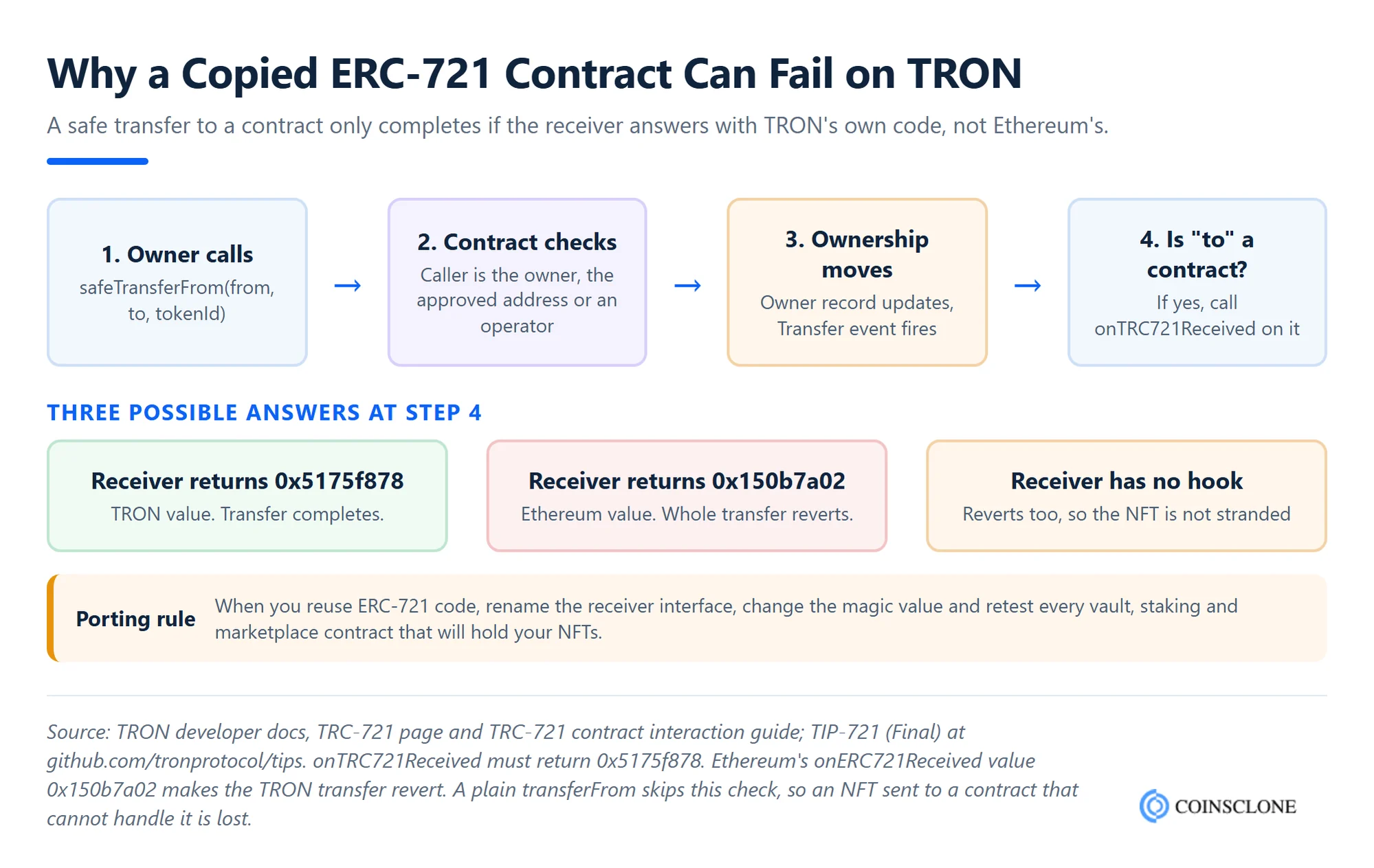
The opposite mistake is just as costly. A plain transferFrom skips the receiver check. TRON’s contract interaction guide warns that an NFT sent this way to a contract without receiver support is lost for good. So your apps should use safeTransferFrom whenever the recipient might be a contract. If you are coming from Ethereum, our guide to ERC721 token development covers the original standard in depth.
TRC-721 vs TRC-20 vs TRC-1155: Which TRON Standard Fits?
TRON’s docs list four token standards today. Picking the right one first saves a costly rebuild later.
- TRC-721: One token per unique item. Best for art, tickets, certificates, land and passes.
- TRC-1155: One contract that holds many token types, fungible and non-fungible. Best for games with many copies of the same item. Its spec, TIP-1155, has been Final since 2022.
- TRC-20: Units that are all the same, such as coins, points or stablecoins. See our TRC20 token development guide.
- TRC-10: An old standard built into the protocol. TRON’s docs say it is not recommended for new tokens.
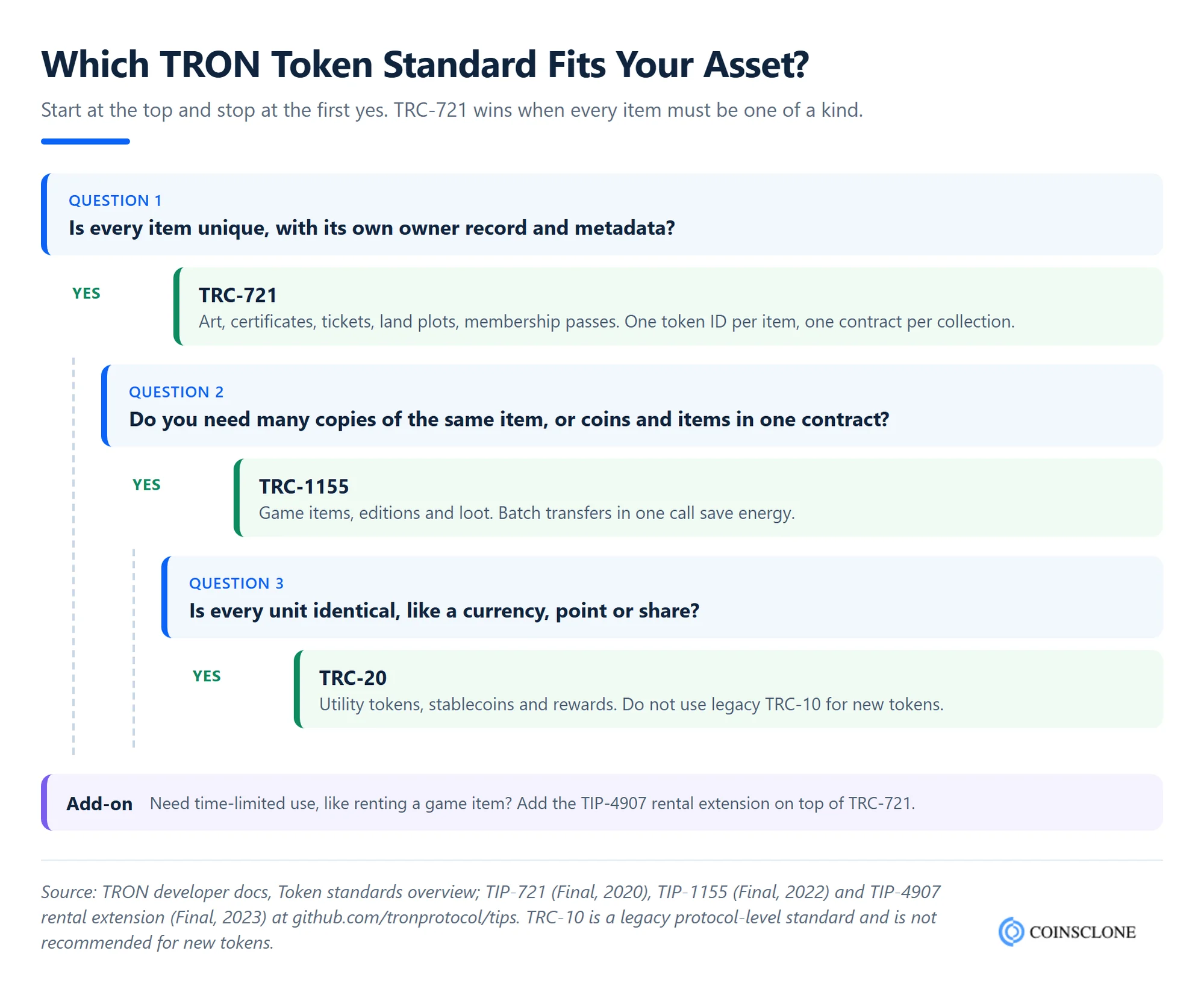
Many projects use two standards together. For example, a game might use TRC-721 for rare heroes, TRC-1155 for potions and a TRC-20 token for its in-game currency.
Our TRC721 Token Development Approaches
Each project has its own tech needs, asset types and use cases. To support them, we build TRC721 tokens in two ways.
TRC721 Token Development from Scratch
This approach means we design and deploy a custom NFT contract based on the TRC-721 standard. We set the owner rules, token IDs, metadata layout, minting logic and transfer functions. The token is built around your use case, your expected scale and TRON’s network rules. It suits projects that need a fully custom TRC721 setup from the ground up.
Hire TRC721 Token Developers
Hiring our token developers suits projects that already have a platform or part of a smart contract. Our developers work with your team to add or improve TRC721 features, such as NFT minting, metadata handling, wallet support and contract tuning. This speeds up your timeline while keeping your design flexible.
Features of TRC721 Token Development
TRC-721 tokens have traits that make them a good fit for NFTs and digital collectibles on TRON:
- One of a kind: Each TRC-721 token is unique, so no two tokens share an owner record or a value.
- Indivisible assets: You cannot split a TRC721 token, which protects the integrity of each asset.
- On-chain traceability: Every transfer is recorded on the TRON blockchain, so anyone can trace ownership.
- Creator and owner checks: The minting address and the current owner are on-chain, so buyers can check authenticity without a middleman.
- Chain security: TRON uses Delegated Proof of Stake (DPoS). Its blocks come from 27 elected Super Representatives.
- Scale and custom logic: Low fees let you run large collections, and you can add rentals, royalties, reveals or soulbound rules to the contract.
Use Cases of TRC721 Token Development
- NFTs for gaming: Games use TRC-721 tokens for in-game assets and collectibles, so players truly own, trade and rent rare items. Devikins, a TRON game, has used a TRC-721 contract for its playable characters since 2021.
- Art tokenization: Artists can turn their work into tokens, so owning it is safe, open and easy to prove.
- NFTs for sports: Clubs and leagues can sell fan items whose origin anyone can check.
- Fashion industry: Brands can pair physical products with TRC-721 tokens to prove origin and fight fakes.
- NFTs for music: Musicians can turn songs, albums and bonus content into tokens for their fans.
- NFT-backed lending: Unique tokens can serve as loan collateral in DeFi apps. Our NFT lending platform development team builds this model.
- Tickets and passes: Event tickets, course awards and club passes work well as one-off tokens.
Benefits of Creating a TRC-721 Token
Beyond the use cases, TRC721 tokens bring real, practical value.
- True ownership: Each token is one of a kind. No one can copy it or swap it for a twin.
- Low and predictable costs: TRON cut its energy price from 210 sun to 100 sun on 29 August 2025, which more than halved the TRX burned per contract call.
- Fees users can avoid: Holders who stake TRX, or projects that sponsor energy, can move NFTs without burning any TRX.
- Fast transfers: TRON’s DPoS network confirms NFT mints and transfers quickly, so the user experience stays smooth.
- Open records: All transfers sit on a public ledger, so the history is clear and cannot be changed.
- Access to TRON’s users: About $93 billion of USDT sat on TRON on 15 October 2026. Many people already hold TRX and use TronLink, which makes it easier to sell NFTs to them.
What a TRC721 Token Costs to Run: Energy and Fees
TRON does not charge gas like Ethereum. Instead, each transaction uses bandwidth for its data, and each contract call, such as a mint or a transfer, uses energy. Users cover these by staking TRX or by burning TRX at the network price.
According to TRON’s resource docs, the current prices are 100 sun per unit of energy and 1,000 sun per unit of bandwidth (1 TRX is 1,000,000 sun). Each account also gets 600 free bandwidth points a day, but no free energy.
To show what that means, we checked real TRC-721 transfers on TRON mainnet. A Devikins NFT transferFrom on 26 August 2026 used 74,636 energy and 378 bytes of bandwidth. The sender had almost no staked energy, so the network burned about 7.83 TRX. A similar transfer on 29 June 2026 used 64,151 energy, all covered by staked TRX, so it burned nothing.
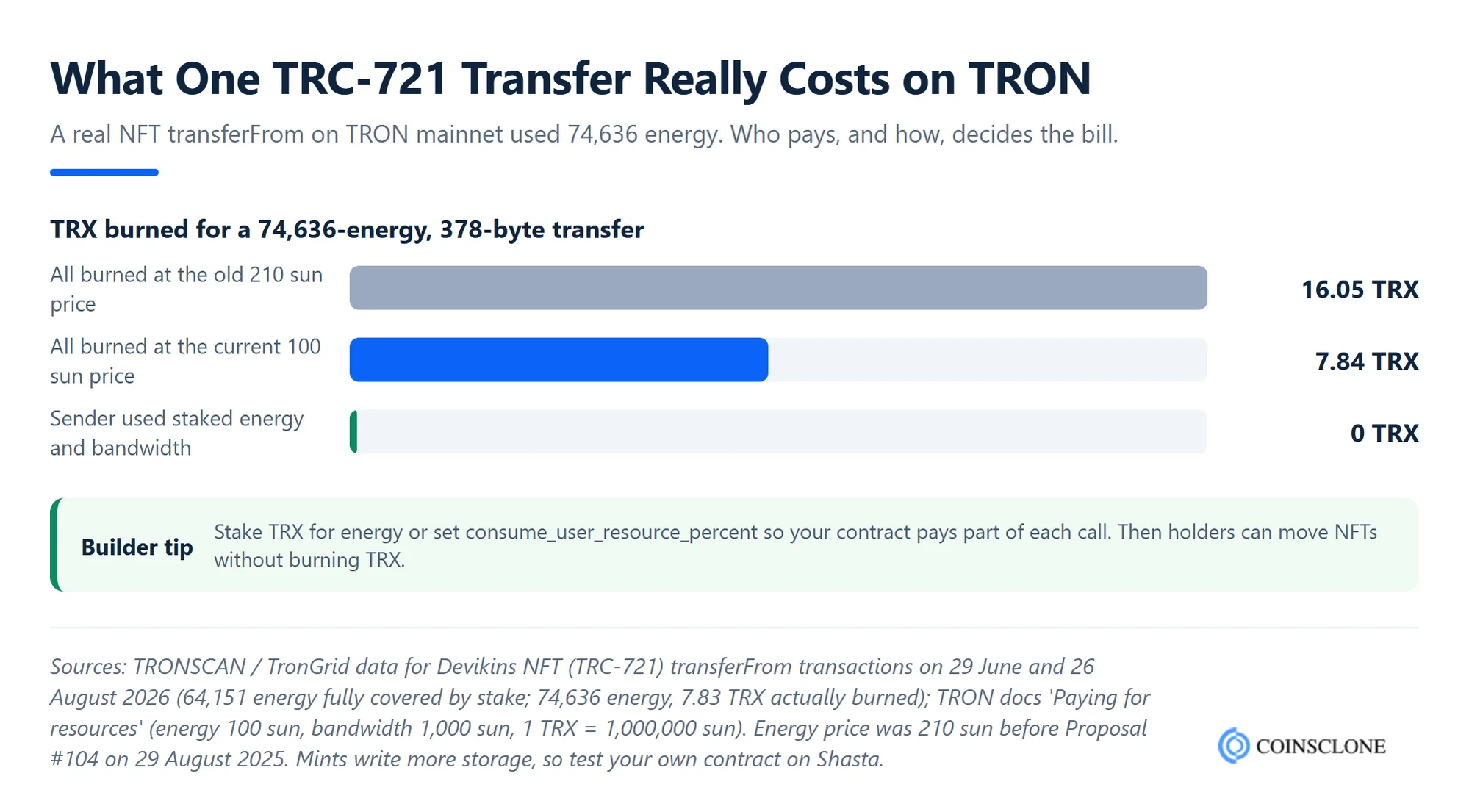
For your project, this leads to three practical choices:
- Show the cost: Display the estimated energy and TRX before users sign, so no one is surprised.
- Cut energy use: Skip enumeration unless you need it, avoid storing long strings on-chain and test energy-heavy paths on the Shasta testnet. Mints write new storage, so they usually cost more than transfers.
- Pay for your users: Stake TRX for energy, or set your contract to pay part of each call (consume_user_resource_percent and origin_energy_limit). This works well for free claims and drops.
TRC721 Token Development: Step by Step
Building a TRC721 token takes a few key steps. Here is how we run each one.
1. Requirement and use case analysis: We start with your goals. Then we decide what the tokens are for, such as NFTs, game items, collectibles or asset records, and how people will use them.
2. Token structure and metadata design: We design the token IDs and metadata format. This sets the owner details, creator info, asset text and linked media, and it decides where files are stored.
3. Smart contract development: We write the TRC721 contract to follow the standard closely. It handles minting, transfers, approvals and metadata, with the right TRON receiver value.
4. Wallet and user experience testing: We test the token in TronLink and other TRON wallets, plus the apps that will use it. Mints, transfers and metadata display must all work smoothly.
5. Security review and launch: Before launch, the contract goes through safety checks and an audit. Once it passes, we deploy it, verify the source on TRONSCAN and connect it to your app or marketplace.
The Tools Behind Each Step
TRON’s own TRC-721 issuance guide shows the current toolchain:
- Contracts: OpenZeppelin Contracts for TRON, written in Solidity 0.8.25.
- Build and deploy: TronBox to compile and TronWeb scripts to deploy.
- Testnet: Shasta, funded with free test TRX, before any mainnet release.
- Minting: A safeMint(to, uri) function that only the owner, or a role you define, can call.
- Verification: Source code verified on TRONSCAN, so buyers can read the contract.
Running this process well takes real skill with NFT standards and with TRON’s fee model. That is why many firms work with Coinsclone on TRC721 tokens.
How to Check a TRC721 Token on TRONSCAN
TRONSCAN is TRON’s main block explorer, and it works as a TRC721 explorer too. Search for a contract address or a collection name, then open its token page. There you can see the holders, the transfers and each token ID.
Before you buy or list an NFT, check three things on TRONSCAN:
- Verified source: The contract code is published and matches the project’s claims.
- Owner powers: Look for mint, pause or URI update functions that the owner can still call.
- Real activity: Transfers should come from many holders, not a few wallets trading among themselves.
Security Checks Before You Launch a TRC721 Token
The chain will not catch mistakes in your own contract. So run these checks before mainnet:
- Receiver value: Check that each contract that takes your NFTs returns 0x5175f878.
- Mint controls: Lock minting to the owner or a minter role, and cap the supply if you promised one.
- Approval risks: Warn users before setApprovalForAll. It lets a third party move all the NFTs they hold.
- Metadata safety: Pin files on IPFS or BTFS, and decide early whether metadata can change.
- Ownership plan: Use a multisig for admin keys. Calling renounceOwnership in TRON’s sample contract ends minting for good, so plan this step.
- Independent audit: Get the final code reviewed, then publish the report.
TRC721 Token Development Cost
The cost of a TRC721 token depends on what you build around it. A simple collection with a standard contract and a mint page costs far less than a game with rentals, reveals and its own marketplace.
The main cost drivers are:
- Contract scope: Royalty logic, rentals (TIP-4907), reveals, allowlists and upgrade paths.
- Front end: A mint site, a collection page or a full NFT marketplace.
- Storage: IPFS or BTFS pinning for images and metadata.
- Audit: An independent review, priced by code size and risk.
- Network fees: TRX for deployment, mints and any energy you sponsor for users.
Ask for a quote that splits these items, so you can see where the money goes.
Why Choose Coinsclone for TRC721 Token Development?
If you plan to create a TRC721 token, Coinsclone is a leading crypto token development company that turns your idea into a secure asset on TRON. We have been building blockchain products since 2018 and have delivered 350+ platforms for 200+ clients across 20 industries.
As a trusted TRON token development company, we build TRC721 tokens from start to finish, at a fair cost and ready to scale. We also build TRC-20 tokens, TRC-1155 game items and full NFT token development projects. If you still run a legacy TRC-10 token, we can support it too. Work with Coinsclone to launch TRC721 tokens that set the bar for ownership in your field.
Frequently Asked Questions
1. What is a TRC721 token?
A TRC721 token is a non-fungible token (NFT) on the TRON blockchain. Each TRC721 token is unique and cannot be swapped one for one like TRC20 tokens. TRC721 tokens are used for NFTs, collectibles, game items and proof of ownership. The standard, TIP-721, has Final status.
2. How is TRC721 different from TRC20?
TRC721 tokens are non-fungible, so each token is unique. TRC20 tokens are fungible, so all units are the same. TRC20 suits coins, points and stablecoins. TRC721 suits NFTs and one-off records on TRON.
3. How is TRC721 different from ERC721?
TRC721 uses the same functions and events as ERC721, so most code carries over. The differences are the chain and the receiver hook. TRC721 runs on the TRON Virtual Machine and uses energy and bandwidth instead of gas. A receiving contract must return 0x5175f878 on TRON, not Ethereum’s 0x150b7a02.
4. What does a TRC721 token development company do?
A TRC721 token development company writes smart contracts that follow the TRC721 standard on TRON. This covers owner rules, minting, metadata, transfers, wallet support and testing, so the token works safely and as planned.
5. What are TRC721 tokens used for?
TRC721 tokens are used for:
- NFTs and digital art
- Blockchain gaming assets
- Digital identity records
- Metaverse assets
- Collectibles, tickets and course awards
Each use case relies on the token’s uniqueness and on-chain ownership record.
6. How does TRC721 token minting work?
Minting creates a new, unique token ID on the TRON blockchain and assigns it to a wallet address. During minting, the contract links a metadata URL to the token, which holds its name, description and image. Once minted, the token’s owner record is permanent on-chain until it is transferred or burned.
7. Is TRC721 compatible with NFT marketplaces?
Yes. TRC721 tokens work with TRON-based NFT marketplaces and wallets that support the standard, such as TronLink. This depends on a clean contract: the owner, transfer, approval and metadata functions must all follow the spec.
8. Is TRC721 secure for NFTs?
TRC721 tokens are secure when the contract follows the official TRON standard and is properly tested and audited. Safety depends on sound owner rules, safe minting, the right receiver value and guards against bad approvals or repeat token IDs.
9. Can I move my existing NFTs to TRC721?
Not directly, because an NFT lives on the chain where it was minted. You can bridge it, which locks the original and mints a copy on TRON, or you can take a snapshot of holders and mint a new TRC721 collection for them. Either way, plan how the old tokens will be locked or burned.
10. Does TRC721 support royalties and lazy minting?
TRON has no royalty standard of its own. So you code royalties into your contract, and each market chooses whether to pay them. Lazy minting works through signed vouchers: the buyer pays the mint cost when they claim. TRON’s typed data signing standard, TIP-712, is Final and suits these vouchers.
11. How do I find a TRC721 token on a blockchain explorer?
Use TRONSCAN, TRON’s main explorer. Search for the contract address or collection name, then open the token page to see holders, transfers and token IDs. Check that the contract source is verified before you trust the collection.
See How Our MVP System Can Launch Your TRC721 Project Faster
TRC721 Token Development — done right.
- MVP System : Build and deploy your TRC721 NFT tokens 90% faster.
- Smart Contracts : Pre-tested and secure TRC721 standards on the TRON blockchain.
- Brand & Customization : Create unique NFTs that match your brand and business goals.
- Utility & Revenue : Enable staking, trading, and NFT marketplaces to maximize profits.
See a free branded demo of your TRC721 project in 48 hours — before you invest a cent.
Book a Free Demo to discover how our TRC721 Token Development Company can take you from idea to launch in just 2–4 weeks.