
A Solflare clone script is ready-made wallet software that lets you launch your own non-custodial Solana wallet with the core features of Solflare: SOL and SPL tokens, staking, swaps, NFTs and a dApp browser. This guide explains what the script includes, how it works for users and admins, and where Solflare itself stands in October 2026, so you copy a model that still wins users.
You will also get real 2026 costs and launch times, the ways a Solana wallet earns money, the safety lessons from past Solana wallet attacks and the legal points to clear before launch. By the end, you will know which kind of Solflare-style wallet fits your business and what it takes to build it.
In this guide:
- What a Solflare clone script includes, from user features to the admin panel
- Solflare’s status in 2026: 4M+ active users, a Mastercard debit card, the Shield tap-to-sign device and in-wallet perps
- How a Solflare-style wallet works, and which parts you build or plug in
- 2026 cost bands, launch weeks and a decision tree for your build path
- Revenue streams with real fee benchmarks, plus the safety and legal checks before launch
See How Our MVP System Can Launch Your Web3 Wallet Faster
Solfare Clone Script — built for scale.
- MVP Wallet System: Launch a Solana wallet like Solflare 90% faster.
- DeFi + dApp Ready: Pre-integrated Solana modules, staking, and SPL token support.
- Brand & Customization: Your UI, your theme, your token ecosystem.
- Bank-Grade Security: MPC/2FA, encryption, anti-phishing, and multi-layer protection.
Get a free branded demo of your Solana wallet in 48 hours — before you invest a cent.
Book a Free Demo to see how our Solfare Clone Script can take you from idea to a live Web3 wallet in just 8-12 weeks.
What Is a Solflare Clone Script?
A Solflare clone script is a ready-made software package that lets firms launch a Web3 wallet like Solflare, and you can change every part of it. Just like Solflare, you get a non-custodial wallet built for the Solana ecosystem. Instead of spending months building a crypto wallet from scratch, you start from a tested base with the main features already in place.
From asset storage, staking, token swaps and NFT management to web and mobile apps, everything is built in and ready to brand. The script supports native SOL, SPL tokens, Solana NFTs and other Solana-based assets. Your team then adds its own design, partners, fees and extra features on top.
A Solflare clone script usually covers three layers:
- Wallet core: key creation on the user’s device, seed phrase backup, transaction signing and Solana network links.
- User apps: iOS and Android apps plus a browser extension, with staking, swaps, NFTs and a dApp browser.
- Admin panel: user insights, token lists, fee settings, alerts and support tools.
Before exploring further, you might wonder why Solflare, of all the top crypto wallets, is the one to copy. The answer starts with where Solflare stands today.
Solflare in 2026: Where the Original Stands
Before you copy a wallet, check that its model still works. Solflare is active and growing in October 2026. Here is what we confirmed at the source on 16 October 2026.
- Users and funds: Solflare’s homepage reports 4M+ active users and about $15.5 billion in funds managed through the wallet, with a 4.84 rating from more than 51,000 App Store reviews.
- Background: Solflare has served Solana users since 2020, starting as a simple web wallet before adding browser extensions and mobile apps. It is run by Solrise Finance Ltd, a British Virgin Islands company, and it stays Solana only.
- Solflare Card: on 19 November 2025, Solflare and Mastercard announced a self-custody debit card. It spends USDC straight from the wallet, with no top-up step, and launched first in the EEA and UK.
- Solflare Shield: in December 2025, Solflare added a tap-to-sign hardware wallet. It is a card with a secure chip and no screen, battery or cable. Users tap it on the phone over NFC to sign, and prices start at $49.
- Perps and AI: the wallet now offers perpetual futures on SOL, BTC, ETH and more through Phoenix, with USDC that stays in the user’s wallet. It also has an AI assistant called Magic.
- June 2026 update: Solflare shipped card borrowing, Reclaim SOL and Titan swaps. Users can now borrow USDC against SOL to spend on the card, recover the SOL locked in empty token accounts and swap without holding SOL for gas.
So the Solflare model is alive and moving fast. It has grown from a staking wallet into a full money app for Solana: trading, perps, a card and hardware signing in one place. A clone in 2026 should copy that “one app for Solana” idea, not just the 2021 feature list.
Why Should You Build a Crypto Wallet Like Solflare?
Creating a crypto wallet like Solflare gives your business a strong foothold on Solana, one of the busiest chains. Solflare won users with strong safety, fast speed and a simple app. Besides these, Solflare stands out in a crowded wallet market because:
- Solana focus: unlike wallets that spread across many networks, Solflare stays focused on Solana. That means fast trades, tiny fees and features built for one chain. A Solana transfer costs a base fee of just 0.000005 SOL per signature, as Solana’s fee docs show.
- One wallet for all of Solana: it holds SOL, SPL tokens and NFTs, so it works for traders, collectors, stakers and Web3 users alike.
- Built-in staking: a clear staking dashboard lets users stake SOL without leaving the wallet. This is one of the main reasons users pick it.
- Self-custody: users own their keys, their data and their assets. This trust model is a big reason behind its growth.
- Wide use: the wallet works across Solana DeFi, GameFi, NFT marketplaces, launchpads and dApps.
So there is clear demand for a focused Solana wallet. Now, this might make you ask how best to build one.
Why Choose a Solflare Clone Script Over Other Build Approaches?
When compared to building a crypto wallet from scratch, a Solflare clone script gives firms a faster and safer path. Like our white label crypto wallet, the Solflare clone script comes with the key parts, safety layers and Solana links built in. It cuts build time, technical risk and launch delays. Besides, choosing a Solflare clone software allows you to:
- Launch fast: go live with a working Solflare-like wallet in weeks, not months.
- Save on engineering: the pre-built design removes the heaviest build costs.
- Use Solana-ready code: the wallet is tuned for SOL, SPL tokens and Solana NFTs.
- Start secure: like Solflare, it comes with built-in security tools.
- Grow smoothly: it handles high user loads and new features without slowing down.
Here is how the two paths compare side by side.
| Factor | Solflare clone script | Built from scratch |
| Launch time | About 3 to 5 weeks (white label) or 8 to 12 weeks (custom) with Coinsclone | Often many months, plus audits |
| Typical cost | Lower end of each cost band below | Upper end, often $50,000 to $200,000 or more |
| Wallet core | Already built and tested | Your team writes key storage, signing and Solana links |
| Custom features | Added on top of a working base | Full freedom, but every part is new code |
| Best for | Startups and brands that need to reach users fast | Teams with unusual security or custody needs |
With this, let’s explore the inner workings and the advanced features of the crypto wallet that come with it.
Built-in Features of Our Solflare Clone Software
The Solflare clone software comes packed with key features for managing crypto and digital assets in one place.
User Features
In-Wallet Staking: Users can stake SOL directly within the wallet. They pick a validator, see expected rewards and earn without leaving the app.
Token Swap Integration: A built-in swap engine handles instant SPL token swaps at live market rates. It sends each trade through swap routers that find the best price, so users get quick, fair swaps.
Web and Mobile Apps: The wallet works as a browser add-on and as an iOS and Android app. Users can reach and manage their assets anytime, on any device.
Private Key Control: Users keep full ownership of their private keys, seed phrases and wallet data. Keys are stored on the user’s device, not on central servers, giving them full control.
NFT Manager: Users can view, send and sort their NFTs in one place. Images and traits are shown clearly for easy management.
dApp Browser: Users connect to Solana DeFi, NFT marketplaces, launchpads, staking platforms and Web3 apps in a tap. There is no need to link wallets by hand or switch apps.
Live Portfolio Tracker: Users can track token balances, staking rewards, market moves and their overall portfolio. Clear charts help them make quick decisions.
Many Wallets in One App: Users can create, import and run more than one wallet in a single app. This helps them keep trading, staking, NFTs and long-term holdings apart.
Fiat On-Ramp Integration: Users can buy SOL and SPL tokens with debit or credit cards, or local payment methods such as UPI, through trusted payment partners. This removes a big barrier for new users.
Live Alerts: Push alerts cover new transfers, staking rewards, NFT sales, price moves and safety warnings. Users stay updated without checking the wallet all the time.
Admin Features
User Management: Admins can monitor user activity, app versions and support requests. Since the wallet is non-custodial, users need no account to start. KYC applies only to fiat features, and the licensed partner usually runs it.
Wallet Activity Monitoring: Admins get live tracking of in-app swaps, staking activity and NFT actions. This keeps things clear, flags odd patterns and helps the app run well.
Staking Settings: Admins choose which validators the wallet shows first and, if you run your own validator, set its commission. The Solana network sets the base reward rate, so admins shape the offer, not the yield.
Token Listing and Management: Admins can list, update or hide SPL tokens in the wallet. They also control token details, price feeds and swap permissions.
Built-in Dashboard: One screen shows user growth, swap volume, staking and earnings.
Security and Access Controls: Admins can turn on multi-factor login and encryption options for the team. Role-based access and activity logs keep the platform safe.
API and Partner Control: Admins manage partner links, RPC and validator links, price feeds and dApp access from one panel.
Alert System: Admins can send instant alerts, updates, promos and safety warnings straight to users.
Security Features of the Solflare Clone Script
The Solflare clone script is built with layered protection to keep users’ assets and personal data safe. These features give users a secure wallet experience:
- Non-Custodial Key Management
- End-to-End Encryption
- Face, Fingerprint and PIN Login
- Secure Recovery Mechanism
- Phishing and Domain Protection
- Transaction Simulation
- Multi-Sig Support
- Real-Time Fraud Detection Alerts
- Secure dApp Permissions Control
- Regular Smart Contract Audits
Why do these matter so much? Look at what happened on Solana. In August 2022, about 9,231 Solana wallets were drained of roughly $4.1 million. The cause was traced to the Slope wallet, which had sent users’ seed phrases to a central logging server. Solflare’s own code was not at fault, but users who had imported the same seed phrase into Slope were hit. The lesson for any Solflare clone is clear: never let a seed phrase or private key leave the device, not even in error logs, and have outside auditors check this before launch.
Transaction previews matter just as much. It shows users what a transaction will do before they sign, which blocks most wallet-drainer scams. For a full checklist, see our guide to crypto wallet security.
On top of these safety tools, you can add extras that make trading and holding easier.
Add-On Integrations to Level Up the Solflare Clone Software
Here are some of the add-on features that you can plug into the Solflare clone script.
NFT Tools: Users can view, send, receive and sort NFTs right in the wallet. Clear images and traits make it easy to manage digital art, collectibles and gaming assets without switching apps.
Token Swaps: Users can swap one token for another instantly. The swap engine finds the best available route, giving a fast, safe and simple way to trade SOL or SPL tokens on the go. Like Solflare’s June 2026 update, you can also let users pay the network fee from the swap token, so they can swap without holding SOL.
Native Staking: Users stake SOL directly from the wallet and earn rewards. They choose validators, see estimated returns and track earnings without outside tools.
Hardware Wallet Support: Like Solflare, which works with Ledger devices and its own Shield card, offer your users hardware signing. This adds an extra layer of safety by keeping private keys offline, away from hackers.
Portfolio View: Users see all their assets at a glance. It shows token balances, NFT values, staking rewards and transaction history in a clean dashboard.
Crypto Debit Card: Through a licensed card partner, let users spend USDC from the wallet at shops, as the Solflare Card does with Mastercard.
Perps Trading: Connect an on-chain perps venue so users can trade with leverage while their USDC stays in the wallet.
Reclaim SOL: Help users close empty token accounts and get back the small SOL deposit each one locks up.
With these add-ons, a Solflare clone gives users one simple, safe place for all they do on Solana. In the next section, we’ll explore how a Solflare clone script works.
How Does a Solflare-like Clone Solution Work?
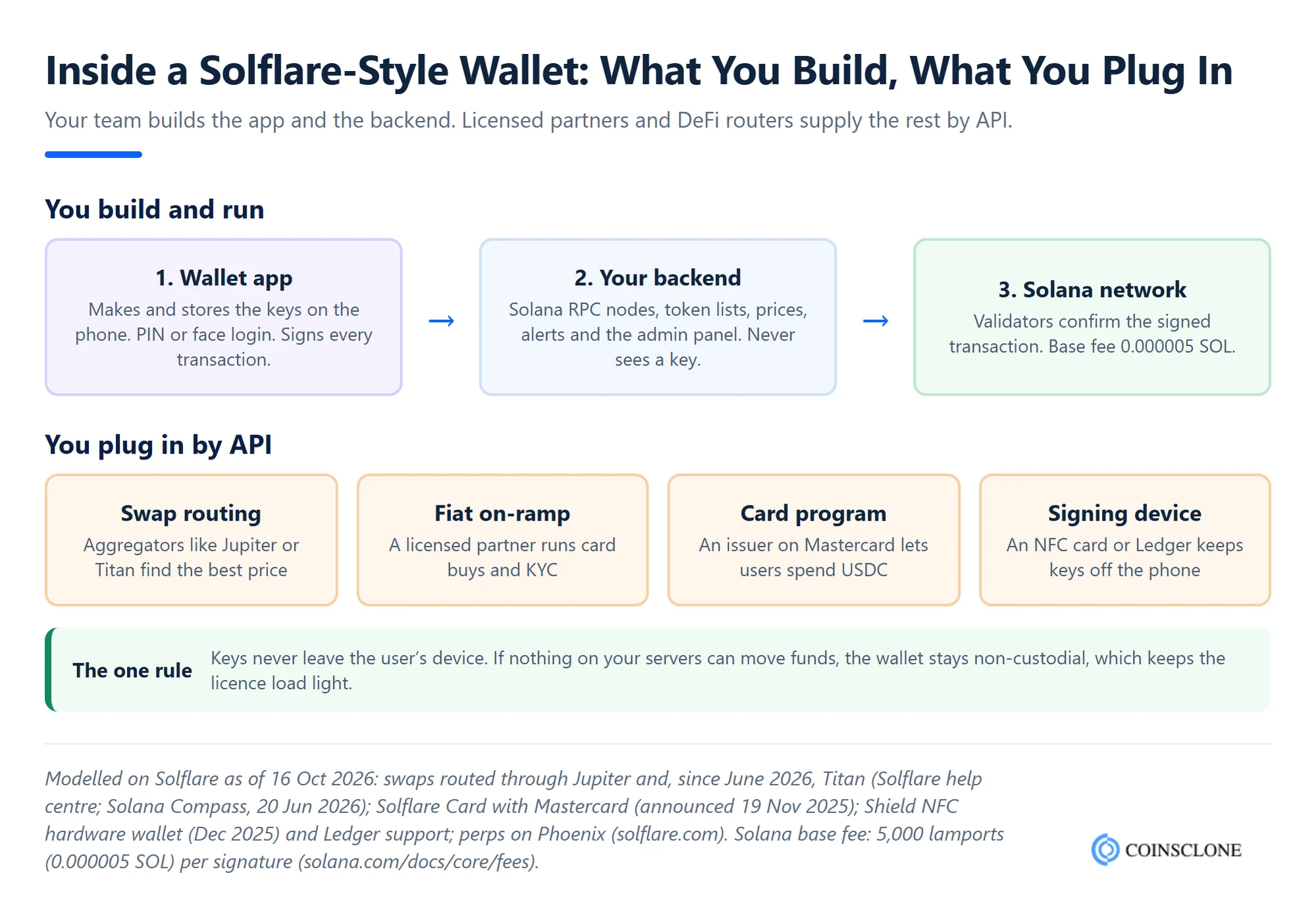
A Solflare clone script follows the same simple workflow as leading Solana wallets. From securing user keys to syncing live asset data, every action runs through fast calls to the Solana blockchain. Here is a quick overview of the full working process of our Solflare clone software.

In plain steps, a user’s journey looks like this:
- Create or import a wallet: the app makes a new key pair on the phone and shows a seed phrase, usually 12 or 24 words, for backup. Users can also import an existing Solana wallet.
- Fund it: users receive SOL or SPL tokens from another wallet, or buy them through the fiat on-ramp partner.
- Use it: users stake, swap, collect NFTs or open dApps. Every action builds a transaction that the app shows in plain words before signing.
- Sign and send: the private key signs on the device, or on a paired hardware wallet. The app then sends the signed transaction to Solana through your RPC nodes.
- Track it: the transaction confirms in seconds, and the portfolio, alerts and history update right away.
Behind those steps, some parts are yours to build and others plug in through partners. This picture shows the split.
With this, let’s also explore the extended options for this Solflare-like crypto wallet.
More Ways to Build Your Solflare Clone
Solflare Clone App Development
Our Solflare clone app service helps you build a fully custom Solana wallet from the ground up. You get full control over everything, from the UI and security layers to add-on features. The apps are built for both Android and iOS, so you can give users a unique wallet experience.
White Label Solflare Clone Solution
Our white label Solflare clone is ready-to-deploy software that lets firms launch a crypto wallet under their own brand in very little time. It comes with core wallet features, safety tools, staking, swaps and NFT tools built in. You can customize all of them to match your business needs.
Launch a Crypto Wallet Business with our Solfare Wallet Clone SDK
Cost-effective. Easy Deployment. Grab a Free Demo Now!
Business Benefits of Our Solflare Clone Script
A Solflare clone script gives firms a fast, low-cost way into Solana with a fully working self-custody wallet. Here are the main business benefits:
- Faster Time-to-Market: launch a white label Solflare-style wallet in about 3 to 5 weeks, or a custom one in about 8 to 12 weeks. This helps you catch market chances early.
- Lower Build Costs: skip the high cost of building a wallet from scratch, including the hard work on key storage and safety tools.
- Fully Customizable: brand the Solflare clone script your way and add features such as fiat on-ramps, a debit card, perps or extra security layers.
- Revenue From Day One: turn on swap fees, staking commissions, partner deals and premium plans from the admin panel.
- High Security: the script comes loaded with key security features to keep users and your brand safe.
- Wide Reach on Solana: link up with DeFi apps, NFT markets, launchpads and Web3 sites on Solana.
How a Solflare Clone Wallet Makes Money
A wallet is free for users, so you need a clear revenue plan from day one. The Solflare clone comes with many ways to earn, whether you target traders, NFT collectors or DeFi users. Wallet admins can earn from:
- Swap fees: a small share of every in-app swap. For scale, Phantom charges 0.85% and MetaMask 0.875% on most swaps.
- Staking commissions: run your own validator and earn its commission, or keep a share of pooled staking rewards. MetaMask, for example, keeps 15% of rewards in its pooled staking.
- Perps builder fees: earn a fee on perps trades routed through your app, as wallets such as Phantom and MetaMask now do.
- Card revenue: share the card fees with your licensed card partner when users spend from the wallet.
- dApp integration fees: charge projects for featured placement in your dApp browser, clearly marked as sponsored.
- NFT fees: charge for NFT listings, featured spots and a cut of each sale in your NFT market.
- In-app ads and promotions: promote token launches and partner offers.
- Premium subscription models: offer advanced tools, alerts or analytics for a monthly or yearly fee.
Your real income depends on how active your users are and what your partners charge. Swap fees usually lead, so design the swap screen with care. For more detail, see our guide on how crypto wallets make money.
How Much Does a Solflare Clone Script Cost?
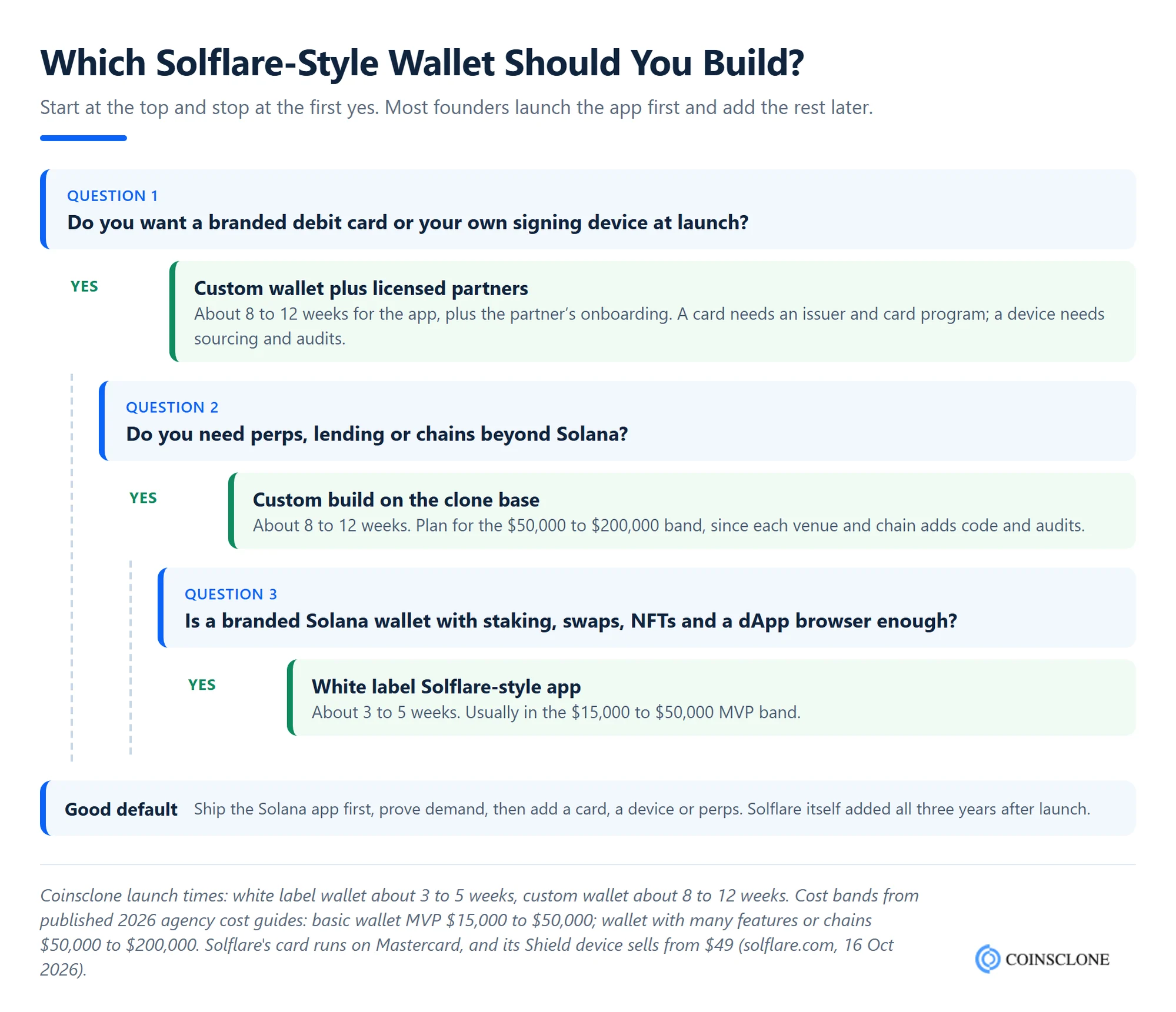
Cost depends on how much you change and which add-ons you need. Published 2026 agency cost guides put a basic wallet MVP at about $15,000 to $50,000. A wallet with many features or chains costs $50,000 to $200,000. A large wallet for banks or funds runs $200,000 to $500,000 or more. A clone script usually sits at the lower end of each band, because the core is already built.
Time matters as much as money. With Coinsclone, a white label wallet launches in about 3 to 5 weeks, and a custom wallet takes about 8 to 12 weeks. A debit card, hardware signing or perps add partner onboarding time on top. The main factors that move the final cost are:
- Features you include
- UI and UX design work
- Web, mobile and browser add-on support
- Security upgrades and audits
- Add-ons and partner links
- Your planned time frame
- The skill of your development team
Not sure which version you need? Use this decision tree.
Also plan for running costs after launch. These include RPC nodes and data APIs, app store fees, audits, support and updates. Our full breakdown of crypto wallet development cost covers each line.
How to Launch Your Solflare-Style Wallet in 6 Steps
Here is the path most of our wallet projects follow, from first call to live app.
- Pick your market and model: choose your users and features, and decide whether you need a card, hardware signing or perps.
- Plan custody and licences: stay non-custodial if you can, and check the rules in each country you serve.
- Brand and design: set your own name, logo, screens and user flows.
- Configure the script: add swap routes, on-ramps, validators, the dApp list and fee settings.
- Test and audit: test on Solana devnet, run a third-party security audit and hold a beta with real users.
- Launch and grow: publish to app stores and the Chrome Web Store, watch the admin dashboard and add features based on real usage.
Once live, keep updating. Solana tools change fast, new tokens arrive every day and app stores update their rules every year.
Legal Points to Clear Before You Launch
A clone script copies features, not a brand. Two legal points matter most.
- Brand and design: never use Solflare’s name, logo or look. “Solflare clone” describes the feature set; your app must carry your own name and design, or you risk trademark claims and app store removal. Fake wallet apps are also a common phishing trick, so a clearly different brand protects your users too.
- Custody rules: in the US, FinCEN’s 2019 guidance says firms that only provide self-custody wallet software are not money transmitters. Wallets that hold user funds usually are. In the EU, MiCA treats holding crypto for clients as a licensed service, so a custodial wallet needs a CASP licence.
Card and fiat features follow payment rules. That is why Solflare runs its card with Mastercard and licensed partners instead of issuing cards itself. For more, read our guide to custodial vs non-custodial wallets, then get legal advice in each market you serve.
Solflare vs Phantom: Which Model Should You Copy?
Many founders weigh Solflare against Phantom, the other big Solana wallet. Both are strong models, but they suit different plans.
| Factor | Solflare model | Phantom model |
| Chains | Solana only | Solana plus Ethereum, Base, Polygon, Sui, Monad and Bitcoin |
| Users | 4M+ active users | More than 20 million users |
| Standout features | Staking dashboard, Mastercard debit card, Shield tap-to-sign device, perps | Multichain swaps, perps, prediction markets, prepaid card |
| Best clone for | Solana-native brands, staking and payments | Traders and gaming projects across several chains |
Pick the Solflare model if your users live on Solana and care about staking, spending and safety. If you need several chains from day one, our Phantom wallet clone script is the closer fit.
Why Should You Choose Coinsclone’s Solflare Clone Script?
Coinsclone is a leading crypto wallet development company. Since 2018, we have delivered 350+ platforms for 200+ clients across 20 industries. Our team of blockchain experts helps you launch secure, scalable crypto products. Instead of spending months building a Solana wallet from scratch, you get a tested, feature-rich Solana wallet.
Coinsclone offers the Solflare clone with a clear design, fast trades, strong safety and room to customize. From add-ons like NFT management, token swaps and staking to compliance-ready design, every part is built for long-term growth. So, if you want to launch a Solana wallet that users trust, our Solflare clone script is a strong choice.
Frequently Asked Questions
What is a Solflare clone script?
A Solflare clone script is pre-built wallet software designed to work on the Solana blockchain. It offers the same core functions as Solflare: storing SOL and SPL tokens, sending and receiving funds, staking, NFT support and dApp access.
What features does a Solflare clone script include?
The Solflare clone script lets users create or import a wallet, send and receive SOL and SPL tokens, stake, swap, view NFTs and open Solana dApps. Add-ons such as a debit card, hardware signing and perps can be plugged in.
Who would need a Solflare clone script?
Any business, developer or startup that wants to launch its own branded Solana wallet can use the Solflare clone software. It suits Solana projects, exchanges, payment brands and communities that want their own wallet.
How does a Solflare clone wallet maintain security?
A well-built Solflare clone script keeps keys on the user’s device and adds PIN and biometric login, encrypted key storage, transaction previews, phishing warnings and hardware wallet support. Outside audits before launch confirm that no seed phrase or key can leak.
Is Solflare safe?
Solflare is a non-custodial wallet, so users hold their own keys and Solflare cannot move their funds. In the August 2022 attack that drained about 9,231 Solana wallets, the cause was traced to the Slope wallet, not to Solflare’s code. Users who want more safety can sign with a Ledger device or Solflare’s Shield card.
Is Solflare a hot or cold wallet?
The Solflare app and browser extension are hot wallets, since they run on online devices. Paired with a Ledger device or the Shield card, signing moves to hardware that keeps the private key off the phone, which works like a cold wallet.
Can I add extra features with a Solflare clone script?
Yes. The Solflare clone script is white label, so you can change the design, add new features or plug in extra tools to suit your plans.
Does using a Solflare clone script save time compared to building a wallet from scratch?
Yes. A wallet built from scratch often takes many months plus audits. With Coinsclone, a white label Solflare-style wallet launches in about 3 to 5 weeks and a custom one in about 8 to 12 weeks, because the core is already built and tested.
Is a Solflare clone script suitable for staking, NFTs and dApp access?
Yes. The Solflare clone script covers all of those uses. Users can stake SOL, manage NFTs and connect to Solana dApps from one app.
See How Our MVP System Can Launch Your Web3 Wallet Faster
Solfare Clone Script — built for scale.
- MVP Wallet System: Launch a Solana wallet like Solflare 90% faster.
- DeFi + dApp Ready: Pre-integrated Solana modules, staking, and SPL token support.
- Brand & Customization: Your UI, your theme, your token ecosystem.
- Bank-Grade Security: MPC/2FA, encryption, anti-phishing, and multi-layer protection.
Get a free branded demo of your Solana wallet in 48 hours — before you invest a cent.
Book a Free Demo to see how our Solfare Clone Script can take you from idea to a live Web3 wallet in just 8-12 weeks.