
Smart contract development cost in 2026 runs from about $5,000 for a basic token to $250,000 or more for a custom DEX or other DeFi protocol. The build is the biggest line. The audit is the second, at $5,000 to $100,000 or more. Deploying the code is the smallest: on Ethereum in November 2026, a token costs well under a dollar in gas.
Most cost guides blur these three lines together. This one splits them. We measured the gas for real contracts, priced it at today’s rates, and pulled audit prices from a published 2026 market reference. You get the numbers, what moves them, and where you can save without taking on risk.
In this guide:
- What each kind of smart contract costs to build, audit and deploy
- Measured gas costs for a token, NFT, staking and vesting contract on 2 November 2026
- 2026 audit price ranges, plus the extra you pay for Rust, Move or ZK code
- How long a build and audit take, phase by phase
- Seven ways to cut cost without cutting safety
Smart Contract Development Cost: The Short Answer
A smart contract has three cost lines. Each one is priced in a different way, so add them up on their own.
| Cost line | Typical 2026 range | What sets the price |
| Build | $5,000 to $15,000 for a basic token; $15,000 to $50,000+ for a complex one; far more for DeFi | Lines of logic, chain, tests, team rates |
| Security audit | $5,000 to $20,000 for a simple token; $25,000 to $100,000 for most DeFi | Code size, risk, language, how fast you need it |
| Deployment (gas) | Under $1 for most single contracts on Ethereum at November 2026 gas prices | Bytecode size, gas price, token price |
| Upkeep | Monitoring, bug bounty, re-audits after upgrades | How much value the contracts hold |
The build ranges come from published 2026 agency cost guides. The audit ranges come from Sherlock’s 2026 audit pricing reference. The gas figures are our own, measured and dated below.
So when someone asks “how much does a smart contract cost?”, the honest answer is: the code you write and the review it needs. The fee to put it on chain barely moves the total.
How Much Does a Smart Contract Cost by Type?
The type of contract sets how much custom logic you need. More custom logic means more build hours, a longer audit and more risk. Here is how the common types compare.
| Contract type | What makes it cost more | Build cost reference | Likely audit band |
| Token (ERC-20, BEP-20) | Taxes, caps, blacklists, minting rules | $5,000 to $15,000 basic; $15,000 to $50,000+ complex | Simple token: $5,000 to $20,000 |
| NFT (ERC-721, ERC-1155) | Royalties, allowlists, reveal logic | Contract alone is a small job; full NFT marketplaces run $10,000 to $150,000+ | Near the token band when built on library code |
| Vesting | Cliffs, many schedules, revocation | Custom quote; small if based on a standard vesting wallet | Near the token band for a standard design |
| Staking | Reward math, lockups, multiple pools | Custom quote; grows with each reward rule | Low end of the DeFi band |
| DEX (swap, liquidity pools) | Pricing curves, fees, routing | $10,000 to $50,000 white label; $40,000 to $250,000+ custom | DeFi band: $25,000 to $100,000 |
| Lending | Interest models, oracles, liquidations | Custom quote; one of the costliest DeFi builds | Upper DeFi band |
| Bridge or cross-chain | Message checks, validators, many chains | Custom quote; the highest-risk category | Multichain: often above $150,000 |
The DEX, token and NFT marketplace ranges are market ranges from published 2026 agency cost guides. For staking, vesting, lending and bridges, no reliable public range exists, because scope varies so much. Use the drivers in the next section to size them. The audit bands are our mapping of each type onto Sherlock’s 2026 ranges.
A few notes on each type:
- Token: A plain token built on OpenZeppelin code is the cheapest contract you can ship. Costs climb when you add transfer taxes, anti-bot rules or custom minting. See our guide to crypto token development for the full scope.
- NFT: The collection contract is small. The cost sits in the marketplace, metadata and minting site around it. Our NFT smart contract guide covers the contract side.
- Staking: The reward math is where bugs hide. Every new pool type, lock period or reward token adds tests and audit time. Our guide on how to create a staking platform walks through the parts.
- Lending and DEX: These hold user funds and depend on prices. In August 2026, the Tectonic lending market on Cronos lost about $124.5 million. The attacker pushed up its exchange rate with a “donation attack”, per DefiLlama’s hacks list.
- Bridge: The most expensive to get right. In April 2026, Kelp’s rsETH bridge lost $293 million after attackers fed it fake cross-chain messages. Its setup trusted a single verifier, per the same DefiLlama record.
What Drives Smart Contract Development Cost?
Six things decide most of the price. If you know where your project sits on each one, you can predict your quote before you ask for it.
Complexity and Lines of Code
Audit firms price by risk and by “nSLOC”, the count of real code lines. Sherlock gives a sense of scale: a contract of about 500 nSLOC can be reviewed in a 3-day contest window, while about 3,000 nSLOC takes around 18 days and 6,000 nSLOC about 38 days. Build time grows the same way. Each new function adds code, tests and review hours.
Blockchain and Language
Most contracts run on EVM chains such as Ethereum, BNB Chain, Base, Arbitrum and Polygon. They use Solidity, which has the largest pool of developers and tools. Other chains use other languages, and that costs more. Sherlock reports audit premiums over EVM work of 25% to 40% for Rust on Solana, 30% to 45% for Cairo (Starknet) and Move (Sui, Aptos), and 80% to 120% for zero-knowledge circuits.
Security Audits and Testing
An audit is not optional for any contract that holds money. Good teams also write unit tests, fuzz tests and “invariant” tests, which check that rules like “total deposits always match balances” hold no matter what users do. Tests take time up front, but they shorten the audit and cut the number of fix rounds.
Upgradability and Admin Controls
An upgradeable contract uses a proxy, which lets you fix bugs later. It also adds code, a second deployment and a new attack path. In April 2026, attackers got admin control of Drift on Solana. They tricked its key holders into signing in advance, then took about $295 million, per DefiLlama. Admin keys, timelocks and multisig wallets need their own design and review.
Integrations
Price oracles, other protocols, cross-chain messaging and off-chain services all add code at the edges. Edges are where many exploits start. Each integration also needs its own tests against real conditions, often on a forked copy of the main network.
Team Rates
People cost more than anything else in the build. Web3.career’s November 2026 pay data puts the average Solidity developer at $150,000 a year. That is about $78 an hour, with a range of $33 to $134.
Worked example: take two coders on a staking contract for six weeks at $78 an hour. That is 2 x 6 x 40 x $78 = $37,440 in build time. Add a $15,000 audit and a $5,000 fix review, and the contract costs about $57,000 before launch. Gas to deploy it would be a few cents.
How Much Does a Smart Contract Audit Cost?
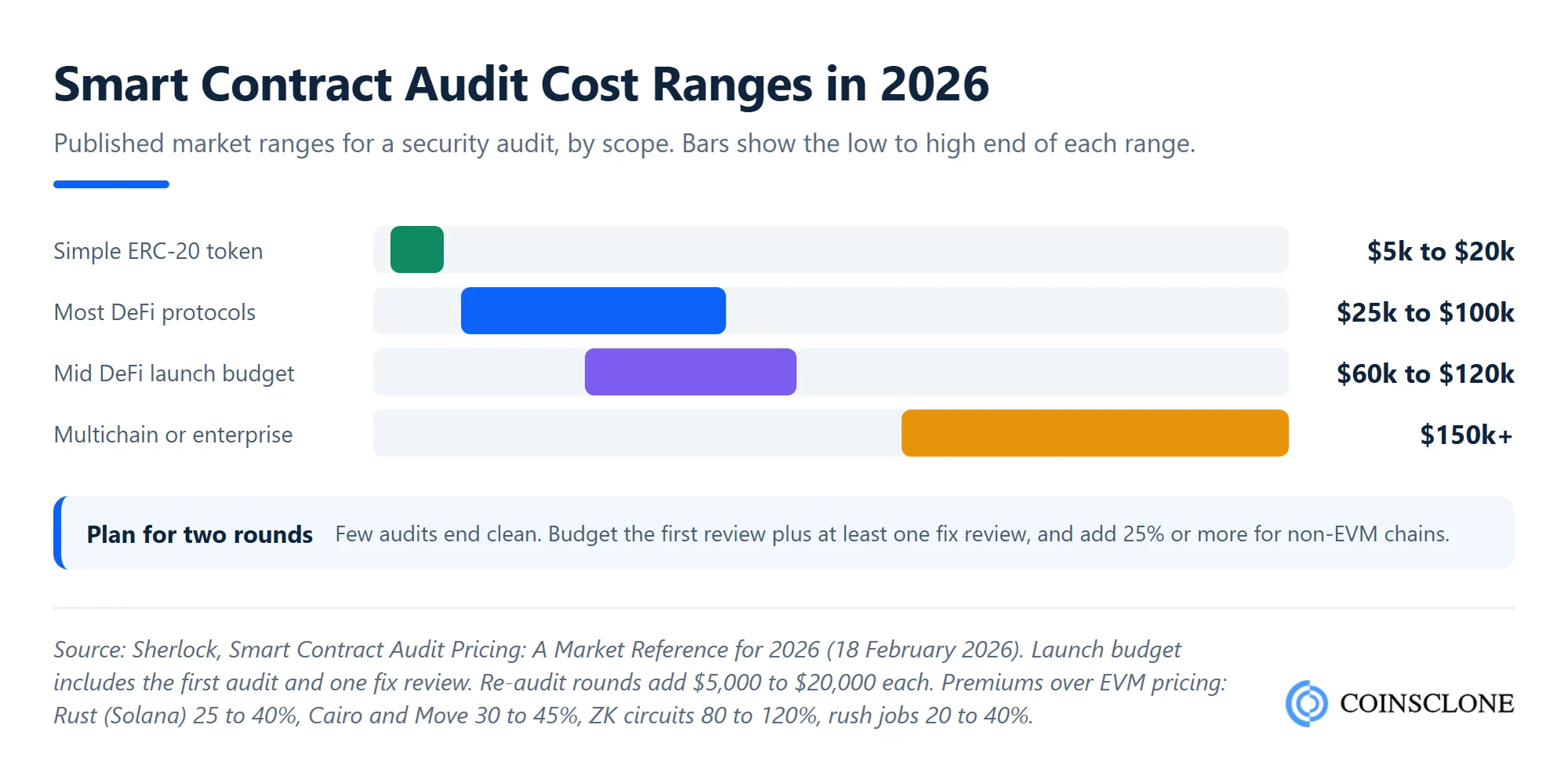
Smart contract audits in 2026 run from about $5,000 for a simple ERC-20 token to $250,000 or more for multichain systems, per Sherlock’s February 2026 market reference. Most DeFi protocol audits land between $25,000 and $100,000.
Four things push an audit quote up:
- Fix reviews: The first audit almost always finds issues. Each re-audit round after fixes adds $5,000 to $20,000. Sherlock suggests a pre-launch budget of $60,000 to $120,000 for a mid-complexity DeFi protocol, which covers the first audit and one fix review.
- Language: Rust, Move, Cairo and ZK code cost 25% to 120% more than Solidity, as above.
- Rush: A rush job adds 20% to 40% to the base fee.
- Scope changes: Code that changes during the audit has to be reviewed again. Freeze the code first.
You can buy an audit in two main ways. A private audit puts a small team of named reviewers on your code for a set time. A competitive audit, or contest, opens your code to many independent researchers who are paid for what they find; Sherlock puts the usual field at 100 to 500. For code that will hold large sums, teams often use both, then add a bug bounty after launch.
A real example from the OpenZeppelin forum shows the usual starting point: a founder with a small budget asking what a 500-line contract costs to audit. At that size, a simple token-style contract falls in the $5,000 to $20,000 band. The same 500 lines with lending or cross-chain logic would sit in the DeFi band.
How Much Does It Cost to Deploy a Smart Contract?
Deploying a smart contract costs gas, and in late 2026 that gas is cheap. On Ethereum, a standard ERC-20 token cost about $0.08 to deploy on 2 November 2026. Even a contract at the maximum allowed size cost about $0.61.
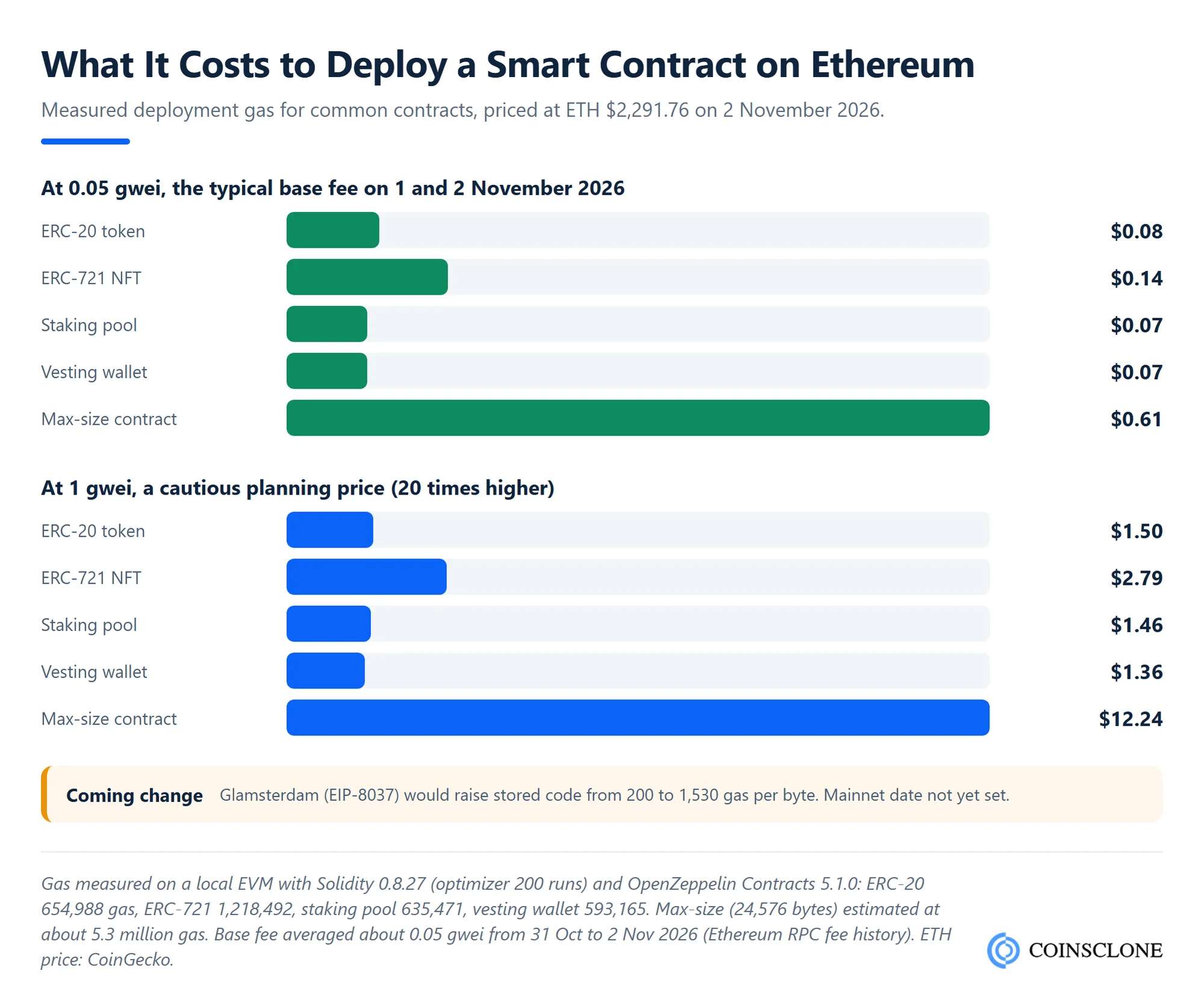
We compiled common contracts with Solidity 0.8.27 and OpenZeppelin Contracts 5.1.0, deployed them on a local EVM and recorded the gas used:
- ERC-20 token with owner minting: 654,988 gas
- ERC-721 NFT with token metadata: 1,218,492 gas
- Single-pool staking contract with rewards: 635,471 gas
- Vesting wallet: 593,165 gas
How the fee works: each deploy pays 21,000 gas for the transaction and 32,000 gas to create the contract. It also pays a fee for each byte of code sent, and 200 gas for each byte of code stored on chain. Then multiply by the gas price and the ETH price. Our ERC-20 at the 0.05 gwei base fee seen from 31 October to 2 November 2026, with ETH at $2,291.76 on CoinGecko: 654,988 x 0.05 gwei x $2,291.76 = about $0.08.
Gas does spike. In the 30 days to 2 November 2026, the Ethereum base fee sat between about 0.03 and 0.4 gwei on most days, with one day near 4.3 gwei. Check Etherscan’s gas tracker before you deploy, and plan with a higher number such as 1 gwei. At 1 gwei, the same token costs about $1.50.
Deployment Cost by Blockchain
| Chain | Gas price on 2 Nov 2026 | Cost to deploy our ERC-20 | Notes |
| Ethereum | About 0.05 gwei base fee | About $0.08 | About $1.50 at 1 gwei |
| BNB Chain | 0.05 gwei | About $0.02 | BNB at $712.08 |
| Polygon PoS | About 278 gwei | About $0.02 | POL at about $0.09 |
| Base | 0.006 gwei | Under $0.01 plus a small L1 data fee | Layer 2 on Ethereum |
| Arbitrum One | 0.02 gwei | A few cents plus a small L1 data fee | Layer 2 on Ethereum |
| Solana | No gas per byte; rent deposit | About 1.02 SOL (about $97) for a 200 KB program | Deposit you get back if you close the program |
Solana works another way. You lock SOL as a rent deposit in the program account, sized by the program. The Solana docs explain that you can reclaim it with the “solana program close” command. On 2 November 2026, the deposit for 100 KB of program data was about 0.51 SOL and for 200 KB about 1.02 SOL, at SOL $95.02.
What Ethereum’s Glamsterdam Upgrade Changes
Ethereum’s next upgrade, Glamsterdam, will change what it costs to deploy. As of 2 November 2026, it runs on two test networks: Sepolia since 6 October and Hoodi since 26 October. The mainnet date is not yet set.
Two changes matter for contract budgets:
- Bigger contracts: EIP-7954 raises the maximum contract size from 24,576 bytes to 65,536 bytes. Large protocols will need fewer workarounds to split code.
- Pricier stored code: EIP-8037 raises the cost of stored code from 200 gas to 1,530 gas per byte, and new contracts and storage slots also cost more. For our 2,177-byte ERC-20, the code charge alone rises from 435,400 gas to about 3.33 million.
Even at seven times the gas, deploying a token at today’s gas prices would still cost well under a dollar. But if you deploy many contracts or use factories, run the numbers again once the upgrade has a date. The EIP values may still change before then.
How Long Does It Take to Build a Smart Contract?
Time follows scope. A simple token can move from spec to mainnet in a few weeks. A lending protocol or bridge can take months, and the audit queue alone can add weeks before work starts.
| Phase | What happens | What sets the time |
| Spec | Write down every rule, role and edge case | How settled your token model is |
| Build and test | Code, unit tests, fuzz and invariant tests | Lines of logic and integrations |
| Audit | Outside review of frozen code | About 3 days for 500 nSLOC to 38 days for 6,000 nSLOC (Sherlock) |
| Fixes and re-audit | Fix findings, review the fixes | Number and severity of findings |
| Deploy and verify | Mainnet launch, source verified on explorers | Multisig setup and launch checks |
For a full product, Coinsclone’s own timelines give a sense of scale: a white label DEX takes 5 to 7 weeks and a standard DEX 10 to 14 weeks. Our guide on how to develop a smart contract covers each step in detail.
How Can You Reduce Smart Contract Development Cost Safely?
The cheapest smart contract is the one with the least new code. Every saving below cuts custom code or wasted review time, not safety.
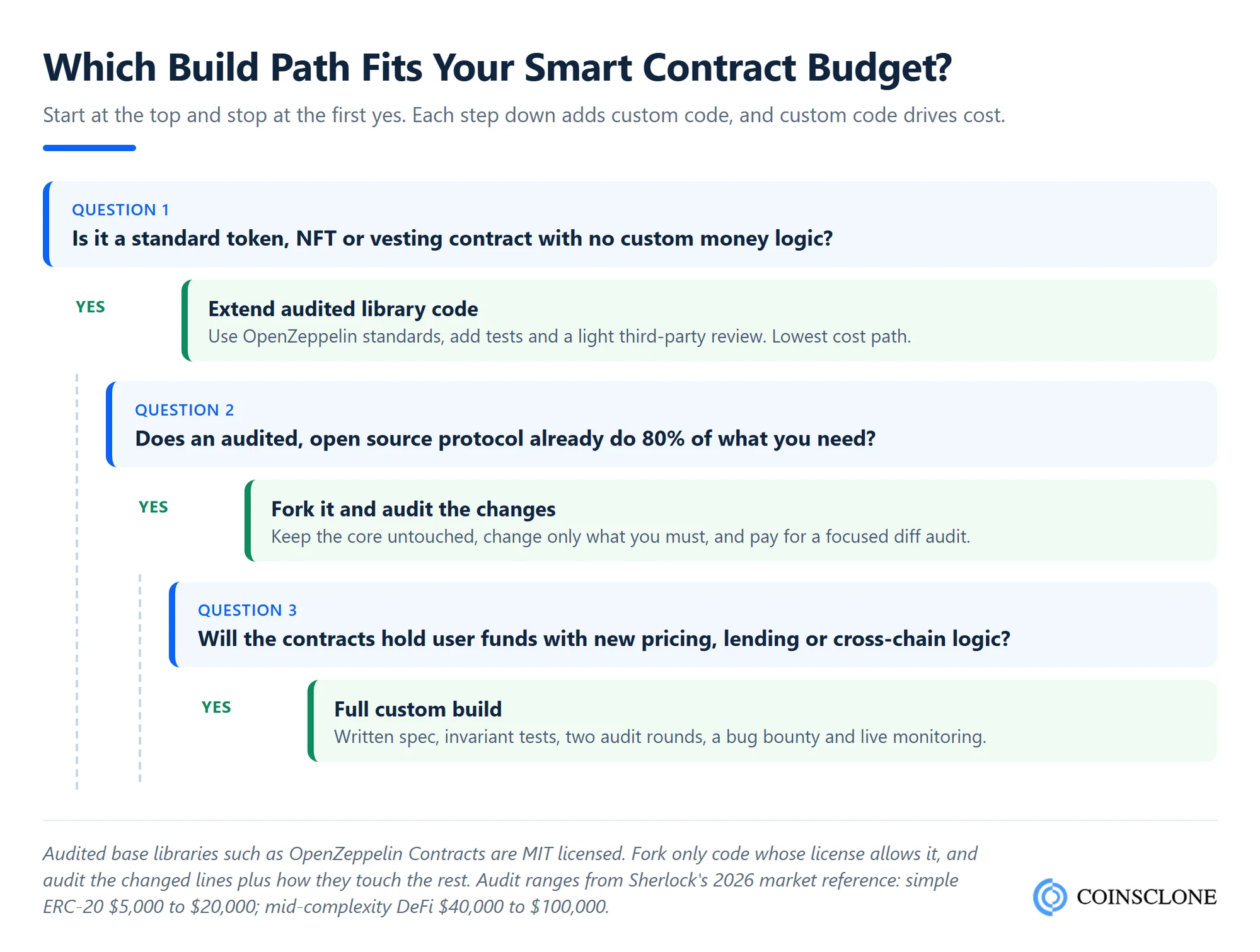
- Start from audited libraries: OpenZeppelin Contracts are MIT licensed and widely reviewed. Building a token or NFT on top of them keeps the custom part small.
- Fork, don’t rewrite: If an audited open source protocol does most of what you need, fork it (where its license allows), change as little as you can, and pay for a focused review of the changes.
- Use a new compiler: Solidity 0.8 and later block overflow bugs by default. In January 2026, Truebit lost $26.44 million to an overflow bug in code compiled with Solidity 0.6.10, per DefiLlama.
- Freeze the code before the audit: Changes mid-audit mean paying twice. Finish tests and internal review first.
- Book the audit early: Rush fees add 20% to 40%. Set the audit date when you plan the build, not when the code is done.
- Pick the chain on purpose: Rust, Move and Cairo audits cost more. Choose a chain for your users and liquidity, then budget for its audit premium.
- Keep admin power small: Use a multisig and a timelock for upgrades, and remove powers you do not need. Fewer admin paths mean less to audit and less to lose.
Budget for life after launch too. A bug bounty, on-chain monitoring and a fresh review after each upgrade cost far less than an exploit.
Get a Smart Contract Quote You Can Trust Before You Build
Smart contract development, done right.
- Token Contracts: ERC-20 and BEP-20 tokens with vesting, minting and supply rules
- DeFi Contracts: Staking pools, DEX liquidity pools and lending logic
- NFT Contracts: ERC-721 and ERC-1155 collections with royalties and allowlists
- Audit Ready Code: Full test suites, multisig admin controls and audit support
See a live demo of our smart contract solutions.
Book a Free Demo to plan your smart contract scope, timeline and budget.
How Coinsclone Helps With Smart Contract Development
Coinsclone builds smart contracts for tokens, NFTs, staking, vesting, DEXs and lending platforms on Ethereum, BNB Chain and other major chains. We scope each contract around the least custom code it needs, test it hard and prepare it for a third-party audit. Coinsclone has built crypto products since 2018 and delivered 350+ platforms for 200+ clients across 20 industries. See our smart contract development services for the full scope, or our DeFi smart contract development page if your contracts will hold user funds.
Frequently Asked Questions
How much does a smart contract cost?
A basic token contract costs about $5,000 to $15,000 to build, and a complex one $15,000 to $50,000 or more, based on published 2026 agency cost guides. DeFi contracts such as DEXs, lending or bridges cost far more. Add an audit of $5,000 to $100,000+ and a small gas fee to deploy.
How much does it cost to deploy a smart contract?
On Ethereum on 2 November 2026, deploying a standard ERC-20 token cost about $0.08 in gas, at a 0.05 gwei base fee and ETH at $2,291.76. Even a maximum-size contract cost about $0.61. On layer 2 chains like Base and Arbitrum it costs a few cents or less. Solana instead needs a rent deposit of about 1 SOL for a 200 KB program, which you can get back.
How much does a smart contract audit cost?
Audits run from about $5,000 to $20,000 for a simple ERC-20 token and $25,000 to $100,000 for most DeFi protocols, per Sherlock’s 2026 pricing reference. Multichain and enterprise systems often go above $150,000. Each fix review adds $5,000 to $20,000.
How long does it take to build a smart contract?
A simple token can go from spec to mainnet in a few weeks. A DeFi protocol takes months once you add testing, an audit and fix rounds. The audit alone takes about 18 days for 3,000 lines of real code, per Sherlock.
Which blockchain is cheapest to deploy a smart contract on?
In November 2026, layer 2 networks like Base and Arbitrum, plus BNB Chain and Polygon, cost a few cents or less to deploy a token. Ethereum mainnet cost under $1 at the time. The deploy fee rarely decides it, so pick the chain where your users and their money are.
How much does it cost to hire a Solidity developer?
Web3.career’s November 2026 data puts the average Solidity developer at about $150,000 a year, or $78 an hour. Hourly rates range from about $33 to $134. Senior auditors and DeFi specialists sit at the top of that range.
Why are audits such a big part of smart contract cost?
Smart contracts are hard to change after launch and often hold real money. One missed bug can cost millions, as 2026 exploits on lending markets and bridges showed. An audit adds expert review that tests alone cannot replace.
What language is used for smart contracts?
Solidity is the main language on Ethereum and other EVM chains. Solana uses Rust, Sui and Aptos use Move, and Starknet uses Cairo. Code in other languages often costs more to audit, because fewer experts know it well.