
Real estate tokenization in Dubai lets UAE residents buy a small share of a ready home from AED 1,000, and each token is tied to the official title deed. The Dubai Land Department (DLD) runs the project with VARA, the city’s crypto regulator. As of 1 November 2026, one licensed app, PRYPCO Mint, sells these tokens to the public, and resale has been live since 20 February 2026.
This guide gives you the current rules, fees and numbers, each one dated. Then it covers the part most guides skip: how a developer or a proptech firm can launch tokenized property in Dubai, with the licences, partners, tech and costs involved.
In this guide:
- Where the DLD project stands in November 2026, with real numbers
- Who can invest, the minimum, the fees and the resale rules
- What VARA’s rulebook asks of anyone who issues property tokens
- Three launch routes for developers and platforms, and how to pick one
- The tech stack and the main cost drivers of a Dubai tokenization platform
What Is Real Estate Tokenization in Dubai?
Real estate tokenization in Dubai splits a property into digital tokens on a blockchain. Each token is a small share of a real home. What makes Dubai different is the land register. The DLD records token owners on its own register and gives each buyer a Property Token Ownership Certificate. So your token is linked to the title deed itself, not to a company that owns the home.
That is the key point for buyers and builders alike. In most countries, a property token is a share in a company or fund. In Dubai, the state registry tracks who holds the tokens. For the general mechanics, see our guide on how real estate tokenization works. This post sticks to Dubai.
| Item | Status as of 1 November 2026 |
| Run by | DLD, with VARA, the Dubai Future Foundation and the Central Bank of the UAE |
| Stage | Phase II of the pilot, with resale live since 20 February 2026 |
| Licensed retail app | PRYPCO Mint (VARA licence VL/25/05/001) |
| Blockchain | XRP Ledger, tokens issued by Ctrl Alt, held with Ripple’s custody tech |
| Who can buy | UAE residents aged 18 or over with a valid Emirates ID |
| Minimum | AED 1,000 (about $270) |
| Cap per investor | 20% of one property’s tokens |
| Payment | UAE dirhams only, no crypto |
| Tokens open for resale | About 7.8 million |
| DLD target | AED 60 billion, or 7% of property deals, by 2033 |
How Does the Dubai Land Department Tokenization Project Work?
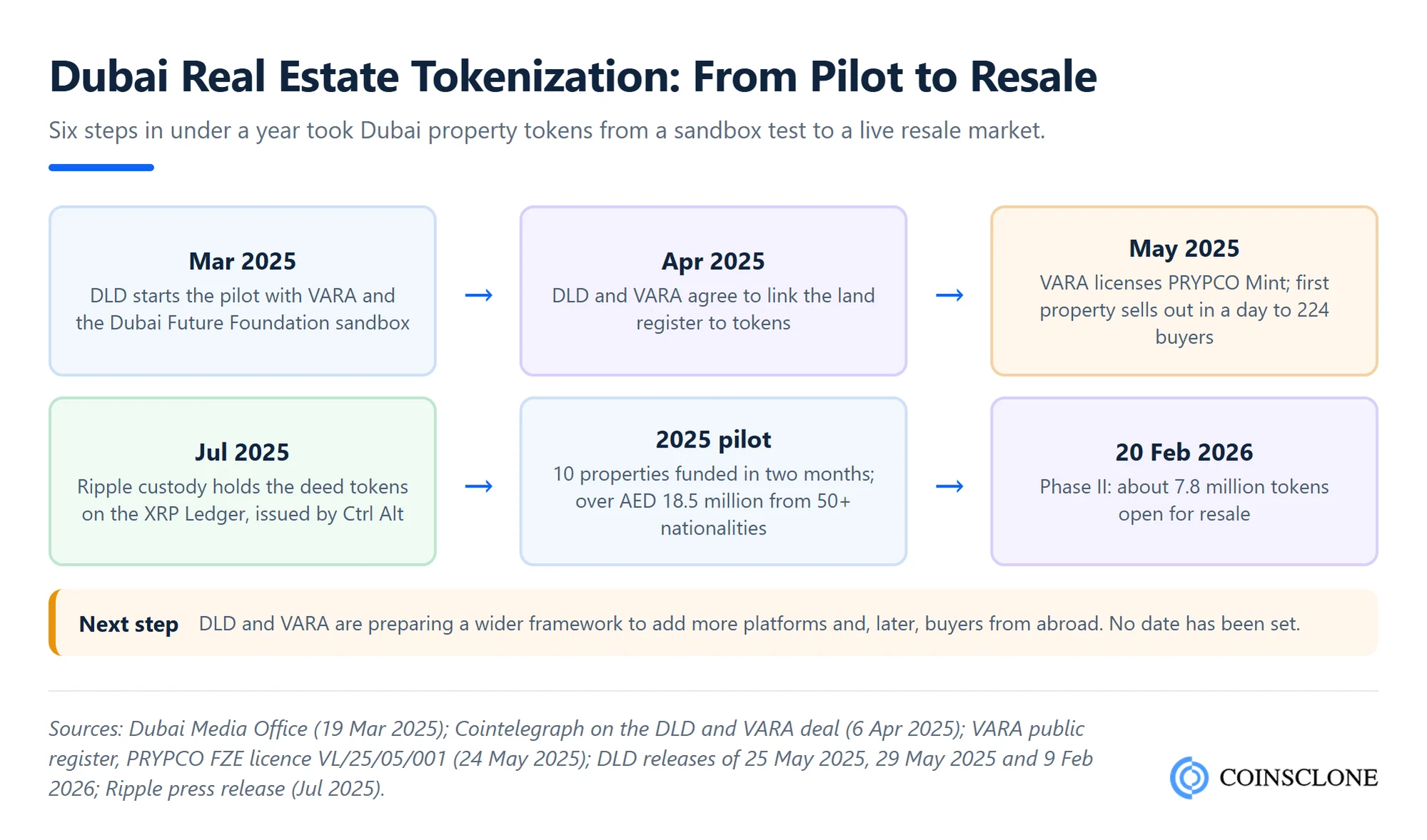
The DLD started the pilot on 19 March 2025, under its Real Estate Innovation Initiative, known as REES. Its launch release set the 2033 target of AED 60 billion. Each party has a clear job:
- Dubai Land Department: Keeps the land register, signs off each property token and records the owners.
- VARA: The Virtual Assets Regulatory Authority licenses the platform and approves each token and its whitepaper.
- Dubai Future Foundation: Hosts the test in its Real Estate Sandbox.
- Central Bank of the UAE: Listed by the DLD as a partner authority.
- PRYPCO Mint: The app investors use. VARA licensed it on 24 May 2025 for broker-dealer services and for issuing tokens.
- Ctrl Alt: The token engine. It got its VARA licence the same day and issues the deed tokens on the XRP Ledger, using Ripple’s custody tech to hold them.
- Zand Digital Bank: The banking partner for dirham payments in the pilot.
How Is a Token Linked to the Title Deed?
The head of PRYPCO Mint laid out the listing steps in an October 2026 talk. The team finds a home through brokers and gets an independent, RICS-approved valuation. It makes an offer, runs KYC and due diligence, and writes a whitepaper with investor risk notes. Then the home goes live for funding.
Once the home is fully funded, tokens are issued and the owners go straight onto the DLD register. PRYPCO says this takes minutes, against two to three weeks for the older company and trustee route.
The token count follows a simple rule. PRYPCO splits every square meter into 10,000 tokens. A 130 square meter flat becomes 1.3 million tokens. If the flat costs AED 2.6 million, each token is worth AED 2.
What Has the Dubai Pilot Achieved So Far?
The early sales went fast. Here is what the DLD and the platform have reported:
- First sale (May 2025): The first home sold out within a day to 224 investors from 44 nations. 70% were new to Dubai property, and the average stake was AED 10,714, the DLD said. The waitlist passed 6,000.
- Phase one: Ten homes were funded in two months. The fastest filled in 1 minute 58 seconds.
- Money raised: The pilot drew over AED 18.5 million from buyers of more than 50 nations, Gulf News reported in February 2026.
- Resale: About 7.8 million tokens became open for resale on 20 February 2026, per the DLD’s Phase II notice.
- Live tokens: The VARA register lists 10 DLD-approved home tokens under PRYPCO’s licence, as of 2 November 2026.
Keep the scale in mind. Dubai closed more than 270,000 property deals worth AED 917 billion in 2025, The National reported. The pilot’s AED 18.5 million is about 0.002% of that. The 7% goal for 2033 needs far more homes, more platforms and buyers from abroad.
Who Can Invest in Tokenized Property in Dubai?
Today the rules are tight. Here is who can buy and on what terms, per PRYPCO Mint’s site, its terms and DLD notices, checked 2 November 2026:
- Residents only: You must live in the UAE, be 18 or over and hold a valid Emirates ID. People abroad cannot buy property tokens yet.
- Minimum: AED 1,000 per home. It was AED 2,000 at launch in May 2025.
- Cap: One person can own up to 20% of a home’s tokens. On an AED 5 million home, that is AED 1 million.
- Payment: Dirhams only. The pilot does not accept crypto.
- Homes: The pilot launched with ready homes, not off-plan units.
- Income: Rent, after costs, is paid monthly into your in-app wallet.
- Votes: Big decisions, such as a sale, pass by simple majority. A sale vote starts on its own once the gain passes 30%.
What about foreign buyers? The DLD has said access from abroad will come in a later phase, with no date. The head of PRYPCO Mint said in October 2026 that it still needs work on KYC, payments and cross-border rules.
What Fees Do You Pay on Tokenized Dubai Property?
The main draw is a lower DLD fee. PRYPCO Mint buyers pay 2% instead of the standard 4%. But the platform charges its own fees, set out in its terms and conditions:
| Fee | Rate | Charged on |
| DLD fee | 2% (standard 4%) | Your share of the home |
| Acquisition fee | 2% | Your share of the funding target |
| Management fee | 0.5% | The funding target |
| Exit fee | 1% | The sale value when the home is sold |
| Incentive fee | Up to 15% | Gain above the funding target, at sale |
| Small withdrawal fee | 2.5% | Withdrawals under AED 50 |
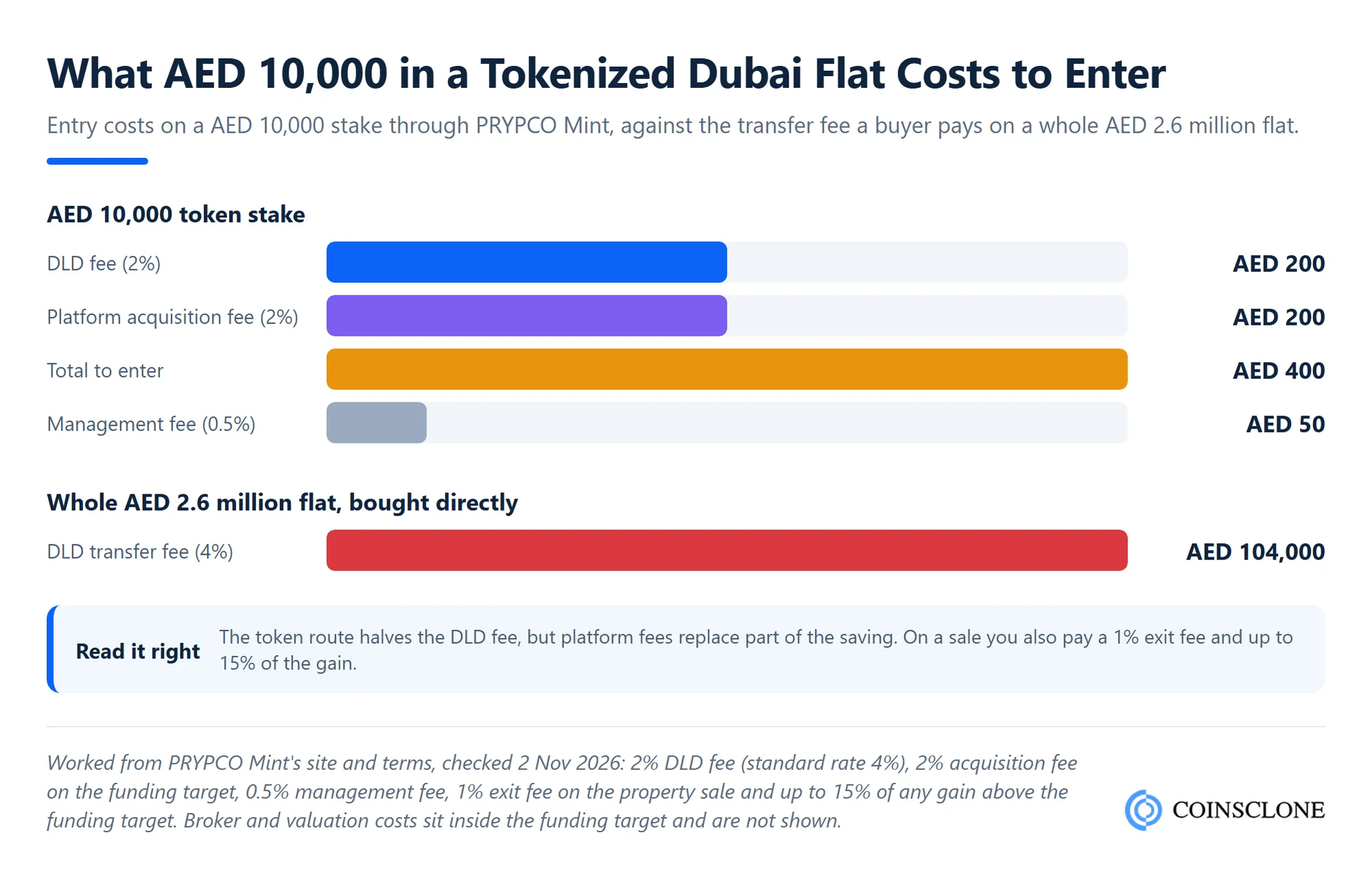
On a stake of AED 10,000, you pay about AED 400 to get in. A buyer of the whole AED 2.6 million flat pays AED 104,000 in DLD fees alone. PRYPCO projects net returns of 8 to 12% a year from rent and growth. Treat that as a projection, not a promise.
How Does Resale Work on the Dubai Secondary Market?
Resale runs inside the PRYPCO Mint app. The rules are strict on purpose:
- Lock-in: You can list tokens only after a three-month lock-in from the home’s purchase date.
- Price band: Your asking price must sit within 15% above or below the latest DLD valuation.
- Buyers: Only approved buyers on the app can see your listing.
- Payout: Once a buyer takes your tokens, you can move the money to your bank account.
The band stops wild swings, but it also caps your price. And there is no public data on daily trade volume yet. If few buyers want a home, you may wait to sell.
What Are VARA’s Rules for Property Tokens?
VARA treats property tokens as asset-referenced virtual assets, or ARVAs. In plain words, that is a token that stands for a real asset or the income from it. Issuing one is a Category 1 activity under VARA’s Virtual Asset Issuance Rulebook (19 June 2025 version). These rules apply to anyone who issues property tokens:
| Rule | What it means | Rulebook reference |
| Licence first | No Category 1 issuance without a VARA licence | Rule I.D.1 |
| Approval per token | VARA must approve each ARVA before it is issued | ARVA Rule I.B.2 |
| Whitepaper | Published before any public sale or marketing, with asset and redemption details | Part III, Rule B.4 |
| Capital | Paid-up capital of the higher of AED 1.5 million or 2% of average reserve assets over 24 months | ARVA Rule III.G.1 |
| Audits | Independent audits of token numbers and reserve assets every six months | ARVA Rule III.D.2.a |
| Safe keeping | Reserve assets held with licensed custodians, apart from the firm’s own money | ARVA Rule III.C.2 |
| Marketing | Must state the token is not covered by any investor protection or deposit scheme | ARVA Rule III.F.2 |
Two more points matter in Dubai. First, deed tokens also need DLD approval. The VARA register ties PRYPCO’s and Ctrl Alt’s licences to “ARVA authorised by Dubai Land Department”. Second, VARA covers mainland Dubai and its free zones, but not the DIFC. Inside the DIFC, the DFSA sets the rules.
Your licence also decides who you can sell to. PRYPCO’s licence lets it serve retail buyers. Ctrl Alt’s licence limits its DLD tokens to qualified and institutional investors.
Which Platforms Are Licensed for Tokenized Real Estate in Dubai?
Only a few firms hold the VARA licences needed to issue property tokens. This is what the public register showed on 2 November 2026:
| Firm | Licence and date | Activities | Who it may serve | DLD deed tokens |
| Prypco FZE (PRYPCO Mint) | VL/25/05/001, 24 May 2025 | Broker-dealer, Category 1 issuance | Retail, qualified and institutional | 10 |
| Ctrl Alt Solutions DMCC | VL/25/05/002, 24 May 2025 | Broker-dealer, Category 1 issuance | Qualified and institutional, for DLD tokens | 2 |
| Tokinvest DMCC | VL/2024/12/004, 30 Dec 2024 | Broker-dealer, Category 1 issuance | Retail, qualified and institutional | None listed |
Other share-based property apps in Dubai, such as SmartCrowd, use a crowdfunding model rather than DLD deed tokens. In its February 2026 notice, the DLD said it will study adding more platforms, subject to results and approvals.
How Do You Launch Real Estate Tokenization in Dubai?
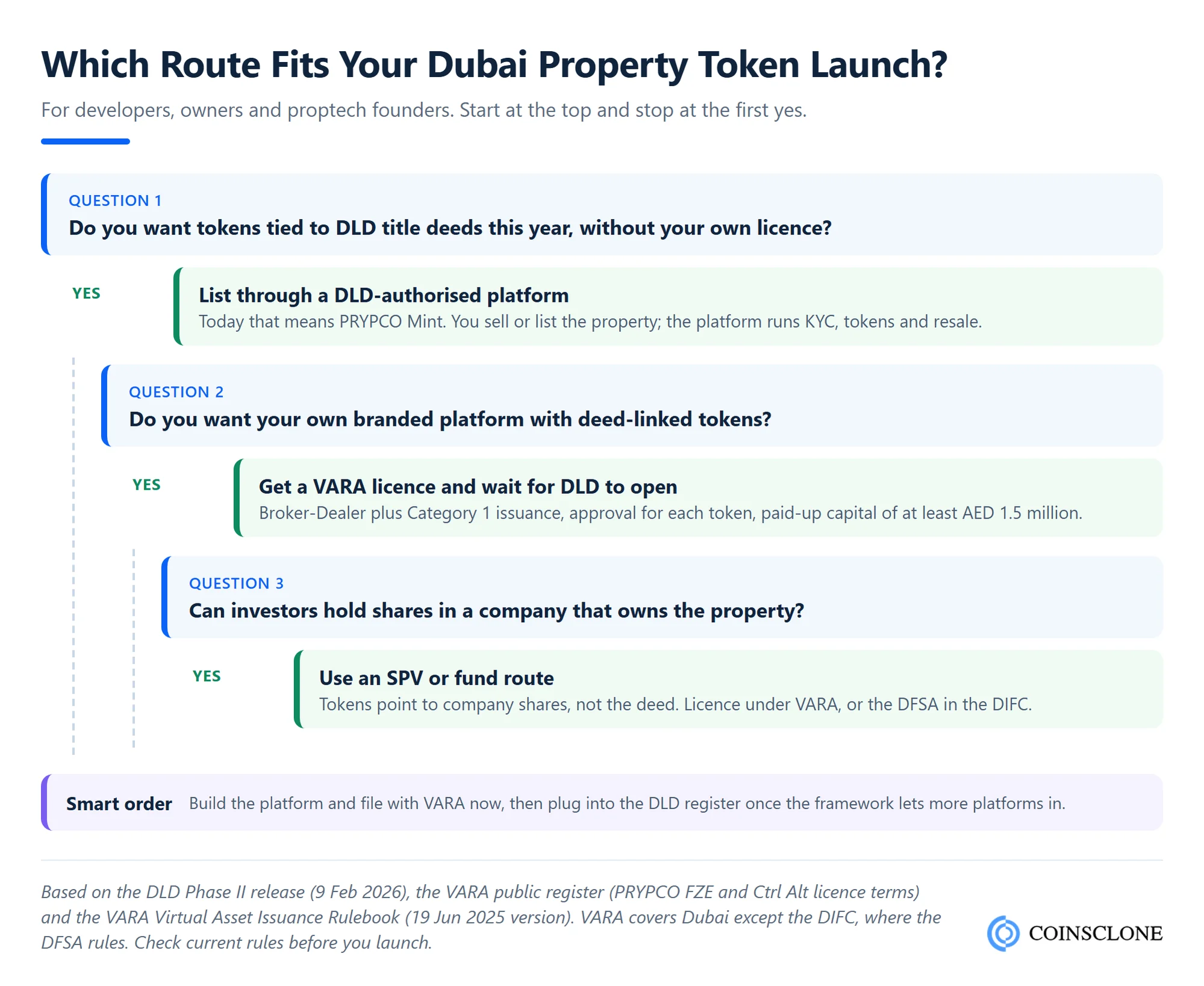
If you are a developer, a home owner or a proptech founder, you have three routes. Your choice depends on speed, control and who you want to sell to.
Route 1: List Through a DLD-Approved Platform
This is the fastest path. You sell or list the home through PRYPCO Mint, which has a page for sellers. The platform handles KYC, tokens, rent and resale. The DLD has said it is working to let developers list their projects. The catch: you use their brand, their fees and their investor rules, and the pilot has listed only ready homes.
Route 2: Build Your Own Licensed Platform
This gives you your own brand, investors and fees. You need a VARA licence for broker-dealer services and Category 1 issuance. You also need the paid-up capital, VARA approval for each token and a whitepaper for each one. To link tokens to title deeds, you then need DLD approval. That depends on the DLD opening the project to more platforms, which it has not dated.
Route 3: Tokenize a Company or Fund That Owns the Property
Here, investors hold tokens in a company or fund that owns the home. It does not give a deed-level record at the DLD. But it can suit offices, hotels and deals the DLD pilot does not cover yet. You license it under VARA’s ARVA rules, or with the DFSA if you set up in the DIFC.
What Are the Steps to Launch Your Own Platform?
For Route 2, the work runs in seven steps. The tech build can run alongside the licence work:
- Pick the structure: Deed tokens, company shares or fund units. Get a UAE legal opinion on what the token gives the buyer.
- Set up the company: Use mainland Dubai or a free zone outside the DIFC if you want VARA as your regulator.
- Apply to VARA: File for broker-dealer and Category 1 issuance, and set aside the paid-up capital.
- Line up partners: A UAE bank for dirhams, a licensed custodian, a RICS valuer, a firm to manage the homes and a KYC firm.
- Build the platform: See the tech stack below.
- Get each token approved: Whitepaper, VARA sign-off and, for deed tokens, DLD approval.
- Launch and run it: Pay rent, run votes, file audits every six months and keep the resale market fair.
Weighing Dubai against other hubs first? Our list of the best countries to launch RWA tokenization compares the rules side by side.
What Tech Does a Dubai Real Estate Tokenization Platform Need?
A Dubai platform needs the usual parts of an RWA tokenization platform, plus a few local ones:
| Module | What it does | Dubai detail |
| Investor app and onboarding | Sign-up, KYC, risk checks | Emirates ID checks and VARA investor classes (retail, qualified, institutional) |
| Token engine | Issues tokens and enforces transfer rules | The DLD pilot uses the XRP Ledger; on EVM chains, use ERC-3643 permissioned tokens |
| Register link | Keeps token owners in step with the land register | In the pilot, this runs through Ctrl Alt, the DLD’s token engine |
| Payments and wallet | Takes money in, pays rent out | Dirham rails through a UAE bank, monthly payouts |
| Resale market | Matches buyers and sellers | Lock-in periods, a price band against the DLD valuation, approved buyers only |
| Voting | Owner votes on repairs and sales | Majority rules and automatic sale triggers |
| Custody | Holds keys and reserve assets | A licensed custodian, with client assets kept apart |
| Compliance | AML, Travel Rule and reports | Six-monthly audits and whitepaper updates |
How Much Does It Cost to Build a Real Estate Tokenization Platform in Dubai?
There is no reliable public price for a full Dubai tokenization platform, because scope varies so much. It helps to price the parts. Published 2026 agency cost guides put token contracts at $5,000 to $15,000 for basic builds and $15,000 to $50,000 or more for complex ones. They put crypto wallets at $15,000 to $90,000 for white label and $50,000 to $200,000 for custom builds.
These factors push the total up or down:
- White label or custom: A white label tokenization platform cuts build time and cost. A custom build fits unusual deal types.
- Chain and custody: XRP Ledger, an EVM chain or both, and whether you run your own keys or use a custodian.
- Integrations: Each bank, KYC, valuation and register link adds work and testing.
- Resale rules: Lock-ins, price bands and order matching take more logic than a simple buy page.
- Mobile apps: Native iOS and Android apps add time on top of the web app.
- Licence capital: Not a build cost, but you must hold at least AED 1.5 million in paid-up capital to issue ARVAs.
On timing, the code is rarely the slow part. VARA does not publish a fixed review time for licences or token approvals. So start the licence file early and build while you wait.
What Are the Risks of Real Estate Tokenization in Dubai?
Dubai’s token market is still young. Weigh these risks before you buy or build:
- Pilot status: The DLD calls its approach gradual. Rules, fees and limits can change between phases.
- Thin resale: The price band and the small pool of buyers can make it slow to sell.
- One retail platform: Today, one app serves retail buyers. If it pauses, so does your access.
- Residents only: Buyers abroad are shut out for now, which limits demand.
- No safety net: VARA makes issuers warn buyers that no deposit or investor scheme covers the token.
- Rent is not fixed: Payouts depend on tenants, repairs and fees.
Launch Tokenized Dubai Property With a Platform Built for VARA Rules
Real estate tokenization platform development, done right.
- Investor App: Sign-up, Emirates ID KYC, investor classes and an in-app dirham wallet
- Property Tokens: Tokens on the XRP Ledger or permissioned ERC-3643 tokens on EVM chains
- Resale Market: Lock-in periods, price bands against the latest valuation and approved buyers only
- Owner Tools: Monthly rent payouts, owner votes, audit reports and whitepaper updates
See a live demo of a real estate tokenization platform with primary sales, rent payouts and resale.
Book a Free Demo to plan your Dubai property token launch, from VARA licence prep to go-live.
How Coinsclone Helps You Launch Real Estate Tokenization in Dubai
Coinsclone builds tokenization platforms for developers, brokers and proptech firms. We build the investor app and KYC flows. We also build tokens on the XRP Ledger or permissioned tokens on EVM chains, plus dirham payouts and a resale market with lock-ins and price bands. Coinsclone has built crypto products since 2018 and delivered 350+ platforms for 200+ clients across 20 industries. See our real estate tokenization development services to plan your Dubai launch.
Frequently Asked Questions
Can foreigners invest in tokenized real estate in Dubai?
Not yet, if they live outside the UAE. As of November 2026, PRYPCO Mint sells home tokens only to people who live in the UAE, are 18 or over and hold a valid Emirates ID. The DLD says access from abroad will come in a later phase, but it has not set a date.
How much do I need to start investing in tokenized real estate in Dubai?
PRYPCO Mint lists a minimum of AED 1,000 per home, about $270, as of November 2026. The minimum was AED 2,000 when the platform launched in May 2025. You also pay a 2% DLD fee and a 2% platform fee on top.
Is real estate tokenization legal and regulated in Dubai?
Yes. The Dubai Land Department runs the project with VARA, which licenses the platforms and approves each token. The DLD records token owners on its land register and issues an ownership certificate. It is still a pilot, so the rules can change.
How can I sell my property tokens in Dubai?
You list them on the PRYPCO Mint marketplace after a three-month lock-in. Your price must be within 15% of the latest DLD valuation, and only approved buyers see the listing. You can also exit when a majority of owners vote to sell the whole home.
How many tokens can I own in one property?
You can own up to 20% of the tokens in a single property on PRYPCO Mint. On a home listed at AED 5 million, that caps your stake at AED 1 million. The limit keeps ownership spread across many investors.
What is the value of one property token in Dubai?
It depends on the home’s size and price. PRYPCO splits each square meter into 10,000 tokens, then divides the purchase price by the token count. A 130 square meter flat bought for AED 2.6 million has 1.3 million tokens worth AED 2 each.
What are the main challenges of real estate tokenization in Dubai?
The biggest limits are the residents-only rule, a single retail platform and a thin resale market with a set price band. Builders also face VARA licences, capital rules and DLD approval for each token. The DLD has not yet dated its next phase.