
This guide compares OpenSea vs Rarible as they work in October 2026. It does not rely on how they worked in the 2021 boom. You will see what each one charges, how creator royalties get paid, which chains and payment methods they support, and how much trading really happens on each. Did you search “Rarible vs OpenSea” to pick a place to buy, sell or launch NFTs? Then this is the current answer.
A lot has changed. OpenSea now charges 1% on NFT sales and has grown into an app for both tokens and NFTs. Rarible was sold to a new owner, IMPOSSIBLE, in 2026 and came back with trading cards and card packs. So most guides you will find online quote old fees and old features. Here, each number comes from the two sites’ own help pages or from on-chain data.
In this guide:
- A side-by-side table of fees, royalties, chains and payments for 2026
- What a seller keeps from a $1,000 sale on each site
- Why OpenSea has far more buyers, with real 30-day fee data
- A quick decision tree to pick the right site for your NFT
- How to build your own NFT marketplace like OpenSea or Rarible
Compare OpenSea Vs Rarible for Your NFT Marketplace Insights
OpenSea Vs Rarible — understand features and platform differences.
- Market Reach: OpenSea offers broader liquidity and asset variety.
- Creator Focus: Rarible emphasizes decentralization and creator royalties.
- Fee & Governance: Rarible uses governance tokens; OpenSea has higher fees.
- Custom Clone Scripts: Build marketplaces tailored to your unique goals.
See a free branded demo of your NFT marketplace in 48 hours — before you invest a cent.
Book a Free Demo to discover how OpenSea Vs Rarible insights can help you launch in just 8–12 weeks.
OpenSea vs Rarible: The 2026 Comparison at a Glance
Here are the key facts in one place. Read the details for each row further down.
| Factor | OpenSea | Rarible |
| Owner | Ozone Networks (founded 2017) | IMPOSSIBLE (bought the brand in 2026; Rarible launched in 2020) |
| Seller fee on NFT sales | 1% | 2% on Ethereum, Base and Polygon; 1.5% on Solana |
| Buyer fee | None on OpenSea listings | None on Rarible listings; 2% on aggregated listings on EVM chains |
| Primary drop (mint) fee | 10% | No public drop fee listed |
| Creator royalties | Enforced for ERC721-C contracts, optional for others | Paid as set by the collection |
| NFT chains | More than 20, including Ethereum, Base, Polygon, Arbitrum, Solana and Ronin | Ethereum, Base, Polygon, Solana and other EVM chains |
| Card payments | Yes, through MoonPay | Yes, card, Apple Pay and Google Pay through MoonPay |
| Extra products | Token swaps, perps, stock tokens | Graded collectibles, Gacha packs |
| Token | SEA announced, launch delayed | None (RARI is run by a separate foundation) |
| Best for | Liquidity, drops and mainstream buyers | Collectibles fans and multichain browsing |
We checked fees on the OpenSea Help Center and the Rarible FAQ on 2 Oct 2026. Gas is extra on both.
Overview of OpenSea
OpenSea is the largest NFT marketplace by trading volume and the one most people try first. It was founded in 2017 and is known for its huge range of art, game items, PFPs, passes and domain names. In May 2025 it launched OS2, a rebuilt app where you trade NFTs and crypto tokens side by side.
Today it supports NFTs on more than 20 chains, from Ethereum and Base to Solana, Ronin and Monad. So you can pick the network with the lowest gas cost for each trade. It has also added token swaps, Hyperliquid perps and stock tokens on Robinhood Chain (not offered in the US). In short, it is turning into a full on-chain trading hub, with NFTs still at its core.
Overview of Rarible
Rarible launched in 2020 as a market built for creators. For years it stood out with its RARI token, which let holders vote on changes to the site. It then grew to cover many chains and added RaribleX, a toolkit that brands used to run their own NFT stores.
In 2026 that story changed. Web3 firm IMPOSSIBLE bought the Rarible brand and core assets, RaribleX too. IMPOSSIBLE first announced the deal in March 2026, and Rarible confirmed it at the end of May. The RARI token was not part of the sale. It stays with the RARI Foundation, so it no longer steers the Rarible market. The new Rarible keeps its NFT market and adds graded cards held as tokens, such as Pokémon and sports cards, plus Gacha card packs. If you plan to launch a similar platform, here is a step-by-step guide on how to create an NFT marketplace like Rarible.
Now that you know where each one stands, let us look at the differences. Both let you buy and sell NFTs, but they work in quite different ways.
OpenSea vs Rarible: A Detailed NFT Marketplace Comparison
These two are still among the best-known names in NFTs. While both let you trade NFTs, they differ in fees, audience, buyer depth and focus. Below, we compare them on audience, fees, royalties, chains, payments, buyer depth, safety, ease of use and more.
1. Target Audience
OpenSea is built for a broad crowd, so it is the top choice for both beginners and seasoned traders. It covers art, game items, PFPs, music, domain names and passes. Since it now handles tokens too, active traders can manage NFTs and coins in one app.
Rarible, on the other hand, began with artists and creators. After the 2026 relaunch, it also targets fans of trading cards and comics. It lists them as tokens with its vault partner, Collector Crypt. So Rarible now suits people who like to browse many chains and item types in one place.
2. Fees
If you want lower fees, here is how the two compare in 2026:
- OpenSea: a 1% fee on NFT sales, taken from the seller and built into the shown price. Minting in a primary drop costs 10%, and swaps carry no OpenSea fee.
- Rarible: a 2% seller fee on Ethereum, Base and Polygon. On Solana it is 1.5%. Fees on other chains vary and show up when you list.
So OpenSea has the edge on seller fees. Buyers pay no extra fee on either site for its own listings. But Rarible also shows listings it pulls from other markets. On EVM chains, buying one of those adds a 2% Rarible fee on top of the price.
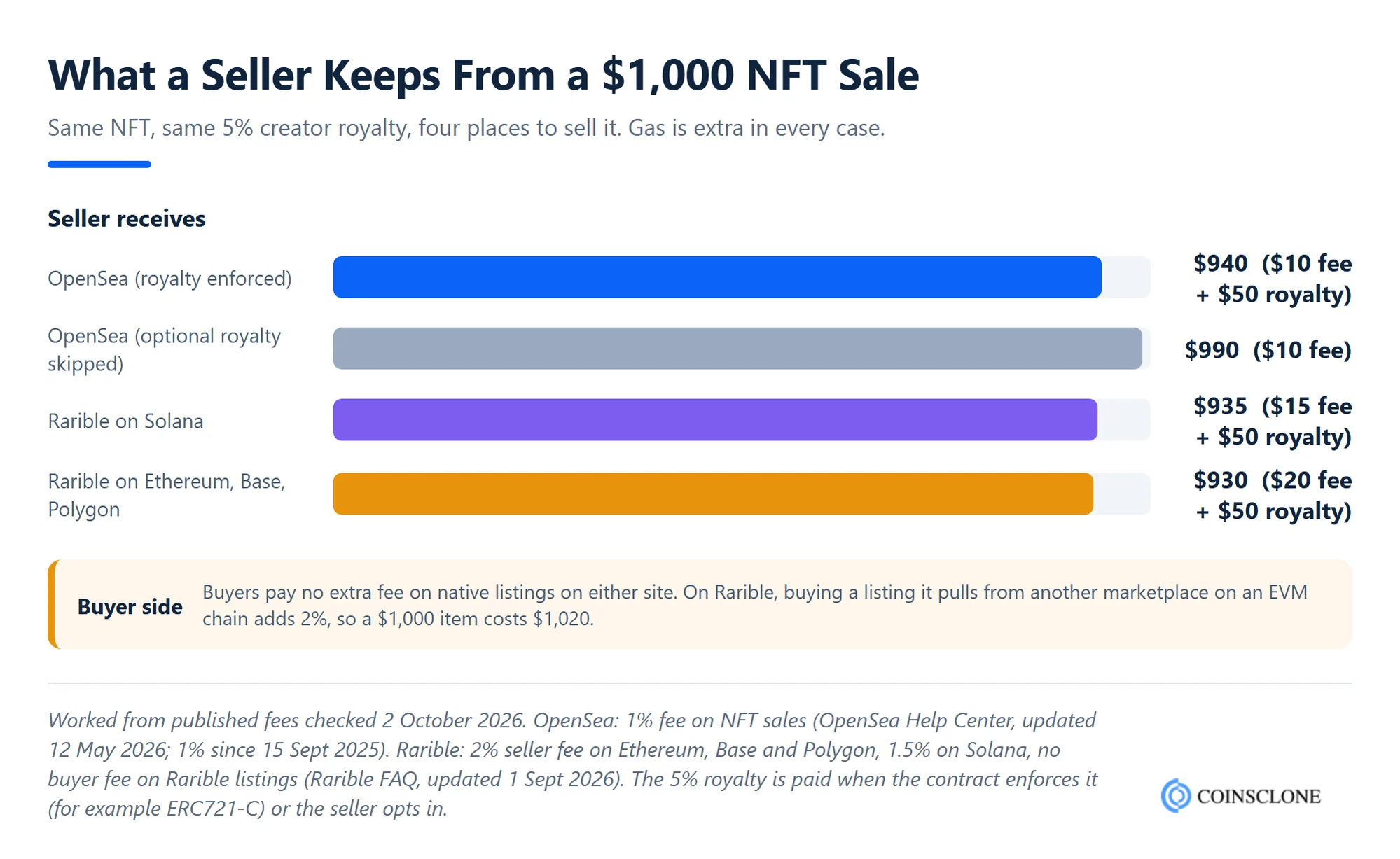
Older guides still quote OpenSea at 2.5% and Rarible at 0.5% to 7.5% per side. Those rates are gone. OpenSea’s fee update set its rate at 1% in mid-September 2025. Rarible’s current rates come from its FAQ, last updated on 1 September 2026.
3. Royalties
For creators who want to profit from resales, royalties are crucial. Here is how each site handles them now:
- OpenSea: creator earnings are either enforced or optional. They are enforced for ERC721-C or ERC1155-C contracts, and for any contract made in OpenSea Studio since 2 April 2024. For older contracts, the seller chooses whether to pay them.
- Rarible: each collection sets its own creator fee, paid out of each sale.
Many guides still claim OpenSea pays a “fixed 10% royalty” and that Rarible allows up to 50%. That is not how it works now. On both sites, the cut a creator gets depends on the smart contract. So if royalties matter to you, deploy a contract that can enforce them, such as ERC721-C. Our guide to OpenSea vs Blur explains how the royalty war started.
4. Blockchain Support
Chain support affects gas costs, speed and which buyers can find you.
- OpenSea: supports NFTs on more than 20 chains, per its help center, and keeps adding more. These include Ethereum, Base, Polygon, Zora, Ronin, Solana and Monad, with newer ones such as Ink and MegaETH. Trades on Base or Polygon cost far less gas.
- Rarible: lists fees for four main chains: Ethereum, Base, Polygon and Solana. It also runs on a set of other EVM chains, such as zkSync Era. And it supports RARI Chain, a low-cost chain with royalty rules built in.
Note that Flow, Tezos and Klaytn, which older posts list, are no longer on these chain lists.
5. Payment Options
Both sites now take crypto and card payments.
OpenSea supports ETH, WETH, POL, SOL, USDC and other tokens across its chains. It works with MetaMask, Coinbase Wallet, Phantom and WalletConnect, and it also offers an email login wallet. If you have no crypto, you can pay by card through MoonPay for buys from $3 to $15,000.
Rarible takes USDC and other crypto from your wallet. Buyers with no crypto can pay by card, Apple Pay or Google Pay through MoonPay. In both cases MoonPay adds its own fee, shown at checkout.
6. Liquidity and Trading Volume
Buyer depth is the factor most guides skip, yet it decides how fast you can sell. A site with more buyers fills your listing sooner and at a better price.
On this measure, the gap is huge. In the last 30 days, OpenSea earned about $651,000 in fees it kept, per DefiLlama. Rarible earned just $179 on the two chains tracked. Since both take a small cut of each sale, that gap points to a far bigger pool of buyers on OpenSea.
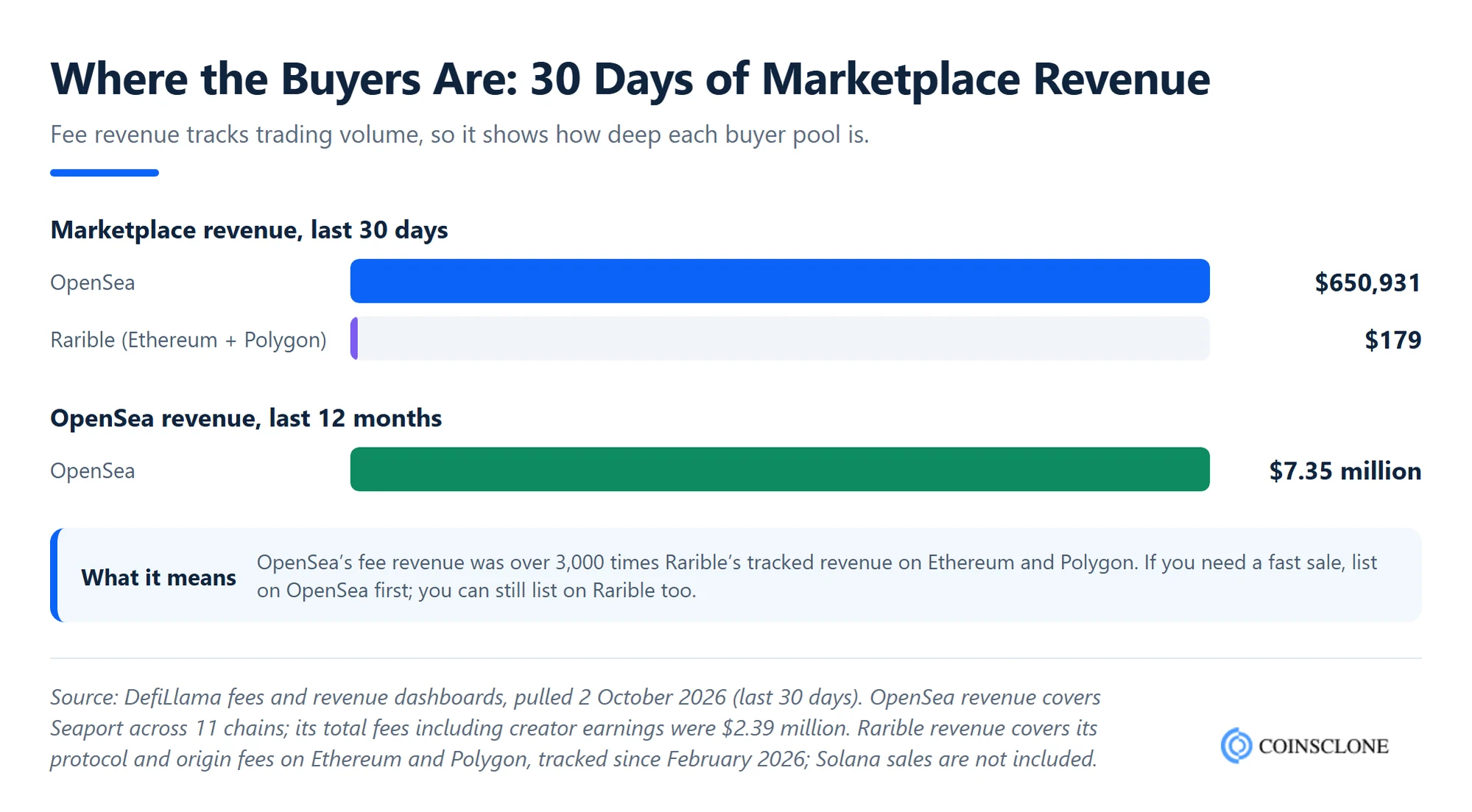
So if you need to sell fast, list on OpenSea first. You can still list the same NFT on Rarible too, since neither site holds your NFT and both read from your wallet.
7. Security
Staying safe is key when you deal with digital assets. On both sites, your NFTs and funds stay in your own wallet. You sign each action yourself, and neither site can move your assets.
OpenSea uses its audited Seaport contracts, flags risky items and hides likely spam. Even so, phishing links, fake collections and “buyer support” scams still target its users. Rarible does not ask for KYC. As on any open market, fake copies of hit collections can appear. So on both sites, check the contract address, ignore direct messages, and never sign a request you do not understand.
8. User Experience
OpenSea is known for its clean, simple design. Beginners can browse, filter by traits and buy in a few clicks. The OS2 app also shows token prices and charts, which helps active traders.
Rarible keeps a fast, simple layout with a strong focus on finding items across chains. Its new cards section shows a deal tag that compares each price with recent sales. For a first-time NFT buyer, both sites are now easy to use.
9. Features
Both sites offer many tools, but their focus differs:
OpenSea:
- Drops: creators launch first mints on a landing page, with allowlists and staged sales.
- OpenSea Studio: deploy a contract with no code and enforce creator earnings.
- Token trading: swap tokens with no OpenSea fee, plus perps and stock tokens.
- Trait filters: sort NFTs and game items by rarity.
Rarible:
- Cross-market listings: see items from other markets next to Rarible’s own.
- Graded cards: buy vaulted cards and comics held as tokens.
- Gacha packs: open a pack to get a random card.
- Collection offers: sell at once by taking an open offer on a collection.
10. Decentralization and Governance
For years, governance was the biggest difference between the two. OpenSea is a company, so its team makes all the calls. Users have no vote, at least until its planned SEA token arrives. OpenSea announced SEA for early 2026, but in March 2026 it delayed the launch with no new date.
Rarible used to let RARI holders vote on fees, features and upgrades. After the 2026 sale, though, IMPOSSIBLE owns the Rarible market. The RARI token now governs only the RARI Foundation and RARI Chain. In practice, both sites are now run by firms, and neither gives users a direct say.
11. Use Cases
The choice between OpenSea and Rarible depends on your use case.
OpenSea is ideal for:
- General NFT trading, from art and PFPs to game items and passes.
- Sellers who want the most buyers and the lowest seller fee.
- Creators who plan a first drop and want royalties enforced.
- Traders who want NFTs and tokens in one app.
Rarible is best for:
- Fans of graded trading cards, comics and other items held as tokens.
- Buyers who like to compare listings across several markets.
- Users of smaller EVM chains that OpenSea does not cover.
After comparing the key differences, the next step is to see how each site makes money. Their business models show how they plan to last and grow.
12. Business and Revenue Model
Here is how OpenSea and Rarible run their sites and earn money.
OpenSea
- Business Model: OpenSea is a trading app for NFTs and tokens that never holds your assets. It runs on the web and on mobile, with its own Seaport smart contracts. Its main costs are its tech team, fraud checks and support.
- Revenue Model: it earns a 1% fee on NFT sales and 10% on first drops. It takes 0% on token swaps today. DefiLlama tracks about $7.4 million in OpenSea fees kept over the past 12 months.
Rarible
- Business Model: Rarible is now owned by IMPOSSIBLE. It runs its own market and also shows listings from other sites. It also sells RaribleX, a white label toolkit that brands use to run their own NFT stores.
- Revenue Model: it earns a 1.5% to 2% seller fee and a 2% fee on outside EVM listings. It also earns from cards, Gacha packs and RaribleX deals.
Overall, OpenSea relies on huge volume at a low fee. Rarible spreads its income across fees, new card products and software for other brands.
So, now that we have covered everything from the basics to the key features, it all comes down to the big question.
Which NFT Marketplace Is Best: OpenSea or Rarible?
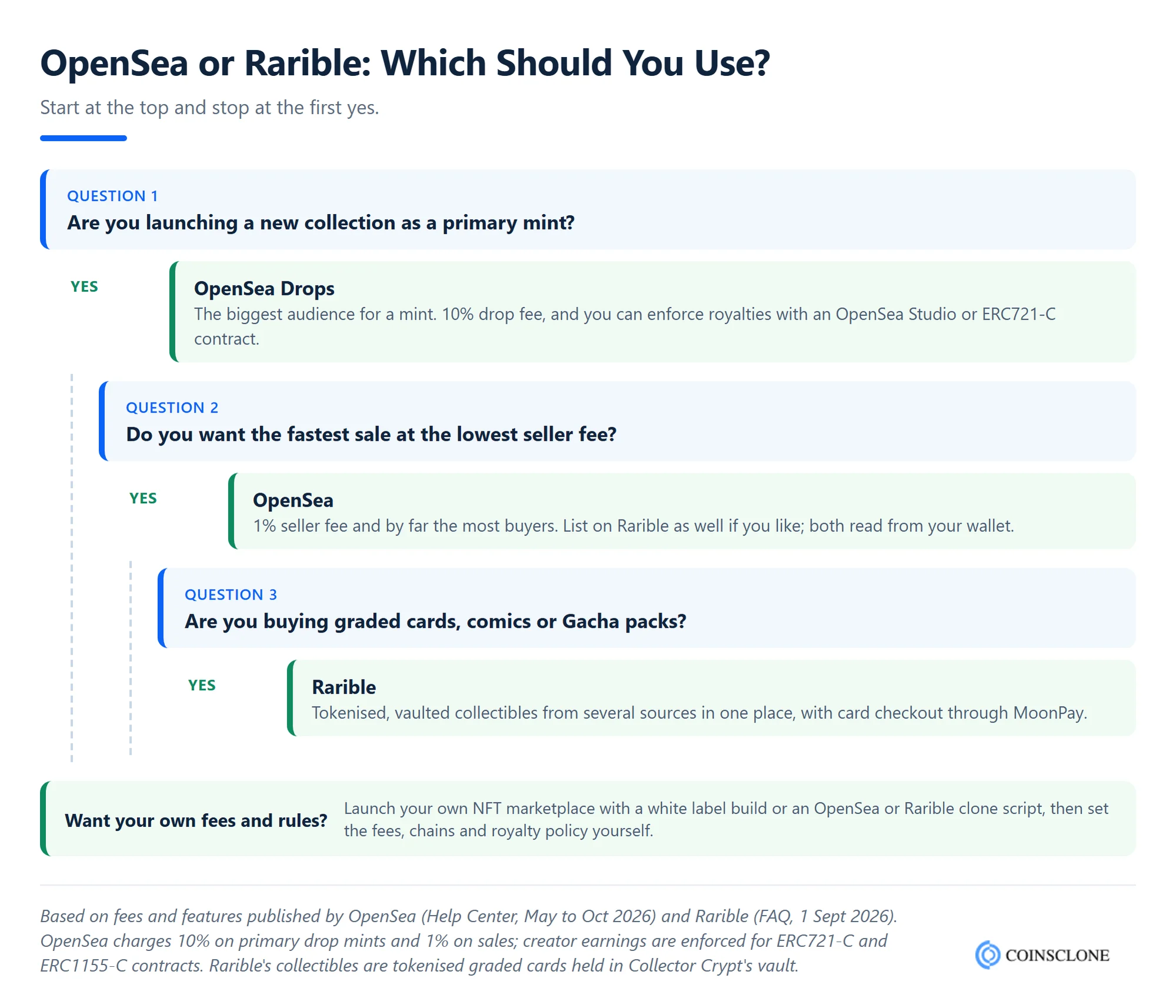
For most people in 2026, OpenSea is the better choice. It has the lower seller fee, more chains for NFTs, enforced royalties for modern contracts, and by far the most buyers. OpenSea has established itself as the leading NFT marketplace. The fee gap shows how far ahead it is.
Rarible still has a clear place, though. If you collect graded cards, enjoy Gacha packs or want to compare listings across markets, it is worth a look. Many sellers also list on both, since it costs little more than a one-time gas fee. The tree below helps you pick in under a minute.
Pros and Cons of Each Platform
OpenSea pros: the most buyers, a 1% seller fee, more than 20 chains, enforced royalties on ERC721-C contracts, and card payments.
OpenSea cons: a 10% fee on first drops, frequent phishing aimed at its users, and an SEA token that keeps slipping.
Rarible pros: no buyer fee on its own listings, a lower 1.5% fee on Solana, graded cards and cross-market browsing.
Rarible cons: far less trading, a higher 2% fee on EVM chains, a 2% extra fee on outside listings, and a new owner whose plans are still unclear.
Benefits of Creating NFT Marketplaces like OpenSea and Rarible
Building a site like OpenSea or Rarible gives startups and brands a way into NFTs on their own terms. You set the fees, pick the chains and decide how royalties work. Building your own NFT marketplace offers:
- High Revenue Potential: earn from sale fees, drop fees, featured listings and paid tools. That is the same mix the big two use.
- Branding and Market Position: build a known brand in one niche, such as game items, tickets or graded cards.
- Room for New Ideas: add what the big sites lack, such as card checkout, real-world asset tokens or a loyalty program.
- Support for Creators and Communities: enforce royalties in the contract and give your creators a home they trust.
Keep in mind that the market itself has changed. NFT sales fell 37% to $5.63 billion in 2025, according to CryptoSlam data. So new sites now win with a clear niche and low fees, not by copying OpenSea feature for feature. Rarible’s own 2026 pivot to graded cards shows the same lesson.
Get Started with Coinsclone for NFT Marketplace Development!
As experts, we at Coinsclone have been building blockchain products since 2018, with 350+ platforms delivered for 200+ clients across 20 industries. As a leading NFT marketplace development company, we offer white label builds and clone scripts. With them, you can launch a site like OpenSea, Rarible or other top NFT markets.
Want a ready base? Our OpenSea clone script and Rarible clone script come with lazy minting, auctions and creator fee controls built in. You get a secure, scalable platform shaped to your brand, with expert help from planning to launch.
Frequently Asked Questions
Is Rarible a good NFT marketplace?
Yes, Rarible is a safe site that never holds your NFTs, and it charges no buyer fee on its own listings. Its seller fee is 2% on Ethereum, Base and Polygon and 1.5% on Solana. However, it has far fewer buyers than OpenSea, so items may take longer to sell. It works best for browsing many chains and buying graded cards.
Which NFT platform is best?
For most users, OpenSea is the best NFT platform in 2026. It charges a 1% seller fee, supports more than 20 chains and has the deepest pool of buyers. Blur suits pro traders on Ethereum. Magic Eden is strong on Solana, and Rarible fits fans of graded cards. Our list of OpenSea alternatives covers more options.
Is OpenSea still profitable?
OpenSea is a private company, so it does not publish its profits. It does still earn steady fees. DefiLlama tracks about $7.4 million in fees kept by OpenSea over the past 12 months, and about $651,000 in the last 30 days.
Is NFT worthless now?
No, but the market is much smaller than in 2021. NFT sales totalled $5.63 billion in 2025, down 37% from 2024, per CryptoSlam. The average sale also dropped to $96. So most NFTs are not worthless, but their value now depends on real use, such as game items, tickets and graded cards, not hype.
Is it easier to sell on Rarible or OpenSea?
It is usually easier to sell on OpenSea, because it has many more active buyers. Its 1% seller fee is also lower than Rarible’s 2% on EVM chains. Rarible can still work for Solana NFTs, where its fee is 1.5%, or for niche cards.
Can you sell on both Rarible and OpenSea?
Yes. Neither site holds your NFT, and both read straight from your wallet, so you can list the same item on both. When it sells on one, the other listing can no longer go through, because the NFT has left your wallet. Still, cancel the old listing to avoid trouble later, which costs a small gas fee.
What is the disadvantage of Rarible?
The main drawback is low buyer depth. Rarible’s tracked fees are a tiny share of OpenSea’s, so fewer buyers see your listing. It also charges a 2% seller fee on EVM chains and adds 2% when you buy a listing it pulls from another site. Finally, its new owner, IMPOSSIBLE, has not yet shared its long-term plans.
Other Related Articles,
An Exclusive Comparison Between ~ OpenSea Vs Blur
Best Alternatives of OpenSea ~ List of top platforms to kickstart with!
Compare OpenSea Vs Rarible for Your NFT Marketplace Insights
OpenSea Vs Rarible — understand features and platform differences.
- Market Reach: OpenSea offers broader liquidity and asset variety.
- Creator Focus: Rarible emphasizes decentralization and creator royalties.
- Fee & Governance: Rarible uses governance tokens; OpenSea has higher fees.
- Custom Clone Scripts: Build marketplaces tailored to your unique goals.
See a free branded demo of your NFT marketplace in 48 hours — before you invest a cent.
Book a Free Demo to discover how OpenSea Vs Rarible insights can help you launch in just 8–12 weeks.