
This guide shows you how to create an NFT marketplace like Rarible in 2026, step by step. Rarible made its name as an open, creator-first market where anyone can mint, list and earn royalties across many chains. Those are still the parts worth copying. You will see the eight build steps, the four ways to build, the features that matter, and what each route costs in time and money.
Rarible itself has changed a lot, though. A firm called IMPOSSIBLE bought the Rarible brand in 2026 and relaunched it with graded trading cards and card packs. NFT sales also fell 37% in 2025, per CryptoSlam data. So the goal is not a straight copy of the 2021 site. Instead, you take the proven Rarible model and point it at a niche that still has buyers.
In this guide:
- The eight steps to create an NFT marketplace like Rarible, from niche to launch
- What Rarible looks like in October 2026: its owner, fees, chains and the lessons for builders
- Four build routes compared, including building on the open Rarible API
- How this kind of site earns money, with a worked fee example from Rarible’s own docs
- Real cost ranges and Coinsclone’s build weeks for each route
Launch Your Rarible-Like NFT Marketplace Faster & Smarter
Rarible Clone Script — a ready-to-launch solution to build a scalable NFT marketplace.
- Multi-Chain Support: Launch on Ethereum, Polygon, BNB Chain, and more.
- Creator-Centric Features: Built-in minting, royalties, and bidding.
- Cost-Effective Development: Save time and budget compared to custom builds.
- Scalable Architecture: Designed for high traffic and future growth.
See a free branded demo of your NFT marketplace in 48 hours — before you invest a cent.
Book a Free Demo to discover how Coinsclone helps you launch in just 8–12 weeks.
How to Create an NFT Marketplace Like Rarible
To create an NFT marketplace like Rarible, you need eight things in order: research, a clear niche, the right chains, a solid tech stack, the core features, security checks, testing and steady upkeep after launch. At Coinsclone, we follow this same process on every build, because each step makes the next one easier. Here is how it works.
Step 1: Research the Market
Good market research decides whether your site succeeds. First, look at where buyers still spend, such as tokenized trading cards, game items or music. Then study rival markets, their fees and the gaps in what they offer. This gives you clear facts before you spend on the build.
Step 2: Define Your Niche
Next, be clear about your niche, your target users and what your platform should achieve. Rarible started as an open market for any creator. Today, though, a new site wins faster with a focus, such as music, game assets, tokenized collectibles or a single brand’s community. A sharp niche lets you onboard users quickly and gain an edge over general markets.
Step 3: Choose the Blockchains
The blockchain you pick shapes speed, fees and who can use your site. Rarible runs on Ethereum, Base, Polygon and Solana, plus a set of other networks. For a new site, a low-cost chain such as Base, Polygon or Solana keeps gas small for buyers. A multi-chain setup reaches more users, but each extra chain adds build and test time.
Step 4: Pick the Tech Stack
A strong tech stack keeps your site stable and ready to grow. Most stacks of this kind use:
- Smart contracts: Solidity contracts for minting, listing, auctions and royalties, using ERC-721 for one-of-a-kind items and ERC-1155 for editions.
- Front end: a fast web app (often React or Next.js) with wallet connect for MetaMask, Phantom and WalletConnect.
- Back end: an indexer that reads chain events, an order book for signed listings, and search with filters.
- Storage: IPFS or Arweave for images and metadata, so files stay online even if your servers change.
Step 5: Build the Core Features
In this phase, we add the features that make the platform work: minting, fixed price sales, auctions, offers and royalties. Lazy minting matters most for a Rarible-style site. It lets a creator list an item for free, and the NFT is only minted when someone buys it. As a result, new creators can join without paying gas first.
Step 6: Add Security and Compliance
Next, make sure the platform meets strong security standards. This means an outside audit of your smart contracts, two-factor login for admin accounts and encrypted data. Depending on your market, you may also add KYC checks for sellers or large sales, plus screening against sanctions lists.
Step 7: Test and Launch
We test the NFT marketplace like Rarible on a testnet first. This proves it works in real-world conditions without bugs or errors. After testing, we launch it on the mainnet. A good launch also brings a few strong creators on day one, so the site never looks empty to its first buyers.
Step 8: Monitor and Improve
Finally, we keep watching the platform’s speed, address risks and ship updates. On an open market, this also means checking for copied artwork, spam collections and fake trading volume. In short, steady care after launch keeps buyers trusting your site for the long term.
Our Rarible clone script already covers most of these steps, so you can spend your time on your niche and your community.
What Is Rarible in 2026?
Rarible is an NFT marketplace that launched in 2020, founded by Alexei Falin and Alex Salnikov. It grew famous for three things: anyone could mint without approval, creators set their own royalties, and its RARI token gave users a vote. Over time it added many chains and an aggregator that shows listings from other markets next to its own.
But the Rarible of 2026 works in a new way:
- New owner: Web3 firm IMPOSSIBLE announced in March 2026 that it had bought the Rarible brand and key platform parts, such as the RaribleX toolkit. The deal closed around 1 June 2026.
- RARI is now separate: the RARI token and the RARI Foundation were not part of the sale. So RARI holders no longer steer the Rarible market. They still govern RARI Chain and the Rarible API.
- New products: Rarible launched Gacha Station on Solana on 22 June 2026 with its partner Collector Crypt. Users open packs of graded Pokémon, One Piece and sports cards from $25, and each pull is a token tied to a real card in a vault.
- Fees: per the Rarible FAQ, sellers pay 2% on Ethereum, Base and Polygon and 1.5% on Solana. Buyers pay no extra fee on Rarible’s own listings.
- Trading: Rarible kept less than $200 in revenue over the last 30 days on the two chains DefiLlama tracks. That shows how far its trading has fallen since the 2021 boom.
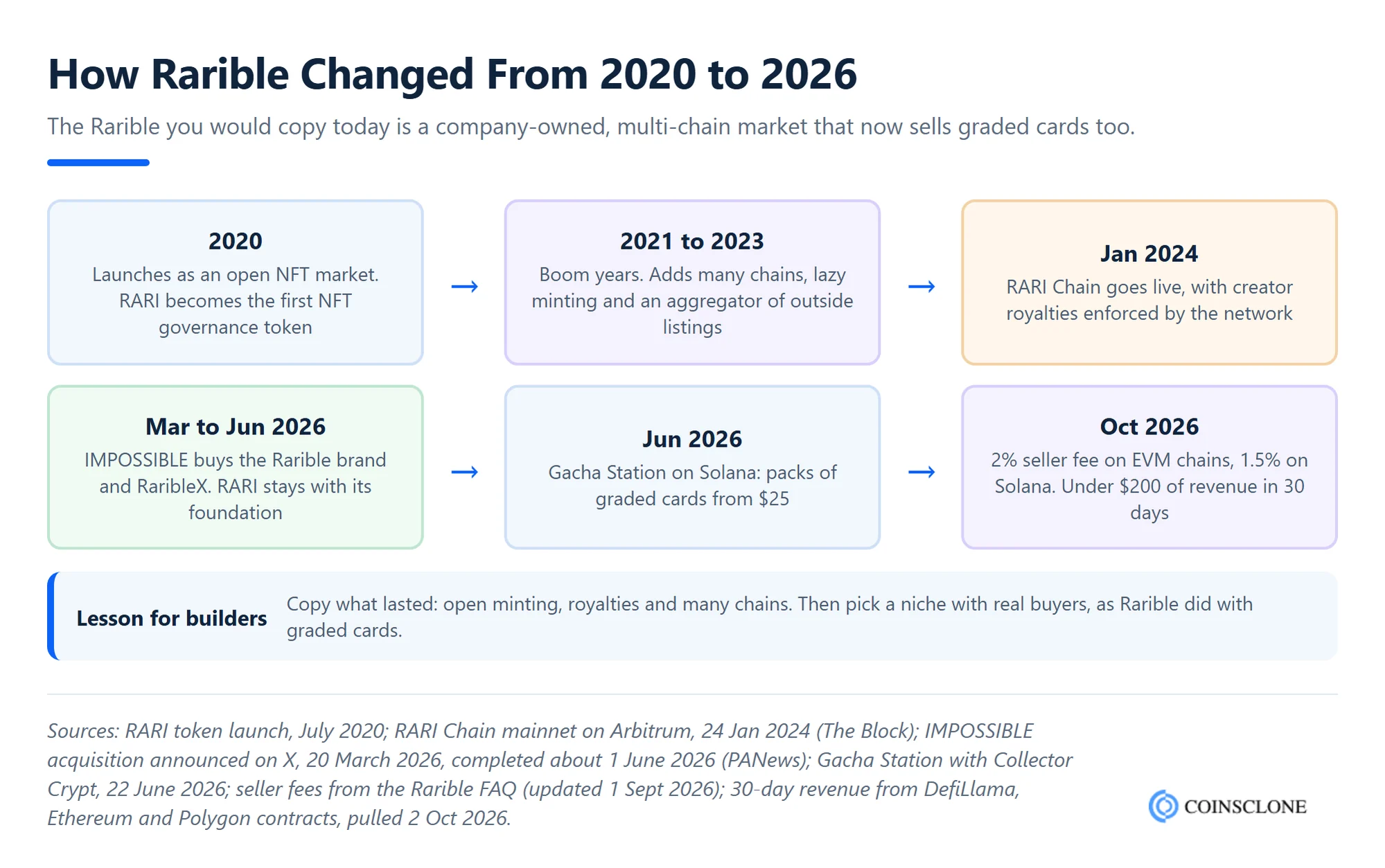
So what does this mean for you? Rarible’s open minting, creator royalties and multi-chain reach still work well. Its move into graded cards also shows that buyers follow real-world value. To compare it with the market leader, read our guide on OpenSea vs Rarible.
Why Do Entrepreneurs Prefer to Launch an NFT Marketplace Like Rarible?
We see many startup owners choose to build an NFT marketplace like Rarible. Here are the main reasons they pick this model over others:
- Open, Non-Custodial Trading: Users keep their NFTs in their own wallets, and smart contracts settle each sale. Traders want ownership and clear records, so they trust platforms that offer both. This gives you an edge.
- User-Friendly Interface: A simple, clean layout attracts users and brings more trading to your site. As a result, this style of design helps you build a large user base.
- Creator-First Model: Founders like how much freedom Rarible gives creators. Any creator can mint, set royalties and run their own collection page without asking for approval.
- Speed and Scale: Startups want to reach the market fast and start earning early. A Rarible-like platform suits this well, and it can grow with your traffic and NFT demand.
- Multi-Chain Reach: Rarible is not tied to one blockchain. It supports Ethereum, Base, Polygon, Solana and more, so your platform does not depend on one network. In turn, this protects your site when users move between chains.
In short, this model gives you a proven base with long-term staying power in the NFT space.
Four Ways to Create an NFT Marketplace Like Rarible
Once you decide that an NFT market fits your plans, the next question is how to build it. At Coinsclone, we build a Rarible-like NFT marketplace in three ways, and there is also a fourth route through Rarible’s own API.
1. Start With an MVP
An MVP lets you test your NFT platform in the market on a small budget. Think of a Rarible-style MVP as a trial version of the full platform. Our MVP includes these core parts:
- Minting NFTs
- Wallet connection
- Listing and buying NFTs
- Basic profiles for creators
We suggest an MVP for startups that want to test demand with real users. You get real feedback from both collectors and creators, then improve features based on how people actually use the site. It also lowers your risk in the early stages of the business.
In short, the MVP route is a smart choice if you want to test a niche market first.
2. Get a White Label Rarible Clone and Customize It
For many firms that want to grow fast, the best choice is a white label Rarible Clone Script. It is ready-made software that copies the core parts and design of Rarible. Since you can change it, you can change the UI/UX, features and security settings, then launch it as your own NFT marketplace.
With our Rarible clone script, you gain:
- Quick market entry
- Less technical work
- Better brand positioning
- Room to scale
This route suits both startups and large firms that want room for future upgrades. White label software works best for firms that want a faster launch, a clear timeline and a lower budget.
3. Build From Scratch
At Coinsclone, we also build Rarible-like NFT marketplaces from scratch. Here, we offer full support from planning to launch. This custom route suits firms with special trading logic, advanced token models and voting, complex links to other systems, or a long-term vision.
In this approach, we create each part, from smart contracts to the front end and the back end, to meet your exact needs. But it comes with trade-offs:
- A longer build time
- A higher cost
- Strong technical planning for the whole process
We support you with a clear roadmap and the team to see it through. In return, you get full control, deep changes and full ownership of your NFT market.
4. Build on the Rarible API
The fourth route is to build your own front end on top of the open Rarible Protocol. The Rarible API indexes more than 1 billion NFTs, and its free plan includes 100 requests a month, with larger plans on request. Its JavaScript SDK lets your site list, buy and bid on NFTs, and both the SDK and the protocol contracts are open source under the MIT license.
The big plus is shared liquidity. Your site can show listings from Rarible and OpenSea, and you can add your own “origin fee” on each sale you route. On the other hand, you depend on an outside API, its rate limits and its plans. So this route suits brands, games and communities that want a store fast, not founders who want to own the whole stack.
Which is Right for You? MVP vs Custom NFT Marketplace Development
Each founder faces the same question: MVP, white label or custom build? We help you choose by matching the route to how you plan to grow in Web3.
An MVP is a great way to test your platform in the real world. You learn how users act on your site, find the fee model that works and track results. So if you are just starting out, choose an MVP with confidence, since it needs a low budget and launches quickly.
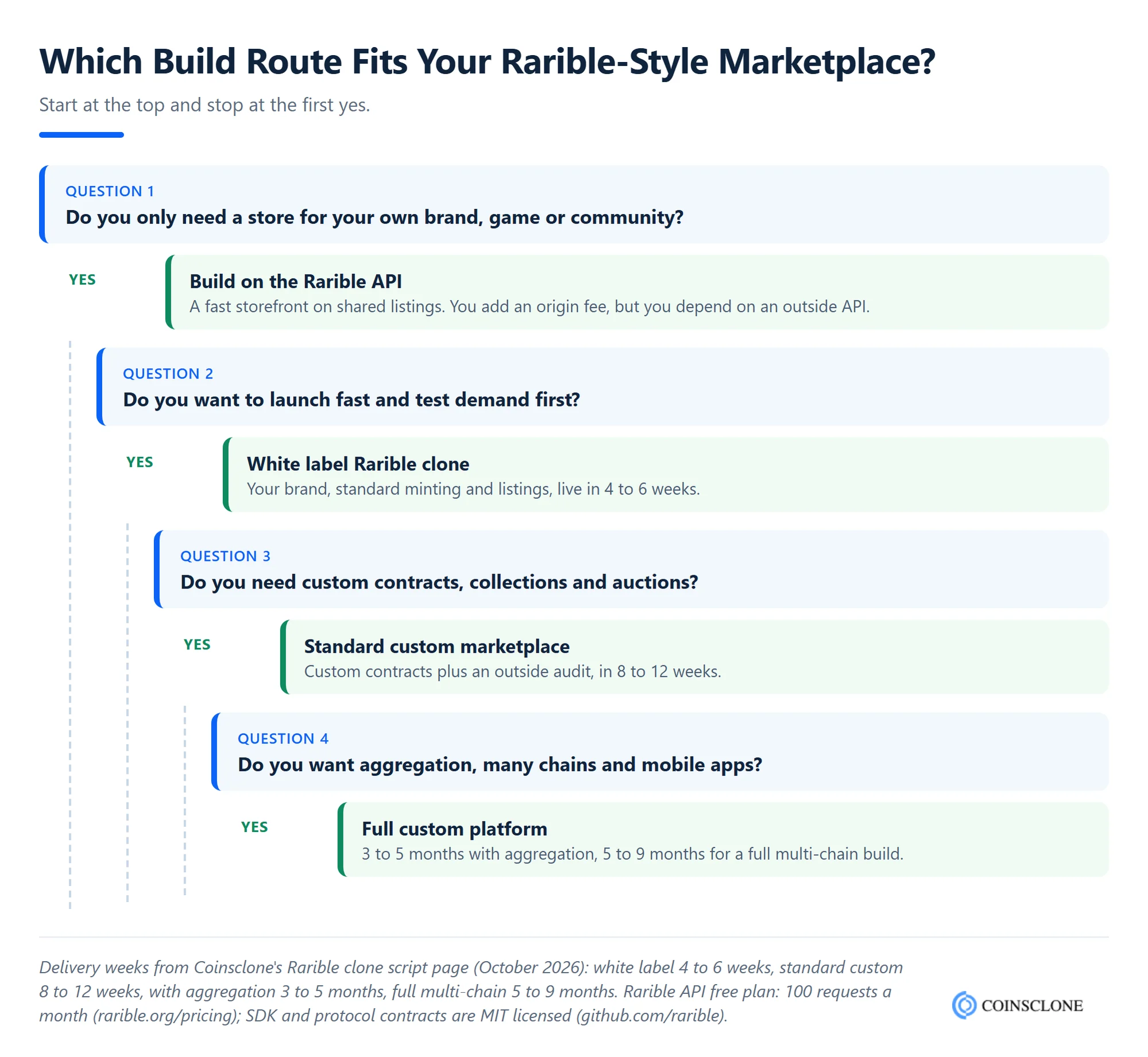
On the other hand, if you have long-term plans to lead your market, choose custom NFT marketplace development. Here, you own and control the whole platform and can scale like a large firm from day one. The decision tree below shows which route fits your plan.
Key Features of Our Rarible-Like NFT Marketplace
The features in your market set it apart from the rest. Here are the key tools that power our Rarible-like NFT marketplace:
- NFT Minting: Users can mint NFTs by uploading digital assets and setting their traits and ownership. A smooth minting flow brings more creators to your site.
- Lazy Minting: Creators list items for free, and the NFT is minted only at the first sale. This removes the upfront gas cost that keeps many new artists away.
- Creator Control: Creators manage their own collections, prices and royalties without a middleman. As a result, they stay loyal to your platform.
- Auction & Bidding: Users can sell at a fixed price, run timed auctions or accept offers. This gives both sellers and buyers more ways to trade.
- Simple Layout: Our design is clean and easy to use. Creators and buyers find their way fast, so they stay longer and trade more.
- Smart Contract-Powered: Smart contracts settle each sale on their own, with no manual steps. This builds trust in each trade on your site.
- Multi-Chain Support: Creators can mint on the chain they prefer. Low-cost chains keep gas fees small, which makes your platform easier for everyone to use.
- Wallet Support: We add top crypto wallets such as MetaMask, Phantom and WalletConnect. So users enjoy smooth login and payments across many networks.
- NFT Royalties: Creators earn a share each time their NFT is resold. We support standard royalty rules such as EIP-2981, so payouts work across most markets.
- Listing Aggregation: Like Rarible, your site can show listings from other markets next to your own. Buyers see more choice, and you earn a fee on the orders you route.
- Trust and Safety Tools: Open minting attracts copied art, spam and fake volume. So we add copy detection at mint time, verified collection badges and wash trading alerts.
With the features in place, the next question is how the site earns money.
How an NFT Marketplace Like Rarible Makes Money
A site like this earns mainly from a small fee on each sale. Rarible itself charges sellers 2% on most EVM chains and 1.5% on Solana. On top of that, you can add other income streams:
- Trading fees: a small cut of each first sale and resale on your site.
- Routing fees: a small fee on orders your site sends to other markets through aggregation.
- Launch services: paid help with drops, allowlists and marketing for new collections.
- Featured spots: clearly labelled paid placement for collections on your home page.
- Card packs and collectibles: Rarible’s 2026 move into Gacha packs shows how a pack model can add revenue.
The Rarible Protocol also shows how fees split on a single sale. In its docs, the protocol takes 1% from both buyer and seller, the creator gets a royalty, and each app that helps with the sale can add its own origin fee. The worked example below uses those exact figures.
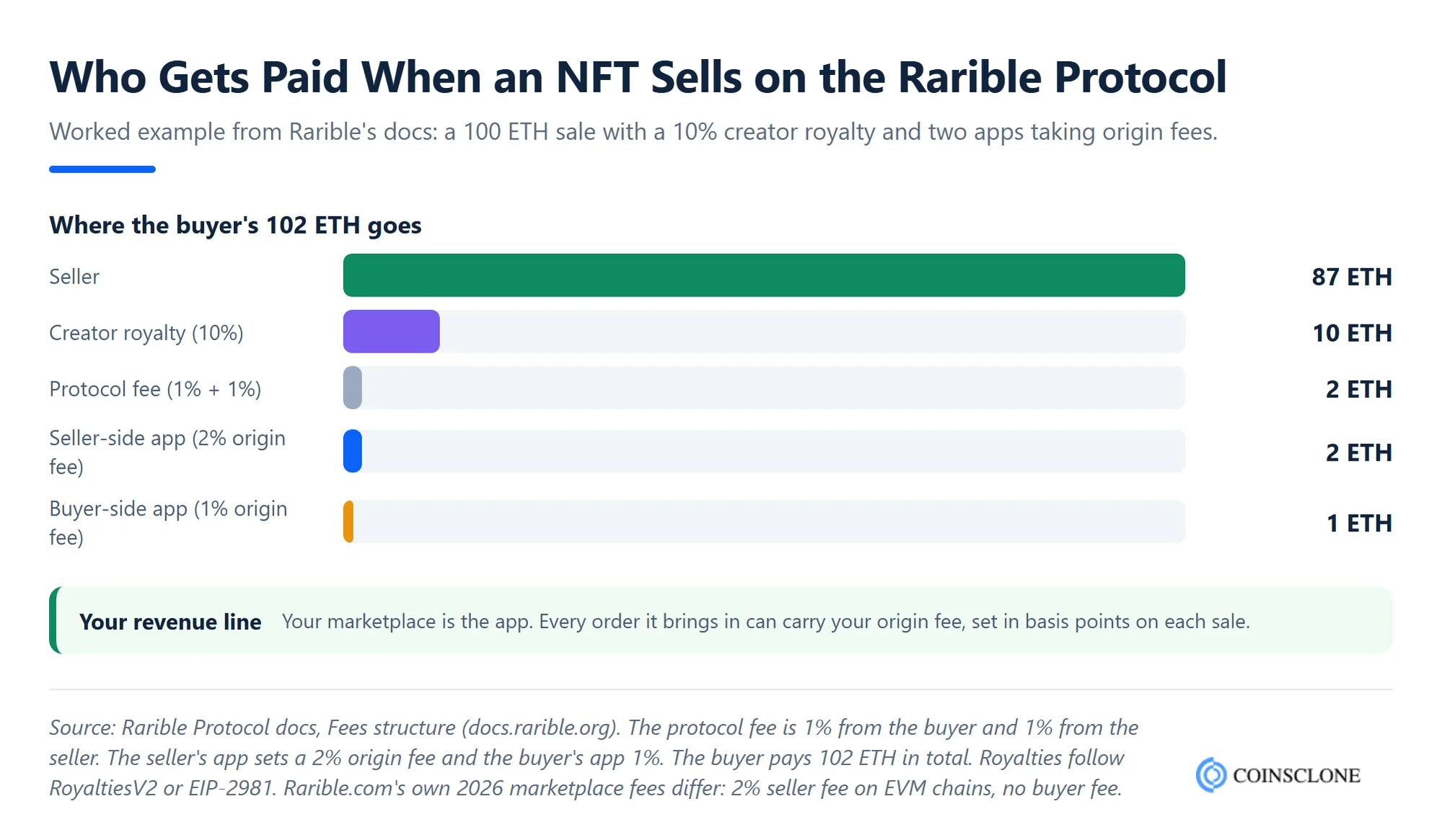
As a quick guide, a site with $2 million in monthly NFT sales and a 2% fee earns $40,000 a month before costs. For a deeper look at fee models, read our guide on how an OpenSea clone makes money.
How Much Does It Cost to Create an NFT Marketplace Like Rarible?
There is no fixed price to build an NFT marketplace like Rarible. The budget depends on how you build it, the features you add, the chains you choose and the upkeep you expect after launch. As a guide, here are the usual market ranges from published 2026 agency cost guides:
| Build type | Usual cost range | What you get |
| White label Rarible clone | $10,000 to $30,000 | Core marketplace, your brand, one or two chains |
| MVP with custom features | $20,000 to $45,000 | Minting, wallet connect, listing and buying |
| Mid-tier marketplace | $40,000 to $80,000 | Auctions, royalties, several wallets and chains |
| Enterprise platform | $80,000 to $150,000+ | Many chains, KYC, mobile apps, a larger audit |
| Large open marketplace with aggregation | $150,000 to $500,000+ | Rarible-scale minting, aggregation and data tools |
These are market estimates, not fixed quotes. Here is what shapes the cost of each route.
MVP Like Rarible
An MVP is an NFT market that offers only the core functions of Rarible.
- Estimated Cost: Low to medium budget.
- Best for startups that want to test a new idea.
- It has a short list of features, such as minting, wallet login and fixed price sales. More custom features move it into the mid-tier range.
White Label Rarible Clone
A white label Rarible clone is ready-made software that you can change and brand as your own.
- Estimated Cost: Low to mid-range.
- Ideal for firms that want to launch fast without losing quality.
- Most of the cost goes into branding, chain setup and the features you add on top of the base.
Custom Build From Scratch
Firms with bigger goals and a long-term vision choose to build from scratch.
- Estimated Cost: High.
- We handle the whole build from start to finish, so you can focus on your users.
- Custom smart contracts, aggregation and many chains push the cost toward the top two ranges.
In addition, plan for running costs after launch. Servers, indexing, IPFS storage, audits of new contracts and support staff often add 15% to 25% of the build cost each year. For a full breakdown by component, see our guide on NFT marketplace development cost.
How Long Does It Take to Build an NFT Marketplace Like Rarible?
The time to create an NFT marketplace like Rarible depends on your needs. Many founders focus on speed to market. Still, long-term growth and stability matter just as much. Here are Coinsclone’s build times for each scope:
- White Label Rarible Clone: a rebranded site with standard minting and listings goes live in about 4 to 6 weeks. You launch quickly and still have room to add features later.
- Standard Custom Build: custom contracts, collections, auctions and an outside audit take about 8 to 12 weeks. This is also the usual scope for a feature-rich MVP.
- Build With Aggregation: cross-market listings, sweep buying, trait bids and fraud checks take about 3 to 5 months.
- Full Multi-Chain Platform: many chains, card checkout, mobile apps and creator programs take about 5 to 9 months.
What adds time? Mostly aggregation, since each outside market has its own order format and limits. Fraud checks also need tuning on real data, and each non-EVM chain needs its own build.
With clear timelines in place, let’s look at the checks to finish before launch.
Security, Royalty and Legal Checks Before Launch
An open market handles other people’s money and art, so a few checks are a must:
- Smart contract audit: get an outside firm to review your minting, auction and payout logic before launch. A single bug in an exchange contract can drain user funds.
- Creator pay: many markets now let buyers skip royalties. If creator pay matters to your niche, use contracts that can enforce it, such as ERC721-C. Rarible’s own RARI Chain enforces royalties at the network level.
- Copy and fraud checks: anyone can mint, so screen uploads for copied art and flag circular trades that fake volume.
- Rules in your market: in the EU, MiCA mostly leaves unique NFTs out of scope. But large series or split-up NFTs can count as normal crypto-assets. Check the rules in each country you serve, and add KYC where needed.
Our guide to NFT smart contract development covers audits and royalty standards in more depth.
Why a Rarible-Like NFT Marketplace Pays Off
Building an NFT marketplace like Rarible offers long-term value. Here are some of the key gains:
Faster Go-to-Market
When you build on a proven model like Rarible, bringing your idea to market is quick and simple. With a white label Rarible clone, you skip the long build phase and grab market chances sooner.
Increased User Retention
A site like this keeps users busy. Creators mint new items, trade and run auctions each week. This steady trading builds loyal users, increases trading and drives growth for your platform.
Strong Brand Reputation
An NFT marketplace like Rarible puts your brand at the center of the NFT space. A well-built, well-run platform earns trust from users, creators and partners. In turn, this builds your brand’s standing in Web3.
Room to Grow
The NFT space keeps changing, as Rarible’s own move into tokenized cards shows. This model lets you grow into new markets and earn from more than one income stream. Also, our Rarible clone script is built to take on new chains and features as the market moves.
Ready to build your own Rarible-like NFT marketplace? That’s why we are here to help.
Build Your Own NFT Marketplace Like Rarible With Coinsclone
Beyond tech, you need a partner you can trust to build an NFT marketplace like Rarible. Coinsclone is a leading NFT Marketplace Development Company that has built blockchain products since 2018, with 350+ platforms delivered for 200+ clients across 20 industries. We help startups, enterprises and business leaders enter the crypto space quickly with our white label software and clone scripts.
Our team builds your NFT market with a solid design, audited smart contracts and a fast UI. With our Rarible clone script, a white label build can go live in 4 to 6 weeks, so you can start earning from day one. We turn your vision into a working platform that grows with your market.
Take the first step and book a free demo today.
Also Read: Cost to Create a Multi-Chain NFT Marketplace Like OpenSea and Rarible
Frequently Asked Questions
How much does it cost to create an NFT marketplace like Rarible?
Published 2026 agency cost guides put a white label Rarible clone at about $10,000 to $30,000 and an MVP at $20,000 to $45,000. A mid-tier site costs $40,000 to $80,000, and a large multi-chain platform with aggregation can pass $150,000. The final figure depends on your chains, features and audits.
How long does it take to build an NFT marketplace like Rarible?
At Coinsclone, a white label Rarible clone goes live in 4 to 6 weeks. A standard custom build with auctions and an audit takes 8 to 12 weeks. Adding aggregation takes 3 to 5 months, and a full multi-chain platform with mobile apps takes 5 to 9 months.
How much does it cost to maintain an NFT marketplace like Rarible?
Plan for about 15% to 25% of the build cost each year. This covers servers, indexing, IPFS storage, security updates, new contract audits and support staff. Costs rise with each extra chain and with KYC checks, which are billed per user.
How does an NFT marketplace like Rarible make money?
It earns mainly from a small fee on each sale. Rarible charges sellers 2% on Ethereum, Base and Polygon and 1.5% on Solana. Your site can also earn from routing fees on aggregated listings, launch services, featured spots and card packs.
Is Rarible a good NFT marketplace?
Rarible is a safe market that never holds your NFTs, and it charges no buyer fee on its own listings. But it has far fewer buyers than OpenSea, and it changed owners in 2026. For founders, its open minting, royalties and multi-chain design remain a strong model to copy.
What is the disadvantage of Rarible?
Its main drawback today is low trading activity, so items can take longer to sell. It also charges a 2% seller fee on EVM chains, higher than OpenSea’s 1%. Finally, its new owner, IMPOSSIBLE, has not yet shared its long-term plans.
Launch Your Rarible-Like NFT Marketplace Faster & Smarter
Rarible Clone Script — a ready-to-launch solution to build a scalable NFT marketplace.
- Multi-Chain Support: Launch on Ethereum, Polygon, BNB Chain, and more.
- Creator-Centric Features: Built-in minting, royalties, and bidding.
- Cost-Effective Development: Save time and budget compared to custom builds.
- Scalable Architecture: Designed for high traffic and future growth.
See a free branded demo of your NFT marketplace in 48 hours — before you invest a cent.
Book a Free Demo to discover how Coinsclone helps you launch in just 8–12 weeks.