

To start a crypto exchange in India, you set up a company, name two compliance officers and build an exchange with KYC, monitoring and tax tools inside it. Then you register with FIU-IND, India’s anti-money laundering unit. There is no separate crypto license. But FIU-IND now asks for a CERT-In audit and a live demo of your compliance tools before it approves you. That means the software has to work before you can register.
This guide covers how to start a crypto exchange in India step by step, checked against the FIU-IND, Income Tax Department, CERT-In and RBI texts in force on 13 November 2026. It also uses the new section numbers of the Income-tax Act, 2025, which most guides still get wrong.
In this guide:
- The FIU-IND registration file, the in-person meeting and what the live demo must show.
- A table that maps each legal duty to the exact feature your exchange software needs.
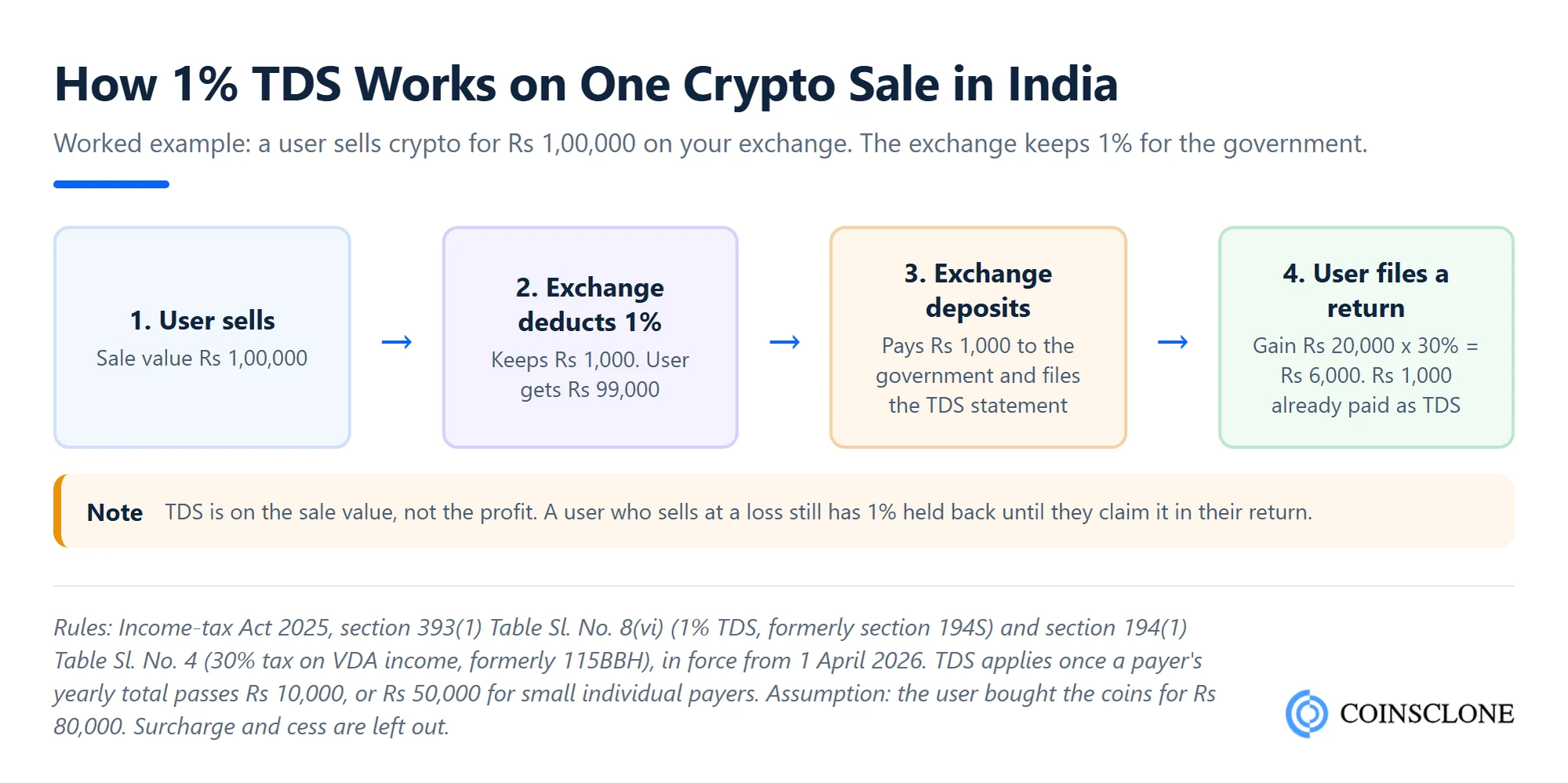
- How the 1% TDS works on a real trade, with the new 2025 Act section numbers.
- A week-by-week launch plan and a worked first-year budget for white label and custom builds.
- Whether to use an Indian company or an offshore entity.
How to Start a Crypto Exchange in India: The Short Answer
Here is the full path, in the order that saves the most time:
- Set up the company: Incorporate, then get PAN, TAN, GST registration and a bank account.
- Appoint your officers: Name a Designated Director (DD) and a Principal Officer (PO). The PO must work full time and be based in India.
- Write your AML policy: Cover client checks, risk grading, monitoring, reporting and record keeping.
- Build the exchange: Include KYC, sanctions screening, transaction monitoring, Travel Rule data and a 1% TDS engine from day one.
- Pass a cyber audit: Use an auditor on CERT-In’s approved list.
- Register with FIU-IND: File on the FINnet 2.0 portal, send the documents, attend the in-person meeting and run the live demo.
- Go live: Open to users only after FIU-IND gives you a Reporting Entity ID.
Steps 1 to 5 run side by side. Step 6 needs all of them done.
Is It Legal to Run a Crypto Exchange in India?
Yes. Crypto trading is not banned in India, and no single crypto law exists. Three sets of rules apply instead.
- Money laundering law: Since 7 March 2023, crypto firms count as “reporting entities” under the PMLA, India’s money laundering law (notice S.O. 1072(E)). FIU-IND has been their regulator since November 2023.
- Income tax: Gains are taxed at 30% and most transfers carry 1% TDS.
- Cyber rules: CERT-In’s April 2022 rules cover breach reports, logs and records.
The March 2023 rule covers five things done for others as a business. These are swapping crypto for rupees or other money, swapping one coin for another, moving crypto, holding crypto for clients, and work tied to a token sale. A normal exchange does at least four of them.
Banks are no longer barred either. The RBI’s 2018 ban on banks serving crypto firms was set aside by the Supreme Court on 4 March 2020. In a May 2021 notice, the RBI told banks to stop citing it, while still doing normal KYC and AML checks on such clients.
Skipping registration is costly. FIU-IND fined Binance Rs 18.82 crore in June 2024 and Bybit Rs 9.27 crore in January 2025 for serving Indian users without registering.
Should You Use an Indian Company or an Offshore Entity?
FIU-IND says crypto firms’ duties depend on what they do, not where they sit. So an offshore exchange that serves Indian users must register too. Here is how the two routes compare.
| Point | Indian company | Offshore entity serving India |
| FIU-IND registration | Required | Required, same process |
| Principal Officer | Full time, based in India | Still must be based in India |
| Registration documents | MCA filings, GST returns, income tax and TDS filings | Same list, so you still need Indian tax registrations |
| CERT-In empanelled audit | Required for registration | Required for registration |
| Rupee deposits | Direct bank and UPI partners | Harder; usually needs an Indian partner or entity |
| Penalty if unregistered | Action under PMLA section 13 | Same; Binance and Bybit are offshore |
| Best fit | Founders building for Indian users with INR | Global exchanges adding India as one market |
For a founder whose main market is India, an Indian private limited company is the simpler route. You will need Indian filings, an Indian officer and Indian banks anyway. The offshore route mostly adds a second set of rules without removing any Indian ones.
If you want to compare India with license routes abroad, our crypto license guide covers the EU, Dubai, Singapore and other markets.
How Does FIU Registration for a Crypto Exchange Work?
Two FIU-IND texts set the process: its registration circular of 15 September 2025 and its AML guidelines, last updated on 8 January 2026.
- Sign up on the portal: Enter your details on FINnet 2.0. You get a temporary ID. This ID is not a registration.
- Send the document file: Submit everything at least 15 days before the in-person meeting. You must also say whether you are already running or still in development.
- Wait for the review: FIU-IND checks the file. Only a full and complete file gets a meeting date.
- Attend the meeting: The DD and the PO must both go in person.
- Run the live demo: Show your KYC system, transaction monitoring, blockchain analytics, Travel Rule tool and sanctions screening working.
- Get approved: The Director of FIU-IND approves the file and issues your FIU Reporting Entity ID.
FIU-IND does not publish a processing time. It can also refuse or cancel a registration if you do not meet your PMLA duties.
What documents are required for FIU registration?
The circular lists 11 items:
- A note on your business and how it falls under the March 2023 notification.
- A note on who owns and runs the company, with an org chart and the real owners.
- Incorporation papers, annual returns, balance sheets and profit and loss accounts filed with the MCA for the last three financial years.
- GST registrations in every state where you operate, and GST returns for the last three years.
- Income tax returns and TDS statements filed for crypto transactions.
- Copies of every agreement with other exchanges, brokers, custodians or crypto firms, with a short note on each.
- A “PACT” letter from any registered crypto firm you partner with. A broker that sends orders to a registered exchange needs one.
- A signed statement that no criminal or police cases are open against the firm or its directors.
- FIU-IND’s AML questionnaire.
- A cyber audit report from an auditor on CERT-In’s approved list.
- Anything else FIU-IND asks for.
A brand new company will not have three years of filings. Ask FIU-IND early what it accepts for the missing years.
Who can be the PO and DD?
The rules for the PO are strict. The person must work for you full time and for no one else. They need at least three years of AML experience, must be based in India and must not run business operations. They report to the board, ideally each quarter. The DD must be a different person. The DD answers for PMLA compliance as a whole.
What Must Your Exchange Software Do on Day One in India?
Most guides list the laws. This table maps each duty to the feature and record your platform needs. It draws on the FIU-IND rules of January 2026, the CERT-In rules of April 2022 and the new tax law.
| Legal duty | Feature your exchange needs | Record or report it produces |
| Client due diligence | PAN check, one ID document, selfie with liveness check, OTP check of mobile and email, GPS location and IP at sign-up | KYC file per user |
| Bank account check | Penny-drop test on each linked bank account | Bank match record |
| Risk grading | High and medium risk tiers, review at least every six months | Risk score history |
| KYC refresh | Re-KYC every six months for high risk users and every year for others | Dated update log |
| Sanctions screening | Screen at sign-up, on KYC change, on list change and before every transfer; hold funds until clear | Screening results |
| Transaction monitoring | Rules and alerts across rupee and crypto flows, plus blockchain analytics | Alert queue with Principal Officer decisions |
| Travel Rule | Send sender PAN, ID number, name, address, date of birth and wallet, plus receiver name and wallet, before or with the transfer | Travel Rule message log |
| Risky assets | Block privacy coins, mixers and tumblers; extra checks on personal wallets | Blocked transfer log |
| Suspicious transaction reports | Case tool where the Principal Officer records each decision, with no tipping off | STRs filed to FIU-IND |
| Monthly reporting | Export of metrics and compliance status | Monthly report to FIU-IND |
| Record keeping | KYC kept 5 years after the account closes; trades kept 5 years; tamper-proof audit trail | Archive you can search on demand |
| 1% TDS | Deduct on each eligible sale, track yearly thresholds, deposit and file | TDS statements and user tax reports |
| Cyber incidents | Alerting and a named CERT-In contact; report within 6 hours | Incident reports |
| Logs and clocks | Keep logs of all systems for 180 days in India; sync clocks to NIC or NPL time servers | Log store |
Two duties are easy to miss. The rules want IP address, device ID and location data on each user. And they want a short summary of your AML policy shown in the app or website at sign-up and login.
For the tooling side, see our guide to crypto compliance software.
What Taxes Does a Crypto Exchange Handle in India?
Tax rules changed in form on 1 April 2026, when the Income-tax Act, 2025 replaced the 1961 Act. The rates stayed the same. The section numbers did not.
| Rule | Old section (1961 Act) | New section (2025 Act) | What it says |
| 1% TDS on crypto transfers | 194S | 393(1), Table Sl. No. 8(vi) | 1% of the sale value |
| TDS thresholds | 194S(3) | 393(4), Table Sl. No. 12 | No TDS up to Rs 50,000 a year for individual or HUF payers without large business income, Rs 10,000 for others |
| 30% tax on gains | 115BBH | 194(1), Table Sl. No. 4 | No deductions except cost; losses cannot be set off |
| Crypto-asset reporting | 285BAA | 509 | Reporting entities report crypto-asset transactions |
You can check the new Act on the Income Tax Department’s 2025 Act page. The department’s VDA tax page still shows the old 1961 numbers, which apply to sales made before April 2026.
How does the 1% TDS work on an exchange?
The exchange sits between buyer and seller, so in practice it deducts the tax, deposits it and files the TDS statements. FIU-IND asks for these filings in your registration file. When a trade is crypto for crypto, with no rupees changing hands, the law says the tax must be paid before the coins are released. Your engine needs a rule for that case.
What does the 30% tax mean for your users?
Users pay 30% on gains, plus surcharge and cess, and can only deduct the cost of the coins. A loss on one coin cannot cut the tax on a gain from another.
Does GST apply to exchange fees?
Yes. Your trading, withdrawal and listing fees are service income, so GST applies. FIU-IND wants your GST papers for each state you work in, so register before launch. Ask your GST adviser to confirm the rate and place of supply for each fee type.
How Do You Get Banking and INR Deposits?
Rupee deposits can be the slowest part. Banks may legally serve crypto firms since 2020, but each bank runs its own checks and decides for itself. Have your FIU-IND papers, AML policy and Principal Officer details ready before you approach one.
Indian exchanges commonly take deposits through UPI, IMPS and NEFT via a bank or payment partner. Whatever rail you use, the FIU-IND rules require a penny-drop check on every user bank account. That check confirms the account exists and belongs to the user.
A crypto-only launch can skip rupee rails at first. But without rupee rails, new users must bring crypto from elsewhere, so plan for both.
What Cyber Security Rules Apply to Crypto Exchanges?
CERT-In’s rules of 28 April 2022 apply to service firms, data centers and companies in India. For an exchange, five points matter:
- Report incidents within 6 hours: Breaches, unauthorized access and attacks on your systems must reach CERT-In within six hours of noticing them.
- Keep logs for 180 days in India: Logs of all your systems, stored within Indian jurisdiction.
- Sync your clocks: Use the NIC or NPL time servers, or sources traceable to them.
- Name a contact: A point of contact for CERT-In.
- Keep KYC and trade records for five years: With IP addresses, timestamps, wallet addresses and amounts, so any trade can be rebuilt.
The FIU-IND audit goes further. It checks who can access what, your network, wallets, keys, backups, cloud and APIs. It also checks that you can report to CERT-In fast.
How Long Does It Take to Start a Crypto Exchange in India?
In a typical plan, expect three to four months from incorporation to the FIU-IND meeting, then the review. The software is not what takes longest. Coinsclone builds a white label exchange in 4 to 6 weeks, 7 to 10 weeks with rupee rails, and 9 to 13 weeks with mobile apps.
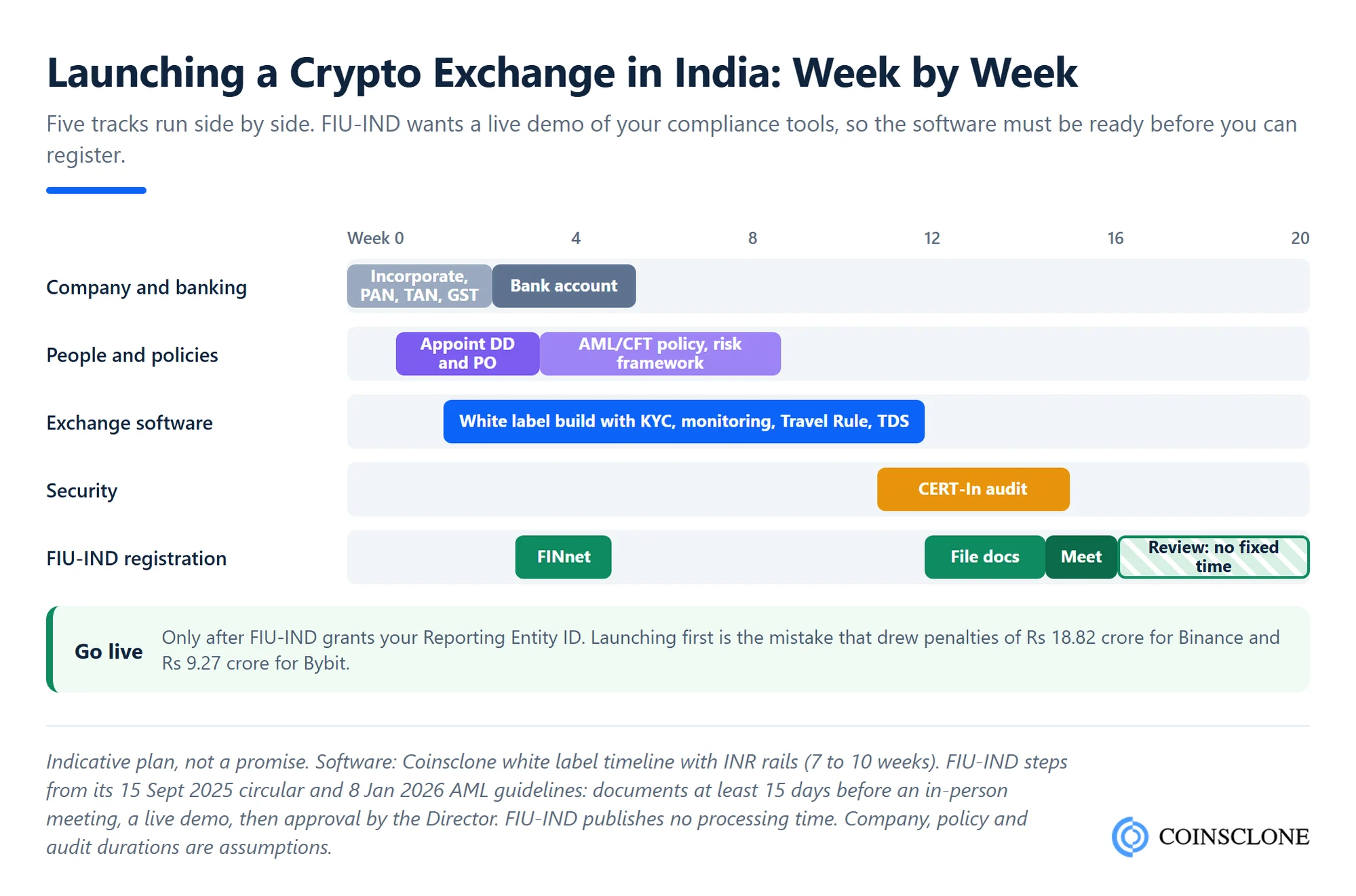
The order matters more than the speed. FIU-IND wants a live demo of your compliance tools, and the CERT-In audit needs a working system. So start the build in the first weeks, not after the paperwork. Founders who build only after the paperwork add the whole build time to their launch date.
How Much Does It Cost to Start a Crypto Exchange in India?
FIU-IND’s published rules set no fee to register and no minimum capital. Your costs are software, people, tools and liquidity. Here is a worked first-year budget.
Assumption: a spot exchange with rupee deposits, one compliance team and a mid-size launch. Software ranges are from published 2026 agency cost guides. Every other line is our assumption, not a quote; get real quotes before you plan.
| Cost line (year one) | White label path | Custom build path |
| Exchange software | $15k to $60k | $100k to $200k |
| Company setup, legal work and AML policy | $10k to $25k | $10k to $25k |
| CERT-In empanelled audit | $5k to $15k | $5k to $15k |
| KYC, blockchain analytics, Travel Rule and screening tools | $20k to $60k | $20k to $60k |
| Compliance team (Principal Officer plus analysts) | $40k to $80k | $40k to $80k |
| Hosting, with logs kept in India | $12k to $36k | $12k to $36k |
| Bank and payment partner setup | $2k to $10k | $2k to $10k |
| Liquidity (market maker or own stock) | $25k to $100k | $25k to $100k |
| Marketing and launch | $20k to $100k | $20k to $100k |
| Total | $149k to $486k | $234k to $626k |
For context, a full-scale exchange build runs $250k to $500k or more on its own, per the same 2026 guides.
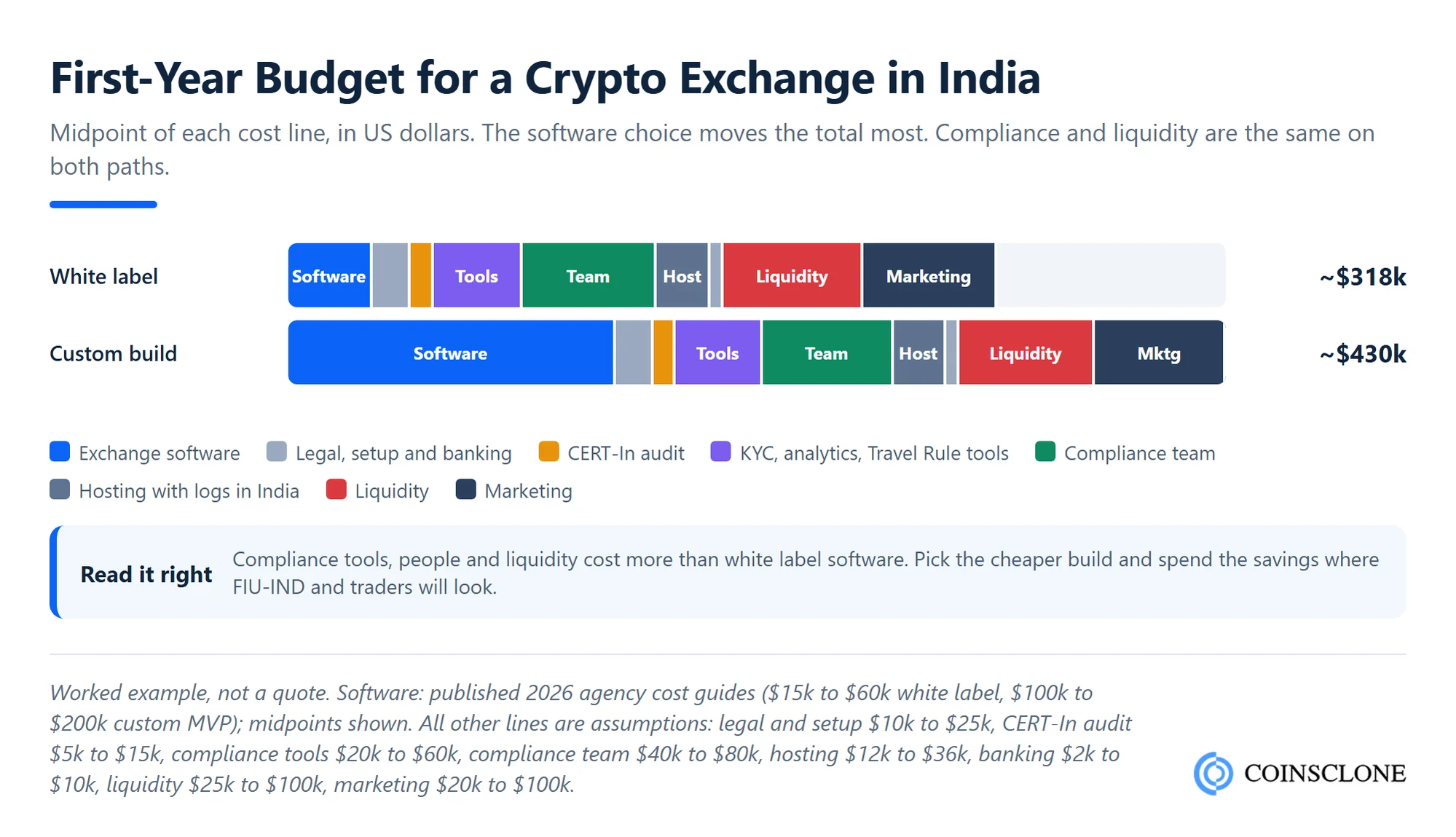
The lesson is simple. On the white label path, software is the smallest big line. Compliance staff, tools and liquidity decide whether you pass FIU-IND and whether traders stay. For a full breakdown of software costs, see our crypto exchange development cost guide.
Common Mistakes When Starting an Exchange in India
- Launching before registration: Every user you serve before FIU-IND approval is a risk under PMLA section 13.
- Building compliance later: The live demo needs KYC, monitoring, Travel Rule and screening already working.
- Citing old tax sections: Since April 2026, reports and user statements should use the 2025 Act numbers.
- Hiring a part-time PO: The rules ask for a full-time officer in India with three years in AML work.
- Storing logs abroad: CERT-In wants 180 days of logs held in India.
Launch an FIU-Ready Crypto Exchange in India
Crypto exchange development for India, done right.
- India KYC: PAN checks, selfie liveness, location capture and penny-drop bank checks at sign-up.
- AML tools: Sanctions screening, transaction alerts, Travel Rule data and an STR case desk for your Principal Officer.
- 1% TDS engine: Deduction on every eligible sale, yearly threshold tracking and reports for your TDS filings.
- INR rails: UPI, IMPS and NEFT deposits through your bank or payment partner, with logs kept in India.
See a live demo of our India-ready crypto exchange software.
Book a Free Demo to plan your exchange, FIU-IND demo and launch timeline.
How Coinsclone Helps You Launch an Exchange in India
Coinsclone builds exchanges for India and can build the FIU-IND tools into them: PAN and selfie KYC, penny-drop bank checks, sanctions checks, Travel Rule data, alerts for odd trades and a 1% TDS engine. You can start from our white label crypto exchange software or an INR-ready WazirX clone script, and launch with rupee rails in 7 to 10 weeks. Coinsclone has built crypto products since 2018 and delivered 350+ platforms for 200+ clients across 20 industries. For a fully custom build, see our cryptocurrency exchange development service.
Frequently Asked Questions
Is running a crypto exchange legal in India?
Yes. India has not banned crypto trading. Exchanges must register with FIU-IND under the PMLA and follow its AML rules. They must also deduct 1% TDS and follow CERT-In’s cyber rules.
Which license is required for a crypto exchange in India?
India has no separate crypto exchange license. The key step is FIU-IND registration. You get it after FIU-IND checks your file, meets your officers and sees a live demo. You also need normal business registrations such as PAN, TAN and GST.
How long does FIU-IND registration take?
FIU-IND does not publish a processing time. The file must reach FIU-IND at least 15 days before the in-person meeting, and the meeting is set only once the file is complete. Plan three to four months to get ready, then allow for the review.
What documents are required for FIU registration in India?
FIU-IND’s September 2025 circular asks for a note on your business and owners, MCA filings, GST papers, and income tax and TDS filings. It also wants partner contracts, PACT letters where needed, a signed statement, an AML form and a cyber audit from a CERT-In listed auditor.
What happens if a crypto exchange operates without FIU-IND registration?
Running without registration breaks the PMLA and can lead to action under section 13. FIU-IND fined Binance Rs 18.82 crore and Bybit Rs 9.27 crore for serving Indian users without registering.
Can Indian banks work with crypto exchanges?
Yes. The Supreme Court set aside the RBI’s 2018 ban on 4 March 2020, and the RBI told banks in May 2021 not to cite it. Each bank still does its own due diligence, so having your FIU-IND registration and AML policy ready helps.
Can a foreign company start a crypto exchange in India?
Yes. FIU-IND’s duties apply to any firm serving Indian users, wherever it is based. A foreign firm can register an offshore entity or set up an Indian subsidiary. Either way it needs an India-based Principal Officer, a CERT-In audit and Indian tax filings.
How much does it cost to start a crypto exchange in India?
Exchange software costs $15k to $60k for white label or $100k to $200k for a custom MVP, per published 2026 agency cost guides. Add compliance staff, tools, audit, hosting, liquidity and marketing. In our worked example, year one totals roughly $149k to $486k on the white label path.