
To start a crypto casino, you pick the markets you may serve and get a gaming license that allows crypto. Then you set up a firm with the key people the regulator wants, and launch on a platform with tested games, crypto payments and KYC built in. Most new brands pick Curacao. Its license costs EUR 4,592 to apply and EUR 47,450 a year, and the hard part is no longer the paperwork. It is the crypto rules and the math.
This guide covers each step in order, with fees taken from the regulators themselves as of 13 November 2026. It also shows what most guides leave out: whether the business pays back, which steps run at the same time, and the crypto risks that sink new sites.
In this guide:
- A license table for Curacao, Anjouan, the Isle of Man and Malta, with fees, decision times and crypto rules
- A launch timeline that shows which steps run in parallel
- A worked monthly profit example, from wagers to net margin, with every assumption labeled
- Four crypto risks to plan for: hot wallet float, bonus abuse, provably fair vs certified RNG, and coin choice
How to Start a Crypto Casino: The Short Answer
Here are the eight steps. Each one gets its own section below.
- Pick your markets: Decide where players may legally join, and block the rest.
- Choose a license: Curacao, Anjouan, the Isle of Man or Malta, based on budget and target markets.
- Set up the firm: Form it in the license country and hire the key people the regulator wants.
- Choose a platform: White label, turnkey or custom.
- Add games: Sign game providers and get every game tested by an approved lab.
- Set up crypto payments: Wallets, deposits, payouts and treasury.
- Build KYC, AML and responsible gambling tools: ID checks, wallet screening, limits and self-exclusion.
- Launch and market within the rules: Geo-blocking, affiliate controls and honest bonus terms.
Step 1: Decide Which Markets You Can Serve
Start here, because the license does not decide where you can operate. Curacao’s license terms say the holder must obey the laws of each country where it offers games, not just its own. An offshore license is not a pass to serve the world.
Many large markets ban offshore online casinos or only allow locally licensed ones:
- United States: Federal law (31 U.S.C. 5363) bars gambling firms from taking payments for unlawful online bets. Only a handful of states license online casinos, and only to operators with a state license.
- United Kingdom: Serving players in Britain needs a license from the Gambling Commission under the Gambling Act 2005. A Curacao or Anjouan license does not count.
- Australia: A 2001 law, the Interactive Gambling Act, bans online casino games for people there. The regulator has ISPs block offshore sites that break it.
Make your target list the markets where offshore crypto gambling is not banned, then confirm each one with a local lawyer. Block every other market with IP checks, VPN detection and the address on the player’s KYC record. Treat the blocked list as part of the product, not a legal footnote.
Step 2: Choose a Crypto Casino License
There is no special “crypto casino license”. You get a normal online gaming license from a regulator that lets you take crypto. These are the four most common choices, with fees from each regulator’s own documents.
| License | Application fee | Annual fee | Time to a decision | Crypto allowed? | How banks and partners see it |
| Curacao (CGA, under the LOK) | EUR 4,592, plus EUR 150 per owner | EUR 47,450 (EUR 24,490 license fee plus EUR 22,960 supervisory fee) | 8 weeks per review phase, up to 16 weeks after a full file; a provisional license is possible | Yes, under the June 2026 crypto policy | Middle. Reformed and now directly supervised |
| Anjouan | EUR 17,828 issuance | EUR 17,828 renewal, plus EUR 500 per extra domain | Not published | Listed as a permitted activity | Lowest. Comoros disputes the regime |
| Isle of Man (GSC) | GBP 5,250 | GBP 36,750 for a full license | About 10 to 12 weeks after the file is accepted | Yes, under set deposit and payout models | High |
| Malta (MGA) | EUR 5,000 | EUR 25,000, plus a revenue-based compliance fee (at least EUR 15,000 for casino games) | Not published | Yes, with MGA approval of each coin | High, EU regulator |
Fees checked on 13 Nov 2026. Sources: the CGA’s fee guide (v2.0, 15 Oct 2025), with review times from the Legal 500 guide to Curacao law. Anjouan’s fee list. The Isle of Man GSC fee sheet and how to apply guide. The MGA’s fees and tax guide.
Which license is best for a crypto casino?
- Curacao: The usual pick for crypto casinos. The new law (the LOK) took effect on 24 Dec 2024 and put the Gaming Authority (CGA) in charge. You need a firm based there with a local director.
- Anjouan: The cheapest annual fee, and it lists crypto gaming as allowed. But the central bank of the Comoros calls the scheme illegal. In Oct 2026 its government asked the UK for help to stop it. Banks, game studios and app stores may refuse to work with you.
- Isle of Man: Strong reputation and clear crypto rules. You need a Designated Official who lives on the island, which raises running costs.
- Malta: The strongest name in Europe. It also costs the most. You need at least EUR 100,000 in share capital for casino games, and its crypto rules need sign-off for each coin.
Some operators run from a Costa Rica company instead. Costa Rica does not issue online gambling licenses, so this is not a license at all, and payment partners treat it that way.
Step 3: Set Up the Company and Key People
Each regulator wants a local company and named people it can hold to account. For Curacao, that means:
- A local firm: The license only goes to a firm formed and based in Curacao.
- A local director: At least one director must live on the island.
- Key persons and a compliance officer: The CGA vets owners with 10% or more, directors and compliance staff before you go live.
- Approved suppliers: You need CGA approval before you sign platform, game or payment suppliers.
From 24 Dec 2026, license holders may not use game suppliers that are not registered with the CGA. That list covers RNG game studios, live dealer studios and game aggregators. Ask every supplier for proof of registration before you sign.
Step 4: Choose a White Label, Turnkey or Custom Platform
| Model | What you get | Speed | Trade-off |
| White label | A ready casino under your brand, often on the provider’s license | Fastest | Revenue share to the provider, little control |
| Turnkey | You own the license and brand and license the software | Medium | Software fees, limited changes |
| Custom | Your own code, wallets and game engine | Slowest | Highest upfront cost, full control and no revenue share |
A white label cuts the time to market but takes a share of revenue every month. A custom build costs more upfront, but you keep the margin and can build crypto features your way, like in-house provably fair games. Many operators start on a white label or turnkey platform and move to their own build once volume proves out. If you go this route, plan the data migration from day one.
Step 5: Add Games and Get Them Certified
Most crypto casinos mix three types of games:
- Third-party slots and live dealer games: Signed through a game hub (an aggregator). The studio takes a share of gross gaming revenue.
- In-house “originals”: Dice, crash, plinko and mines, built on a provably fair method.
- Sportsbook (optional): Adds odds feeds and risk management, and more time.
Under the CGA’s rules, each game you offer, your own games too, must pass tests at a lab the CGA approves. Each game’s rules, odds and payout percentage must be shown to players. Budget time for lab testing before launch.
Step 6: Set Up Crypto Payments and Wallets
Payments are where crypto casinos win or lose players. You need deposit addresses for each player, fast payouts, wallet screening and a split between hot and cold wallets. Curacao’s rules add three limits that shape the design:
- Player funds must sit in a segregated account, apart from company money.
- Coins you accept must trade on regulated exchanges.
- You may not exchange currencies inside the player account, and winnings are paid in the same currency the player used.
You can rent a crypto payment processor, which often charges about 1% of volume, or own your gateway. Our guide to a crypto payment gateway for online casinos works through rent vs build with real numbers. For your own stack, see crypto payment gateway development and how to build a crypto wallet.
Step 7: Build KYC, AML and Responsible Gambling Tools
Crypto does not mean anonymous. The CGA’s money laundering rules (Nov 2026) ban accounts with no name. They require full ID checks once a player’s payments reach XCG 4,000 (about USD 2,200), and that counts small linked payments in one session too.
Plan for these tools:
- ID and liveness checks: Identity services charge per check. Sumsub’s published pricing is $1.35 per check on its basic plan and $1.85 on its compliance plan, which adds AML screening.
- Wallet screening: Check each deposit and payout address against sanctions lists and mixer exposure.
- Responsible gambling: Deposit limits and self-exclusion must be in your terms and easy to use. Cool-off periods help too.
- Reporting: Odd activity must be reported to the local watchdog.
Our post on crypto compliance software covers the screening and monitoring tools in more detail.
Step 8: Launch and Market Within the Rules
Launch in stages. Start with a soft launch to a small group, test payouts at real volume, then open marketing. Your site must show the license details and seal, the terms, the odds and payout rates, and where to get help with gambling problems.
Most crypto casinos grow through affiliates, streamers and VIP programs. Keep three controls in place:
- Partner contracts: Affiliates must not target blocked countries or send offers to players who chose to be shut out.
- Bonus terms: Clear wagering rules, written in English and in the player’s language.
- Geo-blocking on ads: Your ads must follow the same country list as your site.
How Long Does It Take to Launch a Crypto Casino?
Plan on about four to six months from company setup to a public launch. The key is to build the platform while the license is under review, not after.
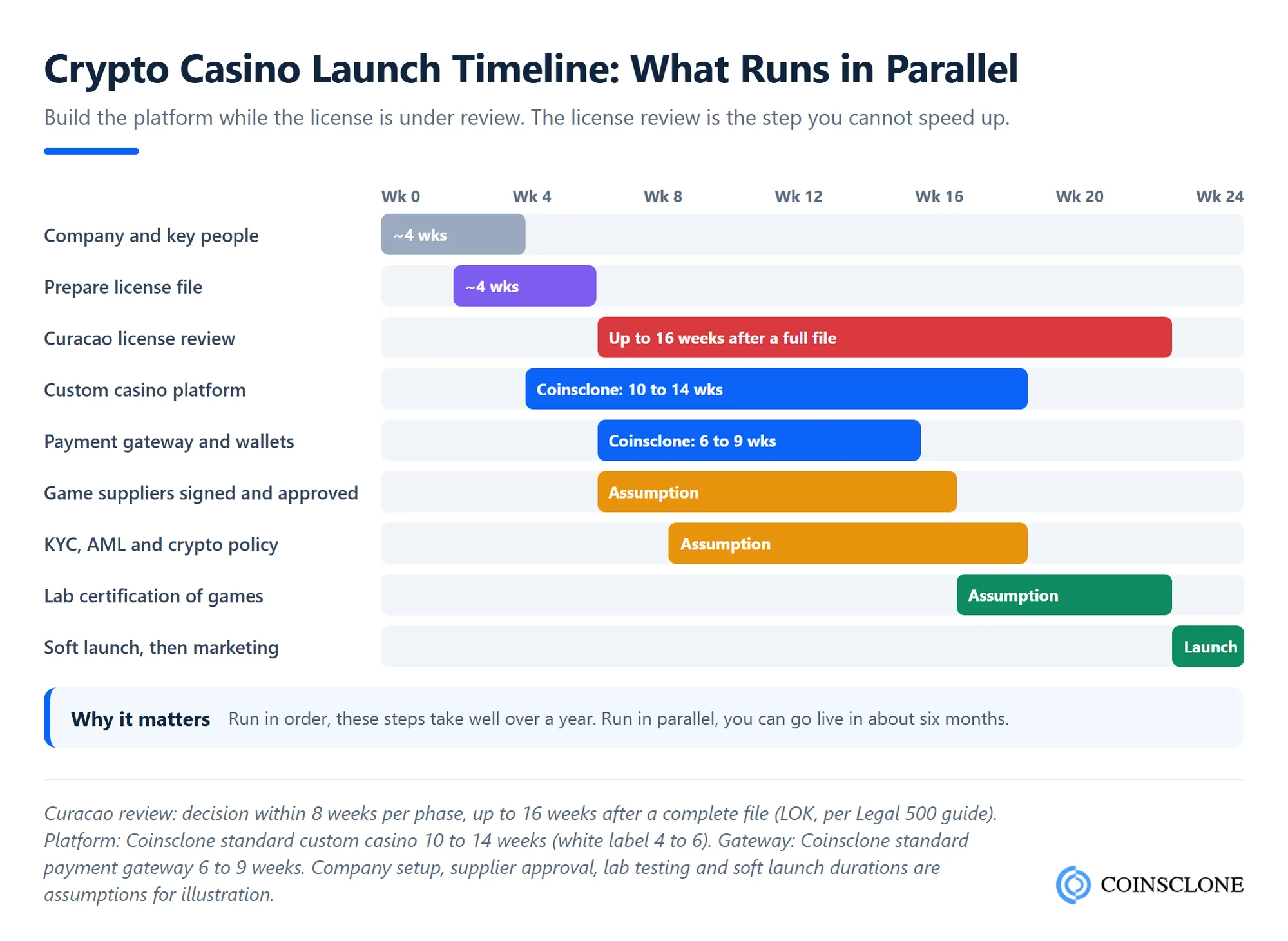
The license is the slowest step you cannot speed up. Curacao’s review runs up to 16 weeks after a complete file, and the Isle of Man aims for 10 to 12 weeks after acceptance. Coinsclone builds a white label casino in 4 to 6 weeks and a standard custom one in 10 to 14 weeks, so the platform should be ready before the license comes. Lab tests and the supplier approvals the license needs set the final launch date.
How Much Does It Cost to Start a Crypto Casino?
Cost depends on four things: the license, the platform model, how many game studios you add, and how much you spend on ads before money comes in.
| Cost item | What drives it | Known figure |
| License (Curacao) | Number of owners, extra domains | EUR 4,592 to apply plus EUR 47,450 a year |
| Platform | White label vs turnkey vs custom, number of features | White label shares revenue; custom is an upfront build |
| Payment gateway | Rent vs own | Own gateway: $20k to $60k white label, $40k to $100k custom (published 2026 agency cost guides) |
| Wallets | Coins and chains supported | $15k to $90k white label, $50k to $200k custom (published 2026 agency cost guides) |
| Games | Number of providers and aggregator terms | Usually a share of gross gaming revenue, set by contract |
| KYC | Number of verified players | $1.35 to $1.85 per check (Sumsub) |
| Compliance team | Local director, compliance officer, audits | Salaries and fees in the licensing country |
| Hot wallet float | Daily payout volume | Your own funds, sized below |
| Marketing | Affiliates, streamers, VIP | Revenue share plus fixed spend |
The license fee is the smallest line once you go live. Marketing and the float you keep for payouts cost more than most first-time operators expect.
Does a Crypto Casino Make Money? A Worked Example
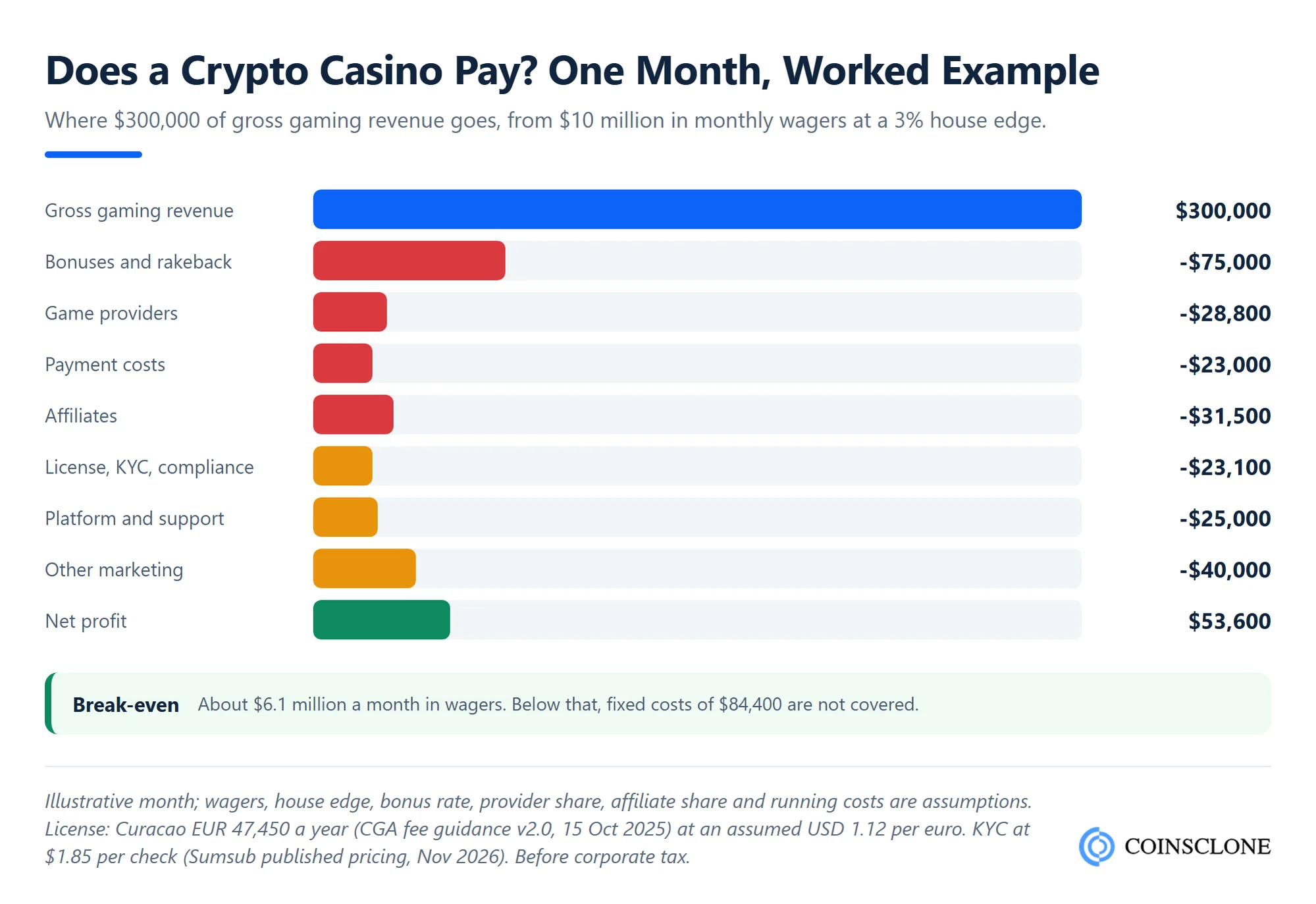
Most guides list costs but stop before the key question: does the business pay back? Here is one month at steady volume. Each number marked “Assumption” is ours, picked to show the math. Your contracts will differ.
| Line | How it is worked out | Monthly (USD) |
| Wagers | Assumption: $10 million wagered in the month | 10,000,000 |
| Gross gaming revenue (GGR) | Assumption: 3% blended house edge across slots, live games and originals | 300,000 |
| Bonuses, rakeback and VIP | Assumption: 25% of GGR | (75,000) |
| Net gaming revenue (NGR) | GGR minus bonuses | 225,000 |
| Game provider fees | Assumption: 12% of the GGR from third-party games, which make 80% of GGR | (28,800) |
| Payment costs | Assumption: $2 million deposits at a 1% processing fee, plus $3,000 network fees | (23,000) |
| Affiliate commission | Assumption: affiliates bring 40% of NGR at a 35% revenue share | (31,500) |
| License | Curacao EUR 47,450 a year, at an assumed USD 1.12 per euro | (4,400) |
| KYC checks | Assumption: 2,000 checks at $1.85 | (3,700) |
| Compliance team and audits | Assumption | (15,000) |
| Platform, hosting and support | Assumption | (25,000) |
| Other marketing | Assumption | (40,000) |
| Net profit before tax | 53,600 |
That is a margin of about 18% of GGR, or about half a cent per dollar wagered.
Three lessons come out of the math:
- Break-even sits near $6 million a month in wagers. About 54% of GGR goes on costs that grow with volume (bonuses, providers, payments, affiliates, KYC). The fixed costs of $84,400 need about $183,000 of GGR to cover them, which is about $6.1 million wagered at a 3% edge.
- Bonuses are the biggest lever. If bonuses and rakeback rise from 25% to 40% of GGR, profit falls from $53,600 to about $14,900, even after affiliate pay drops with NGR.
- Your own games keep more. Originals carry no provider fee, so each dollar of GGR moved to them saves 12 cents in this example.
Payback depends on how fast you reach volume. Assumption: $300,000 spent before launch and during the ramp up. At $53,600 a month, that pays back in under six months after you reach $10 million in monthly wagers. Getting to that volume is the hard part.
Crypto-Specific Risks Most Guides Skip
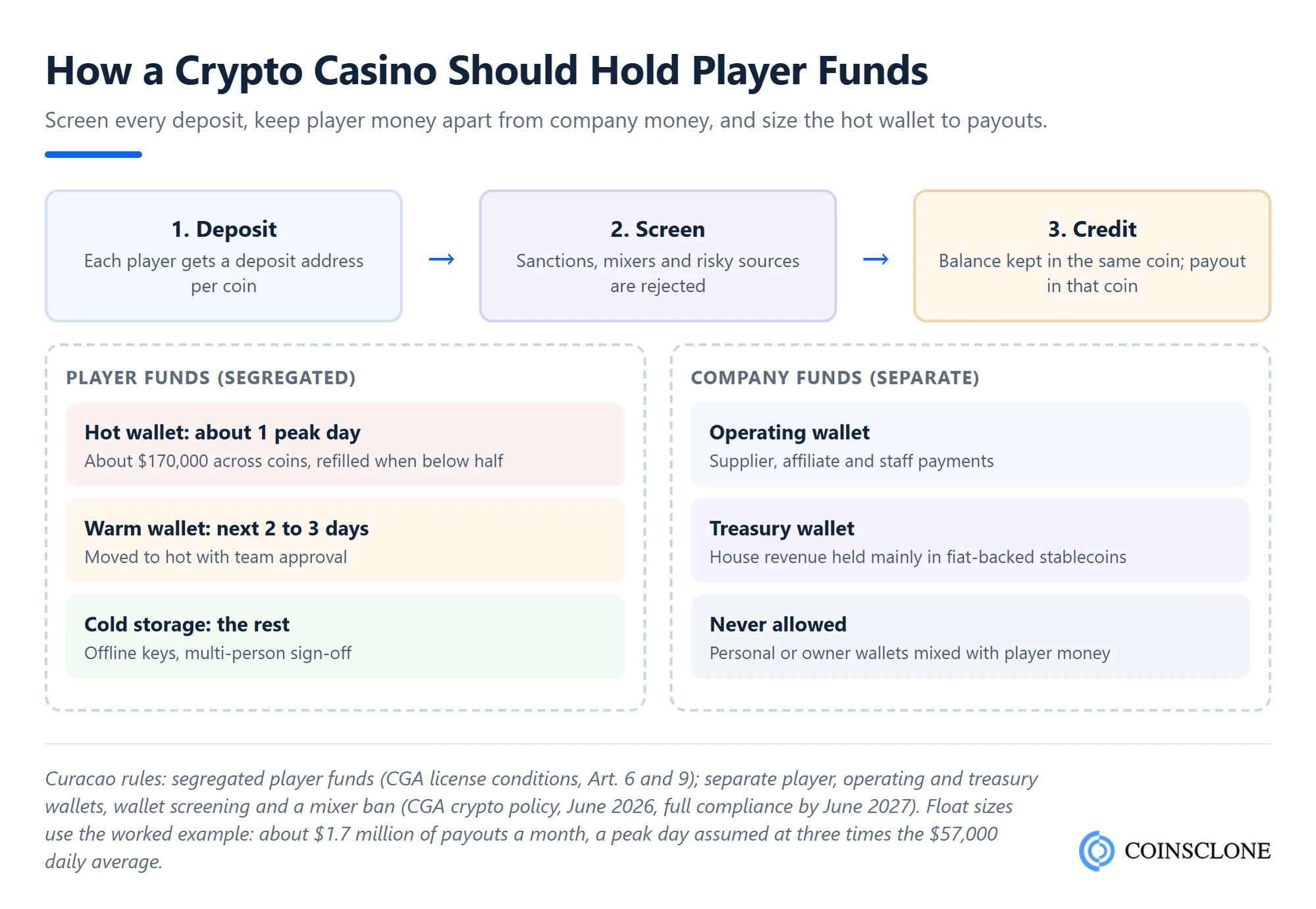
The CGA’s June 2026 crypto rules set the bar. Licensees had three months to file a crypto policy, six months for risk checks and staff training, and must be fully compliant by June 2027. That means split wallets for player, running and house funds, chain tracing tools, and a ban on mixers and sanctioned wallets. Four risks need a plan from day one.
How big should the hot wallet float be?
Too little in the hot wallet and payouts stall. Too much and a hack drains it. Size it from your payout data:
- Average daily payouts: In the example above, players withdraw about $1.7 million a month (deposits minus GGR), or about $57,000 a day.
- Peak day: Assumption: the busiest day is three times the average, about $170,000.
- Hot wallet: Hold about one peak day, split by coin in line with how players withdraw.
- Warm wallet: Hold the next two to three days, moved to hot with approval.
- Cold storage: Keep the rest of player balances offline.
Refill the hot wallet when it falls below half its target, and alert the team when one payout is above a set size. Our guide to crypto treasury management shows how to set sign-off rules for these moves.
How do you stop bonus abuse and multi-accounting?
A new crypto wallet costs nothing, so one person can open many accounts to claim the same welcome bonus. Controls that work:
- KYC before the first withdrawal: Bonus winnings stay locked until ID is verified.
- Device and IP checks: Flag accounts that share a device, browser or network.
- Wallet clustering: Flag accounts funded from the same address or paying out to linked addresses.
- Wagering rules: Require bonuses to be played through before cash out, with lower weighting for low-edge games.
Is provably fair the same as a certified RNG?
No, and you need both under Curacao’s rules.
| Provably fair | Certified RNG | |
| Who checks it | The player, after each round | An approved testing lab, before launch |
| What it proves | The result was fixed before the bet and not changed | The random number generator and game math are sound |
| How it works | Server seed hash shown first, then combined with the player’s seed and a counter | Lab tests the code and output, then certifies the game |
| What it does not prove | That the payout rate matches what you claim | Each single round in real time |
| Regulator view | A trust feature | Required for every game under the CGA license |
Should balances be held in stablecoins or volatile coins?
Curacao and the Isle of Man both bar players from paying in one coin and taking out another. The Isle of Man’s guidance on virtual assets lists that model as not permitted. So player balances stay in the coin they came in.
The CGA prefers fiat-backed stablecoins, and so should your treasury. Two rules keep you safe:
- Match each coin: Hold player float for each coin in that same coin, so a price drop shrinks what you owe and what you hold together.
- Keep house money stable: Revenue, bonuses and fees are planned in dollars, so hold your own share in stablecoins. Bonuses priced in dollars but paid in BTC can cost more than planned after a price swing.
Launch a Licensed Crypto Casino Without Waiting on the Platform
Crypto casino development, done right.
- Casino Platform: White label or custom casino with player accounts, bonuses, VIP tiers and a full admin panel
- Provably Fair Originals: Dice, crash, plinko and mines with public seed checks, ready for lab certification
- Crypto Wallets and Payments: Multi-coin deposits, fast payouts and segregated hot, warm and cold wallets
- Compliance Tools: Tiered KYC, wallet screening, geo-blocking, deposit limits and self-exclusion
See a live demo of a crypto casino with provably fair games and instant crypto payouts.
Book a Free Demo to plan your casino platform while your license is under review.
How Coinsclone Helps You Launch a Crypto Casino
Coinsclone builds the tech side of a crypto casino. That means the platform, provably fair games, links to game hubs, wallets for many coins with a hot and cold split, and the KYC, country blocks and safer play tools a license needs. You bring the license and the market plan, and we build the platform while your application is under review. Coinsclone has built crypto products since 2018 and delivered 350+ platforms for 200+ clients across 20 industries. See our crypto casino clone script for features and build options.
Frequently Asked Questions
How much money do I need to start a crypto casino?
The Curacao license alone costs EUR 4,592 to apply and EUR 47,450 a year. On top of that you pay for the platform, games, payment setup, a compliance team, a hot wallet float and marketing. In our worked example, monthly costs are about $246,000 at $10 million in wagers, so plan funding for several months of losses before you reach volume.
Do crypto casinos need a license?
Yes, in practice. Game studios, payment partners and testing labs work only with licensed operators, and serving players without a license breaks the law in most countries. Most crypto casinos hold a Curacao license. Larger brands also use the Isle of Man or Malta.
Is crypto gambling illegal?
It depends on where the player lives. The UK and the US states that allow online casinos only let their own licensed brands serve players. Australia bans offering online casino games to its residents. A license from Curacao or Anjouan does not make it legal to serve those players.
How long does it take to get a Curacao gaming license?
The CGA must decide within 8 weeks after receiving a complete file in each review phase, up to 16 weeks in total. It can grant a provisional license while the second review runs. The clock only starts once the file is complete, so most delays come from missing documents.
Which license is best for a crypto casino?
Curacao suits most new crypto casinos because it allows crypto and has a known process. The Isle of Man and Malta carry more weight with banks and game studios but cost more to run. Anjouan is cheaper, but the Comoros government disputes its legal standing.
How do crypto casinos make money?
They earn the house edge on every bet, which becomes gross gaming revenue. From that they pay bonuses, game providers, payment costs, affiliates and running costs. In our example, a 3% edge on $10 million in wagers leaves about $53,600 in monthly profit before tax.
Can you open a crypto casino without a license?
You can build the platform without one, but you should not take real-money bets. Without one, game studios, labs and payment partners will not work with you, and you risk criminal charges where your players live.