

In September 2026, Nubank launched a US account that holds deposits as USDC or EURC and pays interest on them. A few months earlier, Circle won final approval for its own US national trust bank. The line between a bank and a crypto app is fading fast.
That opens a real business: a crypto bank, or crypto neobank, that gives users accounts, cards, payments and crypto in one app. Big players are moving, but the market is wide open for focused brands serving a region, a community or businesses.
This guide explains how to start a crypto bank: what it is, which licence path fits, the core features, how these businesses make money, what changed in US and EU rules, and the steps to launch.
What Is a Crypto Bank?
A crypto bank is a financial app that combines normal money services with crypto. Users can hold fiat and crypto, get a card, send payments and trade or store digital assets in one place.
The name covers three different models:
- Licensed crypto banks: real banks that also handle crypto, such as AMINA and Sygnum in Switzerland, which hold full banking licences from FINMA.
- Crypto trust banks: US national trust banks such as Anchorage Digital, which can hold custody but cannot take deposits or lend.
- Crypto neobanks: apps that rely on partner banks and e-money licences for money, and crypto licences for digital assets. Revolut and Nubank’s crypto features follow this pattern.
Most new entrants start as a crypto neobank. It is faster and far cheaper than getting a full bank licence.
Crypto Bank vs Crypto Exchange vs Neobank
| Crypto exchange | Neobank | Crypto neobank | |
| Main job | Trading crypto | Everyday banking | Banking plus crypto |
| Fiat accounts and IBANs | Limited | Yes | Yes |
| Debit cards | Sometimes | Yes | Yes, often spending crypto |
| Crypto trading and custody | Yes | Sometimes via a partner | Yes |
| Typical licences | CASP or MSB | EMI or bank | EMI or partner bank plus CASP |
The crypto neobank sits in the middle. It needs the money rails of a neobank and the crypto engine of an exchange.
Which Licence Does a Crypto Bank Need?
Your licence path decides your timeline, capital and product. Here is how to choose.
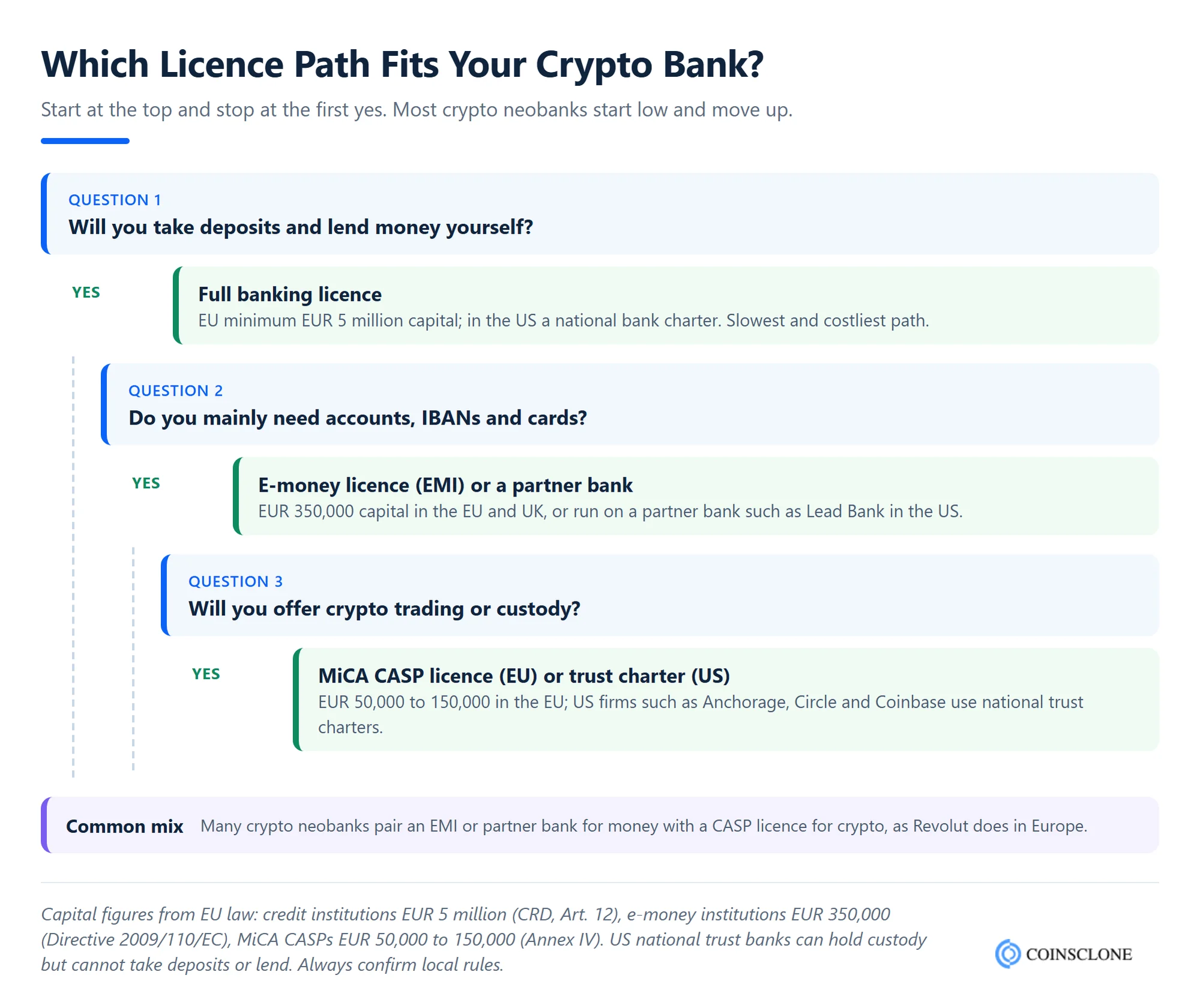
Full banking licence. Needed if you take deposits and lend. In the EU, a credit institution needs at least EUR 5 million in starting capital. It is the slowest and costliest route.
E-money licence or partner bank. For accounts, IBANs and cards without lending, an EU or UK e-money institution needs EUR 350,000 in capital. In the US, many fintechs run on a partner bank. Nubank’s new US account runs through Lead Bank while its own bank charter is pending.
Crypto licence. For trading and custody in the EU, you need MiCA authorisation, with capital of EUR 50,000 to 150,000 depending on services. In the US, firms such as Circle, Ripple, Paxos, BitGo and Fidelity Digital Assets won conditional national trust charters in December 2025.
Revolut is a good example of combining paths. Its crypto arm won a MiCA licence in Cyprus in 2025, covering 30 EEA countries, alongside its banking and e-money licences. For country-by-country costs, see our crypto license guide.
Crypto Bank Examples: What the Leaders Do
Looking at firms already in the market shows which models work:
- Sygnum holds a Swiss banking licence from FINMA and a MiCA licence in Liechtenstein. It served about 2,300 clients with around $6 billion in client assets at the end of 2025, focusing on professional and institutional clients.
- AMINA Bank (formerly SEBA) has held a Swiss banking licence since 2019 and targets wealthy clients and institutions.
- Anchorage Digital runs a US national trust bank for custody, staking and settlement for institutions.
- Xapo Bank is a licensed bank in Gibraltar that pairs a fiat account with a separate crypto entity.
- Nubank has more than 7 million crypto customers in Brazil and launched a stablecoin-based US account in 2026.
- Revolut reached 68.3 million retail customers in 2025 and offers about 300 crypto assets in its app.
The pattern is clear. Licensed banks win institutions and wealthy clients. Neobanks win retail scale by adding crypto to an app people already use daily. A new entrant should pick one of these lanes, not both.
What Changed for Crypto Banks in 2025 and 2026?
US rules turned from hostile to open in 18 months:
- In March 2025, the OCC’s Interpretive Letter 1183 said banks can hold crypto, support stablecoins and run nodes without asking first.
- In March 2025, the FDIC dropped its prior-approval rule for crypto activities.
- In April 2025, the Federal Reserve withdrew its earlier crypto letters.
- In May 2025, OCC Interpretive Letter 1184 let banks buy and sell crypto for customers.
- From December 2025, the OCC granted a wave of crypto trust charters, and Circle got final approval in July 2026.
In the EU, the MiCA transition ended on 1 July 2026. Every firm serving EU clients with crypto services now needs a licence. That raises the bar, but it also gives licensed crypto neobanks a clear advantage.
What Are the Core Features of a Crypto Neobank?
A crypto neobank is really eight systems working as one:
- Accounts and IBANs: fiat accounts through your EMI licence or partner bank.
- Crypto wallets and custody: secure storage for customer assets, often with MPC signing.
- Cards: a debit card that spends fiat or crypto. See our guide on how to launch a crypto card program.
- Trading: buy, sell and swap, with liquidity from exchanges or market makers.
- Payments: transfers, payouts and stablecoin payments at home and abroad.
- KYC, KYB and AML: identity checks, business checks, transaction monitoring and sanctions screening.
- Travel Rule support: required for crypto transfers in the EU with no minimum amount.
- Back office: admin panel, reporting, support tools, fraud controls and accounting.
Most teams do not build every system from scratch. A proven white label crypto exchange and wallet stack covers trading, custody and admin, while partners supply banking rails and cards.
How Does a Crypto Bank Make Money?
Revolut’s 2025 annual report shows how a neobank earns. Its GBP 4.5 billion in revenue came from five main streams.
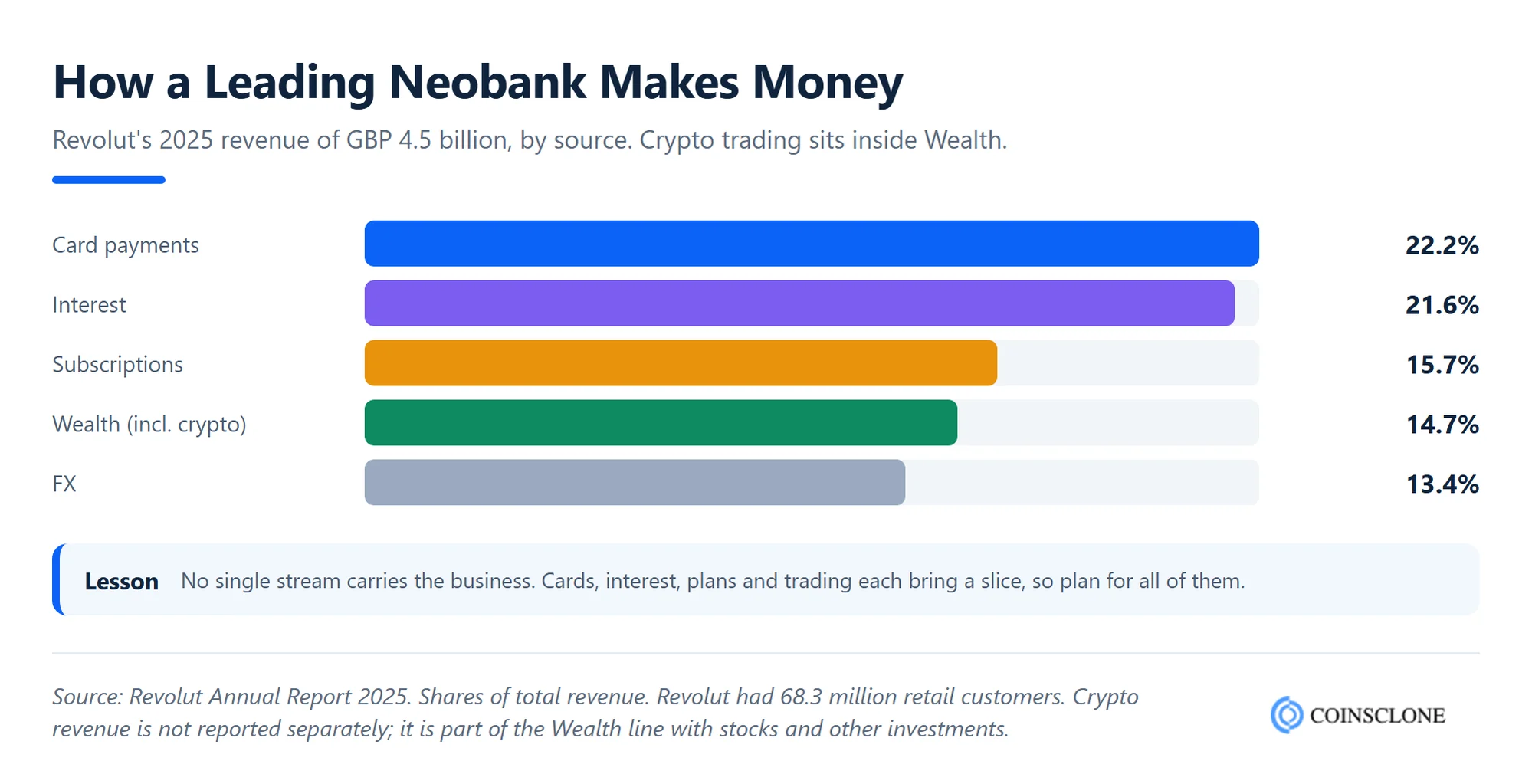
A crypto neobank can earn from the same mix:
- Card payments: interchange on every purchase.
- Interest: income on customer balances, where your licence allows it.
- Subscriptions: paid plans with better rates, cards and limits.
- Trading and wealth: spreads and fees on crypto and other assets.
- FX: fees on currency conversion and cross-border payments.
Stablecoins add a newer option. Nubank’s US account holds deposits as USDC or EURC, and pays 3.50% and 2.20% a year respectively. Yield on stablecoin balances is becoming a selling point, though rules on paying it vary by country.
Launch Your Own Crypto Bank or Crypto Neobank
Crypto Banking Software — done right.
- Core Modules: Accounts, wallets, cards, trading and payments in one platform.
- Compliance Ready: KYC, KYB, AML screening and Travel Rule support from day one.
- Partner Integrations: Plug in partner banks, card issuers, custodians and liquidity providers.
- Revenue Engine: Earn from trading fees, interchange, FX and subscriptions.
Get a free feature and cost scoping call for your crypto bank — before spending a single dollar.
Book a Free Demo to see how our white label exchange and wallet modules power a crypto neobank.
How Much Does It Cost to Start a Crypto Bank?
There is no fixed price, but the big cost blocks are clear:
- Capital: EUR 5 million for an EU bank, EUR 350,000 for an EMI, and EUR 50,000 to 150,000 for a MiCA licence. You need extra money to run until you break even.
- Licence work: legal advice, compliance staff, policies and audits.
- Technology: the eight core systems above, built or licensed.
- Partners: fees to partner banks, card issuers, KYC providers, custodians and liquidity providers.
- Launch and growth: marketing, support and user rewards.
The fastest way to cut cost is to avoid building commodity parts. License the banking rails and cards, and invest in the parts that make you different: your app, your market and your crypto features.
Common Mistakes When Launching a Crypto Neobank
These mistakes sink new crypto banks more often than technology does:
- Building before licensing. A finished app without licences or partners cannot open a single account. Secure your licence path first.
- Relying on one partner bank. If your only partner bank exits crypto, your accounts stop. Plan a second partner early.
- Weak compliance. Regulators and partner banks judge you on your AML programme. Thin compliance is the fastest way to lose a partner.
- Trying every market at once. Each country has its own licences, rails and habits. Win one market first.
- Copying big neobanks. You cannot outspend Revolut. Win on a niche: a currency corridor, a community or a business segment.
- Ignoring stablecoins. Stablecoin accounts, payments and cards are where crypto banking is growing fastest in 2026.
How to Start a Crypto Bank in 8 Steps
- Pick your niche. A country, a diaspora, freelancers, crypto-native businesses or a specific stablecoin use case.
- Choose your licence path. Bank, EMI or partner bank for money; CASP or trust charter for crypto.
- Select partners. Partner bank, card issuer, KYC provider, custodian and liquidity sources.
- Build or license the core. Accounts, wallets, trading, payments, compliance and admin.
- Set up compliance. AML programme, Travel Rule, sanctions screening and a named compliance officer.
- Design the app. Onboarding, balances, cards, crypto and payments in a simple flow.
- Run a closed beta. Test onboarding, card approvals and support with real users.
- Launch and grow. Start with one market, prove the numbers, then expand.
Our team has delivered 350+ crypto platforms, including exchanges, wallets and payment gateways that form the core of a crypto neobank.
Frequently Asked Questions
What is a white label crypto bank?
It is ready-made crypto banking software that you launch under your own brand. It usually includes accounts, wallets, cards, trading and admin tools, and connects to licensed partners for banking and card issuing.
Do I need a banking licence to start a crypto bank?
Not always. Many crypto neobanks use an e-money licence or a partner bank for accounts and cards, and a crypto licence such as MiCA for digital assets. A full banking licence is only needed if you take deposits and lend.
How much capital do I need to start a crypto bank?
In the EU, a full bank needs at least EUR 5 million, an e-money institution EUR 350,000 and a MiCA crypto licence EUR 50,000 to 150,000. You will also need funds to run the business until it breaks even.
Can US banks offer crypto services now?
Yes. Since 2025, the OCC, FDIC and Federal Reserve have removed earlier barriers. OCC Interpretive Letters 1183 and 1184 confirm that banks can hold crypto for customers and buy and sell it at their direction.
What is the difference between a crypto bank and a crypto exchange?
An exchange focuses on trading. A crypto bank adds everyday money services such as accounts, IBANs, cards and payments, so users can live on it, not just trade on it.
How do crypto neobanks make money?
From card interchange, interest on balances, paid subscriptions, trading spreads and FX fees. Revolut’s 2025 revenue came mostly from cards, interest, subscriptions, wealth and FX.
Which crypto banks exist today?
Examples include AMINA and Sygnum (Swiss licensed banks), Anchorage Digital (US national trust bank), Xapo Bank (Gibraltar) and crypto features inside neobanks such as Revolut, N26 and Nubank.
How long does it take to launch a crypto neobank?
With a partner bank and licensed tech, a first version can launch in months. A full banking licence usually takes much longer, often a year or more.