
Crypto exchange marketing is the work of turning strangers into traders who fund an account and come back. For a new exchange, that means fixing liquidity first, then earning trust, then picking the few channels you are allowed to use in each country. Ads, referral bonuses and paid creator posts all carry legal risk in 2026, so the order you work in matters as much as the budget.
This guide is written for exchange owners, not marketers. It shows what to fix before you spend a dollar and which ad platforms will take your money. It also shows how real referral programs pay, and how to track cost per active trader, not cost per signup.
In this guide:
- Why an empty order book wastes every marketing dollar, and what to fix first
- Google, Meta and Apple rules for crypto exchanges, with dates
- How referral programs pay, and where refer a friend bonuses are banned
- Influencer disclosure rules in the US, UK, EU and India
- A worked funnel, a starting budget split and a 90 day plan to 10,000 traders
What Is Crypto Exchange Marketing?
Crypto exchange marketing covers everything that brings a trader from first contact to a funded, active account. It spans ads, referral deals, listings on sites like CoinGecko, content, chat groups and paid creator posts.
It differs from most app marketing in three ways:
- Trust comes before features: People hand you their money. They check licences, security pages and past incidents before they check your fee table.
- Rules change by country: The same referral bonus can be fine in one market and banned in the next. Ad platforms ask for a licence in each country you target.
- The product must work on day one: A trader who lands on a pair with a wide spread and no depth leaves and rarely comes back. Marketing cannot fix a thin order book.
So the real job is not “get traffic”. It is getting the right traders, in markets where you are licensed, onto pairs that trade well.
What Should You Fix Before You Spend on Marketing?
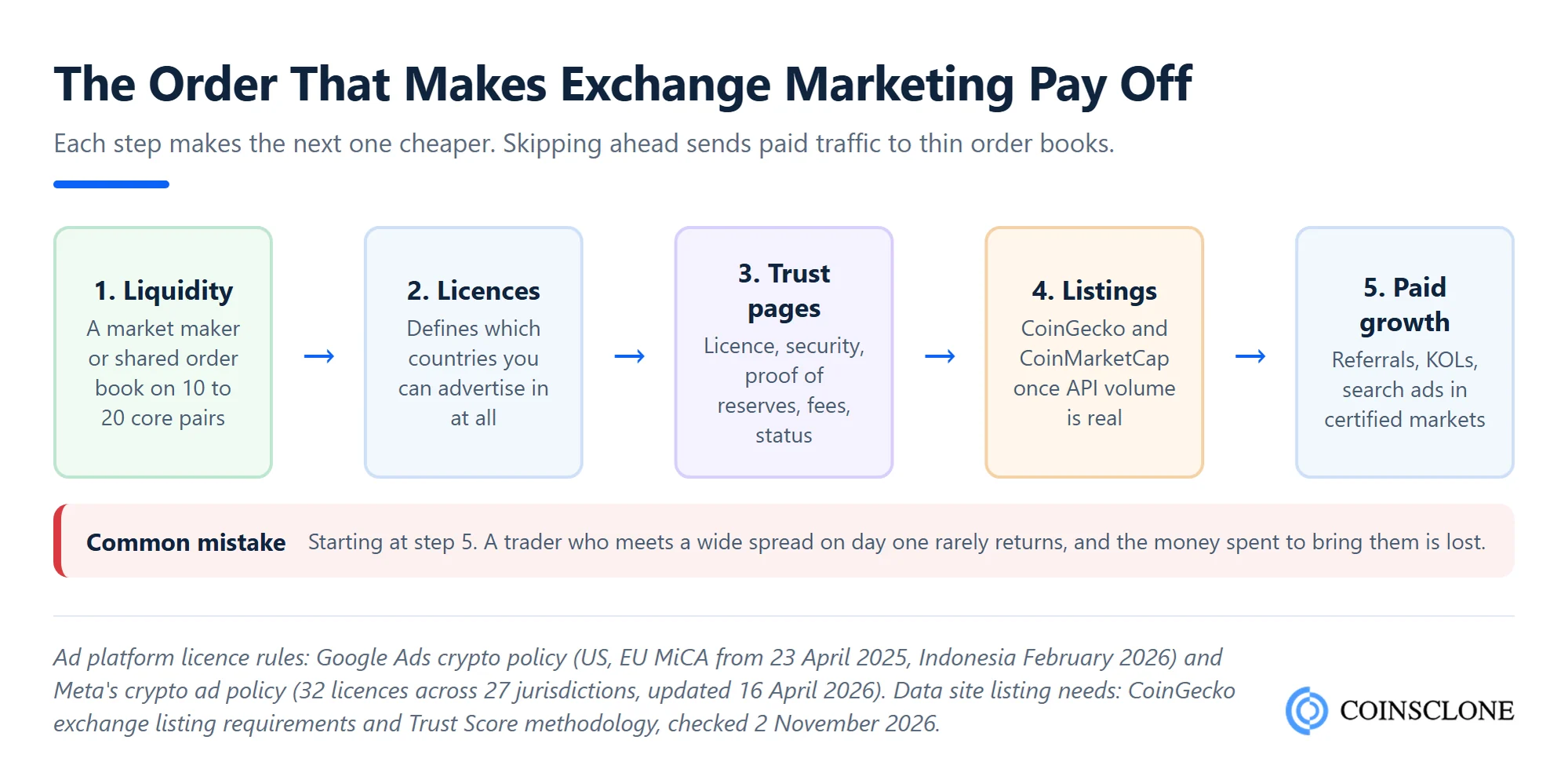
Fix three things first: liquidity, licences and trust pages. Each one decides whether paid traffic turns into traders or into churn.
Why fix liquidity first
Traders judge an exchange in seconds by the spread and the depth on the pairs they care about. If a $5,000 market order moves the price by 2%, they go back to the exchange they came from. Every dollar you spent to bring them is gone.
Line up a market maker or an external liquidity source before launch, and focus on a small set of pairs. Ten deep pairs beat two hundred empty ones. Our guide to crypto liquidity providers explains how shared order books and market maker deals work, and market making software covers running your own quotes.
Liquidity also affects how data sites rank you. CoinGecko’s exchange Trust Score now rates real volume and order book depth. Its May 2026 update dropped web traffic from the score.
Which licences decide where you can market
Your licence map is your marketing map. Google, Meta and Apple all ask for proof that you are licensed in the country you target. In the EU, the MiCA grandfathering period ended on 1 July 2026 at the latest, so only firms with a MiCA licence can serve EU clients now. If you plan to launch in Europe, our guide to a MiCA compliant exchange covers the steps.
Promoting into a country where you hold no licence is not a gray area. The UK FCA took HTX to the High Court over its ads. On 29 October 2026 the FCA said HTX had agreed to stop targeting UK users and had left the UK. The FCA’s warning was plain: being based overseas does not put a firm beyond UK law.
Which trust pages you need live
Build these pages before launch, because every channel below points to them:
- Licences: Name the firm, the regulator and the licence number, and link to the public list.
- Security: How you hold funds (cold, warm and hot wallets), who signs withdrawals and whether you have had an audit.
- Proof of reserves: If you publish one, show the method and the date. CoinGecko counts proof of reserves in its Trust Score.
- Fees: One clear table with maker, taker, deposit and withdrawal fees.
- Status page and support hours: Traders want to know what happens when something breaks.
How Do You Pick a Niche and Position Your Exchange?
Pick one group of traders you can serve better than the big exchanges, and say it in one sentence. “Lower fees” is not a position. Every exchange claims it, and the giants can always go lower.
Positions that work for new exchanges are narrow:
- A local market: Local currency deposits, local language support and local payment rails in one country where you hold a licence.
- An asset niche: Early listings in one ecosystem, tokenized assets or stablecoin pairs for a region.
- A trader type: Pro tools and API access for bots, or the simplest buy flow for first-time buyers.
- A compliance edge: A full licence in a market where most rivals operate offshore, which matters more every month.
Write your position into the homepage headline, the app store listing and your ad copy. Then judge every campaign by one test: does it bring the traders in that sentence?
Can Crypto Exchanges Run Google and Meta Ads?
Yes, but only with a licence in each country you target and an approval from the platform. Google and Meta both review crypto exchanges before ads can run.
| Platform | What you need for exchange ads | Recent changes |
| Google Ads | Google certification for each country, plus a local licence. US: FinCEN money services business registration and at least one state money transmitter licence, or a bank charter. EU: MiCA licence. UK: FCA registration. | EU rule from 23 April 2025. Argentina added September 2025. Indonesia added February 2026. Iceland, Liechtenstein and Norway added August 2026. |
| Meta (Facebook, Instagram) | Prior written permission from Meta, backed by one of 32 recognized licences or registrations across 27 jurisdictions. Apply in Meta Business Suite. | Policy page last updated 16 April 2026. |
| Apple App Store | Exchange features only in countries where the app holds the right licence. Crypto apps may not pay currency for tasks such as getting others to download. | Guideline 3.1.5, checked 2 November 2026. |
Sources: Google’s US rules, its EU update, the Indonesia update, a Nordic report, Meta’s ad policy and Apple’s app rules.
Three practical points:
- Apply per country: A Google certificate for the US does not cover Canada or the EU. Budget weeks for each approval.
- France changed in 2026: Google stopped accepting the older AMF registration on 1 July 2026, so French ads now need a MiCA licence.
- Start with search, not reach: Searches for your brand, for “buy [coin] in [country]” and for rival brands usually convert better than broad awareness ads. X and Telegram run their own rules, so check each policy before you book.
How Do Referral and Affiliate Programs Work for Exchanges?
Most exchanges pay referrers a share of the trading fees their invited users generate. You pay only when the referred trader trades, which makes referrals the safest paid channel for a new exchange.
Binance is the clearest public example. Its affiliate program pays partners up to 50% of the fees their invited users pay on spot, margin and futures. The invited users get up to 20% back on spot fees. Futures commission has no time limit. Smaller exchanges usually start lower and raise rates for affiliates who bring active traders.
A simple design that works:
- Pay on fees, not signups: A share of trading fees rewards real traders and starves bots.
- Tier by quality: Raise the share when an affiliate’s referrals pass KYC, fund and stay active for 30 days.
- Give the new user a reason: A fee rebate for the first months is cleaner than a cash bonus, and allowed in more places.
- Block abuse: Cap rewards per device and per payment method, and hold payouts until the trades settle.
Some places ban referral bonuses. Check these rules before you design yours.
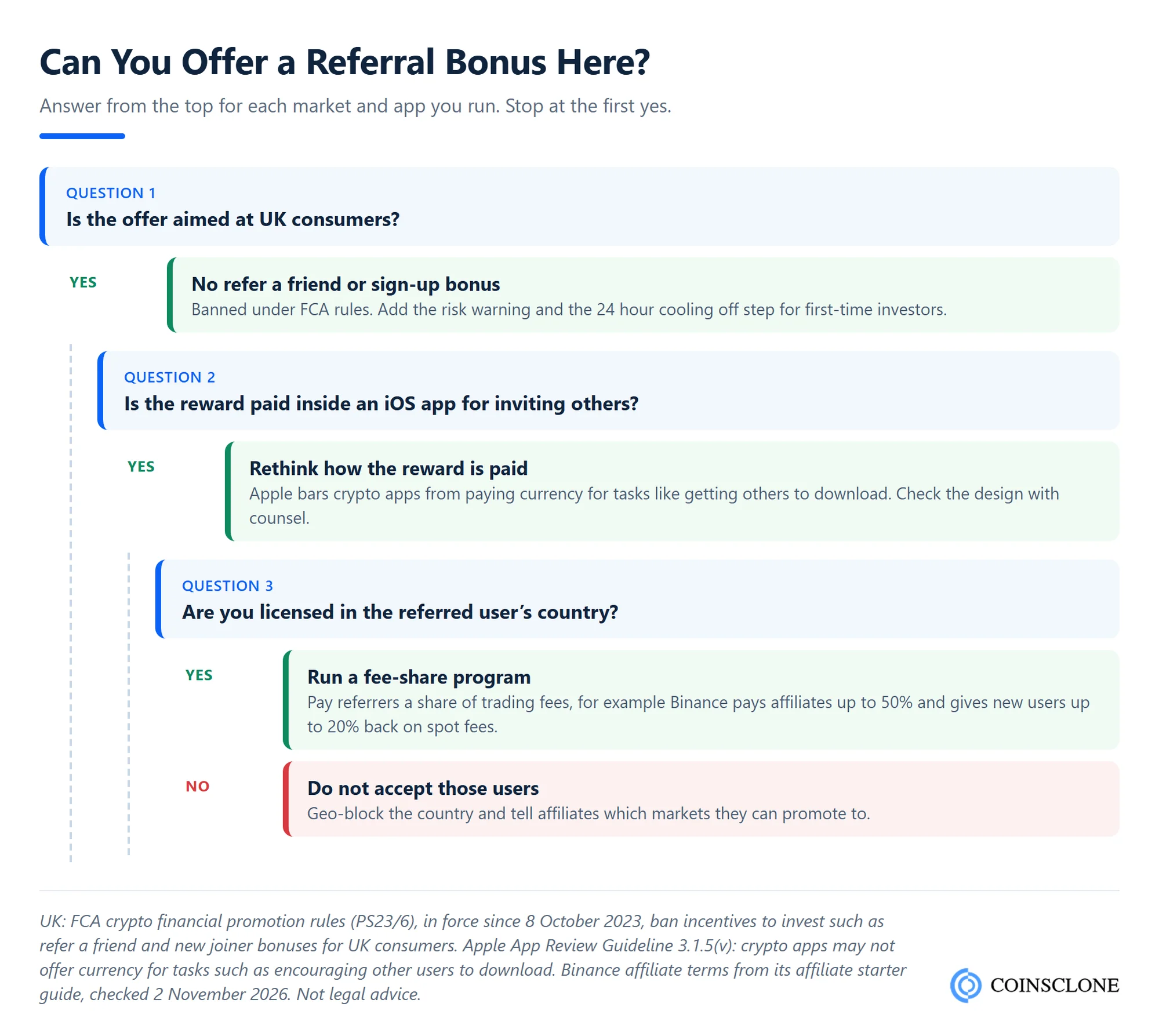
The UK is the strictest. Since 8 October 2023, FCA rules ban incentives to invest in crypto, such as refer a friend or new joiner bonuses, for UK consumers. First-time buyers must wait 24 hours before they see the offer to invest. Ads must carry a risk warning that starts: “Don’t invest unless you’re prepared to lose all the money you invest.” On iOS, Apple’s rule 3.1.5(v) bars crypto apps from paying users for tasks such as getting others to download.
How Do You Get Listed on CoinGecko and CoinMarketCap?
Apply through each site’s request form once your API is stable and your volume is real. Listings matter because many traders check these sites before they sign up anywhere.
CoinGecko posts its exchange listing rules:
- A working exchange website with real trading volume that matches the data in your API
- An API that meets CoinGecko’s exchange API standards, with working REST documentation
- A named contact person for the CoinGecko team
- A coin info page for each traded coin, with name, ticker, logo, website and block explorer
CoinGecko then reviews the request, builds the integration, maps every trading pair and sets the listing live. Meeting the criteria does not guarantee a listing. CoinMarketCap runs a similar request form with an “add new exchange” option.
Do not fake volume to look bigger. CoinGecko now checks volume against order book depth, and a low Trust Score shown to every visitor costs more than a late listing.
How to use new listings as launch news
Each new pair is a reason to post, email users and run an AMA. Promote a pair only once it has liquidity on day one, or the campaign sends traders to an empty book.
How Do Content and SEO Bring Traders to an Exchange?
Content brings traders when it answers the questions people ask just before they pick an exchange. For a new brand, that means pages that win searches rivals ignore, not generic “what is Bitcoin” posts.
Pages that tend to bring buyers:
- How to buy [coin] in [country]: With local payment methods, real fees and a step list. These match your licence map.
- [Your exchange] fees and limits: People search this before they sign up. Own the answer on your own site.
- Is [your exchange] safe?: Link your licence, security and proof of reserves pages.
- Comparisons: “[Your exchange] vs [local rival]” pages, written fairly, with a fee table.
- Coin and pair pages: One page per listed coin, with live price, the pairs you offer and how to deposit.
AI search tools now answer many of these questions directly. Clear fee tables, plain answers at the top of each page and one firm name used everywhere help them cite you. If you are still deciding on your model, our guide on how crypto exchanges make money shows which fees are worth putting front and center.
How Do You Build a Community on Telegram and X?
Use Telegram for support and conversation, and X for news and reach. Both are where crypto traders already spend time, and both reward speed and honesty more than polish.
What a working setup looks like:
- One Telegram group per language: Staffed in market hours, with pinned links to fees, status and your real accounts. Scammers copy official exchange groups, so state in the pinned message that staff never message users first.
- A news channel: New pairs, downtime and outages, posted before users notice.
- X for news and proof: Listing news, product updates, proof of reserves posts and fast replies to complaints.
- AMAs with real answers: Monthly sessions where the team explains fees, security and roadmap. Answer the hard questions in public.
When something breaks, post first, then fix. A clear incident note within the hour keeps more traders than a polished statement the next day.
How Should You Work With Crypto Influencers (KOLs)?
Work with smaller creators whose fans really trade, and pay for tracked results where you can. Every paid post needs a clear label. A KOL post that invites people to sign up is a promotion under most crypto rules, and you share the risk.
| Market | Rule | What it means for KOL deals |
| United States | FTC Endorsement Guides, revised 29 June 2023 | Paid links must be disclosed clearly and where people will see them. In 2022 Kim Kardashian paid $1.26 million to settle SEC charges for not disclosing a $250,000 payment to promote a token. |
| United Kingdom | FCA crypto promotion rules, in force since 8 October 2023 | The post must be lawful for UK consumers, carry the risk warning and offer no sign-up bonus. Firms not allowed to promote to UK users should block UK audiences. |
| European Union | MiCA Article 66 | Marketing must be fair, clear and not misleading, and labeled as marketing. Only work with creators if your exchange holds a MiCA licence. |
| India | ASCI guidelines for virtual digital asset ads, since 1 April 2022 | Ads for crypto exchanges must carry the ASCI risk disclaimer, stating that crypto products are unregulated and can be highly risky. |
How to brief a KOL well:
- Pick by audience, not followers: 20,000 followers who trade beat 500,000 who watch memes. Ask for past campaign data and audience country split.
- Use tracked links and codes: Pay a base fee plus a share of fees from referred traders, so the creator earns from quality.
- Write the must-say lines: Disclosure, risk warning and the countries the offer covers. Ban price calls and words like “guaranteed”.
- Geo-block where you are not licensed: Ask creators which countries their audience lives in, and skip deals where most viewers sit in markets you cannot serve.
Which Metrics Matter, and How Should You Split the Budget?
Measure cost per active trader, not cost per signup. A cheap signup who never passes KYC or funds an account is worth nothing, and signup counts hide that.
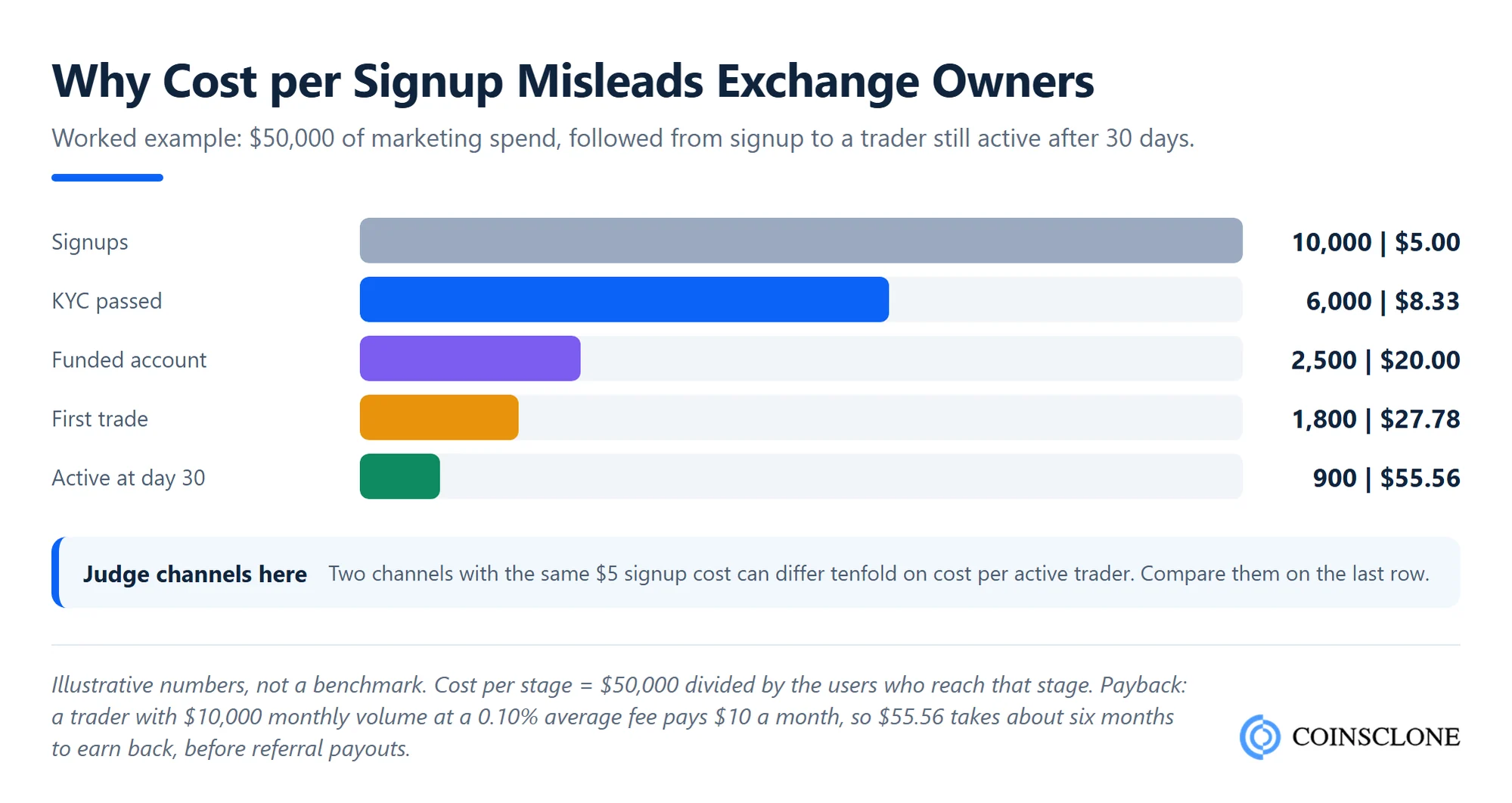
Track these five numbers each week, by channel:
- Signups: Raw interest. Useful only for spotting broken tracking.
- KYC passed: Shows whether the channel brings people from countries you serve.
- Funded accounts: The first real sign of trust.
- First trade: Proves the pairs and the flow work.
- Active at day 30: The number your budget should be judged on.
Then check payback. In the worked example above, an active trader who trades $10,000 a month at a 0.10% average fee brings in $10 a month. If that trader cost $55 to win, payback takes about six months, before referral payouts. Run the same math with your own fees and volumes before you scale any channel.
A starting budget split for a new exchange
This is the split we suggest for the first three months, not an industry benchmark. Shift money toward whatever channel shows the lowest cost per active trader by week six.
| Channel | Share of budget | Why |
| Referral and affiliate payouts | 30% | Paid only when referred users trade |
| Content and SEO | 20% | Slow to start, cheapest per trader after a few months |
| KOLs and creators | 20% | Fast reach in a niche, if disclosed and tracked |
| Paid search and social | 15% | Only in countries where you hold certification |
| Community, AMAs and events | 10% | Keeps traders active and lowers churn |
| Tracking and tools | 5% | Attribution by channel, fraud checks |
A 90 day plan to your first 10,000 traders
- Days 1 to 30: Closed beta, deep liquidity on 10 to 20 pairs, trust pages live, affiliate program open to your first 50 partners, ad certifications filed.
- Days 31 to 60: Public launch, fee rebate for early traders, five to ten tracked KOL deals in your core market, CoinGecko and CoinMarketCap applications.
- Days 61 to 90: Cut the channels with the highest cost per active trader, double the best two, publish your first proof of reserves report and add new pairs only where liquidity is ready.
Ten thousand registered traders in 90 days is a stretch for a new brand. It can work in one country with strong partners and deep books. It rarely works spread across ten countries with thin books.
Launch an Exchange That Is Ready for Your Marketing
Crypto exchange development, done right.
- Liquidity from Day One: Market maker and shared order book links so new traders see tight spreads
- Referral and Affiliate Module: Fee-share tiers, tracked links and payout holds to stop abuse
- Country-Aware Onboarding: KYC flows, geo-blocking and risk warnings set per market
- Trust Pages and Listing APIs: Fee, status and reserves pages plus APIs ready for CoinGecko and CoinMarketCap
See a live demo of a white label exchange with built-in referral and liquidity tools.
Book a Free Demo to plan your exchange launch and first 90 days of growth.
How Coinsclone Helps You Launch a Market-Ready Exchange
Marketing works best on an exchange that is ready for traffic. Coinsclone builds exchanges with deep order book links, referral tools, KYC flows by country and the trust pages traders check first. Coinsclone has built crypto products since 2018 and delivered 350+ platforms for 200+ clients across 20 industries. A white label exchange takes 4 to 6 weeks, 7 to 10 with fiat rails and 9 to 13 with mobile apps. Talk to our cryptocurrency exchange development company team, or read how to start a cryptocurrency exchange to plan the full launch.
Frequently Asked Questions
What is crypto exchange marketing?
Crypto exchange marketing is everything that turns a stranger into a funded, active trader on your exchange. It covers ads, referral deals, listings, content, chat groups and paid creator posts. Unlike most app marketing, it is limited by licences and promotion rules in each country you target.
Which marketing strategy works best for crypto exchanges?
For a new exchange, referral and affiliate programs usually work best, because you pay only when referred users trade. Pair them with content that answers buying questions in your core market and with tracked influencer deals. None of it works without liquidity on the pairs you promote.
How do exchanges build trust with new users?
Exchanges build trust by showing proof, not claims. Publish your licence and register link, explain how funds are stored, post proof of reserves if you have it and keep a public status page. Fast, honest answers on Telegram and X during incidents matter as much as the pages.
How long does it take to see results from crypto exchange marketing?
Paid search, referrals and influencer posts show data within days. SEO and content usually take three to six months to bring steady traffic. Judge each channel on 30 day active traders, which means waiting at least a month after launch before cutting anything.
How can marketing support exchange listings?
Each new trading pair gives you a reason to email users, post on X and Telegram and host an AMA. Listing on CoinGecko and CoinMarketCap also puts your exchange in front of traders who compare platforms there. Only promote a new pair once it has liquidity, or the campaign brings traders to an empty book.
How do you market a crypto exchange app?
Get the app approved first: Apple only allows exchange features in countries where the app is licensed. Then drive installs through search ads in certified markets, referral links and creator content, and track funded accounts per channel. Keep rewards inside the app compliant, since Apple bars crypto apps from paying currency for inviting others.
How do you attract new users to a crypto exchange?
Pick one market and one trader type you can serve better than the big exchanges. Give them deep liquidity, local payment options, clear fees and a fee rebate to start. Then grow through referrals, local content and creators whose audience lives in that market.