
When two strangers trade bitcoin for cash, someone has to go first. The buyer does not want to pay and receive nothing, and the seller does not want to send bitcoin and never get paid. A bitcoin escrow solves this: it locks the seller’s bitcoin until the buyer has paid, then releases it.
A bitcoin escrow script is ready-made software that builds this protection into your own P2P exchange or escrow service. This guide explains what the script does, how a trade flows through it, the three kinds of escrow you can choose from, and the features to include.
See How Our Bitcoin Escrow Script Can Power Your Crypto Business!
Crypto Escrow Development — simplified.
- Instant Setup: Launch your secure escrow platform in weeks, not months.
- Multi-Crypto Support: Bitcoin + altcoins ready out of the box.
- Smart Escrow Logic : Automated release on milestone or approval.
- Revenue-Ready : Earn from fees, premium tiers, and token swaps.
Get a free branded demo of your escrow platform within 48 hours — before spending a cent.
Book a Free Demo and see how our Bitcoin Escrow Script takes you from concept to launch fast.
What Is a Bitcoin Escrow Script?
A bitcoin escrow script is ready-made software for launching a P2P crypto exchange or crypto escrow service, where an escrow system protects every trade. The escrow holds the seller’s bitcoin during the trade and releases it only when the agreed terms are met. Admins can follow every trade and step in when there is a dispute.
Coinsclone provides a secure bitcoin escrow script with P2P trading features, dispute tools and strong security. You can launch an escrow-based bitcoin exchange in weeks, and your users can trade in a trusted setting from day one.
What Is a Bitcoin Escrow Service?
A bitcoin escrow service is a neutral party that holds bitcoin until both sides of a deal have kept their promises. Escrow is an old idea from banking and property sales. Crypto escrow applies it to digital assets, and it is used in three main places:
- P2P exchanges: the seller’s bitcoin is held while the buyer pays in local money.
- OTC deals: large trades between traders or businesses, where both sides want protection.
- Goods and services: freelance work or online sales paid in crypto, where payment is released on delivery.
A bitcoin escrow script lets you build any of these, with the P2P exchange as the most common use. For how escrow works in practice, what escrow services charge and the licence rules, read our guide to crypto escrow.
Custodial, Multisig or Smart Contract Escrow?
There are three ways to hold bitcoin in escrow. The choice decides who can move the coins, how disputes work and how much regulation you face.
- Custodial escrow: the platform moves the seller’s bitcoin into its own escrow wallet during the trade. It is the simplest and most common, used by large exchange P2P desks. The platform carries the security risk and usually needs licences.
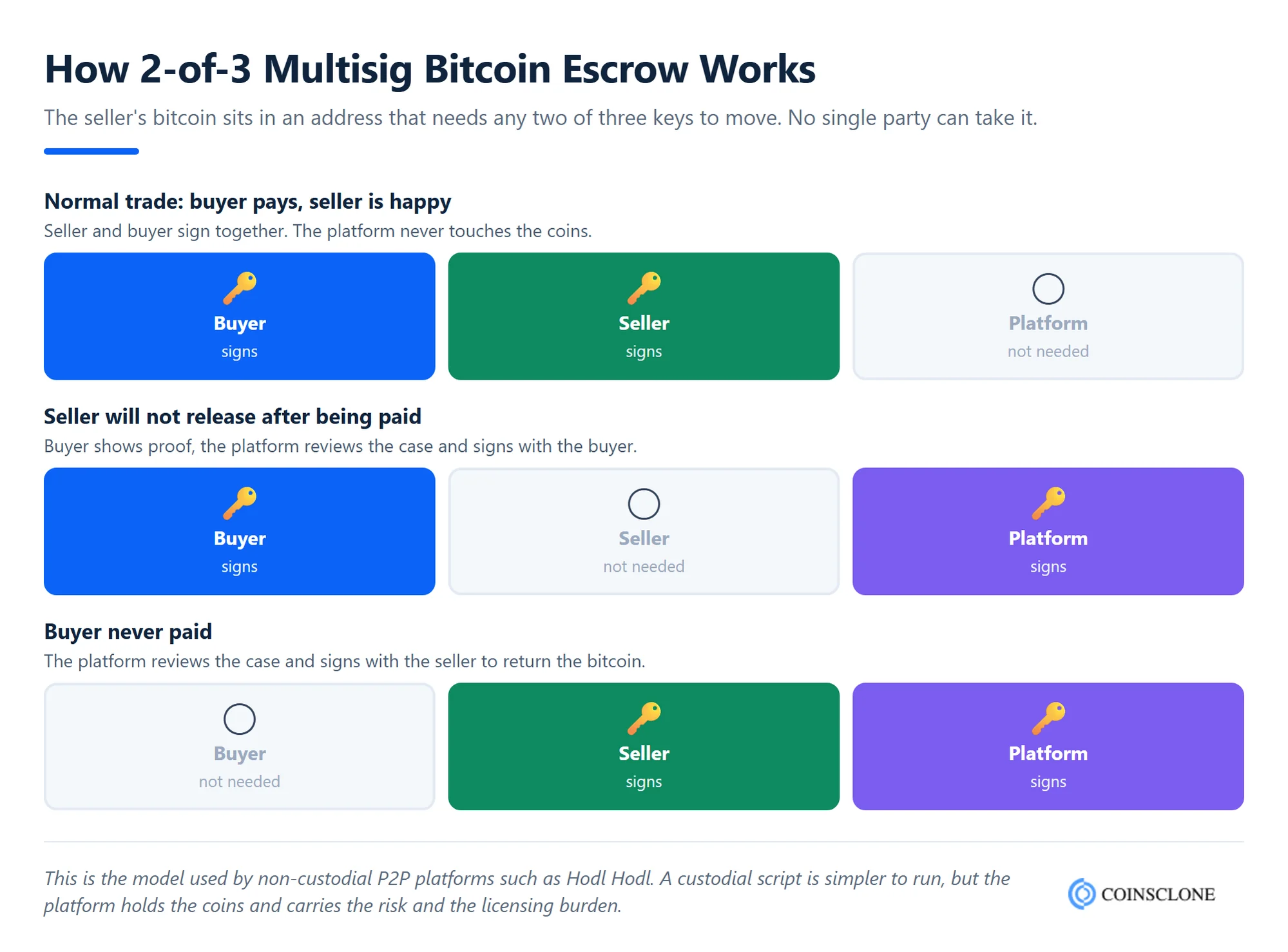
- 2-of-3 multisig escrow: the bitcoin sits in an address that needs any two of three keys (buyer, seller and platform) to move. The platform never holds the coins alone. Non-custodial P2P platforms such as Hodl Hodl use this model.
- Smart contract escrow: on chains such as Ethereum or TRON, a smart contract locks the tokens and releases them by set rules. It suits USDT and other tokens more than native bitcoin.
Why Use a Bitcoin Escrow Script?
- Faster launch: the escrow, trade flow and dispute tools are already built and tested.
- Less fraud: neither side can run off with the other’s money.
- More trust: users trade with strangers because the platform protects them.
- Lower cost: you pay for customisation, not for building escrow from zero.
- Fits your model: choose custodial, multisig or smart contract escrow.
How Does a Bitcoin Escrow Script Work?
Here is how a typical P2P trade flows through the script:
- Sign up and verify: users register and complete KYC to activate trading.
- Agree on terms: the buyer picks a seller’s ad, or the seller answers a buyer’s ad, with the price, amount and payment method.
- Bitcoin goes into escrow: as soon as the trade opens, the seller’s bitcoin is locked in escrow. The buyer can now see it is safe.
- Buyer pays: the buyer pays the seller directly, for example by bank transfer, and marks the trade as paid within the time limit.
- Seller confirms: the seller checks that the money has arrived in their own account. A screenshot alone is not proof.
- Escrow releases: the seller releases the bitcoin, and it moves to the buyer’s wallet.
- Disputes: if the seller does not release, or the buyer never paid, either side opens a dispute. An admin reviews the chat and payment evidence and releases or returns the bitcoin.
This order matters. The bitcoin is locked before any money moves, so the buyer never pays for coins that are not there.
Popular P2P Bitcoin Escrow Scripts
Several well-known P2P marketplaces were built on bitcoin escrow. Some of the original companies have since closed, but their models still work well, and our scripts copy the product, not the company:
- LocalBitcoins clone script: the classic ads-based model with custodial escrow. LocalBitcoins itself closed in 2023.
- Paxful clone script: escrow with hundreds of payment methods. Paxful closed in November 2025.
- Remitano clone script: escrow-backed P2P trading with a focus on local currencies.
- LocalCryptos clone script: non-custodial escrow, where the platform never holds user funds.
All four are built on our P2P crypto exchange script, which you can shape into your own brand.
Why Escrow Is Essential for a P2P Bitcoin Exchange
- The buyer sees the bitcoin is locked before sending any money.
- The seller keeps control until the payment has truly arrived.
- Each trade has its own terms, such as amount, price, payment method and time limit, recorded in the escrow.
- Disputes have evidence, because the trade chat and payment details are stored with the escrow.
Your users can pay by bank transfer, mobile money, cards and other methods. Each method carries a different risk. For example, reversible card payments need stricter limits and hold times than instant bank transfers.
Features of Our Bitcoin Escrow Script
- Escrow wallet: custodial, multisig or smart contract options.
- Trade timers: trades cancel automatically if the buyer does not pay in time.
- Dispute management: case queues, evidence uploads and admin decisions.
- In-trade chat: buyer and seller talk inside the trade, which also serves as evidence.
- Transaction history: a full record of every trade.
- Reputation system: ratings and trade counts for every user.
- KYC and AML tools: identity checks and screening.
- Two-factor authentication: extra protection for every account.
- Notifications: alerts for new trades, payments and disputes.
- Multi-coin support: BTC plus USDT, ETH and other coins.
- Custom UI/UX: your brand and design.
- Admin CMS: manage content, fees and settings without code.
- Referral program and multi-language support.
Every feature can be changed to suit your business with help from the Coinsclone team.
Benefits of an Escrow System in a Crypto Exchange
- Equal protection: both buyers and sellers are protected, and disputes follow clear rules.
- Less fraud: coins cannot move until the trade terms are met.
- Clear records: every trade leaves an audit trail for disputes and regulators.
- Faster than bank escrow: bitcoin escrow opens and settles in minutes, not days.
- Works across borders: users in different countries can trade safely.
- Delivery protection: for goods and services, payment is released only when the buyer confirms delivery.
How to Build a Crypto Escrow Service Website and App
- Pick your use case: P2P exchange, OTC desk, or escrow for goods and services.
- Choose the escrow type: custodial, multisig or smart contract.
- Check the rules: holding user funds usually needs a licence, so confirm this for each market.
- Customise the script: brand, fees, coins, payment methods and dispute rules.
- Add mobile apps: most users trade on their phones.
- Test and audit: focus on the escrow and dispute logic, where money is at risk.
- Launch: start with verified traders so users see an active market.
Why Choose Coinsclone?
Coinsclone is a cryptocurrency exchange development company that has delivered more than 350 blockchain platforms for over 200 clients. We build escrow-powered P2P exchanges, OTC desks and escrow services, with the escrow model and security your business needs.
Want the full picture first? Read our guide on how to start a P2P crypto exchange, then contact our team for a live demo of the bitcoin escrow script.
See How Our Bitcoin Escrow Script Can Power Your Crypto Business!
Crypto Escrow Development — simplified.
- Instant Setup: Launch your secure escrow platform in weeks, not months.
- Multi-Crypto Support: Bitcoin + altcoins ready out of the box.
- Smart Escrow Logic : Automated release on milestone or approval.
- Revenue-Ready : Earn from fees, premium tiers, and token swaps.
Get a free branded demo of your escrow platform within 48 hours — before spending a cent.
Book a Free Demo and see how our Bitcoin Escrow Script takes you from concept to launch fast.
Frequently Asked Questions
What is a bitcoin escrow service?
A bitcoin escrow service holds bitcoin on behalf of two parties until both have met the terms of their deal. It protects the buyer from paying for coins that never arrive, and the seller from sending coins without being paid.
What is escrow in cryptocurrency?
Escrow in cryptocurrency means locking crypto in a wallet, a multisig address or a smart contract until agreed conditions are met, such as the buyer’s payment being confirmed.
What is a bitcoin escrow script?
It is ready-made software for launching a P2P bitcoin exchange or escrow service with built-in escrow, disputes, KYC and admin tools.
Is custodial or multisig escrow better?
Custodial escrow is simpler for users and faster to launch, but the platform holds the coins and usually needs licences. Multisig escrow means the platform never holds funds alone, which lowers custody risk, but it is harder for beginners to use.
How do escrow disputes work?
If a trade goes wrong, either side opens a dispute. An admin reviews the trade chat and payment evidence, then releases the bitcoin to the buyer or returns it to the seller.
Do I need a licence to run a bitcoin escrow service?
Usually yes if you hold customer funds, since many countries treat custodial escrow as a regulated crypto service. Non-custodial multisig escrow may face lighter rules, but check with a lawyer in each market.