

Crypto prices swing each day, but a stablecoin is built to stay put. It is a token pegged to something steady, such as the US dollar, the euro or gold. In 2026 these coins are no longer just a trading pair. Firms use them for payments, payroll and transfers across borders. That is why more of them now look for stablecoin development services to launch a coin of their own.
This guide explains what those services include and how to build a stablecoin from idea to launch. You will see which type fits your plan and how minting and cash-out work. You will also see which chains hold the most coins and which laws apply in the US, EU and Asia. Finally, we cover cost, time and how issuers make money, so you can plan a budget and pick the right partner.
In this guide:
- What stablecoin development services cover, and the four types of stablecoin
- How a stablecoin is minted and redeemed, with a simple flow chart
- The 8-step process to create a stablecoin, plus the features it needs
- 2026 rules: the US GENIUS Act, EU MiCA, Hong Kong, Singapore and the UAE
- What a stablecoin costs to build and run, and how issuers earn
Launch Your Stablecoin Faster with Our MVP System
Stablecoin Development — done right.
- MVP System : Deploy your stablecoin 90% faster.
- Smart Contracts & Wallets : Pre-integrated, secure, and ready to go.
- Brand & Customization : Your design, your tokenomics, your market.
- Revenue Engine : Earn from staking, lending, and transaction fees.
See a free branded demo of your stablecoin in 48 hours — before you invest a cent.
Book a Free Demo to discover how our Stablecoin Development Solutions can take you from concept to live token in just 2–4 weeks.
Stablecoin Development Services
Stablecoin development services cover all a firm needs to issue and run its own coin. A good team does far more than write a token contract. In short, a full service includes:
- Model and reserve design: choosing fiat, asset, crypto or code-based backing, and how the reserve is held.
- Smart contracts: the token, plus mint, burn, pause, freeze and role controls, written and tested.
- Mint and redeem portal: where approved clients swap money for tokens and back again.
- Reserve and custody links: bank, custodian and proof of reserve feeds.
- Compliance tools: KYC, AML checks, Travel Rule data and reports for your regulator.
- Wallets, payments and trading: wallet support, payment gateway links and listings on exchanges and DeFi pools.
- Audit and support: an outside security audit, launch on the main network, then live checks and upgrades.
The market for these coins is large and still growing. Total supply of dollar stablecoins reached about $310.7 billion on 1 October 2026, up from $297.5 billion a year before, per DefiLlama’s stablecoin dashboard. Tether’s USDT holds about $184 billion of that. Circle’s USDC holds about $74 billion. Newer coins from PayPal (PYUSD), Ripple (RLUSD) and World Liberty Financial (USD1) each hold a few billion. So there is still room for focused issuers.
Explore the Top 4 Types of Stablecoin
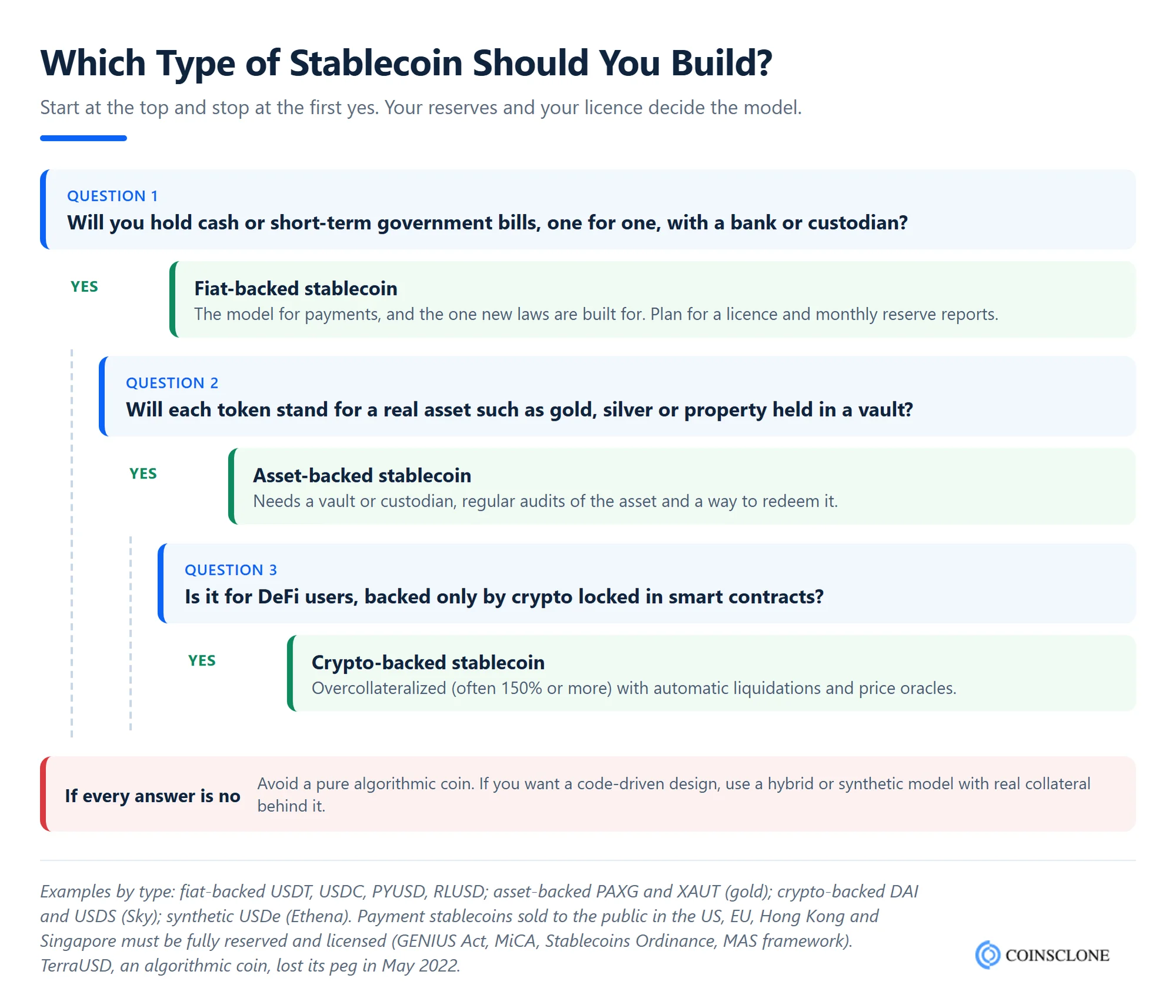
Stablecoins come in a few types, and each keeps its value steady in its own way. Here are the top 4.
1. Fiat-backed Stablecoin
A fiat-backed stablecoin is pegged to a real-world currency, such as the US dollar, the euro or the yen. The peg is usually 1:1. For each token issued, the issuer holds the same amount of cash or short-term bills as a reserve.
This is the most common type. People use it for daily payments, trading and sending money home. It is also the type most new laws are written for.
Known coins: USDT (Tether), USDC (USD Coin), PYUSD (PayPal USD) and RLUSD (Ripple USD).
2. Asset-backed Stablecoin
Asset-backed stablecoins are backed by real things you can touch. Gold, silver or even real estate can serve as the reserve. Instead of holding cash, the issuer tokenizes the asset. Each token then stands for a fixed amount of it, such as one fine troy ounce of gold.
This type appeals to buyers who want real-world value they can move on a blockchain. If this is your plan, our gold tokenization team covers the vault and token side.
Known coins: PAX Gold (PAXG) and Tether Gold (XAUT), both backed by physical gold.
3. Crypto-backed Stablecoin
As the name suggests, crypto-backed coins are backed by other crypto, such as Ether or Bitcoin, locked in smart contracts. Because crypto prices swing, these coins hold more crypto than the value they issue. If a loan becomes unsafe, the system sells the collateral.
This type is fully open on chain, which draws DeFi users.
Known coins: DAI and its successor USDS, both from Sky (once called MakerDAO).
4. Algorithmic Stablecoin
Algorithmic stablecoins do not rely only on fiat, assets or crypto as reserves. Instead, code grows or shrinks the supply. When the price goes above the target, the system adds supply. When it drops below, it removes supply.
However, this type carries the most risk. TerraUSD (UST), the best-known coin of this kind, lost its dollar peg in May 2022. It wiped out tens of billions of dollars. Today most teams that want a code-led design choose a hybrid or “synthetic dollar” model. For instance, Ethena’s USDe backs its dollar with crypto plus short futures that cancel out price moves.
Known coins: USDe (a synthetic dollar) and UST (a failed coin, and a lesson in what to avoid).
Each type serves a different goal. So, before you build, match the model to your plan.
How a Stablecoin Works: Minting and Redemption
Each reserve-backed coin runs on the same simple loop. First, a client sends money. Next, the issuer adds it to the reserve. Then, the smart contract mints the same amount of new tokens.
Cashing out is the same loop in reverse. The client returns tokens and the contract burns them. Then the issuer pays out money from the reserve.
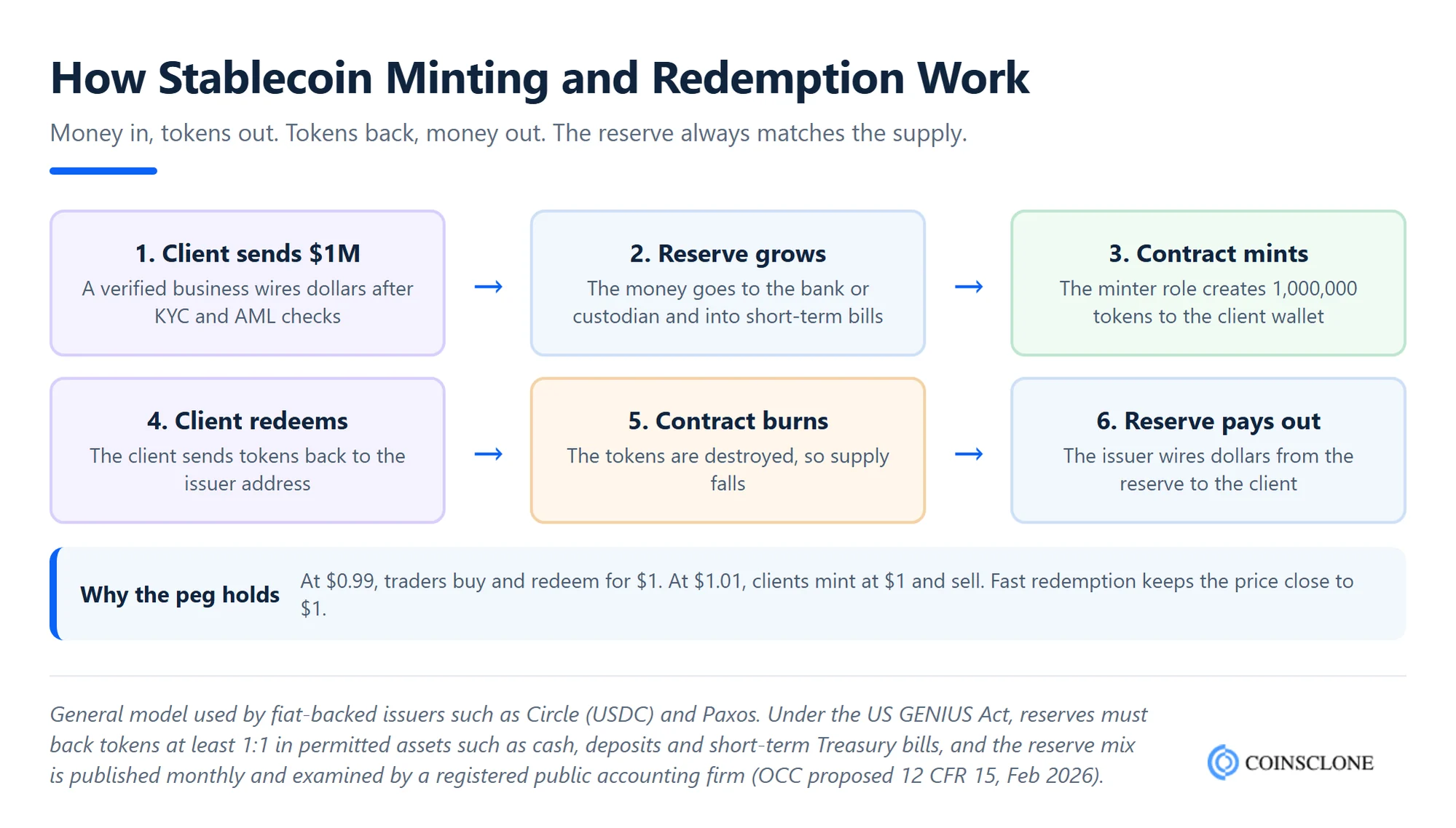
This loop keeps the price close to $1. Say the token trades at $0.99 on an exchange. Traders buy it cheap and redeem it for $1, which pushes the price back up. At $1.01, approved clients mint new tokens at $1 and sell them. That is why fast, steady redemption matters more than any sales claim.
Behind the loop, a stablecoin has four main layers:
- Token layer: the smart contract with mint, burn, pause, freeze and upgrade controls, each held by its own role.
- Issuer back office: onboarding, KYC and AML checks, mint and redeem requests, and limits per client.
- Reserve layer: bank accounts, a custodian and short-term bills, matched to token supply each day.
- Proof layer: on-chain proof of reserve feeds and reports checked by an accounting firm.
Where Businesses Use Stablecoins
A stablecoin lets you serve many markets, thanks to its steady value. Here are some common use cases.
- Payments across borders: firms settle bills between countries in minutes, not days.
- Online stores: shops accept stablecoins through a crypto payment gateway and avoid card chargebacks.
- Money sent home: families send money abroad at lower cost than many transfer services.
- DeFi lending and borrowing: stablecoins are the main asset lent and borrowed on DeFi platforms.
- Payroll and freelancer pay: global teams get paid fast in a coin that holds its value.
- Tokenized assets: tokenized bonds and funds use stablecoins to settle trades.
- Gaming and metaverse: in-game shops use stablecoins so prices stay fixed.
Building any of these types for these markets brings real gains. Let’s take a closer look.
Benefits of Stablecoin Development Services
Global Access
Stablecoins cross borders with ease. Unlike bank transfers, they move around the clock, even where banking is slow or costly. Anyone with a wallet can hold and send them.
Income Streams
Apart from brand reach, a stablecoin opens real income streams. The biggest is the yield earned on reserves. You can also earn from mint and redeem fees, partner deals and extra services. We break these down in the income section below.
Price Stability
Stablecoins are designed to hold a steady value. Because they are pegged to real money or goods like gold, price swings are small. This makes them ideal for daily payments and savings.
Low Cost
Stablecoin transfers are often faster and cheaper than other payment methods, mainly for transfers across borders. As a result, you can cut out extra currency swaps and bank fees.
Smooth Trading
A well-built stablecoin brings smooth trading to an ecosystem. Once it links to DEXs or lending platforms, users can swap assets with ease and take part in the market.
Once the benefits are clear, the next step is to learn how to create a stablecoin the right way.
8 Step-By-Step Process To Create A Stablecoin
Here’s a clear 8-step guide on how to create a stablecoin.
Step 1: Research and Consultation
A good stablecoin build begins with deep market research. This means knowing the market, your target users and your niche. At this stage you also choose the type of coin that fits your goals. Talk with blockchain experts, finance advisors and lawyers early. The licence you need shapes almost each later choice.
Step 2: Project Mapping
Once you’ve gathered your insights, map out the project. Here you decide all the parts, from tech needs to the back end. A clear blueprint shows you the project flow in advance. As a result, the build stays on track and delays stay small.
Step 3: Choose the Blockchain Network
Choosing the chain is one of the biggest choices in stablecoin development. You can pick from Ethereum, Tron, Solana, BNB Chain, Base, Arbitrum and Polygon. Each has its own fees, speed and user base. So, pick the chain that best fits your target market and your tech needs. Many issuers now launch on two or three chains from day one.
Step 4: Plan Your Reserves and Tokenomics
The tokenomics define how your coin keeps its peg and rewards use. Here you decide whether your coin is fully backed, backed with extra crypto, or run by code. For a fiat-backed coin, you also pick the bank, the custodian and the mix of reserve assets. Back these choices with data and a risk review. This builds trust with users and regulators.
Step 5: Plan Your Stablecoin’s Liquidity
Liquidity means users can buy and sell your coin at any time without moving the price. Without a plan, even a well-designed coin can struggle. So, in this phase, you plan cash buffers, DEX pools and deals with market makers and exchanges. A good plan lets users trade with little slippage, which builds long-term trust in the peg.
Step 6: Smart Contract Development
Next comes the core build. Developers write, test and deploy the smart contracts that define how your coin works. These contracts handle minting, burning, transfers, pausing and freezing. Make sure each power sits with its own role. Also set mint limits, so no single key can create endless tokens. Our smart contract development services guide covers this stage in depth.
Step 7: Testing, Audit and Launch
After the build, move on to testing and launch. Unit tests, system tests and an outside security audit help you find and fix bugs before real money is at stake. Once the audit is clear, deploy the coin on the main network and publish the verified code.
Step 8: Marketing and Support
Finally, plan the right marketing to win users and partners. This stage covers community trust, brand presence, exchange listings and payment partners. After launch, steady support, live checks and reserve reports keep your coin in demand.
Coinsclone builds stablecoins as part of its crypto token development services. The team covers the contracts, the mint and redeem portal, wallets and audit prep. Next, let’s look at the features your stablecoin needs.
Key Features of a Stablecoin
Here are the key features to plan for when you create a stablecoin.
- Peg mechanism: the reserve or code rules that hold the peg.
- Smart contracts: audited token code with mint, burn and transfer logic.
- Mint and redeem portal: a simple place for approved clients to issue and cash out tokens.
- Role-based controls: each role holds its own key for minting, pausing, freezing and upgrades, often behind multisig.
- Mint limits: caps that stop very large mints without extra approval.
- Freeze and blocklist: the power to act on court orders and sanctions lists.
- Reserve tracking: dashboards that match token supply to bank and custody balances.
- Proof of reserve: on-chain feeds and monthly reports.
- Compliance: KYC, AML checks and Travel Rule data.
- Multi-asset collateral: for crypto-backed or hybrid designs.
- Wallet support: works with common wallets and your own branded wallet.
- Cross-chain support: native issue or safe bridges across chains.
These features decide how safe and useful your coin will be. Even so, each stablecoin project faces a few hard problems.
Stablecoin Challenges and How to Fix Them
1. Legal hurdles: Stablecoin laws now exist in the US, EU, Hong Kong, Singapore and the UAE, and they differ. Meeting them in many markets is hard.
How to fix: Work with lawyers from day one. Pick your launch market first. Then design reserves, KYC and reports to match its rules.
2. Keeping the peg: A peg can break if users doubt the reserves. In March 2023, USDC briefly fell to about $0.87. Circle had said $3.3 billion of its reserves sat at the failed Silicon Valley Bank.
How to fix: Spread reserves across several banks and custodians. Hold mostly short-term bills, and keep redemption fast and open.
3. Slow and costly networks: A busy chain can slow transfers or push fees up.
How to fix: Choose fast networks, and launch on more than one chain with a safe cross-chain setup.
4. Security threats: Like any digital asset, stablecoins face smart contract bugs, stolen keys and hacks.
How to fix: Use audited code, multisig or MPC for admin keys, and mint limits. Add audits on a set schedule and live alerts.
Even with these problems, a well-launched stablecoin can become a strong business. So, let’s see how issuers actually make money.
Revenue Streams of Our Stablecoin Development
Building a stablecoin lets you earn money in several ways. Here are the most common streams.
Interest on Reserves
This is the main income for most issuers. The reserve sits in short-term bills and bank deposits that pay yield. For example, $100 million in reserves at 4% a year brings in $4 million. Meanwhile, users still hold tokens worth $1 each.
The model works at scale. Circle reported $2.7 billion of total revenue and reserve income for 2025. Tether reported more than $10 billion in net profit for the same year. Note that the US GENIUS Act bans issuers from paying yield to holders. So the reserve income stays with the issuer.
Lending
You can lend your stablecoin, or let others borrow against it, because its price is stable. Borrowers pay back the loan plus a fee.
Investments
You can place part of your own capital, not client reserves, in safe and liquid assets. Most laws limit what reserves can hold, so keep this money apart from the reserve.
Mint and Redeem Fees
You can charge a small fee when clients create or cash out your tokens. While the fee per trade is tiny, it adds up as volume grows.
Transfer Fees
Each time your coin moves through your own payment, transfer or trading products, you can take a small fee. As your user base grows, this becomes one of your most steady streams.
Token Sale for a Companion Token
Crypto-backed and hybrid systems often pair the stablecoin with a governance or utility token. An Initial Coin Offering Development for that token can fund the build and growth. It also helps you build a community early on.
Partner and Referral Programs
This is not direct income, but it grows usage. Reward exchanges, wallets and shops that bring in new users. Your fee and reserve income then grow with them.
With the business model clear, the next big choice is where your stablecoin lives.
Ready to Launch your Stablecoin with Coinsclone.
Cost-effective. Easy Customizations. Get A Free Demo!
Best Blockchain Networks for Stablecoin Development Services
Stablecoins can run on many chains. The chain you pick shapes your fees, speed and the users you can reach. Here is where stablecoins actually sit today:
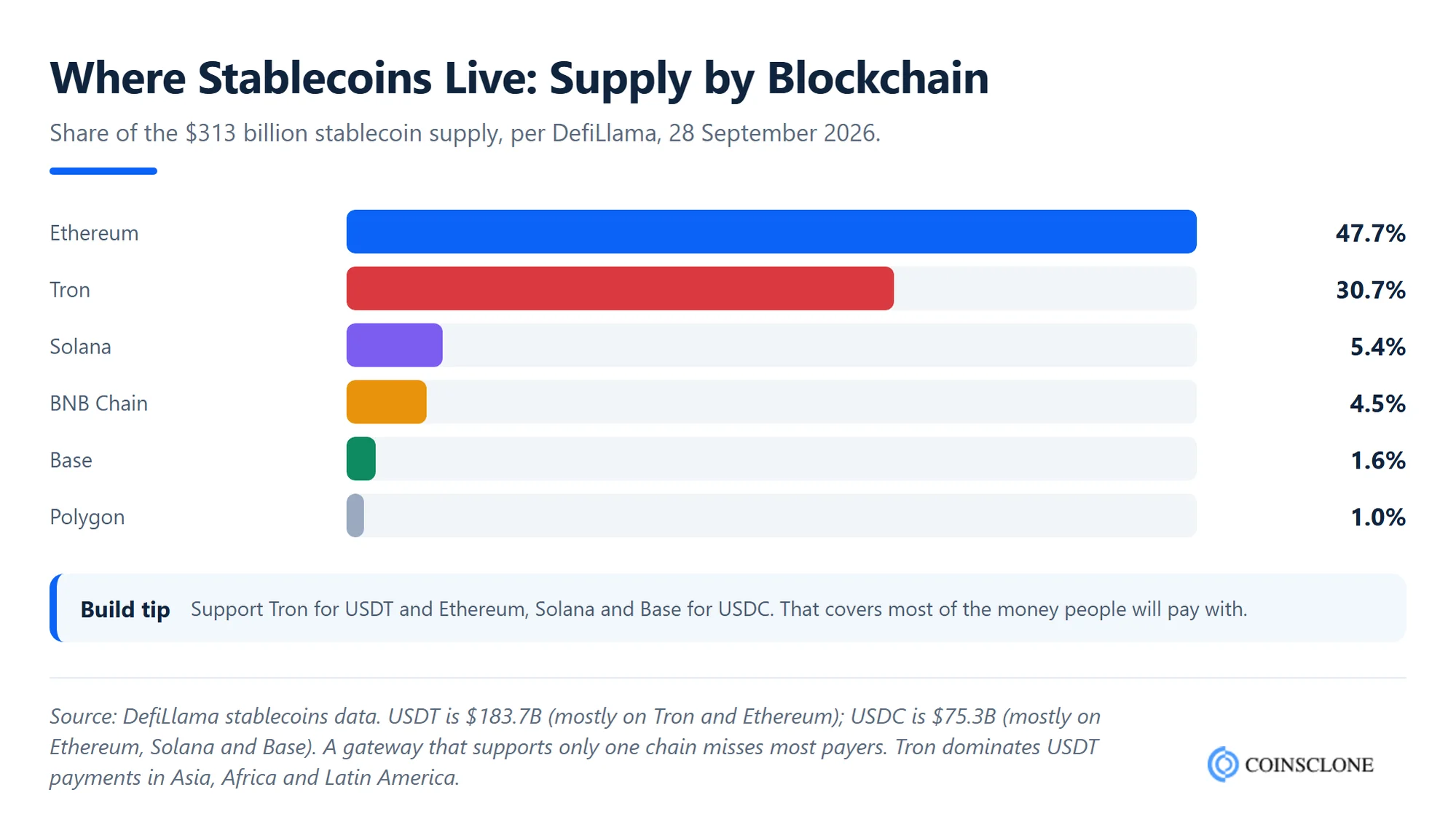
Some of the most used networks for stablecoins are:
- Ethereum: the largest home for stablecoins, with about $146 billion on the chain. It has strong smart contracts and the deepest DeFi links.
- Tron: about $94 billion, almost all USDT. Low fees make TRC-20 tokens a top choice for transfers in Asia, Africa and Latin America.
- Solana: very fast and cheap, which suits payment-heavy coins. It holds about $16 billion.
- BNB Chain: low fees and a large user base, with about $14 billion in stablecoins.
- Base and Arbitrum: Ethereum layer 2 networks with low fees and Ethereum security. Base is a favorite for consumer payment apps.
- Polygon: a chain linked to Ethereum with fast, cheap transfers, used by payment firms.
These are the main networks for stablecoin development services. Next, let’s look at the rest of the tech.
Tech Stack for a Stablecoin
Besides the chain, a sound stablecoin needs a proven tech stack. Here’s a quick overview:
- Smart contract languages: Solidity or Vyper on EVM chains, Rust on Solana.
- Token standards: ERC-20 (with permit for gasless approvals) on EVM chains, TRC-20 on Tron and SPL tokens on Solana.
- Upgrade pattern: a proxy design, so you can fix bugs or add rules later without changing the token address.
- Node and API access: your own nodes and APIs to talk to each chain.
- Oracles and proof of reserve: price and reserve feeds, such as Chainlink, that show backing on chain.
- Cross-chain tools: native issue or messaging tools such as Circle CCTP, Chainlink CCIP or LayerZero.
- Wallet support: safe wallets on each device, for storing and managing stablecoins.
- Reserve and treasury systems: links to banks and custodians, with a daily match of supply and reserves.
- Security controls: multisig or MPC for admin keys, role-based access, rate limits and audits.
- Compliance tools: KYC/AML modules, sanctions checks and Travel Rule data for each region.
A sound stablecoin build combines all of these. Just as vital, it has to follow the law in each market you serve.
Stablecoin Laws and Rules in 2026
Stablecoins are now among the most tightly ruled products in crypto. Before you mint a single token, check the rules in your launch market. Here is a summary of the main ones as of October 2026.
| Region | Law | What it means for issuers |
| United States | GENIUS Act, signed 18 July 2025 | At least 1:1 reserves in cash, deposits, short-term bills and similar assets; monthly reserve reports checked by an accounting firm; no interest paid to holders; issuers up to $10 billion may use a state regime. |
| European Union | MiCA, stablecoin rules since 30 June 2024 | E-money tokens can only be issued by a licensed bank or e-money firm, with a white paper, full reserves and redemption at par. |
| Hong Kong | Stablecoins Ordinance, in force 1 August 2025 | An HKMA licence is required. Out of 36 applicants, only two licences were granted in April 2026. |
| Singapore | MAS stablecoin framework, August 2023 | For coins pegged to the Singapore dollar or a G10 currency: strict reserves, minimum capital and redemption at par within five business days. |
| UAE | Central Bank Payment Token Services Regulation, 2024 | Mainland payments must use licensed dirham tokens; registered foreign stablecoins may be used only to buy virtual assets. Algorithmic stablecoins are banned. |
In the US, the law takes effect on 18 January 2027 at the latest. It starts sooner if final rules come out first: 120 days after they are issued. The OCC proposed its rules in February 2026. Its draft also says an issuer’s safeguards may include a way to block very large mints without extra approval. So build mint limits into your contracts from the start.
How Much Do Stablecoin Development Services Cost?
The cost of stablecoin development depends on the type, the number of chains and how much of the back office you need. Here are typical market ranges in 2026.
| Build scope | Typical market range | What you get |
| Basic token and mint/redeem app | $25,000 to $30,000+ | Token contract, admin panel, simple mint and redeem, testing |
| Growth build | Around $75,000+ | Multi-chain, proof of reserve, KYC/AML, wallet and payment links |
| Enterprise build | $150,000 to $250,000+ | Bank and custody links, treasury dashboards, full compliance and reporting |
| Security audit | $5,000 to $20,000+ | Outside review of a simple token; complex systems cost more |
The ranges above come from agency price lists published in 2026. Keep in mind that the build is often the smaller cost. Licences, lawyers, reserve banking and audits can cost more. For example, the OCC says monthly accountant checks of reserve reports alone add about $40,000 per issuer each year.
As for time, agencies often quote 6 to 8 weeks for a basic build, plus time for the audit. Licensing can take much longer. Hong Kong’s first licences, for instance, came eight months after its law took effect.
Why Choose Coinsclone as the Best Stablecoin Development Company?
Coinsclone is a leading blockchain development company that has built crypto products since 2018. We have delivered 350+ platforms for 200+ clients across 20 industries. We are known for safe, fast builds that scale. Our team brings together blockchain coders, smart contract engineers and advisors who know both the tech and the rules.
We help you choose the right model. Then we build the contracts, the mint and redeem portal, the crypto wallet and the payment gateway links. In short, we offer end-to-end stablecoin development services shaped to your business. With Coinsclone, you get a trusted partner that helps you launch a compliant, audit-ready stablecoin.
Frequently Asked Questions
What is a stablecoin?
A stablecoin is a crypto token built to keep a stable value. It is pegged to a reserve asset, such as the US dollar, gold, or other crypto.
How do stablecoins maintain their value?
Most stablecoins hold reserves worth at least as much as the tokens in use. Approved clients can redeem tokens at $1. Traders buy below the peg and redeem, or mint and sell above it, which pulls the price back. Crypto-backed coins hold extra collateral, and code-based coins change supply.
How much does stablecoin development cost?
Agency price lists in 2026 start around $25,000 to $30,000 for a basic token with a mint and redeem app. They reach $150,000 to $250,000 or more for a large build. Audits, licences, lawyers and reserve banking cost extra.
How long does it take to develop a stablecoin?
A basic build often takes 6 to 8 weeks, plus time for a security audit. A full launch with licences, banking and exchange listings can take many months, based on your market.
Do I need a licence to launch a stablecoin?
In most major markets, yes, if you issue a payment stablecoin to the public. The US GENIUS Act, EU MiCA, Hong Kong’s Stablecoins Ordinance and Singapore’s MAS framework all set licence, reserve and cash-out rules. Check the rules in each market you serve before launch.
What is the difference between fiat-backed and algorithmic stablecoins?
A fiat-backed coin holds real money and short-term bills in reserve, one dollar for each token. An algorithmic coin relies on code that changes supply, with little or no reserve. Fiat-backed coins are far more common, and new laws favor them.
Which blockchain is best for a stablecoin?
Ethereum holds the most stablecoins. Tron leads for low-cost USDT transfers. Solana, BNB Chain and Base suit fast, cheap payments. Many issuers launch on two or three chains to reach more users.
How do stablecoin issuers make money?
Most income comes from yield on reserves held in short-term bills and bank deposits. Issuers also earn from mint and redeem fees, transfer fees and partner deals. In the US, issuers cannot pass that yield on to holders.
What is the future of stablecoins?
Stablecoins are moving into mainstream finance. Total supply passed $310 billion in October 2026. Banks such as HSBC now hold stablecoin issuer licences in Hong Kong. Clear laws in the US, EU and Asia are drawing in payment firms and fintechs.
Launch Your Stablecoin Faster with Our MVP System
Stablecoin Development — done right.
- MVP System : Deploy your stablecoin 90% faster.
- Smart Contracts & Wallets : Pre-integrated, secure, and ready to go.
- Brand & Customization : Your design, your tokenomics, your market.
- Revenue Engine : Earn from staking, lending, and transaction fees.
See a free branded demo of your stablecoin in 48 hours — before you invest a cent.
Book a Free Demo to discover how our Stablecoin Development Solutions can take you from concept to live token in just 2–4 weeks.