
Kalshi vs Polymarket comes down to one choice: a US exchange that holds your dollars, or a crypto market where you hold your own funds. Kalshi is a CFTC-regulated exchange that takes US dollars and is far bigger by volume. Polymarket runs two products: a global on-chain site that blocks US residents, and Polymarket US, a separate CFTC exchange it launched for Americans.
This guide puts the two side by side with facts checked on 2 November 2026. You get the real fee formulas with worked numbers, the rules each one runs under, how money and results move, and who can use which. It ends with what a founder should copy from each model if you plan to build your own prediction market.
In this guide:
- The short answer and a full side-by-side table
- Exact fee formulas, plus a worked trade on both
- How each one holds funds, settles trades and decides results
- Volume, markets and APIs, with dated figures
- What to copy from each model, and how long a build takes
Kalshi vs Polymarket: The Short Answer
Kalshi is the safer pick for US users who want dollars in and dollars out, sports markets and a regulated home for their cash. Polymarket’s global site is the pick for users outside the US who want crypto, wide politics and world-news markets, and full control of their funds. US users who like Polymarket now use the Polymarket US app, which runs under CFTC rules much like Kalshi.
Here is how they compare on the points that matter most.
| Point | Kalshi | Polymarket (global site) | Polymarket US |
| Regulator | CFTC designated contract market since November 2020 | Not CFTC regulated; blocks US residents | CFTC designated contract market (QCX LLC) |
| Who can use it | US users 18+, plus many countries | Users outside the US, minus restricted countries | US users; not live in Nevada |
| Money in | US dollars: ACH, wire, debit card, crypto | pUSD, a token backed 1:1 by USDC | US dollars: card, ACH, Apple Pay, PayPal, Venmo, wire, USDC |
| Who holds funds | Kalshi Klear, its own clearing house | You, in your own wallet | Polymarket Clearing, its own clearing house |
| Taker fee at 50 cents | $1.75 per 100 contracts | $0 to $1.75 per 100, by category | $1.74 per 100 contracts |
| Maker fee | None, except on listed series | Never; makers earn rebates | Rebate paid to makers |
| How results are set | Source named in each contract’s rules | UMA oracle with a 2-hour challenge window | Exchange rules and approved sources |
| 30-day volume to 1 Nov 2026 | $97.5 billion | $5.2 billion | $14.9 billion |
| Main market type | Sports | Politics, world events, crypto, sports | Sports, politics, finance, culture |
Volume figures come from DeFi Rate’s prediction market tracker for 3 October to 1 November 2026. Fee and access facts come from each platform’s own documents, linked below.
What Is Kalshi?
Kalshi is a US exchange where people buy and sell contracts on events, such as who wins a game or where inflation lands. Each contract pays $1 if the event happens and $0 if it does not. The price, from 1 to 99 cents, reads as the market’s odds.
The CFTC designated Kalshi as a contract market in November 2020. In August 2024 it also won registration for Kalshi Klear, its own clearing house. So Kalshi runs both the market and the vault that holds trader cash.
Kalshi is no longer US only. Its help center says you can trade from many countries, with some places blocked by its member agreement. Users abroad fund with a debit card, a wire of at least $1,000 or crypto.
What Is Polymarket, and What Is Polymarket US?
Polymarket is a crypto-based prediction market that has run since June 2020. Trades settle on the Polygon blockchain. Users keep funds in their own wallet, and the company never holds them. That makes it fast to join from almost anywhere, but it also led to a clash with US rules.
Polymarket now runs two separate products, with separate accounts and support teams:
- Polymarket.com: the global site. Its help center says it is not open to US residents, who cannot deposit or trade there.
- Polymarket US: an app for US users, run by QCX LLC, a CFTC-designated exchange. It takes dollars, checks the identity of every user and clears trades through its own clearing house.
The two do not share order books. That is why the volume figures for each are listed apart in this guide.
How Are Kalshi and Polymarket Regulated?
Both now answer to the CFTC in the US, but they got there by very different paths.
How Kalshi Is Regulated
Kalshi applied for a license first and launched after. It holds a contract market license for trading and a clearing license for holding funds. That is the same setup a futures exchange uses. Every user passes identity checks, and every market must follow CFTC rules on what can be listed.
Those rules matter for market choice. Under CFTC Rule 40.11, a US exchange may not list contracts tied to terrorism, assassination, war, gaming or unlawful acts if the agency finds them against the public interest. That limits what Kalshi can offer.
How Polymarket Is Regulated
Polymarket launched first and met the rules later. In January 2022 the CFTC fined Polymarket $1.4 million for running event markets without a license. It had to wind down markets that broke US law, and it blocked US users from then on.
The return came through a purchase. QCX LLC won CFTC designation on 9 July 2025, and Polymarket bought it that month. On 24 November 2025 the CFTC signed an amended order that lets it serve US users through brokers and directly. QCX now trades as Polymarket US. Its trust page says trades clear through QC Clearing LLC and that trading is not yet live in Nevada.
Are Kalshi and Polymarket Legal in Every State?
Federal approval has not ended the fight with states. Many states say sports contracts are betting and need a gaming license. As of 30 October 2026, CBS Sports’ state tracker showed sports markets blocked in Nevada, Michigan and Utah. A court in Washington had halted Kalshi markets there. In Arizona, Connecticut, Maryland and Tennessee, Kalshi offered sports but Polymarket did not.
For a user, that means checking your state before you sign up. For a builder, it means the license is only the first step. Legal costs and geo-blocking belong in your plan from day one.
Kalshi vs Polymarket Fees
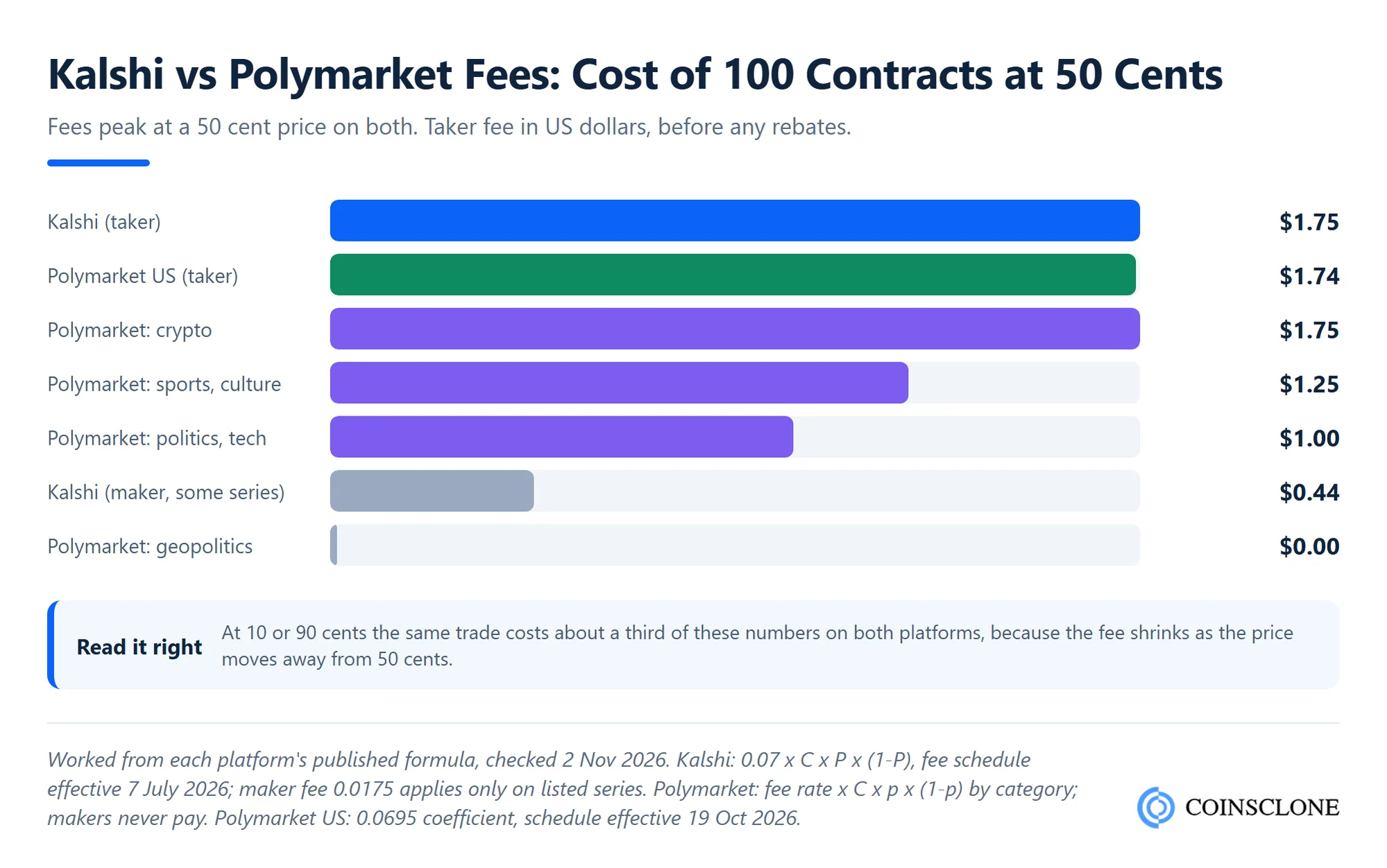
Both platforms charge takers, the traders who hit an order already on the book. Both use the same curve: the fee is biggest when a contract trades at 50 cents and shrinks toward 1 cent and 99 cents. The rates differ.
Kalshi Fees
Kalshi’s fee schedule, effective 7 July 2026, sets the taker fee as:
fee = 0.07 x contracts x price x (1 minus price), rounded up.
So 100 contracts at 50 cents cost $1.75 in fees. At 10 cents the same 100 contracts cost $0.63. Orders that rest on the book pay nothing, except on a list of named series. These cover major sports leagues plus some economic and awards markets. They carry a maker fee of 0.0175 on the same curve, or $0.44 per 100 contracts at 50 cents. A few series pay no fee at all.
Outside trading, Kalshi charges no settlement fee and no fee for ACH deposits or withdrawals. Card deposits carry a fee of up to 2%. Kalshi also pays 3.50% APY on cash and open positions for balances of $250 or more, a variable rate.
Polymarket Fees
Polymarket was fee free for years. It now charges takers a rate set by market type, per its trading fee docs. The formula is the same shape: fee = contracts x rate x price x (1 minus price).
| Market type | Taker rate | Fee on 100 contracts at 50 cents | Share returned to makers |
| Crypto | 0.07 | $1.75 | 20% |
| Sports | 0.05 | $1.25 | 15% |
| Economics, culture, weather, other | 0.05 | $1.25 | 25% |
| Politics, finance, tech, mentions | 0.04 | $1.00 | 25% |
| Geopolitics and world events | 0 | $0.00 | None |
Makers never pay on Polymarket. A share of taker fees flows back to them each day through the maker rebates program. Polymarket charges nothing to deposit or withdraw, though Coinbase or MoonPay may charge their own fee.
Polymarket US Fees
Polymarket US has its own fee schedule, effective 19 October 2026. The taker fee uses a single rate of 0.0695 on the same curve, which works out to $1.74 per 100 contracts at 50 cents. Table tennis markets cost more, at 0.10. Makers get a rebate at the moment of trade, worth $0.09 to $0.26 per 100 contracts at 50 cents, based on their tier. Fees round to the nearest cent.
Kalshi vs Polymarket Fee Example
Say you buy 200 Yes contracts at 30 cents on a sports game, as a taker. The contracts cost $60. If you are right, you get $200.
| Platform | Fee math | Fee | Profit if right |
| Kalshi | 0.07 x 200 x 0.30 x 0.70 | $2.94 | $137.06 |
| Polymarket US | 0.0695 x 200 x 0.30 x 0.70 | $2.92 | $137.08 |
| Polymarket global (sports) | 0.05 x 200 x 0.30 x 0.70 | $2.10 | $137.90 |
| Polymarket global (geopolitics) | 0 | $0.00 | $140.00 |
The gap is small on one trade. For a bot or a market maker trading thousands of times a day, it adds up fast. That is why rebates and fee tiers matter as much as the headline rate.
How Do Settlement and Collateral Differ?
This is the biggest gap between the two, and the one that shapes any platform you build.
How Kalshi Holds and Settles Money
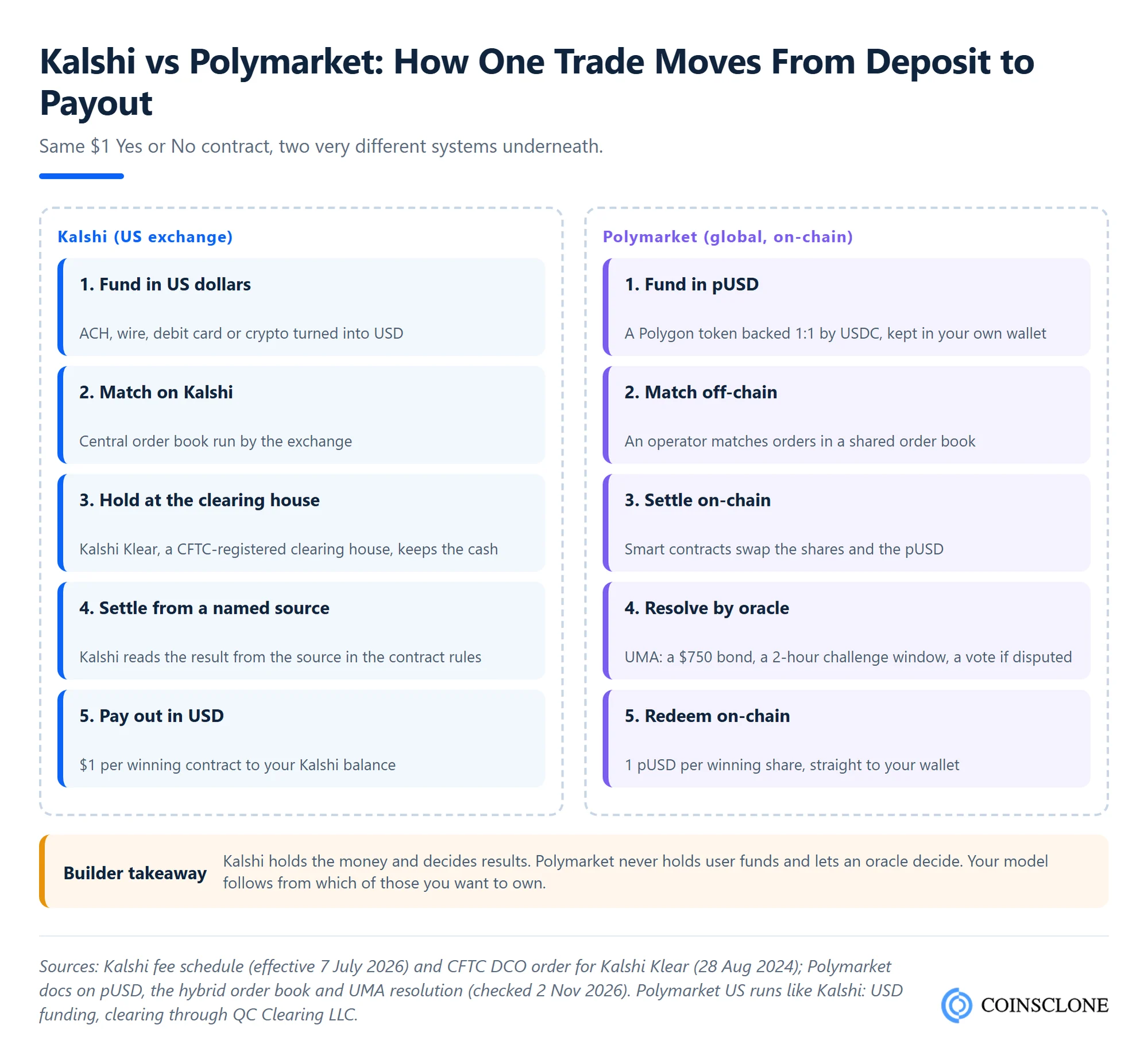
On Kalshi you trade in US dollars. Your cash sits with Kalshi Klear, the clearing house, and every position is fully paid for up front. Kalshi matches orders on its own order book. When the event ends, Kalshi reads the result from the source named in that contract’s rules and pays $1 per winning contract into your balance.
How Polymarket Holds and Settles Money
On the global site you trade in pUSD. Since its exchange upgrade on 28 April 2026, Polymarket has used pUSD as its collateral. It is an ERC-20 token on Polygon, backed 1:1 by USDC, with the backing enforced by a smart contract. It replaced the older USDC.e. Each Yes and No pair is backed by 1 pUSD, so the market is always fully paid for.
Trading runs on a hybrid order book. An operator matches orders off-chain for speed. Smart contracts then settle each matched trade on-chain, so you keep custody until the swap happens.
Results come from the UMA optimistic oracle. Anyone can propose an outcome by posting a bond, usually $750. A 2-hour challenge window follows. If no one disputes, the market resolves. If it is disputed twice, UMA token holders vote, which takes about 48 hours. Short “up or down” price markets use Chainlink data instead.
Where Polymarket US Fits
Polymarket US works like Kalshi. You fund in dollars through card, ACH, Apple Pay, PayPal, Venmo, wire or USDC. Trades clear through Polymarket Clearing, and results follow the exchange’s rules. There is no wallet to set up.
Which Markets Does Each Platform List?
Both list sports, politics, economics, crypto and culture. The mix is what differs.
Kalshi: sports drive most of its trading. On DeFi Rate’s 1 November 2026 snapshot, sports made up about 84% of Kalshi’s daily volume. It also lists economic data such as CPI, jobs and the Fed rate, plus weather, awards and company news. Kalshi now runs perpetual futures too, with a separate account and limits.
Polymarket global: it is known for elections, world news and crypto prices. In the same snapshot, sports made up about 40% of its daily volume. It also lists war and world events markets that a US exchange cannot list under Rule 40.11, and it keeps those fee free.
Polymarket US: its trust page lists elections, world events, financial markets, sports and entertainment.
If your users care about one niche, pick the model that matches it. A sports-first launch looks like Kalshi. A news and crypto launch for a global crowd looks like Polymarket.
Kalshi vs Polymarket Volume and Liquidity
Kalshi is far larger. These are the 30 days to 1 November 2026, per DeFi Rate’s tracker:
| Venue | 30-day volume | Share of all tracked venues | Change vs prior 30 days |
| Kalshi | $97.5 billion | 75.8% | Up 56% |
| Polymarket US | $14.9 billion | 11.6% | Up 62% |
| Polymarket global | $5.2 billion | 4.0% | Up 11% |
Put the two Polymarket products together and Kalshi still traded nearly five times as much. Most of Kalshi’s lead comes from US sports, where it is the biggest venue.
One caution on these numbers. The tracker counts every contract at its $1 face value, the way exchanges report it. The cash that traders actually paid was much lower: $30.0 billion across all tracked venues in the same 30 days, and $21.8 billion on Kalshi, about 22 cents per contract. Use the face value figure to compare venues, not to judge how much money moved.
For a trader, bigger volume means tighter spreads and larger fills on popular markets. On niche markets, depth can be thin on both, so check the order book before you trade in size.
Kalshi API vs Polymarket API
Both platforms offer full APIs, and both are popular with bots and market makers.
Kalshi: a REST API, WebSocket feeds and FIX for large firms. Limits work on a token bucket by tier, with separate budgets for reading data and placing orders. Higher tiers get more speed and up to 1,000 open WebSocket links.
Polymarket global: a CLOB API for orders and order books, plus public endpoints for market data. Orders are signed with your wallet, and trades settle on Polygon, so every fill is public on-chain.
Polymarket US: a separate API. It has a keyed trading API for orders, positions and balances, a public API for markets and sports data, and two WebSocket streams.
For builders, the lesson is plain. A good API brings market makers, and market makers bring liquidity. Plan your API from day one, not as an add-on.
Is Kalshi or Polymarket Better?
Neither wins on every point. It depends on who you are.
- US sports traders: Kalshi. It has the deepest US sports books and pays interest on idle cash.
- US users who want Polymarket’s markets: Polymarket US, if your state allows it.
- Users outside the US: Polymarket global, for self-custody and wide world-news markets. Kalshi is also open in many countries.
- Bots and market makers: both. Kalshi has the volume; Polymarket pays makers a share of fees and charges them nothing.
What Should a Founder Copy From Each Model?
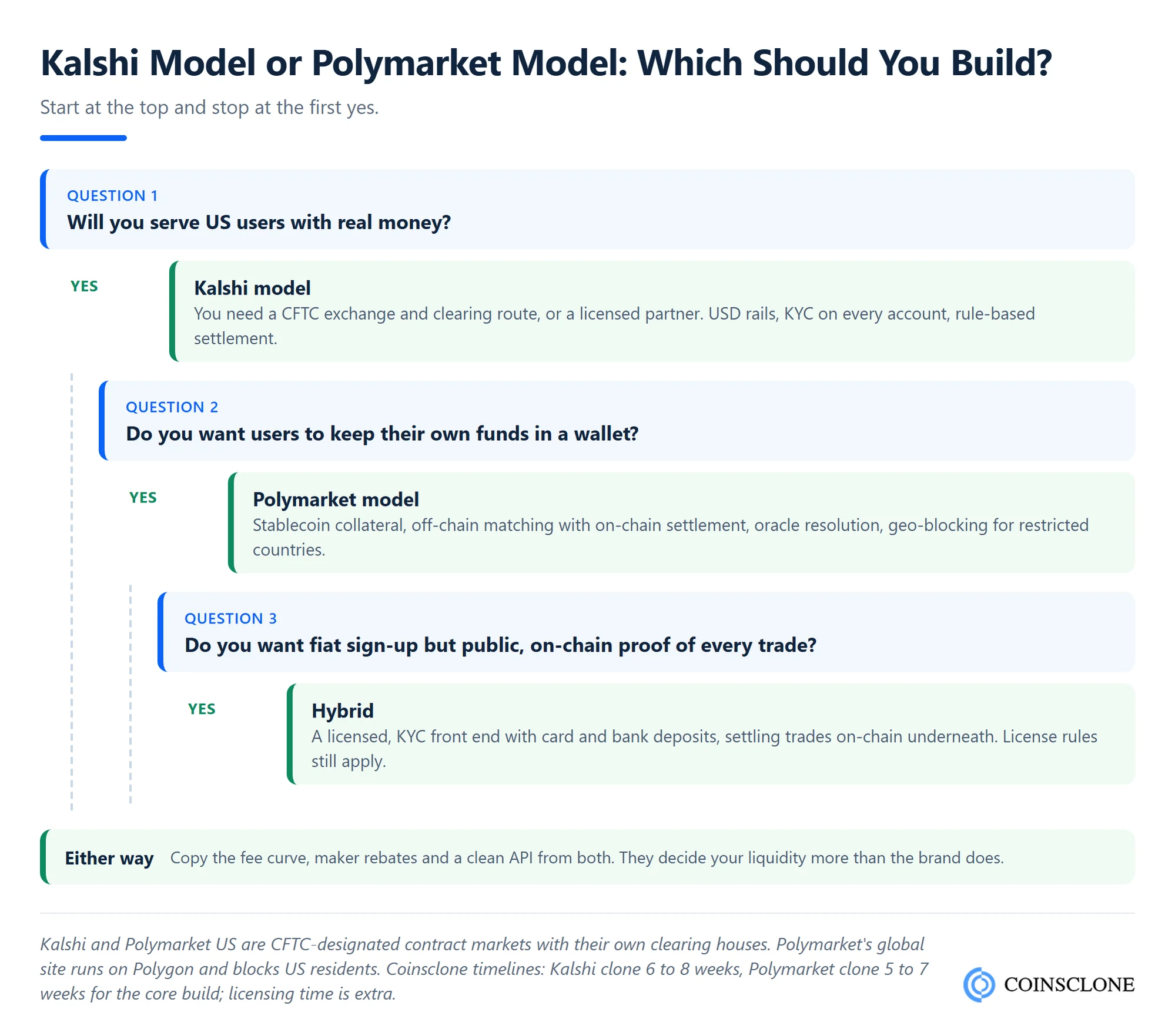
If you plan to launch your own platform, do not pick a brand to copy. Pick the parts that fit your users and your license.
What to Copy From Kalshi
- A clear legal home: a license, KYC on every account and rules for what can be listed. It is slow, but it opens bank rails and big partners.
- Fiat rails: ACH, cards and wires bring in users who will never touch a wallet.
- A held-funds model: a clearing setup that fully backs each position, plus interest on idle cash to keep money on the platform.
- Pro tools: REST, WebSocket and FIX access with tiered limits for market makers.
What to Copy From Polymarket
- Self-custody: users keep their funds, which lowers your custody risk.
- On-chain settlement: every trade is public and provable.
- Oracle results: a bond and challenge window decide outcomes without a team member clicking a button.
- Maker rebates funded by taker fees: a built-in reason for market makers to quote tight prices.
- A fee-free category: a simple way to draw traffic to the markets you want to grow.
How Long Does a Kalshi or Polymarket Clone Take to Build?
Coinsclone’s own timelines are 6 to 8 weeks for a Kalshi clone script and 5 to 7 weeks for a Polymarket clone script. That covers the software. Licensing, banking partners and market maker deals run on their own clock.
Cost depends on a few big choices: custodial or self-custody, fiat rails or crypto only, how you settle results, how many market types you launch with, and how many states or countries you must geo-block. Our guide to prediction market platform development walks through each of these, and our breakdown of how Polymarket makes money shows how fees turn into revenue.
Launch a Prediction Market on the Kalshi or Polymarket Model
Prediction market development, done right.
- Order Book Engine: Fast matching for Yes and No contracts, with maker and taker fee curves you control
- Fiat or On-Chain Funds: USD rails with KYC like Kalshi, or stablecoin wallets with on-chain settlement like Polymarket
- Result Settlement: Rule-based settlement from named sources, or oracle resolution with bonds and a challenge window
- Trading APIs and Admin: REST and WebSocket APIs for market makers, plus tools to list, pause and settle markets
See a live demo of our Kalshi and Polymarket clone scripts.
Book a Free Demo to plan your prediction market launch.
How Coinsclone Helps You Build a Prediction Market
Coinsclone builds prediction market platforms on both models: regulated, fiat-first exchanges like Kalshi and on-chain markets like Polymarket. We build the order book, fee engine, wallets or fiat rails, oracle or rule-based settlement, admin tools and trading APIs. Coinsclone has built crypto products since 2018 and delivered 350+ platforms for 200+ clients across 20 industries. Talk to our prediction market development team to plan the model that fits your market.
Frequently Asked Questions
Is Kalshi or Polymarket better?
Kalshi is better for US users who want dollars, sports markets and a regulated exchange. Polymarket’s global site is better for users outside the US who want crypto, self-custody and world-news markets. US users who like Polymarket can now use the Polymarket US app.
Is Kalshi legal in the US?
Yes. Kalshi has been a CFTC designated contract market since November 2020. Some states still dispute its sports contracts, and as of 30 October 2026 sports markets were blocked in a few states, including Nevada. Check your state before you sign up.
Can you use Polymarket in the US?
Not the global site. Polymarket.com blocks US residents from depositing or trading. Americans use Polymarket US, a separate CFTC-regulated app with its own account, which was not yet live in Nevada as of November 2026.
Why was Polymarket banned in the US?
In January 2022 the CFTC found that Polymarket ran event markets without a license and fined it $1.4 million. Polymarket then blocked US users. It came back in 2025 by buying QCX, a licensed exchange, which now runs as Polymarket US.
Which has better liquidity, Kalshi or Polymarket?
Kalshi, by a wide margin. In the 30 days to 1 November 2026 it traded $97.5 billion, against $14.9 billion on Polymarket US and $5.2 billion on the global site. Polymarket can still be deep on big political and crypto markets.
What blockchain does Polymarket use?
Polymarket runs on Polygon. Since April 2026 it has used pUSD, a Polygon token backed 1:1 by USDC, as the money behind every trade. Kalshi does not settle on a blockchain, though it accepts some crypto deposits.
How do payouts differ on Kalshi and Polymarket?
Both pay $1 for each winning contract and $0 for a losing one. Kalshi pays US dollars into your account after it reads the result from the source in the contract rules. Polymarket pays 1 pUSD per winning share to your wallet once the UMA oracle confirms the outcome.