
Fund tokenization means a fund’s shares are issued and recorded as tokens on a blockchain. The fund keeps its legal form, its manager, its assets and its rules. What changes is the record of who owns what. Shares can also move, settle and be put to work much faster.
This is no longer a test. As of 2 November 2026, tokenized US Treasury and money market funds held $14.21 billion across 85,677 holders, per rwa.xyz’s Treasury tracker. This guide shows how a tokenized fund works and which structure to pick. It then walks through the steps to tokenize a fund of your own.
In this guide:
- The two main models: a native on-chain share register, or a feeder token that sits on top of an existing fund
- Live examples with dated values, from BlackRock BUIDL and Franklin BENJI to venture and credit funds
- The legal wrappers, the transfer agent’s job, and how ERC-3643 compares with ERC-1400
- A step-by-step plan to tokenize a fund, plus what drives the cost and the timeline
What Is Fund Tokenization?
Fund tokenization is the process of issuing a fund’s shares or units as digital tokens. Each token stands for a share, or for a claim on a share. Investors hold the tokens in wallets. Smart contracts then do jobs that back offices now do by hand: they mint new shares, check who may hold them, and pay out.
The fund itself does not change. A tokenized money market fund still buys Treasury bills. A tokenized private credit fund still makes loans. The investor still has the same rights under the fund documents. Tokenization changes the plumbing, not the product.
There are two main ways to do it, plus a lighter third option.
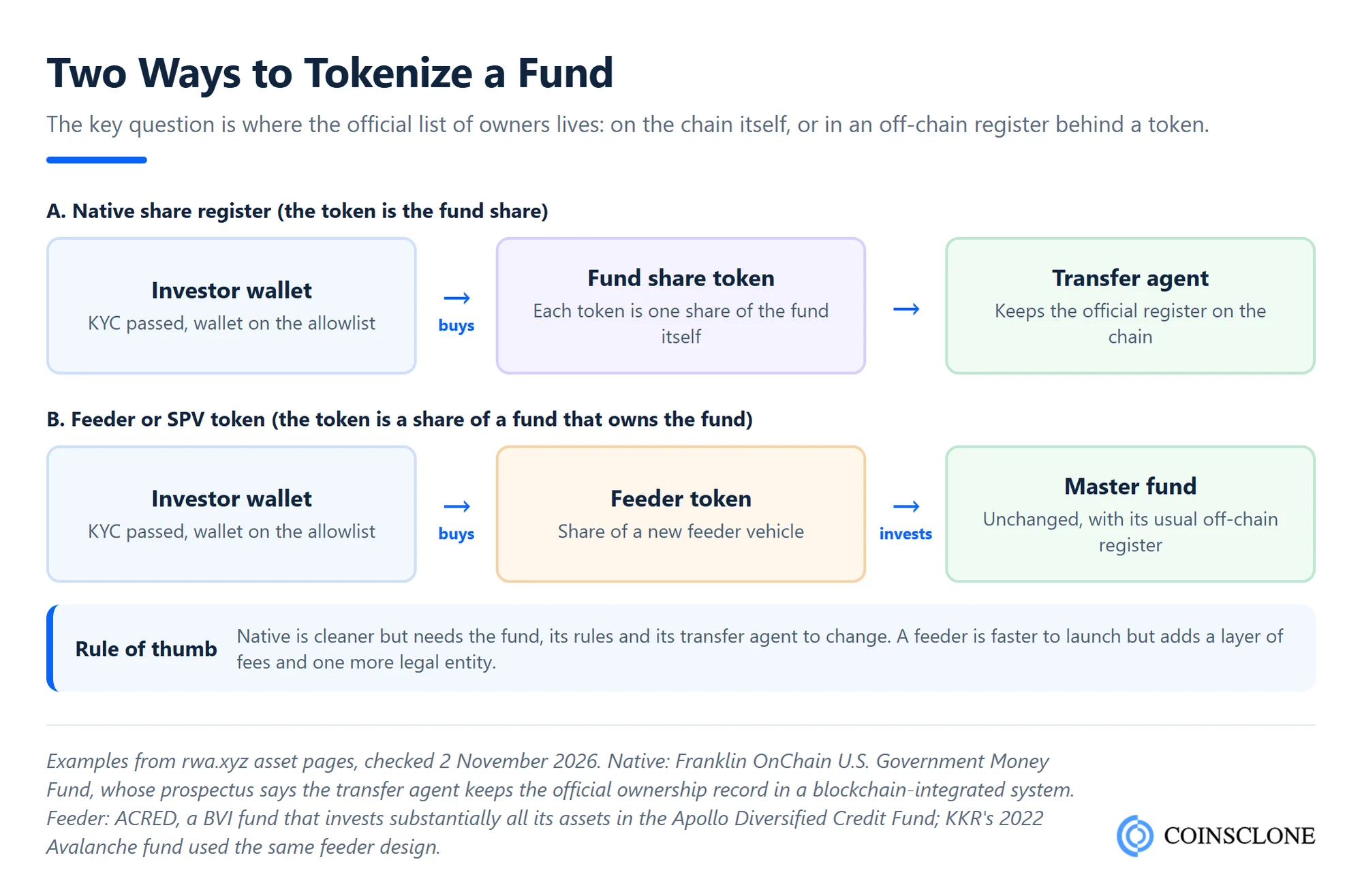
Native On-Chain Register vs Feeder Token
| Model | What the token is | Where the official register lives | Live example |
| Native share register | A share of the fund itself | On the chain, kept by the transfer agent | Franklin OnChain U.S. Government Money Fund (BENJI) |
| Feeder or SPV token | A share of a new vehicle that invests in the fund | Off-chain at the master fund; on-chain at the feeder | Apollo ACRED, KKR’s 2022 Avalanche fund |
| Mirror or twin token | A digital copy of a share held on a normal register | Off-chain; the token tracks it | Used where local law has no on-chain register yet |
Native: Franklin’s fund prospectus says its transfer agent keeps the official record of who owns shares in a system tied to public blockchains. The token is the share.
Feeder: ACRED is a British Virgin Islands fund. It puts almost all its money into the Apollo Diversified Credit Fund. The master fund stays as it is. Only the feeder is tokenized.
A native register gives the cleanest result. But the fund, its documents and its transfer agent must all change. A feeder is faster to launch. But it adds one more legal entity and one more layer of fees.
How Does a Tokenized Fund Work?
A tokenized fund runs the same cycle as any fund: buy in, hold, transfer, sell back. The difference is that each step is a smart contract call. The contract checks the rules before anything moves.
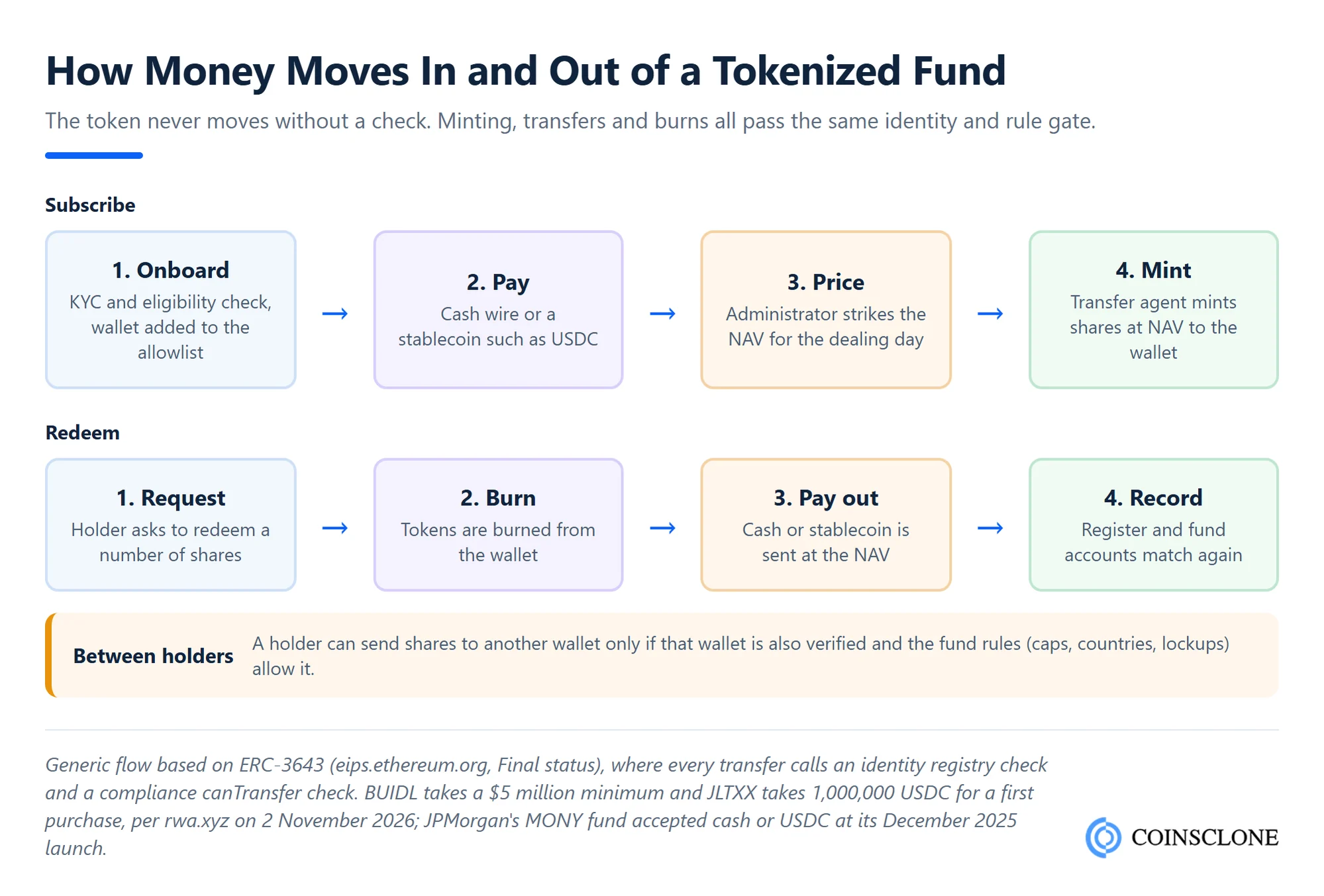
- Sign up: The investor passes KYC and a check that they may invest. Their wallet goes on the fund’s allowlist.
- Buy in: The investor pays in cash or a stablecoin such as USDC. JPMorgan’s MONY fund took both when it launched in late 2025.
- Minting: The administrator strikes the net asset value (NAV). The transfer agent then mints the right number of tokens to the wallet.
- Transfers: Holders can send tokens only to other checked wallets. The fund’s limits must also allow it.
- Income: A smart contract pays income on the dates the fund sets. It pays in new tokens, cash or stablecoins.
- Sell back: Tokens are burned, cash goes back to the holder, and the register updates.
What Is a Tokenized Money Market Fund?
A tokenized money market fund is a regular money market fund whose shares are issued as tokens. It holds short-term government debt and repos. It pays a yield close to T-bill rates, minus fees. The 7-day yield across tokenized Treasury funds was 3.73% on 2 November 2026, per rwa.xyz.
These funds are by far the largest group of tokenized funds. Crypto firms, DAOs and trading desks use them to park cash on chain and still earn a yield. They also work as collateral. In late 2025, Binance let large traders post BUIDL as collateral held off the exchange. Weeks later, CFTC staff guidance said these fund shares can count as margin. The structure must still meet the usual rules.
Does your fund hold T-bills? Our page on tokenized Treasuries development covers that product in depth. It explains yield, payouts and stablecoin rails.
Which Tokenized Funds Are Live in 2026?
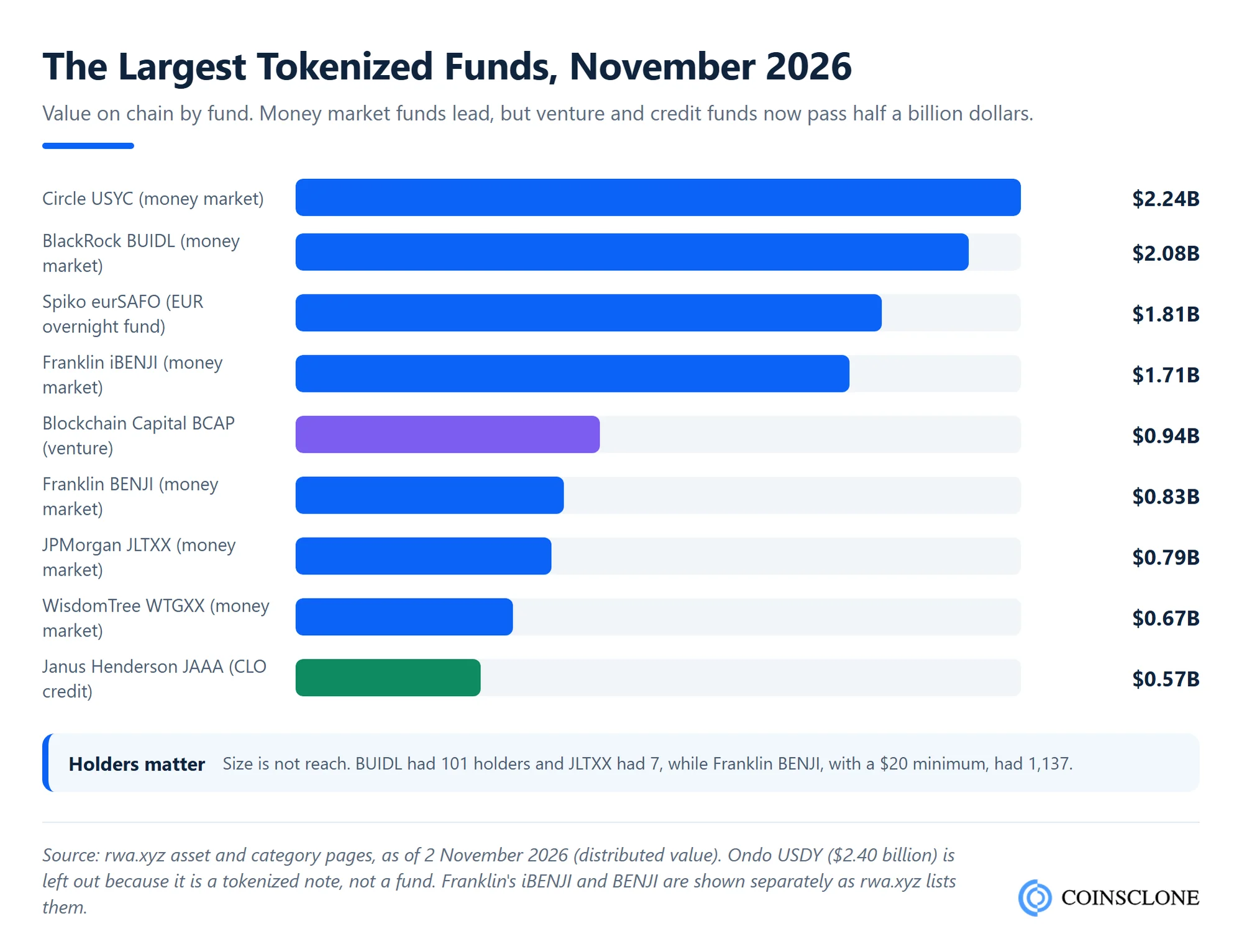
The table below lists real funds across four fund types. All figures come from rwa.xyz asset pages, as of 2 November 2026.
| Fund | Type | Value on chain | Holders | Minimum | Launched |
| BlackRock BUIDL | Money market | $2.08 billion | 101 | $5 million | Mar 2024 |
| Franklin BENJI | Money market | $834 million | 1,137 | $20 | Apr 2021 |
| JPMorgan JLTXX | Money market | $792 million | 7 | 1,000,000 USDC | May 2026 |
| Blockchain Capital BCAP | Venture capital | $940 million | 629 | $20,000 | May 2017 |
| Janus Henderson JAAA | CLO credit | $573 million | 34 | Not listed | May 2025 |
| Apollo ACRED | Private credit (feeder) | $95.6 million | 46 | $50,000 | Jan 2025 |
Two lessons stand out. First, the minimum sets your reach. BENJI asks for $20 and has over ten times as many holders as BUIDL. Second, fees follow the asset, not the token. BUIDL charges 0.20% to 0.50% a year. BCAP still charges a 2.5% fee and a 25% share of gains, as a venture fund would.
What Types of Funds Can Be Tokenized?
Almost any fund can be tokenized. The real question is what the fund gains.
| Fund type | Main gain from tokenization | Watch out for |
| Money market | Cash on chain that earns a yield; use as collateral | Tight price checks; daily NAV feeds |
| Private credit | Wider investor base; automated interest payouts | Loans are hard to value and slow to sell |
| Private equity | Smaller minimums; easier cap table admin | Long lockups limit any real trading |
| Venture capital | Global LP base; cheaper LP admin | Transfers need manager approval |
| Real estate funds | Fractional units; rent payouts on schedule | Property sales take months |
| Hedge funds | Faster subscriptions; live holdings data | Monthly or quarterly redemption limits |
A token can move in seconds. The assets inside a credit or private equity fund cannot. That is why most tokenized funds keep their normal exit terms. They also limit trading to checked buyers.
Which Legal Structure Should a Tokenized Fund Use?
The legal wrapper comes first. The chain comes last. Here is how the main markets treat tokenized funds in 2026.
United States: Tokens are still securities. SEC staff made this plain in a statement on 28 January 2026. It split tokens into two groups: those the issuer makes, and those a third party makes. It gave no new exemption. BUIDL is a private fund sold under Rule 506(c) to large investors. Franklin’s fund is a registered fund under the 1940 Act. It takes a $20 minimum.
United Kingdom: The FCA set its rules in PS26/7 on 30 April 2026. They took effect at once. UK fund managers may now keep the list of unit holders on a blockchain. The FCA also added an optional way for investors to deal with the fund direct.
Luxembourg: A new CSSF FAQ, reported in October 2026, says UCITS and AIFs may issue units straight onto a blockchain. A registrar is still needed. Some funds also need a control agent. That agent must tell the CSSF two months before it starts.
Hong Kong: Since a 2023 SFC circular, funds the SFC has cleared can sell and buy back tokenized units. Firms must talk to the SFC before they launch.
Offshore feeders: Some feeder tokens for US investors use a British Virgin Islands vehicle. ACRED and KKR’s 2022 health care feeder both did.
For more on the security token side of this work, see our page on security token development.
What Does a Transfer Agent Do in a Tokenized Fund?
The transfer agent keeps the official list of who owns the fund. In a tokenized fund, that list lives on the chain or is tied to it. The agent also mints and burns tokens and approves wallets. It handles lost keys, and it moves tokens by force when a court orders it.
Real funds show three set-ups:
- Digital agent: BlackRock named Securitize as transfer agent in its launch release. BNY Mellon holds the assets and runs the books.
- Traditional agent: JPMorgan’s JLTXX lists SS&C as its transfer agent on rwa.xyz.
- In-house agent: Franklin’s own transfer agent keeps BENJI’s official record on its blockchain system.
Whatever you choose, the transfer agent must be able to act on chain. If it cannot freeze a wallet or reissue tokens after a key loss, the fund is not ready.
ERC-3643 vs ERC-1400: Which Token Standard Fits a Fund?
Fund tokens must block transfers to people who may not hold them. Plain ERC-20 cannot do that alone. Two Ethereum standards were built for it.
| Feature | ERC-3643 (T-REX) | ERC-1400 |
| Status | Final ERC | Draft, closed as stale in 2022 |
| Identity | On-chain identity registry linked to each wallet | Left to the issuer |
| Transfer rules | Compliance check runs before every transfer | Transfer checks via ERC-1594 |
| Forced transfer | Yes, by an authorized agent | Yes, via ERC-1644 controller |
| Freeze and recovery | Freeze wallets or part of a balance; recover lost wallets | Not built in |
| Share classes | One token per class | Partitions inside one token (ERC-1410) |
| ERC-20 compatible | Yes | Yes |
ERC-3643 has reached Final status. It covers identity, transfer rules, forced moves, freezes and lost wallets in one standard. That is why many new fund projects start with it. Read more in our guide to ERC-3643 token development.
ERC-1400 is older, from 2018. Its partitions suit funds that need many share classes or lockups inside one token. It never moved past draft. See our ERC-1400 token development guide for when it still makes sense.
Many large funds also use a plain ERC-20 with an allowlist that the transfer agent runs. BCAP, for example, is listed as an ERC-20 token on rwa.xyz.
How to Tokenize a Fund, Step by Step
Here is the order that works. Each step depends on the one before it.
- Set the goal: Do you want lower minimums, new investors, use as collateral, faster trades or cheaper admin? The goal decides the structure.
- Pick the structure: Choose a native share class, a new feeder or SPV, or a mirror token. A new token share class in your current fund is often the fastest native route.
- Update the legal papers: Your fund lawyer confirms the exemption or license you rely on. Then they amend the fund papers (prospectus, PPM or LPA). The new terms cover tokens, wallets, lost keys and transfer limits.
- Hire the service firms: You need a transfer agent that can run an on-chain register. You also need a custodian, an administrator for NAV and a KYC firm. Talk to your regulator early where rules ask for it.
- Choose the chain and token standard: Pick public or private chains based on where your investors are. Then pick ERC-3643, ERC-1400 or an ERC-20 with an allowlist.
- Build the smart contracts and the portal: Code the mint, burn, allowlist, transfer rules, payouts and NAV feeds. Then build the portal where investors sign up, buy, sell back and get reports.
- Audit and test: Get an outside smart contract audit. Run a full test cycle on a test network with real KYC flows and fake money.
- Launch and run: Go live and open the fund to buyers. Then handle daily NAV, income, wallet changes, reports and any trading on approved venues.
Our RWA tokenization platform development page shows how these pieces fit in one platform.
How Much Does Fund Tokenization Cost and How Long Does It Take?
There is no single price. Legal work changes a lot by country and fund type. Here is where the money goes.
| Cost line | What drives it |
| Legal structuring and documents | Country, investor type, new feeder or new share class |
| Token smart contracts | Basic tokens cost $5,000 to $15,000; complex compliance tokens cost $15,000 to $50,000 or more, per published 2026 agency cost guides |
| Investor portal and admin dashboard | Onboarding, wallets, statements, white label or custom |
| Smart contract audit | Code size and number of chains |
| Transfer agent, custodian, administrator | Yearly fees, often based on assets |
| KYC and wallet screening | Cost per investor checked |
| Gas and chain fees | Chain choice; small next to the items above |
For timing, start from the normal launch time. Calastone research from March 2025 found it takes 12 weeks to launch a new fund today. It also put the cost savings from tokens at about $135 billion across UCITS, UK and US funds. Then add the legal and regulator steps for your market, such as the two-month CSSF notice in Luxembourg. The tech build runs alongside the legal work, so it rarely sets the launch date.
What Are the Risks of Tokenized Funds?
- Cash gap: A token can move in seconds, but a loan book or a building cannot be sold that fast. Keep exit terms honest.
- Thin trading: Few holders means few buyers. BUIDL had 101 holders and JLTXX had 7 on 2 November 2026.
- Smart contract risk: A bug can freeze or misprice shares. Audits and upgrade controls matter.
- Third-party tokens: SEC staff warned that tokens made by firms other than the fund can add extra risk if that firm fails.
- Lost keys: Investors lose keys. The fund needs a tested way to restore them that the transfer agent controls.
Launch a Tokenized Fund Your Investors Can Trust
Fund tokenization development, done right.
- Share Tokens: ERC-3643, ERC-1400 or allowlisted ERC-20 tokens for each share class
- Compliance Engine: KYC allowlists, investor caps, country rules, freezes and wallet recovery
- NAV and Payouts: NAV feeds, minting at NAV, income payouts and burns on redemption
- Investor Portal: Sign up, subscriptions in cash or stablecoins, statements and transfer agent dashboard
See a live demo of our fund tokenization platform.
Book a Free Demo to plan your tokenized fund with our team.
How Coinsclone Helps You Tokenize a Fund
Coinsclone builds the tech side of fund tokenization. That means ERC-3643 and ERC-1400 share tokens, allowlist and rule modules, NAV and payout code, investor portals and admin dashboards. We work with your lawyers, transfer agent and custodian, so the code matches your fund papers. Coinsclone has built crypto products since 2018 and delivered 350+ platforms for 200+ clients across 20 industries. To plan your fund, start with our security token development team.
Frequently Asked Questions
What is BlackRock’s tokenized fund?
It is BUIDL, the BlackRock USD Institutional Digital Liquidity Fund. It launched on Ethereum on 20 March 2024 and holds cash, T-bills and repos. It held $2.08 billion across nine networks on 2 November 2026, per rwa.xyz. The minimum is $5 million.
What is the difference between tokenized funds and stablecoins?
A stablecoin aims to hold a fixed $1 value, and the issuer usually keeps the yield on its reserves. A tokenized money market fund passes its yield to holders. But its shares are securities. That means KYC, approved wallets and set times to sell back. Stablecoins move freely; fund tokens move only between checked wallets.
Can tokenized money market funds be used as collateral?
Yes, and this is one of their main uses. Binance began to take BUIDL as collateral held off the exchange in late 2025. Soon after, CFTC staff said these fund shares can serve as margin in US futures and swaps. The structure must still meet the usual rules.
What is a tokenized mutual fund?
It is a registered mutual fund whose shares are recorded on a blockchain. Franklin OnChain U.S. Government Money Fund is the best-known case. It is registered under the 1940 Act and has a $20 minimum. Its transfer agent keeps the official share record on a blockchain system.
Can retail investors buy tokenized funds?
Some, but not most. BUIDL and JLTXX are for large investors, with minimums of $5 million and 1,000,000 USDC. Registered funds such as Franklin BENJI take $20. They are open to retail buyers in the markets where they are sold.
Does the FCA allow fund tokenization in the UK?
Yes. The FCA set its rules in PS26/7 on 30 April 2026. UK fund managers may keep the list of unit holders on a blockchain. The rules took effect at once. They also added an optional way to deal with the fund direct.
Why are tokenized funds set up in Luxembourg?
Luxembourg law lets funds keep their records on blockchains, and its regulator now gives clear rules. The October 2026 CSSF FAQ says UCITS and AIFs can issue units straight onto a blockchain. It also sets out the roles of the registrar and the control agent.