

Creating a crypto payment gateway is not just about adding a wallet or a Bitcoin button at checkout. The real work is in the choices behind it: the custody model, the blockchains, the compliance setup and how merchants get paid. Get those right and the gateway scales. Get them wrong and it quietly breaks six months after launch.
The timing is good. Stablecoins such as USDC and USDT have become the go-to coins for crypto payments, the US passed the GENIUS Act to regulate payment stablecoins in July 2025, and large payment companies such as Stripe and Shopify have added stablecoin payments. Merchants are asking for crypto checkout, and many regions still lack a local provider.
This guide is for founders and businesses who want a clear, practical plan. It covers how a gateway works, the six steps to build one, costs and timelines, revenue models and the mistakes to avoid.
See How Our MVP System Can Launch Your Crypto Payment Gateway Faster
Crypto Payment Gateway Development — done right.
- MVP System : Build and launch your gateway 90% faster.
- Multi-Currency Support : Accept 100+ cryptos with zero manual setup.
- Merchant Dashboard : Full control over payments, invoices, and settlements.
- Security & Compliance : PCI-DSS level security and KYC-ready architecture.
Get a free branded demo of your payment gateway in just 48 hours — before you invest a cent.
Book a Free Demo to discover how our Crypto Payment Gateway Script can take you from concept to live gateway in just 8 to 12 weeks.
What Is a Cryptocurrency Payment Gateway?
A cryptocurrency payment gateway is a payment system that lets merchants accept crypto from customers. It sits between the buyer, the merchant and the blockchain. It creates an invoice, watches the blockchain for the payment, tells the merchant when it arrives, and settles the money in crypto, stablecoins or local currency.
Unlike card processors, a crypto gateway does not rely on card networks to move money. Payments settle on the blockchain, which means lower fees for many transfers, no chargebacks, and access for customers anywhere in the world.
Modern gateways come with a merchant dashboard, APIs and plugins, and support for Bitcoin, Ethereum and stablecoins across several networks.
Why Build a Crypto Payment Gateway? (The Business Case)
- Global reach: customers can pay from anywhere, without card or banking limits.
- Recurring revenue: every payment earns a small percentage or flat fee, so income grows with merchant volume.
- Stablecoin demand: merchants want to accept USDC and USDT without price risk, and clear stablecoin rules in the US and EU make that easier.
- First-mover advantage: in regions with weak banking or few providers, a local gateway can lead the market.
- Room to expand: a gateway is the base for wallets, exchanges, payouts, lending and subscription billing.
How Does a Crypto Payment Gateway Work?
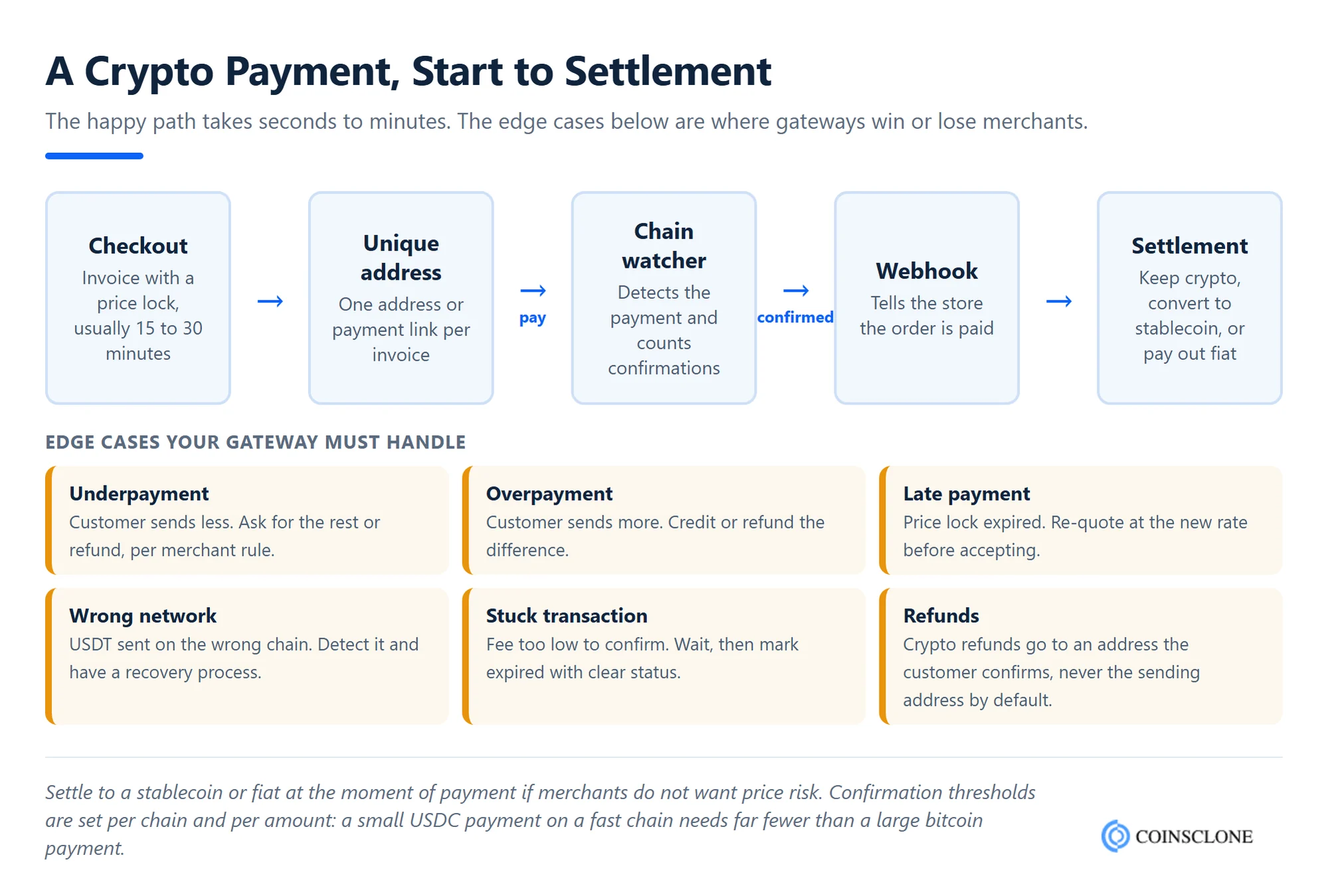
A crypto payment gateway links the customer’s wallet to the merchant’s account and checks every payment on the blockchain. Here is the typical flow:
- Checkout: the customer picks a coin, and the gateway creates an invoice with a locked price for a short time.
- Payment address: the gateway shows a unique address or QR code for that invoice.
- Blockchain check: the gateway watches the network until the payment has enough confirmations.
- Merchant alert: a webhook tells the store the order is paid, and the dashboard updates.
- Settlement: the merchant keeps the crypto, converts it to a stablecoin, or receives local currency.
How to Create a Cryptocurrency Payment Gateway in 6 Steps
- Choose your gateway model
- Plan for regulation and banking
- Design the core architecture
- Build the key features
- Test thoroughly
- Launch in stages
Step 1: Choose Your Crypto Payment Gateway Model
The first decision is who holds the funds. It shapes your features, licences and risk.
| Aspect | Custodial gateway | Non-custodial gateway |
| Who holds the keys | The gateway holds merchant funds | Funds go straight to the merchant’s own wallet |
| Settlement options | Crypto, stablecoin or fiat, with batched payouts | Mostly crypto, paid directly |
| Compliance scope | Heavier: licences, KYB, AML and monitoring | Lighter, but still depends on your market |
| Merchant experience | Easiest: no wallet skills needed | Merchants must manage their own wallets |
| Your risk | You guard the funds | You never touch the funds |
Many gateways offer both: non-custodial for crypto-native merchants, and custodial with fiat payouts for everyone else. Choosing early lets you plan your compliance and growth.
Step 2: Plan for Regulation and Banking
Compliance is the backbone of a payment business. A gateway that holds funds or pays out fiat usually needs a licence as a payment or crypto service provider in each market, plus KYB checks on merchants and AML screening on payments.
Get legal and banking advice for each target market early. Crypto-friendly banks and payment partners are needed for fiat on-ramps, off-ramps and payouts, and onboarding them is often the longest step in the whole project. Without reliable banking, even a well-built gateway struggles to pay merchants on time.
Step 3: Design the Core Architecture
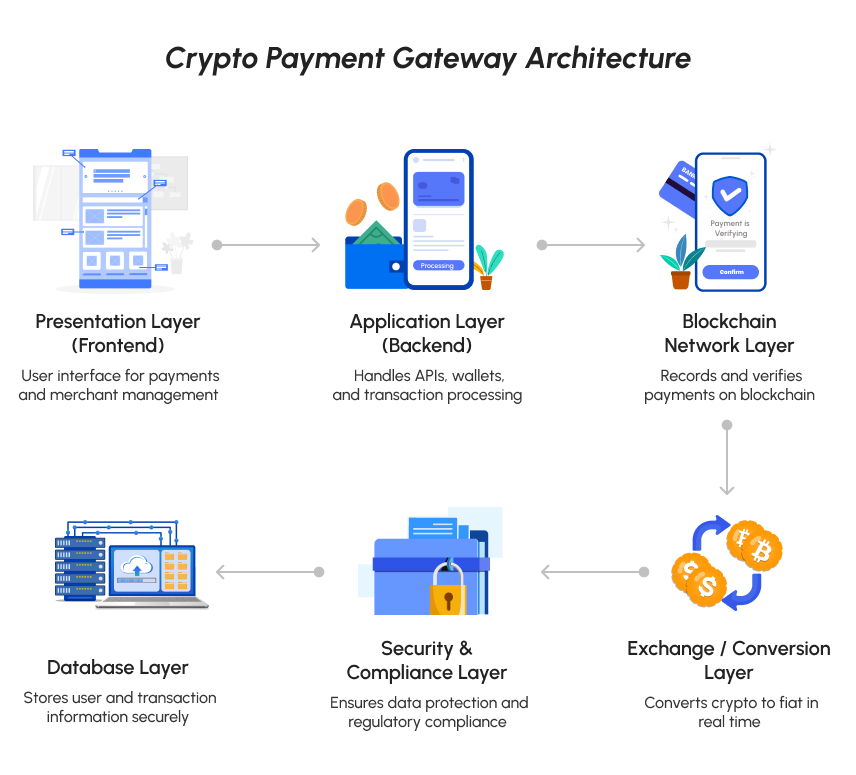
A good architecture keeps the gateway fast, available and secure, and makes it easy to add new chains later. The main layers are:
- Blockchain integration: connects to each network through nodes or node providers.
- Wallet management: creates deposit addresses, stores keys securely and moves funds to cold storage.
- Payment engine: matches payments to invoices, counts confirmations and handles edge cases.
- Security and compliance: protects funds and data, screens addresses and flags risky activity.
- API and merchant layer: connects websites, apps, POS systems and e-commerce platforms.
Keep the design modular. It is the only way to add chains, meet new rules and grow without rebuilding the core.
Recommended Tech Stack
| Layer | Technology | Purpose |
| Frontend | React.js / Vue.js | Merchant dashboard and checkout pages |
| Backend | Node.js / Go / Python | Core logic, APIs and payment processing |
| Smart contracts | Solidity (EVM) / Rust (Solana) | Optional on-chain payment logic |
| Blockchain libraries | ethers.js / viem / bitcoinjs | Addresses and blockchain interaction |
| Database | PostgreSQL | Invoices, payments and ledgers |
| Authentication | JWT / 2FA / API keys | User and merchant access control |
| KYC/KYB and AML | Sumsub / Jumio / Onfido, plus address screening | Identity checks and compliance |
Which Blockchains to Support First
Start with the networks your merchants’ customers already use. For most gateways that means USDT and USDC on low-fee networks such as TRON, Solana, BNB Chain, Base, Polygon and Arbitrum, plus Bitcoin and Ethereum. Add more only when merchants ask, because every chain adds nodes, monitoring and support work.
Step 4: Build the Key Features
Many startups overbuild at launch and confuse merchants. Focus on the core first:
- Wallet handling: multi-currency support, hot and cold wallets, and address management.
- Payment confirmation: automatic detection and confirmation rules per chain.
- Merchant dashboard: payments, settlements, refunds and reports in real time.
- Webhooks: instant payment alerts for smooth order processing.
- Payment links and invoices: for merchants without a website.
- Security controls: strong login, encryption and monitoring.
Add these once the core is stable:
- Plugins: ready-made integrations for Shopify, WooCommerce and other platforms.
- POS checkout: QR-based payments in physical stores.
- Auto-conversion: instant conversion to stablecoins or fiat.
- Mass payouts: pay suppliers or staff in crypto.
- Advanced analytics: deeper insight into payments and performance.
Step 5: Test Thoroughly
Testing proves the gateway works under real conditions.
- Functional testing: every feature works across devices, browsers and APIs.
- Security testing: penetration tests against hacking, phishing and unauthorised access.
- Load testing: the gateway handles peak volumes without delays.
- Blockchain testing: payments are detected, confirmed and settled correctly on every chain, including every edge case in the diagram above.
- Webhook testing: stores receive every alert, even after network failures and retries.
- Compliance testing: KYB, AML and monitoring flows work and are logged.
Step 6: Launch in Stages
Launch is a process, not a switch.
- Beta: onboard a small group of merchants and watch real payments closely.
- 24/7 monitoring: track wallets, servers, payment anomalies and system health from day one.
- Support: have a support team and an incident plan ready before you go public.
- Compliance sign-off: make sure licences, banking and legal documents are in place before full launch.
How Much Does It Cost, and How Long Does It Take?
Cost and timeline depend mainly on scope: how many chains you support, whether you settle in fiat, the compliance your markets require, and the plugins you need. Coinsclone’s published timelines are:
| Scope | Typical timeline | What it includes |
| Standard gateway | 6 to 9 weeks | Checkout, core assets, webhooks and dashboard |
| Gateway with settlement | 10 to 14 weeks | Conversion, batched payouts, reconciliation and plugins |
| Gateway with fiat rails | 4 to 7 months | Banking integration, fiat payouts and full compliance |
| Multi-region gateway | 7 to 11 months | Several regions, currencies and institutional merchants |
Fiat rails take longest because banking and payment partner onboarding cannot be rushed. For a fixed quote, share your scope with our team.
How Does a Crypto Payment Gateway Make Money?
- Transaction fees: a percentage of each payment, commonly around 0.5% to 1% among well-known providers.
- Conversion spread: a small margin when converting crypto to stablecoins or fiat.
- Payout fees: fees on withdrawals and mass payouts.
- Subscriptions: monthly plans for high-volume merchants with lower per-payment fees.
- Premium features: plugins, POS, advanced analytics and API limits.
Compare what leading providers offer in our list of the top crypto payment gateways.
Critical Mistakes to Avoid
Knowing how to create a crypto payment gateway is only half the job. Knowing what not to do is the other half.
Overbuilding Features
- Mistake: launching with too many features confuses merchants and delays launch.
- Solution: start with reliable confirmations, webhooks, a clear dashboard and simple onboarding.
Ignoring Settlement
- Mistake: underestimating price swings, liquidity, tax reporting and banking leads to late payouts and messy accounts.
- Solution: offer instant stablecoin or fiat conversion, and plan liquidity and reconciliation from the start.
Weak Monitoring and Risk Controls
- Mistake: poor monitoring lets fraud and errors slip through and damages trust.
- Solution: track payments in real time, screen addresses, and flag suspicious activity automatically.
Not Handling Edge Cases
- Mistake: treating every payment as perfect. Real customers underpay, overpay, pay late and use the wrong network.
- Solution: build clear rules and customer messages for each case, as shown in the payment flow diagram.
Misunderstanding Merchants
- Mistake: assuming merchants understand wallets, gas fees, confirmations and volatility.
- Solution: offer guides, simple settings and fiat payouts, so merchants never have to become crypto experts.
Build Your Crypto Payment Gateway With Coinsclone
Coinsclone is a trusted crypto payment gateway development company that has delivered more than 350 blockchain platforms for over 200 clients.
We build gateways that are compliance-ready, modular and able to handle real merchant volume from day one. Whether you choose a custom build or a faster route with a CoinPayments clone script, we deliver a tested, audited platform with support after launch.
- Fully customisable design, features and branding
- Multi-currency and multi-blockchain support, with stablecoins built in
- KYB, KYC and AML tools built in from the start
- Plugins, payment links and merchant APIs
- A dedicated support team after launch
Ready to start? Talk to our team and get a free demo of your crypto payment gateway.
See How Our MVP System Can Launch Your Crypto Payment Gateway Faster
Crypto Payment Gateway Development — done right.
- MVP System : Build and launch your gateway 90% faster.
- Multi-Currency Support : Accept 100+ cryptos with zero manual setup.
- Merchant Dashboard : Full control over payments, invoices, and settlements.
- Security & Compliance : PCI-DSS level security and KYC-ready architecture.
Get a free branded demo of your payment gateway in just 48 hours — before you invest a cent.
Book a Free Demo to discover how our Crypto Payment Gateway Script can take you from concept to live gateway in just 8 to 12 weeks.
Frequently Asked Questions
What is crypto payment gateway development?
It is the process of building a platform that lets merchants accept cryptocurrency payments. It covers blockchain integration, wallet management, compliance, a merchant dashboard and APIs, all working together to process payments securely.
How much does it cost to create a crypto payment gateway?
It depends on scope: the number of chains, fiat settlement, compliance and plugins. A standard gateway is a much smaller project than one with fiat rails in several regions. Share your scope with a development team for a fixed quote.
How long does it take to build a crypto payment gateway?
A standard gateway takes about 6 to 9 weeks. Adding settlement and plugins takes 10 to 14 weeks, a gateway with fiat rails 4 to 7 months, and a multi-region gateway 7 to 11 months.
Which cryptocurrencies should a payment gateway support?
Start with USDT and USDC on low-fee networks, plus Bitcoin and Ethereum. Stablecoins are the most popular choice for payments because they hold a steady value.
How does a crypto payment gateway make money?
Through transaction fees, conversion spreads, payout fees, merchant subscriptions and premium features such as plugins and POS.
Is it legal to start a crypto payment gateway business?
Yes, in most countries, but the rules vary. Gateways that hold funds or pay out fiat usually need a licence as a payment or crypto service provider, plus KYB and AML checks. Always get legal advice for each market.
What are the main challenges in building a crypto payment gateway?
The biggest challenges are licences in each market, banking partners for fiat payouts, price volatility, payment edge cases, and a team that understands both blockchain and payments.