
IEO development services help you raise money by selling your token on a crypto exchange, instead of on your own website. The exchange checks your project, runs KYC on buyers, holds the sale and lists your token for trading right after. If you already run an exchange, the same services can add an IEO module so you can host token sales for other projects and earn from each one.
This guide explains what an initial exchange offering is, how the sale works step by step, and how it compares with an ICO, an IDO and an STO. You will also see which exchanges still run token sales in 2026, what an IEO really costs, the rules that apply now, and how Coinsclone builds both the token side and the exchange side.
In this guide:
- What IEO development services include, for a project and for an exchange owner.
- How an IEO sale moves money and tokens, in one diagram.
- Where IEOs happen in 2026, with real results from Coinbase, Binance and Kraken.
- What an IEO costs, from listing deposits to audits, and how long the build takes.
- The SEC and MiCA rules that shape an IEO today.
See How Our MVP System Can Launch Your IEO Faster
IEO Development — done right.
- MVP System: Launch your Exchange-Based Token Offering 90% faster.
- Exchange Integration: Seamless launchpad setup on trusted crypto exchanges.
- Smart Contracts: Fully audited and customizable for secure fundraising.
- Branding & Customization: Your project, your token, your exchange presence.
- Investor Management: Automated token distribution, analytics, and KYC modules.
Get a free branded demo of your IEO platform in just 48 hours — before you invest a cent.
Book a Free Demo to discover how our IEO Development Services can take you from idea to live token launch in just 2–4 weeks.
IEO Development Services: What They Cover
An initial exchange offering (IEO) is a token sale that a crypto exchange runs for a project, on its own platform, for its own checked users. The project gets the exchange’s buyers and a listing. The buyers get a project the exchange has vetted. IEO development services are the build and launch work that makes this happen.
There are two kinds of buyers for these services, and they need different things.
| You are | What you need built | Typical deliverables |
| A project raising funds | A token and launch kit that passes an exchange’s review | Tokenomics, white paper, audited token contract, vesting, data room, listing support |
| An exchange owner | An IEO module (launchpad) inside your exchange | Project onboarding, KYC rules, subscription engine, allocation, token distribution, spot listing hook |
Coinsclone works on both sides. Projects come to us for the token, the vesting contracts and the papers an exchange asks for. Exchange owners come to us for the crypto launchpad development module that lets them host IEOs and earn from every sale.
Before you build, every IEO needs a few basics in place:
- A real business model: the token must have a job in your product.
- A token: usually ERC-20 or BEP-20, with clear supply and vesting.
- A strong technical team: exchanges check who is behind the project.
- A working product or MVP: most exchanges now want live users, not only a plan.
- Security tools: an audited contract and safe key storage.
- Investors and a community: exchanges look for real demand before they say yes.
What Is an Initial Exchange Offering?
In our physical world, many currencies exist, but money is still the core of every deal. In the digital world, cryptocurrencies play that role, and new projects need ways to raise them. ICOs (initial coin offerings), IEOs (initial exchange offerings) and STOs (security token offerings) are the three classic routes for startups and investors.
An IEO is a token sale held inside a crypto exchange. It grew out of the ICO boom of 2017 and 2018, when many projects sold tokens from their own sites and some turned out to be scams. Binance made the model popular in January 2019, when Binance Launchpad ran a token sale for BitTorrent. Since the exchange puts its name on the sale, buyers trust it more than an unknown website.
Trust is not the same as safety, though. The SEC’s investor alert on initial exchange offerings warns that many of these platforms are not registered in the US, and that there is no such thing as an SEC-approved IEO. So a good IEO still needs sound legal work, not just an exchange partner.
How Does an IEO Work?
An IEO is a token sale run on a crypto exchange. Buyers do not deal with the project’s smart contract. Instead, they log in to their exchange account, pass KYC, and commit funds they already hold there, such as BNB, USDT or USDC. When the sale ends, the exchange shares out the tokens and opens trading.
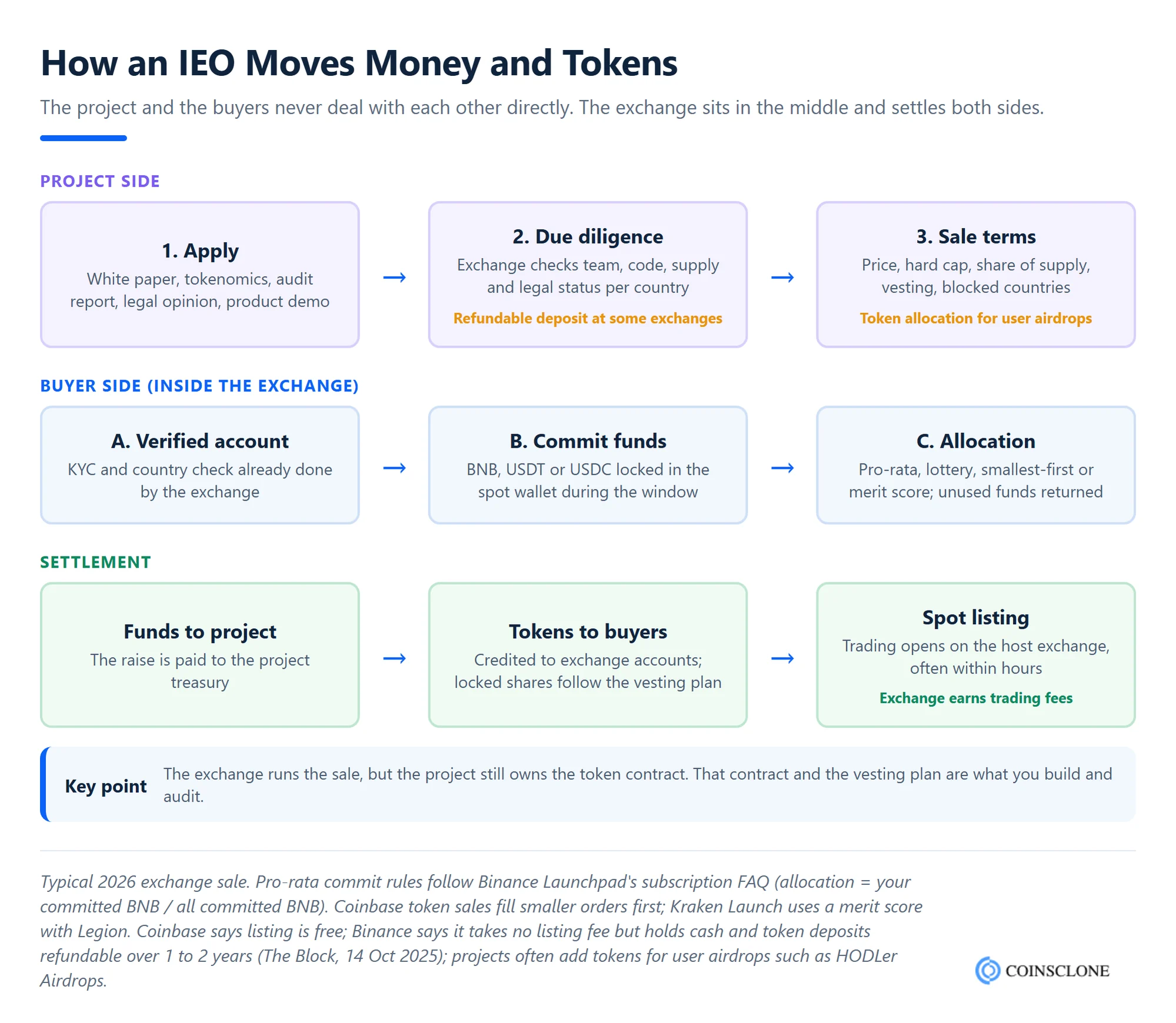
Here is the path from start to finish:
- The project applies: it sends the white paper, tokenomics, team details, audit report and legal opinion to the exchange’s launchpad team.
- The exchange checks it: due diligence covers the team, the code, the token supply and the legal status in each country.
- The sale terms are set: price, hard cap, the share of supply on offer, vesting and the countries that are blocked.
- Users commit funds: checked users pledge funds during the sale window. On Binance Launchpad, for example, users commit BNB and get tokens in proportion to their share of all BNB committed, as its subscription rules explain.
- Tokens are shared out: the exchange deducts the funds, sends tokens to buyers and pays the raise to the project.
- Trading opens: the token lists on the exchange’s spot market, often within hours of the sale closing.
In simple terms, think of a team with a strong idea for a game but no reach to find backers. The exchange brings the backers and the trust. If the game grows over time, both the team and the early buyers gain.
IEO vs ICO vs IDO vs STO
The main difference between these models is who hosts the sale and who checks it. Here is how they compare.
| Point | IEO | ICO | IDO | STO |
| Where the sale runs | A centralized exchange | The project’s own site | A DEX launchpad | A licensed platform or broker |
| Who checks buyers | The exchange | The project | Often no one, or the launchpad | Licensed firms, by law |
| Who runs the contract | The exchange | The project | The launchpad contract | The issuer and transfer agent |
| Listing after the sale | Instant, on the host exchange | Must be won later | Instant, in a DEX pool | On a licensed venue, after lock-ups |
| Best for | Projects with a working product and traction | Teams with their own big community | DeFi projects with on-chain users | Shares, bonds and real assets |
If an ICO fits you better, our guide on how to start an ICO walks through it. The four sections below explain where the IEO model differs most from an ICO.
Fundraising Environment
In an ICO, the project runs investor and admin dashboards on its own site. An IEO moves the whole sale into the exchange. As a result, buyers use an account they already trust, and the project skips most of the sale website work.
Project and Investor Screening
Exchanges check projects and buyers against set rules before a sale goes live. This screening adds trust and makes the sale safer. It can also cut the project’s own compliance costs, because the exchange takes on much of the review.
Smart Contract Management
In an ICO, the project runs and secures the sale contract. In an IEO, the exchange handles the sale itself inside its own system. The project still owns the token contract, so it must still be audited.
KYC and AML Checks
In an ICO, the project must check every buyer for KYC (know your customer) and AML (anti-money laundering). In an IEO, the exchange does this with the checks it already runs on its users. This saves time and money and makes the whole sale more secure.
Where IEOs Happen in 2026
The IEO market looks very different from the 2019 boom. Classic “buy at a fixed price” exchange sales are now rarer, and exchanges mix sales with farming, airdrops and merit scores. These are the main venues in 2026:
- Binance: classic Launchpad sales are now rare. Most new tokens come through Launchpool, HODLer Airdrops and Binance Wallet token events, where Alpha Points decide who joins.
- Coinbase token sales: opened to US buyers in November 2025. Its first sale, for Monad, offered MON at $0.025 for a $187.5 million allocation and drew $269 million in bids from about 86,000 buyers, as The Block reported. Coinbase fills smaller orders first.
- Kraken Launch: built with Legion and live since September 2025. Its Squid sale, from 30 June to 3 July 2026, offered 5% of supply for USDC pledges, with a merit system that rewards real users, per Kraken Launch.
- KuCoin Spotlight: pro-rata, lottery or snapshot sales for KCS, USDT or USDC holders, with long country block lists.
- Bybit Launchpad: lottery and pro-rata entries based on MNT or USDT balances. Its rules were refreshed in December 2025.
The venue you pick matters a lot. The chart below shows how tokens from each venue traded by the end of 2025.
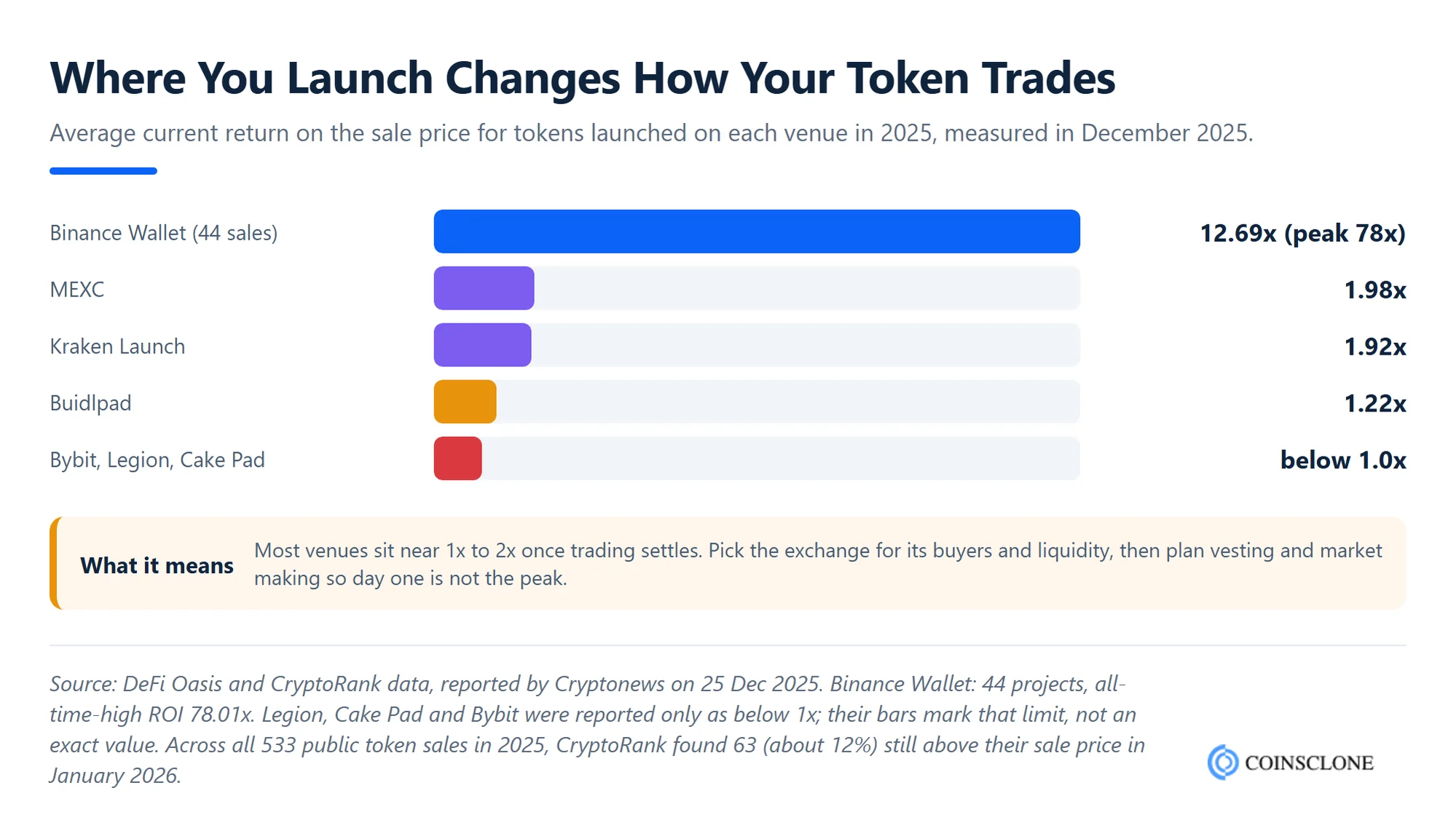
The wider lesson is sobering. CryptoRank counted 533 public token sales in 2025, and only 63 of them, about 12%, still traded above their sale price in January 2026. A strong exchange gets you buyers on day one. Long-term value still depends on your product, your vesting and your liquidity plan.
How Much Does an IEO Cost?
An IEO has four main cost lines: listing, build, audit and launch support. The total depends on the exchange tier and how much you build.
- Listing and sale fees: top exchanges say they do not charge listing fees. Coinbase states that listing on Coinbase is free. Binance also says it takes no listing fee, but it asks for cash and token deposits that are refundable over one to two years, per The Block. Many projects also set aside tokens for Binance user rewards such as HODLer Airdrops. Smaller exchanges often charge a fixed fee or a share of the raise.
- Token allocation: many sales now come with a slice of supply for Launchpool rewards, airdrops or trading campaigns. Plan for it in your tokenomics from day one.
- Build: published 2026 agency cost guides start IEO technical packages at about $20,000 for a token, vesting and launch kit. An exchange-side IEO module is a bigger build: the same guides put a white label launchpad at roughly $20,000 to $50,000 and a custom one at about $100,000 to $300,000.
- Audit: the 2026 audit pricing reference from Sherlock puts mid-size DeFi code at $40,000 to $100,000. A simple token with vesting costs much less.
- Legal and market making: legal opinions for each target market, plus a market maker to keep the order book healthy after listing.
The exact cost can only be set after a close look at your token, your target exchange and your markets. Coinsclone scopes this with you before any build starts.
IEO Rules in 2026
Rules depend on where you sell and who buys. Here are the key points for the two biggest markets:
- United States: the SEC warns that most IEO platforms are not registered and that a token sale can still be a securities offering. On 18 August 2026, the SEC proposed Regulation Crypto Assets. It would let startups raise up to $5 million over four years, and up to $75 million a year with more disclosure. It is still a proposal, with comments open until 20 October 2026. This is why most global exchange sales block US buyers, while Coinbase and Kraken run US-facing sales with their own legal checks.
- European Union: under MiCA, a project that offers tokens to the public or seeks a listing must publish a MiCA white paper, unless an exemption applies. An exchange that “places” tokens for a project offers a regulated service and needs a CASP licence. The transitional period for older firms ended on 1 July 2026.
- Everywhere: plan for KYC and AML checks, country blocks, clear sale terms and honest marketing.
This section is a general guide, not legal advice. Always work with a lawyer in each country where you sell.
Benefits of IEO Development
- Trust: the exchange vets the project, so buyers feel safer than with an unknown ICO site.
- Built-in buyers: the exchange brings millions of checked users, so you do not need to find each investor yourself.
- Instant liquidity: the token lists on the exchange right after the sale, so buyers can trade at once.
- Less admin: the exchange handles KYC, AML and the sale process, which cuts your compliance work.
- Fewer scams: since the exchange screens each project, low-effort scam tokens rarely get through.
- New income for exchanges: an exchange that hosts IEOs earns from token allocations, new users and extra trading volume.
Risks and Limits of an IEO
An IEO is not right for every project. Weigh these points before you apply:
- Hard to get in: top exchanges accept few projects and want a live product, real users and a clean audit.
- Less control: the exchange sets much of the sale format, timing, blocked countries and allocation rules.
- Price swings after listing: many tokens pop on day one and then fall. Only about 12% of 2025 sales stayed above their sale price.
- Hidden costs: deposits, airdrop allocations and market making can add up, even with no listing fee.
- One-venue risk: if the host exchange has problems, your token’s main market suffers with it.
How Can Coinsclone Assist You?
Whether you plan to raise funds for a new token or add a revenue stream to your trading platform, Coinsclone can help. We have delivered 350+ platforms for 200+ clients across 20 industries since 2018, and we build both sides of an IEO.
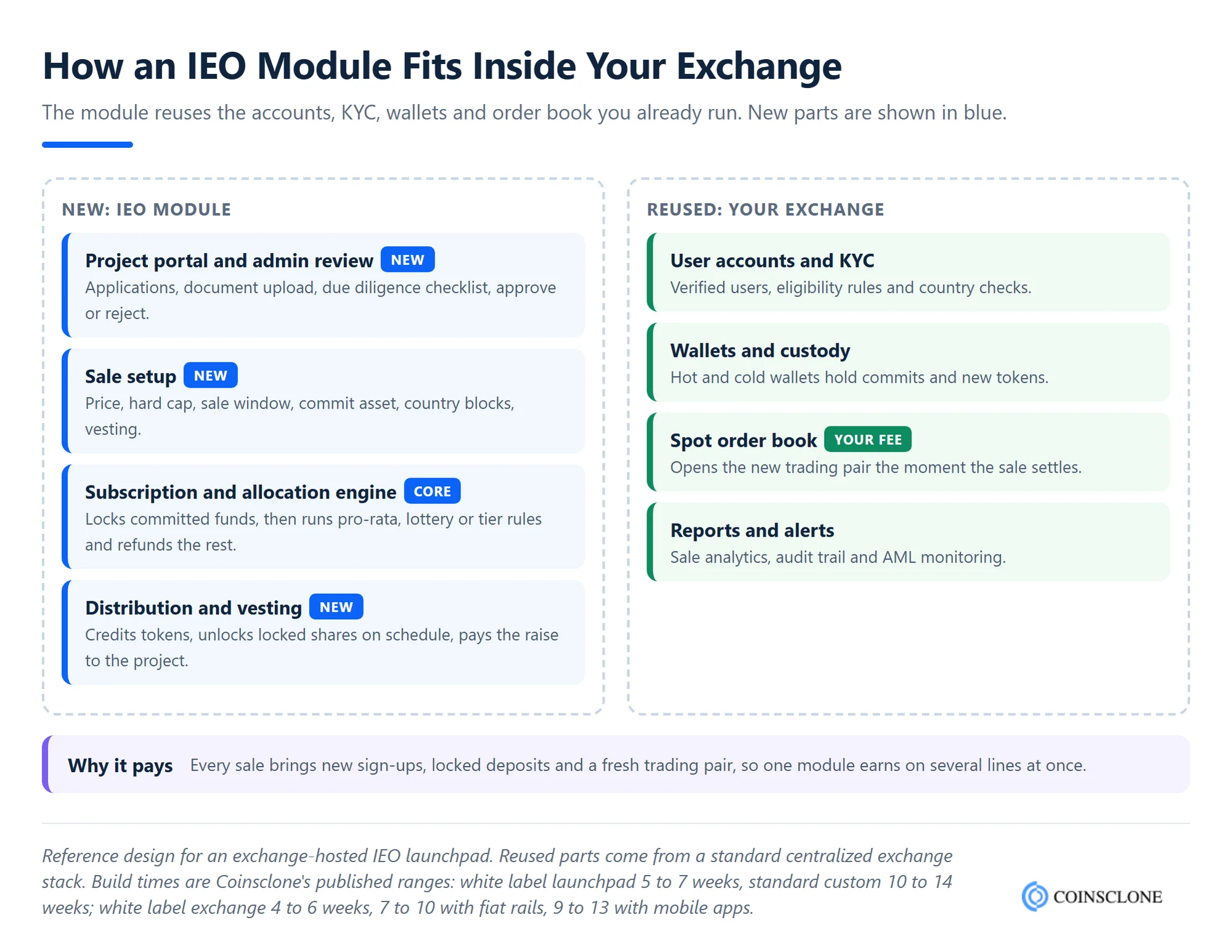
If you already run a crypto exchange, our IEO module plugs into it and adds a new income stream from every sale you host. If you are starting a new trading platform, our white label crypto exchange software comes with a built-in IEO module from day one. And if you are a project, we build the audited token and the launch kit that exchanges ask for.
Process of Our Initial Exchange Offering Development
Launching an IEO is a safe and clear way to raise funds while you build trust with investors. The process follows a set path, and each step below prepares you for the next one.
1. White Paper Creation
The first step is a close study of your project, followed by a clear white paper. This paper explains your business to investors and to the exchange’s review team. Our team plans a short content strategy that shows what your project does, why the token matters and how funds will be used. For EU sales, we shape it to the MiCA white paper format.
2. Tokenomics and Vesting Design
Next, we set the total supply, the share for the sale, the team, investors and the exchange, and the unlock schedule. Exchanges look hard at this, because a low float with large unlocks often leads to sharp price drops.
3. Token Creation
At the heart of every IEO is a token built for your project. Our team builds tokens on Ethereum, BNB Chain, Solana, Base and other chains through our crypto token development service. We write the token and vesting contracts, test them and send them to an independent audit.
4. Exchange Due Diligence Support
We prepare the data room an exchange asks for: the audit report, legal opinion, team details, token flow and product demo. A complete pack shortens the review and raises your chance of a yes.
5. Listing Tokens
Our team has worked with many crypto exchanges, so we know what each one looks for. We help you prepare and submit your listing, so investors can buy and trade your token once the sale ends. This step widens your reach across the crypto community.
6. Post-Launch Support
After the listing, we help with token claims, vesting unlocks, wallet support and links to market makers. A calm first month matters as much as the sale day.
How Long Does IEO Development Take?
Build time depends on which side you are on and how much you build. These are Coinsclone’s own timelines:
| What you build | Typical build time |
| White label launchpad (IEO module) | 5 to 7 weeks |
| Standard custom launchpad | 10 to 14 weeks |
| White label exchange with IEO module | 4 to 6 weeks, 7 to 10 with fiat rails, 9 to 13 with mobile apps |
For a project, the token and contracts take a few weeks. The audit, legal review and the exchange’s own checks usually take longer than the code, so start those early. If you plan a DEX-based sale as well, our IDO development team can build that track too.
Kickstart Your Fundraising Journey: Build and Launch Your IEO Today
In today’s fast-moving market, timing and trust make all the difference. An IEO can give your project both, by linking you with checked investors and a ready market. With the right partner, you are not just running a sale. You are setting up a launchpad for growth, trust and global reach.
Whether you are a startup or an exchange owner, Coinsclone builds the token, the contracts and the IEO module you need, and supports you well past launch day. Talk to our team to scope your IEO.
Frequently Asked Questions
What is an IEO in crypto?
An IEO, or initial exchange offering, is a token sale that a crypto exchange runs for a project on its own platform. The exchange checks the project, runs KYC on buyers, holds the sale and lists the token for trading right after.
How does an IEO work?
The project applies to an exchange, which checks the team, code and legal status. Then the exchange sets the sale terms, its checked users commit funds such as BNB or USDT, tokens are shared out pro-rata or by lottery, and spot trading opens.
How much does it cost to launch an IEO?
Top exchanges such as Coinbase and Binance say they charge no listing fee, but Binance asks for refundable deposits, and many projects set aside tokens for user airdrops. On top of that, plan for the token build, which starts around $20,000, an audit, legal advice and market making.
How is an IEO different from an ICO?
An ICO runs on the project’s own website, and the project handles buyers, KYC and the sale contract. An IEO runs on an exchange, which checks the project and buyers, runs the sale and lists the token at once.
Can US users join IEO launchpads?
Usually not on the largest global exchange launchpads, which block US buyers. Coinbase token sales and Kraken Launch are the main exchange-run sales open to US users in 2026.
Do IEO tokens list right after the sale?
Yes, in most cases. Exchange-run sales usually list the token on the host exchange’s spot market shortly after the sale closes, often within hours.
How long does IEO development take?
A white label IEO module takes 5 to 7 weeks with Coinsclone, and a standard custom launchpad takes 10 to 14 weeks. For a project, the audit and the exchange review usually take longer than building the token.
How do you keep an IEO platform safe?
Use audited token and vesting contracts, strong KYC and AML checks, cold storage for raised funds, rate limits and bot checks on the sale, and clear country blocks. Test the platform under heavy load before the first sale.
See How Our MVP System Can Launch Your IEO Faster
IEO Development — done right.
- MVP System: Launch your Exchange-Based Token Offering 90% faster.
- Exchange Integration: Seamless launchpad setup on trusted crypto exchanges.
- Smart Contracts: Fully audited and customizable for secure fundraising.
- Branding & Customization: Your project, your token, your exchange presence.
- Investor Management: Automated token distribution, analytics, and KYC modules.
Get a free branded demo of your IEO platform in just 48 hours — before you invest a cent.
Book a Free Demo to discover how our IEO Development Services can take you from idea to live token launch in just 2–4 weeks.