
Rollups are no longer a scaling experiment. Over 95 percent of on-chain activity now happens on Layer 2, and combined rollup value locked passed 30 billion dollars in the first quarter of 2026. That maturity has produced a different problem: deploying your own chain became so cheap that many teams did it without a reason, and most of those chains emptied within weeks of their token event. This guide covers the real differences between rollup families in 2026, what a rollup-as-a-service deployment actually commits you to, and the question that should come first, which is whether you need your own chain at all.
Which Rollup Service Is Best for Your Blockchain Project?
No rollup service is best in the abstract. The right one is decided by where your users and liquidity already sit, how fast withdrawals need to clear, and how closely your code depends on exact Ethereum behavior. Once those three are answered, the field narrows to one or two options on its own.
Start from this summary, then read the sections that apply to you:
- Deploying an application, not a chain? Use an existing rollup. Arbitrum, Base and OP Mainnet hold the largest installed user base and the deepest liquidity.
- Need withdrawals in minutes? Choose a ZK rollup. Optimistic challenge windows are still measured in days.
- Depend on exact EVM behavior and mature debugging? Optimistic stacks still have the edge on equivalence and tooling depth.
- Need a custom gas token or guaranteed blockspace? That is the case for launching your own rollup, and close to the only one.
- Already inside an L2 ecosystem? A Layer 3 gives isolation without leaving the ecosystem you already sell into.
The honest headline is that for most teams the best rollup service is the one you do not deploy, because the application rather than the chain is the differentiator.
Optimistic vs ZK Rollups: What Is the Difference in 2026?
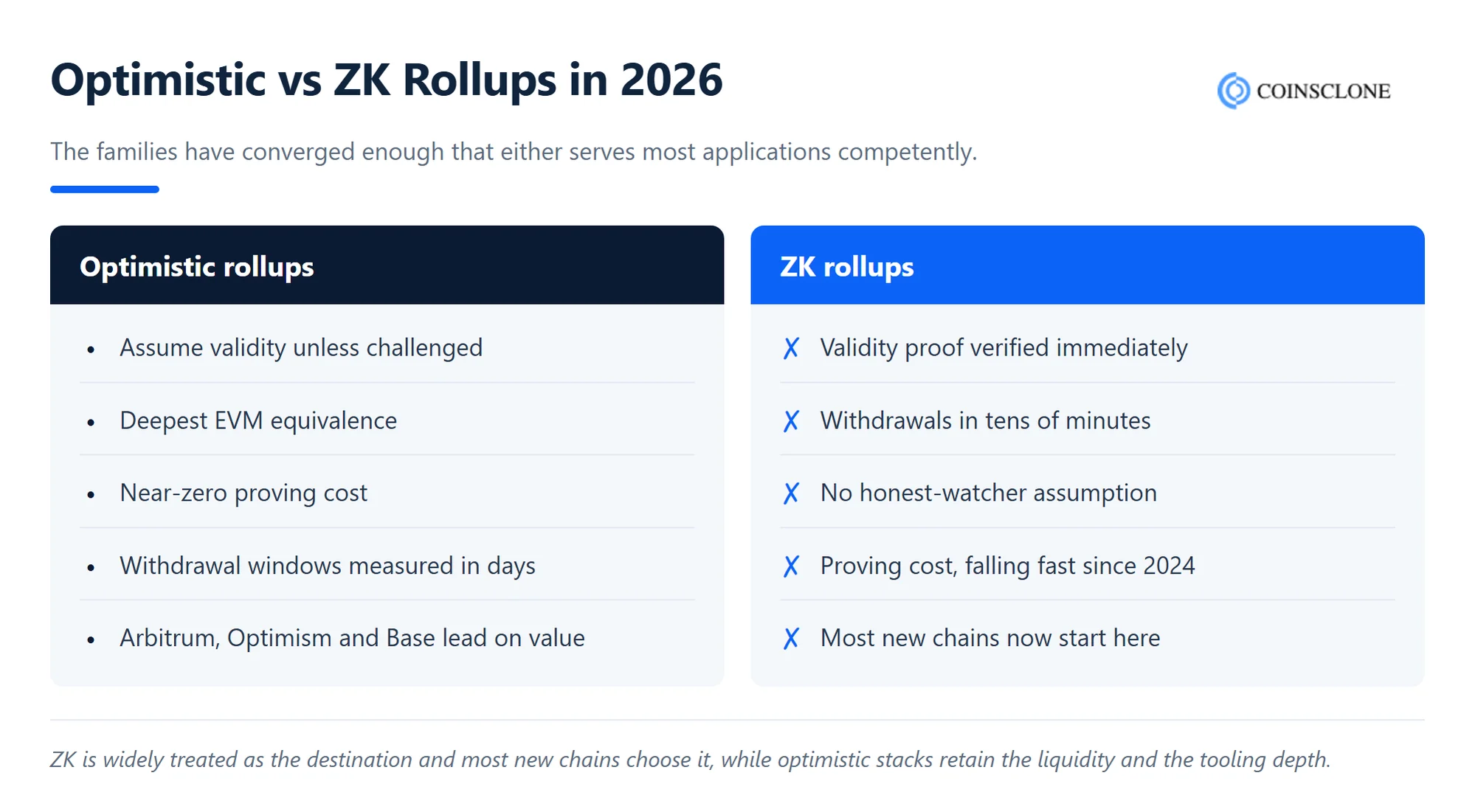
Optimistic rollups execute transactions off-chain, post results to Ethereum, and assume validity unless challenged. Arbitrum, Optimism and Base still settle the majority of Layer 2 value. Their advantages are the deepest EVM equivalence, since they run nearly unmodified Ethereum clients, and near-zero proving cost because there is no prover, only fraud-proof machinery that activates when challenged. The cost is withdrawal latency: challenge windows remain measured in days, with seven days standard and Base operating a shorter window.
ZK rollups attach a cryptographic validity proof to every batch, which Ethereum verifies immediately. That gives fast finality and withdrawals typically completing in tens of minutes rather than days, and a stronger long-term security story because there is no assumption that an honest watcher is present. Proving cost was historically the barrier, and specialized hardware and optimized GPU clusters have reduced it dramatically since 2024.
The 2026 position: ZK is widely treated as the destination, most new chains choose it, and optimistic stacks are themselves moving toward proof-based systems. Optimistic chains retain the liquidity and the tooling depth.
Best Rollup as a Service Providers in 2026
Rollup-as-a-service providers all deliver the same core outcome, a running chain with a sequencer, bridge contracts and endpoints. They differ in which execution framework they are built around and how much of the stack they operate for you.
- Conduit is closely associated with OP Stack and Arbitrum Orbit deployments and is a common choice for teams that want a managed sequencer without adopting a new framework.
- Caldera supports multiple frameworks and markets heavily on speed to a running testnet.
- AltLayer focuses on ephemeral and restaked rollups, which suits bursty workloads rather than permanent chains.
- Gelato RaaS bundles deployment with the off-chain automation, oracles and relayers most applications end up needing anyway.
- Zeeve and Alchemy both target teams that want the surrounding infrastructure, node management and monitoring included rather than assembled.
Compare them on the operational questions rather than the marketing: who runs the sequencer, what happens if it fails, whether you can migrate the chain elsewhere later, and what the bridge has been audited against.
OP Stack vs Arbitrum Orbit vs ZK Stack vs Polygon CDK
The execution framework decides your tooling, your ecosystem and who can easily build on top of you. Four dominate.
- OP Stack. The most widely deployed, behind Base and the wider Superchain. Strong EVM equivalence, a large pool of engineers who already know it, and a shared ecosystem story.
- Arbitrum Orbit. Built on the Nitro stack, with strong performance, Stylus support for non-Solidity languages, and the option to settle to Arbitrum rather than to Ethereum directly.
- ZK Stack. The framework behind zkSync, aimed at teams that want validity proofs and fast finality from the start rather than as a later migration.
- Polygon CDK. ZK-based, designed around shared liquidity between chains built on it.
Frameworks are not neutral. Choosing one places you inside its ecosystem, its bridging assumptions and its shared tooling, and that placement usually matters more than the technical differences between them.
What Does Rollup as a Service Actually Include?
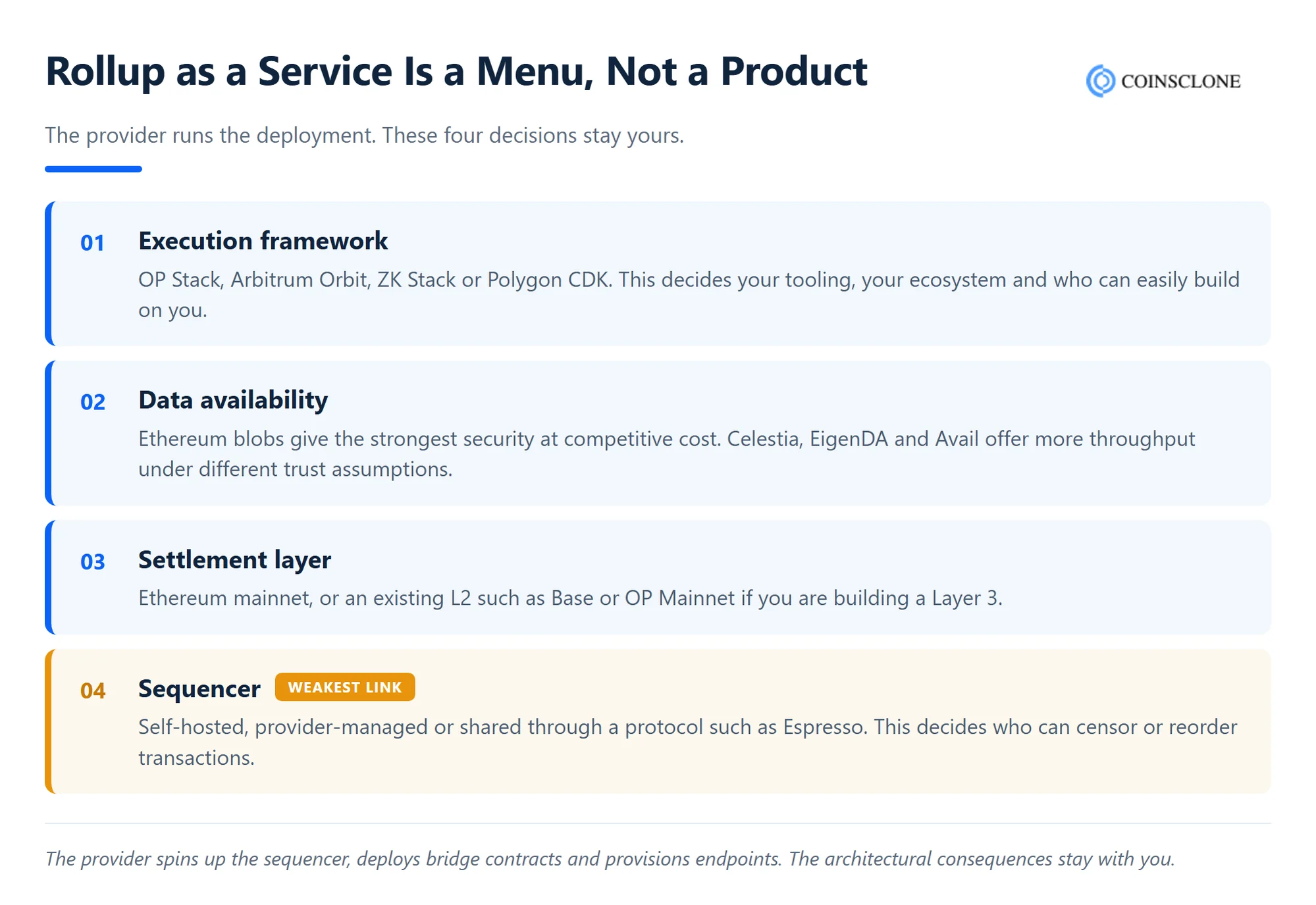
Providers make deployment simple, but four decisions remain yours and each has consequences.
Execution framework. OP Stack, Arbitrum Orbit, ZK Stack or Polygon CDK. This determines your tooling, your ecosystem and who can easily build on you.
Data availability. Ethereum blobs give the strongest security and, since the introduction of blob transactions, competitive cost. Alternatives such as Celestia, EigenDA and Avail offer higher throughput with different trust assumptions.
Settlement layer. Ethereum mainnet, or an existing L2 such as Base or OP Mainnet if you are building a Layer 3.
Sequencer. Self-hosted, provider-managed, or shared through a protocol such as Espresso. This decides who can censor or reorder transactions.
The provider spins up the sequencer, deploys bridge contracts, configures data availability and provisions endpoints. The architectural consequences stay with you.
How Much Does It Cost to Launch a Rollup?
Deployment is the cheap part. Managed testnet deployments often start in the low thousands of dollars per month, and a mainnet chain with a managed sequencer commonly runs from several thousand dollars per month upward depending on throughput and support level. Verify current pricing directly with providers, because it moves and most publish by quote rather than by rate card.
The costs teams underestimate are the ones that continue after launch.
- Data availability. Publishing to Ethereum blobs is the secure default and now competitively priced, but an alternative layer changes both cost and trust assumptions.
- Proving. ZK chains pay for proof generation, whether on your own hardware or through a proving service.
- Bridge and contract audits. The bridge holds user funds, so this is not the place to economize.
- Liquidity bootstrapping. Usually the largest line item, and the one with no technical fix.
- Ongoing operations. Monitoring, incident response and upgrades do not stop.
A chain with no users costs money every month regardless. That is the real argument for deploying on an existing rollup first.
Should You Launch Your Own Rollup at All?
This is the question most teams skip, and the honest answer for most applications is no.
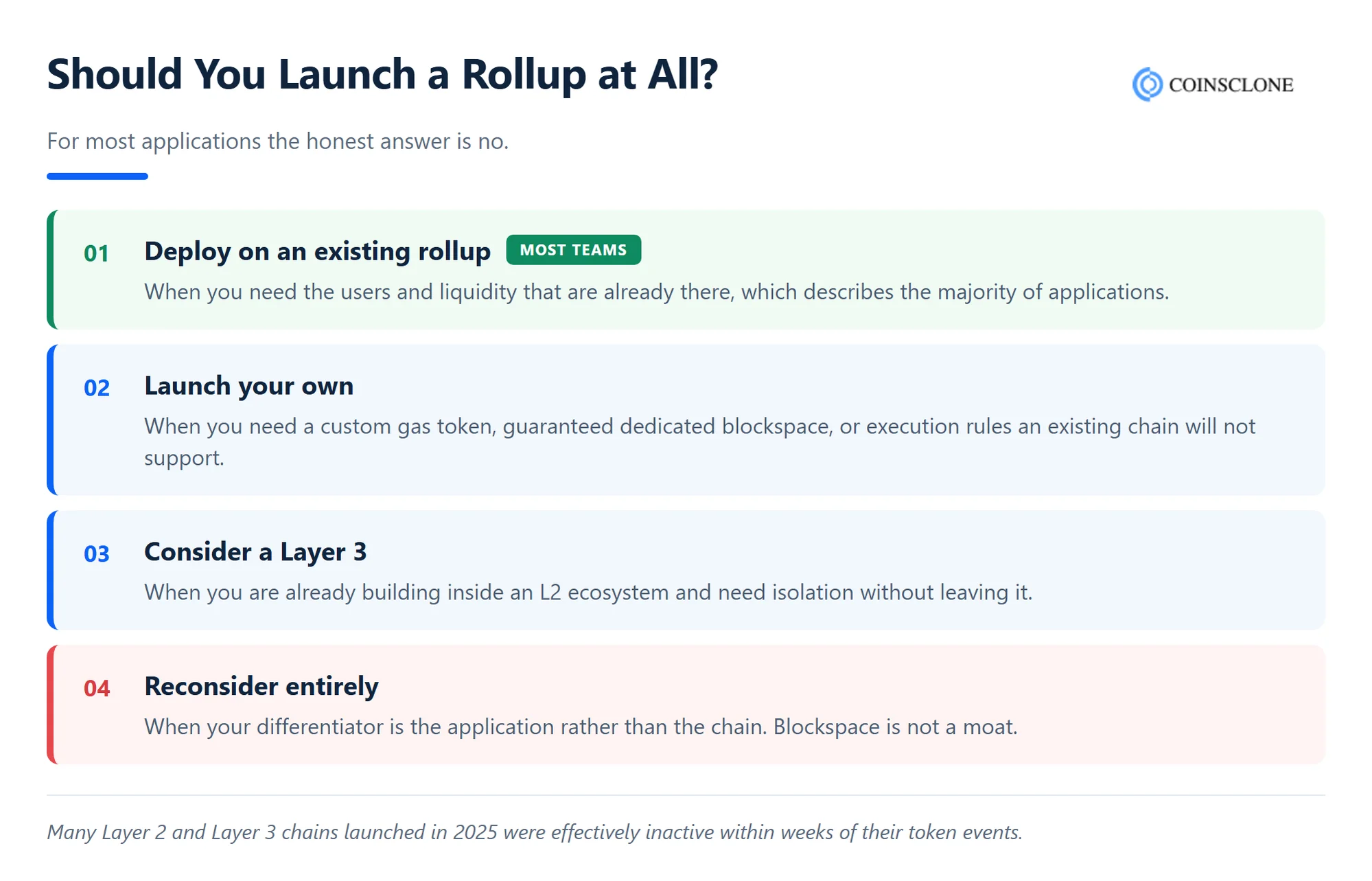
Cheap deployment created an oversupply of blockspace. The pattern that followed became predictable: launch a chain, incentivize usage with points, attract mercenary capital, hold a token event, then watch users and liquidity leave. Many Layer 2 and Layer 3 chains launched in 2025 were effectively inactive within weeks.
Deploy on an existing rollup when you need the users and liquidity that are already there, which describes most applications.
Launch your own when you need a custom gas token, guaranteed dedicated blockspace, or execution rules an existing chain will not support.
Consider a Layer 3 when you are already building inside an L2 ecosystem and need isolation without leaving it.
Reconsider entirely when your differentiator is the application rather than the chain. Blockspace is not a moat.
Who Runs the Sequencer, and Why It Matters
Almost every production rollup today runs a single sequencer, and most are operated by the chain’s own team or its provider. That is the weakest link in the decentralization story and the thing worth interrogating before you commit.
Three questions settle it.
- Who can censor or reorder? A single sequencer can do both. Decide whether that is acceptable for your application, and say so publicly rather than implying otherwise.
- What is the escape hatch? A forced-inclusion mechanism lets users submit transactions directly to the settlement layer if the sequencer stops or censors. Confirm it exists and has been tested, not just documented.
- What happens on failure? If the sequencer goes down, does the chain halt, and for how long? Ask for the incident history rather than the design intent.
Shared sequencing protocols such as Espresso offer an alternative, trading some control for stronger neutrality and cross-chain composability.
Six Questions That Decide Which Rollup You Choose
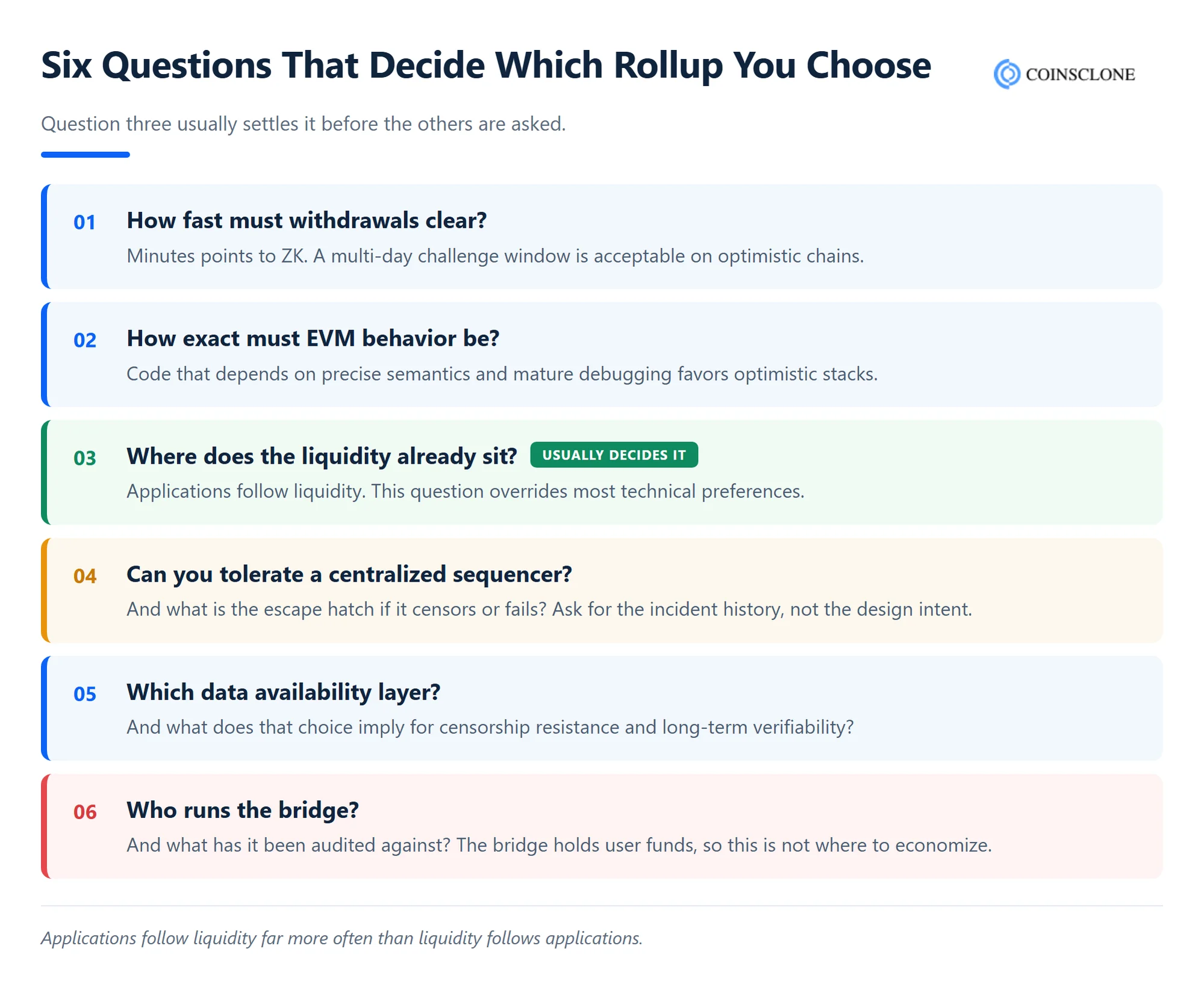
Do users need withdrawals in minutes, or is a multi-day window acceptable? Does your code depend on exact EVM behavior and mature debugging tooling? Where does the liquidity your application needs already sit? Can you tolerate a centralized sequencer, and what is the escape hatch if it censors or fails? Which data availability layer, and what does that imply for long-term verifiability? And who runs the bridge, and what has it been audited against?
Question three usually settles it. Applications follow liquidity far more often than liquidity follows applications.
Conclusion
Rollup selection in 2026 is less a technical comparison than a distribution decision. The families have converged enough that either can serve most applications competently, and the differences that remain, withdrawal latency, EVM fidelity, proving cost and data availability assumptions, matter in specific rather than general ways. Start by deciding whether you need a chain at all, then follow the users and liquidity, then check the sequencer and bridge assumptions before committing.
Coinsclone builds enterprise-grade Web3 platforms including crypto exchanges, wallets, DEXs, NFT marketplaces, payment gateways and RWA tokenization, using customizable white-label clone scripts. Talk to our blockchain experts for a free consultation and live demo.
Frequently Asked Questions
What is the difference between optimistic and ZK rollups?
Optimistic rollups assume transactions are valid and rely on fraud proofs during a challenge window, which remains measured in days. ZK rollups attach a cryptographic validity proof to each batch that Ethereum verifies immediately, giving withdrawals in tens of minutes. Optimistic rollups have deeper EVM equivalence; ZK rollups have faster finality and a stronger long-term security model.
Which rollup is best for my project?
It depends on withdrawal latency requirements, EVM fidelity needs and, above all, where the liquidity your application needs already sits. Optimistic chains such as Arbitrum, Base and Optimism hold the largest installed base, while ZK chains suit applications where fast exits and validity-proof finality matter.
Should we launch our own rollup?
Usually not. Most applications should deploy on an existing rollup where users and liquidity already exist. Launching your own is justified when you need a custom gas token, dedicated blockspace or execution rules an existing chain cannot support. Many chains launched in 2025 became inactive within weeks of their token events.
What is rollup as a service?
A managed deployment offering where a provider spins up your sequencer, deploys bridge contracts, configures data availability and provisions endpoints. You still choose the execution framework, the data availability layer, the settlement layer and the sequencer model, and those choices carry the architectural consequences.
What is a data availability layer and why does it matter?
It is where transaction data is published so that anyone can reconstruct and verify chain state. Ethereum blobs offer the strongest security guarantees, while alternatives such as Celestia, EigenDA and Avail offer higher throughput under different trust assumptions. The choice affects censorship resistance and long-term verifiability.
How long do rollup withdrawals take?
On optimistic rollups the native challenge window is typically seven days, with some chains operating shorter periods, though third-party fast bridges can provide liquidity sooner for a fee. On ZK rollups withdrawals commonly complete within tens of minutes depending on proof batching frequency.
What is a Layer 3?
A rollup that settles to another rollup rather than directly to Ethereum. It suits teams already building within an L2 ecosystem who want isolated blockspace or custom execution rules without leaving that ecosystem, at the cost of an additional layer of trust assumptions.