
On 28 May 2026, an Ethereum token called ONTR lost about 49.5 WETH, roughly $98,000, in minutes. No admin key was stolen. The creator had renounced ownership to win trust, and a custom check in the code let anyone in once the owner was the zero address. Verichains traced the exploit to that one line. Renouncing opened the door it was meant to close.
So, should I renounce ownership of my token? Creators ask this all the time. The honest answer is “sometimes, and rarely as the only step.” This guide shows what it does on EVM chains and on Solana, what you lose for good, and safer setups that give buyers the same comfort. You also get a decision tree, the flags that Token Sniffer and RugCheck test, and a plan you can copy.
In this guide:
- Renounce only a finished token: if nothing is left to change and nothing else holds power, renounce. If not, use a multisig and a timelock.
- Renouncing is not proof of safety: roles, proxy admins, liquidity and creator wallets all stay in place.
- Solana has no owner: you revoke the mint, freeze and metadata powers, one at a time and for good.
- Scanners weigh supply powers most: in RugCheck’s data on 16 October 2026, a live mint authority scored 50,000 risk points, against 100 for changeable metadata.
- Two days is the standard delay: the Compound and Uniswap timelocks allow 2 to 30 days, so holders can exit before a change lands.
Should You Renounce Ownership of Your Token?
Renounce ownership of your token only when three things are true. The supply is final. No setting will ever need to change. And the owner is the only path to power in the contract. If any of these fails, it either breaks your project or proves nothing.
Most serious projects do not renounce. They give admin powers to a multisig wallet, put risky changes behind a timelock, and publish what each power does. Meme coins and simple fixed-supply tokens are the main exception.
| Your token | What to do with ownership |
| Fixed-supply meme coin, no fees, no upgrades | Renounce (EVM) or revoke mint and freeze (Solana) after launch |
| Token with a fee, limits or a tax you may tune | Multisig plus timelock, with the fee capped in code |
| Token that will mint rewards later | Give the minter role to a staking or vesting contract |
| Upgradeable token or DeFi protocol | Multisig plus timelock now, DAO votes later |
| Stablecoin or real-world asset token | Keep mint and freeze with the regulated issuer |
What Renouncing Ownership Does on EVM Chains
On Ethereum, Base, BNB Chain and other EVM chains, most tokens use OpenZeppelin’s Ownable contract. Calling `renounceOwnership()` sets the owner to the zero address. The OpenZeppelin docs say it “leaves the contract without owner,” and no one can call `onlyOwner` functions again. There is no undo.
But it only switches off functions marked `onlyOwner`. Here is what stays:
- Roles: tokens built with AccessControl have their own roles, such as minter or pauser. Each one needs its own `renounceRole` call.
- Proxy admins: an upgradeable token runs behind a proxy. A separate ProxyAdmin contract controls upgrades, and its owner can swap all of the token’s code.
- Liquidity: renouncing does not lock the pool. As the BitcoinTalk thread “Renounced Contract Is a Trap” puts it, renounced is not the same as LP burnt or locked.
- Creator wallets: a team that holds 30% of supply can still sell it.
- Custom checks: home-made access code can open up to everyone, as ONTR showed.
Watch for the “fake renounce” too. A team moves ownership to a second wallet it controls, or hides a function that brings it back. Scanners test for both.
How to renounce ownership of a smart contract
If you have decided to renounce, follow this order:
- Finish owner tasks: mint the final supply and set fee exclusions and limits.
- Drop other roles: call `renounceRole` for every minter, pauser and admin role.
- Settle the proxy: if the token can be upgraded, renounce the ProxyAdmin owner as well.
- Lock or burn the liquidity: this is a separate step on the DEX or a locker.
- Call renounceOwnership(): check on the block explorer that `owner()` returns the zero address, then share the transaction links.
How Solana Handles It: Mint, Freeze and Update Authority
Solana tokens have no owner function. Each SPL mint has separate powers, called authorities. Revoking them is the Solana way to give up control.
- Mint authority: can create new supply at any time.
- Freeze authority: can freeze any holder’s account, so they cannot sell.
- Metadata update authority: can change the name, ticker and image.
- Program upgrade authority: can change any custom program’s code.
- Token-2022 extras: some Token-2022 extensions add their own powers. One can change fees, one can halt transfers, and a permanent delegate can move or burn tokens from any account.
You revoke the mint authority with `spl-token authorize <MINT> mint –disable`, and the freeze authority the same way with `freeze`. The Solana token docs say this cannot be reversed. For a program, `solana program set-upgrade-authority –final` makes the code immutable. Each step costs only the base fee of 5,000 lamports per signature.
Context matters. USDC still had a live mint and freeze authority when we checked on chain on 16 October 2026. That is normal for a regulated stablecoin. On a meme coin, a live freeze authority is the clearest exit-scam sign there is.
| Control | EVM token | Solana token |
| How to give it up | `renounceOwnership()` and `renounceRole()` | `spl-token authorize … –disable` for each one |
| New supply | Mint function behind owner or role | Mint authority |
| Block a holder | Blacklist or pause function | Freeze authority, or Token-2022 pause |
| Change the code | Proxy admin or UUPS upgrade | Program upgrade authority |
What You Lose When You Renounce
There is no way back. On the OpenZeppelin forum, one creator who renounced could not fix a sale limit. Another could not reclaim tokens locked for a listing. Neither could undo it. Here is what you give up:
- Bug fixes: if a flaw turns up, your only path is a new contract that every holder must swap into.
- Fee and limit changes: a tax set at launch stays forever, even if pools or aggregators reject it.
- New exclusions: new DEX pools, bridges and market makers often need fee exclusions you can no longer add.
- Emergency pause: during an exploit, you cannot stop transfers.
- Future minting: staking rewards, grants and new chains often need new supply.
- Compliance tools: stablecoins and RWA tokens need freeze and recovery powers.
- Upgrades: on a UUPS proxy, upgrades usually sit behind `onlyOwner`, so the code is frozen for good.
OpenZeppelin’s access control guide warns that if key role holders vanish, “the entire contract (and any contract it controls) becomes locked indefinitely.” Renouncing does this on purpose.
Safer Options: Multisig, Timelock and DAO
You can earn most of the trust that renouncing buys and still keep the power to fix things.
| Option | Who can act | Emergency speed | Trust signal | Best for |
| Single deployer key | One person | Instant | Weak, a top red flag | Testnets only |
| Multisig (Safe on EVM, Squads on Solana) | 2-of-3 or 3-of-5 signers | Hours | Good if signers are public | Early-stage tokens |
| Multisig plus timelock | Signers, after a public delay | Days, unless a guardian can pause | Strong | Tokens with fees, limits or upgrades |
| DAO votes plus timelock | Token holders | Slowest | Strongest | Mature DeFi protocols |
| Renounced | No one | None | Strong only if nothing else holds power | Finished, fixed-supply tokens |
Multisig: this wallet needs several keys to sign. OpenZeppelin’s own example is a 2-of-3 wallet run by the project leads. On Solana, the Squads v4 protocol adds time locks, spending limits and roles, and it can hold a program’s upgrade authority.
Timelock: a timelock makes each change wait in public. OpenZeppelin’s TimelockController sets a minimum delay. Even that delay can only change through the timelock. The Compound timelock has a 2-day minimum, a 30-day maximum and a 14-day grace period. Uniswap uses the same limits. During the delay, holders who dislike a change can sell first.
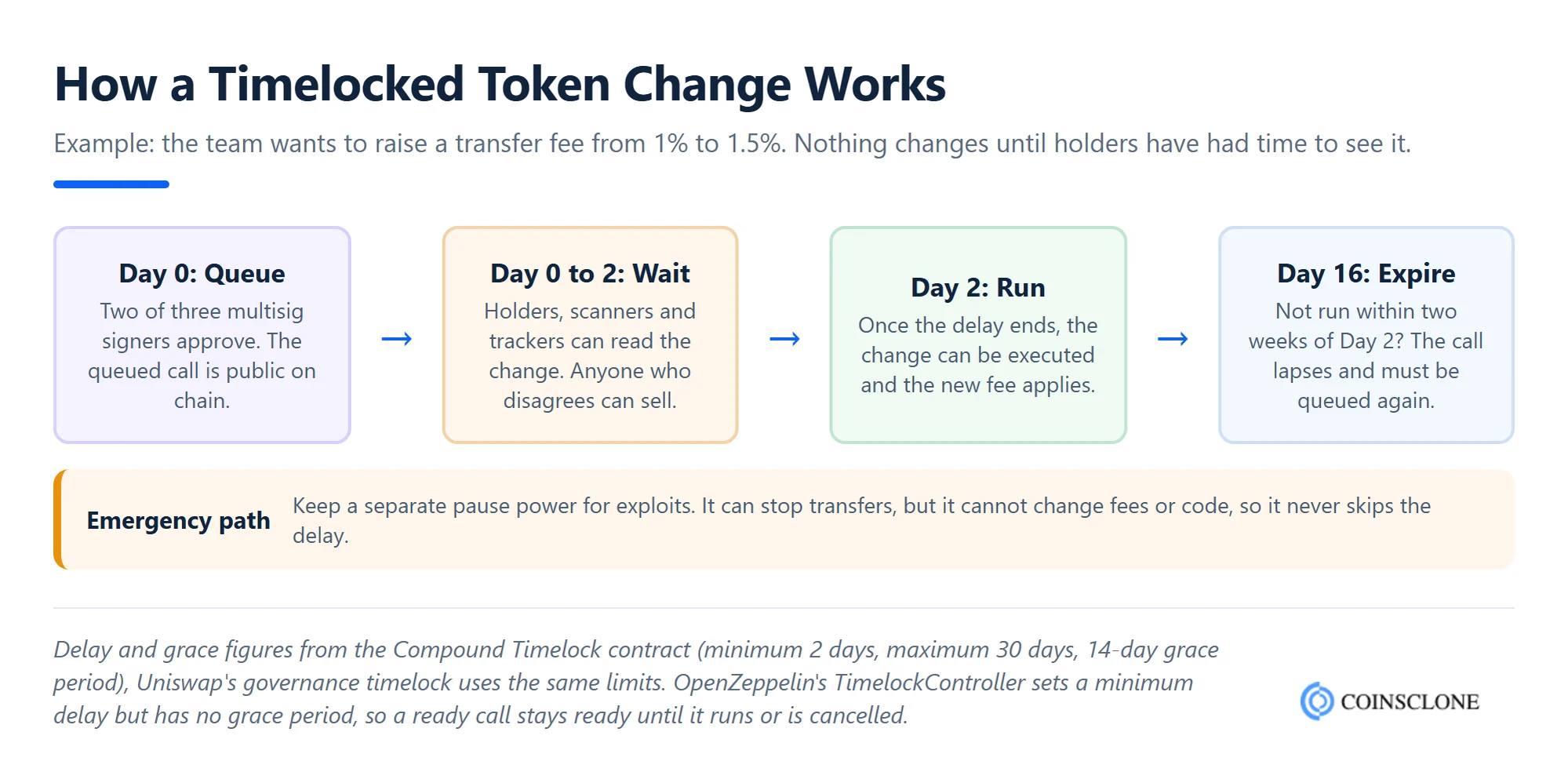
DAO votes: holders vote on changes, and the timelock carries them out. This is the end state for many DeFi tokens. Our guide on how to start a DAO covers the voting setup.
Split the powers: renounce the minter but keep a fee setter behind a timelock, or hard-code a 2% fee cap so no admin can go higher.
Two safety habits: use Ownable2Step, so a new owner must accept the transfer and a typo cannot lose the contract. And once a TimelockController is set up, renounce its admin role, which can skip the delay.
A Decision Tree for Renouncing
Start at the top and stop at the first yes. Most tokens stop at question 2 or 3.
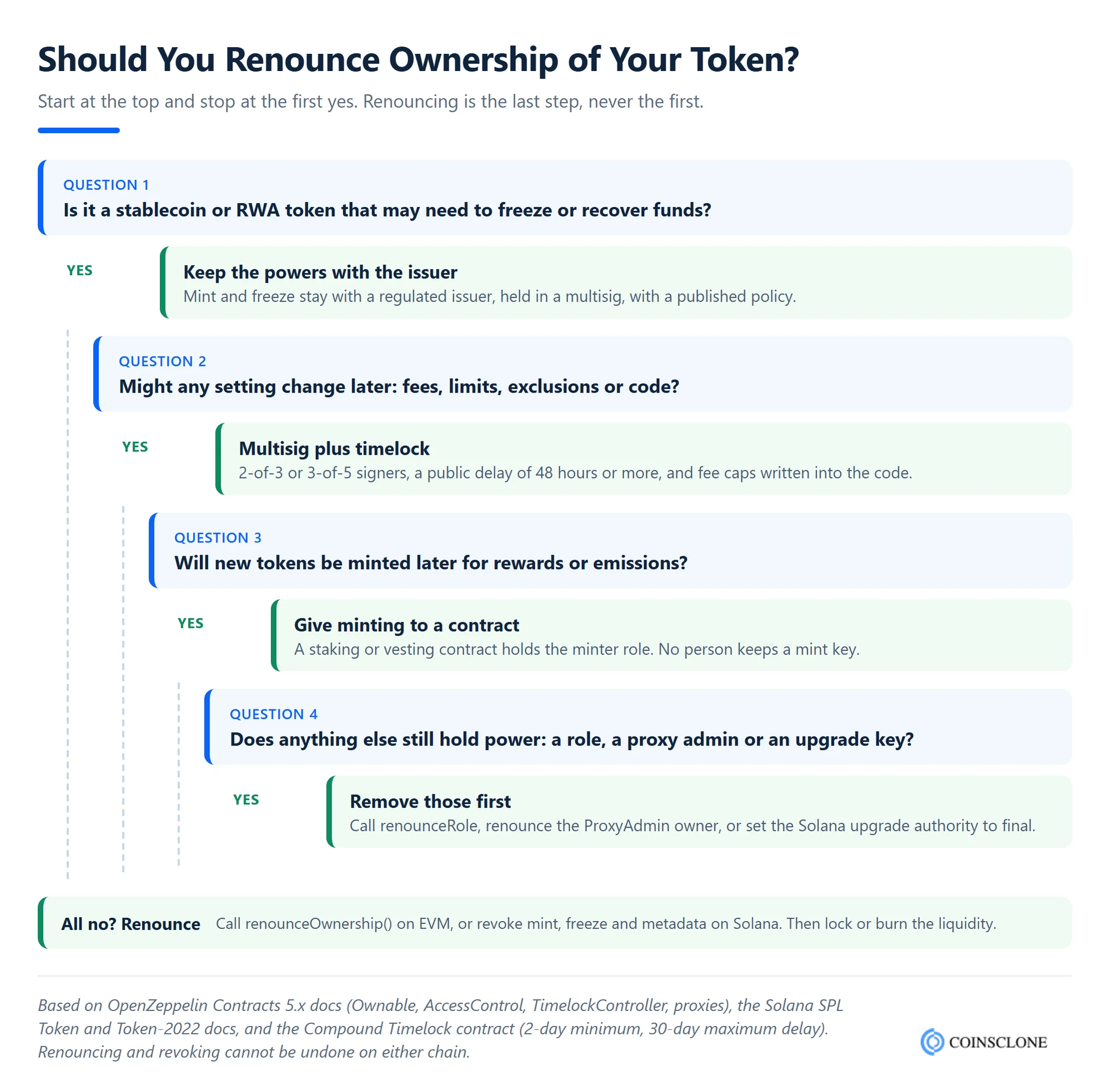
The hidden rule: renounce last, not first. You can go from a multisig to a renounced contract, but never back. That also answers the Reddit question “should I do that yet?” For most tokens, not on launch day. Wait until fees, pools and listings settle.
What Buyers and Scanners Check
Buyers rarely read your code. They paste your token into a scanner, so learn what these tools test.
Token Sniffer (EVM): its API docs list the tests behind its 0 to 100 score:
- ownership renounced, no mint function, no way to restore ownership
- no fee changes, proxy, pause or blacklist
- 95% or more of liquidity locked or burned
- creator and owner each under 5% of supply, sell fees under 5%, and the token can be sold
A score of 85 or more is low risk. Below 60 is high risk.
Note the gap. The mint test checks whether a mint function exists in the code, not who can call it. So a renounced token can still show as “mintable.” The clean fix is to mint the full supply at deployment and ship no mint function.
GoPlus (EVM): its token security fields feed many wallets. They include hidden owner, can take back ownership, is proxy and is mintable. A renounced owner with “is proxy” still true is a warning.
RugCheck (Solana): we sampled the RugCheck public API on 16 October 2026, across the newest tokens and a few large ones. Here are the risk points each flag added.
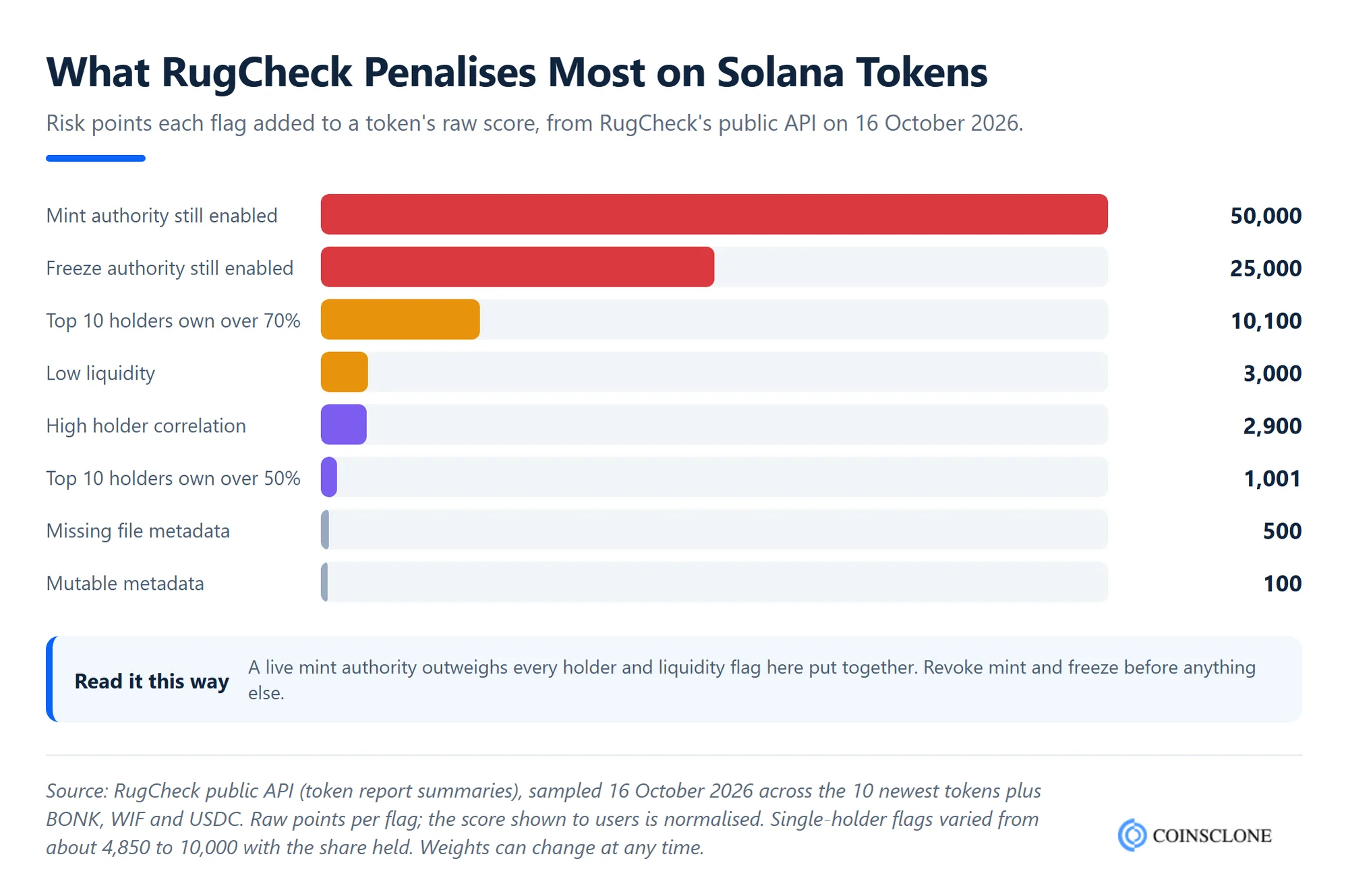
Supply powers lead by far: a live mint authority outweighs the holder and liquidity flags combined. And context counts. BONK showed only “Mutable metadata,” while USDC showed no risks despite its live authorities.
Solidus Labs found that 98.6% of over 7 million pump.fun tokens launched from January 2024 to March 2025 fell below $1,000 in liquidity, as The Defiant reported. In that market, a clean scan is the entry ticket.
Launch a Token Buyers Can Trust
Token Development — done right.
- Permission Map: Every owner, role, authority and proxy admin listed in writing before any code is written.
- Multisig Ownership: Admin powers handed to your Safe or Squads multisig at launch, never left on one deployer key.
- Timelocked Changes: Fee, limit and upgrade changes routed through a public delay, with a clear path to renounce later.
- EVM and Solana: ERC-20, BEP-20 and SPL or Token-2022 tokens with mint and freeze authority set by design.
Get a token that passes scanner checks and keeps the power to fix what matters.
Book a Free Demo to plan your token’s ownership and launch setup.
A Worked Ownership Plan Before Launch
Change the numbers to fit your project.
EVM example: a 1 billion supply community token on Base with a 1% transfer fee.
- Map every power: mint, set fee, exclude from fee, pause, upgrade. Write down who holds each one.
- Delete what you do not need: mint all 1 billion at deployment, remove the mint function, and make the token non-upgradeable.
- Cap what you keep: hard-code the fee ceiling at 2%.
- Move control to a multisig: a 2-of-3 Safe with three named signers on separate devices, using Ownable2Step.
- Add a timelock: send fee changes and new exclusions through a 48-hour delay. Keep pause with the multisig for the first 90 days.
- Lock the liquidity: lock the LP tokens for 12 months, or burn them.
- Publish the map: list each power, its holder and its delay.
- Renounce later: once the fee has been stable for a few months, renounce.
Solana example: a 1 billion supply SPL token with team vesting.
- Mint the full supply, fund vesting and treasury, then revoke mint and freeze.
- Keep metadata control in a Squads multisig for a few weeks to fix the logo, then revoke it.
- Hold any custom program’s upgrade authority in Squads with a time lock until the audit is done, then set it final.
- Burn or lock the LP tokens and share every transaction link.
Our guides on ERC20 token development and Solana token development show how to build these plans in from day one. For a meme coin, the trust checklist in how to create a meme coin covers the launch steps around it.
Rules, Timeline and Cost
Rules: no law makes you renounce. But what you say about control is a claim. The SEC’s staff statement on meme coins of 27 February 2025 puts most meme coins outside securities law. It adds that fraud linked to them “may be subject to enforcement action or prosecution” by other agencies. Calling a token “renounced” while a hidden owner exists invites that trouble. In the EU, MiCA requires a white paper for most public token offers, so list admin powers there plainly.
Timeline: Coinsclone’s service pages quote 1 to 2 weeks for a plain ERC-20 or SPL token, and 3 to 5 weeks with vesting. Staking or voting with timelocks takes 6 to 10 weeks on ERC-20. Custom Solana programs take 6 to 12 weeks with an audit.
Cost: renouncing costs only gas. The real cost is the build and the audit. Published 2026 agency cost guides put a basic custom token at about $5,000 to $15,000. A token with vesting, staking or governance runs $15,000 to $50,000 or more. An audit adds about $5,000 to $15,000 for a simple token, and $15,000 to $70,000 for complex code. A timelock adds little code but needs careful tests, since a wrong role setup can lock you out.
How to Choose a Partner and Prepare for a Scoping Call
A good token team asks about permissions before it writes any code. Bring these answers to your first call:
- Supply plan: fixed or ongoing, and who gets new tokens.
- Settings you might change: fees, limits, exclusions, metadata.
- Signers and delay: who holds keys, and how long holders get before a change.
- End state and chains: renounce, DAO or multisig, on EVM, Solana or both.
Then judge the partner. Do they map every role and proxy admin in writing? Do they use audited libraries, not home-made access checks like the one that sank ONTR? Coinsclone has been building since 2018 and has delivered 350+ platforms for 200+ clients across 20 industries. Our crypto token development company team hands control to your multisig, with timelocks on admin powers.
Frequently Asked Questions
What does ownership renounced mean?
It means the token’s owner is now the zero address, so no one can call owner-only functions such as fee, limit or mint changes. It does not cover other roles, proxy admins, liquidity or the creator’s own tokens.
How do I renounce ownership of a smart contract?
On an EVM chain, call `renounceOwnership()` from the owner wallet, then check on the block explorer that the owner is the zero address. Drop any other roles first, and settle the proxy admin if the token can be upgraded. On Solana, run `spl-token authorize <MINT> mint –disable`, then the same command for freeze.
Can a renounced token still be a rug pull or honeypot?
Yes. A creator can still pull unlocked liquidity, dump a large wallet, or rely on a proxy, a hidden role or a sell block in the code. Check the liquidity lock, the holder spread, the proxy status and a small test sell before you buy.
Can I get ownership back after renouncing?
No. On a standard contract, it is permanent. If a contract lets a past owner reclaim control, scanners flag it as a risk. After a mistake, the only fix is a new token and a migration.
Should I renounce ownership right after launch?
Usually not. Fees, pool exclusions and listing needs often change in the first weeks. Put control in a multisig with a timelock, publish the setup, and renounce once nothing is left to change.
Can I still list my token on an exchange after renouncing?
Often yes, since renouncing does not stop trading or listing. But you can no longer add the fee exclusions or limit changes a new venue may need, so settle those and ask the listing team first.
Why does my token still show as mintable after renouncing?
Many scanners, Token Sniffer among them, test whether a mint function exists in the code, not who can call it. To clear the flag, mint the full supply at deployment and ship no mint function.
Is revoking mint authority on Solana the same as renouncing?
It is the Solana version of the same idea. Solana has separate mint, freeze and metadata powers, and each must be revoked on its own. Revoking mint fixes the supply, and revoking freeze stops anyone from locking holders’ tokens.
Is a multisig or timelock better than renouncing?
For any token that may need fixes, yes. A multisig stops one person from acting alone, and a timelock gives holders days to react before a change goes live. Keep renouncing for finished tokens where nothing else holds power.