

Most private blockchain projects die for a reason nobody writes into the proposal: the other companies never joined.
The technology is not the problem. Platforms are mature, documentation is good, and a competent team can stand a network up in weeks. So what actually goes wrong? Usually one of two things. Either the consortium never forms, or a single organization writes every record and the ledger adds nothing a plain database could not.
This guide gives you the vocabulary, the platforms that genuinely run in production, the six build steps in order, and five honest checks to run before you spend anything.
Key Takeaways
- A private blockchain puts one organization in control of membership, validation and read access.
- Hyperledger Fabric, R3 Corda and ConsenSys Quorum run most production deployments.
- If only one party writes to the record, a database with append-only audit logging is the better answer.
- Governance takes longer than the engineering. Agree it before anyone writes code.
- The most common failure is a technically sound network that nobody else joined.
What Is a Private Blockchain?
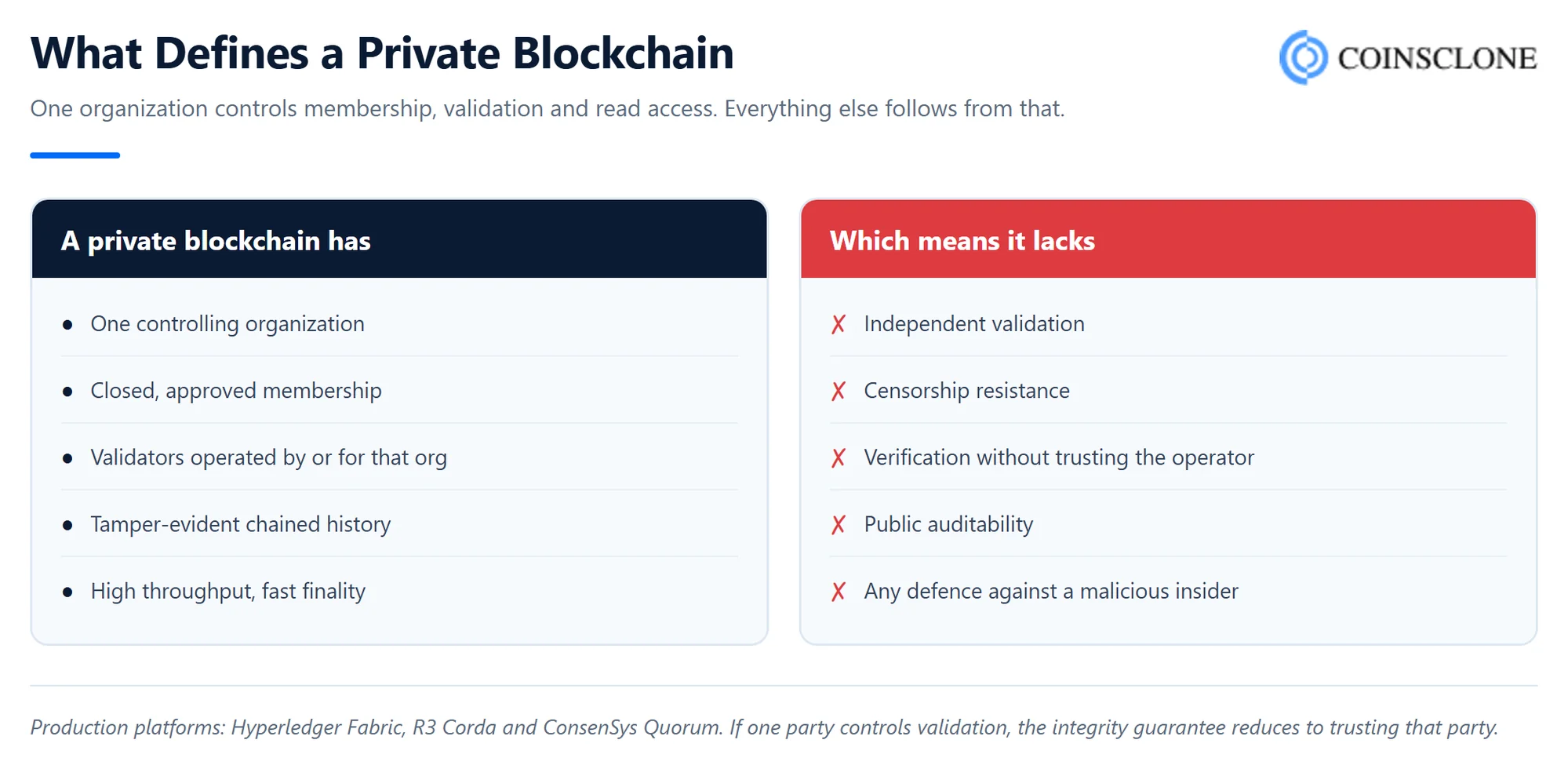
A private blockchain is a distributed ledger where a single organization controls who can join, who can validate transactions, and who can read the data. It uses the same cryptographic chaining as a public chain, with the open membership removed.
Every node is operated by, or on behalf of, one controlling entity, which is what separates a private chain from a consortium chain run jointly by several organizations. The production platforms are Hyperledger Fabric, R3 Corda and ConsenSys Quorum, all built for this deployment model rather than adapted to it.
Because one party controls validation, the integrity guarantee reduces to trusting that party. That is the trade-off the architecture is deliberately making, and stating it plainly early is what separates a workable project from an expensive one.
Private, Permissioned, Consortium and Public: What Is the Difference?
Four terms that overlap, are used loosely, and cause most of the confusion in this area.
Public chains allow open read, write and validate. Ethereum, Solana and Bitcoin.
Private chains are controlled by one organization, which sets membership and validation rights. Usually internal to a company or its direct partners.
Consortium chains are jointly validated by several known organizations. Private in access but shared in control.
Permissioned is a property rather than a category. It means participation rights are restricted, and it applies to both private and consortium networks.
The short version: private describes who owns it, permissioned describes how access works, and a chain can be both. We cover the access model in detail in permissioned blockchain.
What Is an Example of a Private Blockchain?
Named production deployments run on three platforms: Hyperledger Fabric, R3 Corda and ConsenSys Quorum, with Quorum being the most cited enterprise build.
Hyperledger Fabric, hosted by the Linux Foundation, uses channels so subsets of members share data invisible to the rest of the network.
R3 Corda was designed for regulated financial agreements and shares transaction data only with parties to that transaction rather than broadcasting to all nodes.
ConsenSys Quorum, originally developed at J.P. Morgan as a fork of Go Ethereum, adds private transactions and permissioning to an Ethereum-compatible base.
Which Platforms Are Used in Production?
Five options, and one property that matters more than the rest.
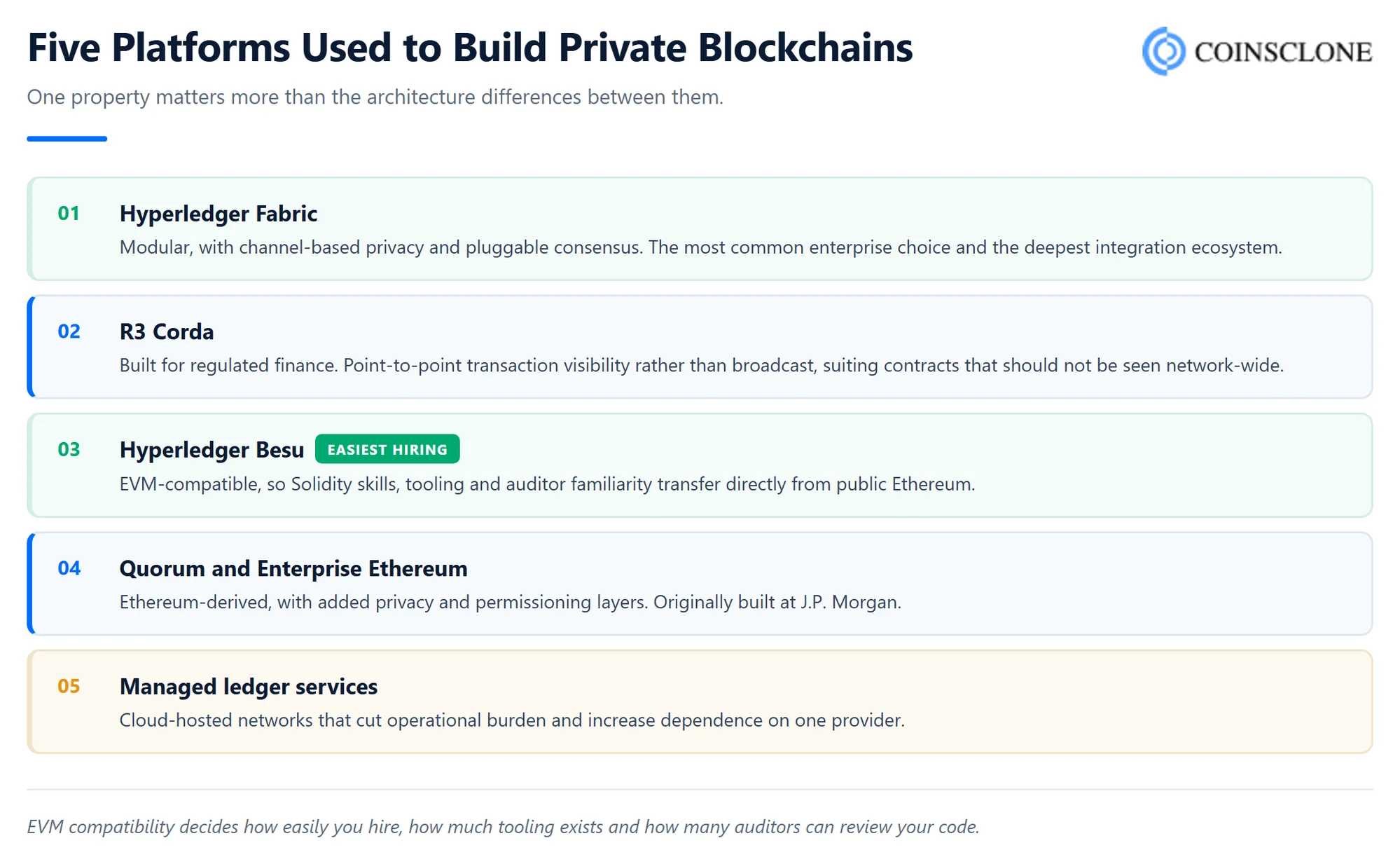
Hyperledger Fabric. Modular architecture with channel-based privacy and pluggable consensus. The most common enterprise choice, and the one with the deepest integration ecosystem.
R3 Corda. Built for regulated finance, with point-to-point transaction visibility rather than broadcast to all participants, which suits contracts that should not be seen network-wide.
Hyperledger Besu. EVM-compatible, so Solidity skills, tooling and auditor familiarity transfer directly from public Ethereum.
Quorum and Enterprise Ethereum stacks. Ethereum-derived platforms with added privacy and permissioning layers.
Managed ledger services. Cloud-hosted networks that reduce operational burden while increasing dependence on a single provider.
EVM compatibility is worth more than it first appears. It determines how easily you can hire, how much tooling exists, and how many auditors can review your code, which are three of the largest cost lines in any multi-year deployment.
What Is the Difference Between a Private Blockchain and a Database?
A private blockchain adds tamper-evident history and multi-party validation to what is otherwise a replicated database. If one organization controls all validators, that difference is smaller than most vendors imply.
A database can be silently edited by anyone with write access. A chained ledger makes that edit detectable, which is the one property genuinely worth paying for. A well-configured database with append-only audit logging delivers most of the same assurance at higher throughput and lower operational cost.
The honest test: if no external party ever needs to verify the record without trusting you, you are describing a database requirement. That question disqualifies more proposals than any other in this category, and asking it first saves the budget rather than spending it.
How Do You Build a Private Blockchain?
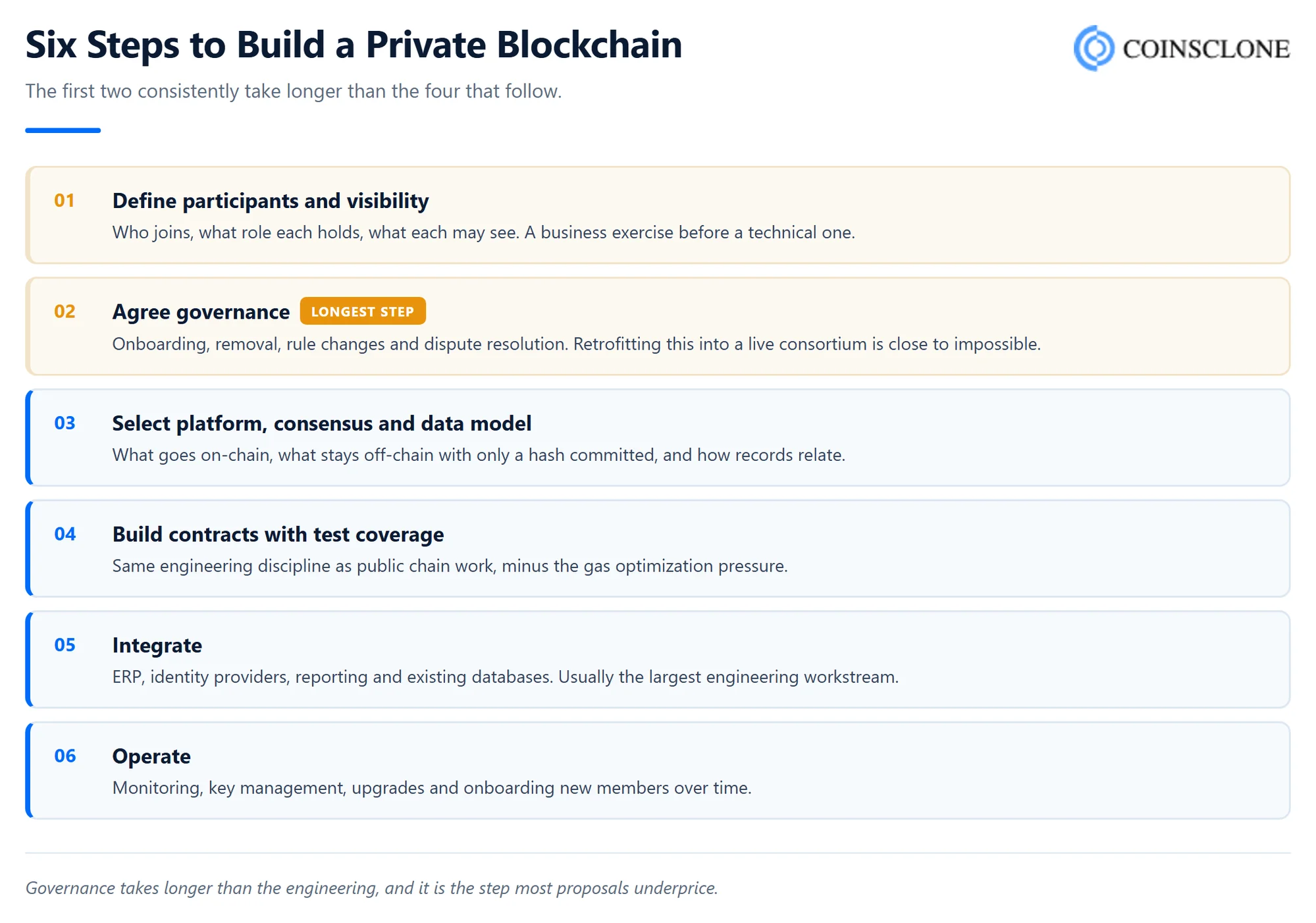
Six steps, and the first two consistently take longer than the four that follow.
Step one: define participants and visibility. Who joins, what role each holds, and what each may see. This is a business exercise before a technical one.
Step two: agree governance. Onboarding, removal, rule changes and dispute resolution. Do this before writing code, because retrofitting governance into a live consortium is close to impossible.
Step three: select platform and consensus, and design the data model. What goes on-chain, what stays off-chain with only a hash committed, and how records relate.
Step four: build smart contracts or chaincode with test coverage. Same engineering discipline as public chain work, minus the gas optimization pressure.
Step five: integrate. ERP, identity providers, reporting and existing databases. This is usually the largest engineering workstream.
Step six: operate. Monitoring, key management, upgrades and onboarding new members over time.
How Much Does It Cost to Build a Private Blockchain?
Cost is driven by integration and governance rather than by the ledger software, which is open source in every major platform.
Hyperledger Fabric, Corda and Besu are free to license. The spend is node infrastructure, integration with existing ERP or core systems, identity management, and ongoing operations.
Multi-organization deployments add the largest hidden line: negotiating the data model and governance rules between members, which is commercial work rather than engineering. A single-organization pilot on managed infrastructure is a conventional software project. A production consortium is a multi-year program, and pricing one as the other is how these engagements go wrong.
Can a Private Blockchain Be Hacked?
Yes, and the attack surface differs from a public chain. The risk is not a 51 percent attack but compromise of the controlling organization’s keys, nodes or admin access.
With few validators, an attacker who compromises the operator can rewrite history, because there is no independent majority to reject the change. Consensus in private networks is usually crash-fault-tolerant, such as Raft, which assumes participants are honest and does not defend against a malicious insider.
The mitigation is operational rather than cryptographic: key custody, node separation across administrative domains, and anchoring periodic hashes to an independent public chain so that internal tampering becomes externally detectable.
What Five Checks Should You Run Before You Build?
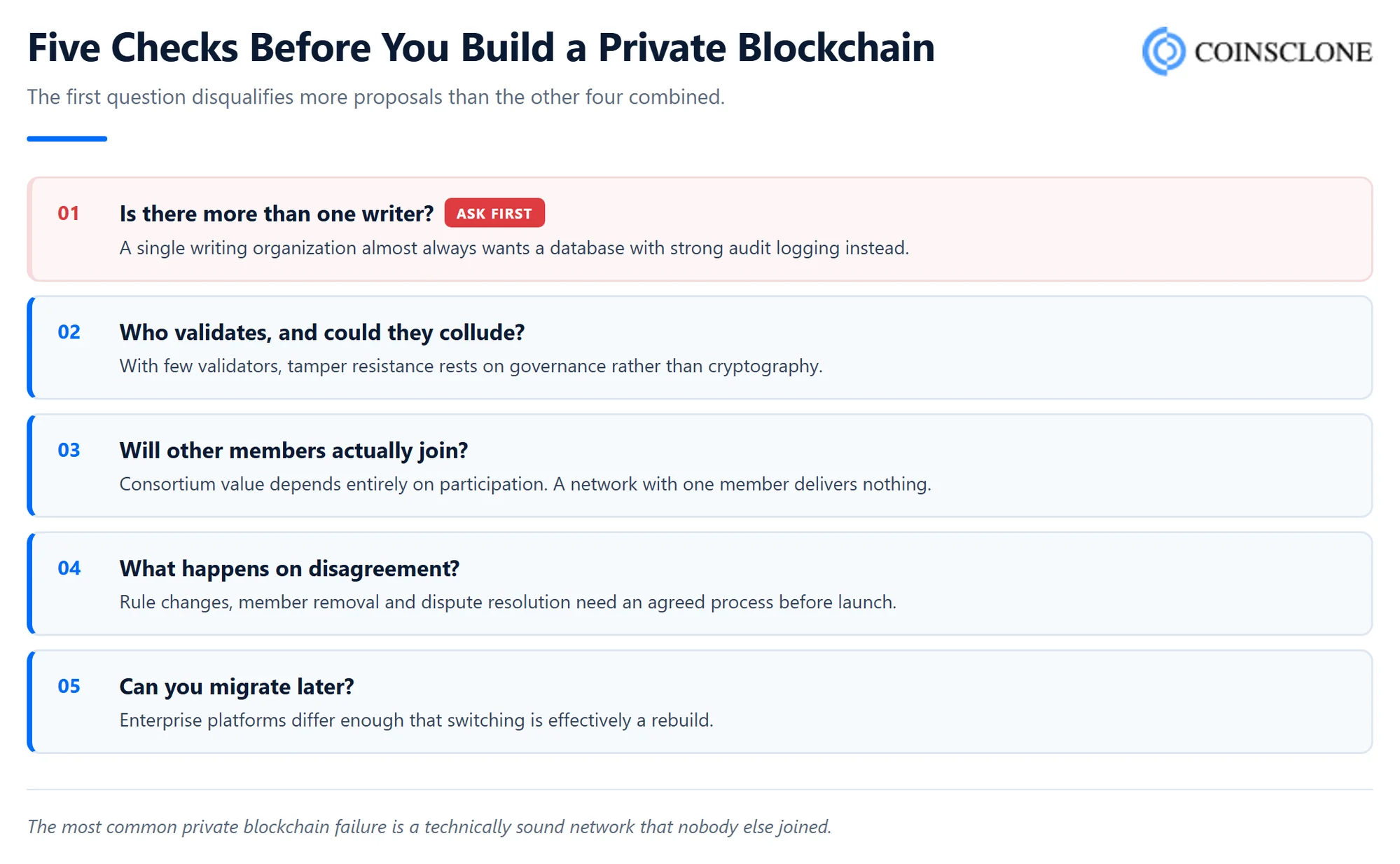
Is there more than one writer? A single writing organization almost always wants a database with strong audit logging instead.
Who validates, and could they collude? With few validators, tamper resistance rests on governance rather than cryptography.
Will other members actually join? Consortium value depends entirely on participation, and a network with one member delivers nothing.
What happens on disagreement? Rule changes, member removal and dispute resolution need an agreed process before launch, not after the first conflict.
Can you migrate later? Enterprise platforms differ enough that switching is effectively a rebuild, so choose deliberately rather than by familiarity.
The most common private blockchain failure is a technically sound network that nobody else joined.
Conclusion
A private blockchain earns its place when several parties write to a shared record, none of them should own it outright, and an outsider must be able to verify it. It earns nothing when one organization writes everything and trusts itself, which describes most proposals that reach a vendor.
Settle governance before platform. Choose EVM compatibility unless a specific requirement rules it out, because hiring and audit availability will shape your costs for years. And run the five checks honestly, because the cheapest moment to discover you needed a database is before the first invoice. Do that, and a private blockchain becomes a defensible decision rather than an expensive assumption.
Coinsclone builds enterprise-grade Web3 platforms including private and consortium blockchain networks on Hyperledger Fabric, Besu and Corda, smart contract development and audit, RWA tokenization, crypto exchanges, wallets and payment gateways, using customizable white-label solutions. Talk to our blockchain experts for a free consultation and a live demo.
FAQ
Q: What is a private blockchain?
A distributed ledger where one organization controls who can join, who can validate transactions and who can read the data. It uses the same cryptographic chaining as a public chain with the open membership removed, which means the integrity guarantee reduces to trusting the controlling organization.
Q: What is an example of a private blockchain?
Production deployments typically run on Hyperledger Fabric, R3 Corda or ConsenSys Quorum. Quorum, originally built at J.P. Morgan as a fork of Go Ethereum, is the most cited enterprise example. Fabric uses channels for privacy; Corda shares data only with parties to a transaction.
Q: What is the difference between a private blockchain and a database?
A ledger makes edits detectable, which a database does not. If no external party ever needs to verify your records without trusting you, a database with append-only audit logging is faster, cheaper and easier to operate. That single question disqualifies most private blockchain proposals.
Q: Is a private blockchain the same as a permissioned blockchain?
Not quite. All private blockchains are permissioned, but a permissioned network can span many independent organizations without any one controlling it. Private describes ownership; permissioned describes access.
Q: How much does it cost to build a private blockchain?
The ledger software is free, since Fabric, Corda and Besu are open source. Cost sits in node infrastructure, ERP and identity integration, and operations. For multi-organization networks the largest hidden cost is negotiating governance and the shared data model, which is commercial rather than engineering work.
Q: Can a private blockchain be hacked?
Yes, though not by a 51 percent attack. The realistic threat is compromise of the operator’s keys, nodes or admin access. Private networks often use crash-fault-tolerant consensus such as Raft, which assumes honest participants and offers no defence against a malicious insider.
Q: Does a private blockchain need a token?
No. Without open validation there is nothing to incentivize, so most enterprise networks run without one. This removes a substantial amount of regulatory and accounting complexity, which is one of the practical advantages of the model.
Q: Which platform should I choose for a private blockchain?
Hyperledger Fabric for channel-based privacy and the deepest integration ecosystem, Corda for regulated finance where transactions should not be broadcast, and Besu where EVM compatibility matters. EVM compatibility affects hiring, tooling and audit availability more than architecture does.
Q: How long does it take to build a private blockchain?
The engineering is rarely the constraint. Defining participants, visibility and governance takes longest, and for multi-organization networks that is a negotiation rather than a development task. A single-organization pilot is a conventional project; a production consortium is a multi-year program.
Q: Why do private blockchain projects fail?
Almost always for organizational reasons. Either other parties never join, so the network delivers nothing, or one organization writes all the data and the ledger adds nothing over a database. Both are visible before development starts if the right questions are asked.