

You can build a copy trading platform on blockchain in a few months. Getting the license position right takes longer, and skipping it can end the product entirely.
Here is the trap. When one trader’s positions replicate automatically into someone else’s account, regulators often treat that as portfolio management rather than signalling. Both the FCA and ESMA have said so directly.
That single determination shapes everything downstream: custody, fee structure, who can sign up, and which of the three architectures you can legally use.
So this guide starts with the legal position. Then it covers the three models and their risk profiles, the engineering problems that quietly close platforms, and what a complete build actually contains.
Key Takeaways
Settle the legal position before the architecture, because it decides which of the three models you can use.
The FCA treats automatic replication as portfolio management, and ESMA applies MiFID II guidance under MiCA too.
Three architectures exist: non-custodial, pooled vault and signal relay. Migrating between them later is a rebuild.
Slippage and front-running are the two engineering problems that close copy trading platforms.
Any contract holding follower funds needs an independent audit plus a remediation round.
Is Copy Trading Legal?
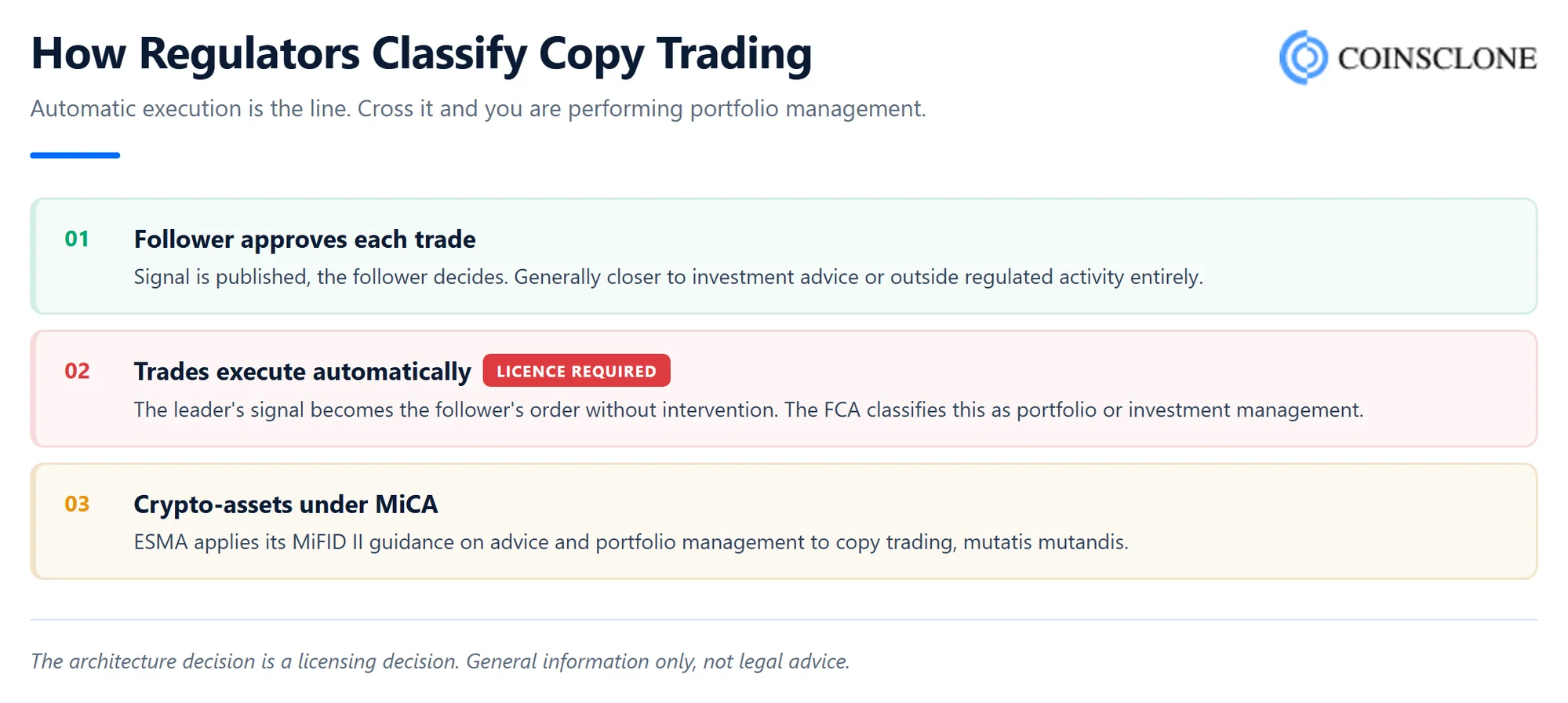
Copy trading is legal in most major markets but is usually a regulated activity, not an unregulated one. Where trades are replicated automatically without the follower deciding each one, regulators generally treat it as portfolio management.
The UK’s FCA classifies copy trading as portfolio or investment management when another party’s signals become orders without further intervention from the account holder. ESMA has stated that MiFID II guidance on investment advice and portfolio management applies to copy trading, and applies equally under MiCA for crypto-assets.
The consequence is a license requirement plus suitability assessment obligations, which is a materially different product from an unregulated signals feed.
Do You Need a License to Build a Copy Trading Platform?
In most regulated markets, yes. If followers’ orders execute automatically from a leader’s signal, the operator is generally performing portfolio management and needs the corresponding authorization.
Under MiFID II that means an investment firm license covering portfolio management, with suitability assessments for every follower. For crypto-assets in the EU, MiCA introduced crypto-asset portfolio management as a regulated service, and ESMA has applied its MiFID II interpretation to it. A firm dealing in both MiFID instruments and non-MiFID crypto-assets needs both authorizations.
Manual-confirmation designs, where the follower approves each trade, can fall outside portfolio management. That is why the architecture decision is a licensing decision, and why it has to come first.
Which Four Questions Settle Your Regulatory Position?
Four answers shape the architecture, and each one narrows what you can build.
Who controls the funds? Non-custodial designs where the follower retains custody carry a materially different profile from pooled custody where the platform or a contract holds assets.
Is it discretionary? Automatic replication without per-trade consent looks considerably more like discretionary management than signalling does.
How are leaders paid? Performance fees are frequently the specific trigger for licensing obligations, more so than the copying mechanism itself.
Who are your users? Retail access in most jurisdictions carries obligations that professional-only access does not, and geofencing is a product requirement rather than an afterthought.
This is general information rather than legal advice. Obtain qualified counsel in every jurisdiction where users will access the platform, before choosing an architecture rather than after.
What Are the Three Architectures?
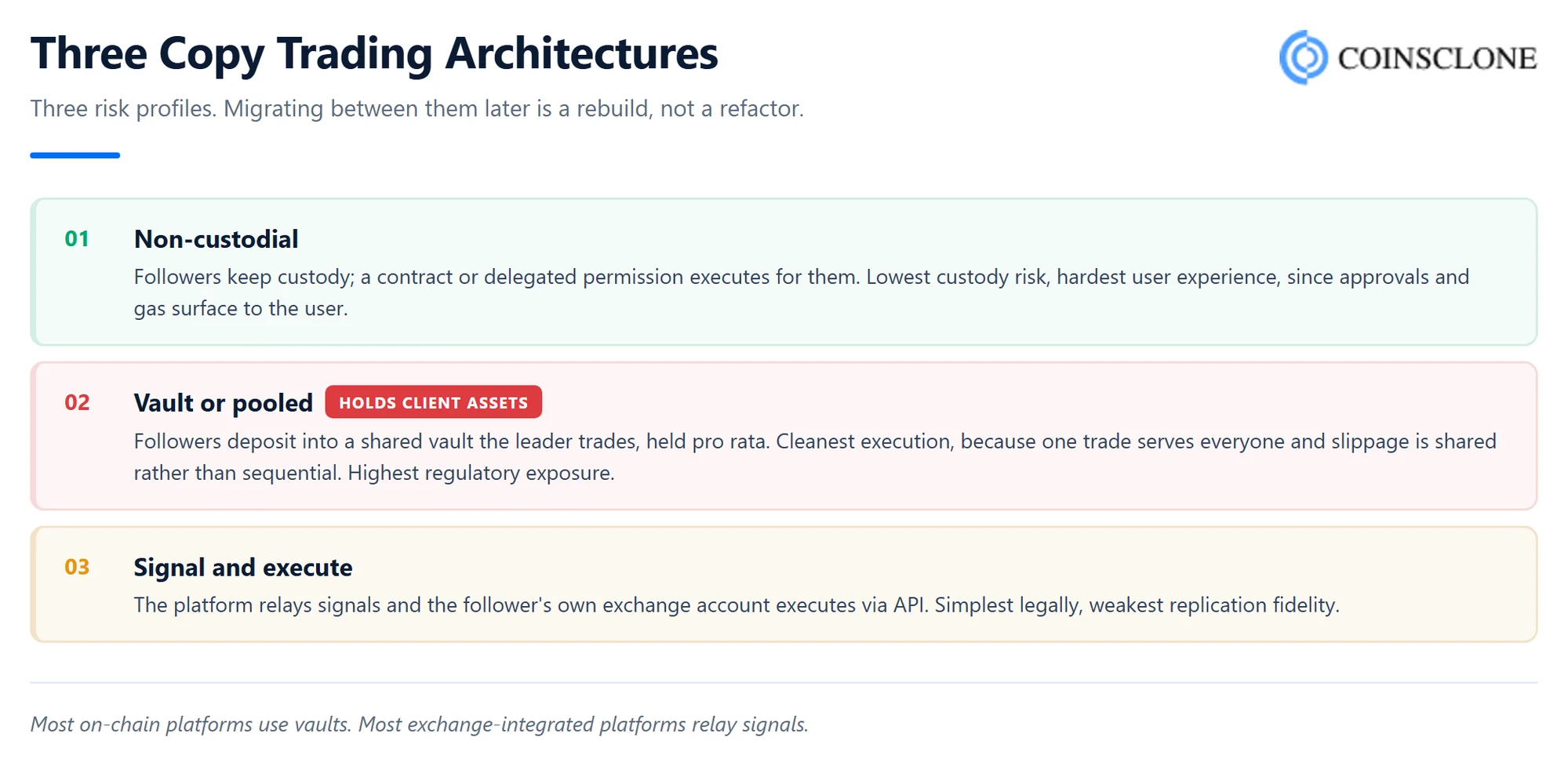
Three models, three risk profiles, and migrating between them later is a rebuild.
Non-custodial. Followers keep custody, and a smart contract or delegated permission executes trades on their behalf. Lowest custody risk, and the hardest user experience because approvals, gas and permission scopes all surface to the user.
Vault or pooled. Followers deposit into a shared vault that the leader trades, with positions held pro rata. This gives the cleanest execution, since one trade serves all followers simultaneously and slippage is shared rather than sequential. It also carries the highest regulatory exposure, because you are holding and managing pooled client assets.
Signal and execute. The platform relays signals and the follower’s own exchange account executes via API. Simplest legally, and the weakest replication fidelity because timing and available balance vary per follower.
Most on-chain platforms use vaults. Most exchange-integrated platforms relay signals.
What Is the Difference Between Copy Trading, Mirror Trading and Social Trading?
Copy trading replicates a specific trader’s positions proportionally. Mirror trading replicates a strategy or algorithm rather than a person. Social trading is the broader category including discussion and signal sharing without automatic execution.
The regulatory line falls on automatic execution, not on the label, so copy and mirror trading usually attract the same treatment. Social trading that stops at publishing ideas is generally closer to investment advice, or to no regulated activity at all, depending on how it is presented.
Choosing the marketing term does not change the classification, which is determined by what the system does when a signal arrives.
Which Engineering Problems Decide Whether It Works?
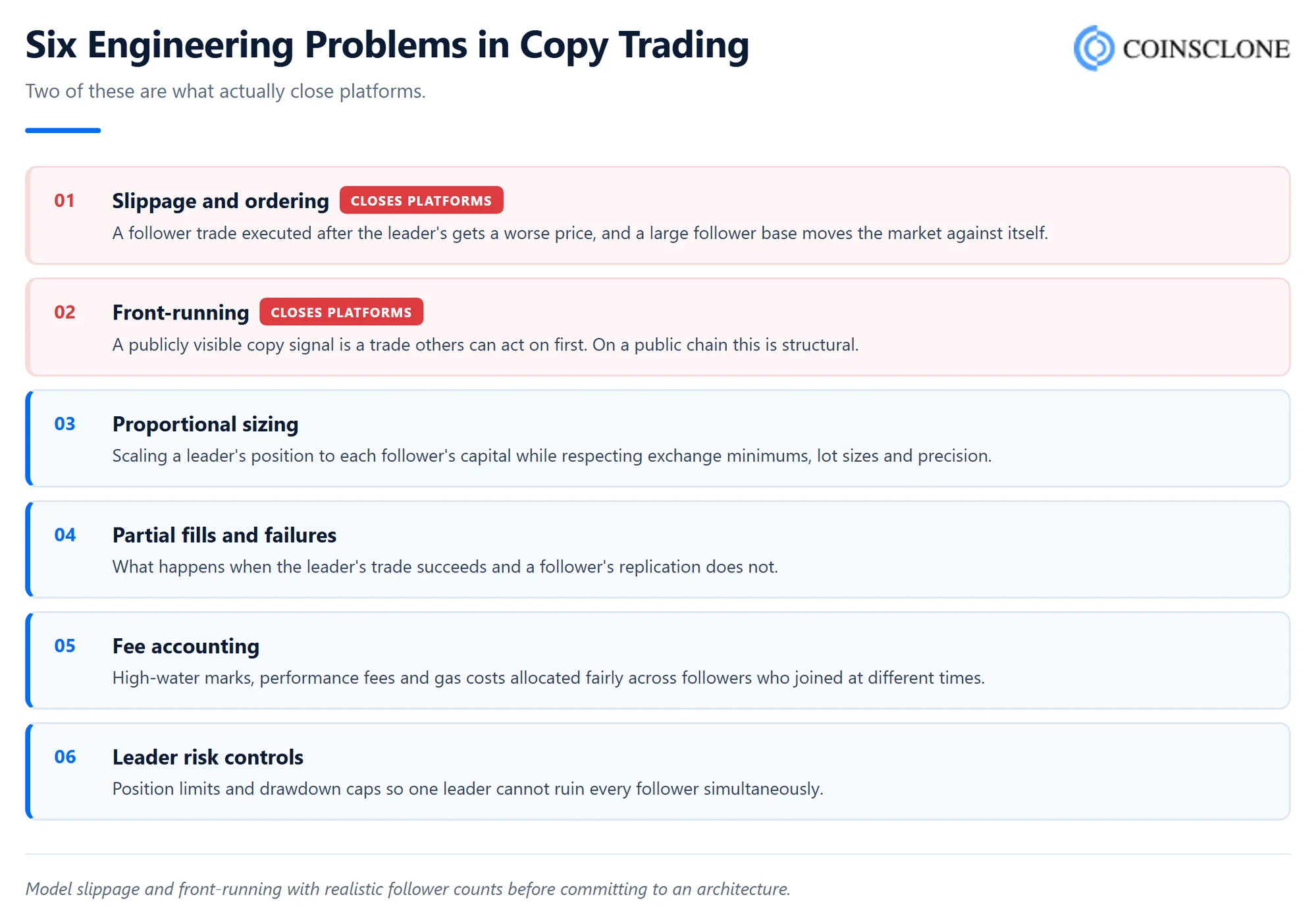
Six, and two of them close platforms.
Slippage and ordering. A follower trade executed after the leader’s gets a worse price, and a large follower base moves the market against itself. This is the single most common reason copy trading returns diverge from advertised leader performance.
Proportional sizing. Scaling a leader’s position to each follower’s capital while respecting exchange minimums, lot sizes and decimal precision.
Front-running. A publicly visible copy signal is a trade others can act on first. On a public chain this risk is structural rather than incidental.
Partial fills and failures. Deciding what happens when the leader’s trade succeeds and a follower’s replication does not, which is a product decision as much as an engineering one.
Fee accounting. High-water marks, performance fees and gas costs allocated fairly across followers who joined at different times.
Leader risk controls. Position limits and drawdown caps so that one leader cannot ruin every follower simultaneously.
Model slippage and front-running before committing to an architecture. They are the two that close platforms.
How Do Copy Trading Platforms Make Money?
Through performance fees shared with lead traders, spread markups or commission on copied volume, and subscription access to selected strategies.
Performance fee splits are the most common model, typically taken from follower profits and shared with the strategy provider. Volume-based revenue aligns the operator with trading frequency rather than follower returns, which regulators increasingly scrutinize as a conflict of interest. Subscription pricing avoids that conflict and produces predictable revenue, at the cost of a harder acquisition story.
Whichever you choose, the fee model feeds directly back into the licensing question, because performance fees are one of the specific triggers regulators look at.
What Does a Build Actually Contain?
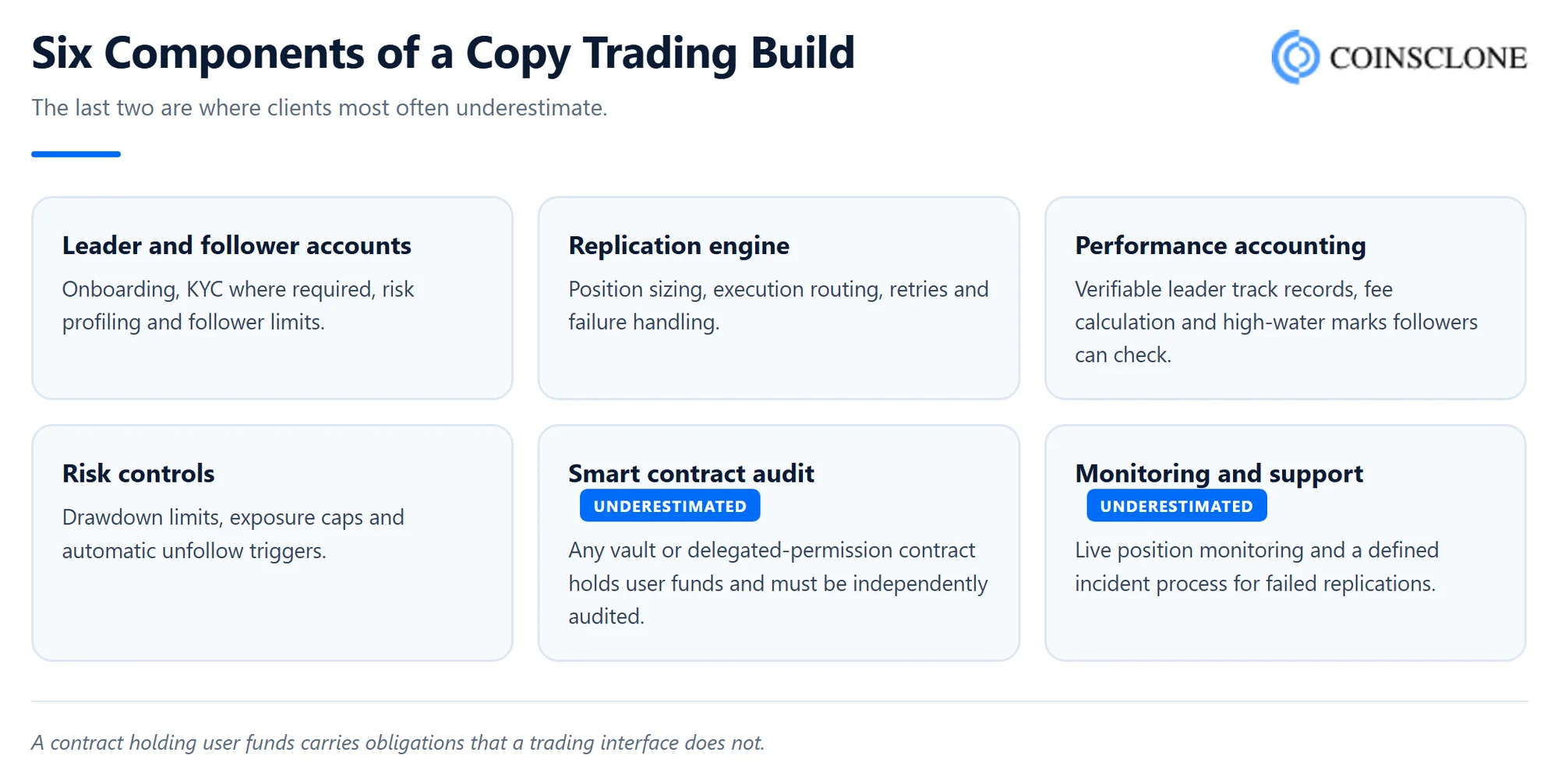
Six components, and the last two are where clients most often underestimate.
Leader and follower accounts, covering onboarding, KYC where required, risk profiling and follower limits.
Replication engine, handling position sizing, execution routing, retries and failure handling.
Performance accounting, producing verifiable leader track records, fee calculation and high-water marks that followers can check.
Risk controls, including drawdown limits, exposure caps and automatic unfollow triggers.
Smart contract audit. Any vault or delegated-permission contract holds user funds and must be independently audited, with remediation and re-audit budgeted as a phase.
Monitoring and support, covering live position monitoring and a defined incident process for failed replications.
A contract holding user funds carries obligations that a trading interface does not, and pricing the two the same way is the most common scoping error in this category.
Conclusion
A copy trading platform is a regulated financial product wearing a technology interface. The license question determines the architecture, the architecture determines the execution quality, and the execution quality determines whether followers stay.
Settle the legal position in your target markets before choosing between non-custodial, vault and signal relay. Model slippage and front-running with realistic follower counts rather than with three test accounts. Budget an audit and a remediation round for any contract that holds funds. And be honest in your marketing about the gap between leader performance and follower performance, because that gap is structural and disclosing it is cheaper than being asked about it later. Get that sequence right, and a copy trading platform on blockchain becomes a licensable product rather than a legal problem.
Coinsclone builds enterprise-grade Web3 platforms including copy trading and social trading systems, crypto exchanges, DEXs, smart contract development and audit, wallets and payment gateways, using customizable white-label solutions. Talk to our blockchain experts for a free consultation and a live demo.
FAQ
Q: Is copy trading legal?
Legal in most major markets, but usually a regulated activity. The UK’s FCA classifies it as portfolio or investment management when signals become orders without further intervention from the account holder, and ESMA applies MiFID II guidance to copy trading including under MiCA for crypto-assets.
Q: Do you need a license to run a copy trading platform?
In most regulated markets, yes. Automatic execution generally makes the operator a portfolio manager, requiring an investment firm license and suitability assessments. Designs where the follower approves each trade can fall outside that, which is why architecture and licensing must be decided together.
Q: How do you build a copy trading platform on blockchain?
Settle the regulatory position first, then choose between non-custodial, pooled vault or signal relay architectures. Build the replication engine, performance accounting, risk controls and monitoring, and independently audit any contract that holds user funds.
Q: What is the difference between copy trading, mirror trading and social trading?
Copy trading replicates a specific trader’s positions proportionally. Mirror trading replicates a strategy or algorithm. Social trading is the broader category including discussion without automatic execution. The regulatory line falls on automatic execution, not on the label.
Q: How do copy trading platforms make money?
Performance fees shared with lead traders, spread markups or commission on copied volume, and subscription access to strategies. Volume-based revenue creates a conflict of interest that regulators increasingly scrutinize, since it rewards trading frequency rather than follower returns.
Q: Why do copy trading returns differ from the leader’s returns?
Slippage and ordering. A follower’s trade executes after the leader’s and gets a worse price, and a large follower base moves the market against itself. This is structural rather than a bug, and it is the most common source of complaints.
Q: What is the safest copy trading architecture?
Non-custodial carries the lowest custody risk because followers retain their assets, at the cost of a harder user experience. Pooled vaults give the cleanest execution and the highest regulatory exposure, since you are holding and managing client assets.
Q: How much does it cost to build a copy trading platform?
The replication engine is conventional development. The cost concentrates in compliance and licensing, and in smart contract audit plus remediation for any vault contract holding funds. Pricing a fund-holding contract like a trading interface is the most common scoping error.
Q: Can copy trading be done non-custodially?
Yes, using delegated permissions or a smart contract that executes on the follower’s behalf while they retain custody. It reduces custody risk and regulatory exposure, and it pushes approvals, gas and permission scopes into the user experience.
Q: What is front-running in copy trading?
A publicly visible copy signal is a trade others can act on before the follower’s order executes. On a public chain this is structural rather than incidental, and it should be modelled before an architecture is chosen rather than discovered after launch.