
Hashgraph is frequently described as a faster blockchain, which is misleading in both directions. It is not a blockchain, and speed is not the interesting difference. The genuinely interesting difference is structural: a blockchain appends batches of transactions into a linear chain and discards competing blocks, while a hashgraph records events into a directed acyclic graph where nothing is thrown away. That produces different finality characteristics, a different fault tolerance model and a very different decentralization profile. This comparison sets out how the mechanism actually works and where each model is genuinely stronger.
What Is the Difference Between Hashgraph and Blockchain?
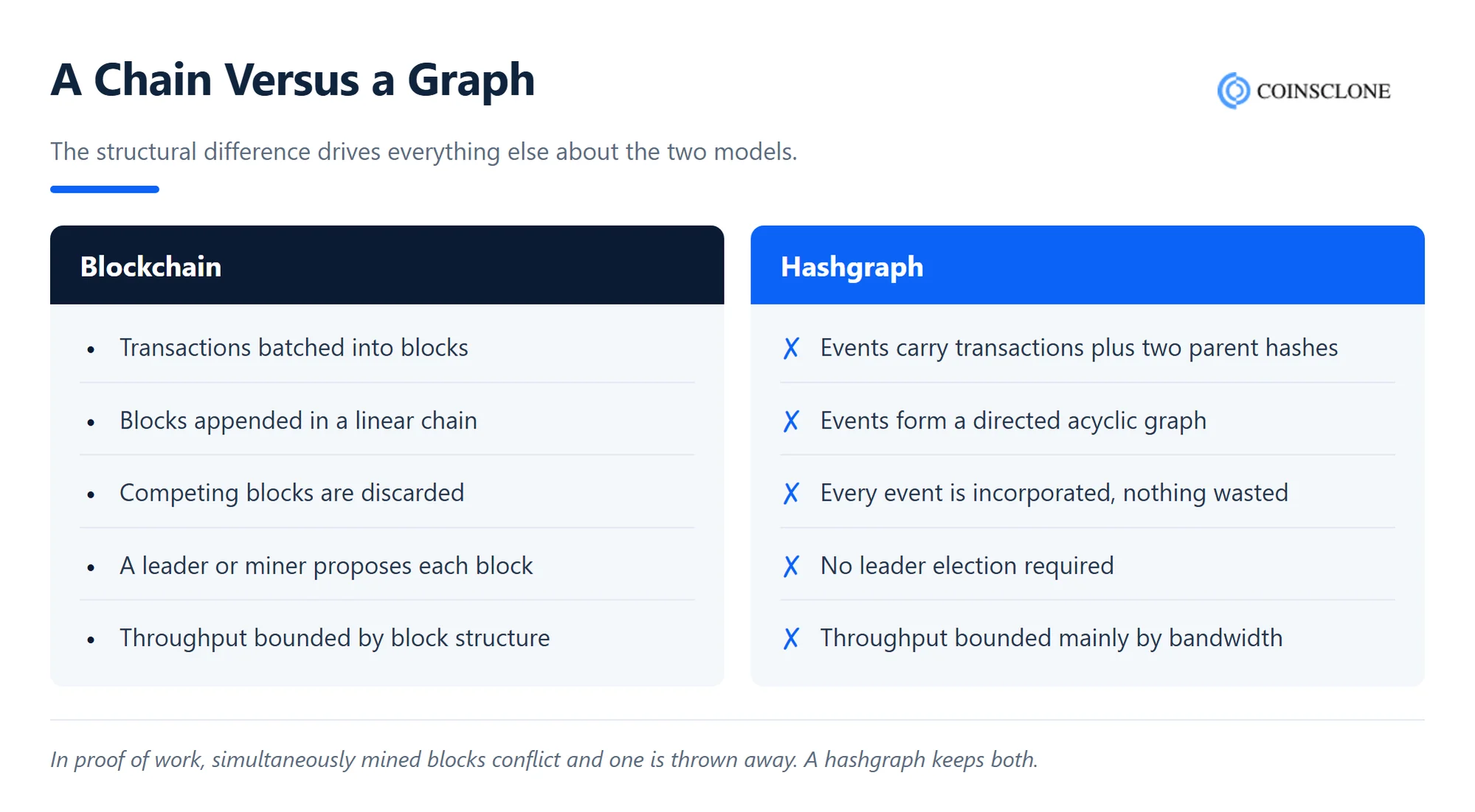
Hashgraph is not a faster blockchain. It is a different data structure. A blockchain batches transactions into blocks and appends them in a line, discarding any competing block. A hashgraph records individual events into a directed acyclic graph and keeps every one of them. That single structural difference drives everything else: how consensus is reached, how quickly a transaction becomes final, and how decentralized the network can realistically be.
Here is the short version before the detail:
- Structure. Blockchain is a linear chain of blocks. Hashgraph is a directed acyclic graph of events.
- Consensus. Blockchains elect a leader or miner per block. Hashgraph uses gossip about gossip plus virtual voting, with no leader and no separate voting round.
- Finality. Hashgraph gives deterministic finality in seconds. Most blockchains give probabilistic finality that strengthens as blocks stack up.
- Fees. Hedera prices transactions in USD terms, so cost does not swing with the token. Blockchain fees float with demand.
- Openness. Public blockchains let anyone run a consensus node. Hedera’s consensus nodes are permissioned and council-operated.
- Ecosystem. Public blockchains carry far deeper tooling, liquidity and composability.
The rest of this comparison explains each of those, then says plainly which model fits which requirement.
How Does Hashgraph Differ From Blockchain Structurally?
In a blockchain, transactions are batched into blocks, blocks are appended in a linear chain, and when two valid blocks are produced simultaneously one is discarded. A leader or miner proposes each block, and throughput is bounded by the block structure itself.
In a hashgraph, the unit is an event rather than a block. An event contains a set of transactions plus two hashes referencing the last two events that node knew about. Those references form a directed acyclic graph rather than a line. Every event is incorporated into the ledger, so no work is discarded, there is no leader election, and throughput is bounded primarily by available bandwidth rather than by architecture.
That last point is the substantive claim: in a chain, block structure creates a ceiling regardless of hardware improvements. In a graph, it does not.
How Do Gossip About Gossip and Virtual Voting Work?
The mechanism is easier to follow as a sequence.
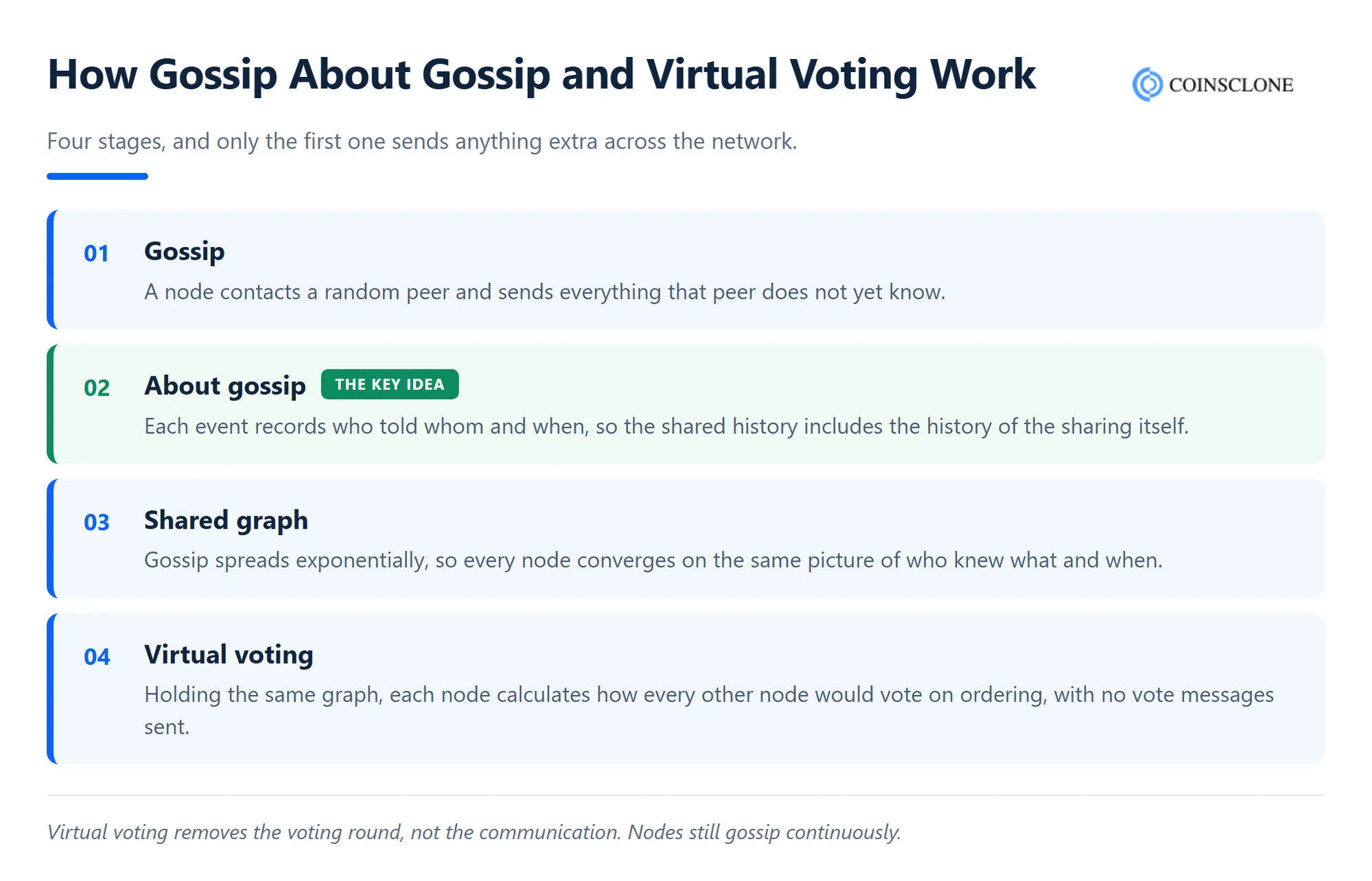
Gossip. A node contacts a random peer and sends everything the peer does not yet know.
About gossip. Crucially, each event records who told whom and when, so the history being shared includes the history of the sharing itself.
Shared graph. Because gossip spreads exponentially, every node converges on the same picture of who knew what and at what point.
Virtual voting. Since each node holds the same graph, it can calculate how every other node would vote on transaction ordering without those nodes sending any vote messages.
Order and timestamps. Consensus timestamps and deterministic ordering follow from that calculation.
One clarification matters, because it is often stated incorrectly: virtual voting does not eliminate communication. Nodes still gossip continuously. What it eliminates is a separate round of voting messages, because votes are inferable from data already held.
Is Hashgraph Faster Than Blockchain?
Hashgraph finalizes transactions in seconds and Hedera has demonstrated high throughput, but the speed difference comes from the structure rather than from better engineering. Because no event is ever discarded, no work is wasted, and because votes are inferred rather than sent, the network spends its bandwidth on data instead of on coordination messages.
Two cautions belong with any speed claim here.
- Headline transactions-per-second figures vary enormously by source and by workload. Treat any single number, from either side, as a marketing figure until you see the test conditions.
- Throughput on a hashgraph is bounded mainly by bandwidth, while on a blockchain it is bounded by block structure. That is the claim worth taking seriously, because hardware improvements lift one ceiling and not the other.
Finality is the more useful comparison for most applications. A payment that is deterministically final in three seconds behaves differently in a product than one that is merely very probably final after twelve blocks.
Is Hedera a Blockchain?
Hedera is a public network, but it is not a blockchain and its consensus nodes are not open to anyone. A council of enterprises operates the consensus nodes and rotates membership, which is the central trade-off in the entire design and deserves to be stated plainly rather than buried in a footnote.
That arrangement buys real things. Governance is predictable, the node set is accountable, fees are stable, and an enterprise can name the parties running the network. It also costs real things. You cannot permissionlessly join consensus, the validator set is not open, and the censorship-resistance story is weaker than on a public blockchain where anyone can run a node.
Anyone can read the ledger, submit transactions and deploy contracts. The permissioning applies to who reaches consensus, not to who can use the network.
Hashgraph vs Blockchain Compared Across Six Dimensions
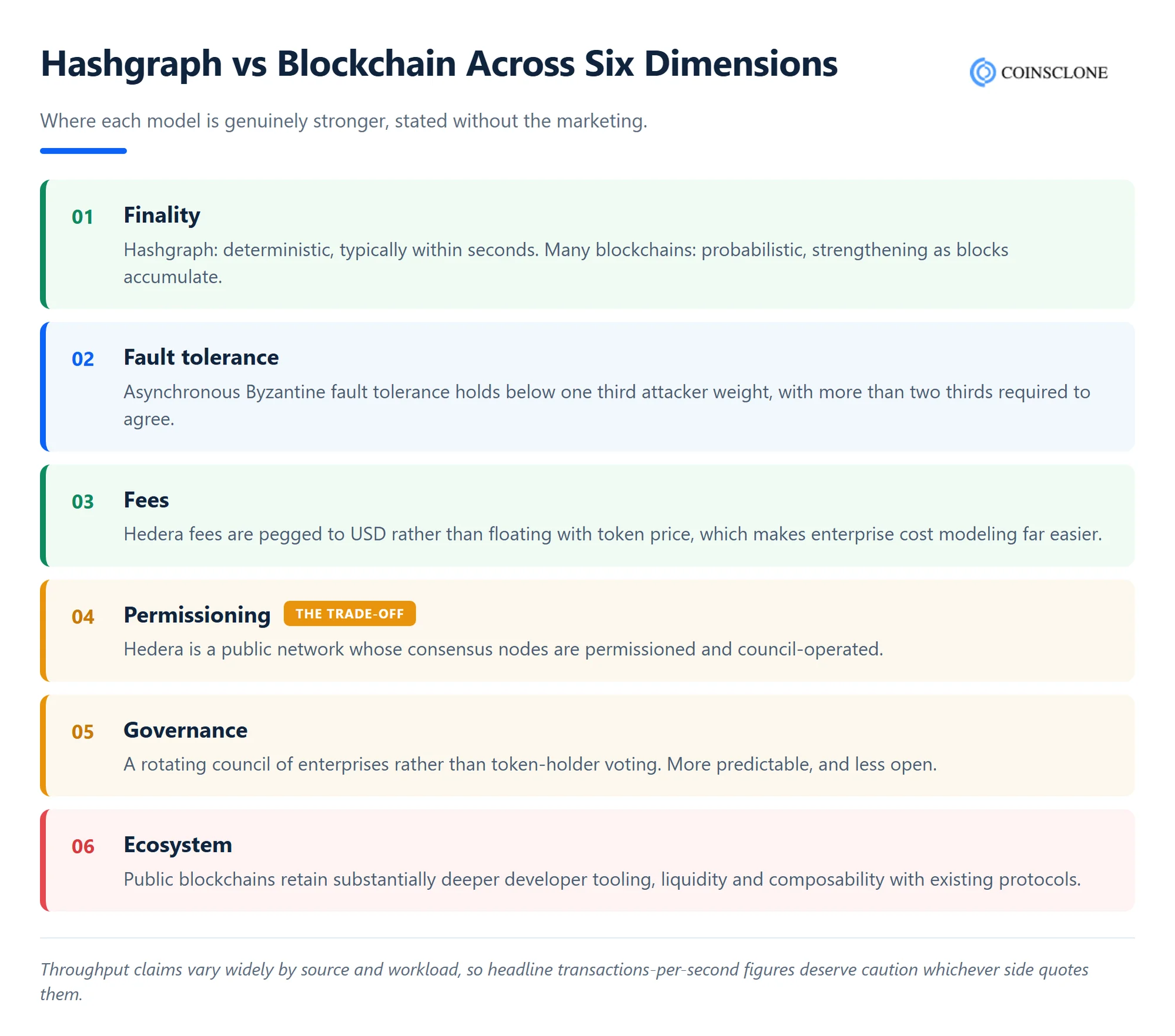
Finality. Hashgraph provides deterministic finality typically within seconds. Many blockchains provide probabilistic finality that strengthens as blocks accumulate.
Fault tolerance. Asynchronous Byzantine fault tolerance holds while an attacker controls less than one third of consensus weight, with more than two thirds required for agreement. The one-third threshold is frequently misstated, so it is worth being precise about.
Fees. Hedera fees are fixed at a small figure pegged to USD rather than floating with token price, which makes cost modeling considerably easier for enterprises.
Permissioning. Hedera is a public network whose consensus nodes are permissioned and council-operated. This is the central trade and it should be stated plainly rather than buried.
Governance. A rotating council of enterprises rather than token-holder voting. More predictable, and less open.
Ecosystem. Public blockchains retain substantially deeper developer tooling, liquidity and composability with existing protocols.
Throughput claims vary widely by source and workload, so headline transactions-per-second figures should be treated with caution regardless of which side quotes them.
What Are the Disadvantages of Hashgraph?
Every comparison that only lists hashgraph’s advantages is selling something. The honest weaknesses are these.
- Permissioned consensus. Council-operated nodes mean the decentralization profile is nearer to a consortium chain than to Ethereum, whatever the network’s public status.
- Patent history. The algorithm’s proprietary origins shaped a much smaller implementation ecosystem than open protocols enjoy.
- Shallower ecosystem. Developer tooling, audited libraries, liquidity and composability with existing protocols all sit far deeper on public blockchains.
- Fewer independent eyes. A smaller community means fewer people probing the implementation, which matters for any security argument.
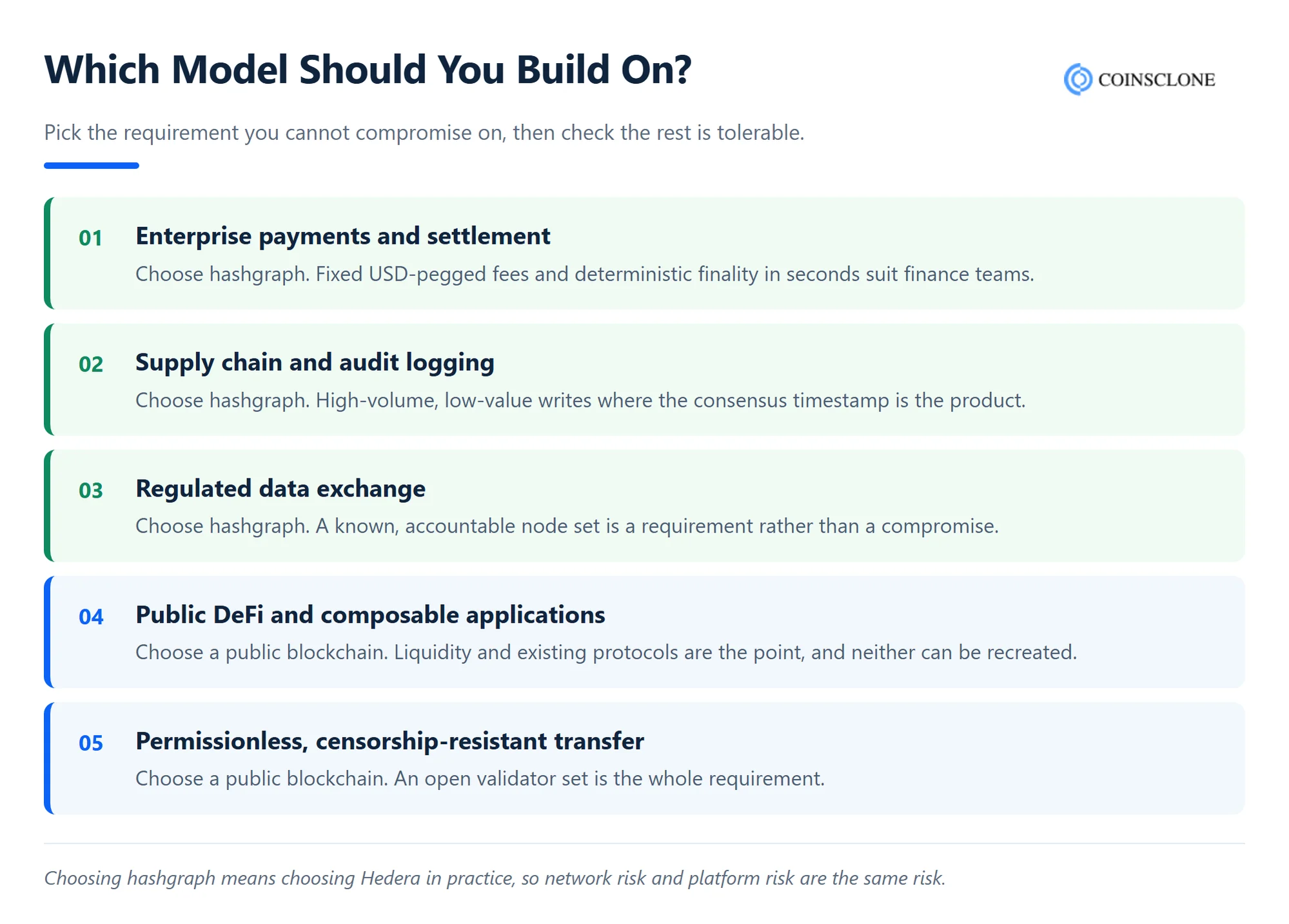
- Single production network. In practice, choosing hashgraph means choosing Hedera, so network risk and platform risk are the same risk.
None of these rule it out. They decide whether the finality and fee advantages are worth what you give up.
Where Hashgraph Fits and Where Blockchain Fits
The structural differences map onto specific workloads rather than onto a general verdict.
- Enterprise payments and settlement. Fixed USD-pegged fees make cost modeling straightforward, and deterministic finality in seconds suits settlement flows where probabilistic finality is awkward to explain to a finance team.
- Supply chain and audit logging. High-volume, low-value writes where the consensus timestamp is the product and open validator participation is not required.
- Regulated data exchange. Consortium arrangements where a known, accountable node set is a requirement rather than a compromise.
- Public DeFi and composable applications. A public blockchain wins here, because liquidity and existing protocols are the point and neither can be recreated on a newer network.
- Permissionless, censorship-resistant value transfer. A public blockchain wins again, because an open validator set is the whole requirement.
Pick the model that matches the requirement you cannot compromise on, then check whether the other differences are tolerable.
Hashgraph vs Blockchain: Which Should You Build On?
Choose hashgraph when you need predictable fees, fast deterministic finality, and enterprise council governance is acceptable or actively desirable, which is often the case in regulated settings.
Choose a public blockchain when you need deep liquidity, composability with existing protocols and permissionless validation, which describes most decentralized finance and consumer applications.
Choose a permissioned chain when participants are known, data must stay private, and no public settlement is required.
Reconsider entirely when the application has a single writer, in which case a database remains the honest answer regardless of how the ledger is structured.
The decision follows your requirements rather than the elegance of the underlying data structure. Hashgraph is not a faster blockchain; it is a different consensus model with a different decentralization profile, and that profile is the thing to evaluate.
Conclusion
Hashgraph earns attention because it addresses a real limitation: block structure imposes a throughput ceiling and discards valid work. The directed acyclic graph approach avoids both, and virtual voting removes a round of consensus messaging. What it trades is openness of validation, since the main production network operates permissioned council nodes rather than permissionless validators. Whether that trade is acceptable depends entirely on whether your application needs neutral, permissionless infrastructure or predictable, governed infrastructure.
Coinsclone builds enterprise-grade Web3 platforms including crypto exchanges, wallets, DEXs, NFT marketplaces, payment gateways and RWA tokenization, using customizable white-label clone scripts. Talk to our blockchain experts for a free consultation and live demo.
Frequently Asked Questions
Is hashgraph a blockchain?
No. A blockchain arranges transactions into blocks appended in a linear chain. Hashgraph uses a directed acyclic graph of events, each containing transactions and two hashes referencing previously known events. Both are distributed ledger technologies, but the data structure and consensus mechanism differ fundamentally.
What is gossip about gossip?
A protocol where nodes share not only transaction data but also the history of who communicated with whom and when. Because that communication history is itself shared, every node converges on the same picture of the network, which is what makes virtual voting possible.
What is virtual voting?
A technique where each node calculates how every other node would vote on transaction ordering, using the shared event graph it already holds, rather than those nodes broadcasting vote messages. It removes a separate round of voting communication, though nodes still gossip continuously.
Is hashgraph more secure than blockchain?
It offers asynchronous Byzantine fault tolerance, which holds while an attacker controls less than one third of consensus weight. That is a strong theoretical guarantee. However, the main production network uses permissioned council-operated consensus nodes, so its security model rests on different assumptions from a permissionless blockchain.
Is Hedera decentralized?
Partially, and this is the central trade-off. It is a public open-source network, but consensus nodes are permissioned and operated by a rotating council of enterprises, and governance does not work through token voting. It prioritises predictable governance and performance over permissionless validation.
How fast is hashgraph compared to blockchain?
Hedera reports throughput above ten thousand transactions per second for native services with deterministic finality typically under five seconds. Higher figures circulate from laboratory conditions. Throughput claims vary substantially by source and workload, so they should be verified against your own requirements rather than accepted from marketing material.
When should I choose hashgraph over a blockchain?
When predictable fixed fees, fast deterministic finality and enterprise governance suit your application, particularly in regulated settings. Choose a public blockchain when you need deep liquidity, composability with existing protocols, and permissionless validation.