
One rule governs decentralized health data ownership with blockchain, and everything else follows from it. Personal health data never goes on the chain.
Not encrypted. Not hashed. Not just for a pilot.
Why so absolute? Because a ledger is append-only. Once personal data lands there, nobody can correct it or delete it, and patients hold rights that require both.
Accept that constraint, however, and the design becomes clear and genuinely useful. The chain records who consented to what, who accessed what, and whether a record has changed. The data itself stays encrypted off-chain.
This guide walks through that architecture, explains what patient control really means, shows how consent and erasure work together, and covers where wearables complicate the picture.
Key Takeaways
Decentralized health data ownership puts consent and integrity proofs on-chain, never the records themselves.
Blockchain is not HIPAA compliant by default. Keeping protected health information off-chain is what makes compliance tractable.
GDPR erasure works by deleting the off-chain record, leaving an on-chain hash that resolves to nothing.
Most wearable data sits outside HIPAA, because manufacturers are not covered entities.
Real patient control means revocation that is recorded and enforced, not a request a custodian may action.
Can Patient Health Data Be Stored on a Blockchain?
It can be, and it should not be. Protected health information belongs off-chain, with only hashes, pointers and consent records committed to the ledger.
A public ledger exposes what it stores and cannot delete it, which conflicts directly with GDPR’s right to erasure and with HIPAA’s minimum necessary principle. The established pattern is off-chain encrypted storage with on-chain hashes proving the record has not been altered, which preserves integrity without publishing anything.
Hashing is not anonymization. A hash of a predictable value can be matched by guessing, so hashed identifiers still require treatment as personal data. Any vendor proposing to store patient records on a blockchain has not read the regulation, and that single question is a useful early filter when evaluating proposals.
What Belongs On-Chain in Decentralized Health Data?
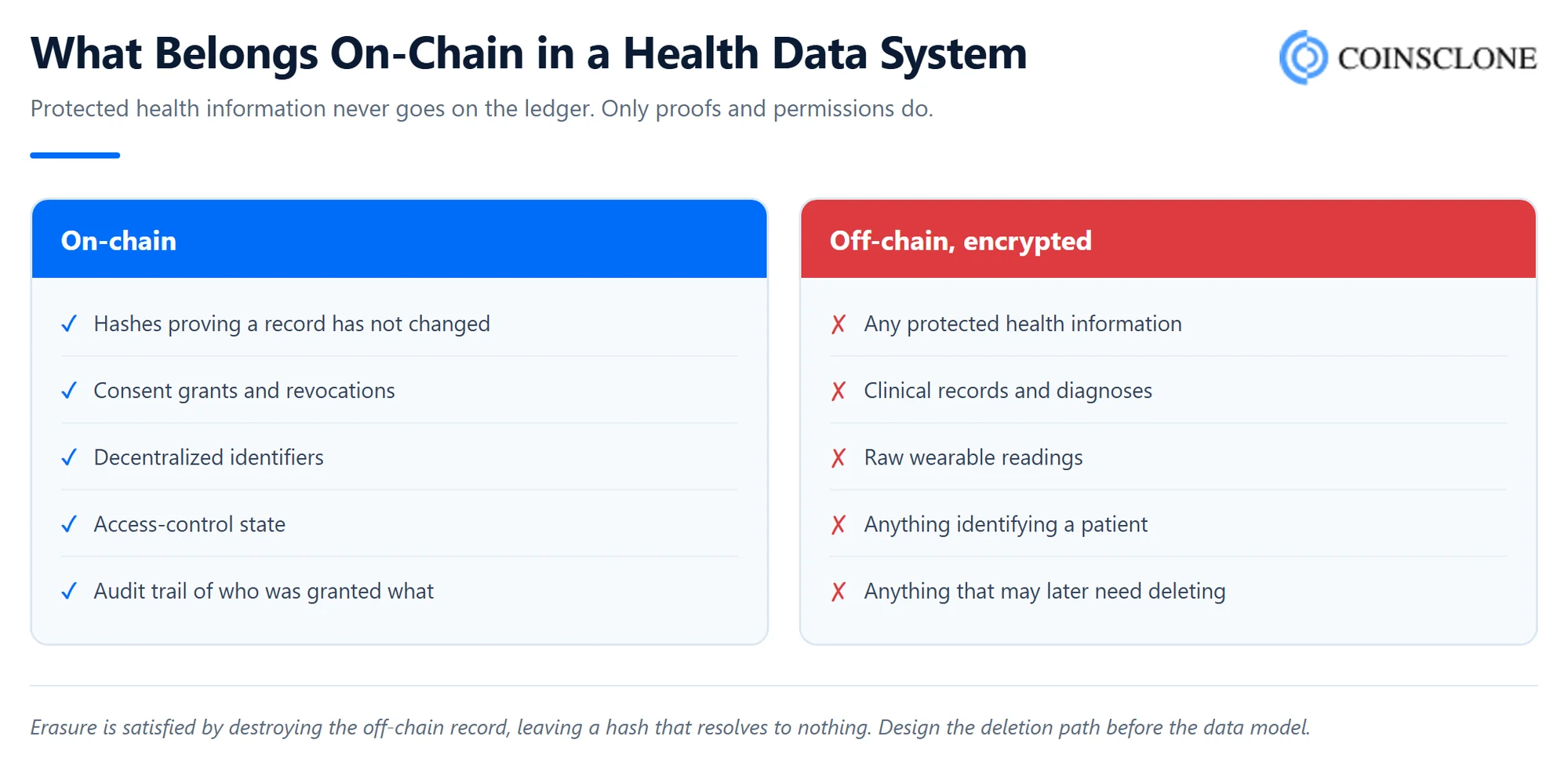
On-chain: consent records, access grants and revocations, audit events, and hashes proving a record has not changed since it was written.
Off-chain: the clinical record itself, wearable time series, imaging and anything that identifies a patient, held in encrypted storage.
The link: an encrypted pointer plus a hash, so the chain can prove integrity without holding any content.
The right to erasure: delete the off-chain record and the on-chain hash becomes a reference to nothing. That is not a workaround, it is the intended design.
Is Blockchain HIPAA Compliant?
Blockchain is a technology, not a compliance state. A blockchain-based system can be built to satisfy HIPAA, and nothing about using a ledger makes it compliant by default.
HIPAA requires access controls, audit trails, encryption and the ability to restrict disclosure. A ledger helps with audit trails and hurts with restriction, because entries cannot be withdrawn. Any vendor touching protected health information is a business associate and needs a Business Associate Agreement, including node operators if nodes process identifiable data.
Keeping PHI entirely off-chain is what makes the compliance case tractable, because the ledger then holds no protected information to govern.
How Does GDPR’s Right to Erasure Work With an Immutable Blockchain?
It does not, which is why compliant designs never put personal data on-chain in the first place. Erasure is satisfied by deleting the off-chain record, leaving an on-chain hash that no longer resolves to anything.
Once you destroy the underlying data, the remaining hash points to no recoverable subject. Most compliant designs reconcile the two requirements exactly this way. Storing personal data on-chain, encrypted or hashed, creates an obligation you cannot discharge, because keys can be compromised and hashes of predictable inputs can be reversed by brute force.
Design the erasure path before the data model. Retrofitting deletion into a ledger architecture is not possible.
What Does Patient-Controlled Health Data Actually Mean?
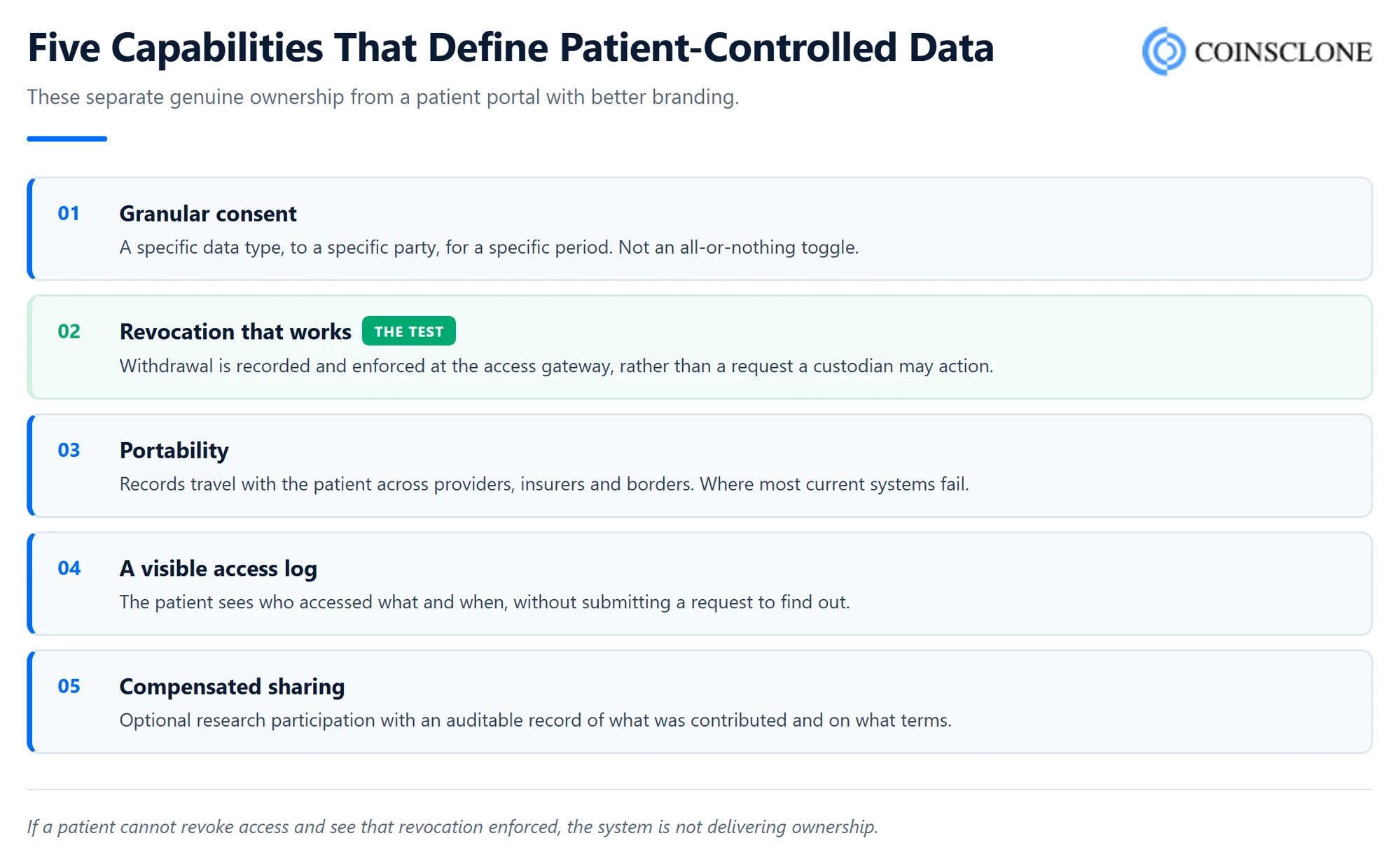
Five capabilities separate genuine data ownership from a patient portal with better branding.
Granular consent. Sharing a specific data type with a specific party for a specific period, rather than an all-or-nothing toggle.
Revocation that works. Withdrawing access is recorded and enforced at the access gateway, rather than being a request that a custodian may action.
Portability. Records travel with the patient across providers, insurers and borders, which is where most current systems fail.
A visible access log. The patient can see who accessed what and when without submitting a request to find out.
Compensated sharing. Optional participation in research with an auditable record of what was contributed and under what terms.
If a patient cannot revoke access and see that revocation enforced, the system does not deliver ownership, whatever the vendor calls it.
How Does Blockchain Consent Management Work?
Consent terms are encoded as smart contracts tied to a patient’s decentralized identifier, producing a tamper-evident record of who was granted access to what, when, and on what basis.
Revocation triggers an on-chain state change that access-control systems check before releasing data, and the revocation itself is permanently logged. The audit trail is the genuine benefit: proving what a patient consented to at a given moment is difficult in conventional systems and straightforward here.
The limit is enforcement. A smart contract can record that consent was withdrawn; it cannot retrieve data a recipient already downloaded. Systems that imply otherwise are overselling, and clinicians notice.
Who Owns Data From a Wearable Device?
In most cases the device manufacturer controls it under their terms of service, not the person wearing the device. This is the gap decentralized health data projects are trying to close.
Consumer wearables generally fall outside HIPAA entirely, because the manufacturer is not a covered entity, which means health-like data sits under consumer privacy law rather than health privacy law. Data becomes protected health information when it enters a covered entity’s systems, so the same heart rate reading carries different obligations depending on where it sits.
Patient-controlled architectures address this with decentralized identifiers and smart contract consent records, giving the individual a revocable grant rather than ownership in the legal sense.
Where Do Wearables Complicate Health Data Ownership?
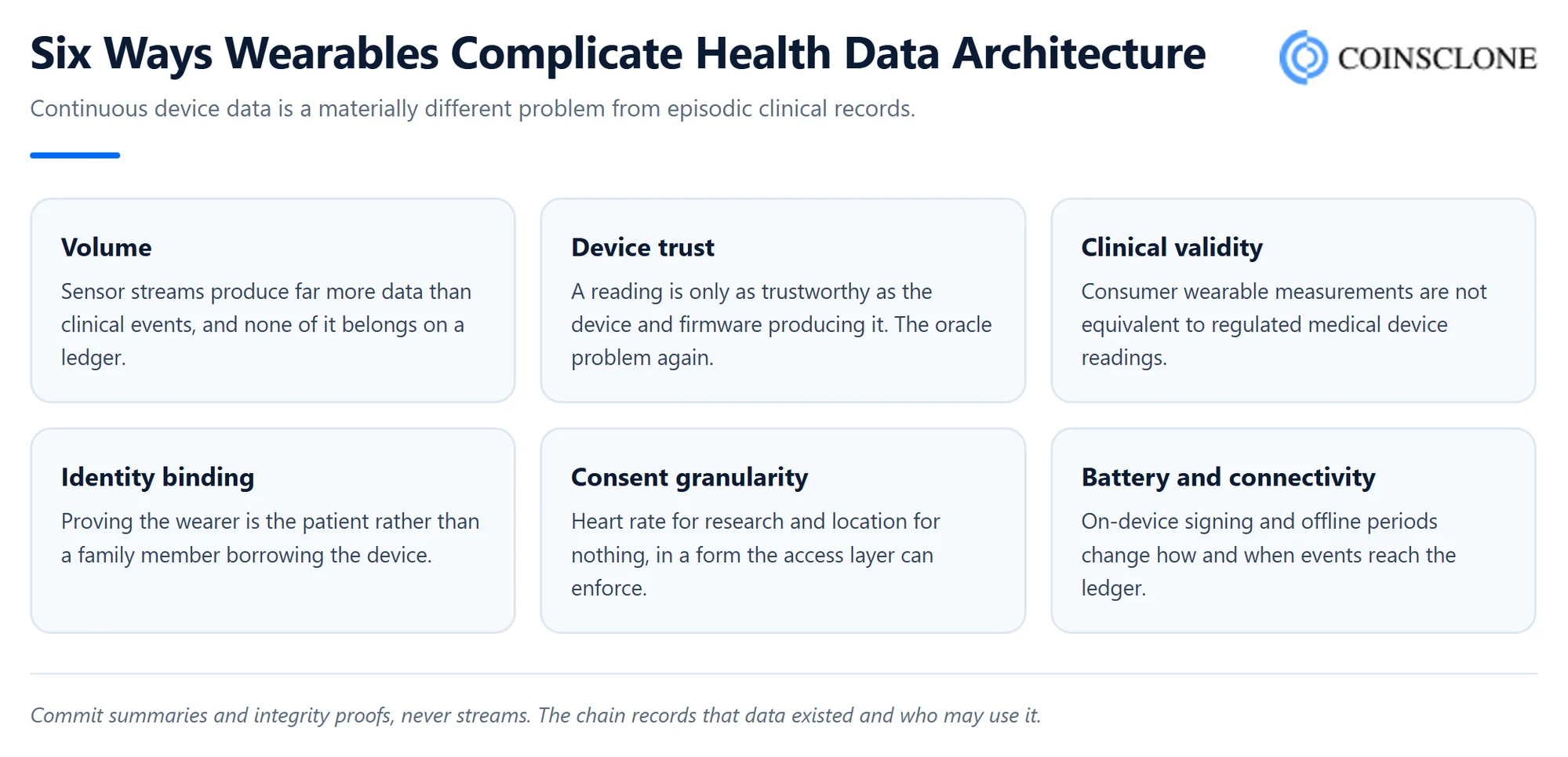
Continuous device data is a materially different problem from episodic clinical records.
Volume. Sensor streams produce far more data than clinical events, and none of it belongs on a ledger.
Device trust. A reading is only as trustworthy as the device and firmware that produced it, which reintroduces exactly the oracle problem that supply chain projects face.
Clinical validity. Consumer wearable measurements are not equivalent to regulated medical device readings, and systems that blur this create clinical risk.
Identity binding. Proving the wearer is the patient rather than a family member borrowing the device.
Consent granularity. Heart rate for research and location for nothing, expressed in a form the access layer can actually enforce.
Battery and connectivity. On-device signing and offline periods change how and when events reach the ledger.
Commit summaries and integrity proofs, not streams. The chain records that data existed and who may use it.
Conclusion
Decentralized health data works when the ledger is used for what it is good at, which is proving consent and integrity, and kept away from what it is bad at, which is holding anything that might later need correcting or deleting.
Keep every piece of protected health information off-chain and encrypted. Design the erasure path before the data model, because it cannot be added afterwards. Make revocation enforceable at the access gateway rather than advisory. And be precise with clinicians about what a consent record proves, which is what was agreed and when, not what happened to data after it was released. Handled that way, decentralized health data ownership with blockchain gives patients something they can actually use, and regulators something they can accept.
Coinsclone builds enterprise-grade Web3 platforms including decentralized identity and consent management systems, healthcare data exchange networks, IoT data anchoring, smart contract development and audit, and enterprise consortium networks, using customizable white-label solutions. Talk to our blockchain experts for a free consultation and a live demo.
FAQ
Q: Can patient health data be stored on a blockchain?
It can be and it should not be. Protected health information belongs off-chain in encrypted storage, with only hashes, pointers and consent records on the ledger. A chain cannot delete or correct entries, which conflicts directly with data protection rights.
Q: Is blockchain HIPAA compliant?
Blockchain is a technology, not a compliance state. A system built on it can satisfy HIPAA if PHI stays off-chain, access controls are enforced and business associate agreements are in place. Using a ledger does not make anything compliant by default.
Q: How does GDPR’s right to erasure work with an immutable blockchain?
By never putting personal data on-chain. Erasure is satisfied by destroying the off-chain record, which leaves an on-chain hash pointing at nothing. Storing personal data on-chain, even hashed, creates an obligation that cannot be discharged.
Q: Who owns data from a wearable device?
Usually the manufacturer controls it under their terms of service. Consumer wearables generally fall outside HIPAA because the manufacturer is not a covered entity, so the data sits under consumer privacy law until it enters a healthcare provider’s systems.
Q: How does blockchain consent management work?
Consent terms are encoded as smart contracts tied to a patient’s decentralized identifier. Grants and revocations are recorded on-chain and checked by access-control systems before data is released, producing a tamper-evident record of what was agreed and when.
Q: What is a decentralized identifier in healthcare?
An identifier the patient controls rather than one issued by a provider, used to sign consent and prove identity across organizations. It is what allows a consent record to travel with the patient instead of living inside one hospital’s system.
Q: Can a patient really revoke access to their health data?
Revocation can be recorded and enforced at the access gateway, so future requests are refused. It cannot retrieve data a recipient already downloaded, and any system implying otherwise is overselling.
Q: What data from wearables should go on-chain?
Summaries and integrity proofs, never raw streams. Sensor data volume alone rules out on-chain storage, and the readings are personal data regardless. The ledger records that data existed, that it has not been altered, and who may use it.
Q: Is wearable data as reliable as clinical data?
No. Consumer wearable measurements are not equivalent to regulated medical device readings, and a reading is only as trustworthy as the device and firmware producing it. Systems that blur this distinction create clinical risk.
Q: What does patient-controlled health data actually require?
Granular consent by data type, party and period; revocation that is recorded and enforced; portability across providers and borders; a visible access log the patient can read without asking; and optional compensated sharing with an auditable record.